seats INFINITI QX50 2014 Owners Manual
[x] Cancel search | Manufacturer: INFINITI, Model Year: 2014, Model line: QX50, Model: INFINITI QX50 2014Pages: 498, PDF Size: 2.47 MB
Page 6 of 498
Illustrated table of contents0
Safety—Seats, seat belts and supplemental restraint
system1
Instruments and controls
Pre-driving checks and adjustments
Monitor, climate, audio, phone and voice recognition
systems
Starting and driving
In case of emergency
Appearance and care
Maintenance and do-it-yourself
Technical and consumer information
Index
2
3
4
5
6
7
8
9
10
Table of
Contents
Page 8 of 498
0 Illustrated table of contents
Seats, seat belts and Supplemental Restraint
System (SRS) ....................................................... 0-2
Exterior front ....................................................... 0-3
Exterior rear......................................................... 0-4
Passenger compartment ...................................... 0-5
Cockpit ................................................................ 0-6Instrument panel................................................. 0-8
Meters and gauges ............................................. 0-9
Engine compartment ......................................... 0-10
VQ37VHR engine ......................................... 0-10
Warning and indicator lights ............................. 0-11
Page 9 of 498
0-2Illustrated table of contents
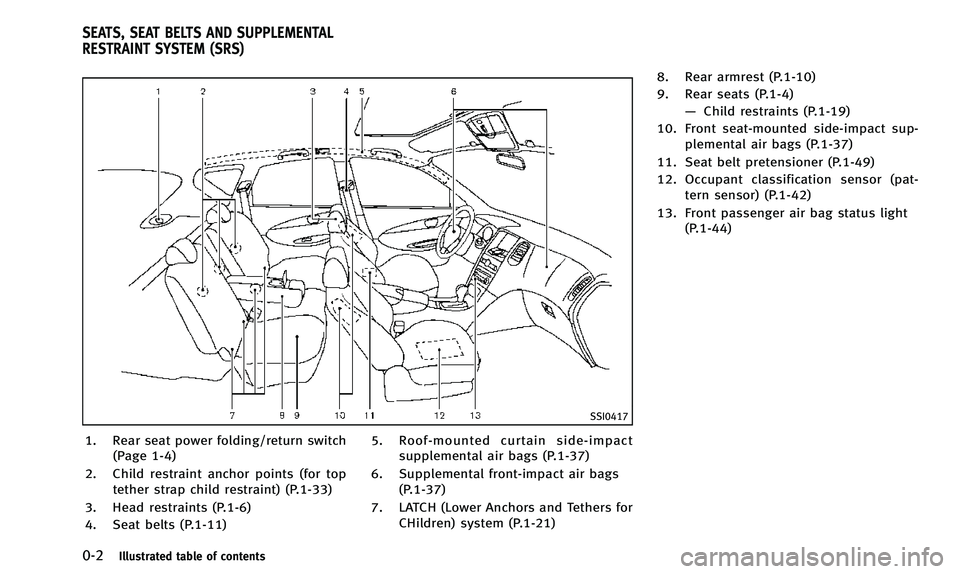
SSI0417
1. Rear seat power folding/return switch(Page 1-4)
2. Child restraint anchor points (for top tether strap child restraint) (P.1-33)
3. Head restraints (P.1-6)
4. Seat belts (P.1-11) 5. Roof-mounted curtain side-impact
supplemental air bags (P.1-37)
6. Supplemental front-impact air bags (P.1-37)
7. LATCH (Lower Anchors and Tethers for CHildren) system (P.1-21) 8. Rear armrest (P.1-10)
9. Rear seats (P.1-4)
—Child restraints (P.1-19)
10. Front seat-mounted side-impact sup- plemental air bags (P.1-37)
11. Seat belt pretensioner (P.1-49)
12. Occupant classification sensor (pat- tern sensor) (P.1-42)
13. Front passenger air bag status light (P.1-44)
SEATS, SEAT BELTS AND SUPPLEMENTAL
RESTRAINT SYSTEM (SRS)
Page 20 of 498
1 Safety—Seats, seat belts and supplemental
restraint system
Seats................................................................... 1-2
Front seats ...................................................... 1-3
Rear seats ....................................................... 1-4
Head restraints................................................ 1-6
Front-seat active head restraint ....................... 1-9
Armrest ......................................................... 1-10
Seat belts .......................................................... 1-11 Precautions on seat belt usage ..................... 1-11
Pregnant women ........................................... 1-13
Injured persons ............................................. 1-13
Three-point type seat belt ............................. 1-13
Seat belt extenders ....................................... 1-16
Seat belt maintenance................................... 1-17
Child safety ....................................................... 1-17 Infants........................................................... 1-18
Small children ............................................... 1-18
Larger children .............................................. 1-18
Child restraints .................................................. 1-19 Precautions on child restraints ...................... 1-20
Lower Anchors and Tethers for CHildren
(LATCH) system.............................................. 1-21 Rear-facing child restraint installation
using LATCH................................................. 1-23
Rear-facing child restraint installation using
the seat belts .............................................. 1-25
Forward-facing child restraint installation
using LATCH................................................. 1-27
Forward-facing child restraint installation
using the seat belts ..................................... 1-29
Installing top tether strap ............................ 1-33
Booster seats .............................................. 1-33
Supplemental restraint system .......................... 1-37 Precautions on supplemental
restraint system........................................... 1-37
INFINITI Advanced Air Bag System
(front seats) ................................................. 1-42
Front seat-mounted side-impact supplemental
air bag and roof-mounted curtain side-impact
supplemental air bag systems ..................... 1-47
Seat belts with pretensioners (front seats).... 1-49
Supplemental air bag warning labels ........... 1-50
Supplemental air bag warning light ............. 1-50
Repair and replacement procedure............... 1-51
Page 21 of 498
1-2Safety—Seats, seat belts and supplemental restraint system
SSS0133
WARNING
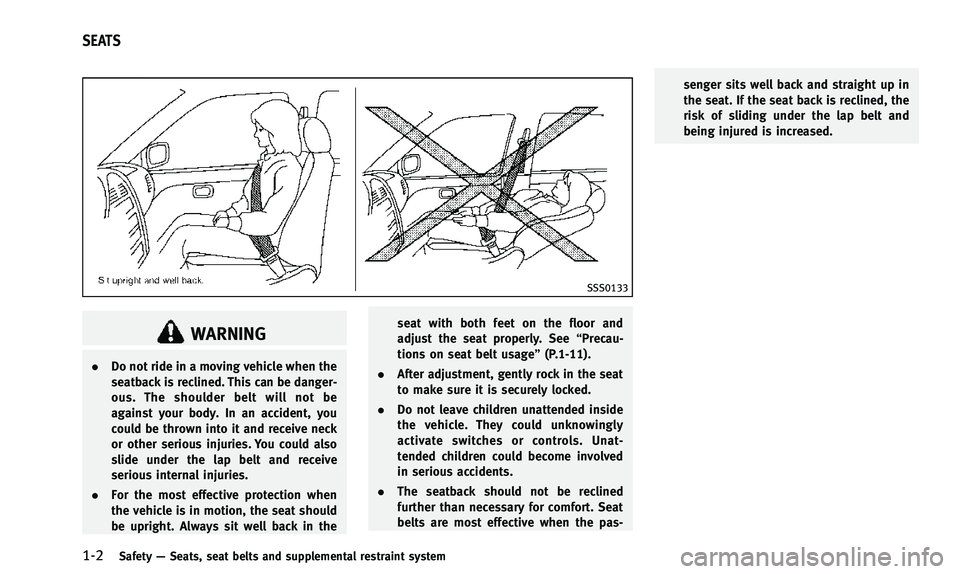
. Do not ride in a moving vehicle when the
seatback is reclined. This can be danger-
ous. The shoulder belt will not be
against your body. In an accident, you
could be thrown into it and receive neck
or other serious injuries. You could also
slide under the lap belt and receive
serious internal injuries.
. For the most effective protection when
the vehicle is in motion, the seat should
be upright. Always sit well back in the seat with both feet on the floor and
adjust the seat properly. See
“Precau-
tions on seat belt usage” (P.1-11).
. After adjustment, gently rock in the seat
to make sure it is securely locked.
. Do not leave children unattended inside
the vehicle. They could unknowingly
activate switches or controls. Unat-
tended children could become involved
in serious accidents.
. The seatback should not be reclined
further than necessary for comfort. Seat
belts are most effective when the pas- senger sits well back and straight up in
the seat. If the seat back is reclined, the
risk of sliding under the lap belt and
being injured is increased.
SEATS
Page 22 of 498
FRONT SEATS
Front power seat adjustment
Operating tips:
.The power seat motor has an auto-reset
overload protection circuit. If the motor
stops during operation, wait 30 sec-
onds, then reactivate the switch.
. Do not operate the power seat switch
for a long period of time when the
engine is off. This will discharge the
battery.
See “Automatic drive positioner” (P.3-26)
for the seat position memory function (if so
equipped).
CAUTION
When adjusting the seat positions, be sure
not to contact any moving parts to avoid
possible injuries and/or damages.
SSS1051
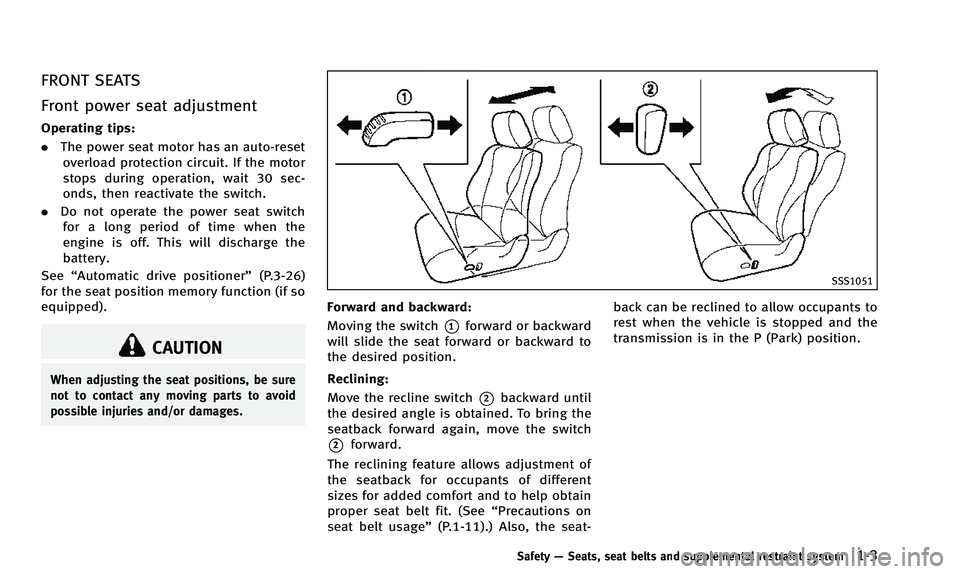
Forward and backward:
Moving the switch
*1forward or backward
will slide the seat forward or backward to
the desired position.
Reclining:
Move the recline switch
*2backward until
the desired angle is obtained. To bring the
seatback forward again, move the switch
*2forward.
The reclining feature allows adjustment of
the seatback for occupants of different
sizes for added comfort and to help obtain
proper seat belt fit. (See “Precautions on
seat belt usage” (P.1-11).) Also, the seat- back can be reclined to allow occupants to
rest when the vehicle is stopped and the
transmission is in the P (Park) position.
Safety
—Seats, seat belts and supplemental restraint system1-3
Page 23 of 498
1-4Safety—Seats, seat belts and supplemental restraint system
SSS1052
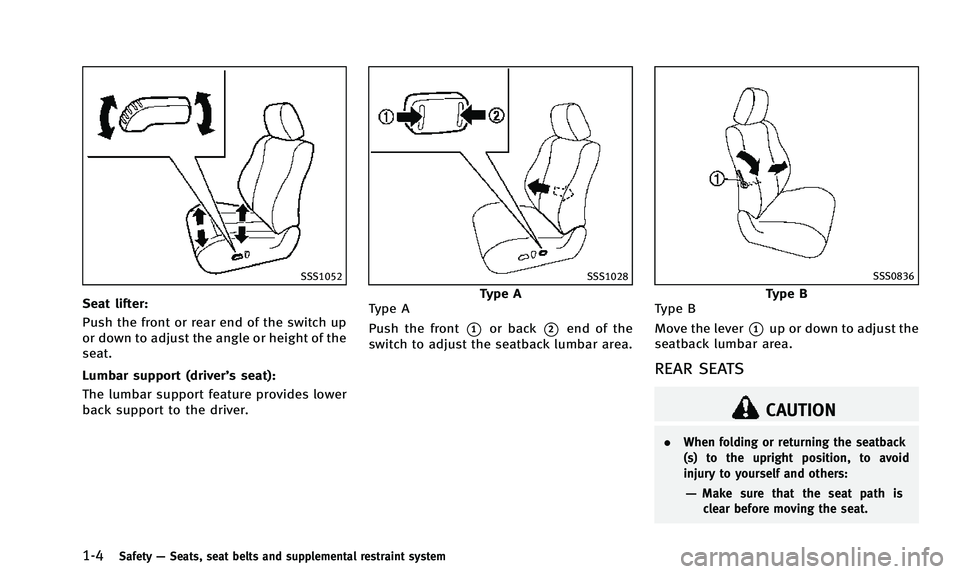
Seat lifter:
Push the front or rear end of the switch up
or down to adjust the angle or height of the
seat.
Lumbar support (driver’s seat):
The lumbar support feature provides lower
back support to the driver.
SSS1028
Type A
Type A
Push the front
*1or back*2end of the
switch to adjust the seatback lumbar area.
SSS0836
Type B
Type B
Move the lever
*1up or down to adjust the
seatback lumbar area.
REAR SEATS
CAUTION
. When folding or returning the seatback
(s) to the upright position, to avoid
injury to yourself and others:
—Make sure that the seat path is
clear before moving the seat.
Page 24 of 498
.When operating the rear power seatback
return, make sure that the vehicle is
stopped and the transmission is in the P
(Park) position.
. Make sure the lid of the rear seat cup
holders is closed before folding the rear
seatback.
WARNING
.Never allow anyone to ride in the cargo
area or on the rear seat when it is in the
fold-down position. Use of these areas
by passengers without proper restraints
could result in serious injury in an
accident or sudden stop.
. When returning the seatbacks to the
upright position, be certain they are
completely secured in the latched posi-
tion. If they are not completely secured,
passengers may be injured in an acci-
dent or sudden stop.
. Properly secure all cargo to help prevent
it from sliding or shifting. Do not place
cargo higher than the seatbacks. In a
sudden stop or collision, unsecured
cargo could cause personal injury.SSS0828
Type A
Power folding
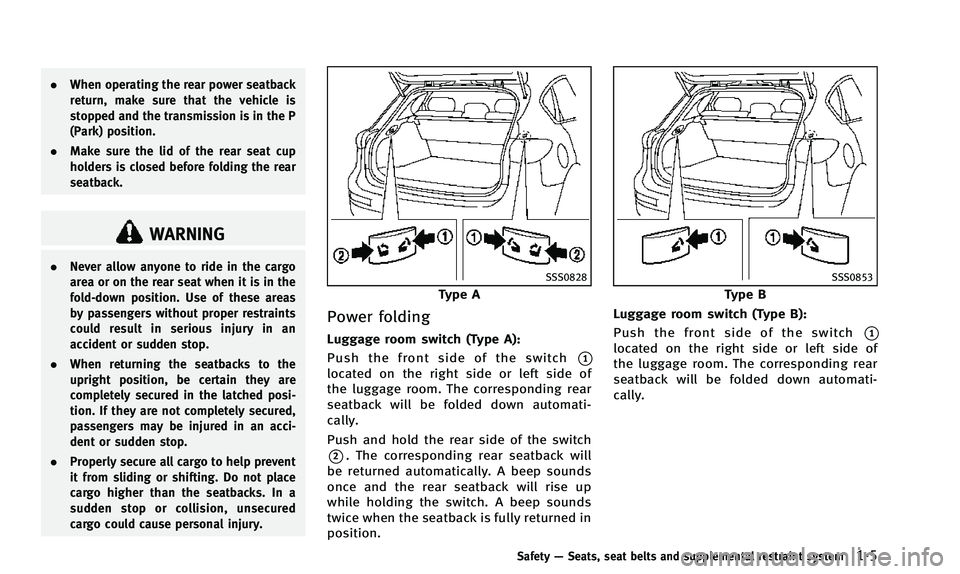
Luggage room switch (Type A):
Push the front side of the switch
*1
located on the right side or left side of
the luggage room. The corresponding rear
seatback will be folded down automati-
cally.
Push and hold the rear side of the switch
*2. The corresponding rear seatback will
be returned automatically. A beep sounds
once and the rear seatback will rise up
while holding the switch. A beep sounds
twice when the seatback is fully returned in
position.
SSS0853
Type B
Luggage room switch (Type B):
Push the front side of the switch
*1
located on the right side or left side of
the luggage room. The corresponding rear
seatback will be folded down automati-
cally.
Safety —Seats, seat belts and supplemental restraint system1-5
Page 25 of 498
1-6Safety—Seats, seat belts and supplemental restraint system
SSS0829
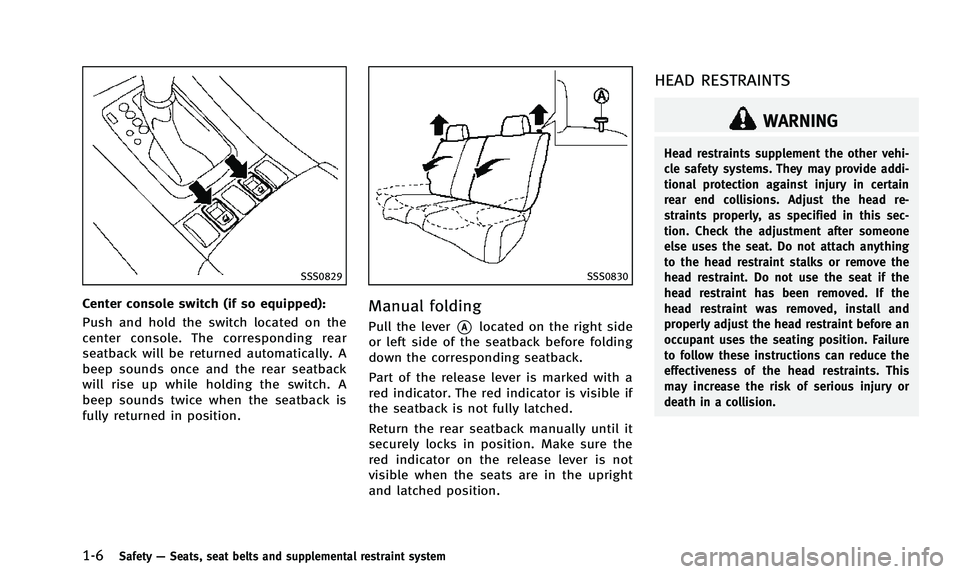
Center console switch (if so equipped):
Push and hold the switch located on the
center console. The corresponding rear
seatback will be returned automatically. A
beep sounds once and the rear seatback
will rise up while holding the switch. A
beep sounds twice when the seatback is
fully returned in position.
SSS0830
Manual folding
Pull the lever*Alocated on the right side
or left side of the seatback before folding
down the corresponding seatback.
Part of the release lever is marked with a
red indicator. The red indicator is visible if
the seatback is not fully latched.
Return the rear seatback manually until it
securely locks in position. Make sure the
red indicator on the release lever is not
visible when the seats are in the upright
and latched position.
HEAD RESTRAINTS
WARNING
Head restraints supplement the other vehi-
cle safety systems. They may provide addi-
tional protection against injury in certain
rear end collisions. Adjust the head re-
straints properly, as specified in this sec-
tion. Check the adjustment after someone
else uses the seat. Do not attach anything
to the head restraint stalks or remove the
head restraint. Do not use the seat if the
head restraint has been removed. If the
head restraint was removed, install and
properly adjust the head restraint before an
occupant uses the seating position. Failure
to follow these instructions can reduce the
effectiveness of the head restraints. This
may increase the risk of serious injury or
death in a collision.
Page 26 of 498

JVR0051X
The illustration shows the seating posi-
tions equipped with head restraints and
headrest. The head restraints are adjusta-
ble.
Indicates the seating position is
equipped with a head restraint.
+ Indicates the seating position is
equipped with a headrest.
SSS0992
Components
1. Head restraint
2. Adjustment notches
3. Lock knob
4. Stalks
SSS0997
Adjustment
Adjust the head restraint so the center is
level with the center of your ears.
Safety —Seats, seat belts and supplemental restraint system1-7