tires INFINITI QX60 2017 Service Manual
[x] Cancel search | Manufacturer: INFINITI, Model Year: 2017, Model line: QX60, Model: INFINITI QX60 2017Pages: 629, PDF Size: 6.89 MB
Page 575 of 629

Engine coolant*:
Replace coolant at the specified interval. When
adding or replacing coolant, be sure to use only
Genuine NISSAN Long Life Antifreeze/Coolant
(blue) or equivalent with the proper mixture. (For
additional information on the proper mixture for
your area, refer to “Engine cooling system” in the
“Do-it-yourself” section of this manual.)
NOTE: Mixing any other type of coolant or
the use of non-distilled water may reduce
the recommended service interval of the
coolant.
Engine oil and oil filter:
Replace engine oil and oil filter at the specified
intervals. For recommended oil grade and viscos-
ity refer to “Recommended fluids/lubricants and
capacities” in the “Technical and consumer infor-
mation” section of this manual.
Engine valve clearance*:
Inspect only if valve noise increase. Adjust valve
clearance if necessary.
Evaporative emissions control vapor lines*:
Check vapor lines for leaks or looseness. Tighten
connections or replace parts as necessary.Fuel lines*:
Check the fuel hoses, piping and connections for
leaks, looseness, or deterioration. Tighten con-
nections or replace parts as necessary.
Spark plugs:
Replace at specified intervals. Install new plugs
of the same type as originally equipped.
CHASSIS AND BODY
MAINTENANCE:
Brake lines and cables:
Visually inspect for proper installation. Check for
chafing, cracks, deterioration, and signs of leak-
ing. Replace any deteriorated or damaged parts
immediately.
Brake pads and rotors:
Check for wear, deterioration and fluid leaks.
Replace any deteriorated or damaged parts im-
mediately.
Exhaust system:
Visually inspect the exhaust pipes, muffler and
hangers for leaks, cracks, deterioration, and dam-
age. Tighten connections or replace parts as
necessary.In-cabin microfilter:
Replace at specified intervals. When driving for
prolonged periods in dusty conditions, replace
the filter more frequently.
Propeller shaft(s):
Check for damage, looseness, and grease leak-
age. (AWD)
Steering gear and linkage, axle and sus-
pension parts, drive shaft boots:
Check for damage, looseness, and leakage of oil
or grease. Under severe driving conditions, in-
spect more frequently.
Tire rotation:
Tires should be rotated every 5,000 miles
(8,000 km) according to the instructions under
“Explanation of general maintenance items” in
this section. When rotating tires, check for dam-
age and uneven wear. Replace if necessary.
Transmission fluid/oil, differential oil and
transfer case oil:
Visually inspect for signs of leakage at specified
intervals.
Replace at specified intervals.
9-6Maintenance and schedules
Page 586 of 629

10 Technical and consumer information
Recommended fluids/lubricants and capacities......10-2
Fuel recommendation .......................... 10-4
Engine oil and oil filter recommendations .........10-6
Air conditioner system refrigerant and oil
recommendations ............................. 10-7
Specifications .................................... 10-8
Engine ....................................... 10-8
Wheels and tires .............................. 10-9
Dimensions and weights .......................10-9
When traveling or registering in another country .....10-10
Vehicle identification ............................. 10-10
Vehicle identification number (VIN) plate ........10-10
Vehicle identification number
(chassis number) ............................. 10-10
Engine serial number .......................... 10-11
F.M.V.S.S./C.M.V.S.S. certification label .........10-11
Emission control information label ..............10-11
Tire and Loading Information label ..............10-12
Air conditioner specification label ...............10-12
Installing front license plate .......................10-12Vehicle loading information
.......................10-13
Terms ....................................... 10-13
Vehicle load capacity ......................... 10-14
Securing the load ............................. 10-16
Loading tips ................................. 10-16
Measurement of weights ......................10-17
Towing a trailer .................................. 10-17
Maximum load limits .......................... 10-18
Towing load/specification ......................10-21
Towing safety ................................ 10-21
Flat towing for front wheel drive vehicle
(if so equipped) .............................. 10-28
Flat towing for All–Wheel drive vehicle
(if so equipped) .............................. 10-28
Uniform tire quality grading .......................10-29
Emission control system warranty .................10-30
Reporting safety defects ......................... 10-30
Readiness
for inspection/maintenance (I/M) test ....10-31
Event Data Recorders (EDR) ......................10-32
Owner’s Manual/Service Manual order information . .10-33
Page 594 of 629

WHEELS AND TIRES
Wheel typeOffset in (mm) Size
Aluminum 1.97 (50) 18 x 7.5J
1.97 (50) 20 x 7.5J
Spare Wheel - Steel 18 x4T
Tire size 235/65R18
235/55R20
Spare tire T165/90D18
DIMENSIONS AND WEIGHTS
Overall lengthin (mm)199.8 (5,075)
Overall width in (mm)77.2 (1,960)
Overall height without roof rack in (mm)68.6 (1,742)
with roof rack in (mm)71.4 (1,813)
Front and rear track in (mm)65.7 (1,670)
Wheelbase in (mm)114.2 (2,900)
Gross vehicle weight rating lb (kg) Refer to the “F.M.V.S.S./C.M.
V.S.S. certification label” on
the center pillar between the driver’s side front and rear doors.
Gross axle weight rating
Front lb (kg)
Rear lb (kg)
Technical and consumer information10-9
Page 601 of 629
5. Determine the combined weight ofluggage and cargo being loaded on
the vehicle. That weight may not
safely exceed the available cargo and
luggage load capacity calculated in
step 4.
6. If your vehicle will be towing a trailer, load from your trailer will be trans-
ferred to your vehicle. Consult this
manual to determine how this re-
duces the available cargo and lug-
gage load capacity of your vehicle.
Before driving a loaded vehicle, confirm
that you do not exceed the GVWR or the
GAWR for your vehicle. For additional
information, refer to “Measurement of
weights” in this section.
Also check tires for proper inflation pres-
sures. For additional information, refer to
the “Tire and Loading Information label” in
the “Do-it-yourself” section of this
manual.
SECURING THE LOAD
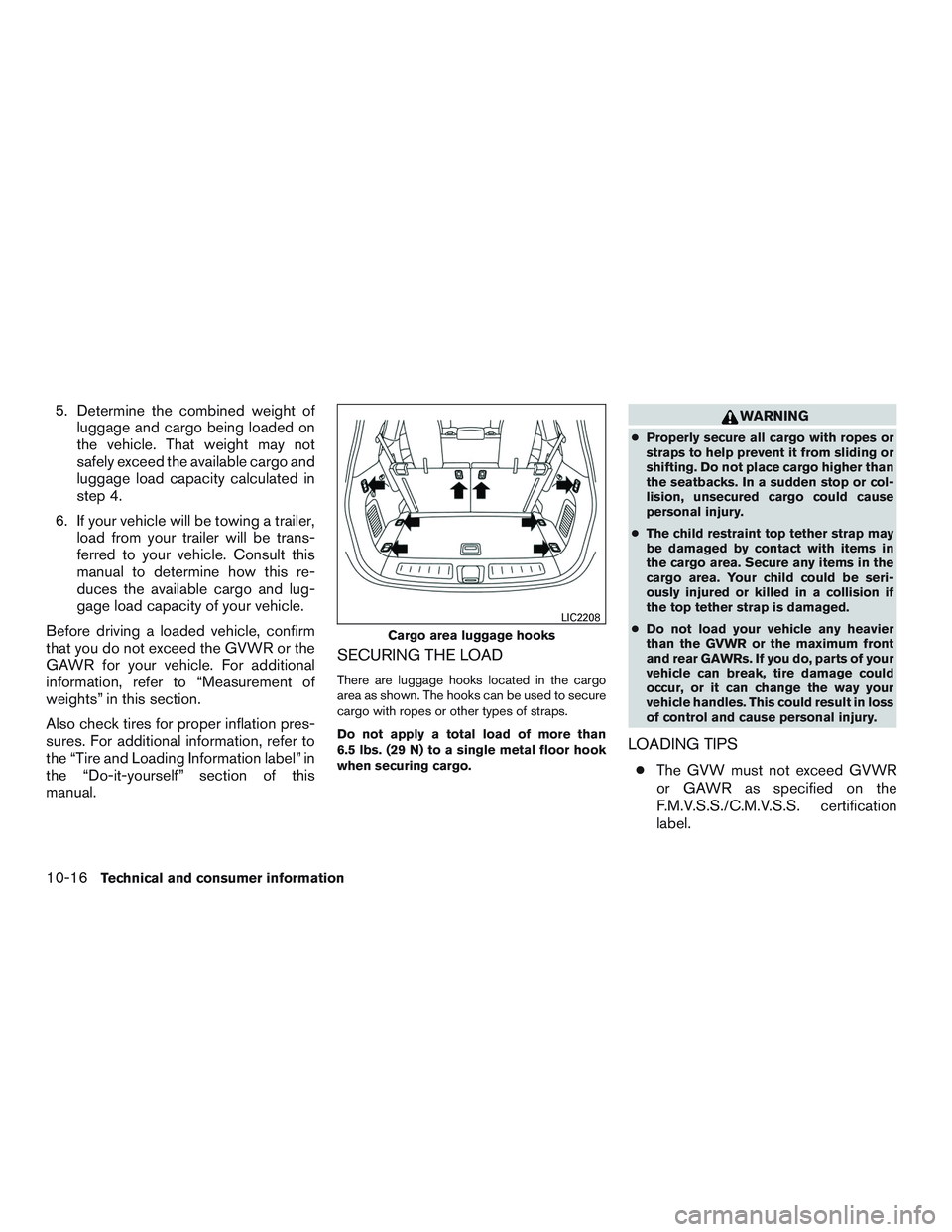
There are luggage hooks located in the cargo
area as shown. The hooks can be used to secure
cargo with ropes or other types of straps.
Do not apply a total load of more than
6.5 lbs. (29 N) to a single metal floor hook
when securing cargo.
WARNING
● Properly secure all cargo with ropes or
straps to help prevent it from sliding or
shifting. Do not place cargo higher than
the seatbacks. In a sudden stop or col-
lision, unsecured cargo could cause
personal injury.
● The child restraint top tether strap may
be damaged by contact with items in
the cargo area. Secure any items in the
cargo area. Your child could be seri-
ously injured or killed in a collision if
the top tether strap is damaged.
● Do not load your vehicle any heavier
than the GVWR or the maximum front
and rear GAWRs. If you do, parts of your
vehicle can break, tire damage could
occur, or it can change the way your
vehicle handles. This could result in loss
of control and cause personal injury.
LOADING TIPS
● The GVW must not exceed GVWR
or GAWR as specified on the
F.M.V.S.S./C.M.V.S.S. certification
label.
Cargo area luggage hooks
LIC2208
10-16Technical and consumer information
Page 608 of 629

3. Attach the trailer to the vehicle and adjustthe hitch equalizers so that the front bumper
height is within0-.5inches (0 – 13 mm) of
the reference height measured in step 2. The
rear bumper should be no higher than the
reference height measured in step 2.
WARNING
Properly adjust the weight distributing
hitch so the rear of the bumper is no
higher than the measured reference
height when the trailer is attached. If the
rear bumper is higher than the measured
reference height when loaded, the vehicle
may handle unpredictably which could
cause a loss of vehicle control and cause
serious personal injury or property
damage.
Sway control device
Sudden maneuvers, wind gusts, and buffeting
caused by other vehicles can affect trailer han-
dling. Sway control devices may be used to help
control these affects. If you choose to use one,
contact a reputable trailer hitch supplier to make
sure the sway control device will work with the
vehicle, hitch, trailer and the trailer’s brake sys-
tem. Follow the instructions provided by the
manufacturer for installing and using the sway
control device.
Class I hitch
Class I trailer hitch equipment (receiver, ball
mount and hitch ball) can be used to tow trailers
of a maximum weight of 2,000 lb (907 kg) .
Class II hitch
Class II trailer hitch equipment (receiver, ball
mount and hitch ball) can be used to tow trailers
of a maximum weight of 3,500 lb (1,587 kg).
Tire pressures
●When towing a trailer, inflate the ve-
hicle tires to the recommended cold
tire pressure indicated on the Tire
and Loading Information label.
● Trailer tire condition, size, load rating
and proper inflation pressure should
be in accordance with the trailer and
tire manufacturer’s specifications.
Safety chains
Always use suitable safety chains between your
vehicle and the trailer. The safety chains should
be crossed and should be attached to the hitch,
not to the vehicle bumper or axle. The safety
chains can be attached to the bumper if the hitch ball is mounted to the bumper. Be sure to leave
enough slack in the chains to permit turning
corners.
Trailer lights
CAUTION
When splicing into the vehicle electrical
system, a commercially available power-
type module/converter must be used to
provide power for all trailer lighting. This
unit uses the vehicle battery as a direct
power source for all trailer lights while
using the vehicle tail light, stoplight and
turn signal circuits as a signal source. The
module/converter must draw no more that
15 milliamps from the stop and tail lamp
circuits. Using a module/converter that
exceeds these power requirements may
damage the vehicle’s electrical system.
See a reputable trailer retailer to obtain
the proper equipment and to have it
installed.
Technical and consumer information10-23
Page 613 of 629
●When launching a boat, don’t allow the wa-
ter level to go over the exhaust tail pipe or
rear bumper.
● Make sure you disconnect the trailer lights
before backing the trailer into the water or
the trailer lights may burn out.
When towing a trailer, final drive gear oil
should be replaced and transmission
oil/fluid should be changed more fre-
quently. For additional information, refer to
the “Do-it-yourself” section of this manual.
FLAT TOWING FOR FRONT WHEEL
DRIVE VEHICLE (if so equipped)
Towing your vehicle with all four wheels on the
ground is sometimes called flat towing. This
method is sometimes used when towing a vehicle
behind a recreational vehicle, such as a motor
home.
CAUTION
● Failure to follow these guidelines can
result in severe transmission damage.
● Whenever flat towing your vehicle, al-
ways tow forward, never backward. ●
Never tow your front wheel drive vehicle
with the front tires on the ground. Doing
so may cause serious and expensive
damage to the powertrain.
● DO NOT tow your front wheel drive con-
tinuously variable transmission vehicle
with all four wheels on the ground (flat
towing) . Doing so WILL DAMAGE inter-
nal transmission parts due to lack of
transmission lubrication.
● For emergency towing procedures refer
to “Towing recommended by INFINITI”
in the “In case of emergency” section of
this manual.
FLAT TOWING FOR ALL–WHEEL
DRIVE VEHICLE (if so equipped)
Towing your vehicle with all four wheels on the
ground is sometimes called flat towing. This
method is sometimes used when towing a vehicle
behind a recreational vehicle, such as a motor
home.
CAUTION
● Failure to follow these guidelines can
result in severe transmission damage.
● Never flat tow your All-wheel drive
(AWD) vehicle. ●
DO NOT tow your All-wheel drive (AWD)
vehicle with any wheels on the ground.
Doing so may cause serious and expen-
sive damage to the powertrain.
● For emergency towing procedures refer
to “Towing recommended by INFINITI”
in the “In case of emergency” section of
this manual.
Continuously Variable Transmission
To tow a vehicle equipped with a continuously
variable transmission, an appropriate vehicle
dolly MUST be placed under the towed vehicle’s
drive wheels. Alwaysfollow the dolly manufac-
turer’s recommendations when using their prod-
uct.
10-28Technical and consumer information
Page 614 of 629

DOT (Department of Transportation) Quality
Grades: All passenger car tires must conform to
federal safety requirements in addition to these
grades.
Quality grades can be found where applicable on
the tire sidewall between tread shoulder and
maximum section width. For example:
Treadwear 200 Traction AA Temperature A
Treadwear
The treadwear grade is a comparative rating
based on the wear rate of the tire when tested
under controlled conditions on a specified gov-
ernment test course. For example, a tire graded
150 would wear one and one-half (1 1/2) times
as well on the government course as a tire graded
100. The relative performance of tires depends
upon the actual conditions of their use, however,
and may depart significantly from the norm due to
variations in driving habits, service practices and
differences in road characteristics and climate.
Traction AA, A, B and C
The traction grades, from highest to lowest, are
AA, A, B, and C. Those grades represent the
tire’s ability to stop on wet pavement as mea-
sured under controlled conditions on specified
government test surfaces of asphalt and con-
crete. A tire marked C may have poor traction
performance.WARNING
The traction grade assigned to this tire is
based on straight-ahead braking traction
tests, and does not include acceleration,
cornering, hydroplaning, or peak traction
characteristics.
Temperature A, B and C
The temperature grades are A (the highest) , B,
and C, representing the tire’s resistance to the
generation of heat, and its ability to dissipate heat
when tested under controlled conditions on a
specified indoor laboratory test wheel. Sustained
high temperature can cause the material of the
tire to degenerate and reduce tire life, and exces-
sive temperature can lead to sudden tire failure.
The grade C corresponds to a level of perfor-
mance which all passenger car tires must meet
under the Federal Motor Safety Standard No.
109. Grades B and A represent higher levels of
performance on the laboratory test wheel than
the minimum required by law.
WARNING
The temperature grade for this tire is es-
tablished for a tire that is properly inflated
and not overloaded. Excessive speed,
under-inflation, or excessive loading, ei-
ther separately or in combination, can
cause heat build-up and possible tire
failure.
UNIFORM TIRE QUALITY GRADING
Technical and consumer information10-29
Page 626 of 629

Tirepressure .............8-24,8-24
Tire rotation..................8-32
Types of tires.................8-30
Uniform tire quality grading ........10-29
Wheels and tires ...............8-24
Wheel/tire size ................10-9
Tire pressure Low tire pressure warning light .......2-10
Tire Pressure Monitoring System (TPMS) ....5-5
Top tether strap child restraint .........1-33
Towing Flattowing.................10-28
Towing load/specification .........10-21
Towtrucktowing...............6-13
Trailer towing ................10-17
Towing a trailer .................10-17
Transceiver HomeLink® Universal
Transceiver...........2-69,2-71,2-72
Transmission Continuously Variable Transmission (CVT)
fluid.......................8-9
Driving with Continuously Variable
Transmission (CVT) .............5-17
Travel (See registering a vehicle in another
country) .....................10-10
Trip odometer ...................2-5
Turn signal switch ................2-42
U
Uniform tire quality grading ..........10-29
USB interface ...............4-62,4-79
USB/iPod®ChargingPorts ..........4-85 V
Vanity mirror ...................3-33
Vehicle dimensions and weights ........10-9
Vehicle dynamic control (VDC) off switch . . .2-48
Vehicle dynamic control (VDC) system ....5-134
Vehicle Dynamic Control (VDC) system . . .5-134
Vehicle identification ..............10-10
Vehicle identification number (VIN) ......10-10
Vehicle identification number (VIN)
(Chassis number) ...............10-10
Vehicle identification number (VIN) plate . . .10-10
Vehicle immobilizer system ...........5-16
Vehicle Information Display ...........2-17
Vehicle loading information ..........10-13
Vehicle recovery ..............6-15,6-16
Vehicle security system .............2-30
(INFINITI vehicle immobilizer system) ,
engine start ...........2-31,3-4,5-16
Vents.......................4-47
Visors.......................3-32
Voice Recognition System ...........4-140
W
Warning Airbagwarninglight.........1-69,2-12
Anti-lock brake warning light .........2-9
Battery charge warning light ........2-10
Blind Spot Intervention (BSI) warning
light......................5-46
Blind Spot Warning (BSW) warning
light......................5-37
Brake warning light ..............2-9 Distance Control Assist (DCA)
.......5-96
Hazard warning flasher switch ........6-2
Lane Departure Prevention . .5-26, 5-31, 5-34
Lane Departure Warning
light...............5-26,5-31,5-34
Loose fuel cap warning ...........2-27
Low fuel warning light ........2-12,2-27
Low tire pressure warning light .......2-10
Low windshield-washer fluid warning
light......................2-27
Passenger air bag and status light .....1-60
Seat belt warning light ........1-20,2-12
Supplemental air bag warning
light ..................1-69,2-12
Vehicle security system ...........2-30
Warning/indicator lights and audible
reminders .............2-8,2-9,2-13
Warning labels (for SRS) ..........1-68
Warning/indicator lights and audible
reminders...............2-8, 2-9, 2-13 Audiblereminders.........2-8,2-9,2-13
Indicatorlights...........2-8,2-9,2-13
Warning lights ...........2-8,2-9,2-13
Warning lights .............
2-8,2-9,2-13
Warning lights, indicator lights and audible
reminders .....................2-8
Warning systems switch ............2-47
Washer switch Rear window wiper and washer
switches...................2-35
Weights (See dimensions and weights) ....10-9
Wheels and tires .................8-24
Wheel/tire size ..................10-9
When traveling or registering in another
country .....................10-10
Windows .....................2-60
11-7
Page 628 of 629

FUEL RECOMMENDATION:
INFINITI recommends the use of unleaded pre-
mium gasoline with an octane rating of at least
91 AKI (Anti-Knock Index) number (Research
octane number 96) . If unleaded premium gaso-
line is not available, you may use unleaded regu-
lar gasoline with an octane rating of at least
87 AKI number (Research octane number 91) ,
but you may notice a decrease in performance.
CAUTION
●Using a fuel other than that specified
could adversely affect the emission
control system, and may also affect the
warranty coverage.
● Under no circumstances should a
leaded gasoline be used, because this
will damage the three-way catalyst.
● Do not use E-15 or E-85 fuel in your
vehicle. Your vehicle is not designed to
run on E-15 E-85 fuel. Using E-15 or E-85
fuel in a vehicle not specifically de-
signed for E-15 or E-85 fuel can ad-
versely affect the emission control de-
vices and systems of the vehicle.
Damage caused by such fuel is not cov-
ered by the INFINITI New Vehicle Lim-
ited Warranty. ●
Do not use fuel that contains the octane
booster methylcyclopentadienyl man-
ganese tricarbonyl (MMT) . Using fuel
containing MMT may adversely affect
vehicle performance and vehicle emis-
sions. Not all fuel dispensers are la-
beled to indicate MMT content, so you
may have to consult your gasoline re-
tailer for more details. Note that Fed-
eral and California laws prohibit the use
of MMT in reformulated gasoline.
● U.S. government regulations require
ethanol dispensing pumps to be identi-
fied by a small, square, orange and
black label with the common abbrevia-
tion or the appropriate percentage for
that region.
For additional information, refer to “Recom-
mended fluids/lubricants and capacities” in the
“Technical and consumer information” section of
this manual.
ENGINE OIL RECOMMENDATION:
• Genuine “Nissan Motor Oil 0W-20 SN”
For additional information, refer to “Engine oil and
oil filter recommendations” in the “Technical and
consumer information” section of this manual.
COLD TIRE PRESSURE:
Refer to the Tire and loading information label.
The label is typically located on the driver side
center pillar or on the driver’s door. For additional
information, refer to “Wheels and tires” in the
“Do-it-yourself” section of this manual.
RECOMMENDED NEW VEHICLE
BREAK-IN PROCEDURE:
During the first 1,200 miles (2,000 km) of vehicle
use, follow the break-in procedure recommenda-
tions for the future reliability and economy of your
new vehicle. For additional information, refer to
“Break-in schedule” in the “Starting and driving”
section of this manual. Failure to follow these
recommendations may result in vehicle damage
or shortened engine life.
GAS STATION INFORMATION