light INFINITI QX60 2019 Owners Manual
[x] Cancel search | Manufacturer: INFINITI, Model Year: 2019, Model line: QX60, Model: INFINITI QX60 2019Pages: 540, PDF Size: 6.41 MB
Page 466 of 540

play screen by sending a signal from a
sensor that is installed in each wheel.
The TPMS will activate only when the
vehicle is driven at speeds above
16 mph (25 km/h). Also, this system
may not detect a sudden drop in tire
pressure (for example a flat tire while
driving).
For additional information, refer to
“Low tire pressure warning light” in the
“Instruments and controls” section,
“Tire Pressure Monitoring System
(TPMS)” in the “Starting and driving”
section and “Flat tire” in the “In case of
emergency” section of this manual.
Tire inflation pressure
Check the tire pressures (including the
spare) often and always prior to long
distance trips. The recommended tire
pressure specifications are shown on
the F.M.V.S.S./C.M.V.S.S. certifica-
tion label or the Tire and Loading In-
formation label under the “Cold Tire
Pressure” heading. The Tire and Load-
ing Information label is affixed to thedriver side center pillar. Tire pressures
should be checked regularly because:
∙ Most tires naturally lose air over time.
∙ Tires can lose air suddenly when driven over potholes or other ob-
jects or if the vehicle strikes a curb
while parking.
The tire pressures should be checked
when the tires are cold. The tires are
considered COLD after the vehicle has
been parked for 3 or more hours, or
driven less than 1 mile (1.6 km) at mod-
erate speeds.
TPMS with Tire Inflation Indicator
provides visual and audible signals
outside the vehicle for inflating the
tires to the recommended COLD tire
pressure. For additional information,
refer to “TPMS with Tire Inflation In-
dicator” in the “Starting and driving”
section of this manual.
Incorrect tire pressure, including un-
der inflation, may adversely affect
tire life and vehicle handling.
WARNING
∙ Improperly inflated tires can fail suddenly and cause an accident.
∙ The Gross Vehicle Weight Rating (GVWR) is located on the
F.M.V.S.S./C.M.V.S.S. certifica-
tion label. The vehicle weight ca-
pacity is indicated on the Tire and
Loading Information label. Do not
load your vehicle beyond this ca-
pacity. Overloading your vehicle
may result in reduced tire life, un-
safe operating conditions due to
premature tire failure, or unfavor-
able handling characteristics and
could also lead to a serious acci-
dent. Loading beyond the speci-
fied capacity may also result in
failure of other vehicle
components.
∙ Before taking a long trip, or when- ever you heavily load your vehicle,
use a tire pressure gauge to ensure
that the tire pressures are at the
specified level.
8-28
Do-it-yourself
Page 474 of 540
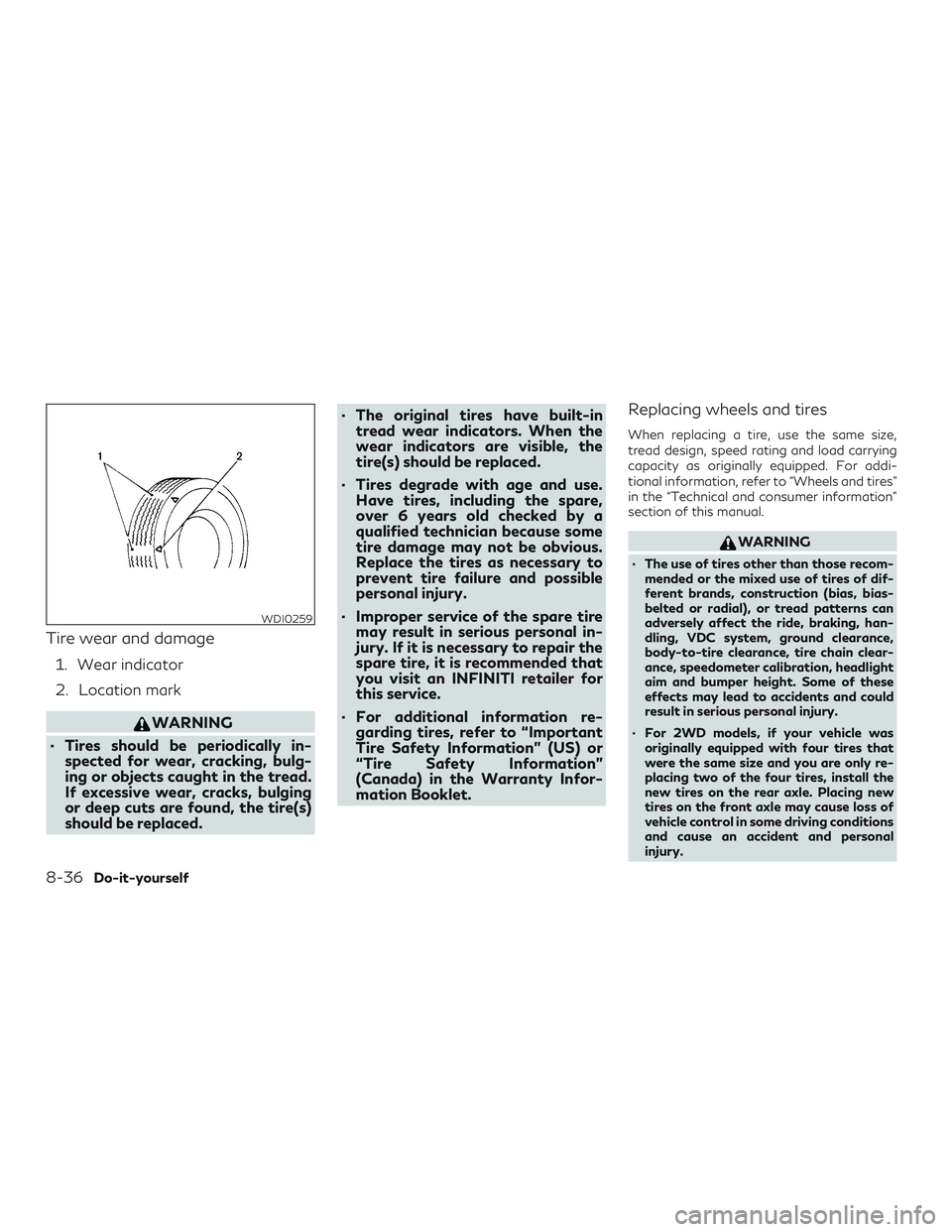
Tire wear and damage
1. Wear indicator
2. Location mark
WARNING
∙ Tires should be periodically in- spected for wear, cracking, bulg-
ing or objects caught in the tread.
If excessive wear, cracks, bulging
or deep cuts are found, the tire(s)
should be replaced. ∙ The original tires have built-in
tread wear indicators. When the
wear indicators are visible, the
tire(s) should be replaced.
∙ Tires degrade with age and use. Have tires, including the spare,
over 6 years old checked by a
qualified technician because some
tire damage may not be obvious.
Replace the tires as necessary to
prevent tire failure and possible
personal injury.
∙ Improper service of the spare tire may result in serious personal in-
jury. If it is necessary to repair the
spare tire, it is recommended that
you visit an INFINITI retailer for
this service.
∙ For additional information re- garding tires, refer to “Important
Tire Safety Information” (US) or
“Tire Safety Information”
(Canada) in the Warranty Infor-
mation Booklet.
Replacing wheels and tires
When replacing a tire, use the same size,
tread design, speed rating and load carrying
capacity as originally equipped. For addi-
tional information, refer to “Wheels and tires”
in the “Technical and consumer information”
section of this manual.
WARNING
∙ The use of tires other than those recom-
mended or the mixed use of tires of dif-
ferent brands, construction (bias, bias-
belted or radial), or tread patterns can
adversely affect the ride, braking, han-
dling, VDC system, ground clearance,
body-to-tire clearance, tire chain clear-
ance, speedometer calibration, headlight
aim and bumper height. Some of these
effects may lead to accidents and could
result in serious personal injury.
∙ For 2WD models, if your vehicle was originally equipped with four tires that
were the same size and you are only re-
placing two of the four tires, install the
new tires on the rear axle. Placing new
tires on the front axle may cause loss of
vehicle control in some driving conditions
and cause an accident and personal
injury.
WDI0259
8-36Do-it-yourself
Page 475 of 540

∙ If the wheels are changed for any reason,always replace with wheels which have
the same off-set dimension. Wheels of a
different off-set could cause premature
tire wear, degrade vehicle handling char-
acteristics, affect the VDC system
and/or interference with the brake discs.
Such interference can lead to decreased
braking efficiency and/or early brake
pad wear. For additional information on
wheel off-set dimensions, refer to
“Wheels and tires” in the “Technical and
consumer information” section of this
manual.
∙ When replacing a wheel without the TPMS, such as the spare tire, the TPMS
will not function and the low tire pressure
warning light will flash for approximately
1 minute. The light will remain on after
1 minute. Have your tires replaced
and/or TPMS system reset as soon as
possible. It is recommended that you visit
an INFINITI retailer for this service.
∙ Replacing tires with those not originally specified by INFINITI could affect the
proper operation of the TPMS.
∙ The TPMS sensor may be damaged if it is not handled correctly. Be careful when
handling the TPMS sensor. ∙ When replacing the TPMS sensor, the ID
registration may be required. It is recom-
mended that you visit an INFINITI re-
tailer for ID registration.
∙ Do not use a valve stem cap that is not specified by INFINITI. The valve stem cap
may become stuck.
∙ Be sure that the valve stem caps are cor- rectly fitted. Otherwise the valve may be
clogged up with dirt and cause a malfunc-
tion or loss of pressure.
∙ Do not install a damaged or deformed wheel or tire even if it has been repaired.
Such wheels or tires could have structural
damage and could fail without warning.
∙ The use of retread tires is not recommended.
∙ For additional information regarding tires, refer to “Important Tire Safety In-
formation” (US) or “Tire Safety Informa-
tion” (Canada) in the Warranty Informa-
tion Booklet.
Wheel balance
Unbalanced wheels may affect vehicle han-
dling and tire life. Even with regular use,
wheels can get out of balance. Therefore,
they should be balanced as required. Wheel balance service should be performed
with the wheels off the vehicle. Spin balanc-
ing the wheels on the vehicle could lead to
mechanical damage.
∙ For additional information regarding
tires, refer to “Important Tire Safety In-
formation” (US) or “Tire Safety Informa-
tion” (Canada) in the Warranty Informa-
tion Booklet.
Care of wheels
∙ Wash the wheels when washing the ve-
hicle to maintain their appearance.
∙ Clean the inner side of the wheels when the wheel is changed or the underside of
the vehicle is washed.
∙ Do not use abrasive cleaners when washing the wheels.
∙ Inspect wheel rims regularly for dents or corrosion. Such damage may cause loss
of pressure or poor seal at the tire bead.
∙ INFINITI recommends waxing the road wheels to protect against road salt in
areas where it is used during winter.
Do-it-yourself8-37
Page 479 of 540
latch keeps the hood from opening when the
primary latch is released.
When driving in areas using road salt or other
corrosive materials, check lubrication fre-
quently.
Lights*:Clean the headlights on a regular
basis. Make sure that the headlights, stop
lights, tail lights, turn signal lights, and other
lights are all operating properly and installed
securely. Also check headlight aim.
Road wheel nuts (lug nuts)*: When checking
the tires, make sure no wheel nuts are miss-
ing, and check for any loose wheel nuts.
Tighten if necessary.
Tire rotation*: Tires should be rotated every
5,000 miles (8,000 km).
Tires*: Check the pressure with a gauge of-
ten and always prior to long distance trips. If
necessary, adjust the pressure in all tires, in-
cluding the spare, to the pressure specified.
Check carefully for damage, cuts or excessive
wear.
Tire Pressure Monitoring System (TPMS)
transmitter components: Replace the TPMS
transmitter grommet seal, valve core and cap
when the tires are replaced due to wear or
age. Tire, wheel alignment and balance:
If the ve-
hicle should pull to either side while driving on
a straight and level road, or if you detect
uneven or abnormal tire wear, there may be a
need for wheel alignment. If the steering
wheel or seat vibrates at normal highway
speeds, wheel balancing may be needed.
For additional information regarding tires, re-
fer to “Important Tire Safety Information”
(US) or “Tire Safety Information” (Canada) in
the INFINITI Warranty Information Booklet.
Windshield: Clean the windshield on a regu-
lar basis. Check the windshield at least every
six months for cracks or other damage. Have
a damaged windshield repaired by a qualified
repair facility.
Windshield wiper blades*: Check for cracks
or wear if they do not wipe properly.
Inside the vehicle
The maintenance items listed here should be
checked on a regular basis, such as when
performing scheduled maintenance, cleaning
the vehicle, etc.
Accelerator pedal: Check the pedal for
smooth operation and make sure the pedal
does not catch or require uneven effort. Keep
the floor mat away from the pedal. Brake pedal:
Check the pedal for smooth op-
eration. If the brake pedal suddenly goes
down further than normal, the pedal feels
spongy or the vehicle seems to take longer to
stop, have your vehicle checked immediately.
It is recommended that you visit an INFINITI
retailer for this service. Keep the floor mat
away from the pedal.
Brakes: Check that the brakes do not pull the
vehicle to one side when applied.
Continuously Variable Transmission (CVT) P
(Park) position mechanism: On a fairly steep
hill check that the vehicle is held securely with
the shift lever in the P (Park) position without
applying any brakes.
Parking brake: Check the parking brake op-
eration regularly. The vehicle should be se-
curely held on a fairly steep hill with only the
parking brake applied. If the parking brake
needs adjustment, it is recommended that
you visit an INFINITI retailer for this service.
Seat belts: Check that all parts of the seat
belt system (for example, buckles, anchors,
adjusters and retractors) operate properly
and smoothly, and are installed securely.
Check the belt webbing for cuts, fraying,
wear or damage.
Maintenance and schedules9-3
Page 480 of 540

Seats:Check seat position controls such as
seat adjusters, seatback recliner, etc., to en-
sure they operate smoothly and all latches
lock securely in every position. Check that the
head restraints/headrests move up and
down smoothly and the locks (if so equipped)
hold securely in all latched positions.
Steering wheel: Check for changes in the
steering system, such as excessive free play,
hard steering or strange noises.
Warning lights and chimes: Make sure all
warning lights and chimes are operating
properly.
Windshield defroster: Check that the air
comes out of the defroster outlets properly
and in sufficient quantity when operating the
heater or air conditioner.
Windshield wiper and washer*: Check that
the wipers and washer operate properly and
that the wipers do not streak.
Under the hood and vehicle
The maintenance items listed here should be
checked periodically (for example, each time
you check the engine oil or refuel).
Battery (except for maintenance free bat-
teries)*: Check the fluid level in each cell. The
fluid should be at the bottom of the filler opening. Vehicles operated in high tempera-
tures or under severe conditions require fre-
quent checks of the battery fluid level.
Battery (for maintenance free batteries)*:
This vehicle is equipped with a sealed main-
tenance free battery. It is recommended that
you visit an INFINITI dealer for service
NOTE:
Care should be taken to avoid situations
that can lead to potential battery discharge
and potential no-start conditions such as:
1. Installation or extended use of elec-
tronic accessories that consume battery
power when the engine is not running
(Phone chargers, GPS, DVD players,
etc.).
2. Vehicle is not driven regularly and/or
only driven short distances.
In these cases, the battery may need to be
charged to maintain battery health.
Brake fluid level*: Make sure that the brake
fluid level is between the MAX and MIN lines
on the reservoir.
Engine coolant level*: Check the coolant level
when the engine is cold. Engine drive belt*:
Make sure the drive belt is
not frayed, worn, cracked or oily.
Engine oil level*: Check the level after parking
the vehicle on a level spot and turning off the
engine. Wait more than 15 minutes for the oil
to drain back into the oil pan.
Exhaust system: Make sure there are no
loose supports, cracks or holes. If the sound
of the exhaust seems unusual or there is a
smell of exhaust fumes, immediately have the
exhaust system inspected. It is recommended
that you visit an INFINITI retailer for this
service. For additional information, refer to
“Exhaust gas (carbon monoxide)” in the
“Starting and driving” section of this manual.
Fluid leaks: Check under the vehicle for fuel,
oil, water or other fluid leaks after the vehicle
has been parked for a while. Water dripping
from the air conditioner after use is normal. If
you should notice any leaks or if fuel fumes
are evident, check for the cause and have it
corrected immediately.
Power steering fluid level* and lines: Check
the level when the fluid is cold, with the en-
gine off. Check the lines for proper attach-
ment, leaks, cracks, etc.
9-4Maintenance and schedules
Page 494 of 540
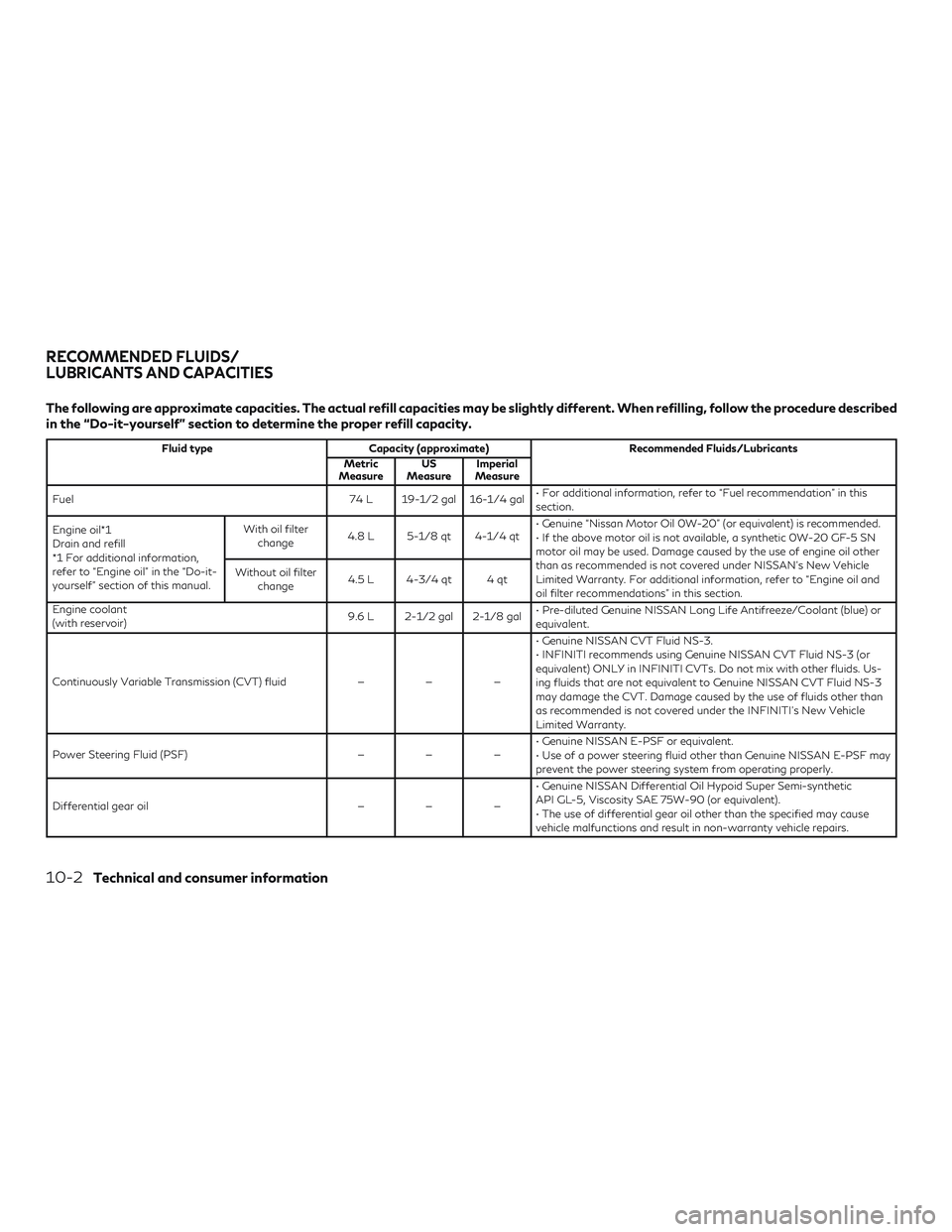
The following are approximate capacities. The actual refill capacities may be slightly different. When refilling, follow the procedure described
in the “Do-it-yourself” section to determine the proper refill capacity.
Fluid typeCapacity (approximate) Recommended Fluids/Lubricants
Metric
Measure US
Measure Imperial
Measure
Fuel 74 L 19-1/2 gal 16-1/4 gal• For additional information, refer to “Fuel recommendation” in this
section.
Engine oil*1
Drain and refill
*1 For additional information,
refer to “Engine oil” in the “Do-it-
yourself” section of this manual. With oil filter
change 4.8 L 5-1/8 qt 4-1/4 qt • Genuine “Nissan Motor Oil 0W-20” (or equivalent) is recommended.
• If the above motor oil is not available, a synthetic 0W-20 GF-5 SN
motor oil may be used. Damage caused by the use of engine oil other
than as recommended is not covered under NISSAN’s New Vehicle
Limited Warranty. For additional information, refer to “Engine oil and
oil filter recommendations” in this section.
Without oil filter
change 4.5 L 4-3/4 qt 4 qt
Engine coolant
(with reservoir) 9.6 L 2-1/2 gal 2-1/8 gal
• Pre-diluted Genuine NISSAN Long Life Antifreeze/Coolant (blue) or
equivalent.
Continuously Variable Transmission (CVT) fluid ———• Genuine NISSAN CVT Fluid NS-3.
• INFINITI recommends using Genuine NISSAN CVT Fluid NS-3 (or
equivalent) ONLY in INFINITI CVTs. Do not mix with other fluids. Us-
ing fluids that are not equivalent to Genuine NISSAN CVT Fluid NS-3
may damage the CVT. Damage caused by the use of fluids other than
as recommended is not covered under the INFINITI’s New Vehicle
Limited Warranty.
Power Steering Fluid (PSF) ———• Genuine NISSAN E-PSF or equivalent.
• Use of a power steering fluid other than Genuine NISSAN E-PSF may
prevent the power steering system from operating properly.
Differential gear oil ———• Genuine NISSAN Differential Oil Hypoid Super Semi-synthetic
API GL-5, Viscosity SAE 75W-90 (or equivalent).
• The use of differential gear oil other than the specified may cause
vehicle malfunctions and result in non-warranty vehicle repairs.
RECOMMENDED FLUIDS/
LUBRICANTS AND CAPACITIES
10-2Technical and consumer information
Page 497 of 540

Take care not to spill gasoline during refuel-
ing. Gasoline containing oxygenates can
cause paint damage.
E–15 fuel
E-15 fuel is a mixture of approximately 15%
fuel ethanol and 85% unleaded gasoline.
E-15 can only be used in vehicles designed to
run on E-15 fuel. U.S. government regula-
tions require fuel ethanol dispensing pumps
to be identified with small, square, orange
and black label with the common abbrevia-
tion or the appropriate percentage for that
region.
E–85 fuel
E-85 fuel is a mixture of approximately 85%
fuel ethanol and 15% unleaded gasoline.
E-85 can only be used in a Flexible Fuel Ve-
hicle (FFV). Do not use E-85 in your vehicle.
U.S. government regulations require fuel
ethanol dispensing pumps to be identified by
a small, square, orange and black label with
the common abbreviation or the appropriate
percentage for that region.
Fuel containing MMT
MMT, or methylcyclopentadienyl manganese
tricarbonyl, is an octane boosting additive.
INFINITI does not recommend the use of fuelcontaining MMT. Such fuel may adversely
affect vehicle performance, including the
emissions control system. Note that while
some fuel pumps label MMT content, not all
do, so you may have to consult your gasoline
retailer for more details.
Aftermarket fuel additives
INFINITI does not recommend the use of any
aftermarket fuel additives (for example, fuel
injector cleaner, octane booster, intake valve
deposit removers, etc.) which are sold com-
mercially. Many of these additives intended
for gum, varnish or deposit removal may con-
tain active solvents or similar ingredients that
can be harmful to the fuel system and engine.
Octane rating tips
Using unleaded gasoline with an octane rat-
ing lower than recommended can cause per-
sistent, heavy “spark knock.” (“Spark knock”
is a metallic rapping noise.) If severe, this can
lead to engine damage. If you detect a per-
sistent heavy spark knock even when using
gasoline of the stated octane rating, or if you
hear steady spark knock while holding a
steady speed on level roads, it is recom-
mended that you have an INFINITI retailer
correct the condition. Failure to correct the
condition is misuse of the vehicle, for which
INFINITI is not responsible.Incorrect ignition timing may result in spark
knock, after-run and/or overheating, which
may cause excessive fuel consumption or en-
gine damage. If any of the above symptoms
are encountered, have your vehicle checked.
It is recommended that you visit an INFINITI
retailer.
However, now and then you may notice light
spark knock for a short time while accelerat-
ing or driving up hills. This is not a cause for
concern, because you get the greatest fuel
benefit when there is light spark knock for a
short time under heavy engine load.
Technical and consumer information10-5
Page 515 of 540
Sway control device
Sudden maneuvers, wind gusts, and buffet-
ing caused by other vehicles can affect trailer
handling. Sway control devices may be used
to help control these affects. If you choose to
use one, contact a reputable trailer hitch sup-
plier to make sure the sway control device will
work with the vehicle, hitch, trailer and the
trailer’s brake system. Follow the instructions
provided by the manufacturer for installing
and using the sway control device.
Class I hitch
Class I trailer hitch equipment (receiver, ball
mount and hitch ball) can be used to tow
trailers of a maximum weight of 2,000 lbs.
(907 kg).
Class II hitch
Class II trailer hitch equipment (receiver, ball
mount and hitch ball) can be used to tow
trailers of a maximum weight of 3,500 lbs.
(1,587 kg).
Class III hitch
Class III trailer hitch equipment (receiver, ball
mount and hitch ball) can be used to tow
trailers of a maximum weight of 5,000 lbs.
(2,268 kg).
Tire pressures
∙ When towing a trailer, inflate thevehicle tires to the recommended
cold tire pressure indicated on the
Tire and Loading Information la-
bel.
∙ Trailer tire condition, size, load rat- ing and proper inflation pressure
should be in accordance with the
trailer and tire manufacturer’s
specifications.
Safety chains
Always use suitable safety chains between
your vehicle and the trailer. The safety chains
should be crossed and should be attached to
the hitch, not to the vehicle bumper or axle.
The safety chains can be attached to the
bumper if the hitch ball is mounted to the
bumper. Be sure to leave enough slack in the
chains to permit turning corners.
Trailer lights
CAUTION
When splicing into the vehicle electrical
system, a commercially available power-
type module/converter must be used to
provide power for all trailer lighting. This
unit uses the vehicle battery as a direct
power source for all trailer lights while us-
ing the vehicle tail light, stop light and turn
signal circuits as a signal source. The
module/converter must draw no more than
15 milliamps from the stop and tail lamp
circuits. Using a module/converter that ex-
ceeds these power requirements may dam-
age the vehicle’s electrical system. See a
reputable trailer retailer to obtain the
proper equipment and to have it installed.
Trailer lights should comply with federal
and/or local regulations. For assistance in
hooking up trailer lights, contact an INFINITI
retailer or reputable trailer retailer. Vehicles
equipped with the optional trailer tow pack-
age are equipped with a 7-pin trailer harness
connector. If your trailer is equipped with a
flat 4-pin connector, an adapter will be
needed to connect the trailer lights to the
vehicle. Adapters are available at auto parts
stores and hitch retailers.
Technical and consumer information10-23
Page 518 of 540

Pre-towing tips
∙ Be certain your vehicle maintains a levelposition when a loaded and/or unloaded
trailer is hitched. Do not drive the vehicle
if it has an abnormal nose-up or nose-
down condition; check for improper
tongue load, overload, worn suspension
or other possible causes of either condi-
tion.
∙ Always secure items in the trailer to pre- vent load shift while driving.
∙ Keep the cargo load as low as possible in the trailer to keep the trailer center of
gravity low.
∙ Load the trailer so approximately 60% of the trailer load is in the front half and
40% is in the back half. Also make sure
the load is balanced side to side.
∙ Check your hitch, trailer tire pressure, ve- hicle tire pressure, trailer light operation,
and trailer wheel lug nuts every time you
attach a trailer to the vehicle.
∙ Be certain your rearview mirrors conform to all federal, state or local regulations. If
not, install any mirrors required for tow-
ing before driving the vehicle. ∙ Determine the overall height of the ve-
hicle and trailer so the required clearance
is known.
Trailer towing tips
In order to gain skill and an understanding of
the vehicle’s behavior, you should practice
turning, stopping and backing up in an area
which is free from traffic. Steering stability
and braking performance will be somewhat
different than under normal driving condi-
tions.
∙ Always secure items in the trailer to pre- vent load shift while driving.
∙ Lock the trailer hitch coupler with a pin or lock to prevent the coupler from inadver-
tently becoming unlatched.
∙ Avoid abrupt starts, acceleration or stops.
∙ Avoid sharp turns or lane changes.
∙ Always drive your vehicle at a moderate speed. ∙ When backing up, hold the bottom of the
steering wheel with one hand. Move your
hand in the direction in which you want
the trailer to go. Make small corrections
and back up slowly. If possible, have
someone guide you when you are back-
ing up.
Always block the wheels on both vehicle and
trailer when parking. Parking on a slope is not
recommended; however, if you must do so:
CAUTION
If you move the shift selector to the
P (Park) position before blocking the
wheels and applying the parking brake,
transmission damage could occur.
1. Apply and hold the brake pedal.
2. Have someone place blocks on the downhill side of the vehicle and trailer
wheels.
3. After the wheel blocks are in place, slowly release the brake pedal until the
blocks absorb the vehicle load.
4. Apply the parking brake.
5. Shift the transmission into P (Park).
6. Turn off the engine.
10-26Technical and consumer information
Page 520 of 540
∙ Increase your following distance to allowfor greater stopping distances while
towing a trailer. Anticipate stops and
brake gradually.
∙ INFINITI recommends that the cruise control not be used while towing a trailer.
∙ Some states or provinces have specific regulations and speed limits for vehicles
that are towing trailers. Obey the local
speed limits.
∙ Check your hitch, trailer wiring harness connections, and trailer wheel lug nuts
after 50 miles (80 km) of travel and at
every break.
∙ When launching a boat, don’t allow the water level to go over the exhaust tail
pipe or rear bumper.
∙ Make sure you disconnect the trailer lights before backing the trailer into the
water or the trailer lights may burn out.
When towing a trailer, final drive gear oil
should be replaced and transmission
oil/fluid should be changed more frequently.
For additional information, refer to the “Do-
it-yourself” section of this manual.FLAT TOWING FOR ALL–WHEEL
DRIVE VEHICLE (if so equipped)
Towing your vehicle with all four wheels on
the ground is sometimes called flat towing.
This method is sometimes used when towing
a vehicle behind a recreational vehicle, such
as a motor home.
CAUTION
∙ Failure to follow these guidelines can re- sult in severe transmission damage.
∙ Never flat tow your All-wheel drive (AWD) vehicle.
∙ DO NOT tow your All-wheel drive (AWD) vehicle with any wheels on the ground.
Doing so may cause serious and expen-
sive damage to the powertrain.
∙ For emergency towing procedures refer to “Towing recommended by INFINITI” in
the “In case of emergency” section of this
manual.
FLAT TOWING FOR FRONT
WHEEL DRIVE VEHICLE
(if so equipped)
Towing your vehicle with all four wheels on
the ground is sometimes called flat towing.
This method is sometimes used when towing
a vehicle behind a recreational vehicle, such
as a motor home.
CAUTION
∙ Failure to follow these guidelines can re-sult in severe transmission damage.
∙ Whenever flat towing your vehicle, al- ways tow forward, never backward.
∙ Never tow your front wheel drive vehicle with the front tires on the ground. Doing
so may cause serious and expensive dam-
age to the powertrain.
∙ DO NOT tow your front wheel drive con- tinuously variable transmission vehicle
with all four wheels on the ground (flat
towing). Doing so WILL DAMAGE inter-
nal transmission parts due to lack of
transmission lubrication.
∙ For emergency towing procedures refer to “Towing recommended by INFINITI” in
the “In case of emergency” section of this
manual.
10-28Technical and consumer information