heating INFINITI QX60 2023 User Guide
[x] Cancel search | Manufacturer: INFINITI, Model Year: 2023, Model line: QX60, Model: INFINITI QX60 2023Pages: 636, PDF Size: 7.28 MB
Page 590 of 636
Octane rating tips
Using unleaded gasoline with an octane rat-
ing lower than recommended can cause per-
sistent, heavy “spark knock.” (“Spark knock”
is a metallic rapping noise.) If severe, this can
lead to engine damage. If you detect a per-
sistent heavy spark knock even when using
gasoline of the stated octane rating, or if you
hear steady spark knock while holding a
steady speed on level roads, it is recom-
mended that you have an INFINITI retailer
correct the condition. Failure to correct the
condition is misuse of the vehicle, for which
INFINITI is not responsible.
Incorrect ignition timing may result in spark
knock, after-run and/or overheating, which
may cause excessive fuel consumption or en-
gine damage. If any of the above symptoms
are encountered, have your vehicle checked.
It is recommended that you visit an INFINITI
retailer.
However, now and then you may notice light
spark knock for a short time while accelerat-
ing or driving up hills. This is not a cause for
concern, because you get the greatest fuel
benefit when there is light spark knock for a
short time under heavy engine load.
ENGINE OIL AND OIL FILTER
RECOMMENDATIONS
Selecting the correct oil
It is essential to choose the correct grade,
quality and viscosity engine oil to ensure sat-
isfactory engine life and performance. For
additional information, see "Recommended
fluids/lubricants and capacities" (P. 10-2).
INFINITI recommends the use of an energy
conserving oil in order to improve fuel
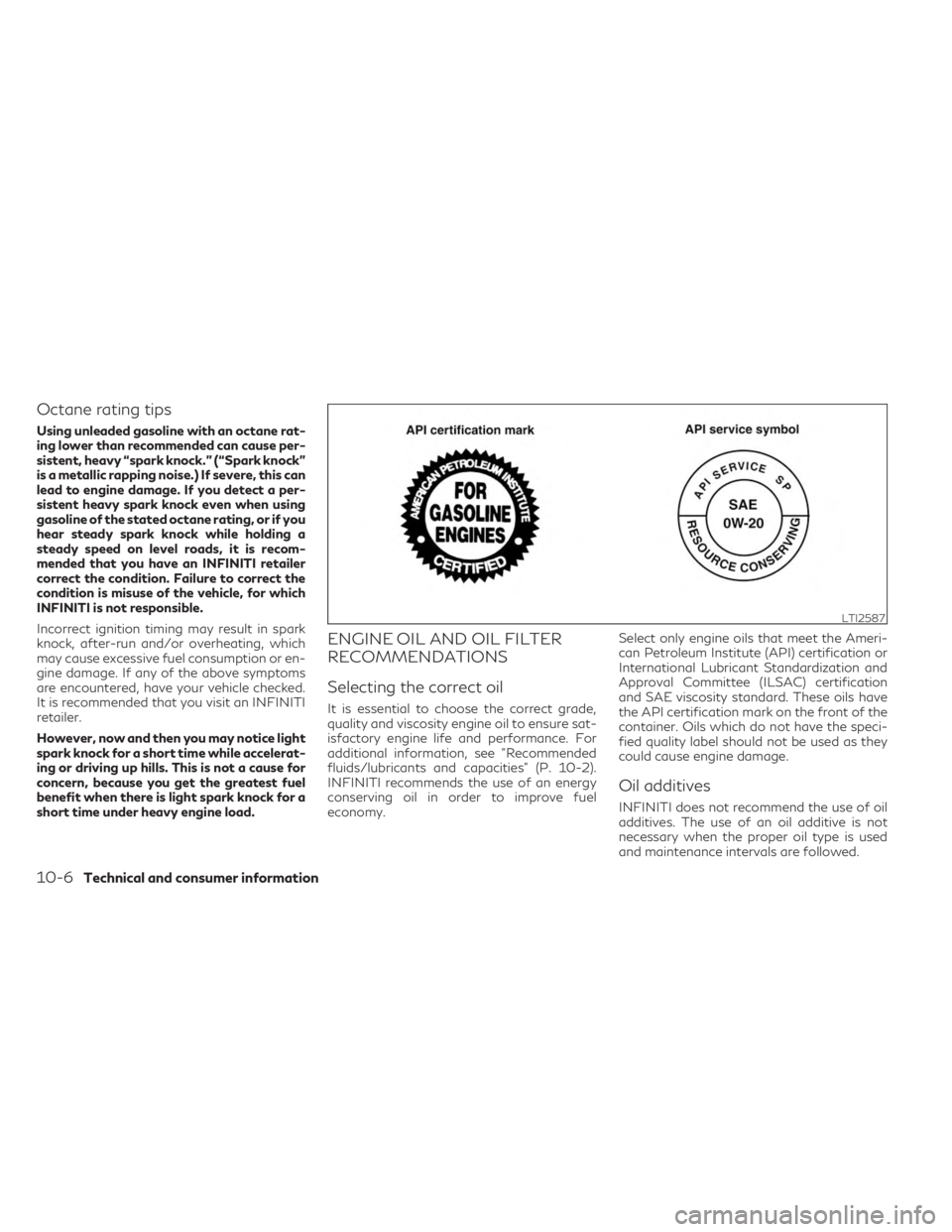
economy.Select only engine oils that meet the Ameri-
can Petroleum Institute (API) certification or
International Lubricant Standardization and
Approval Committee (ILSAC) certification
and SAE viscosity standard. These oils have
the API certification mark on the front of the
container. Oils which do not have the speci-
fied quality label should not be used as they
could cause engine damage.
Oil additives
INFINITI does not recommend the use of oil
additives. The use of an oil additive is not
necessary when the proper oil type is used
and maintenance intervals are followed.
LTI2587
10-6Technical and consumer information
Page 605 of 636
Temperature conditions can also affect tow-
ing. For example, towing a heavy trailer in
high outside temperatures on graded roads
can affect engine performance and cause
overheating. Vehicle speed may decrease un-
der high load. Plan your trip carefully to ac-
count for trailer and vehicle load, weather
and road conditions.
WARNING
Overheating can result in reduced engine
power and vehicle speed. The reduced
speed may be lower than other traffic,
which could increase the chance of a colli-
sion. Be especially careful when driving.
If the vehicle cannot maintain a safe driving
speed, pull to the side of the road in a safe
area. Allow the engine to cool and return
to normal operation. For additional infor-
mation, see “If your vehicle overheats”
(P. 6-14).
CAUTION
Vehicle damage resulting from improper
towing procedures is not covered by
INFINITI warranties.
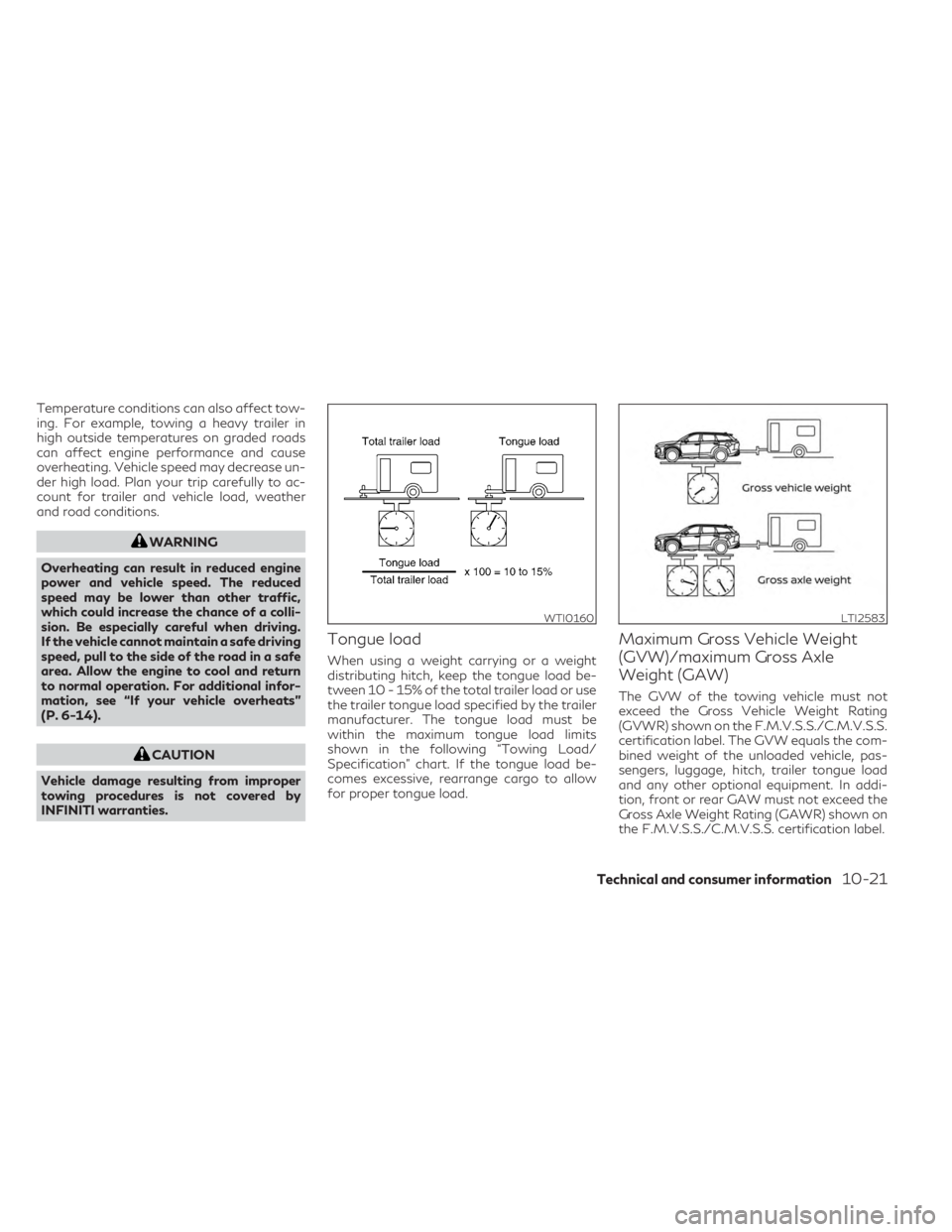
Tongue load
When using a weight carrying or a weight
distributing hitch, keep the tongue load be-
tween 10 - 15% of the total trailer load or use
the trailer tongue load specified by the trailer
manufacturer. The tongue load must be
within the maximum tongue load limits
shown in the following “Towing Load/
Specification” chart. If the tongue load be-
comes excessive, rearrange cargo to allow
for proper tongue load.
Maximum Gross Vehicle Weight
(GVW)/maximum Gross Axle
Weight (GAW)
The GVW of the towing vehicle must not
exceed the Gross Vehicle Weight Rating
(GVWR) shown on the F.M.V.S.S./C.M.V.S.S.
certification label. The GVW equals the com-
bined weight of the unloaded vehicle, pas-
sengers, luggage, hitch, trailer tongue load
and any other optional equipment. In addi-
tion, front or rear GAW must not exceed the
Gross Axle Weight Rating (GAWR) shown on
the F.M.V.S.S./C.M.V.S.S. certification label.
WTI0160LTI2583
Technical and consumer information10-21
Page 613 of 636

• Lock the trailer hitch coupler with a pin orlock to prevent the coupler from inadver-
tently becoming unlatched.
• Avoid abrupt starts, acceleration or stops.
• Avoid sharp turns or lane changes.
• Always drive your vehicle at a moderate speed.
• When backing up, hold the bottom of the steering wheel with one hand. Move your
hand in the direction in which you want the
trailer to go. Make small corrections and
back up slowly. If possible, have someone
guide you when you are backing up.
Always block the wheels on both vehicle and
trailer when parking. Parking on a slope is not
recommended; however, if you must do so:
CAUTION
If you push the park button to engage the P
(Park) position before blocking the wheels
and applying the parking brake, transmis-
sion damage could occur. 1. Apply and hold the brake pedal.
2. Have someone place blocks on the down-
hill side of the vehicle and trailer wheels.
3. After the wheel blocks are in place, slowly release the brake pedal until the blocks
absorb the vehicle load.
4. Apply the parking brake.
5. Push the park button to engage the P (Park) position.
6. Turn off the engine.
To drive away:
1. Start the vehicle.
2. Apply and hold the brake pedal.
3. Shift the transmission into gear.
4. Release the parking brake.
5. Drive slowly until the vehicle and trailer are clear from the blocks.
6. Apply and hold the brake pedal.
7. Have someone retrieve and store the blocks. • While going downhill, the weight of the
trailer pushing on the tow vehicle may de-
crease overall stability. Therefore, to main-
tain adequate control, reduce your speed
and shift to a lower gear. Avoid long or
repeated use of the brakes when descend-
ing a hill, as this reduces their effectiveness
and could cause overheating. Shifting to a
lower gear instead provides “engine brak-
ing” and reduces the need to brake as
frequently.
• If the engine coolant temperature rises to a high temperature, see “If your vehicle over-
heats” (P. 6-14).
• Trailer towing requires more fuel than nor- mal circumstances.
• Avoid towing a trailer for your vehicle's first 500 miles (805 km).
•For the first 500 miles (805 km) that you do
tow, do not drive over 50 mph (80 km/h).
• Have your vehicle serviced more often than at intervals specified in the recommended
maintenance schedule in the “Maintenance
and schedules” section of this manual.
• When making a turn, your trailer wheels will be closer to the inside of the turn than your
vehicle wheels. To compensate for this,
make a larger than normal turning radius
during the turn.
Technical and consumer information10-29