wheel lock INFINITI QX60 2023 Owner's Manual
[x] Cancel search | Manufacturer: INFINITI, Model Year: 2023, Model line: QX60, Model: INFINITI QX60 2023Pages: 636, PDF Size: 7.28 MB
Page 475 of 636

Normal operation
The Anti-lock Braking System (ABS) operates
at speeds above3-6mph(5-10km/h). The
speed varies according to road conditions.
When the ABS senses that one or more
wheels are close to locking up, the actuator
rapidly applies and releases hydraulic pres-
sure. This action is similar to pumping the
brakes very quickly. You may feel a pulsation
in the brake pedal and hear a noise from
under the hood or feel a vibration from the
actuator when it is operating. This is normal
and indicates that the ABS is operating prop-
erly. However, the pulsation may indicate
that road conditions are hazardous and extra
care is required while driving.
BRAKE ASSIST
When the force applied to the brake pedal
exceeds a certain level, the Brake Assist is
activated generating greater braking force
than a conventional brake booster even with
light pedal force.
WARNING
The Brake Assist is only an aid to assist
braking operation and is not a collision
warning or avoidance device. It is the driv-
er’s responsibility to stay alert, drive safely
and be in control of the vehicle at all times. • The ABLS system uses automatic braking
to transfer power from a slipping drive
wheel to the wheel on the same axle with
more traction. The ABLS system applies
braking to the slipping wheel, which helps
redirect power to the other wheel.
• The ABLS system is always on. In some conditions, the system may automatically
turn the ABLS system off. If the system is
automatically turned off, normal brake
function will continue. ABLS will function
even when the Vehicle Dynamic Control
system is turned off.
• The ABLS does not operate if both wheels on a drive axle are slipping.
WARNING
• The ABLS system helps provide in-
creased traction, but will not prevent ac-
cidents due to abrupt steering operation
or by careless driving or dangerous driv-
ing practices. Reduce vehicle speed and
be especially careful when driving and
cornering on slippery surfaces. Always
drive carefully.
ACTIVE BRAKE LIMITED SLIP (ABLS)
SYSTEM
Starting and driving5-167
Page 486 of 636
• If the sonar sensors are dirty, wipe them offwith a soft cloth while being careful to not
damage them.
• The sonar sensors may be blocked by tem- porary ambient conditions such as splash-
ing water, mist or fog. The blocked condi-
tion may also be caused by objects such as
ice, frost or dirt obstructing the sonar sen-
sors. Check for and remove objects ob-
structing the area around the sonar
sensors.
• Do not subject the area around the sonar sensors to strong impact. Also, do not re-
move or disassemble the sonar sensors. If
the sonar sensors and peripheral areas are
deformed in an accident, etc., have the so-
nar sensors checked by an INFINITI retailer.
• Do not attach stickers (including transpar- ent material), install accessories or apply
additional paint on the sonar sensors and
their surrounding areas. This may cause a
malfunction or improper operation.
• When washing the vehicle using a high- pressure washer, do not apply direct
washer pressure on the sonar sensors. This
may cause a malfunction of the sonar
sensors. The Idling Stop System activates to prevent
unnecessary fuel consumption, exhaust
emissions and noise.
• When you stop the vehicle, the engine is
turned off automatically.
• When you release the brake pedal to begin moving again, the engine is turned on
automatically.
WARNING
The engine restarts if the vehicle moves at
approximately 1 mph (2 km/h) or more (on
a downhill grade, etc.) while the engine is
turned off by the Idling Stop System. De-
press the brake pedal immediately to stop
the vehicle to prevent an accident.
CAUTION
At the end of the journey the engine must
be stopped and ignition switch be pushed
off. Lock the vehicle as normal. Pushing the
ignition switch off will shut down all elec-
trical systems. Failure to do this may result
in a discharged battery.
NOTE:
The Idling Stop System will not activate un-
der the following conditions:
• When the engine is kept idling without the
vehicle being driven after the engine is
turned on.
• When the engine coolant temperature is
low.
• When the battery capacity is low.
• When the battery temperature is low.
• When the vehicle is moving.
• When a negative pressure booster
decreases.
• When the engine hood is opened with the
engine running.
• When the engine is turned on with the en-
gine hood open.
• When the driver’s seat belt is not fastened.
• When the driver’s door is open.
• When the steering wheel is operated.
• When the Idling Stop System indicator
blinks at a low speed.
•
When the fan speed control is in any position
other than “OFF,” (0) while the air flow con-
trol is in the front defogger position.
• When the front defroster switch is on.
IDLING STOP SYSTEM
5-178Starting and driving
Page 498 of 636
•When using a wheel without TPMS such
as the spare tire, the TPMS will not func-
tion and the low tire pressure warning
light will flash for approximately 1 min-
ute. The light will remain on after 1 min-
ute. Have your tires replaced and/or
TPMS system reset as soon as possible.
It is recommended that you visit an
INFINITI retailer for these services.
• Replacing tires with those not originally
specified by INFINITI could affect the
proper operation of the TPMS.
• Do not inject any tire liquid or aerosol tire
sealant into the tires, as this may cause a
malfunction of the tire pressure sensors.
CHANGING A FLAT TIRE
If you have a flat tire, follow the instructions
below:
Stopping the vehicle
1. Safely move the vehicle off the road and away from traffic.
2. Turn on the hazard warning flashers.
3. Park on a level surface and apply the park- ing brake. Push the park button to shift to
the P (Park) position.
4. Turn off the engine. 5. Raise the hood to warn other traffic and
to signal professional road assistance
personnel that you need assistance.
6. Have all passengers get out of the vehicle and stand in a safe place, away from traf-
fic and clear of the vehicle.
WARNING
• Make sure the parking brake is securely
applied and the shift position is placed in
the P (Park) position.
• Never change tires when the vehicle is on
a slope, ice or slippery areas. This is
hazardous.
• Never change tires if oncoming traffic is
close to your vehicle. Wait for profes-
sional road assistance.
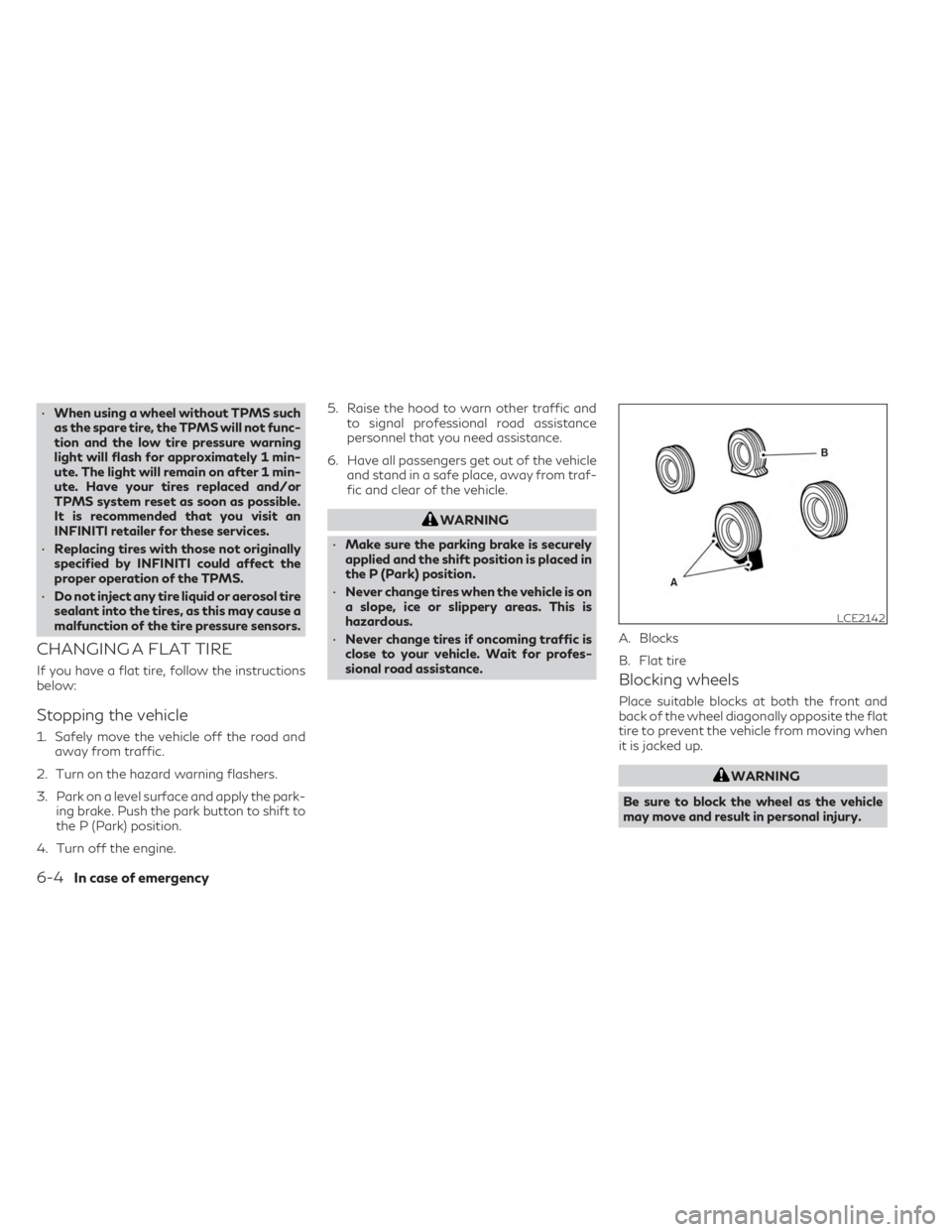
Blocking wheels
Place suitable blocks at both the front and
back of the wheel diagonally opposite the flat
tire to prevent the vehicle from moving when
it is jacked up.
WARNING
Be sure to block the wheel as the vehicle
may move and result in personal injury.
LCE2142
A. Blocks
B. Flat tire
6-4In case of emergency
Page 500 of 636

4. Remove the jack.
• The jack is secured by a fastener
OC.To
release the fastener, assemble the jacking
rod
ODinto the wheel nut wrenchOEand
rotate counterclockwise to release.
• Insert the flat end of the wheel nut wrench
OEinto the slot of the fastenerOC, and
rotate counterclockwise to release the jack.
5. The lowering mechanism for the spare tire is located on the passenger side of the
cargo area. Remove the cover
OFto ac-
cess the lowering mechanism. 6. Attach the spare tire winch socket
OGto
the lowering mechanism nut.
7. To lower the spare tire, insert the wheel nut wrench
OEinto the jacking rodODand
insert the T-shaped end of the jacking rod
into the winch socket
OGand rotate
counterclockwise.
8. Once the spare tire is lowered, release it from the vehicle by guiding the lowering
cable and winch through the center of the
tire.
NOTE:Fully lower the spare tire below the vehicle
before attempting to remove the winch from
the spare tire.
9. After removing the spare tire from underthe vehicle, be sure to crank the cable up
by rotating the winch socket clockwise to
stow it.
LCE2475LCE2484
6-6In case of emergency
Page 502 of 636
Jacking up vehicle and removing
the damaged tire
WARNING
• Never get under the vehicle while it is
supported only by the jack. If it is neces-
sary to work under the vehicle, support it
with safety stands.
• Use only the jack provided with your ve-
hicle to lift the vehicle. Do not use the
jack provided with your vehicle on other
vehicles. The jack is designed for lifting
only your vehicle during a tire change.
• Use the correct jack-up points. Never use
any other part of the vehicle for jack
support.
• If your vehicle is equipped with Running
Boards use the Jack Point located on the
front or rear mounting brackets.
• Never jack up the vehicle more than
necessary.
• Never use blocks on or under the jack. •
Do not start or run the engine while ve-
hicle is on the jack. It may cause the ve-
hicle to move. This is especially true for
vehicles with limited slip differentials.
• Do not allow passengers to stay in the
vehicle while it is on the jack.
• Never run the engine with a wheel(s) off
the ground. It may cause the vehicle to
move.
Always refer to the illustration for the correct
placement and jack-up points for your spe-
cific vehicle model and jack type.
Carefully read the caution label attached to
the jack body and the following instructions.
6-8In case of emergency
Page 504 of 636

WARNING
• If your vehicle is equipped with Running
Boards use the Jack Point located on the
front or rear mounting brackets.
• The Jack Point is located directly behind
the triangle shaped protrusion near the
front and rear of the Running Board
stepping surface.
1. Loosen each wheel nut one or two turns by turning counterclockwise with the
wheel nut wrench. Do not remove the
wheel nuts until the tire is off the ground.
2. Place the jack directly under the jack-up point as illustrated so the top of the jack
contacts the vehicle at the jack-up point.
The jack-up points are indicated by the
notches under the frame.
If the vehicle is equipped with INFINITI
Running Boards, the jack-up points are
indicated on the running board stepping
surface and the running board mounting
brackets.
The jack should be used on firm and level
ground.
LCE2469
Vehicle shown with running boards
6-10In case of emergency
Page 512 of 636
•When towing automatic transmission
models with the rear wheels on the
ground or on towing dollies:
– Place the ignition switch in the OFF
position, and secure the steering
wheel in a straight-ahead position
with a rope or similar device. Never
secure the steering wheel by placing
the ignition switch in the LOCK posi-
tion. This may damage the steering
lock mechanism (for models with a
steering lock mechanism).
NOTE:
If the battery is completely drained the
transmission will not manually shift to other
positions.
VEHICLE RECOVERY (freeing a
stuck vehicle)
WARNING
To avoid vehicle damage, serious personal
injury or death when recovering a stuck
vehicle:
• Contact a professional towing service to
recover the vehicle if you have any ques-
tions regarding the recovery procedure. •
Tow chains or cables must be attached
only to main structural members of the
vehicle.
• Do not use the vehicle tie-downs to tow
or free a stuck vehicle.
• Only use devices specifically designed for
vehicle recovery and follow the manu-
facturer's instructions.
• Always pull the recovery device straight
out from the front of the vehicle. Never
pull at an angle.
• Route recovery devices so they do not
touch any part of the vehicle except the
attachment point.
If your vehicle is stuck in sand, snow, mud,
etc., use a tow strap or other device designed
specifically for vehicle recovery. Always fol-
low the manufacturer's instructions for the
recovery device.Rocking a stuck vehicle
WARNING
• Stand clear of a stuck vehicle.
• Do not spin your tires at high speed. This
could cause them to explode and result in
serious injury. Parts of your vehicle could
also overheat and be damaged. If your vehicle is stuck in sand, snow, mud,
etc., use the following procedure:
1. Turn off the Vehicle Dynamic Control
(VDC) system.
2. Make sure the area in front and behind the vehicle is clear of obstructions.
3. Turn the steering wheel right and left to clear an area around the front tires.
4. Slowly rock the vehicle forward and backward.
• Shift back and forth between R (Re- verse) and D (Drive).
• Apply the accelerator as little as pos- sible to maintain the rocking motion.
• Release the accelerator pedal before shifting between R (Reverse) and D
(Drive).
• Do not spin the tires above 35 mph (55 km/h).
5. If the vehicle cannot be freed after a few tries, contact a professional towing ser-
vice to remove the vehicle.
6-18In case of emergency
Page 522 of 636

When performing any inspection or maintenance
work on your vehicle, always take care to pre-
vent serious accidental injury to yourself or dam-
age to the vehicle. The following are general
precautions which should be closely observed.
WARNING
• Park the vehicle on a level surface, apply
the parking brake securely and block the
wheels to prevent the vehicle from mov-
ing. Push the park button to engage the
P (Park) position.
• Be sure the ignition switch is in the OFF
or LOCK position when performing any
parts replacement or repairs.
• If you must work with the engine run-
ning, keep your hands, clothing, hair and
tools away from moving fans, belts and
any other moving parts.
• It is advisable to secure or remove any
loose clothing and remove any jewelry,
such as rings, watches, etc. before work-
ing on your vehicle.
• Always wear eye protection whenever
you work on your vehicle.
• Your vehicle is equipped with an auto-
matic engine cooling fan. It may come on
at any time without warning, even if the
ignition switch is in the OFF position and the engine is not running. To avoid injury,
always disconnect the negative battery
cable before working near the fan.
• If you must run the engine in an enclosed
space such as a garage, be sure there is
proper ventilation for exhaust gases to
escape.
• Never get under the vehicle while it is
supported only by a jack. If it is necessary
to work under the vehicle, support it
with safety stands.
•
Keep smoking materials, flame and sparks
away from the fuel tank and battery.
• Because the fuel lines on gasoline engine
models are under high pressure even
when the engine is off, it is recommended
that you visit an INFINITI retailer for ser-
vice of the fuel filter or fuel lines.
CAUTION
• Do not work under the hood while the
engine is hot. Turn the engine off and
wait until it cools down.
• Avoid contact with used engine oil and
coolant. Improperly disposed engine oil,
engine coolant and/or other vehicle flu-
ids can damage the environment. Always
conform to local regulations for disposal
of vehicle fluid. •
Never leave the engine or automatic
transmission related component har-
nesses disconnected while the ignition
switch is in the ON position.
• Never connect or disconnect the battery
or any transistorized component while
the ignition switch is in the ON position.
NOTE:
If the battery is completely drained the
transmission will not manually shift to other
positions.
This “Do-it-yourself” section gives instruc-
tions regarding only those items which are
relatively easy for an owner to perform.
A Genuine INFINITI service manual is also
available. For additional information, see
“Owner’s Manual/Service Manual order in-
formation” (P. 10-36).
You should be aware that incomplete or im-
proper servicing may result in operating diffi-
culties or excessive emissions, and could af-
fect warranty coverage. If in doubt about any
servicing, it is recommended that you have it
done by an INFINITI retailer.
MAINTENANCE PRECAUTIONS
8-2Do-it-yourself
Page 565 of 636

Doors and engine hood:Check that the doors
and engine hood operate properly. Also en-
sure that all latches lock securely. Lubricate
hinges, latches, latch pins, rollers and links if
necessary. Make sure that the secondary
latch keeps the hood from opening when the
primary latch is released.
When driving in areas using road salt or other
corrosive materials, check lubrication
frequently.
Check that the gas stays or struts properly
and securely hold the hood, trunk, or rear
hatch fully open. If the hood, trunk, or rear
hatch is not held open, have the gas stays or
struts replaced.
Lights*: Clean the headlights on a regular
basis. Make sure that the headlights, stop
lights, tail lights, turn signal lights, and other
lights are all operating properly and installed
securely. Also check headlight aim.
Road wheel nuts (lug nuts)*: When checking
the tires, make sure no wheel nuts are miss-
ing, and check for any loose wheel nuts.
Tighten if necessary.
Tire rotation*: Rotate tires at the specified
interval shown in the maintenance schedule.
Tires*: Check the pressure with a gauge
often and always prior to long distance trips. If necessary, adjust the pressure in all tires,
including the spare, to the pressure specified.
Check carefully for damage, cuts or excessive
wear.
Tire Pressure Monitoring System (TPMS)
tire pressure sensor:
It is recommended that
you replace the TPMS tire pressure sensor
assembly when the tires are replaced due to
wear or age.
Wheel alignment and balance: If the vehicle
should pull to either side while driving on a
straight and level road, or if you detect un-
even or abnormal tire wear, there may be a
need for wheel alignment.
If the steering wheel or seat vibrates at nor-
mal highway speeds, wheel balancing may be
needed.
For additional information regarding tires, re-
fer to “Important Tire Safety Information”
(US) or “Tire Safety Information” (Canada) in
the INFINITI Warranty Information Booklet.
Windshield: Clean the windshield on a regu-
lar basis. Check the windshield at least
every six months for cracks or other damage.
Have a damaged windshield repaired by a
qualified repair facility. It is recommended
that you have a damaged windshield re-
paired by an INFINITI retailer, or an INFINITI Certified Collision Center. To locate a colli-
sion center in your area, refer to
http://collision.infinitiusa.com.
Inside the vehicle
The maintenance items listed here should be
checked on a regular basis, such as when
performing scheduled maintenance, cleaning
the vehicle, etc.
Accelerator pedal:
Check the pedal for
smooth operation and make sure the pedal
does not catch or require uneven effort. Keep
the floor mat away from the pedal.
Automatic transmission P (Park) position
mechanism: On a fairly steep hill check that
the vehicle is held securely with the shift po-
sition in the P (Park) position without apply-
ing any brakes.
Brake pedal: Check the pedal for smooth op-
eration. If the brake pedal suddenly goes
down further than normal, the pedal feels
spongy or the vehicle seems to take longer to
stop, have your vehicle checked immediately.
It is recommended that you visit an INFINITI
retailer for this service. Keep the floor mat
away from the pedal.
Brakes: Check that the brakes do not pull the
vehicle to one side when applied.
Maintenance and schedules9-3
Page 566 of 636

Parking brake:Check the parking brake op-
eration regularly. The vehicle should be se-
curely held on a fairly steep hill with only the
parking brake applied. If the parking brake
needs adjustment, it is recommended that
you visit an INFINITI retailer for this service.
Seat belts: Check that all parts of the seat
belt system (for example, buckles, anchors,
adjusters and retractors) operate properly
and smoothly, and are installed securely.
Check the belt webbing for cuts, fraying,
wear or damage.
Seats: Check seat position controls such as
seat adjusters, seatback recliner, etc., to en-
sure they operate smoothly and all latches
lock securely in every position. Check that the
head restraints/headrests move up and
down smoothly and the locks (if so equipped)
hold securely in all latched positions.
Steering wheel: Check for changes in the
steering system, such as excessive free play,
hard steering or strange noises.
Warning lights and chimes: Make sure all
warning lights and chimes are operating
properly.
Windshield defroster: Check that the air
comes out of the defroster outlets properly
and in sufficient quantity when operating the
heater or air conditioner. Windshield wiper and washer*:
Check that
the wipers and washer operate properly and
that the wipers do not streak.
Under the hood and vehicle
The maintenance items listed here should be
checked periodically (for example, each time
you check the engine oil or refuel).
Battery (for maintenance free batteries)*:
This vehicle is equipped with a sealed main-
tenance free battery. It is recommended that
you visit an INFINITI retailer for this service.
NOTE:
Care should be taken to avoid situations
that can lead to potential battery discharge
and potential no-start conditions such as:
1. Installation or extended use of electronic accessories that consume battery power
when the engine is not running (Phone
chargers, GPS, DVD players, etc.).
2. Vehicle is not driven regularly and/or only driven short distances.
In these cases, the battery may need to be
charged to maintain battery health.
Brake fluid level*: Make sure that the brake
fluid level is between the MAX and MIN lines
on the reservoir. Engine coolant level*:
Check the coolant level
when the engine is cold.
Engine drive belt*: Make sure the drive belt is
not frayed, worn, cracked or oily.
Engine oil level*: Check the level after parking
the vehicle on a level spot and turning off the
engine. Wait more than 15 minutes for the oil
to drain back into the oil pan.
Exhaust system: Make sure there are no
loose supports, cracks or holes. If the sound
of the exhaust seems unusual or there is a
smell of exhaust fumes, immediately have the
exhaust system inspected. It is recommended
that you visit an INFINITI retailer for this
service. For additional information, see “Ex-
haust gas (carbon monoxide)” (P. 5-4).
Fluid leaks: Check under the vehicle for fuel,
oil, water or other fluid leaks after the vehicle
has been parked for a while. Water dripping
from the air conditioner after use is normal. If
you should notice any leaks or if fuel fumes
are evident, check for the cause and have it
corrected immediately.
Radiator and hoses: Check the front of the
radiator and clean off any dirt, insects, leaves,
etc., that may have accumulated. Make sure
the hoses have no cracks, deformation, rot or
loose connections.
9-4Maintenance and schedules