ECO mode INFINITI QX60-HYBRID 2015 Owners Manual
[x] Cancel search | Manufacturer: INFINITI, Model Year: 2015, Model line: QX60-HYBRID, Model: INFINITI QX60-HYBRID 2015Pages: 577, PDF Size: 5.58 MB
Page 10 of 577

HEV Overview
INFINITI Direct Response Hybrid® System........HEV-2
Lithium-ion (Li-ion) Battery .......................HEV-2
High-voltage cautions ........................... HEV-3
Road accident cautions ......................... HEV-3
Emergency shut-off system ......................HEV-4
Operation of the hybrid system ...................HEV-4
Starting and slow speed driving ...............HEV-5
Medium or high speed driving . . ...............HEV-5
Rapid acceleration ........................... HEV-5
Deceleration and braking .....................HEV-5
Stopping ................................... HEV-5
Energy monitors ................................ HEV-6
Assist charge gauge ......................... HEV-6
Energy Flow
(models with navigation system) ...............HEV-6 Fuel Economy
(models with navigation system)
...............HEV-7
Fuel Economy
(models without navigation system) ............HEV-8
Fuel economy history
(models with navigation system) ...............HEV-8
Fuel economy history
(models without navigation system) ............HEV-9
Regenerative brake ............................ HEV-10
Efficient use of your vehicle .....................HEV-10
Approaching Vehicle Sound for Pedestrians (VSP)
System ....................................... HEV-11
Hybrid vehicle precautions ......................HEV-11
High-voltage components and their locations . . HEV-11
Hybrid vehicle characteristics ................HEV-13
Page 16 of 577

This is an example of the Energy Flow display.
The Energy Flow display changes, depending on
the following operating conditions. The graphic
indicates the amount of power in the Li-ion bat-
tery.
The following are displayed on the Energy Flow
screen.● When the vehicle is powered only by the
electric motor or gasoline engine.
● When the vehicle is powered by both the
electric motor and the gasoline engine. ●
When the vehicle is charging the Li-ion bat-
tery with the regenerative brake and gaso-
line engine.
● When the vehicle is powered by the gaso-
line engine and is charging the Li-ion battery.
● When there is no Energy Flow in the vehicle
The Energy Flow and remaining Li-ion battery
charge can be also shown on the vehicle infor-
mation display. For additional information, refer to
“Trip computer” in the “Instruments and controls”
section of this manual.FUEL ECONOMY (models with
navigation system)
Press the INFO button, then touch the FUEL
ECONOMY key on the display screen.
This screen displays the rate of fuel consumption
and distance to empty.
NJE0003NJE0013
HEV OverviewHEV-7
Page 17 of 577

FUEL ECONOMY (models without
navigation system)
Press the INFO button, then select the FUEL
ECONOMY key on the display screen.
This screen displays the rate of fuel consumption
and distance to empty.
FUEL ECONOMY HISTORY (models
with navigation system)
The Fuel Economy History screen appears in the
display with the navigation system when the
screen is in the Fuel Economy History mode.1. Push the INFO button on the control panel and highlight the “Energy Flow” key on the
display using the INFINITI controller. Then
push the ENTER button.
2. Highlight the “History” key, and push the ENTER button. The Fuel Economy History can be displayed on
the navigation system monitor. This displays the
vehicle’s average fuel consumption and regen-
erative electric power at 2 minute intervals.
The displayed values on the screen indicate gen-
eral driving conditions. Accuracy varies with driv-
ing habits and road conditions.
1. Regenerated energy in the past 12 minutes: The regenerated energy in the past 12 min-
utes is indicated with symbols. One symbol
indicates 30 watt-hour. The energy of
30 watt-hour illuminates a 30 watt bulb for
an hour.
2. Fuel consumption in the past 12 minutes: Fuel consumption in the past 12 minutes is
displayed.
3. Current fuel consumption (Latest column): The current fuel consumption is calculated
and displayed based on distance and fuel
consumption.
NOTE:
Information shown in the yellow column
means current (within 2 minutes) and infor-
mation shown in the blue columns means
past (more than 2 minutes) .
NJE0012NJE0008
HEV-8HEV Overview
Page 18 of 577
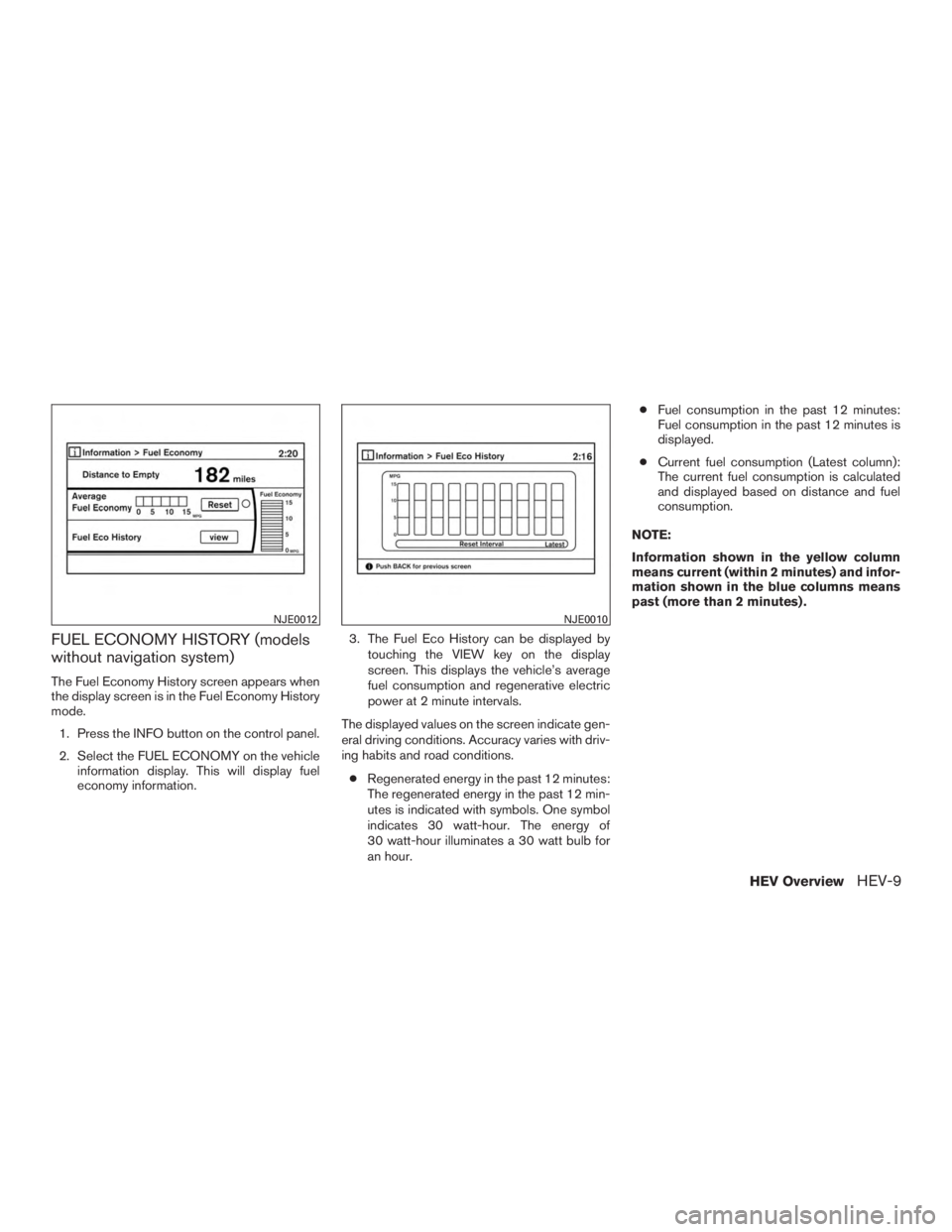
FUEL ECONOMY HISTORY (models
without navigation system)
The Fuel Economy History screen appears when
the display screen is in the Fuel Economy History
mode.1. Press the INFO button on the control panel.
2. Select the FUEL ECONOMY on the vehicle information display. This will display fuel
economy information. 3. The Fuel Eco History can be displayed by
touching the VIEW key on the display
screen. This displays the vehicle’s average
fuel consumption and regenerative electric
power at 2 minute intervals.
The displayed values on the screen indicate gen-
eral driving conditions. Accuracy varies with driv-
ing habits and road conditions. ● Regenerated energy in the past 12 minutes:
The regenerated energy in the past 12 min-
utes is indicated with symbols. One symbol
indicates 30 watt-hour. The energy of
30 watt-hour illuminates a 30 watt bulb for
an hour. ●
Fuel consumption in the past 12 minutes:
Fuel consumption in the past 12 minutes is
displayed.
● Current fuel consumption (Latest column):
The current fuel consumption is calculated
and displayed based on distance and fuel
consumption.
NOTE:
Information shown in the yellow column
means current (within 2 minutes) and infor-
mation shown in the blue columns means
past (more than 2 minutes) .
NJE0012NJE0010
HEV OverviewHEV-9
Page 19 of 577
This vehicle is equipped with two braking sys-
tems.● Hydraulic brake system
● Regenerative brake system
When the vehicle decelerates while the vehicle is
driven with the shift lever in the D (drive) position
or in the manual shift mode, the Li-ion battery can
be charged by the electric motor. The electric
motor converts the energy of the rotating wheels
into electric power under the following circum-
stances: ● When the accelerator pedal is released
● When the brake pedal is depressed
● When there is no malfunction in the brake
system or the INFINITI Direct Response Hy-
brid® System
The regenerative brake may not work properly if
the vehicle is installed with tires and road wheels
other than the ones specified in this manual.
While the regenerative cooperative brake system
is operating, you might feel a slight vibration or
hear the system working when braking. This is
normal. The regenerative cooperative brake system con-
trols both hydraulic and regenerative brakes. If
you feel unusual deceleration when braking, have
an INFINITI retailer check both the brake and
hybrid systems.
Drive your vehicle with smooth accelera-
tion and deceleration.
● While driving, energy is recovered through
the regenerative brake as the vehicle decel-
erates. However, for most efficient use, do
not accelerate or decelerate your vehicle
more than necessary.
● Avoid abrupt acceleration and deceleration.
● The power of the Li-ion battery can be
checked on the Energy Flow in the center
display (models with navigation system) or
Li-ion battery status meter in the vehicle
information display. For additional informa-
tion, refer to “Energy Flow (models with navi-
gation system)” or “Trip computer” in the
“Instruments and controls” section of this
manual. Gradual or non-abrupt acceleration
and deceleration will make more effective
use of the electric power.
● When parking, be sure to place the shift
lever in the P (Park) position. While driving,
place the shift lever in the D (Drive) position.
REGENERATIVE BRAKE EFFICIENT USE OF YOUR VEHICLE
HEV-10HEV Overview
Page 32 of 577
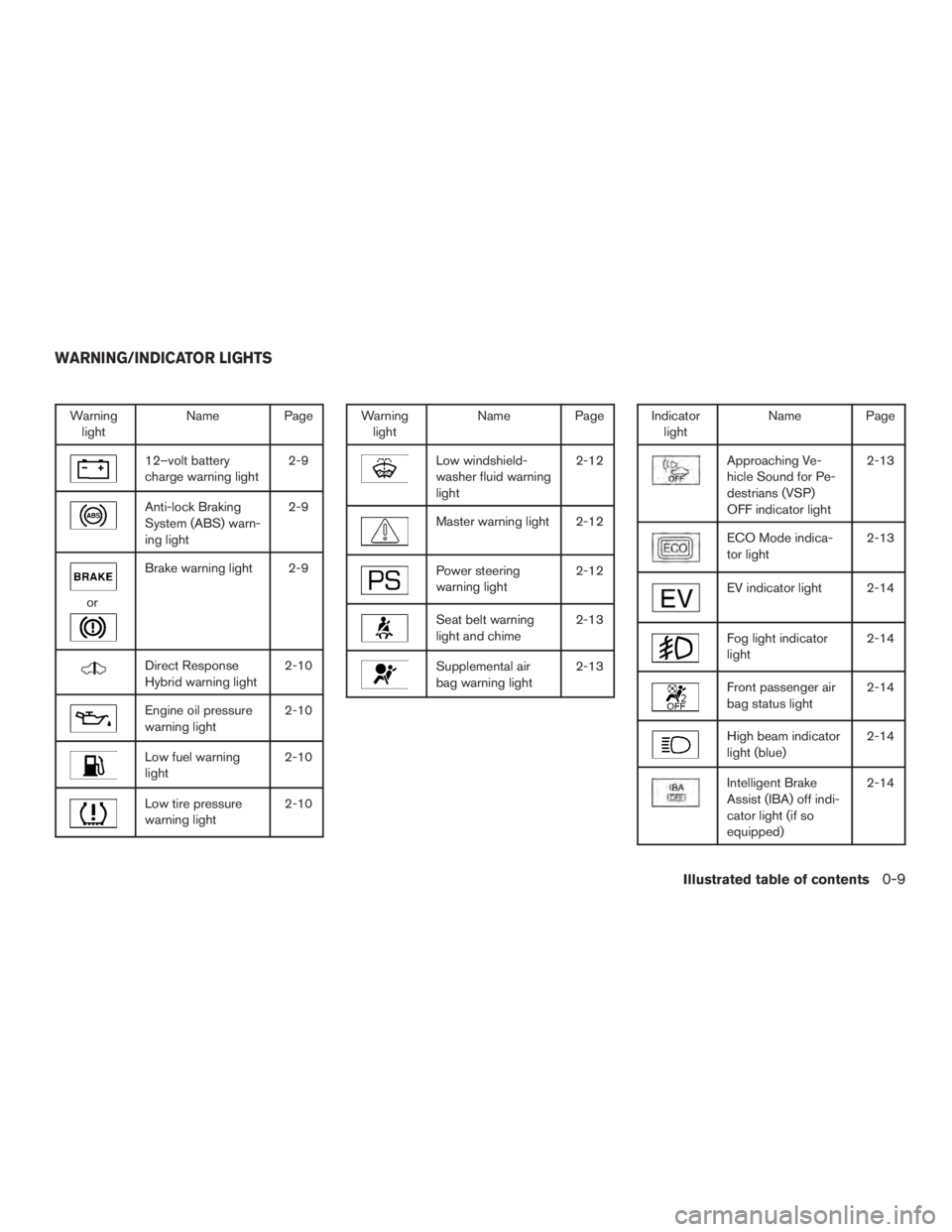
Warninglight Name Page
12–volt battery
charge warning light 2-9
Anti-lock Braking
System (ABS) warn-
ing light2-9
or
Brake warning light 2-9
Direct Response
Hybrid warning light
2-10
Engine oil pressure
warning light2-10
Low fuel warning
light2-10
Low tire pressure
warning light2-10
Warning
light Name Page
Low windshield-
washer fluid warning
light 2-12
Master warning light 2-12
Power steering
warning light
2-12
Seat belt warning
light and chime2-13
Supplemental air
bag warning light2-13
Indicator
light Name Page
Approaching Ve-
hicle Sound for Pe-
destrians (VSP)
OFF indicator light 2-13
ECO Mode indica-
tor light
2-13
EV indicator light 2-14
Fog light indicator
light2-14
Front passenger air
bag status light2-14
High beam indicator
light (blue)2-14
Intelligent Brake
Assist (IBA) off indi-
cator light (if so
equipped)2-14
WARNING/INDICATOR LIGHTS
Illustrated table of contents0-9
Page 52 of 577
If the motor cannot retract the seat belt when the
seat belt is fastened or unfastened, it may indi-
cate the pre-crash seat belt system has a mal-
function. Have your INFINITI retailer check and
repair the system.
When the seat belt is retracted repeatedly in a
short period of time, the motor may not be able to
retract the seat belt. After 8 minutes, the motor
reactivates and retracts the seat belt. If the seat
belt still cannot be retracted by the motor, the
pre-crash seat belt system has a malfunction.
Have your INFINITI retailer check and repair the
system.
THREE-POINT TYPE SEAT BELT
WITH RETRACTOR
WARNING
●Every person who drives or rides in this
vehicle should use a seat belt at all
times.
● Do not ride in a moving vehicle when
the seatback is reclined. This can be
dangerous. The shoulder belt will not
be against your body. In an accident,
you could be thrown into it and receive
neck or other serious injuries. You
could also slide under the lap belt and
receive serious internal injuries. ●
For the most effective protection when
the vehicle is in motion, the seat should
be upright. Always sit well back in the
seat with both feet on the floor and
adjust the seat belt properly.
● Do not allow children to play with the
seat belts. Most seating positions are
equipped with Automatic Locking Re-
tractor (ALR) mode seat belts. If the seat
belt becomes wrapped around a child’s
neck with the ALR mode activated, the
child can be seriously injured or killed if
the seat belt retracts and becomes
tight. This can occur even if the vehicle
is parked. Unbuckle the seat belt to
release the child. If the seat belt cannot
be unbuckled or is already unbuckled,
release the child by cutting the seat belt
with a suitable tool (such as a knife or
scissors) to release the seat belt.
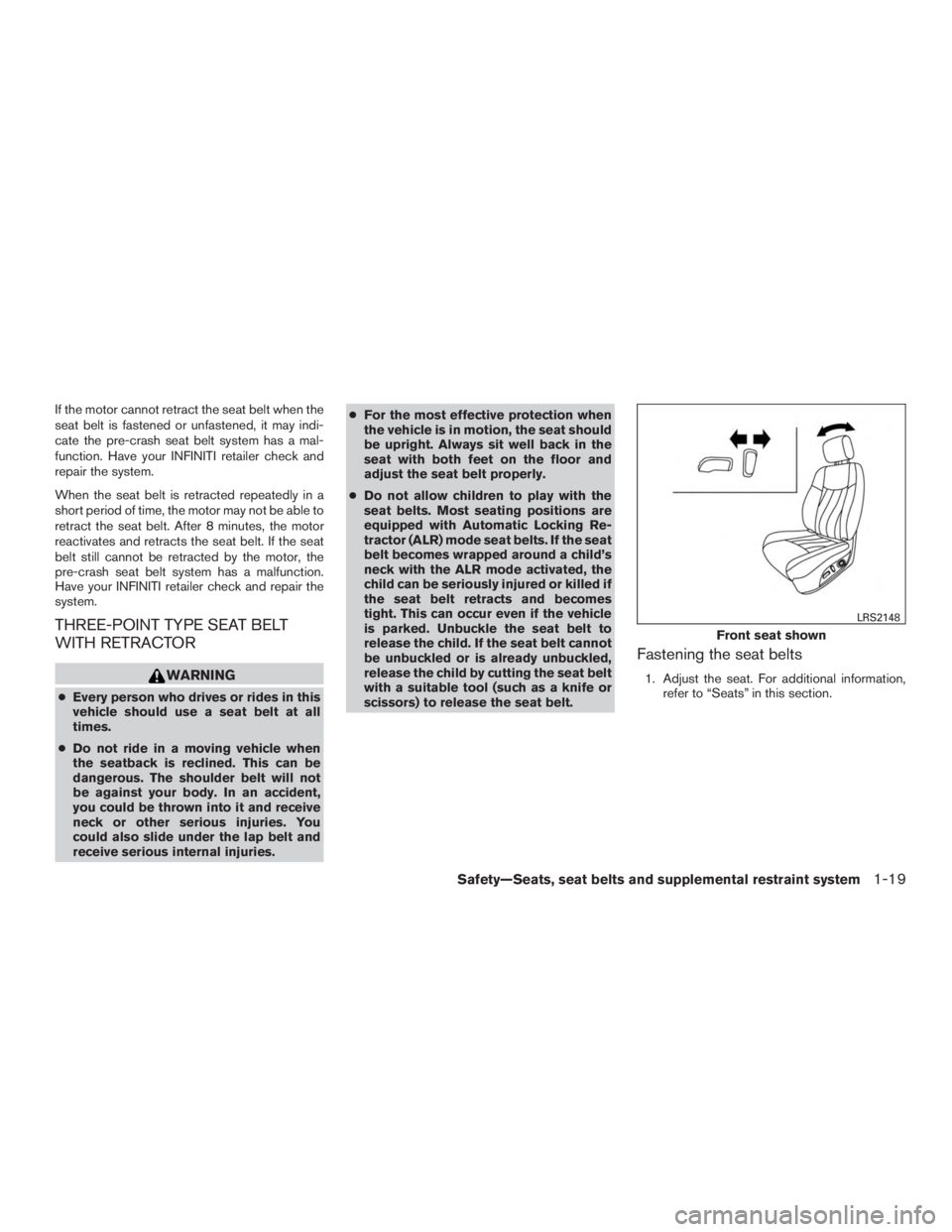
Fastening the seat belts
1. Adjust the seat. For additional information,
refer to “Seats” in this section.
Front seat shown
LRS2148
Safety—Seats, seat belts and supplemental restraint system1-19
Page 56 of 577
SEAT BELT MAINTENANCE
●To clean the seat belt webbing, apply a
mild soap solution or any solution recom-
mended for cleaning upholstery or carpet.
Then wipe with a cloth and allow the seat
belts to dry in the shade. Do not allow the
seat belts to retract until they are completely
dry.
● If dirt builds up in the shoulder belt
guide of the seat belt anchors, the seat
belts may retract slowly. Wipe the shoulder
belt guide with a clean, dry cloth.
● Periodically check to see that the seat
belt and the metal components, such as
buckles, tongues, retractors, flexible wires
and anchors, work properly. If loose parts,
deterioration, cuts or other damage on the
webbing is found, the entire seat belt as-
sembly should be replaced.
WARNING
Do not allow children to play with the seat
belts. Most seating positions are
equipped with Automatic Locking Retrac-
tor (ALR) mode seat belts. If the seat belt
becomes wrapped around a child’s neck
with the ALR mode activated, the child can
be seriously injured or killed if the seat
belt retracts and becomes tight. This can
occur even if the vehicle is parked. Un-
buckle the seat belt to release the child. If
the seat belt cannot be unbuckled or is
already unbuckled, release the child by
cutting the seat belt with a suitable tool
(such as a knife or scissors) to release the
seat belt.
Children need adults to help protect them.
They need to be properly restrained.
In addition to the general information in this
manual, child safety information is available from
many other sources, including doctors, teachers,
government traffic safety offices, and community
organizations. Every child is different, so be sure
to learn the best way to transport your child.
There are three basic types of child restraint
systems: ● Rear-facing child restraint ●
Forward-facing child restraint
● Booster seat
The proper restraint depends on the child’s size.
Generally, infants up to about 1 year and less
than 20 lbs (9 kg) should be placed in rear-facing
child restraints. Forward-facing child restraints
are available for children who outgrow rear-
facing child restraints and are at least 1 year old.
Booster seats are used to help position a vehicle
lap/shoulder belt on a child who can no longer
use a forward-facing child restraint.
WARNING
Infants and children need special protec-
tion. The vehicle’s seat belts may not fit
them properly. The shoulder belt may
come too close to the face or neck. The lap
belt may not fit over their small hip bones.
In an accident, an improperly fitting seat
belt could cause serious or fatal injury.
Always use appropriate child restraints.
All U.S. states and Canadian provinces or territo-
ries require the use of approved child restraints
for infants and small children. For additional infor-
mation, refer to “Child restraints” in this section.
CHILD SAFETY
Safety—Seats, seat belts and supplemental restraint system1-23
Page 68 of 577
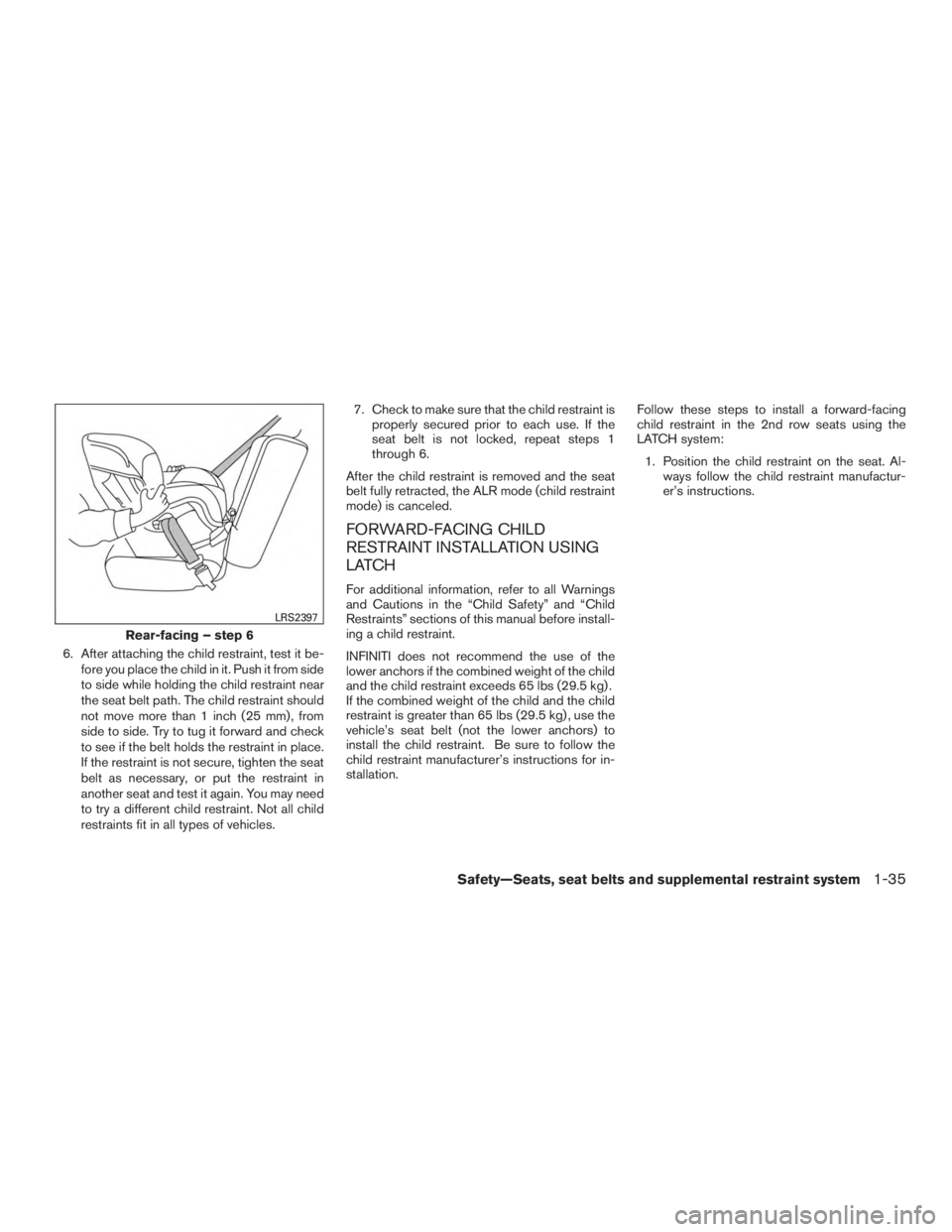
6. After attaching the child restraint, test it be-fore you place the child in it. Push it from side
to side while holding the child restraint near
the seat belt path. The child restraint should
not move more than 1 inch (25 mm) , from
side to side. Try to tug it forward and check
to see if the belt holds the restraint in place.
If the restraint is not secure, tighten the seat
belt as necessary, or put the restraint in
another seat and test it again. You may need
to try a different child restraint. Not all child
restraints fit in all types of vehicles. 7. Check to make sure that the child restraint is
properly secured prior to each use. If the
seat belt is not locked, repeat steps 1
through 6.
After the child restraint is removed and the seat
belt fully retracted, the ALR mode (child restraint
mode) is canceled.
FORWARD-FACING CHILD
RESTRAINT INSTALLATION USING
LATCH
For additional information, refer to all Warnings
and Cautions in the “Child Safety” and “Child
Restraints” sections of this manual before install-
ing a child restraint.
INFINITI does not recommend the use of the
lower anchors if the combined weight of the child
and the child restraint exceeds 65 lbs (29.5 kg) .
If the combined weight of the child and the child
restraint is greater than 65 lbs (29.5 kg) , use the
vehicle’s seat belt (not the lower anchors) to
install the child restraint. Be sure to follow the
child restraint manufacturer’s instructions for in-
stallation. Follow these steps to install a forward-facing
child restraint in the 2nd row seats using the
LATCH system:
1. Position the child restraint on the seat. Al- ways follow the child restraint manufactur-
er’s instructions.
Rear-facing – step 6
LRS2397
Safety—Seats, seat belts and supplemental restraint system1-35
Page 92 of 577
bag OFF for specified child restraints as required
by the regulations. Failing to properly secure
child restraints and to use the ALR mode may
allow the restraint to tip or move in a collision or
sudden stop. This can also result in the passen-
ger air bag inflating in a crash instead of being
OFF. For additional information, refer to “Child
restraints” in this section for proper use and in-
stallation.
If the front passenger seat is not occupied, the
passenger air bag is designed not to inflate in a
crash. However, heavy objects placed on the
seat could result in air bag inflation, because of
the object’s weight detected by the Occupant
Classification Sensor. Other conditions could
also result in air bag inflation, such as if a child is
standing on the seat, or if two children are on the
seat, contrary to the instructions in this manual.
Always be sure that you and all vehicle occupants
are seated and restrained properly.
Using the passenger air bag status light, you can
monitor when the front passenger air bag is au-
tomatically turned OFF with the seat occupied.
The light will not illuminate when the front pas-
senger seat is unoccupied.
If an adult occupant is in the seat but the passen-
ger air bag status light is illuminated (indicating
that the air bag is OFF) , it could be that theperson is a small adult, or is not sitting on the seat
properly or not using the seat belt properly.
If a child restraint must be used in the front seat,
the passenger air bag status light may or may not
be illuminated, depending on the size of the child
and the type of child restraint being used. If the air
bag status light is not illuminated (indicating that
the air bag might inflate in a crash) , it could be
that the child restraint or seat belt is not being
used properly. Make sure that the child restraint is
installed properly, the seat belt is used properly
and the occupant is positioned properly. If the air
bag status light is not illuminated, reposition the
occupant or child restraint in a rear seat.
If the passenger air bag status light will not illu-
minate even though you believe that the child
restraint, the seat belts and the occupant are
properly positioned, the system may be sensing
an unoccupied seat (in which case the air bag is
OFF) . Your INFINITI retailer can check that the
system is OFF by using a special tool. However,
until you have confirmed with your retailer that
your air bag is working properly, reposition the
occupant or child restraint in a rear seat.
The air bag system and passenger air bag status
light will take a few seconds to register a change
in the passenger seat status. For example, if a
large adult who is sitting in the front passenger
seat exits the vehicle, the passenger air bagstatus light will go from OFF to ON for a few
seconds and then to OFF. This is normal system
operation and does not indicate a malfunction.
If a malfunction occurs in the front passenger air
bag system, the supplemental air bag warning
light
, located in the meter and gauges area
of the instrument panel, will blink. Have the sys-
tem checked by an INFINITI retailer.
Normal operation
In order for the occupant classification system to
classify the right front passenger based on
weight, please follow the precautions and steps
outlined below:
Precautions
● Make sure there are no objects weighing
over 2.2 lbs (1 kg) hanging on the seat or
placed in the seat-back pocket.
● Make sure that a child seat or other object is
not pressing against the rear of the seat-
back.
● Make sure that a rear passenger is not push-
ing or pulling on the back of the front pas-
senger’s seat.
● Make sure that the front seat or seat-back is
not forced back against an object on the
seat or floor behind it.
Safety—Seats, seat belts and supplemental restraint system1-59