ignition INFINITI QX80 2018 Owners Manual
[x] Cancel search | Manufacturer: INFINITI, Model Year: 2018, Model line: QX80, Model: INFINITI QX80 2018Pages: 522, PDF Size: 2.41 MB
Page 437 of 522
8-18Do-it-yourself
SDI2518
SDI2532
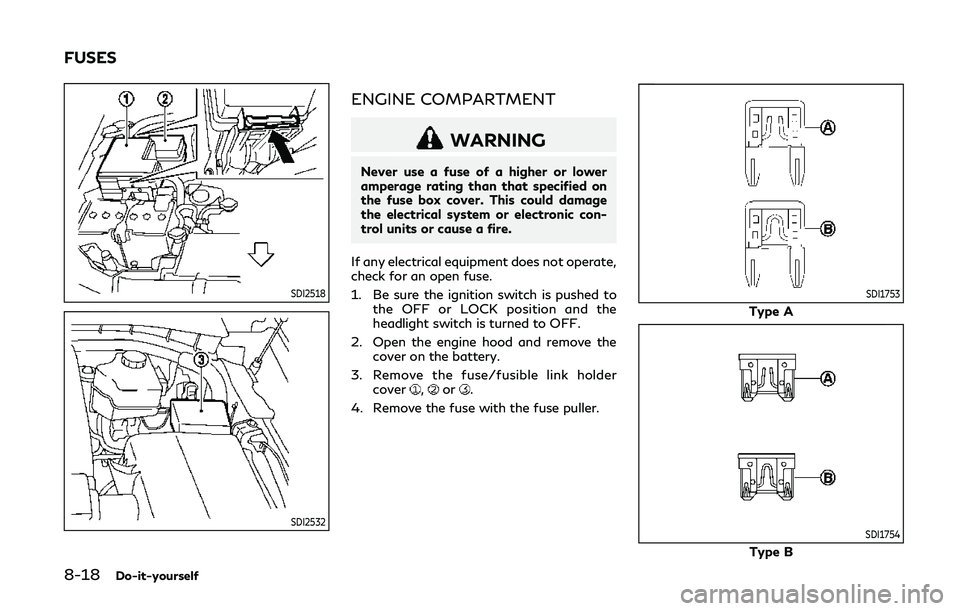
ENGINE COMPARTMENT
WARNING
Never use a fuse of a higher or lower
amperage rating than that specified on
the fuse box cover. This could damage
the electrical system or electronic con-
trol units or cause a fire.
If any electrical equipment does not operate,
check for an open fuse.
1. Be sure the ignition switch is pushed to the OFF or LOCK position and the
headlight switch is turned to OFF.
2. Open the engine hood and remove the cover on the battery.
3. Remove the fuse/fusible link holder cover
,or.
4. Remove the fuse with the fuse puller.
SDI1753
Type A
SDI1754
Type B
FUSES
Page 438 of 522

5. If the fuse is open, replace it with a
new fuse. Spare fuses are stored in the
passenger compartment fuse box.
6. If a new fuse also opens, have the electrical system checked and repaired.
It is recommended you visit an INFINITI
retailer for this service.
Fusible links
If any electrical equipment does not operate
and fuses are in good condition, check the
fusible links. If any of these fusible links are
melted, replace only with genuine INFINITI
parts.
JVM0200X
PASSENGER COMPARTMENT
WARNING
Never use a fuse of a higher or lower
amperage rating than that specified on
the fuse box cover. This could damage
the electrical system or electronic con-
trol units or cause a fire.
If any electrical equipment does not operate,
check for an open fuse.
1. Be sure the ignition switch is pushed to the OFF or LOCK position and the
headlight switch is turned to OFF. 2. Open the fuse box lid.
3. Remove the fuse with the fuse puller
.
4. If the fuse is open, replace it with a new fuse.
5. If a new fuse also opens, have the electrical system checked and repaired.
It is recommended you visit an INFINITI
retailer for this service. Spare fuses are
stored in the fuse box.
Do-it-yourself8-19
Page 439 of 522

8-20Do-it-yourself
SDI2704
Extended storage fuse switch (if so
equipped)
To reduce battery drain, the extended
storage fuse switch comes from the factory
switched off. Prior to delivery of your
vehicle, the switch is pushed in (switched
on) and should always remain on.
If the extended storage fuse switch is not
pushed in (switched on), the “SHIPPING
MODE ON, PUSH STORAGE FUSE” warn-
ing may appear on the vehicle information
display (if so equipped). See “Vehicle infor-
mation display” (P.2-21).
If any electrical equipment does not operate,
remove the extended storage fuse switchand check for an open fuse.
NOTE:
If the extended storage fuse switch mal-
functions or if the fuse is open, it is not
necessary to replace the switch. In this case,
remove the extended storage fuse switch
and replace it with a new fuse of the same
rating.
How to remove the extended storage fuse
switch:
1. To remove the extended storage fuse
switch, be sure the ignition switch is in
the OFF or LOCK position.
2. Be sure the headlight switch is in the OFF position.
3. Remove the fuse box cover.
4. Pinch the locking tabsfound on each
side of the storage fuse switch.
5. Pull the storage fuse switch straight out from the fuse box
.
CAUTION
Be careful not to allow children to
swallow the battery and removed parts.
INTELLIGENT KEY BATTERY
REPLACEMENT
Page 478 of 522

.E-15 fuel contains more than 10%
oxygenate. E-15 fuel will adversely
affect the emission control devices and
systems of the vehicle and should not be
used. Damage caused by such fuel is not
covered by the INFINITI new vehicle
limited warranty.
. If a methanol blend is used, it should
contain no more than 5% methanol
(methyl alcohol, wood alcohol). It should
also contain a suitable amount of ap-
propriate cosolvents and corrosion in-
hibitors. If not properly formulated with
appropriate cosolvents and corrosion
inhibitors, such methanol blends may
cause fuel system damage and/or vehi-
cle performance problems. At this time,
sufficient data is not available to ensure
that all methanol blends are suitable for
use in INFINITI vehicles.
If any undesirable driveability problems such
as engine stalling or hard hot starting are
experienced after using oxygenate-blend
fuels, immediately change to a non-oxyge-
nate fuel or a fuel with a low blend of MTBE.
Take care not to spill gasoline during
refueling. Gasoline containing oxygenates
can cause paint damage.E-15 fuel
E-15 fuel is a mixture of approximately 15%
fuel ethanol and 85% unleaded gasoline. E-
15 can only be used in vehicles designed to
run on E-15 fuel. Do not use E-15 in your
vehicle. U.S. government regulations require
fuel ethanol dispensing pumps to be identi-
fied with small, square, orange and black
label with the common abbreviation or the
appropriate percentage for that region.
E-85 fuel
E-85 fuel is a mixture of approximately 85%
fuel ethanol and 15% unleaded gasoline. E-
85 can only be used in a Flexible Fuel Vehicle
(FFV). Do not use E-85 fuel in your vehicle.
U.S. government regulations require fuel
ethanol dispensing pumps to be identified
by a small, square, orange and black label
with the common abbreviation or the appro-
priate percentage for that region.
Fuel containing MMT
MMT, or methylcyclopentadienyl manga-
nese tricarbonyl, is an octane boosting
additive. INFINITI does not recommend the
use of fuel containing MMT. Such fuel may
adversely affect vehicle performance, in-
cluding the emissions control system. Note
that while some fuel pumps label MMT
content, not all do, so you may have to consult your gasoline retailer for more de-
tails.
Aftermarket fuel additives
INFINITI does not recommend the use of any
aftermarket fuel additives (Example: fuel
injector cleaner, octane booster, intake valve
deposit removers, etc.) which are sold com-
mercially. Many of these additives intended
for gum, varnish or deposit removal may
contain active solvent or similar ingredients
that can be harmful to the fuel system and
engine.
Octane rating tips
Using unleaded gasoline with an octane
rating lower than recommended above can
cause persistent, heavy spark knock. (Spark
knock is a metallic rapping noise.) If severe,
this can lead to engine damage. If you
detect a persistent heavy spark knock even
when using gasoline of the stated octane
rating, or if you hear steady spark knock
while holding a steady speed on level roads,
it is recommended you have an INFINITI
retailer correct the condition. Failure to
correct the condition is misuse of the
vehicle, for which INFINITI is not respon-
sible.
Incorrect ignition timing will result in knock-
ing, after-run or overheating. This in turn
may cause excessive fuel consumption or
Technical and consumer information10-5
Page 481 of 522

10-8Technical and consumer information
ENGINE
ModelVK56VD
Type Gasoline, 4-cycle
Cylinder arrangement 8-cylinder, V-slanted at 90°
Bore × Stroke in (mm)3.858 × 3.622 (98 × 92)
Displacement cu in (cm
3)338.78 (5,552)
Firing order 1-8-7-3-6-5-4-2
Idle speed rpm
See the emission control information label
on the underside of the hood.
Ignition timing (B.T.D.C.) degree/rpm
Spark plug StandardDILKAR7B11
Spark plug gap (Normal) in (mm) 0.043 (1.1)
Camshaft operation Timing chain
This spark ignition system complies with the Canadian standard ICES-002.
STI0397B
SPECIFICATIONS
Page 497 of 522

10-24Technical and consumer information
cause serious personal injury or property
damage.
Hitch ball
Choose a hitch ball of the proper size and
weight rating for your trailer:
.The required hitch ball size is stamped on
most trailer couplers. Most hitch balls
also have the size printed on top of the
ball.
. Choose the proper class hitch ball based
on the trailer weight.
. The diameter of the threaded shank of
the hitch ball must be matched to the ball
mount hole diameter. The hitch ball
shank should be no more than 1/16”
smaller than the hole in the ball mount.
. The threaded shank of the hitch ball must
be long enough to be properly secured to
the ball mount. There should be at least 2
threads showing beyond the lock washer
and nut.
Ball mount
The hitch ball is attached to the ball mount
and the ball mount is inserted into the hitch
receiver. Choose a proper class ball mount
based on the trailer weight. Additionally, the
ball mount should be chosen to keep the
trailer tongue level with the ground.
Weight carrying hitches
A weight carrying or “dead weight” ball
mount is one that is designed to carry the
whole amount of tongue weight and gross
weight directly on the ball mount and on the
receiver.
Weight distribution hitch
This type of hitch is also called a “load-
leveling” or “equalizing” hitch. A set of bars
attach to the ball mount and to the trailer to
distribute the tongue weight (hitch weight)
of your trailer. Many vehicles cannot carry
the full tongue weight of a given trailer, and
need some of the tongue weight transferred
through the frame and pushing down on the
front wheels. This gives stability to the tow
vehicle.
A weight-distributing hitch system (Class IV)
is recommended if you plan to tow trailers
with a maximum weight over 5,000 lbs
(2,267 kg). Check with the trailer and towing
equipment manufacturers to determine if
they recommend the use of a weight-
distributing hitch system.
NOTE:
A weight-distributing hitch system may
affect the operation of trailer surge brakes.
If you are considering use of a weight-
distributing hitch system with a surge brake-equipped trailer, check with the
surge brake, hitch or trailer manufacturer
to determine if and how this can be done.
Follow the instructions provided by the
manufacturer for installing and using the
weight-distributing hitch system.
General set-up instructions are as follows:
1. Park unloaded vehicle on a level surface.
With the ignition switch in the ON
position and the doors closed, allow the
vehicle to stand for several minutes so
that it can level.
2. Measure the height of a reference point on the front and rear bumpers at the
center of the vehicle.
3. Attach the trailer to the vehicle and adjust the hitch equalizers so that the
front bumper height is within 0 - .5
inches (0 - 13 mm) of the reference
height measured in step 2. The rear
bumper should be no higher than the
reference height measured in step 2.
WARNING
Properly adjust the weight distributing
hitch so the rear of the bumper is no
higher than the measured reference
height when the trailer is attached. If
the rear bumper is higher than the
Page 502 of 522

— the Forward Emergency Braking(FEB) with pedestrian detection sys-
tem
— the Predictive Forward Collision Warning (PFCW) system
. Some states or provinces have specific
regulations and speed limits for vehicles
that are towing trailers. Obey the local
speed limits.
. Check your hitch, trailer wiring harness
connections, and trailer wheel lug nuts
after 50 miles (80 km) of travel and at
every break.
. When launching a boat, do not allow the
water level to go over the exhaust tail
pipe or rear bumper.
. Make sure you disconnect the trailer
lights before backing the trailer into the
water or the trailer lights may burn out.
When towing a trailer, the transmission
fluid should be changed more frequently.
For additional information, see “9. Main-
tenance and schedules” section.
TOW mode
Using TOW mode is recommended when
pulling a heavy trailer or hauling a heavy
load. Push the TOW mode switch to activate
TOW mode. The TOW mode indicator light
in the meter illuminates when TOW mode is
selected. Push the TOW mode switch again to turn TOW mode off. TOW mode is
automatically cancelled when the ignition
switch is placed in the OFF position.
TOW mode includes the following features:
.
Grade logic — Adjusts transmission shifts
when pulling a trailer or hauling a load up
a grade.
. Downhill Speed Control (DSC) — auto-
matically downshifts when driving down
a grade with a trailer or heavy load to
help control vehicle speed.
Driving the vehicle in the TOW mode with no
trailer/load or light trailer/light load will not
cause any damage. However, fuel economy
may be reduced and the transmission/
engine driving characteristics may feel unu-
sual.
When towing a trailer, the transmission
fluid should be changed more frequently.
For additional information, see “9. Main-
tenance and schedules” section.
Trailer Sway Control
To minimize trailer sway, your vehicle may
apply braking to individual wheels based on
input from your vehicle sensors and vehicle
speed. Trailer Sway Control is a function of
the Vehicle Dynamic Control (VDC) system
and is active when the VDC function is
enabled.
CAUTION
If the VDC OFF switch is on (meaning
VDC system OFF), the Trailer Sway
Control is also disabled.
When Trailer Sway Control is in operation,
the VDC warning light blinks. When vehicle
control is regained, VDC warning light will
turn OFF.
For additional information about the VDC
system, see “Vehicle Dynamic Control (VDC)
system” (P.5-133).
If Trailer Sway Control activates:
1. Take your foot off the accelerator pedal to allow the vehicle to coast and steer as
straight ahead as the road conditions
allow. This combination will help stabilize
the vehicle.
CAUTION
Do not try to correct trailer sway by
steering or applying the brakes.
2. When the trailer sway stops, gently apply the brakes and pull to the side of
the road in a safe area.
Technical and consumer information10-29
Page 506 of 522

WARNING
A vehicle equipped with Four-Wheel
Drive (4WD) should never be tested
using a two wheel dynamometer (such
as the dynamometers used by some
states for emissions testing), or similar
equipment. Make sure you inform test
facility personnel that your vehicle is
equipped with 4WD before it is placed
on a dynamometer. Using the wrong test
equipment may result in transmission
damage or unexpected vehicle move-
ment which could result in serious vehicle
damage or personal injury.
Due to legal requirements in some states and
Canadian Provinces, your vehicle may be
required to be in what is called the “ready
condition” for an Inspection/Maintenance
(I/M) test of the emission control system.
The vehicle is set to the “ready condition”
when it is driven through certain driving
patterns. Usually, the “ready condition” can
be obtained by ordinary usage of the vehicle.
If a powertrain system component is re-
paired or the battery is disconnected, the
vehicle may be reset to a “not ready condi-
tion”. Before taking the I/M test, check the
vehicle’s inspection/maintenance test readi- ness condition. Place the ignition switch in
the ON position without starting the engine.
If the Malfunction Indicator Light (MIL)
comes on steady for 20 seconds and then
blinks for 10 seconds, the I/M test condition
is “not ready”. If the MIL does not blink after
20 seconds, the I/M test condition is
“ready”.
It is recommended you visit an INFINITI
retailer to set “ready condition” or to prepare
the vehicle for testing.
This vehicle is equipped with an Event Data
Recorder (EDR). The main purpose of an
EDR is to record, in certain crash or near
crash-like situations, such as an air bag
deployment or hitting a road obstacle, data
that will assist in understanding how a
vehicle’s systems performed. The EDR is
designed to record data related to vehicle
dynamics and safety systems for a short
period of time, typically 30 seconds or less.
The EDR in this vehicle is designed to record
such data as:
.
How various systems in your vehicle were
operating;
. Whether or not the driver and passenger
safety belts were buckled/fastened;
. How far (if at all) the driver was depres-
sing the accelerator and/or brake pedal;
and,
. How fast the vehicle was traveling.
. Sounds are not recorded.
These data can help provide a better under-
standing of the circumstances in which
crashes and injuries occur.
NOTE: EDR data are recorded by your
vehicle only if a nontrivial crash situation
occurs; no data are recorded by the EDR
under normal driving conditions and no
personal data (e.g. name, gender, age and
crash location) are recorded. However, other
parties, such as law enforcement, could
combine the EDR data with the type of
Technical and consumer information10-33
READINESS FOR INSPECTION/
MAINTENANCE (I/M) TEST EVENT DATA RECORDERS (EDR)
Page 510 of 522

Extended storage fuse warning ...................... 2-25
Extended storage switch .................................. 8-20
F
F.M.V.S.S./C.M.V.S.S. certification label .... 10-12
FilterAir cleaner housing filter ............................. 8-14
Changing engine oil and filter ...................... 8-6
Flashers (See hazard warning
flasher switch) ......................................................... 6-2
Flat tire ...................................................................... 6-3
Flat towing ......................................................... 10-30
Flexible seating ..................................................... 1-11
Floor mat cleaning ................................................. 7-6
Fluid
Automatic Transmission Fluid (ATF) ......... 8-8
Brake fluid ......................................................... 8-9
Capacities and
recommended fluids/lubricants ................. 10-2
Engine coolant .................................................. 8-4
Engine oil ........................................................... 8-6
Power steering fluid ....................................... 8-8
Window washer fluid .................................. 8-10
Fog light switch ................................................... 2-44
Forward Emergency Braking (FEB) with
pedestrian detection system ......................... 5-100
Forward Emergency Braking system
warning light ......................................................... 2-15
Front passenger air bag and status light ..... 1-60
Front power seat adjustment ............................. 1-4 Front seat
Front seat adjustment ........................ 1-4, 1-10
Front-seat active head restraint ...................... 1-17
Fuel
Capacities and
recommended fluids/lubricants ................. 10-2
Fuel economy .............................................. 5-120
Fuel information ........................................... 10-4
Fuel octane rating ........................................ 10-4
Fuel-filler cap .................................................. 3-26
Fuel-filler door ............................................... 3-26
Gauge .................................................................. 2-9
LOOSE FUEL CAP warning ...................... 3-28
Fuel efficient driving tips ................................. 5-119
Fuses ....................................................................... 8-18
Fusible links ........................................................... 8-19
G
Garage door opener HomeLink®
Universal Transceiver ....................... 2-68, 2-72
Gas cap ................................................................... 3-26
Gauge ........................................................................\
. 2-6 Engine coolant temperature gauge ............ 2-8
Engine oil pressure gauge ............................. 2-9
Fuel gauge ......................................................... 2-9
Odometer ............................................................ 2-7
Speedometer ...................................................... 2-7
Tachometer ....................................................... 2-8
Trip computer ................................................. 2-28
General maintenance ............................................. 9-2 Glove box ............................................................... 2-56
H
Hazard warning flasher switch ........................... 6-2
Head restraints/headrests ................................ 1-13
Headlight washer ................................................ 2-42
Headlights
Aiming control ................................................ 2-41
Aiming control (See adaptive front
lighting system (AFS)) .................................. 2-42
Bulb replacement .......................................... 8-24
Headlight switch ............................................ 2-37
Heated seats ......................................................... 2-46
Heated steering wheel ....................................... 2-45
Heater Automatic climate control ............. 4-26, 4-28
Engine block heater .................................... 5-137
High beam assist ................................................. 2-39
Hill start assist system ..................................... 5-128
HomeLink
®Universal Transceiver ...... 2-68, 2-72
Hood release ......................................................... 3-21
Hook Coat hooks ...................................................... 2-59
Luggage hook ................................................. 2-59
Horn ........................................................................\
. 2-45
I
Ignition switch (Push-button) .......................... 5-12
Immobilizer system .............................................. 2-32
In-cabin microfilter .............................................. 4-35
11-3
Page 513 of 522

11-6
Predictive Forward Collision
Warning (PFCW) ............................................... 5-110
Push starting ......................................................... 6-13
Push-button ignition switch ............................. 5-12
R
RadioCar phone or CB radio ................................. 4-36
Rain-sensing auto wiper system ..................... 2-35
Rapid air pressure loss .......................................... 5-9
Readiness for inspection/maintenance
(I/M) test ............................................................ 10-33
Rear door lock, Child safety rear door lock .... 3-6
Rear personal lights ............................................ 2-66
Rear ventilators .................................................... 4-25
Rear window wiper and washer switch ....... 2-36
Rear window wiper blades ............................... 8-16
Recorders, Event data .................................... 10-33
Registering your vehicle in
another country ................................................. 10-11
Remote engine start ................................ 3-17, 3-18
Remote keyless entry system .......................... 3-15
Reporting safety defects ................................ 10-32
Roadside assistance program ............................. 6-2
Rollover .................................................................... 5-8
Roof Moonroof ......................................................... 2-64
Roof rack ........................................................ 2-60
S
Safety
Child seat belts ............................................... 1-29
Towing safety .............................................. 10-22
Seat adjustment
Front power seat adjustment ...................... 1-4
Front seats ............................................. 1-4, 1-10
Seat belt(s)
Child safety ..................................................... 1-29
Infants ............................................................... 1-30
Injured persons ............................................... 1-21
Larger children ............................................... 1-30
Precautions on seat belt usage ................. 1-18
Pregnant women ........................................... 1-21
Seat belt cleaning ............................................. 7-7
Seat belt extenders ....................................... 1-28
Seat belt maintenance ................................. 1-28
Seat belt warning light and chime ............ 2-17
Seat belts ......................................................... 1-18
Seat belts with pretensioners .................... 1-67
Small children .................................................. 1-30
Three-point type ............................................ 1-21
Seat(s)
Climate controlled seats ............................. 2-48
Driver-side memory ...................................... 3-39
Heated seats ................................................... 2-46
Seats .................................................................... 1-3
Security system (INFINITI Vehicle
Immobilizer System), Engine start .................. 2-32
Security system, Vehicle security system ..... 2-31 Servicing climate control ................................... 4-35
Setting memory function, Automatic
drive positioner ................................................... 3-40
Shift lever, Shift lock release ............................ 5-21
Shift lock release
Transmission ................................................... 5-21
Shifting, Automatic transmission .................... 5-18
Side ventilators .................................................... 4-25
Smart Rearview Mirror ...................................... 3-31
SNOW mode ...................................................... 5-130
Snow mode switch .............................................. 2-49
Spare tire ................................................... 8-37, 10-9
Spark plugs ............................................................ 8-14
Speedometer ............................................................ 2-7
Standard maintenance .......................................... 9-7
Starting
Before starting the engine .......................... 5-15
Jump starting .................................................. 6-11
Precautions when starting and driving ..... 5-4
Push starting ................................................... 6-13
Starting the engine ....................................... 5-15
Status light, Front passenger air bag ............ 1-60
Steering
Heated steering wheel ................................. 2-45
Power steering fluid ....................................... 8-8
Power steering system .............................. 5-131
Tilt/telescopic steering ................................ 3-29
Storage ................................................................... 2-54
Sun visors ............................................................... 3-29
Sunglasses holder ................................................ 2-56
Supplemental air bag warning labels ............. 1-68