diesel ISUZU TF SERIES 2004 User Guide
[x] Cancel search | Manufacturer: ISUZU, Model Year: 2004, Model line: TF SERIES, Model: ISUZU TF SERIES 2004Pages: 4264, PDF Size: 72.63 MB
Page 1738 of 4264

6E–366 4JA1/4JH1 ENGINE DRIVEABILITY AND EMISSIONS
HARD START SYMPTOM
DEFINITIONS: Engine cranks, but does not start for a long time. Does eventually start, or may start and then
immediately stall.
Step Action Value(s) Yes No
1Was the “On-Board Diagnostic (OBD) System Check”
performed?
—Go to Step 2Go to On Board
Diagnostic
(OBD) System
Check
2 1. Perform a bulletin search.
2. If a bulletin that addresses the symptom is found,
correct the condition as instructed in the bulletin.
Was a bulletin found that addresses the symptom?—Verify repair Go to Step 3
3 Was a visually/physical check performed?
—Go to Step 4Go to Visual /
physical Check
4 Is the customer using the incorrect fuel type? Diesel fuel
onlyReplace with
diesel fuel Go to Step 6
5 Visually/physically inspect for the following conditions.
Restrict air intake system. Check for a restricted air
filter element, or foreign objects blocking the air
intake system
Check for objects blocking or ex cessive deposits in
the throttle bore and on the throttle plate
Check for a condition that causes a large vacuum
leak, such as an incorrectly installed or faulty
crankcase ventilation hose.
Restrict air intake system at the turbocharger.
Check for objects blocking the turbocharger
compressor wheel or turbine shaft sticking.
If a problem is found, repair as necessary.
Was a problem found?—Verify repair Go to Step 6
6 Check the ECM & PSG grounds to verify that they are
clean and tight. Refer to the ECM wiring diagrams.
Was a problem found?—Verify repair Go to Step 7
7 1. Using the Tech 2, display the ECT sensor and IAT
sensor value.
2 . C h e c k t h e d i s p l a y e d v a l u e .
Does the Tech 2 indicate correct temperature
depending on engine condition?
If a problem is found, repair as necessary.
Was the problem found?—Verify repair Go to Step 8
8 1. Using the Tech 2, display the FT sensor value.
2. Check the displayed value.
Does the Tech 2 indicate correct temperature
depending on engine condition?
If a problem is found, repair as necessary.
Was the problem found?—Go to Step 20Go to Step 9
9 1. Using the Tech 2, ignition “On”.
2. Monitor the “Glow Time Relay” in the data display.
Does the Tech 2 indicate correct “Glow Time Relay”
status depending on the time from ignition switch
“On”?
If a problem is found, repair as necessary.
Was the problem found?—Go to Step 20Go to Step 10
Page 1742 of 4264

6E–370 4JA1/4JH1 ENGINE DRIVEABILITY AND EMISSIONS
ROUGH, UNSTABLE, OR INCORRECT IDLE, STALLING SYMPTOM
DEFINITIONS: Engine runs unevenly at idle. If severe,
the engine or vehicle may shake. Engine idle speed
may vary in RPM. Either condition may be severe
enough to stall the engine.
X
time rpm
Rough I dle
Stal l
Step Action Value(s) Yes No
1Was the “On-Board Diagnostic (OBD) System Check”
performed?
—Go to Step 2Go to On Board
Diagnostic
(OBD) System
Check
2 1. Perform a bulletin search.
2. If a bulletin that addresses the symptom is found,
correct the condition as instructed in the bulletin.
Was a bulletin found that addresses the symptom?—Verify repair Go to Step 3
3 Was a visually/physical check performed?
—Go to Step 4Go to Visual /
physical Check
4 Is the customer using the incorrect fuel type? Diesel fuel
onlyReplace with
diesel fuel Go to Step 5
5 1. Check for incorrect idle speed. Ensure that the
following conditions are present.
Engine fully warm.
Accessories are “OFF”.
2. Using a Tech 2, monitor “Desired Engine Idle
Speed” and “Engine Speed”.
Is the “Engine Speed” within the specified values?Desired
Engine Idle
Speed ± 25
rpm Go to Step 7Go to Step 6
6 Visually/physically inspect for the following conditions.
Restrict air intake system. Check for a restricted air
filter element, or foreign objects blocking the air
intake system
Check for objects blocking or ex cessive deposits in
the throttle bore and on the throttle plate
Check for a condition that causes a large vacuum
leak, such as an incorrectly installed or faulty
crankcase ventilation hose.
Restrict air intake system at the turbocharger.
Check for objects blocking the turbocharger
compressor wheel or turbine shaft sticking.
If a problem is found, repair as necessary.
Was a problem found?—Verify repair Go to Step 7
7 Check the ECM & PSG grounds to verify that they are
clean and tight. Refer to the ECM wiring diagrams.
Was a problem found?—Verify repair Go to Step 8
Page 1749 of 4264

4JA1/4JH1 ENGINE DRIVEABILITY AND EMISSIONS 6E–377
SURGES AND/OR CHUGS SYMPTOM
DEFINITIONS: Engine power variation under steady
throttle or cruise. Feels like the vehicle speeds up and
slows down with no charge in the accelerator pedal.
time rpm
Su rge
Step Action Value(s) Yes No
1Was the “On-Board Diagnostic (OBD) System Check”
performed?
—Go to Step 2Go to On Board
Diagnostic
(OBD) System
Check
2 1. Perform a bulletin search.
2. If a bulletin that addresses the symptom is found,
correct the condition as instructed in the bulletin.
Was a bulletin found that addresses the symptom?—Verify repair Go to Step 3
3 Was a visually/physical check performed?
—Go to Step 4Go to Visual /
physical Check
4 Is the customer using the incorrect fuel type? Diesel fuel
onlyReplace with
diesel fuel Go to Step 5
5 Visually/physically inspect for the following conditions.
Restrict air intake system. Check for a restricted air
filter element, or foreign objects blocking the air
intake system
Check for objects blocking or ex cessive deposits in
the throttle bore and on the throttle plate
Check for a condition that causes a large vacuum
leak, such as an incorrectly installed or faulty
crankcase ventilation hose.
Restrict air intake system at the turbocharger.
Check for objects blocking the turbocharger
compressor wheel or turbine shaft sticking.
If a problem is found, repair as necessary.
Was a problem found?—Verify repair Go to Step 6
6 Check the ECM & PSG grounds to verify that they are
clean and tight. Refer to the ECM wiring diagrams.
Was a problem found?—Verify repair Go to Step 7
7 1. Using the Tech 2, ignition “On” and engine “Run”.
2. Monitor the “A/C Information Switch” in the data
display.
Does the Tech 2 indicate correct “A/C Information
Switch” status depending on A/C switch position?
If a problem is found, repair as necessary.
Was the problem found?—Verify repair Go to Step 8
Page 1755 of 4264
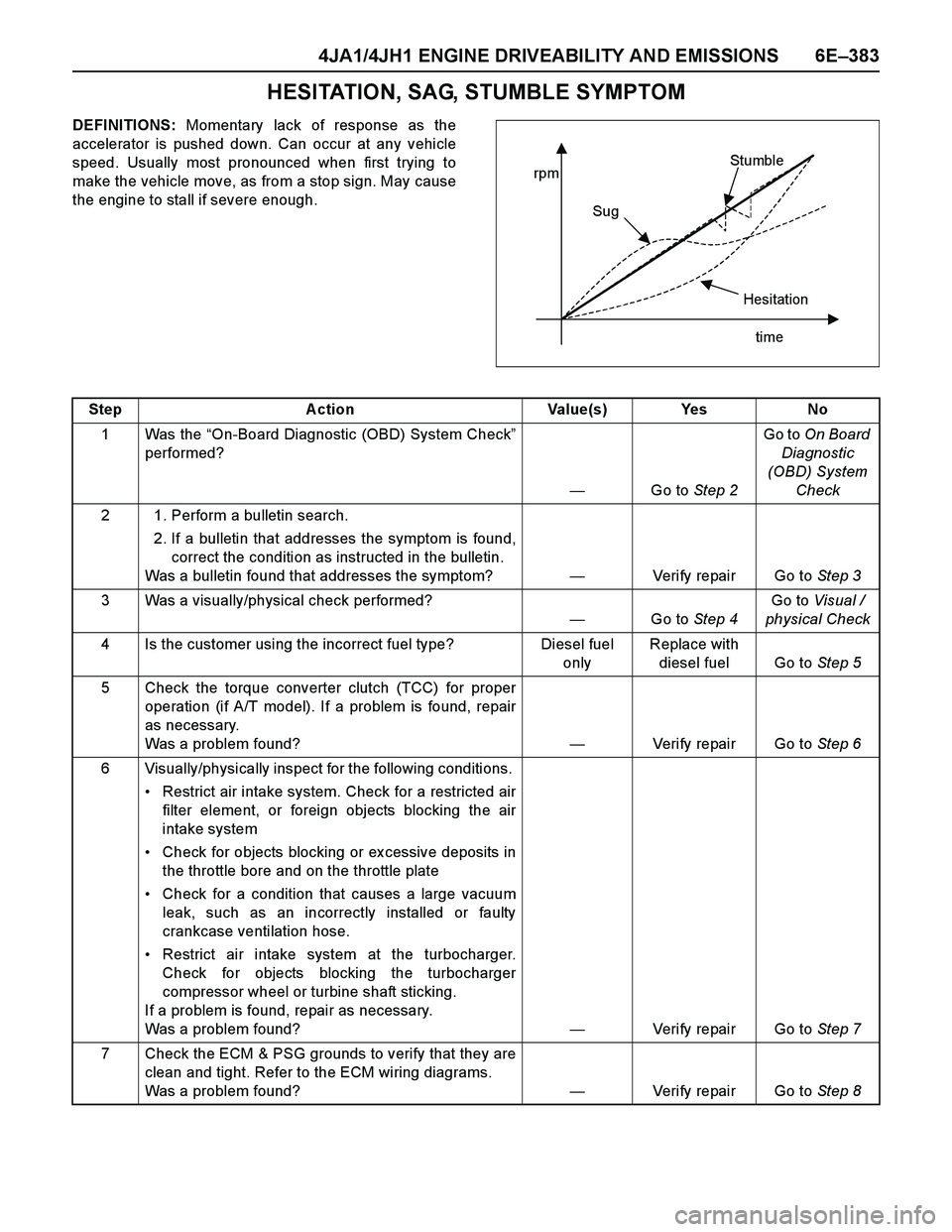
4JA1/4JH1 ENGINE DRIVEABILITY AND EMISSIONS 6E–383
HESITATION, SAG, STUMBLE SYMPTOM
DEFINITIONS: Momentary lack of response as the
accelerator is pushed down. Can occur at any vehicle
speed. Usually most pronounced when first trying to
make the vehicle move, as from a stop sign. May cause
the engine to stall if severe enough.
time rpm
Sug
Hesitation Stumble
Step Action Value(s) Yes No
1Was the “On-Board Diagnostic (OBD) System Check”
performed?
—Go to Step 2Go to On Board
Diagnostic
(OBD) System
Check
2 1. Perform a bulletin search.
2. If a bulletin that addresses the symptom is found,
correct the condition as instructed in the bulletin.
Was a bulletin found that addresses the symptom?—Verify repair Go to Step 3
3 Was a visually/physical check performed?
—Go to Step 4Go to Visual /
physical Check
4 Is the customer using the incorrect fuel type? Diesel fuel
onlyReplace with
diesel fuel Go to Step 5
5 Check the torque converter clutch (TCC) for proper
operation (if A/T model). If a problem is found, repair
as necessary.
Was a problem found?—Verify repair Go to Step 6
6 Visually/physically inspect for the following conditions.
Restrict air intake system. Check for a restricted air
filter element, or foreign objects blocking the air
intake system
Check for objects blocking or ex cessive deposits in
the throttle bore and on the throttle plate
Check for a condition that causes a large vacuum
leak, such as an incorrectly installed or faulty
crankcase ventilation hose.
Restrict air intake system at the turbocharger.
Check for objects blocking the turbocharger
compressor wheel or turbine shaft sticking.
If a problem is found, repair as necessary.
Was a problem found?—Verify repair Go to Step 7
7 Check the ECM & PSG grounds to verify that they are
clean and tight. Refer to the ECM wiring diagrams.
Was a problem found?—Verify repair Go to Step 8
Page 1761 of 4264

4JA1/4JH1 ENGINE DRIVEABILITY AND EMISSIONS 6E–389
CUTS OUT, MISSES SYMPTOM
DEFINITIONS: Steady pulsation or jerking that follows
engine speed; usually more pronounced as engine load
increases.
time rpm
Step Action Value(s) Yes No
1Was the “On-Board Diagnostic (OBD) System Check”
performed?
—Go to Step 2Go to On Board
Diagnostic
(OBD) System
Check
2 1. Perform a bulletin search.
2. If a bulletin that addresses the symptom is found,
correct the condition as instructed in the bulletin.
Was a bulletin found that addresses the symptom?—Verify repair Go to Step 3
3 Was a visually/physical check performed?
—Go to Step 4Go to Visual /
physical Check
4 Is the customer using the incorrect fuel type? Diesel fuel
onlyReplace with
diesel fuel Go to Step 5
5 Visually/physically inspect for the following conditions.
Restrict air intake system. Check for a restricted air
filter element, or foreign objects blocking the air
intake system
Check for objects blocking or ex cessive deposits in
the throttle bore and on the throttle plate
Check for a condition that causes a large vacuum
leak, such as an incorrectly installed or faulty
crankcase ventilation hose.
Restrict air intake system at the turbocharger.
Check for objects blocking the turbocharger
compressor
wheel or turbine shaft sticking.
If a problem is found, repair as necessary.
Was a problem found?—Verify repair Go to Step 6
6 Check the ECM & PSG grounds to verify that they are
clean and tight. Refer to the ECM wiring diagrams.
Was a problem found?—Verify repair Go to Step 7
Page 1768 of 4264

6E–396 4JA1/4JH1 ENGINE DRIVEABILITY AND EMISSIONS
LACK OF POWER, SLUGGISH OR SPONGY SYMPTOM
DEFINITIONS: Engine delivers less than ex pected power. Attempting part-throttle acceleration results in little or no
increase in vehicle speed.
Step Action Value(s) Yes No
1Was the “On-Board Diagnostic (OBD) System Check”
performed?
—Go to Step 2Go to On Board
Diagnostic
(OBD) System
Check
2 1. Perform a bulletin search.
2. If a bulletin that addresses the symptom is found,
correct the condition as instructed in the bulletin.
Was a bulletin found that addresses the symptom?—Verify repair Go to Step 3
3 Was a visually/physical check performed?
—Go to Step 4Go to Visual /
physical Check
4 Is the customer using the incorrect fuel type? Diesel fuel
onlyReplace with
diesel fuel Go to Step 5
5 Visually/physically inspect for the following conditions.
Restrict air intake system. Check for a restricted air
filter element, or foreign objects blocking the air
intake system
Check for objects blocking or ex cessive deposits in
the throttle bore and on the throttle plate
Check for a condition that causes a large vacuum
leak, such as an incorrectly installed or faulty
crankcase ventilation hose.
Restrict air intake system at the turbocharger.
Check for objects blocking the turbocharger
compressor wheel or turbine shaft sticking.
If a problem is found, repair as necessary.
Was a problem found?—Verify repair Go to Step 6
6 Check the ECM & PSG grounds to verify that they are
clean and tight. Refer to the ECM wiring diagrams.
Was a problem found?—Verify repair Go to Step 7
7 1. Using the Tech 2, display the ECT sensor and IAT
sensor value.
2. Check the displayed value.
Does the Tech 2 indicate correct temperature
depending on engine condition?
If a problem is found, repair as necessary.
Was the problem found?—Verify repair Go to Step 8
8 1. Using the Tech 2, display the FT sensor value.
2. Check the displayed value.
Does the Tech 2 indicate correct temperature
depending on engine condition?
If a problem is found, repair as necessary.
Was the problem found?—Go to Step 29Go to Step 9
9 1. Using the Tech 2, ignition “On” and engine “Run”.
2. Monitor the “Mass Air Flow” in the data display.
Does the Tech 2 indicate correct “Mass Air Flow”
depending on accelerator pedal operation? —Go to Step 14Go to Step 10
Page 1779 of 4264

4JA1/4JH1 ENGINE DRIVEABILITY AND EMISSIONS 6E–407
EXCESSIVE WHITE SMOKE
Step Action Value(s) Yes No
1Was the “On-Board Diagnostic (OBD) System Check”
performed?
—Go to Step 2Go to On Board
Diagnostic
(OBD) System
Check
2 1. Perform a bulletin search.
2. If a bulletin that addresses the symptom is found,
correct the condition as instructed in the bulletin.
Was a bulletin found that addresses the symptom?—Verify repair Go to Step 3
3 Was a visually/physical check performed?
—Go to Step 4Go to Visual /
physical Check
4 Is the customer using the incorrect fuel type? Diesel fuel
onlyReplace with
diesel fuel Go to Step 5
5 Check the engine coolant consumption to verify that it
leaks to combustion chamber or ex haust through the
gasket.
Was a problem found?—Verify repair Go to Step 6
6 Check the ECM & PSG grounds to verify that they are
clean and tight. Refer to the ECM wiring diagrams.
Was a problem found?—Verify repair Go to Step 7
7 1. Using the Tech 2, display the ECT sensor and IAT
sensor value.
2. Check the displayed value.
Does the Tech 2 indicate correct temperature
depending on engine condition?
If a problem is found, repair as necessary.
Was the problem found?—Verify repair Go to Step 8
8 1. Using the Tech 2, display the FT sensor value.
2. Check the displayed value.
Does the Tech 2 indicate correct temperature
depending on engine condition?
If a problem is found, repair as necessary.
Was the problem found?—Go to Step 30Go to Step 9
9 1. Using the Tech 2, ignition “On” and engine “Run”.
2. Monitor the “Mass Air Flow” in the data display.
Does the Tech 2 indicate correct “Mass Air Flow”
depending on accelerator pedal operation? —Go to Step 14Go to Step 10
10 Remove the MAF & IAT sensor assembly and check
for the following conditions.
Objects blocking at the MAF sensor element.
If a problem is found, repair as necessary.
Was the problem found?—Verify repair Go to Step 11
11 Check the MAF sensor harness for the following
conditions.
Check for poor connector connection.
Check for misrouted harness.
Check for any accessory parts which may cause
electric interference.
If a problem is found, repair as necessary.
Was a problem found? —Verify repair Go to Step 12
Page 1785 of 4264
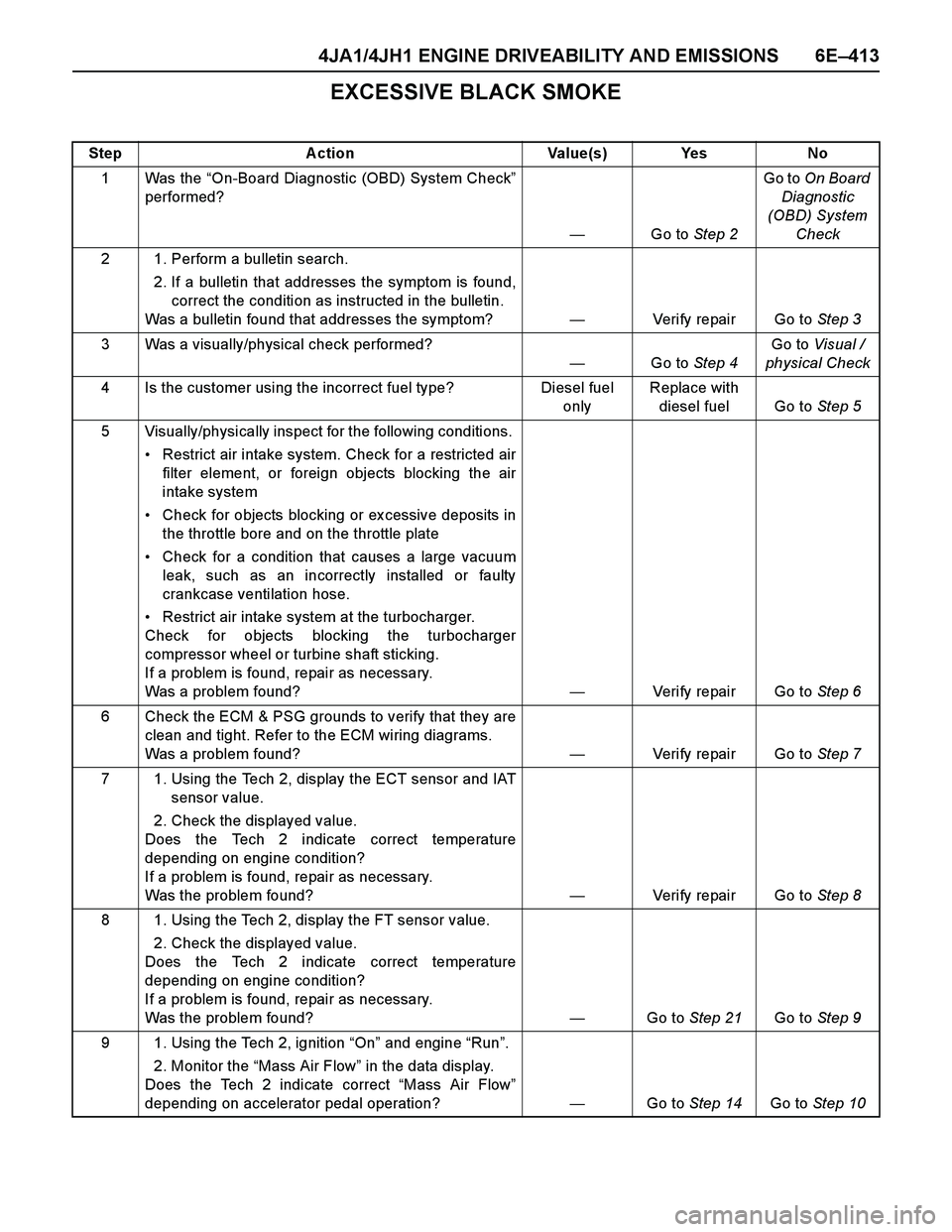
4JA1/4JH1 ENGINE DRIVEABILITY AND EMISSIONS 6E–413
EXCESSIVE BLACK SMOKE
Step Action Value(s) Yes No
1Was the “On-Board Diagnostic (OBD) System Check”
performed?
—Go to Step 2Go to On Board
Diagnostic
(OBD) System
Check
2 1. Perform a bulletin search.
2. If a bulletin that addresses the symptom is found,
correct the condition as instructed in the bulletin.
Was a bulletin found that addresses the symptom?—Verify repair Go to Step 3
3 Was a visually/physical check performed?
—Go to Step 4Go to Visual /
physical Check
4 Is the customer using the incorrect fuel type? Diesel fuel
onlyReplace with
diesel fuel Go to Step 5
5 Visually/physically inspect for the following conditions.
Restrict air intake system. Check for a restricted air
filter element, or foreign objects blocking the air
intake system
Check for objects blocking or ex cessive deposits in
the throttle bore and on the throttle plate
Check for a condition that causes a large vacuum
leak, such as an incorrectly installed or faulty
crankcase ventilation hose.
Restrict air intake system at the turbocharger.
Check for objects blocking the turbocharger
compressor wheel or turbine shaft sticking.
If a problem is found, repair as necessary.
Was a problem found?—Verify repair Go to Step 6
6 Check the ECM & PSG grounds to verify that they are
clean and tight. Refer to the ECM wiring diagrams.
Was a problem found?—Verify repair Go to Step 7
7 1. Using the Tech 2, display the ECT sensor and IAT
sensor value.
2. Check the displayed value.
Does the Tech 2 indicate correct temperature
depending on engine condition?
If a problem is found, repair as necessary.
Was the problem found?—Verify repair Go to Step 8
8 1. Using the Tech 2, display the FT sensor value.
2. Check the displayed value.
Does the Tech 2 indicate correct temperature
depending on engine condition?
If a problem is found, repair as necessary.
Was the problem found?—Go to Step 21Go to Step 9
9 1. Using the Tech 2, ignition “On” and engine “Run”.
2. Monitor the “Mass Air Flow” in the data display.
Does the Tech 2 indicate correct “Mass Air Flow”
depending on accelerator pedal operation? —Go to Step 14Go to Step 10
Page 1945 of 4264

ENGINE FUEL (6VE1 3.5L) 6C-3
Fuel Metering
The Engine Control Module (ECM) is in complete
control of this fuel delivery system during normal driving
conditions.
The intake manifold function, like that of a diesel, is
used only to let air into the engine. The fuel is injected
by separate injectors that are mounted over the intake
manifold.
The Barometric Pressure (BARO) sensor measures the
changes in the barometric pressure which result from
engine load and speed changes, which the BARO
sensor converts to a voltage output.
This sensor generates the voltage to change
corresponding to the flow of the air drawn into the
engine.
The changing voltage is transformed into an electric
signal and provided to the ECM.
With receipt of the signals sent from the BARO sensor,
Intake Air Temperature sensor and others, the ECM
determines an appropriate fuel injection pulse width
feeding such information to the fuel injector valves to
effect an appropriate air/fuel ratio.
The Multiport Fuel Injection system utilizes an injection
system where the injectors turn on at every crankshaf
t
revolution. The ECM controls the injector on time so
that the correct amount of fuel is metered depending on
driving conditions.
Two interchangeable “O" rings are used on the injecto
r
that must be replaced when the injectors are removed.
The fuel rail is attached to the top of the intake manifold
and supplies fuel to all the injectors.
Fuel is recirculated through the rail continually while the
engine is running. This removes air and vapors from the
fuel as well as keeping the fuel cool during hot weathe
r
operation.
The fuel pressure control valve that is mounted on the
fuel rail maintains a pressure differential across the
injectors under all operating conditions. It is
accomplished by controlling the amount of fuel that is
recirculated back to the fuel tank based on engine
demand.
See Section “Driveability and Emission" for more
information and diagnosis.
Page 1999 of 4264

3.5L ENGINE DRIVEABILITY AND EMISSIONS 6E-3
DTC P0201 (FLASH CODE 31) INJECTOR 1
CONTROL CIRCUIT ........................................ 6E-226
DTC P0202 (FLASH CODE 31) INJECTOR 2
CONTROL CIRCUIT ........................................ 6E-226
DTC P0203 (FLASH CODE 31) INJECTOR 3
CONTROL CIRCUIT ........................................ 6E-226
DTC P0204 (FLASH CODE 31) INJECTOR 4
CONTROL CIRCUIT ........................................ 6E-226
DTC P0205 (FLASH CODE 31) INJECTOR 5
CONTROL CIRCUIT ........................................ 6E-226
DTC P0206 (FLASH CODE 31) INJECTOR 6
CONTROL CIRCUIT ........................................ 6E-226
DTC P0336 (FLASH CODE 29) CRANKSHAFT
POSITION SENSOR CIRCUIT
RANGE/PERFORMANCE (58X) ...................... 6E-234
DTC P0337 (FLASH CODE 29) CRANKSHAFT
POSITION SENSOR CIRCUIT NO SIGNAL
(58X) ................................................................. 6E-234
DTC P0341 (FLASH CODE 41) CAMSHAFT
POSITION SENSOR CIRCUIT
RANGE/PERFORMANCE ............................... 6E-243
DTC P0342 (FLASH CODE 41) CAMSHAFT
POSITION SENSOR CIRCUIT NO SIGNAL .... 6E-243
DTC P0351 (FLASH CODE 42) IGNITION 1
CONTROL CIRCUIT ........................................ 6E-249
DTC P0352 (FLASH CODE 42) IGNITION 2
CONTROL CIRCUIT ........................................ 6E-249
DTC P0353 (FLASH CODE 42) IGNITION 3
CONTROL CIRCUIT ........................................ 6E-249
DTC P0354 (FLASH CODE 42) IGNITION 4
CONTROL CIRCUIT ........................................ 6E-249
DTC P0355 (FLASH CODE 42) IGNITION 5
CONTROL CIRCUIT ........................................ 6E-249
DTC P0356 (FLASH CODE 42) IGNITION 6
CONTROL CIRCUIT ........................................ 6E-249
DTC P0404 (FLASH CODE 32) EGR CIRCUIT
RANGE/PERFORMANCE (OPEN VALVE)....... 6E-258
DTC P1404 (FLASH CODE 32) EGR CIRCUIT
RANGE/PERFORMANCE (CLOSED VALVE) .. 6E-258
DTC P0405 (FLASH CODE 32) EGR
CIRCUIT LOW.................................................. 6E-263
DTC P0406 (FLASH CODE 32) EGR
CIRCUIT HIGH ................................................. 6E-268
DTC P0444 EVAP PURGE SOLENOID
VALVE CIRCUIT LOW VOLTAGE ................... 6E-274
DTC P0445 EVAP PURGE SOLENOID
VALVE CIRCUIT HIGH VOLTAGE .................. 6E-274
DTC P0500 (FLASH CODE 24) VEHICLE
SPEED SENSOR (VSS) CIRCUIT
RANGE/PERFORMANCE ................................ 6E-279 DTC P0562 (FLASH CODE 66) SYSTEM
VOLTAGE LOW .............................................. 6E-288
DTC P0563 (FLASH CODE 66) SYSTEM
VOLTAGE HIGH .............................................. 6E-321
DTC P0601 (FLASH CODE 51) ENGINE
CONTROL MODULE (ECM) MEMORY
CHECKSUM ..................................................... 6E-293
DTC P0602 PROGRAMMING ERROR............. 6E-295
DTC P1508 (FLASH CODE 22) IDLE AIR
CONTROL SYSTEM LOW/CLOSED ............... 6E-296
DTC P1509 (FLASH CODE 22) IDLE AIR
CONTROL SYSTEM HIGH/OPEN ................... 6E-296
DTC P1601 (FLASH CODE 65) CAN BUS
OFF .................................................................. 6E-304
DTC U2104 (FLASH CODE 67) CAN BUS
RESET COUNTER OVER-RUN ...................... 6E-310
DTC P1626 IMMOBILIZER NO SIGNAL ........... 6E-317
DTC P1631 IMMOBILIZER WRONG
SIGNAL ............................................................ 6E-323
DTC P1648 IMMOBILIZER WRONG
SECURITY CODE ENTERED .......................... 6E-325
DTC P1649 IMMOBILIZER FUNCTION NOT
PROGRAMMED ................................................ 6E-327
SYMPTOM DIAGNOSIS ................................... 6E-329
PRELIMINARY CHECKS .............................. 6E-329
VISUAL/PHYSICAL CHECK .......................... 6E-329
INTERMITTENT ............................................. 6E-329
ENGINE CRANKS BUT WILL NOT RUN ......... 6E-331
HARD START SYMPTOM ................................ 6E-334
ROUGH, UNSTABLE, OR INCORRECT
IDLE, STALLING SYMPTOM ........................... 6E-337
SURGES AND/OR CHUGS SYMPTOM ........... 6E-341
HESITATION, SAG, STUMBLE SYMPTOM ..... 6E-345
CUTS OUT, MISSES SYMPTOM ..................... 6E-347
LACK OF POWER, SLUGGISH OR SPONGY
SYMPTOM ....................................................... 6E-352
DETONATION/SPARK KNOCK SYMPTOM..... 6E-356
POOR FUEL ECONOMY SYMPTOM ............... 6E-359
EXCESSIVE EXHAUST EMISSIONS OR
ODORS SYMPTOM ......................................... 6E-362
DIESELING, RUN-ON SYMPTOM .................... 6E-365
BACKFIRE SYMPTOM ..................................... 6E-366
ON-VEHICLE SERVICE PROCEDURE ........... 6E-368
ENGINE CONTROL MODULE (ECM) .............. 6E-368
CRANKSHAFT POSITION (CKP) SENSOR ..... 6E-369
CAMSHAFT POSITION (CMP) SENSOR ......... 6E-369
ENGINE COOLANT TEMPERATURE (ECT)
SENSOR .......................................................... 6E-370
MASS AIR FLOW (MAF) SENSOR & INTAKE AIR
TEMPERATURE (IAT) SENSOR ...................... 6E-370