electrical ISUZU TROOPER 1998 Service Repair Manual
[x] Cancel search | Manufacturer: ISUZU, Model Year: 1998, Model line: TROOPER, Model: ISUZU TROOPER 1998Pages: 3573, PDF Size: 60.36 MB
Page 1537 of 3573
SERVICE INFORMATION 00 Ð 37
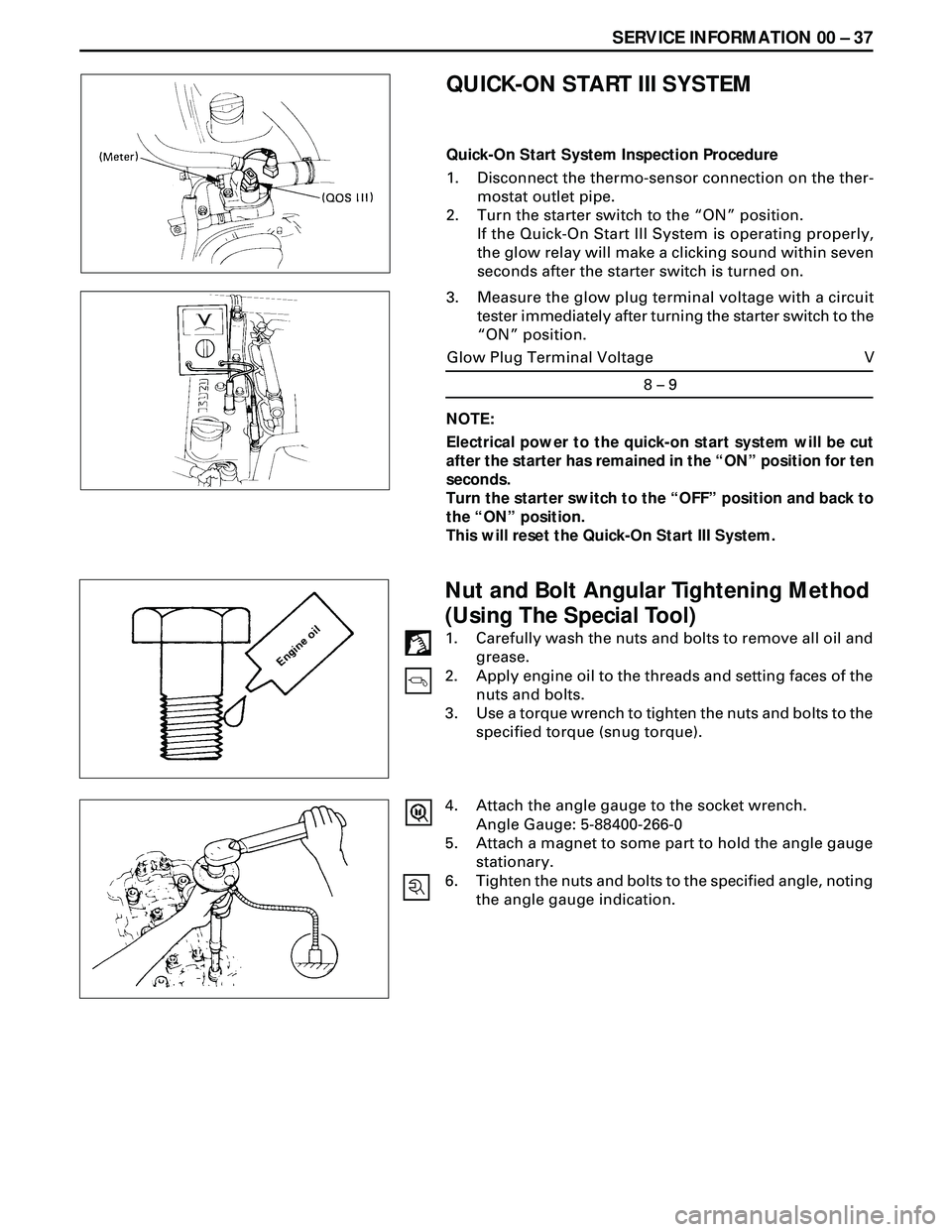
3. Measure the glow plug terminal voltage with a circuit
tester immediately after turning the starter switch to the
ÒONÓ position.
8 – 9
V Glow Plug Terminal Voltage
QUICK-ON START III SYSTEM
Quick-On Start System Inspection Procedure
1. Disconnect the thermo-sensor connection on the ther-
mostat outlet pipe.
2. Turn the starter switch to the ÒONÓ position.
If the Quick-On Start III System is operating properly,
the glow relay will make a clicking sound within seven
seconds after the starter switch is turned on.
NOTE:
Electrical power to the quick-on start system will be cut
after the starter has remained in the ÒONÓ position for ten
seconds.
Turn the starter switch to the ÒOFFÓ position and back to
the ÒONÓ position.
This will reset the Quick-On Start III System.
Nut and Bolt Angular Tightening Method
(Using The Special Tool)
1. Carefully wash the nuts and bolts to remove all oil and
grease.
2. Apply engine oil to the threads and setting faces of the
nuts and bolts.
3. Use a torque wrench to tighten the nuts and bolts to the
specified torque (snug torque).
4. Attach the angle gauge to the socket wrench.
Angle Gauge: 5-88400-266-0
5. Attach a magnet to some part to hold the angle gauge
stationary.
6. Tighten the nuts and bolts to the specified angle, noting
the angle gauge indication.
Page 1543 of 3573
SERVICE INFORMATION 00 Ð 43
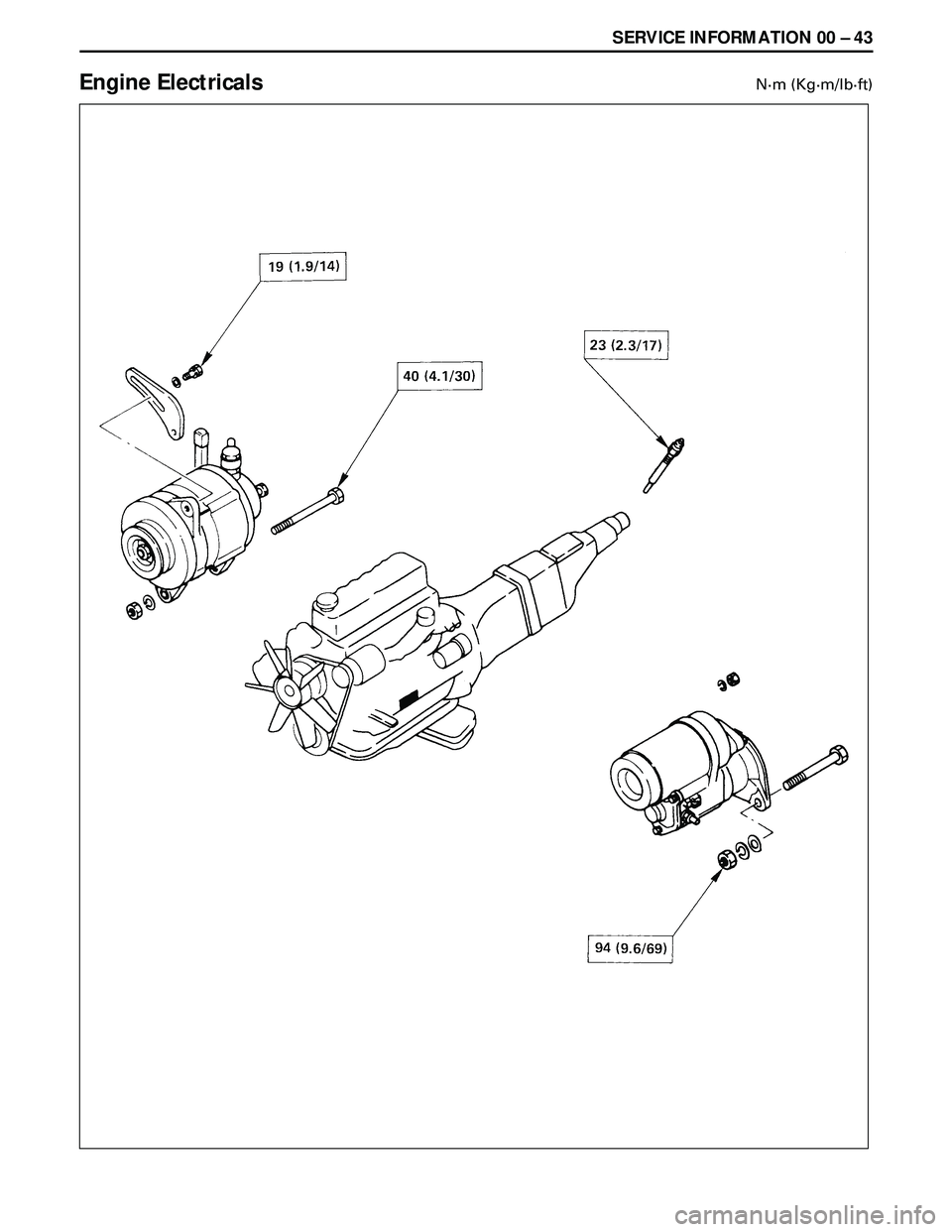
Engine ElectricalsNám (Kgám/lbáft)
Page 1691 of 3573
ENGINE ELECTRICAL 6D1 Ð 1
SECTION 6D
ENGINE ELECTRICAL
CONTENTS
Battery................................................................................................................................... Section 6D1
Starting System ................................................................................................................... Section 6D2
Charging System.................................................................................................................. Section 6D3
QOS-IIIPreheating System ................................................................................................. Section 6D6
SECTION 6D1
BATTERY
CONTENTS
General Description ......................................... 6D1Ð1
Diagnosis .......................................................... 6D1Ð1
On-Vehicle Service........................................... 6D1Ð3
Battery Charging .......................................... 6D1Ð3Jump Starting .............................................. 6D1Ð3
Removal and Installation of Battery .......... 6D1Ð4
GENERAL DESCRIPTION
There are six battery fluid caps at the top of the
battery. These are covered by a paper label.
The battery is completely sealed except for the six
small vent holes at the side. These vent holes per-
mit the escape of small amounts of gas generated
by the battery.
This type of battery has the following advantages
over conventional batteries:1. There is no need to add water during the entire
service life of the battery.
2. The battery protects itself against overcharging.
The battery will refuse to accept an excessive
charge.
(A conventional battery will accept an excessive
charge, resulting in gassing and loss of battery
fluid.)
3. The battery is much less vulnerable to self-
discharge than a conventional type battery.
DIAGNOSIS
1. VISUAL INSPECTION
Inspect the battery for obvious physical damage,
such as a cracked or broken case, which would
permit electrolyte loss.
Replace the battery if obvious physical damage is
discovered during inspection.
Check for any other physical damage and correct it
as necessary. If not, proceed to Step 2.
2. HYDROMETER CHECK
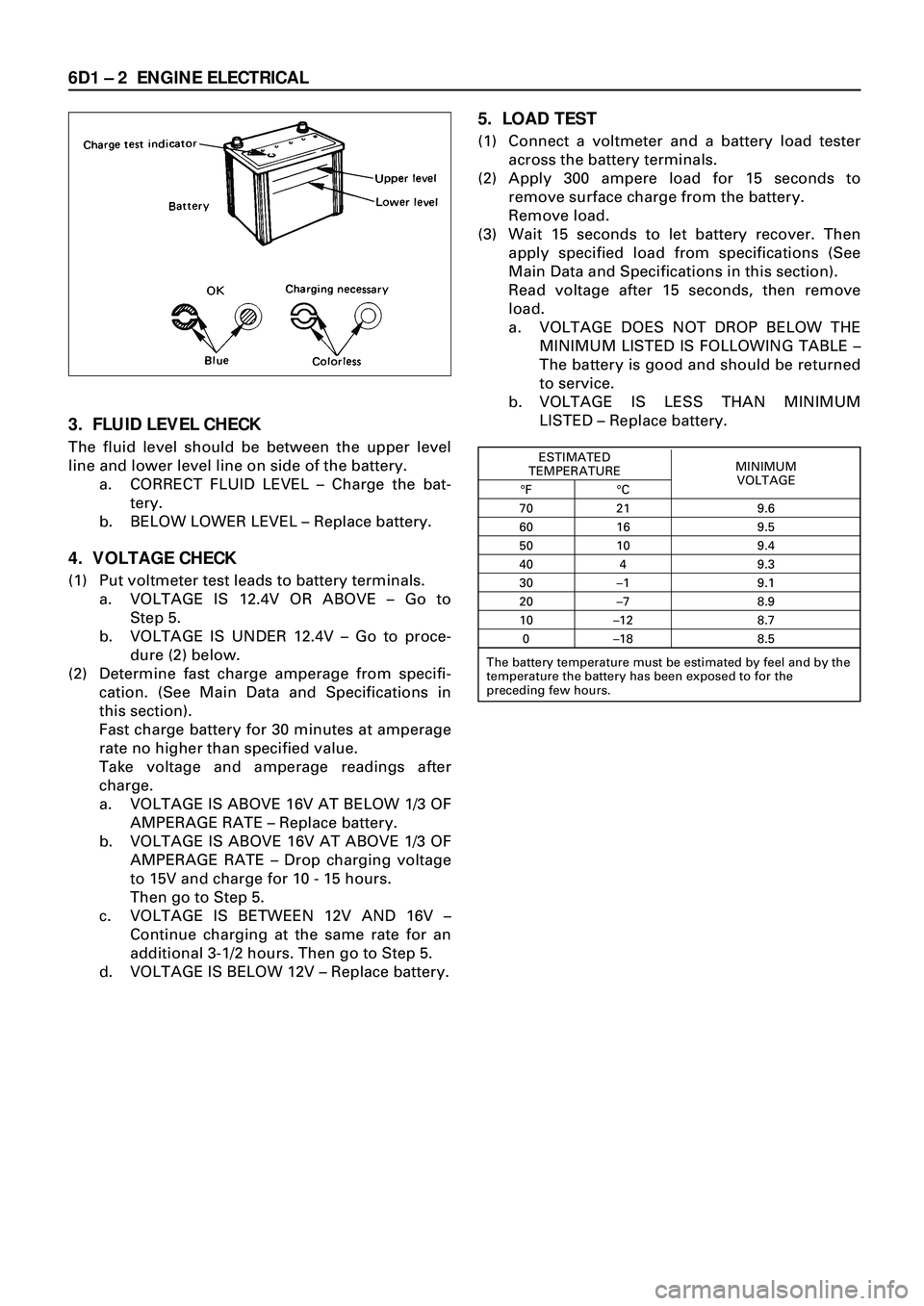
There is a built-in hydrometer (Charge test indica-
tor) at the top of the battery. It is designed to be
used during diagnostic procedures.Before trying to read the hydrometer, carefully
clean the upper battery surface.
If your work area is poorly lit, additional light may
be necessary to read the hydrometer.
a. BLUE RING OR DOT VISIBLE Ð Go to Step
4.
b. BLUE RING OR DOT NOT VISIBLE Ð Go to
Step 3.
Page 1692 of 3573
6D1 Ð 2 ENGINE ELECTRICAL
3. FLUID LEVEL CHECK
The fluid level should be between the upper level
line and lower level line on side of the battery.
a. CORRECT FLUID LEVEL Ð Charge the bat-
tery.
b. BELOW LOWER LEVEL Ð Replace battery.
4. VOLTAGE CHECK
(1) Put voltmeter test leads to battery terminals.
a. VOLTAGE IS 12.4V OR ABOVE Ð Go to
Step 5.
b. VOLTAGE IS UNDER 12.4V Ð Go to proce-
dure (2) below.
(2) Determine fast charge amperage from specifi-
cation. (See Main Data and Specifications in
this section).
Fast charge battery for 30 minutes at amperage
rate no higher than specified value.
Take voltage and amperage readings after
charge.
a. VOLTAGE IS ABOVE 16V AT BELOW 1/3 OF
AMPERAGE RATE Ð Replace battery.
b. VOLTAGE IS ABOVE 16V AT ABOVE 1/3 OF
AMPERAGE RATE Ð Drop charging voltage
to 15V and charge for 10 - 15 hours.
Then go to Step 5.
c. VOLTAGE IS BETWEEN 12V AND 16V Ð
Continue charging at the same rate for an
additional 3-1/2 hours. Then go to Step 5.
d. VOLTAGE IS BELOW 12V Ð Replace battery.
5. LOAD TEST
(1) Connect a voltmeter and a battery load tester
across the battery terminals.
(2) Apply 300 ampere load for 15 seconds to
remove surface charge from the battery.
Remove load.
(3) Wait 15 seconds to let battery recover. Then
apply specified load from specifications (See
Main Data and Specifications in this section).
Read voltage after 15 seconds, then remove
load.
a. VOLTAGE DOES NOT DROP BELOW THE
MINIMUM LISTED IS FOLLOWING TABLE Ð
The battery is good and should be returned
to service.
b. VOLTAGE IS LESS THAN MINIMUM
LISTED Ð Replace battery.
ESTIMATED
MINIMUM
TEMPERATURE
VOLTAGE
¡F ¡C
70 21 9.6
60 16 9.5
50 10 9.4
40 4 9.3
30 Ð1 9.1
20 Ð7 8.9
10 Ð12 8.7
0 Ð18 8.5
The battery temperature must be estimated by feel and by the
temperature the battery has been exposed to for the
preceding few hours.
Page 1693 of 3573
ENGINE ELECTRICAL 6D1 Ð 3
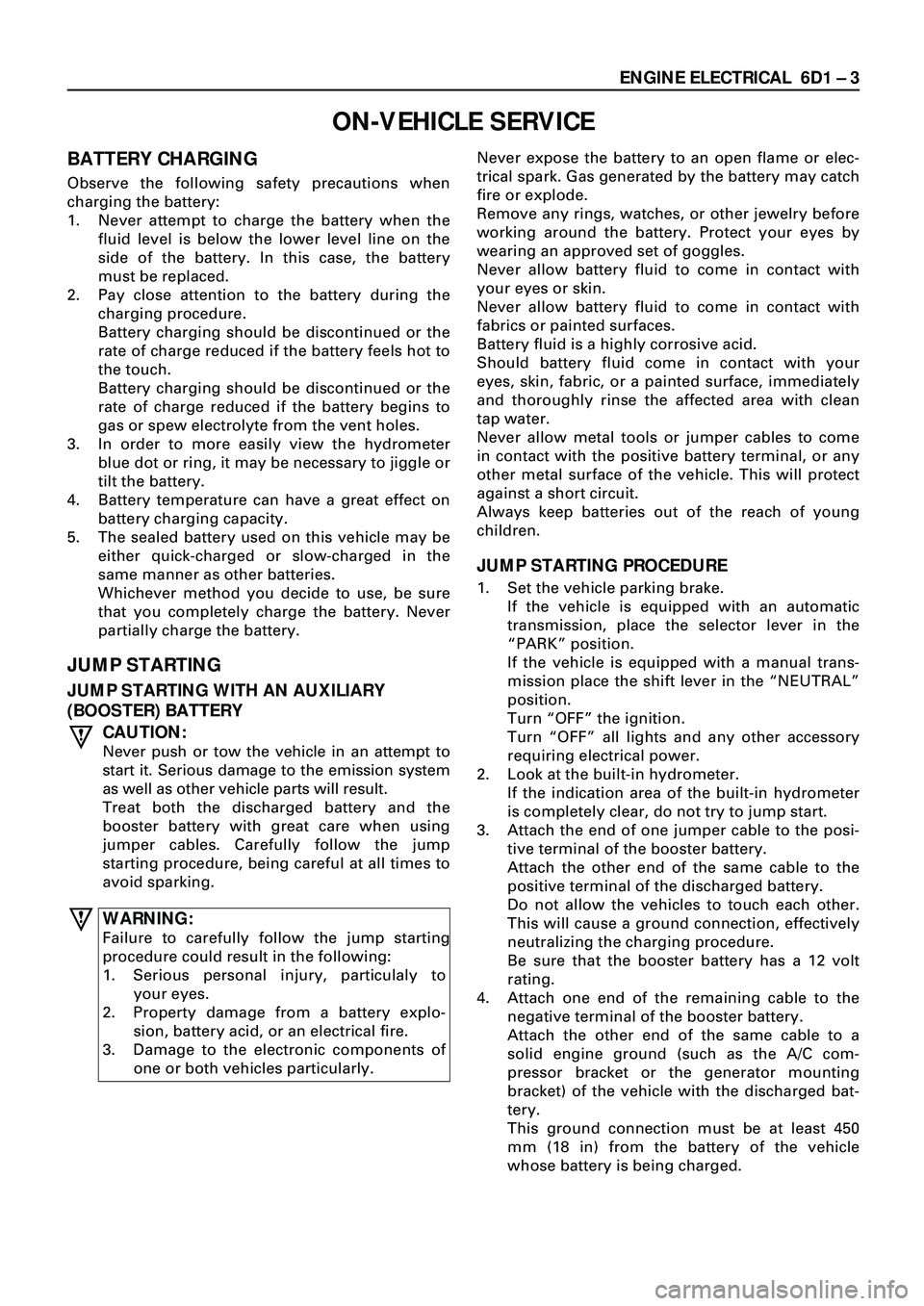
BATTERY CHARGING
Observe the following safety precautions when
charging the battery:
1. Never attempt to charge the battery when the
fluid level is below the lower level line on the
side of the battery. In this case, the battery
must be replaced.
2. Pay close attention to the battery during the
charging procedure.
Battery charging should be discontinued or the
rate of charge reduced if the battery feels hot to
the touch.
Battery charging should be discontinued or the
rate of charge reduced if the battery begins to
gas or spew electrolyte from the vent holes.
3. In order to more easily view the hydrometer
blue dot or ring, it may be necessary to jiggle or
tilt the battery.
4. Battery temperature can have a great effect on
battery charging capacity.
5. The sealed battery used on this vehicle may be
either quick-charged or slow-charged in the
same manner as other batteries.
Whichever method you decide to use, be sure
that you completely charge the battery. Never
partially charge the battery.
JUMP STARTING
JUMP STARTING WITH AN AUXILIARY
(BOOSTER) BATTERY
CAUTION:
Never push or tow the vehicle in an attempt to
start it. Serious damage to the emission system
as well as other vehicle parts will result.
Treat both the discharged battery and the
booster battery with great care when using
jumper cables. Carefully follow the jump
starting procedure, being careful at all times to
avoid sparking.
WARNING:
Failure to carefully follow the jump starting
procedure could result in the following:
1. Serious personal injury, particulaly to
your eyes.
2. Property damage from a battery explo-
sion, battery acid, or an electrical fire.
3. Damage to the electronic components of
one or both vehicles particularly. Never expose the battery to an open flame or elec-
trical spark. Gas generated by the battery may catch
fire or explode.
Remove any rings, watches, or other jewelry before
working around the battery. Protect your eyes by
wearing an approved set of goggles.
Never allow battery fluid to come in contact with
your eyes or skin.
Never allow battery fluid to come in contact with
fabrics or painted surfaces.
Battery fluid is a highly corrosive acid.
Should battery fluid come in contact with your
eyes, skin, fabric, or a painted surface, immediately
and thoroughly rinse the affected area with clean
tap water.
Never allow metal tools or jumper cables to come
in contact with the positive battery terminal, or any
other metal surface of the vehicle. This will protect
against a short circuit.
Always keep batteries out of the reach of young
children.
JUMP STARTING PROCEDURE
1. Set the vehicle parking brake.
If the vehicle is equipped with an automatic
transmission, place the selector lever in the
ÒPARKÓ position.
If the vehicle is equipped with a manual trans-
mission place the shift lever in the ÒNEUTRALÓ
position.
Turn ÒOFFÓ the ignition.
Turn ÒOFFÓ all lights and any other accessory
requiring electrical power.
2. Look at the built-in hydrometer.
If the indication area of the built-in hydrometer
is completely clear, do not try to jump start.
3. Attach the end of one jumper cable to the posi-
tive terminal of the booster battery.
Attach the other end of the same cable to the
positive terminal of the discharged battery.
Do not allow the vehicles to touch each other.
This will cause a ground connection, effectively
neutralizing the charging procedure.
Be sure that the booster battery has a 12 volt
rating.
4. Attach one end of the remaining cable to the
negative terminal of the booster battery.
Attach the other end of the same cable to a
solid engine ground (such as the A/C com-
pressor bracket or the generator mounting
bracket) of the vehicle with the discharged bat-
tery.
This ground connection must be at least 450
mm (18 in) from the battery of the vehicle
whose battery is being charged.
ON-VEHICLE SERVICE
Page 1694 of 3573
6D1 Ð 4 ENGINE ELECTRICAL
WARNING:
Never attach the end of the jumper cable
directly to the negative terminal of the dead
battery.
5. Start the engine of the vehicle with the good
battery.
Make sure that all unnecessary electrical acces-
sories have been turned ÒOFFÓ.
6. Start the engine of the vehicle with the dead
battery.
7. To remove the jumper cables, follow the above
directions in the reverse order.
Be sure to first disconnect the negative cable
from the vehicle with the discharged battery.
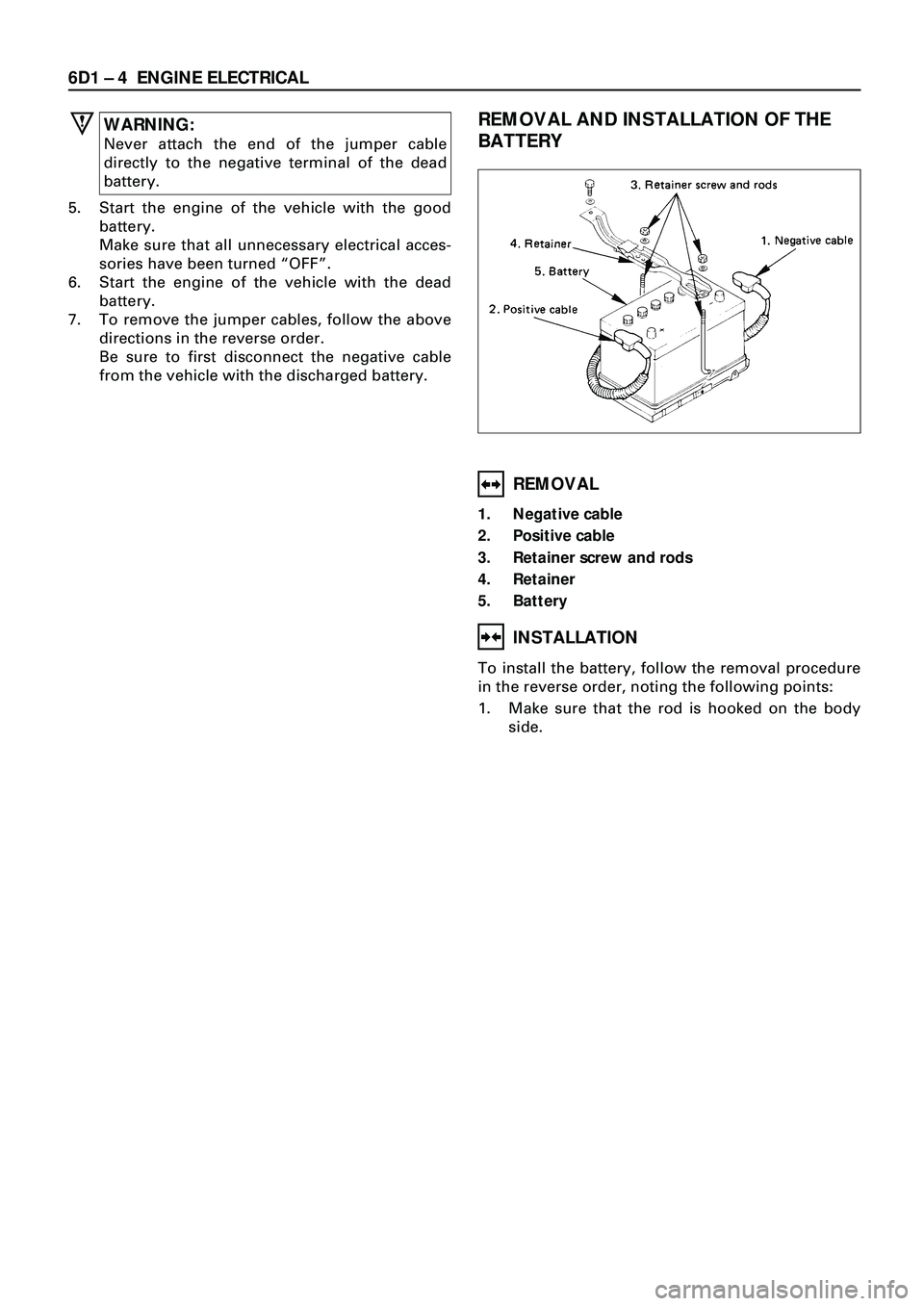
REMOVAL AND INSTALLATION OF THE
BATTERY
REMOVAL
1. Negative cable
2. Positive cable
3. Retainer screw and rods
4. Retainer
5. Battery
INSTALLATION
To install the battery, follow the removal procedure
in the reverse order, noting the following points:
1. Make sure that the rod is hooked on the body
side.
Page 1746 of 3573
ENGINE MECHANICAL 6A – 13
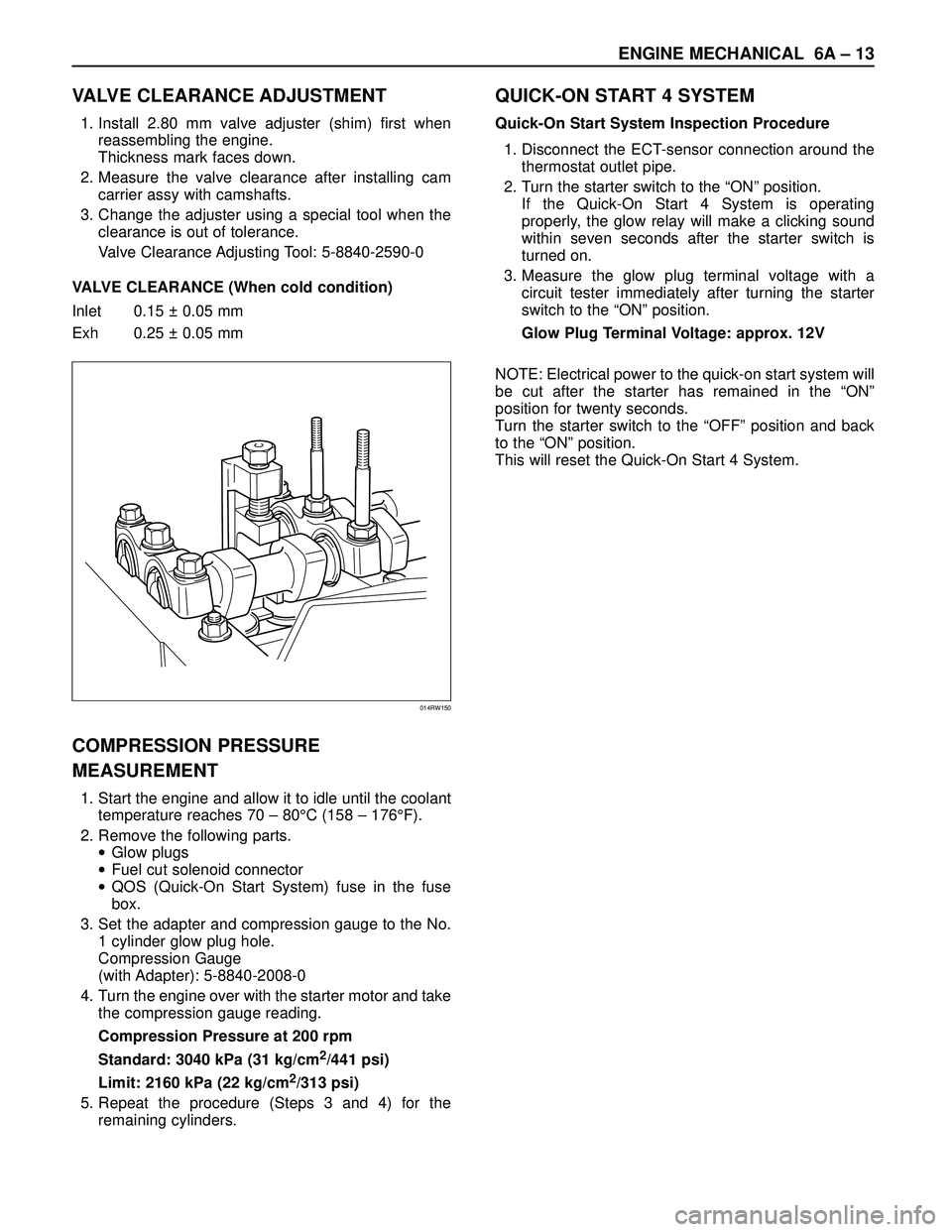
VALVE CLEARANCE ADJUSTMENT
1. Install 2.80 mm valve adjuster (shim) first when
reassembling the engine.
Thickness mark faces down.
2. Measure the valve clearance after installing cam
carrier assy with camshafts.
3. Change the adjuster using a special tool when the
clearance is out of tolerance.
Valve Clearance Adjusting Tool: 5-8840-2590-0
VALVE CLEARANCE (When cold condition)
Inlet 0.15 ± 0.05 mm
Exh 0.25 ± 0.05 mm
COMPRESSION PRESSURE
MEASUREMENT
1. Start the engine and allow it to idle until the coolant
temperature reaches 70 – 80°C (158 – 176°F).
2. Remove the following parts.
•Glow plugs
•Fuel cut solenoid connector
•QOS (Quick-On Start System) fuse in the fuse
box.
3. Set the adapter and compression gauge to the No.
1 cylinder glow plug hole.
Compression Gauge
(with Adapter): 5-8840-2008-0
4. Turn the engine over with the starter motor and take
the compression gauge reading.
Compression Pressure at 200 rpm
Standard: 3040 kPa (31 kg/cm
2/441 psi)
Limit: 2160 kPa (22 kg/cm
2/313 psi)
5. Repeat the procedure (Steps 3 and 4) for the
remaining cylinders.
QUICK-ON START 4 SYSTEM
Quick-On Start System Inspection Procedure
1. Disconnect the ECT-sensor connection around the
thermostat outlet pipe.
2. Turn the starter switch to the “ON” position.
If the Quick-On Start 4 System is operating
properly, the glow relay will make a clicking sound
within seven seconds after the starter switch is
turned on.
3. Measure the glow plug terminal voltage with a
circuit tester immediately after turning the starter
switch to the “ON” position.
Glow Plug Terminal Voltage: approx. 12V
NOTE: Electrical power to the quick-on start system will
be cut after the starter has remained in the “ON”
position for twenty seconds.
Turn the starter switch to the “OFF” position and back
to the “ON” position.
This will reset the Quick-On Start 4 System.
014RW150
Page 1751 of 3573
6A – 18 ENGINE MECHANICAL
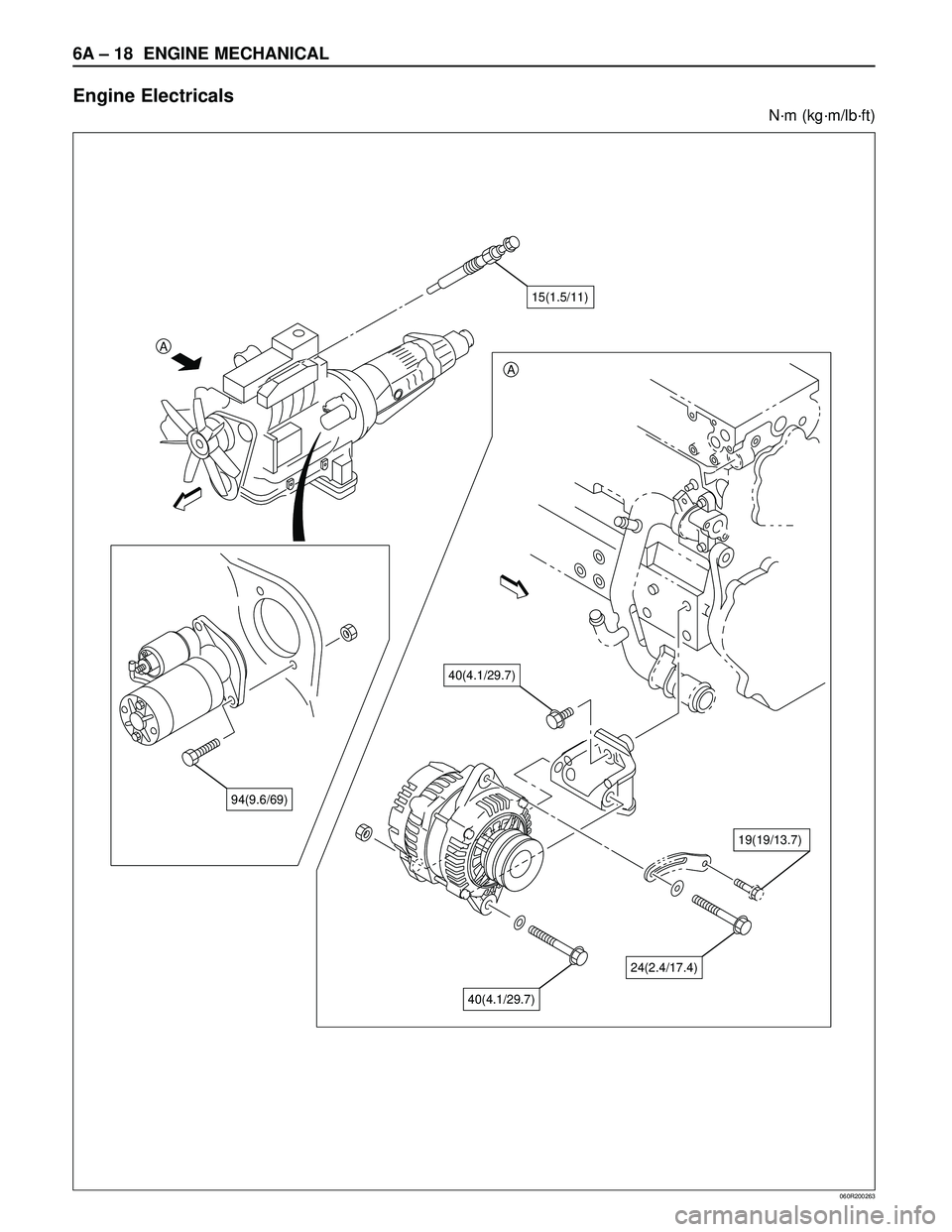
Engine Electricals
N·m (kg·m/lb·ft)
060R200263
A
A
15(1.5/11)
94(9.6/69)
40(4.1/29.7)
40(4.1/29.7)
24(2.4/17.4)
19(19/13.7)
Page 1868 of 3573
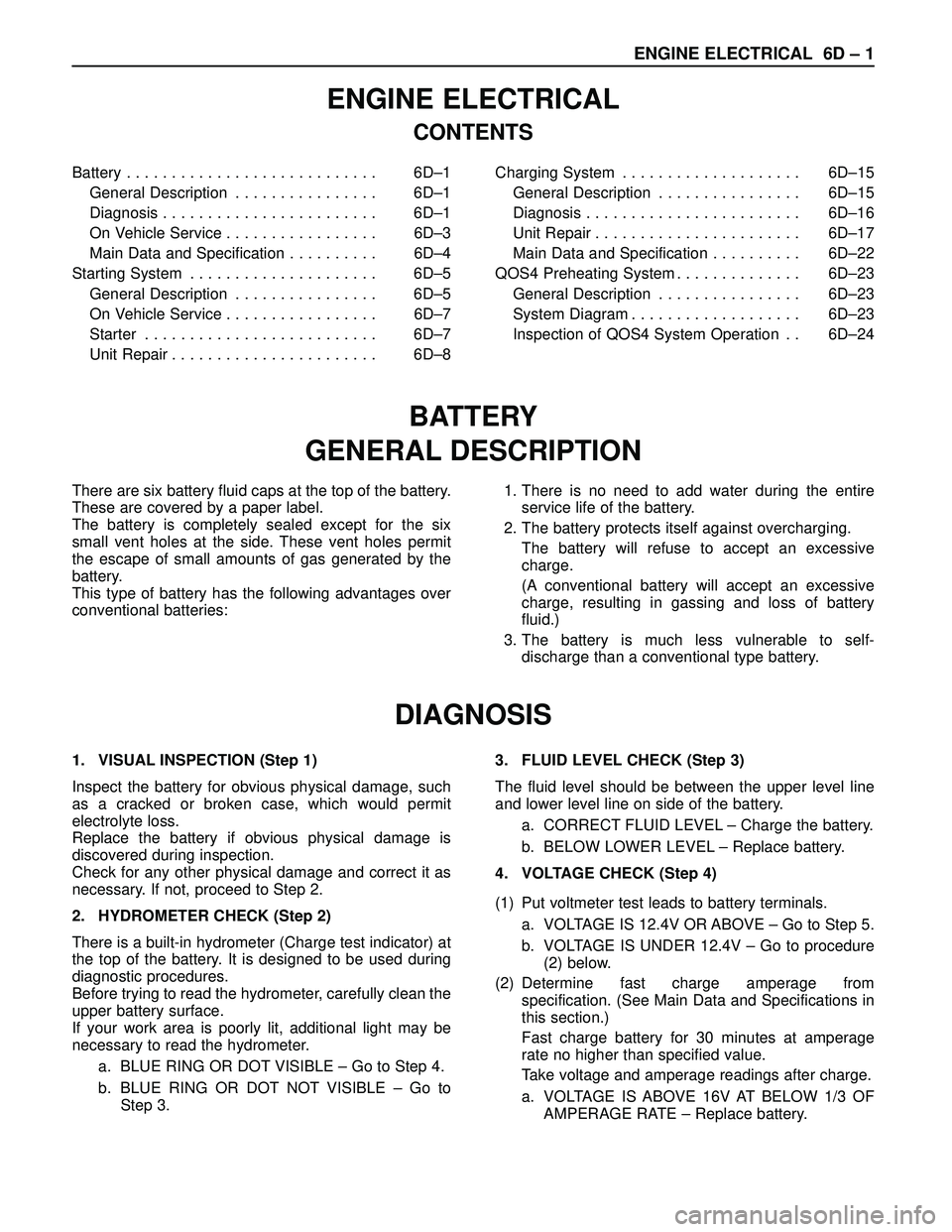
ENGINE ELECTRICAL 6D – 1
ENGINE ELECTRICAL
CONTENTS
Battery . . . . . . . . . . . . . . . . . . . . . . . . . . . . 6D–1
General Description . . . . . . . . . . . . . . . . 6D–1
Diagnosis . . . . . . . . . . . . . . . . . . . . . . . . 6D–1
On Vehicle Service . . . . . . . . . . . . . . . . . 6D–3
Main Data and Specification . . . . . . . . . . 6D–4
Starting System . . . . . . . . . . . . . . . . . . . . . 6D–5
General Description . . . . . . . . . . . . . . . . 6D–5
On Vehicle Service . . . . . . . . . . . . . . . . . 6D–7
Starter . . . . . . . . . . . . . . . . . . . . . . . . . . 6D–7
Unit Repair . . . . . . . . . . . . . . . . . . . . . . . 6D–8Charging System . . . . . . . . . . . . . . . . . . . . 6D–15
General Description . . . . . . . . . . . . . . . . 6D–15
Diagnosis . . . . . . . . . . . . . . . . . . . . . . . . 6D–16
Unit Repair . . . . . . . . . . . . . . . . . . . . . . . 6D–17
Main Data and Specification . . . . . . . . . . 6D–22
QOS4 Preheating System . . . . . . . . . . . . . . 6D–23
General Description . . . . . . . . . . . . . . . . 6D–23
System Diagram . . . . . . . . . . . . . . . . . . . 6D–23
Inspection of QOS4 System Operation . . 6D–24
BATTERY
GENERAL DESCRIPTION
DIAGNOSIS
There are six battery fluid caps at the top of the battery.
These are covered by a paper label.
The battery is completely sealed except for the six
small vent holes at the side. These vent holes permit
the escape of small amounts of gas generated by the
battery.
This type of battery has the following advantages over
conventional batteries:1. There is no need to add water during the entire
service life of the battery.
2. The battery protects itself against overcharging.
The battery will refuse to accept an excessive
charge.
(A conventional battery will accept an excessive
charge, resulting in gassing and loss of battery
fluid.)
3. The battery is much less vulnerable to self-
discharge than a conventional type battery.
1. VISUAL INSPECTION (Step 1)
Inspect the battery for obvious physical damage, such
as a cracked or broken case, which would permit
electrolyte loss.
Replace the battery if obvious physical damage is
discovered during inspection.
Check for any other physical damage and correct it as
necessary. If not, proceed to Step 2.
2. HYDROMETER CHECK (Step 2)
There is a built-in hydrometer (Charge test indicator) at
the top of the battery. It is designed to be used during
diagnostic procedures.
Before trying to read the hydrometer, carefully clean the
upper battery surface.
If your work area is poorly lit, additional light may be
necessary to read the hydrometer.
a. BLUE RING OR DOT VISIBLE – Go to Step 4.
b. BLUE RING OR DOT NOT VISIBLE – Go to
Step 3.3. FLUID LEVEL CHECK (Step 3)
The fluid level should be between the upper level line
and lower level line on side of the battery.
a. CORRECT FLUID LEVEL – Charge the battery.
b. BELOW LOWER LEVEL – Replace battery.
4. VOLTAGE CHECK (Step 4)
(1) Put voltmeter test leads to battery terminals.
a. VOLTAGE IS 12.4V OR ABOVE – Go to Step 5.
b. VOLTAGE IS UNDER 12.4V – Go to procedure
(2) below.
(2) Determine fast charge amperage from
specification. (See Main Data and Specifications in
this section.)
Fast charge battery for 30 minutes at amperage
rate no higher than specified value.
Take voltage and amperage readings after charge.
a. VOLTAGE IS ABOVE 16V AT BELOW 1/3 OF
AMPERAGE RATE – Replace battery.
Page 1869 of 3573
6D – 2 ENGINE ELECTRICAL
b. VOLTAGE IS ABOVE 16V AT ABOVE 1/3 OF
AMPERAGE RATE – Drop charging voltage to
15V and charge for 10 – 15 hours.
Then go to Step 5.
c. VOLTAGE IS BETWEEN 12V AND 16V –
Continue charging at the same rate for an
additional 3-1/2 hours. Then go to Step 5.
d. VOLTAGE IS BELOW 12V – Replace battery.
5. LOAD TEST (Step 5)
(1) Connect a voltmeter and a battery load tester
across the battery terminals.
(2) Apply 300 ampere load for 15 seconds to remove
surface charge from the battery.
Remove load.
(3) Wait 15 seconds to let battery recover. Then apply
specified load from specifications (See Main Data
and Specifications in this section).
Read voltage after 15 seconds, then remove load.
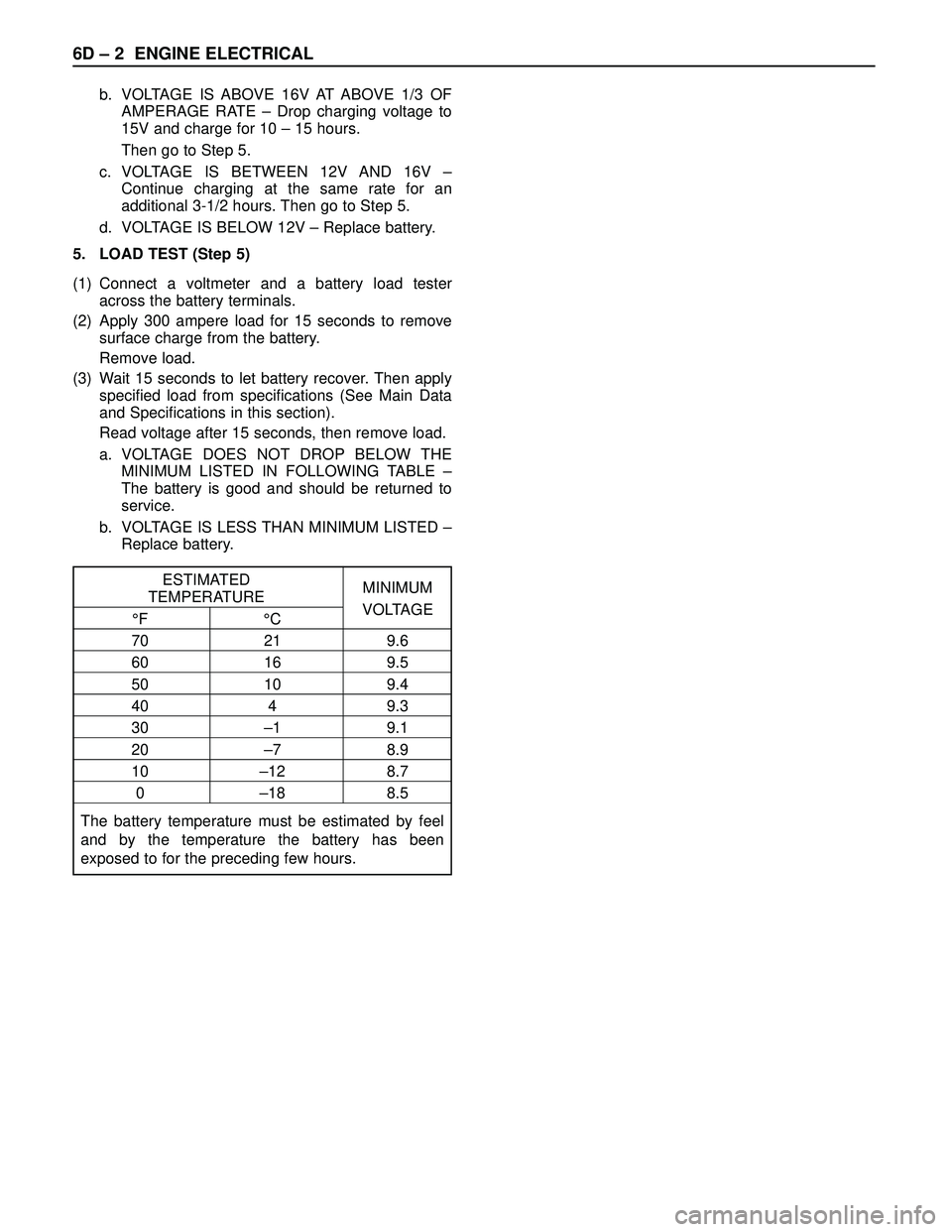
a. VOLTAGE DOES NOT DROP BELOW THE
MINIMUM LISTED IN FOLLOWING TABLE –
The battery is good and should be returned to
service.
b. VOLTAGE IS LESS THAN MINIMUM LISTED –
Replace battery.
ESTIMATED
TEMPERATUREMINIMUM
°F °CVOLTAGE
70 21 9.6
60 16 9.5
50 10 9.4
40 4 9.3
30 –1 9.1
20 –7 8.9
10 –12 8.7
0 –18 8.5
The battery temperature must be estimated by feel
and by the temperature the battery has been
exposed to for the preceding few hours.