ABS ISUZU TROOPER 1998 Service User Guide
[x] Cancel search | Manufacturer: ISUZU, Model Year: 1998, Model line: TROOPER, Model: ISUZU TROOPER 1998Pages: 3573, PDF Size: 60.36 MB
Page 286 of 3573
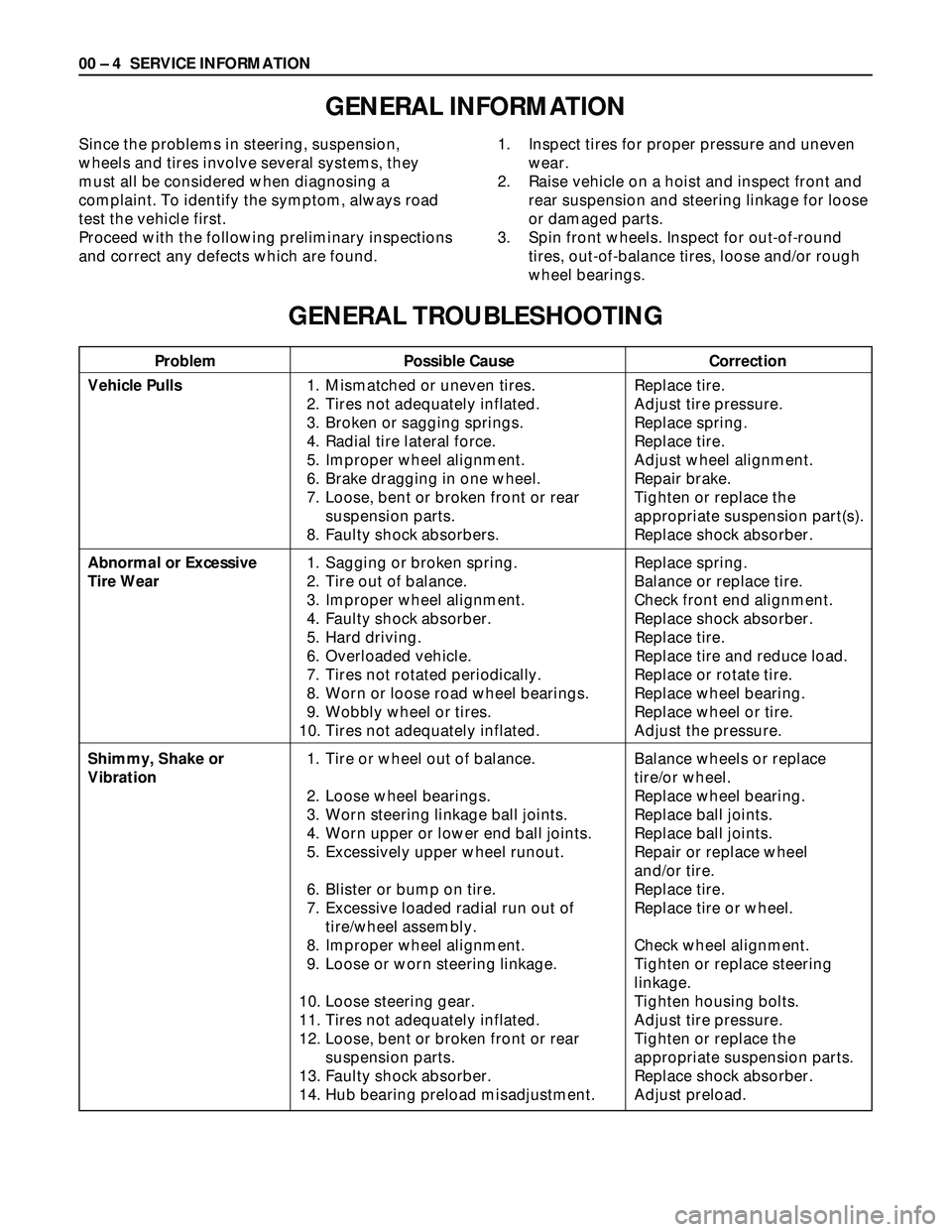
Problem Possible Cause Correction
00 – 4 SERVICE INFORMATION
GENERAL INFORMATION
Since the problems in steering, suspension,
wheels and tires involve several systems, they
must all be considered when diagnosing a
complaint. To identify the symptom, always road
test the vehicle first.
Proceed with the following preliminary inspections
and correct any defects which are found.1. Inspect tires for proper pressure and uneven
wear.
2. Raise vehicle on a hoist and inspect front and
rear suspension and steering linkage for loose
or damaged parts.
3. Spin front wheels. Inspect for out-of-round
tires, out-of-balance tires, loose and/or rough
wheel bearings.
GENERAL TROUBLESHOOTING
Vehicle Pulls
Abnormal or Excessive
Tire Wear
Shimmy, Shake or
Vibration1. Mismatched or uneven tires.
2. Tires not adequately inflated.
3. Broken or sagging springs.
4. Radial tire lateral force.
5. Improper wheel alignment.
6. Brake dragging in one wheel.
7. Loose, bent or broken front or rear
suspension parts.
8. Faulty shock absorbers.
1. Sagging or broken spring.
2. Tire out of balance.
3. Improper wheel alignment.
4. Faulty shock absorber.
5. Hard driving.
6. Overloaded vehicle.
7. Tires not rotated periodically.
8. Worn or loose road wheel bearings.
9. Wobbly wheel or tires.
10. Tires not adequately inflated.
1. Tire or wheel out of balance.
2. Loose wheel bearings.
3. Worn steering linkage ball joints.
4. Worn upper or lower end ball joints.
5. Excessively upper wheel runout.
6. Blister or bump on tire.
7. Excessive loaded radial run out of
tire/wheel assembly.
8. Improper wheel alignment.
9. Loose or worn steering linkage.
10. Loose steering gear.
11. Tires not adequately inflated.
12. Loose, bent or broken front or rear
suspension parts.
13. Faulty shock absorber.
14. Hub bearing preload misadjustment.Replace tire.
Adjust tire pressure.
Replace spring.
Replace tire.
Adjust wheel alignment.
Repair brake.
Tighten or replace the
appropriate suspension part(s).
Replace shock absorber.
Replace spring.
Balance or replace tire.
Check front end alignment.
Replace shock absorber.
Replace tire.
Replace tire and reduce load.
Replace or rotate tire.
Replace wheel bearing.
Replace wheel or tire.
Adjust the pressure.
Balance wheels or replace
tire/or wheel.
Replace wheel bearing.
Replace ball joints.
Replace ball joints.
Repair or replace wheel
and/or tire.
Replace tire.
Replace tire or wheel.
Check wheel alignment.
Tighten or replace steering
linkage.
Tighten housing bolts.
Adjust tire pressure.
Tighten or replace the
appropriate suspension parts.
Replace shock absorber.
Adjust preload.
Page 287 of 3573
SERVICE INFORMATION 00 – 5
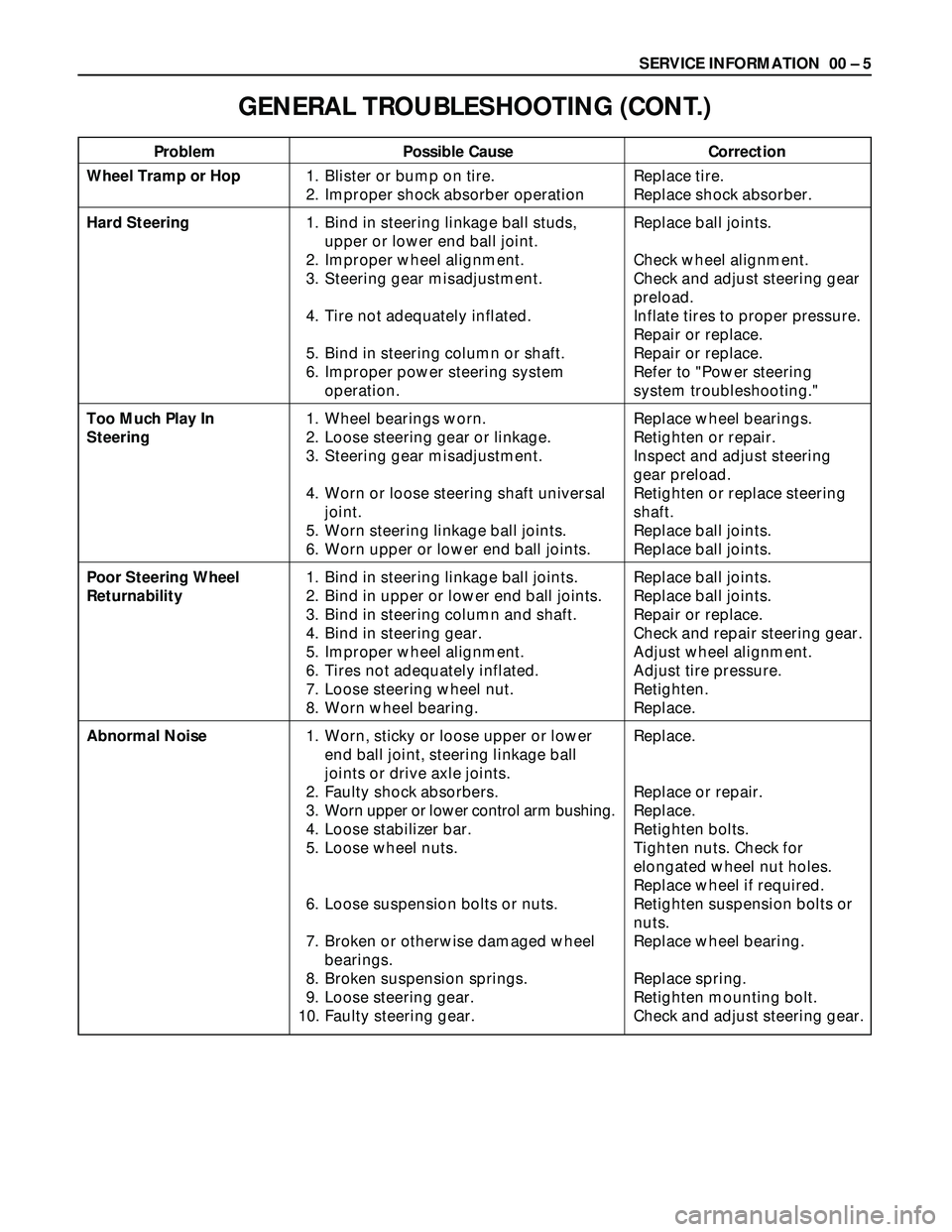
Problem Possible Cause Correction
GENERAL TROUBLESHOOTING (CONT.)
Wheel Tramp or Hop
Hard Steering
Too Much Play In
Steering
Poor Steering Wheel
Returnability
Abnormal Noise1. Blister or bump on tire.
2. Improper shock absorber operation
1. Bind in steering linkage ball studs,
upper or lower end ball joint.
2. Improper wheel alignment.
3. Steering gear misadjustment.
4. Tire not adequately inflated.
5. Bind in steering column or shaft.
6. Improper power steering system
operation.
1. Wheel bearings worn.
2. Loose steering gear or linkage.
3. Steering gear misadjustment.
4. Worn or loose steering shaft universal
joint.
5. Worn steering linkage ball joints.
6. Worn upper or lower end ball joints.
1. Bind in steering linkage ball joints.
2. Bind in upper or lower end ball joints.
3. Bind in steering column and shaft.
4. Bind in steering gear.
5. Improper wheel alignment.
6. Tires not adequately inflated.
7. Loose steering wheel nut.
8. Worn wheel bearing.
1. Worn, sticky or loose upper or lower
end ball joint, steering linkage ball
joints or drive axle joints.
2. Faulty shock absorbers.
3. Worn upper or lower control arm bushing.
4. Loose stabilizer bar.
5. Loose wheel nuts.
6. Loose suspension bolts or nuts.
7. Broken or otherwise damaged wheel
bearings.
8. Broken suspension springs.
9. Loose steering gear.
10. Faulty steering gear.Replace tire.
Replace shock absorber.
Replace ball joints.
Check wheel alignment.
Check and adjust steering gear
preload.
Inflate tires to proper pressure.
Repair or replace.
Repair or replace.
Refer to "Power steering
system troubleshooting."
Replace wheel bearings.
Retighten or repair.
Inspect and adjust steering
gear preload.
Retighten or replace steering
shaft.
Replace ball joints.
Replace ball joints.
Replace ball joints.
Replace ball joints.
Repair or replace.
Check and repair steering gear.
Adjust wheel alignment.
Adjust tire pressure.
Retighten.
Replace.
Replace.
Replace or repair.
Replace.
Retighten bolts.
Tighten nuts. Check for
elongated wheel nut holes.
Replace wheel if required.
Retighten suspension bolts or
nuts.
Replace wheel bearing.
Replace spring.
Retighten mounting bolt.
Check and adjust steering gear.
Page 288 of 3573
00 – 6 SERVICE INFORMATION
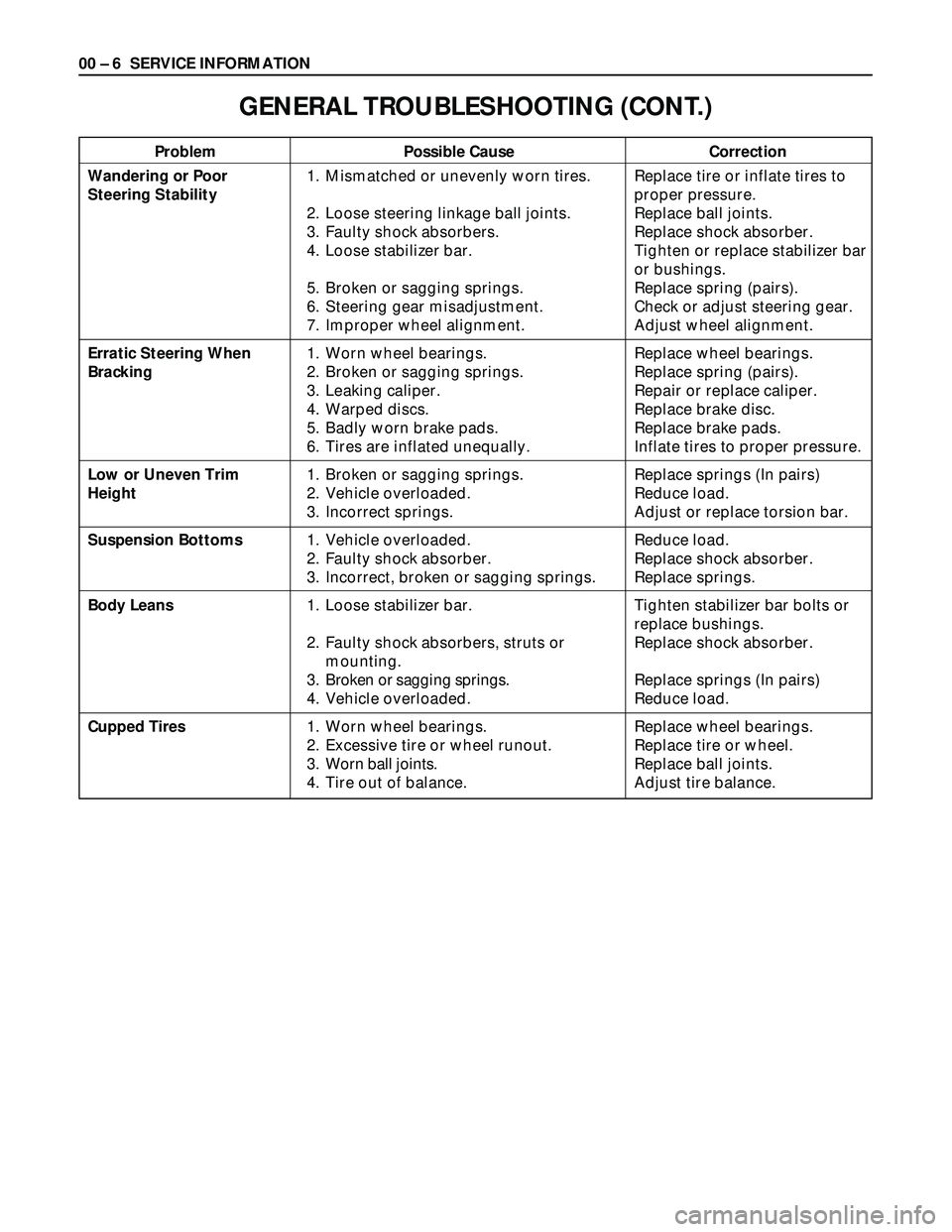
Problem Possible Cause Correction
GENERAL TROUBLESHOOTING (CONT.)
Wandering or Poor
Steering Stability
Erratic Steering When
Bracking
Low or Uneven Trim
Height
Suspension Bottoms
Body Leans
Cupped Tires1. Mismatched or unevenly worn tires.
2. Loose steering linkage ball joints.
3. Faulty shock absorbers.
4. Loose stabilizer bar.
5. Broken or sagging springs.
6. Steering gear misadjustment.
7. Improper wheel alignment.
1. Worn wheel bearings.
2. Broken or sagging springs.
3. Leaking caliper.
4. Warped discs.
5. Badly worn brake pads.
6. Tires are inflated unequally.
1. Broken or sagging springs.
2. Vehicle overloaded.
3. Incorrect springs.
1. Vehicle overloaded.
2. Faulty shock absorber.
3. Incorrect, broken or sagging springs.
1. Loose stabilizer bar.
2. Faulty shock absorbers, struts or
mounting.
3. Broken or sagging springs.
4. Vehicle overloaded.
1. Worn wheel bearings.
2. Excessive tire or wheel runout.
3. Worn ball joints.
4. Tire out of balance.Replace tire or inflate tires to
proper pressure.
Replace ball joints.
Replace shock absorber.
Tighten or replace stabilizer bar
or bushings.
Replace spring (pairs).
Check or adjust steering gear.
Adjust wheel alignment.
Replace wheel bearings.
Replace spring (pairs).
Repair or replace caliper.
Replace brake disc.
Replace brake pads.
Inflate tires to proper pressure.
Replace springs (In pairs)
Reduce load.
Adjust or replace torsion bar.
Reduce load.
Replace shock absorber.
Replace springs.
Tighten stabilizer bar bolts or
replace bushings.
Replace shock absorber.
Replace springs (In pairs)
Reduce load.
Replace wheel bearings.
Replace tire or wheel.
Replace ball joints.
Adjust tire balance.
Page 305 of 3573
INSPECTION
Before making any adjustments affecting caster, camber
or toe-in, the following front end inspection should be
made.
INSPECT
1. Tires for proper inflation pressure. Refer to “Wheels
and Tires” in section 3E.
2. Front wheel bearings for proper adjustment. Refer to
“Front Wheel Drive” in section 4C.
3. Ball joints, tie rod ends and relay rods. If excessive
looseness is noted, correct before adjusting. Refer to
“Steering Linkage” in section 2A.
4. Wheel and tires for run-out. Refer to “Wheels and
Tires”in section 3E.
5. Trim height. If not within specifications, the
correction must be made before adjusting caster.
6. Steering gear for looseness at the frame.
7. Shock absorbers for leaks or any noticeable noise.
Refer to “Front Suspension” in section 3C.
8. Control arms or stabilizer bar attachment for
looseness. Refer to “Front Suspension“ in section 3C.
9. Alignment equipment. Follow the manufacturer’s
instructions.
10. Level of the vehicle. The vehicle must be on a level
surface.
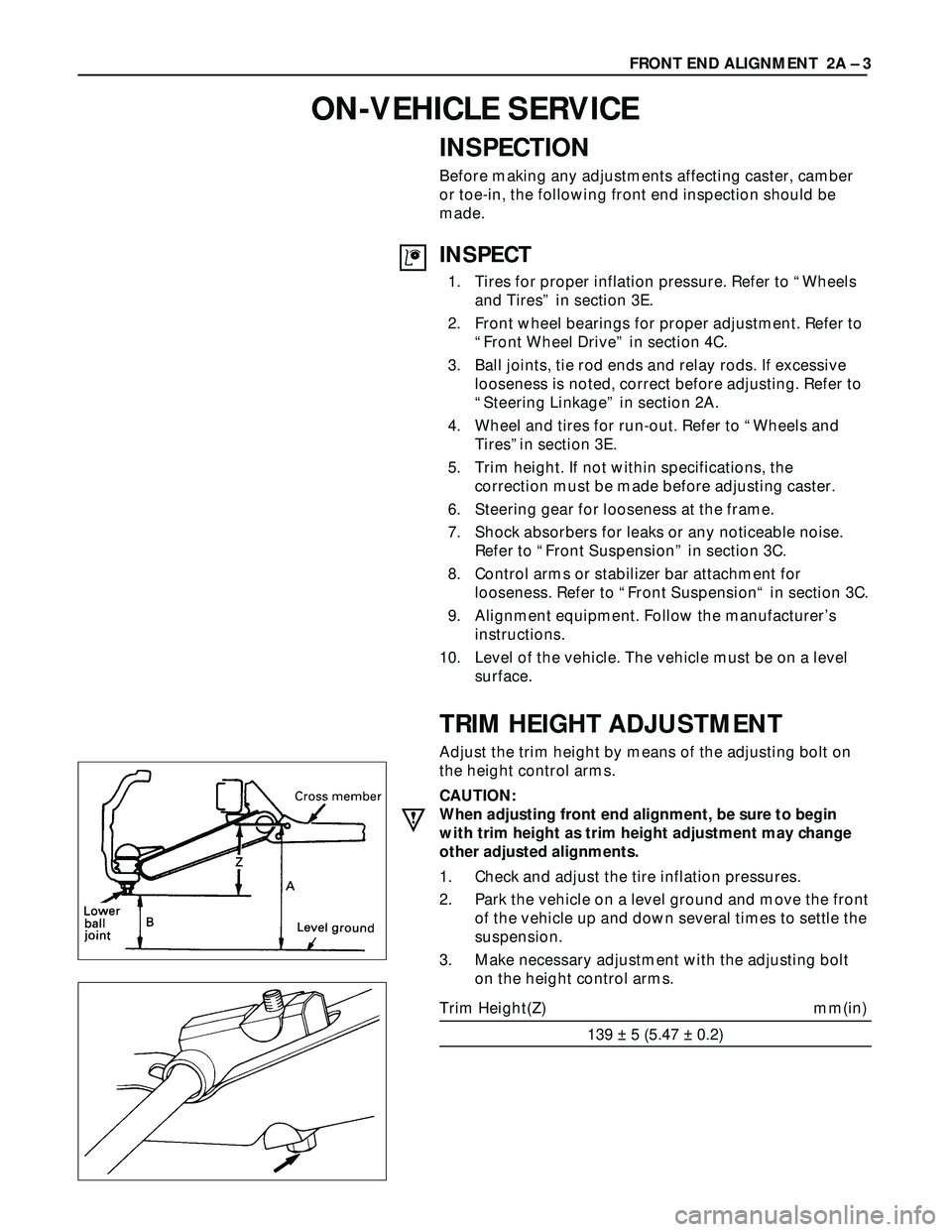
TRIM HEIGHT ADJUSTMENT
Adjust the trim height by means of the adjusting bolt on
the height control arms.
CAUTION:
When adjusting front end alignment, be sure to begin
with trim height as trim height adjustment may change
other adjusted alignments.
1. Check and adjust the tire inflation pressures.
2. Park the vehicle on a level ground and move the front
of the vehicle up and down several times to settle the
suspension.
3. Make necessary adjustment with the adjusting bolt
on the height control arms.
Trim Height(Z) mm(in)
139 ± 5 (5.47 ± 0.2)FRONT END ALIGNMENT 2A – 3
ON-VEHICLE SERVICE
Page 354 of 3573
This steering wheel and column repair section
covers the Supplemental Restraint System (SRS)
steering column. The following repair procedures
are specific to SRS Components. When servicing a
vehicle equipped with Supplemental Restraint
System, pay close attention to all WARNINGS and
CAUTIONS.
For detailed explanation about SRS, refer to Section
9J "SUPPLEMENTAL RESTRAINT SYSTEM (SRS)"
of manual.
The steering column has three important features in
addition to the steering function:
1. The column is energy absorbing, designed to
compress in a front-end collision to minimize
the possibility of injury to the driver of the
vehicle.
2. The ignition switch and lock are mounted
conveniently on the column.
3. With the column mounted lock, the ignition
and steering operation can be locked to
prevent theft of the vehicle.
The column may be disassembled and
reassembled. To insure the energy absorbing
action, it is important that the specified screws,
bolts and nuts be used only as designated and that
they are tightened to the specified torque.
When the column is removed from the vehicle, a
sharp blow on the end of steering shaft or shift
lever, leaning on the column assembly, or dropping
the assembly could shear or loosen the fasteners
that maintain column rigidity.
WARNING
THIS VEHICLE HAS A SUPPLEMENTAL RE-
STRAINT SYSTEM (SRS).REFER TO THE SRS
COMPONENT AND WIRING LOCATION VIEW
IN ORDER TO DETERMINE WHETHER YOU ARE
PERFORMING SERVICE ON OR NEAR THE SRS
COMPONENTS OR THE SRS WIRING. WHEN
YOU ARE PERFORMING SERVICE ON OR NEAR
THE SRS COMPONENTS OR THE SRS WIRING,
REFER TO THE SRS SERVICE INFORM ATION.
FAILURE TO FOLLOW WARNINGS COULD RE-
SULT IN POSSIBLE AIR BAG DEPLOYMENT,
PERSONAL INJURY, OR OTHERWISE UN-
NEEDED SRS SYSTEM REPAIRS.
SAFE HANDLING OF INFLATOR MODULES
REQUIRES FOLLOWING THE PROCEDURES
DESCRIBED BELOW FOR BOTH LIVE AND
DEPLOYED MODULES.
SAFETY PRECAUTIONS MUST BE FOLLOWEDWHEN HANDLING A DEPLOYED AIR BAG AS-
SEMBLY (AIR BAG). AFTER DEPLOYMENT,
THE AIR BAG ASSEMBLY (AIR BAG) SURFACE
MAY CONTAIN A SMALL AMOUNT OF SODIUM
HYDROXIDE, A BY-PRODUCT OF THE DEPLOY-
MENT REACTION, THAT IS IRRITATING TO THE
SKIN AND EYES.MOST OF THE POWDER ON
THE AIR BAG ASSEMBLY (AIR BAG) IS HARM-
LESS. AS A PRECAUTION, WEAR GLOVES
AND SAFETY GLASSES WHEN HANDLING A
DEPLOYED AIR BAG ASSEMBLY, AND WASH
YOUR HANDS WITH MILD SOAP AND WATER
AFTERWARDS.
WHEN CARRYING A LIVE AIR BAG ASSEMBLY,
MAKE SURE THE BAG AND TRIM COVER ARE
POINTED AWAY FROM YOU. NEVER CARRY
AN AIR BAG ASSEMBLY BY THE WIRES OR
CONNECTOR ON THE UNDERSIDE OF MODULE.
IN THE CASE OF AN ACCIDENTAL DEPLOY-
MENT, THE BAG WILL THEN DEPLOY WITH
MINIMAL CHANCE OF INJURY. WHEN PLACING
A LIVE AIR BAG ASSEMBLY ON A BENCH OR
OTHER SURFACE, ALWAYS FACE THE BAG AND
TRIM COVER UP, AWAY FROM THE SURFACE.
NEVER REST A STEERING COLUMN ASSEMBLY
ON THE STEERING WHEEL WITH THE AIR
BAG ASSEMBLY FACE DOWN AND COLUMN
VERTICAL.THIS IS NECESSARY SO THAT A
FREE SPACE IS PROVIDED TO ALLOW THE AIR
BAG ASSEMBLY TO EXPAND IN THE UNLIKELY
EVENT OF ACCIDENTAL DEPLOYMENT. OTHER-
WISE, PERSONAL INJURY COULD RESULT.
TO AVOID DEPLOYMENT WHEN TROUBLE
SHOOTING THE SRS SYSTEM, DO NOT USE
ELECTRICAL TEST EQUIPMENT, SUCH AS
BATTERY-POWERED OR A/C-POWERED VOLT-
METER, OHMMETER, ETC., OR ANY TYPE OF
ELECTRICAL EQUIPMENT OTHER THAN SPECI-
FIED IN THIS MANUAL. DO NOT USE A NON-
POWERED PROBE-TYPE TESTER.
INSTRUCTIONS IN THIS MANUAL MUST BE
FOLLOWED CAREFULLY, OTHERWISE PER-
SONAL INJURY MAY RESULT. 2A – 52 SUPPLEMENTAL RESTRAINT SYSTEM STEERING WHEEL & COLUMN
GENERAL DESCRIPTION
Page 357 of 3573
SUPPLEMENTAL RESTRAINT SYSTEM STEERING WHEEL & COLUMN 2A Ð 55
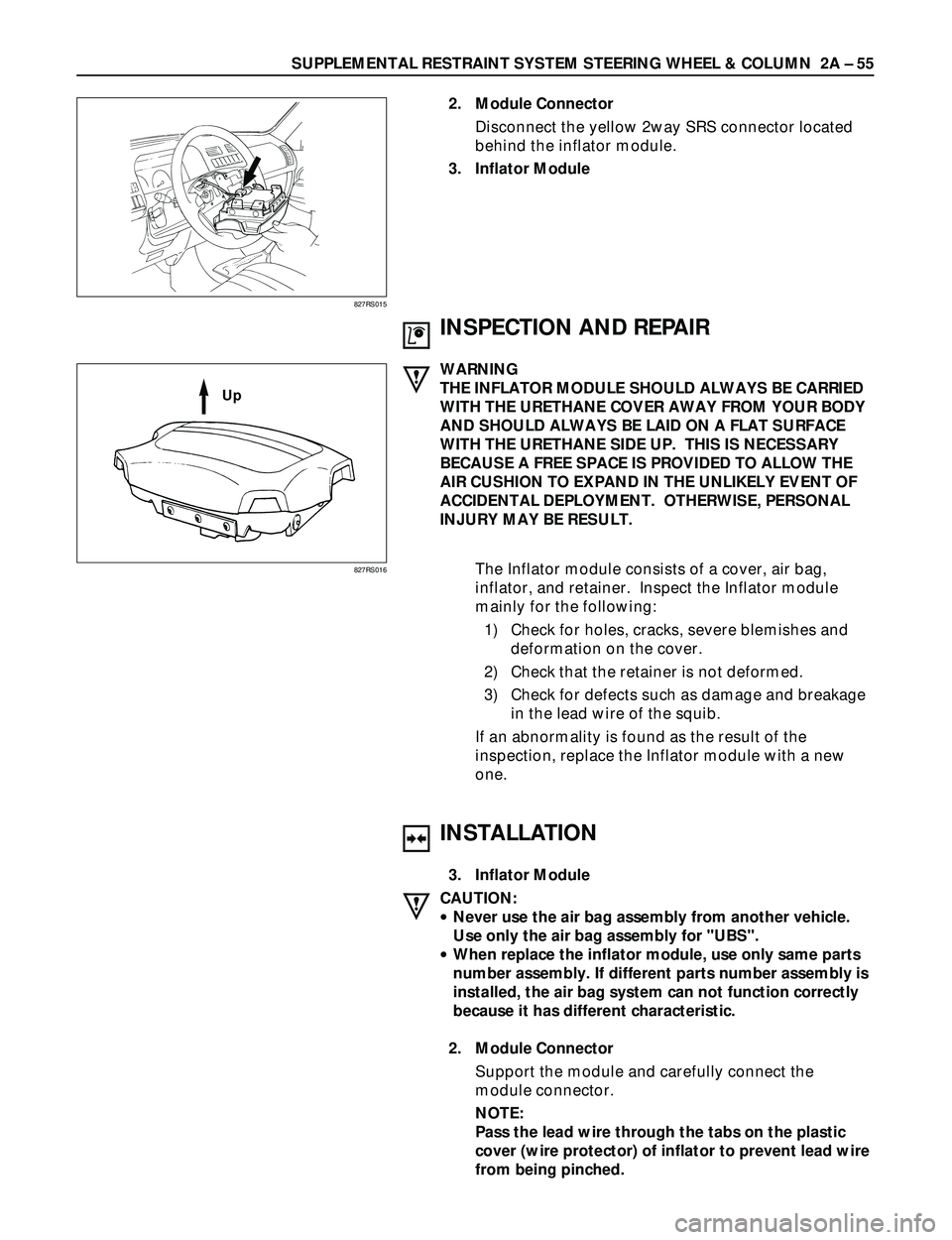
2. Module Connector
Disconnect the yellow 2way SRS connector located
behind the inflator module.
3. Inflator Module
827RS015
827RS016
INSPECTION AND REPAIR
WARNING
THE INFLATOR MODULE SHOULD ALWAYS BE CARRIED
WITH THE URETHANE COVER AWAY FROM YOUR BODY
AND SHOULD ALWAYS BE LAID ON A FLAT SURFACE
WITH THE URETHANE SIDE UP. THIS IS NECESSARY
BECAUSE A FREE SPACE IS PROVIDED TO ALLOW THE
AIR CUSHION TO EXPAND IN THE UNLIKELY EVENT OF
ACCIDENTAL DEPLOYMENT. OTHERWISE, PERSONAL
INJURY MAY BE RESULT.
INSTALLATION
3. Inflator Module
CAUTION:
·Never use the air bag assembly from another vehicle.
Use only the air bag assembly for "UBS".
·When replace the inflator module, use only same parts
number assembly. If different parts number assembly is
installed, the air bag system can not function correctly
because it has different characteristic.
2. Module Connector
Support the module and carefully connect the
module connector.
NOTE:
Pass the lead wire through the tabs on the plastic
cover (wire protector) of inflator to prevent lead wire
from being pinched.
The Inflator module consists of a cover, air bag,
inflator, and retainer. Inspect the Inflator module
mainly for the following:
1) Check for holes, cracks, severe blemishes and
deformation on the cover.
2) Check that the retainer is not deformed.
3) Check for defects such as damage and breakage
in the lead wire of the squib.
If an abnormality is found as the result of the
inspection, replace the Inflator module with a new
one.
Up
Page 360 of 3573
2A – 58 SUPPLEMENTAL RESTRAINT SYSTEM STEERING WHEEL & COLUMN
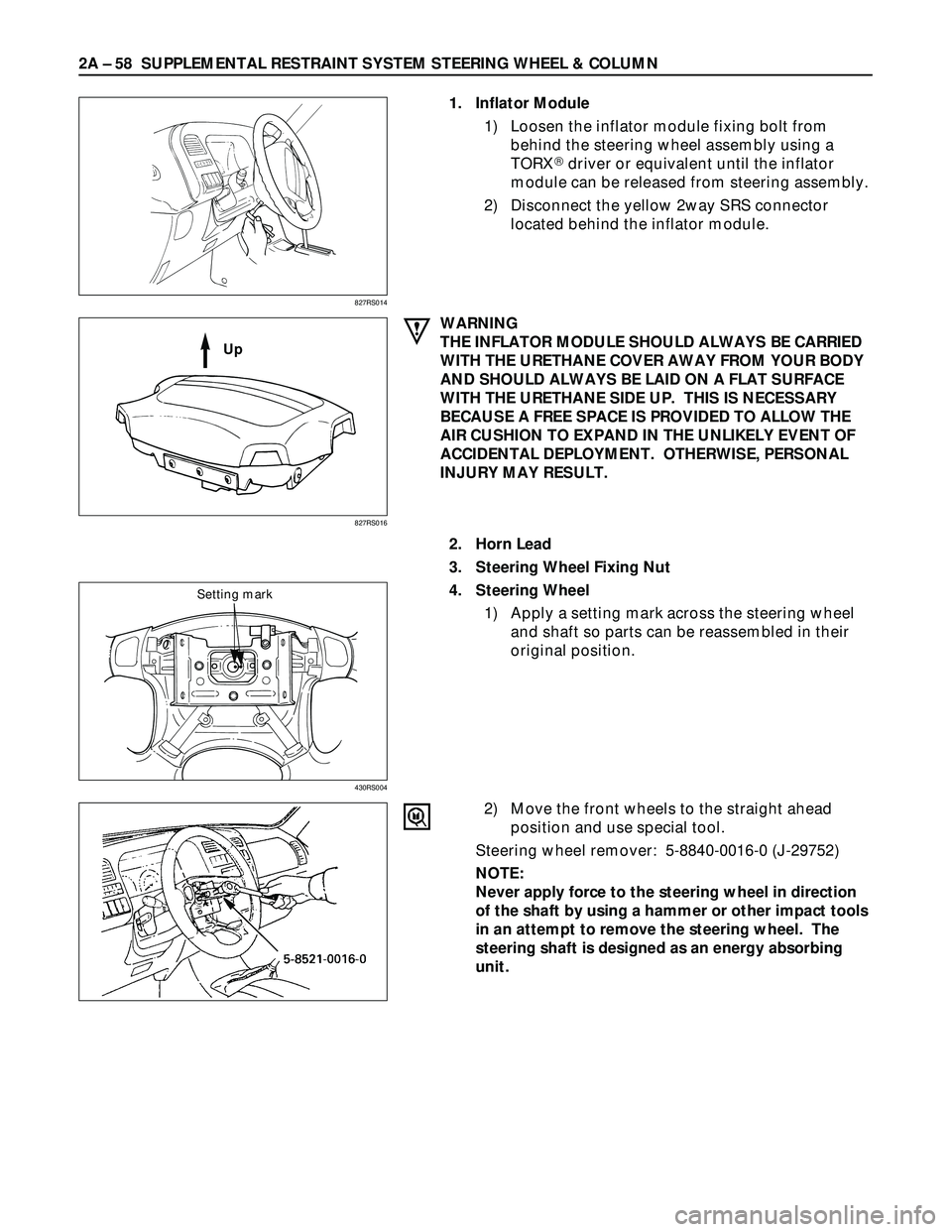
1. Inflator Module
1) Loosen the inflator module fixing bolt from
behind the steering wheel assembly using a
TORX
driver or equivalent until the inflator
module can be released from steering assembly.
2) Disconnect the yellow 2way SRS connector
located behind the inflator module.
WARNING
THE INFLATOR MODULE SHOULD ALWAYS BE CARRIED
WITH THE URETHANE COVER AWAY FROM YOUR BODY
AND SHOULD ALWAYS BE LAID ON A FLAT SURFACE
WITH THE URETHANE SIDE UP. THIS IS NECESSARY
BECAUSE A FREE SPACE IS PROVIDED TO ALLOW THE
AIR CUSHION TO EXPAND IN THE UNLIKELY EVENT OF
ACCIDENTAL DEPLOYMENT. OTHERWISE, PERSONAL
INJURY MAY RESULT.
2. Horn Lead
3. Steering Wheel Fixing Nut
4. Steering Wheel
1) Apply a setting mark across the steering wheel
and shaft so parts can be reassembled in their
original position.
2) Move the front wheels to the straight ahead
position and use special tool.
Steering wheel remover: 5-8840-0016-0 (J-29752)
NOTE:
Never apply force to the steering wheel in direction
of the shaft by using a hammer or other impact tools
in an attempt to remove the steering wheel. The
steering shaft is designed as an energy absorbing
unit.
827RS014
827RS016
430RS004
Up
Setting mark
Page 361 of 3573
SUPPLEMENTAL RESTRAINT SYSTEM STEERING WHEEL & COLUMN 2A Ð 59
INSTALLATION
4. Steering Wheel
Align the setting marks made when removing.
CAUTION:
Never apply force to the setting wheel in direction of the
shaft by using a hammer or other impact tools in an
attempt to install the steering wheel. The setting shaft is
designed as an energy absorbing unit.
3. Steering Wheel Fixing Nut
Steering Wheel Nut Torque Nám (kgám/lbáft)
34 (3.5 / 25)
2. Horn Lead
1. Inflator Module
1) Support the module and carefully connect the
module connector.
CAUTION:
·Never use the air bag assembly from another vehicle.
Use only the air bag assembly for "UBS".
·When replace the inflator module, use only same parts
number assembly. If different parts number assembly is
installed, the air bag system can not function correctly
because it has different characteristic.
NOTE:
Pass the lead wire through the tabs on the plastic
cover (wire protector) of inflator to prevent lead wire
from being pinches.
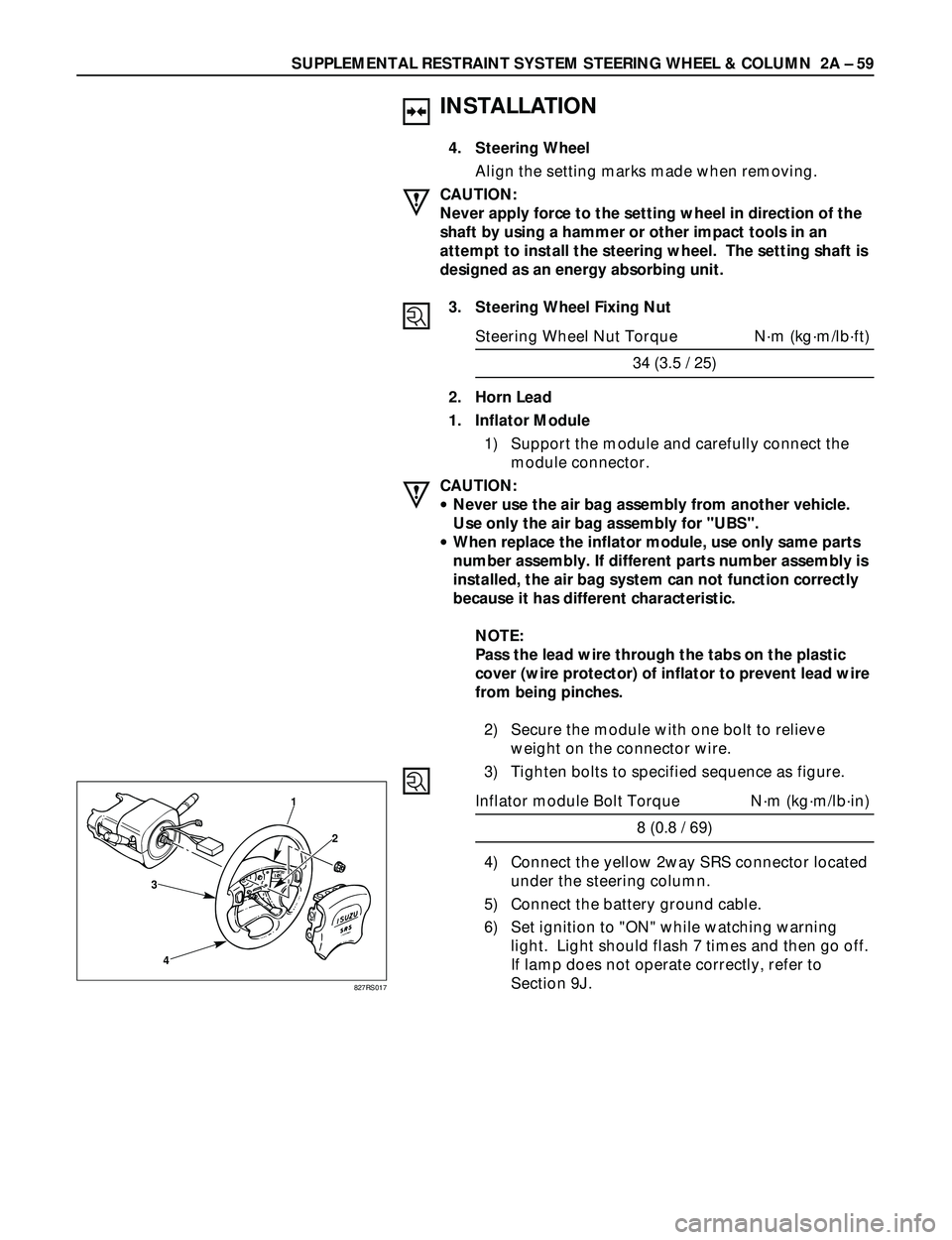
2) Secure the module with one bolt to relieve
weight on the connector wire.
3) Tighten bolts to specified sequence as figure.
Inflator module Bolt Torque Nám (kgám/lbáin)
8 (0.8 / 69)
4) Connect the yellow 2way SRS connector located
under the steering column.
5) Connect the battery ground cable.
6) Set ignition to "ON" while watching warning
light. Light should flash 7 times and then go off.
If lamp does not operate correctly, refer to
Section 9J.
3
41
2
827RS017
Page 364 of 3573
2A Ð 62 SUPPLEMENTAL RESTRAINT SYSTEM STEERING WHEEL & COLUMN
Use special tool. Remove the steering wheel.
Move the tires to the straight ahead position before
removing the steering wheel.
Steering wheel remover: 5-8840-0016-0 (J-29752)
CAUTION:
Never apply force to the steering wheel in direction of the
shaft by using a hammer or other impact tools in an
attempt to remove the steering wheel. The steering shaft
is designed as an energy absorbing unit.
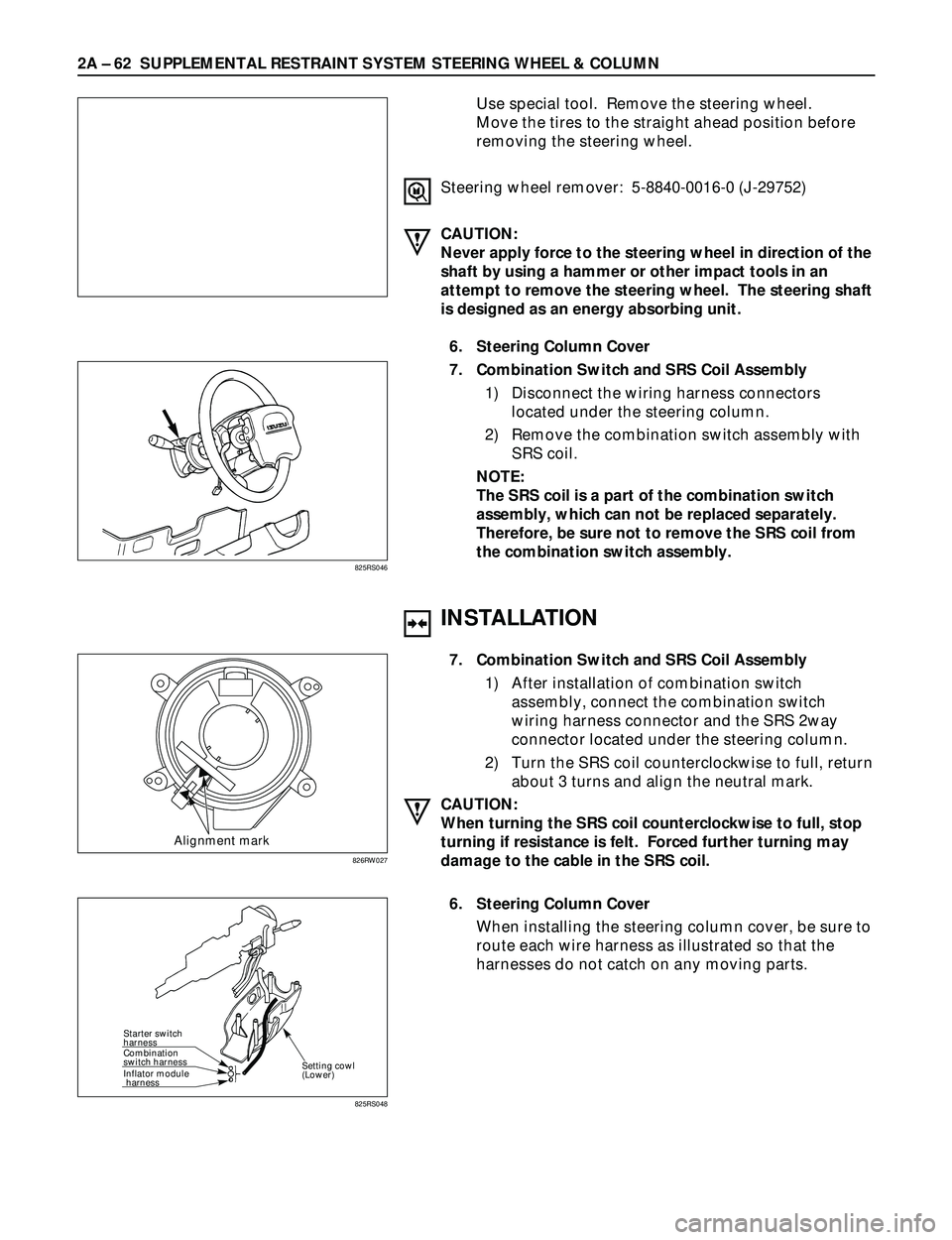
6. Steering Column Cover
7. Combination Switch and SRS Coil Assembly
1) Disconnect the wiring harness connectors
located under the steering column.
2) Remove the combination switch assembly with
SRS coil.
NOTE:
The SRS coil is a part of the combination switch
assembly, which can not be replaced separately.
Therefore, be sure not to remove the SRS coil from
the combination switch assembly.
825RS046
INSTALLATION
Alignment mark
7. Combination Switch and SRS Coil Assembly
1) After installation of combination switch
assembly, connect the combination switch
wiring harness connector and the SRS 2way
connector located under the steering column.
2) Turn the SRS coil counterclockwise to full, return
about 3 turns and align the neutral mark.
CAUTION:
When turning the SRS coil counterclockwise to full, stop
turning if resistance is felt. Forced further turning may
damage to the cable in the SRS coil.
826RW027
Starter switch
harness
Combination
switch harness
Inflator module
harness
Setting cowl
(Lower)
6. Steering Column Cover
When installing the steering column cover, be sure to
route each wire harness as illustrated so that the
harnesses do not catch on any moving parts.
825RS048
Page 365 of 3573
SUPPLEMENTAL RESTRAINT SYSTEM STEERING WHEEL & COLUMN 2A Ð 63
5. Steering Wheel
Align the setting marks made when removing.
CAUTION:
Never apply force to the steering wheel in direction of the
shaft by using a hammer or other impact tools in an
attempt to remove the steering wheel. The steering shaft
is designed as an energy absorbing unit.
Tighten the steering wheel fixing nut to the specified
torque.
Steering Wheel Nut Torque Nám (kgám/lbáft)
34 (3.5 / 25)
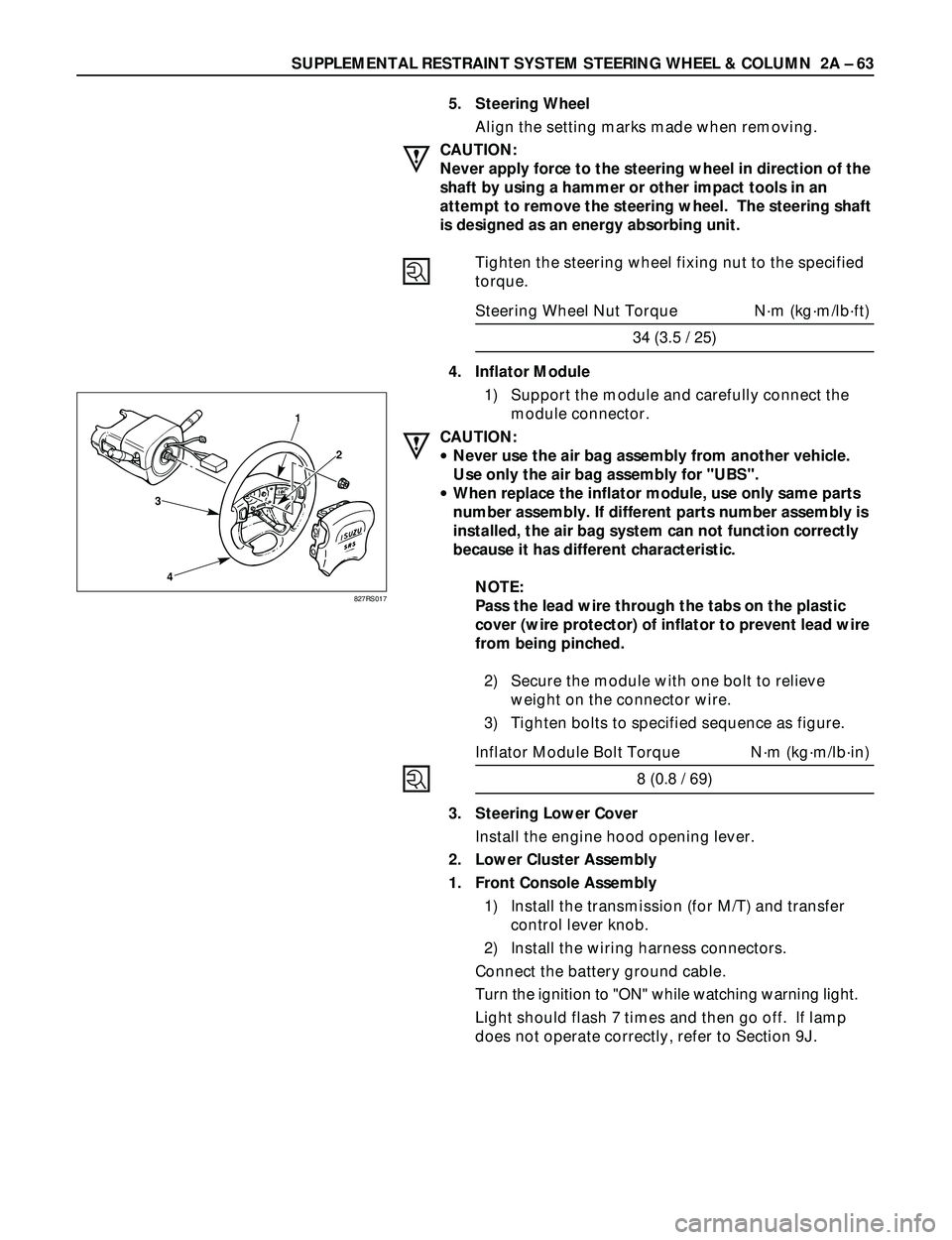
4. Inflator Module
1) Support the module and carefully connect the
module connector.
CAUTION:
·Never use the air bag assembly from another vehicle.
Use only the air bag assembly for "UBS".
·When replace the inflator module, use only same parts
number assembly. If different parts number assembly is
installed, the air bag system can not function correctly
because it has different characteristic.
NOTE:
Pass the lead wire through the tabs on the plastic
cover (wire protector) of inflator to prevent lead wire
from being pinched.
2) Secure the module with one bolt to relieve
weight on the connector wire.
3) Tighten bolts to specified sequence as figure.
Inflator Module Bolt Torque Nám (kgám/lbáin)
8 (0.8 / 69)
3. Steering Lower Cover
Install the engine hood opening lever.
2. Lower Cluster Assembly
1. Front Console Assembly
1) Install the transmission (for M/T) and transfer
control lever knob.
2) Install the wiring harness connectors.
Connect the battery ground cable.
Turn the ignition to "ON" while watching warning light.
Light should flash 7 times and then go off. If lamp
does not operate correctly, refer to Section 9J.
3
41
2
827RS017