differential ISUZU TROOPER 1998 Service Repair Manual
[x] Cancel search | Manufacturer: ISUZU, Model Year: 1998, Model line: TROOPER, Model: ISUZU TROOPER 1998Pages: 3573, PDF Size: 60.36 MB
Page 7 of 3573
PAGE BACK PAGE NEXT
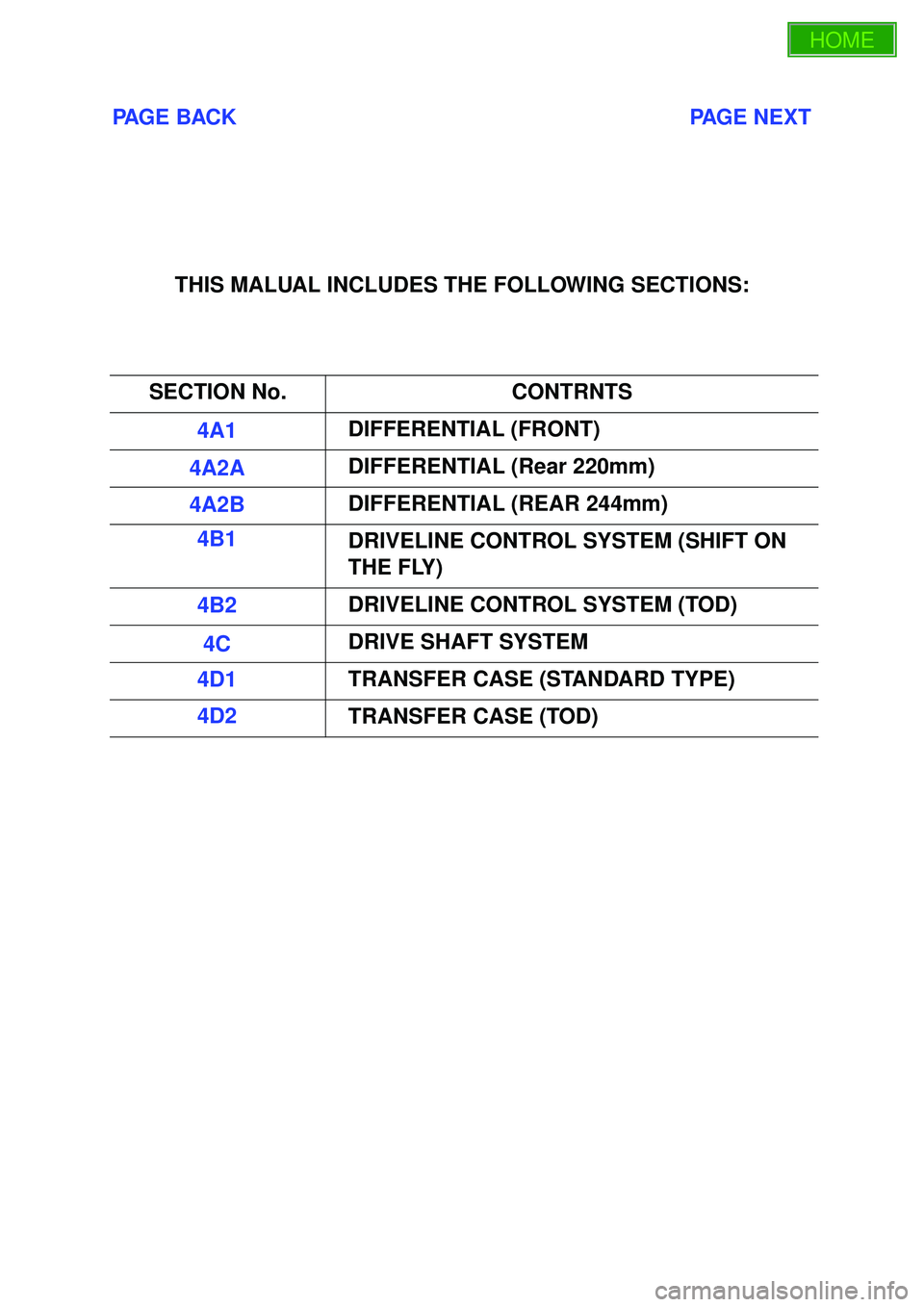
THIS MALUAL INCLUDES THE FOLLOWING SECTIONS:
SECTION No. CONTRNTS
4A1 DIFFERENTIAL (FRONT)
4A2A DIFFERENTIAL (Rear 220mm)
4A2B DIFFERENTIAL (REAR 244mm)
4B1 DRIVELINE CONTROL SYSTEM (SHIFT ON
THE FLY)
4B2 DRIVELINE CONTROL SYSTEM (TOD)
4C DRIVE SHAFT SYSTEM
4D1 TRANSFER CASE (STANDARD TYPE)
4D2 TRANSFER CASE (TOD)
Page 26 of 3573
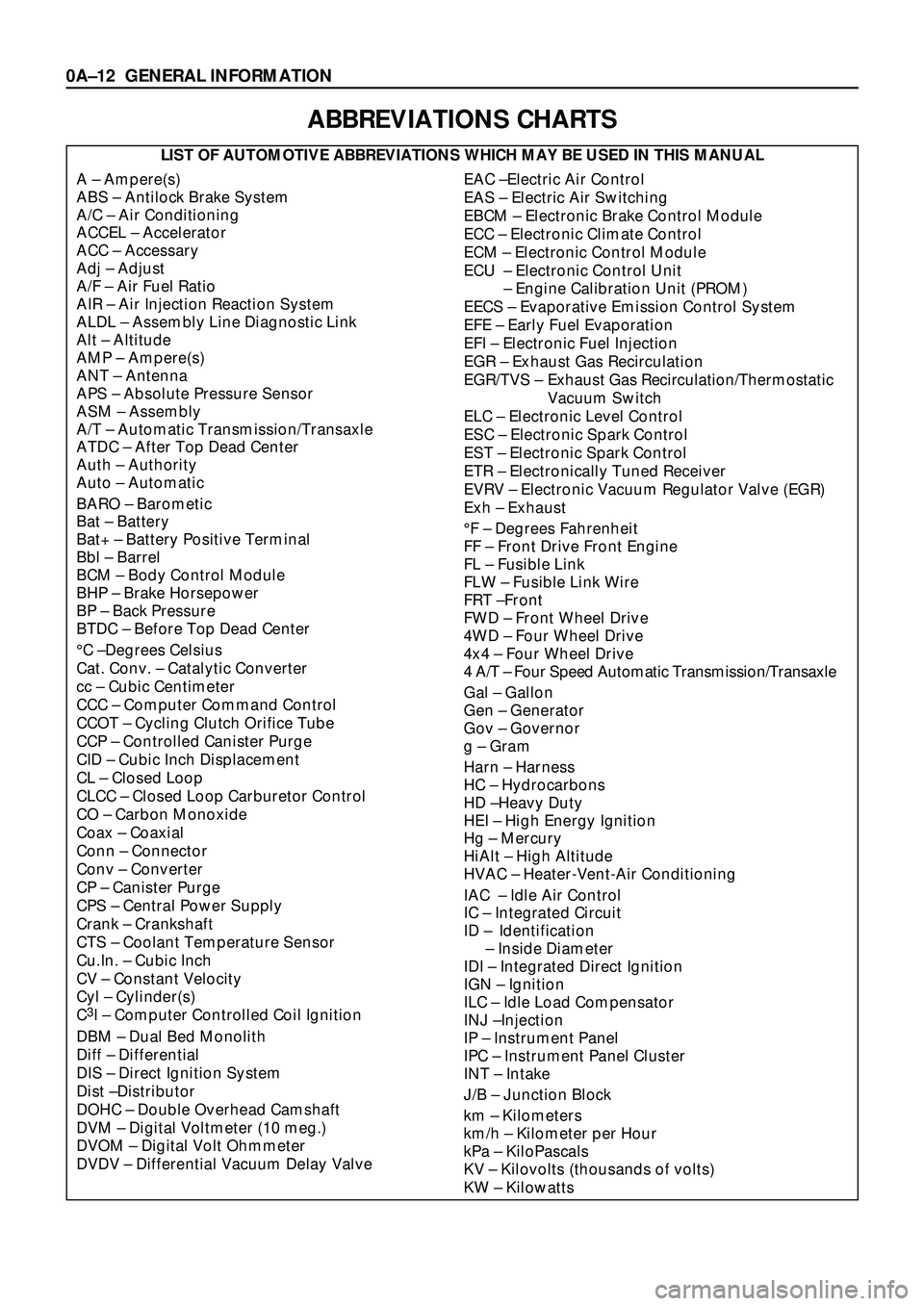
ABBREVIATIONS CHARTS
LIST OF AUTOMOTIVE ABBREVIATIONS WHICH MAY BE USED IN THIS MANUAL
A Ð Ampere(s)
ABS Ð Antilock Brake System
A/C Ð Air Conditioning
ACCEL Ð Accelerator
ACC Ð Accessary
Adj Ð Adjust
A/F Ð Air Fuel Ratio
AIR Ð Air Injection Reaction System
ALDL Ð Assembly Line Diagnostic Link
Alt Ð Altitude
AMP Ð Ampere(s)
ANT Ð Antenna
APS Ð Absolute Pressure Sensor
ASM Ð Assembly
A/T Ð Automatic Transmission/Transaxle
ATDC Ð After Top Dead Center
Auth Ð Authority
Auto Ð Automatic
BARO Ð Barometic
Bat Ð Battery
Bat+ Ð Battery Positive Terminal
Bbl Ð Barrel
BCM Ð Body Control Module
BHP Ð Brake Horsepower
BP Ð Back Pressure
BTDC Ð Before Top Dead Center
¡C ÐDegrees Celsius
Cat. Conv. Ð Catalytic Converter
cc Ð Cubic Centimeter
CCC Ð Computer Command Control
CCOT Ð Cycling Clutch Orifice Tube
CCP Ð Controlled Canister Purge
CID Ð Cubic Inch Displacement
CL Ð Closed Loop
CLCC Ð Closed Loop Carburetor Control
CO Ð Carbon Monoxide
Coax Ð Coaxial
Conn Ð Connector
Conv Ð Converter
CP Ð Canister Purge
CPS Ð Central Power Supply
Crank Ð Crankshaft
CTS Ð Coolant Temperature Sensor
Cu.In. Ð Cubic Inch
CV Ð Constant Velocity
Cyl Ð Cylinder(s)
C
3I Ð Computer Controlled Coil Ignition
DBM Ð Dual Bed Monolith
Diff Ð Differential
DIS Ð Direct Ignition System
Dist ÐDistributor
DOHC Ð Double Overhead Camshaft
DVM Ð Digital Voltmeter (10 meg.)
DVOM Ð Digital Volt Ohmmeter
DVDV Ð Differential Vacuum Delay Valve
EAC ÐElectric Air Control
EAS Ð Electric Air Switching
EBCM Ð Electronic Brake Control Module
ECC Ð Electronic Climate Control
ECM Ð Electronic Control Module
ECU Ð Electronic Control Unit
Ð Engine Calibration Unit (PROM)
EECS Ð Evaporative Emission Control System
EFE Ð Early Fuel Evaporation
EFI Ð Electronic Fuel Injection
EGR Ð Exhaust Gas Recirculation
EGR/TVS Ð Exhaust Gas Recirculation/Thermostatic
Vacuum Switch
ELC Ð Electronic Level Control
ESC Ð Electronic Spark Control
EST Ð Electronic Spark Control
ETR Ð Electronically Tuned Receiver
EVRV Ð Electronic Vacuum Regulator Valve (EGR)
Exh Ð Exhaust
¡F Ð Degrees Fahrenheit
FF Ð Front Drive Front Engine
FL Ð Fusible Link
FLW Ð Fusible Link Wire
FRT ÐFront
FWD Ð Front Wheel Drive
4WD Ð Four Wheel Drive
4x4 Ð Four Wheel Drive
4 A/T Ð Four Speed Automatic Transmission/Transaxle
Gal Ð Gallon
Gen Ð Generator
Gov Ð Governor
g Ð Gram
Harn Ð Harness
HC Ð Hydrocarbons
HD ÐHeavy Duty
HEI Ð High Energy Ignition
Hg Ð Mercury
HiAlt Ð High Altitude
HVAC Ð Heater-Vent-Air Conditioning
IAC Ð Idle Air Control
IC Ð Integrated Circuit
ID Ð Identification
Ð Inside Diameter
IDI Ð Integrated Direct Ignition
IGN Ð Ignition
ILC Ð Idle Load Compensator
INJ ÐInjection
IP Ð Instrument Panel
IPC Ð Instrument Panel Cluster
INT Ð Intake
J/B Ð Junction Block
km Ð Kilometers
km/h Ð Kilometer per Hour
kPa Ð KiloPascals
KV Ð Kilovolts (thousands of volts)
KW Ð Kilowatts
0AÐ12 GENERAL INFORMATION
Page 29 of 3573
0BÐ2 MAINTENANCE AND LUBRICATION
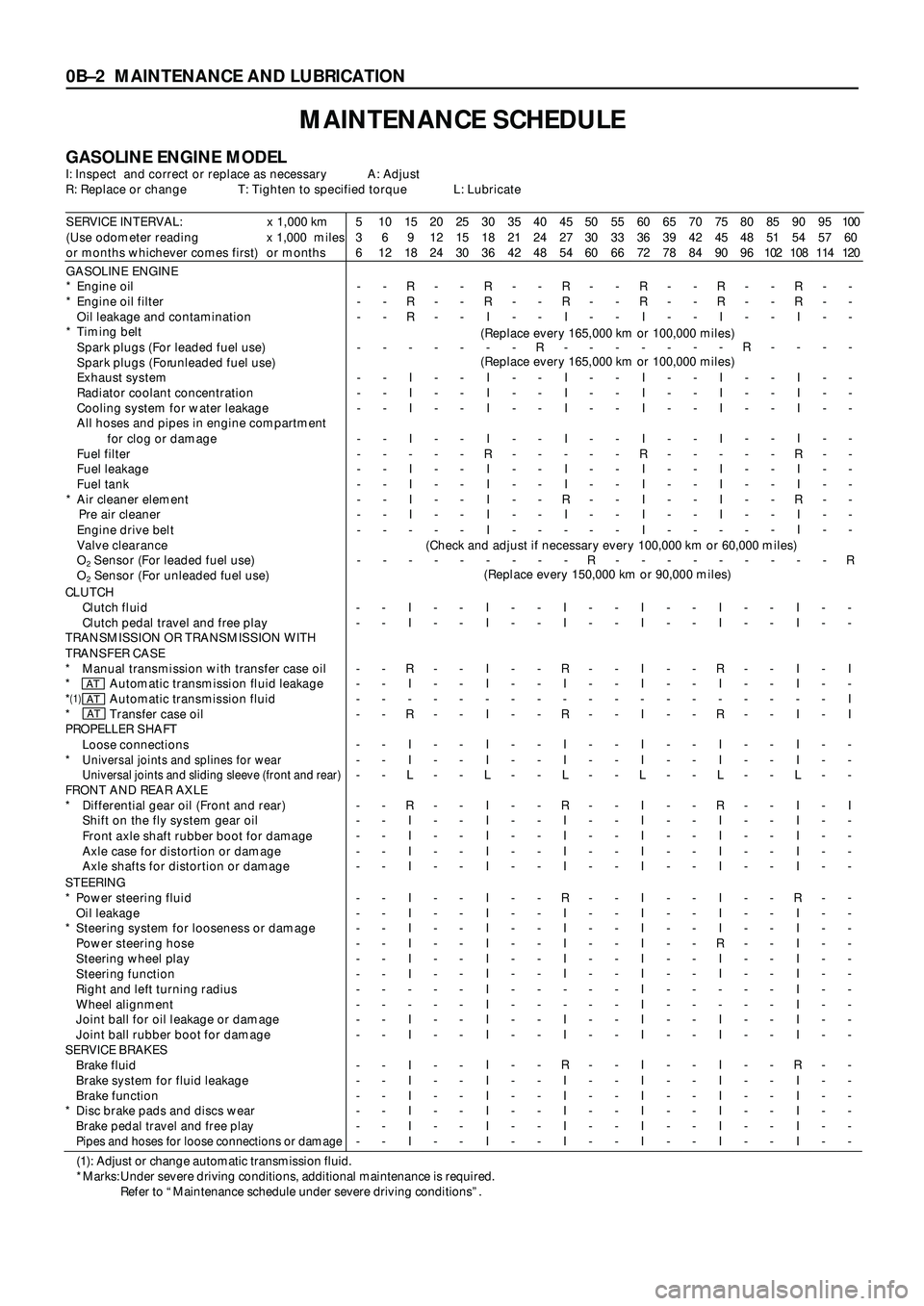
MAINTENANCE SCHEDULE
GASOLINE ENGINE MODELI: Inspect and correct or replace as necessary A: Adjust
R: Replace or change T: Tighten to specified torque L: Lubricate
SERVICE INTERVAL: x 1,000 km
(Use odometer reading x 1,000 miles
or months whichever comes first) or months5
3
610
6
1215
9
1820
12
2425
15
3030
18
3635
21
4240
24
4845
27
5450
30
6055
33
6660
36
7265
39
7870
42
8475
45
9080
48
9685
51
10290
54
10895
57
114100
60
120
GASOLINE ENGINE
* Engine oil
* Engine oil filter
Oil leakage and contamination
* Timing belt
Spark plugs (For leaded fuel use)
Spark plugs (For unleaded fuel use)
Exhaust system
Radiator coolant concentration
Cooling system for water leakage
All hoses and pipes in engine compartment
for clog or damage
Fuel filter
Fuel leakage
Fuel tank
* Air cleaner element
Pre air cleaner
Engine drive belt
Valve clearance
O
2 Sensor (For leaded fuel use)
O
2 Sensor (For unleaded fuel use)-
-
-
-
-
-
-
-
-
-
-
-
-
-
--
-
-
-
-
-
-
-
-
-
-
-
-
-
-R
R
R
-
I
I
I
I
-
I
I
I
I
-
--
-
-
-
-
-
-
-
-
-
-
-
-
-
--
-
-
-
-
-
-
-
-
-
-
-
-
-
-R
R
I
-
I
I
I
I
R
I
I
I
I
I
--
-
-
-
-
-
-
-
-
-
-
-
-
-
--
-
-
R
-
-
-
-
-
-
-
-
-
-
-R
R
I
-
I
I
I
I
-
I
I
R
I
-
--
-
-
-
-
-
-
-
-
-
-
-
-
-
R-
-
-
-
-
-
-
-
-
-
-
-
-
-
-R
R
I
-
I
I
I
I
R
I
I
I
I
I
--
-
-
-
-
-
-
-
-
-
-
-
-
-
--
-
-
-
-
-
-
-
-
-
-
-
-
-
-R
R
I
-
I
I
I
I
-
I
I
I
I
-
--
-
-
R
-
-
-
-
-
-
-
-
-
-
--
-
-
-
-
-
-
-
-
-
-
-
-
-
-R
R
I
-
I
I
I
I
R
I
I
R
I
I
--
-
-
-
-
-
-
-
-
-
-
-
-
-
--
-
-
-
-
-
-
-
-
-
-
-
-
-
R
(Replace every 165,000 km or 100,000 miles)
(Replace every 165,000 km or 100,000 miles)
(Check and adjust if necessary every 100,000 km or 60,000 miles)
(Replace every 150,000 km or 90,000 miles)
CLUTCH
Clutch fluid
Clutch pedal travel and free play
TRANSMISSION OR TRANSMISSION WITH
TRANSFER CASE
* Manual transmission with transfer case oil
* Automatic transmission fluid leakage
*
(1)Automatic transmission fluid
* Transfer case oil
PROPELLER SHAFT
Loose connections
*
Universal joints and splines for wear
Universal joints and sliding sleeve (front and rear)
FRONT AND REAR AXLE
* Differential gear oil (Front and rear)
Shift on the fly system gear oil
Front axle shaft rubber boot for damage
Axle case for distortion or damage
Axle shafts for distortion or damage-
-
-
-
-
-
-
-
-
-
-
-
-
--
-
-
-
-
-
-
-
-
-
-
-
-
-I
I
R
I
-
R
I
I
L
R
I
I
I
I-
-
-
-
-
-
-
-
-
-
-
-
-
--
-
-
-
-
-
-
-
-
-
-
-
-
-I
I
I
I
-
I
I
I
L
I
I
I
I
I-
-
-
-
-
-
-
-
-
-
-
-
-
--
-
-
-
-
-
-
-
-
-
-
-
-
-I
I
R
I
-
R
I
I
L
R
I
I
I
I-
-
-
-
-
-
-
-
-
-
-
-
-
--
-
-
-
-
-
-
-
-
-
-
-
-
-I
I
I
I
-
I
I
I
L
I
I
I
I
I-
-
-
-
-
-
-
-
-
-
-
-
-
--
-
-
-
-
-
-
-
-
-
-
-
-
-I
I
R
I
-
R
I
I
L
R
I
I
I
I-
-
-
-
-
-
-
-
-
-
-
-
-
--
-
-
-
-
-
-
-
-
-
-
-
-
-I
I
I
I
-
I
I
I
L
I
I
I
I
I-
-
-
-
-
-
-
-
-
-
-
-
-
--
-
I
-
I
I
-
-
-
I
-
-
-
-
ATATAT
STEERING
* Power steering fluid
Oil leakage
* Steering system for looseness or damage
Power steering hose
Steering wheel play
Steering function
Right and left turning radius
Wheel alignment
Joint ball for oil leakage or damage
Joint ball rubber boot for damage
SERVICE BRAKES
Brake fluid
Brake system for fluid leakage
Brake function
* Disc brake pads and discs wear
Brake pedal travel and free play
Pipes and hoses for loose connections or damage
-
-
-
-
-
-
-
-
-
-
-
-
-
-
-
--
-
-
-
-
-
-
-
-
-
-
-
-
-
-
-I
I
I
I
I
I
-
-
I
I
I
I
I
I
I
I-
-
-
-
-
-
-
-
-
-
-
-
-
-
-
--
-
-
-
-
-
-
-
-
-
-
-
-
-
-
-I
I
I
I
I
I
I
I
I
I
I
I
I
I
I
I-
-
-
-
-
-
-
-
-
-
-
-
-
-
-
--
-
-
-
-
-
-
-
-
-
-
-
-
-
-
-R
I
I
I
I
I
-
-
I
I
R
I
I
I
I
I-
-
-
-
-
-
-
-
-
-
-
-
-
-
-
--
-
-
-
-
-
-
-
-
-
-
-
-
-
-
-I
I
I
I
I
I
I
I
I
I
I
I
I
I
I
I-
-
-
-
-
-
-
-
-
-
-
-
-
-
-
--
-
-
-
-
-
-
-
-
-
-
-
-
-
-
-I
I
I
R
I
I
-
-
I
I
I
I
I
I
I
I-
-
-
-
-
-
-
-
-
-
-
-
-
-
-
--
-
-
-
-
-
-
-
-
-
-
-
-
-
-
-R
I
I
I
I
I
I
I
I
I
R
I
I
I
I
I-
-
-
-
-
-
-
-
-
-
-
-
-
-
-
--
-
-
-
-
-
-
-
-
-
-
-
-
-
-
-
(1): Adjust or change automatic transmission fluid.
*Marks: Under severe driving conditions, additional maintenance is required.
Refer to “Maintenance schedule under severe driving conditions”.
Page 31 of 3573
0BÐ4 MAINTENANCE AND LUBRICATION
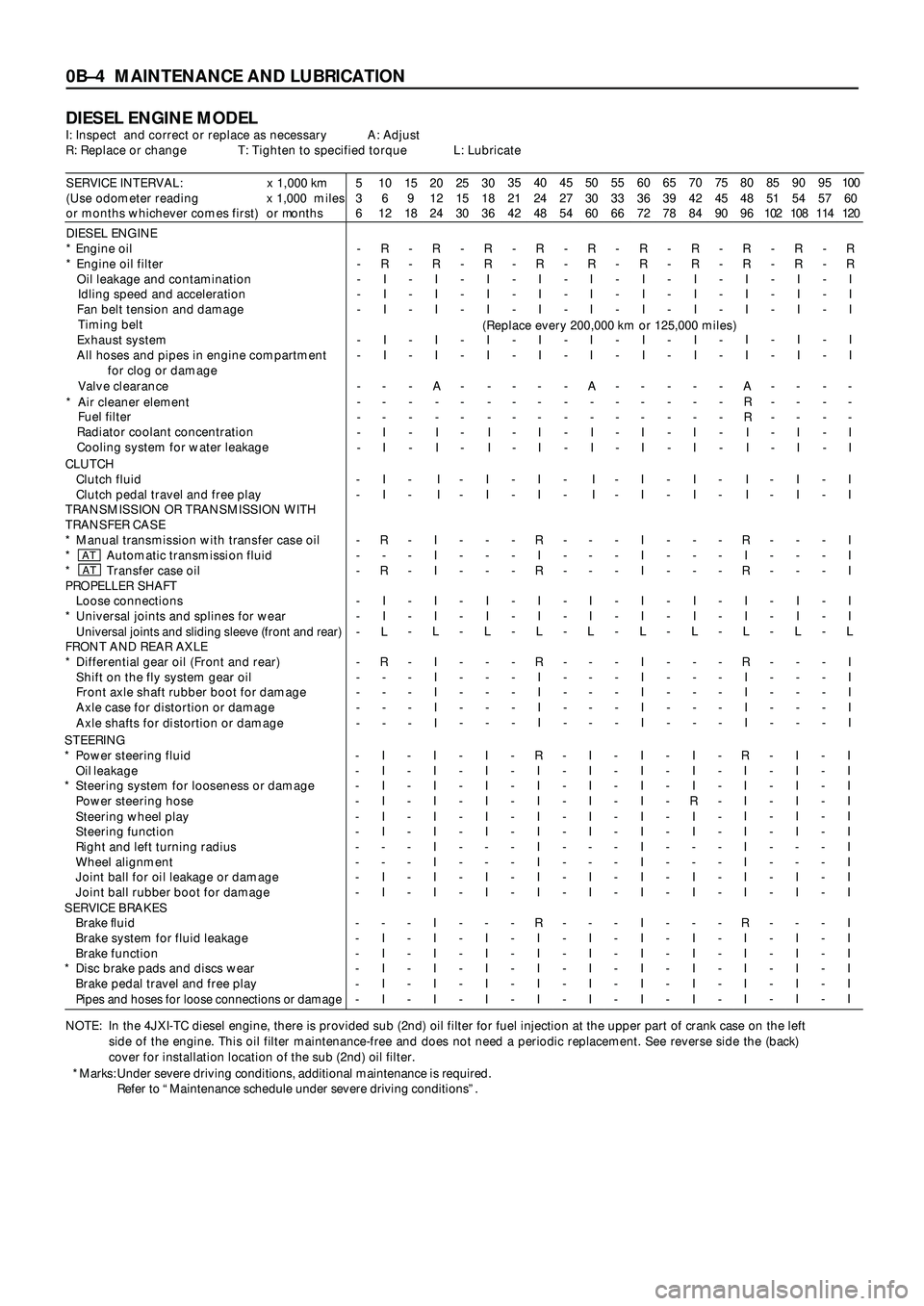
DIESEL ENGINE MODELI: Inspect and correct or replace as necessary A: Adjust
R: Replace or change T: Tighten to specified torque L: Lubricate
SERVICE INTERVAL: x 1,000 km
(Use odometer reading x 1,000 miles
or months whichever comes first) or months5
3
610
6
1215
9
1820
12
2425
15
3030
18
3635
21
4240
24
4845
27
5450
30
6055
33
6660
36
7265
39
7870
42
8475
45
9080
48
9685
51
10290
54
10895
57
114100
60
120
DIESEL ENGINE
* Engine oil
* Engine oil filter
Oil leakage and contamination
Idling speed and acceleration
Fan belt tension and damage
Timing belt
Exhaust system
All hoses and pipes in engine compartment
for clog or damage
Valve clearance
* Air cleaner element
Fuel filter
Radiator coolant concentration
Cooling system for water leakage-
-
-
-
-
-
-
-
-
-
-
-R
R
I
I
I
I
I
-
-
-
I
I-
-
-
-
-
-
-
-
-
-
-
-R
R
I
I
I
I
I
A
-
-
I
I-
-
-
-
-
-
-
-
-
-
-
-R
R
I
I
I
I
I
-
-
-
I
I-
-
-
-
-
-
-
-
-
-
-
-R
R
I
I
I
I
I
-
-
-
I
I-
-
-
-
-
-
-
-
-
-
-
-R
R
I
I
I
I
I
A
-
-
I
I-
-
-
-
-
-
-
-
-
-
-
-R
R
I
I
I
I
I
-
-
-
I
I-
-
-
-
-
-
-
-
-
-
-
-R
R
I
I
I
I
I
-
-
-
I
I-
-
-
-
-
-
-
-
-
-
-
-R
R
I
I
I
I
I
A
R
R
I
I-
-
-
-
-
-
-
-
-
-
-
-R
R
I
I
I
I
I
-
-
-
I
I-
-
-
-
-
-
-
-
-
-
-
-R
R
I
I
I
I
I
-
-
-
I
I
NOTE: In the 4JXI-TC diesel engine, there is provided sub (2nd) oil filter for fuel injection at the upper part of crank case on the left
side of the engine. This oil filter maintenance-free and does not need a periodic replacement. See reverse side the (back)
cover for installation location of the sub (2nd) oil filter.(Replace every 200,000 km or 125,000 miles)
*Marks: Under severe driving conditions, additional maintenance is required.
Refer to “Maintenance schedule under severe driving conditions”. CLUTCH
Clutch fluid
Clutch pedal travel and free play
TRANSMISSION OR TRANSMISSION WITH
TRANSFER CASE
* Manual transmission with transfer case oil
* Automatic transmission fluid
* Transfer case oil
PROPELLER SHAFT
Loose connections
* Universal joints and splines for wear
Universal joints and sliding sleeve (front and rear)FRONT AND REAR AXLE
* Differential gear oil (Front and rear)
Shift on the fly system gear oil
Front axle shaft rubber boot for damage
Axle case for distortion or damage
Axle shafts for distortion or damage-
-
-
-
-
-
-
-
-
-
-
-
-I
I
R
-
R
I
I
L
R
-
-
-
--
-
-
-
-
-
-
-
-
-
-
-
-I
I
I
I
I
I
I
L
I
I
I
I
I-
-
-
-
-
-
-
-
-
-
-
-
-I
I
-
-
-
I
I
L
-
-
-
-
--
-
-
-
-
-
-
-
-
-
-
-
-I
I
R
I
R
I
I
L
R
I
I
I
I-
-
-
-
-
-
-
-
-
-
-
-
-I
I
-
-
-
I
I
L
-
-
-
-
--
-
-
-
-
-
-
-
-
-
-
-
-I
I
I
I
I
I
I
L
I
I
I
I
I-
-
-
-
-
-
-
-
-
-
-
-
-I
I
-
-
-
I
I
L
-
-
-
-
--
-
-
-
-
-
-
-
-
-
-
-
-I
I
R
I
R
I
I
L
R
I
I
I
I-
-
-
-
-
-
-
-
-
-
-
-
-I
I
-
-
-
I
I
L
-
-
-
-
--
-
-
-
-
-
-
-
-
-
-
-
-I
I
I
I
I
I
I
L
I
I
I
I
I
ATAT
STEERING
* Power steering fluid
Oil leakage
* Steering system for looseness or damage
Power steering hose
Steering wheel play
Steering function
Right and left turning radius
Wheel alignment
Joint ball for oil leakage or damage
Joint ball rubber boot for damage
SERVICE BRAKES
Brake fluid
Brake system for fluid leakage
Brake function
* Disc brake pads and discs wear
Brake pedal travel and free play
Pipes and hoses for loose connections or damage
-
-
-
-
-
-
-
-
-
-
-
-
-
-
-
-I
I
I
I
I
I
-
-
I
I
-
I
I
I
I
I-
-
-
-
-
-
-
-
-
-
-
-
-
-
-
-I
I
I
I
I
I
I
I
I
I
I
I
I
I
I
I-
-
-
-
-
-
-
-
-
-
-
-
-
-
-
-I
I
I
I
I
I
-
-
I
I
-
I
I
I
I
I-
-
-
-
-
-
-
-
-
-
-
-
-
-
-
-R
I
I
I
I
I
I
I
I
I
R
I
I
I
I
I-
-
-
-
-
-
-
-
-
-
-
-
-
-
-
-I
I
I
I
I
I
-
-
I
I
-
I
I
I
I
I-
-
-
-
-
-
-
-
-
-
-
-
-
-
-
-I
I
I
I
I
I
I
I
I
I
I
I
I
I
I
I-
-
-
-
-
-
-
-
-
-
-
-
-
-
-
-I
I
I
R
I
I
-
-
I
I
-
I
I
I
I
I-
-
-
-
-
-
-
-
-
-
-
-
-
-
-
-R
I
I
I
I
I
I
I
I
I
R
I
I
I
I
I-
-
-
-
-
-
-
-
-
-
-
-
-
-
-
-I
I
I
I
I
I
-
-
I
I
-
I
I
I
I
I-
-
-
-
-
-
-
-
-
-
-
-
-
-
-
-I
I
I
I
I
I
I
I
I
I
I
I
I
I
I
I
Page 33 of 3573
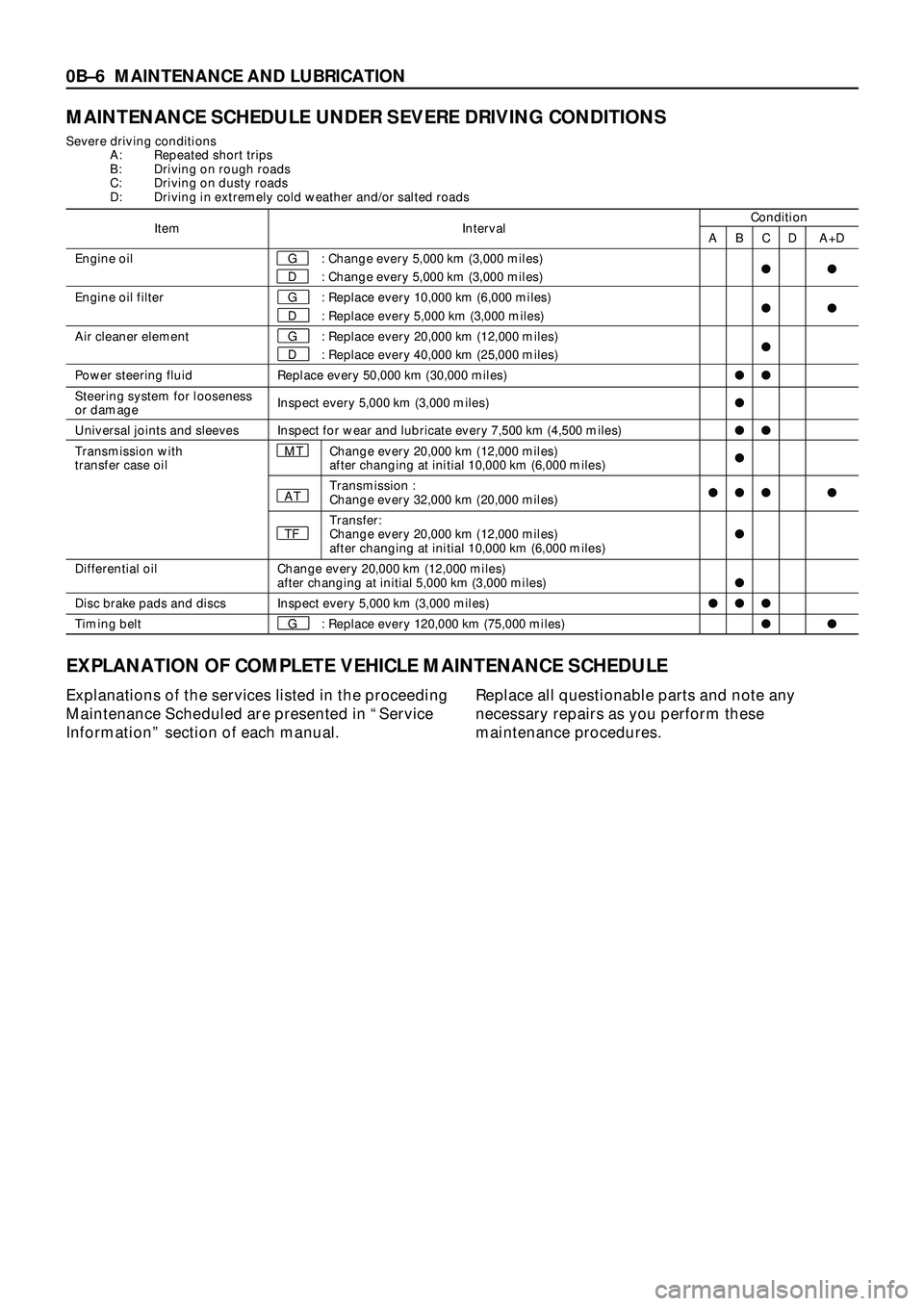
0BÐ6 MAINTENANCE AND LUBRICATION
Item IntervalCondition
ABCD A+D
Engine oil G : Change every 5,000 km (3,000 miles)
D : Change every 5,000 km (3,000 miles) ll
Engine oil filter G : Replace every 10,000 km (6,000 miles)
D : Replace every 5,000 km (3,000 miles) ll
Air cleaner element G : Replace every 20,000 km (12,000 miles)
D : Replace every 40,000 km (25,000 miles)l
Power steering fluid Replace every 50,000 km (30,000 miles)ll
Steering system for looseness
or damage Inspect every 5,000 km (3,000 miles)l
Universal joints and sleeves Inspect for wear and lubricate every 7,500 km (4,500 miles)ll
Transmission with MT Change every 20,000 km (12,000 miles)
transfer case oil after changing at initial 10,000 km (6,000 miles)l
Transmission :
AT
Change every 32,000 km (20,000 miles) lll l
Transfer:
TF Change every 20,000 km (12,000 miles)
after changing at initial 10,000 km (6,000 miles)l
Differential oil Change every 20,000 km (12,000 miles)
after changing at initial 5,000 km (3,000 miles) l
Disc brake pads and discs Inspect every 5,000 km (3,000 miles)lll
Timing belt G : Replace every 120,000 km (75,000 miles)ll
EXPLANATION OF COMPLETE VEHICLE MAINTENANCE SCHEDULE
Explanations of the services listed in the proceeding
Maintenance Scheduled are presented in ÒService
InformationÓ section of each manual.Replace all questionable parts and note any
necessary repairs as you perform these
maintenance procedures.
MAINTENANCE SCHEDULE UNDER SEVERE DRIVING CONDITIONS
Severe driving conditions
A: Repeated short trips
B: Driving on rough roads
C: Driving on dusty roads
D: Driving in extremely cold weather and/or salted roads
Page 34 of 3573
MAINTENANCE AND LUBRICATION 0BÐ7
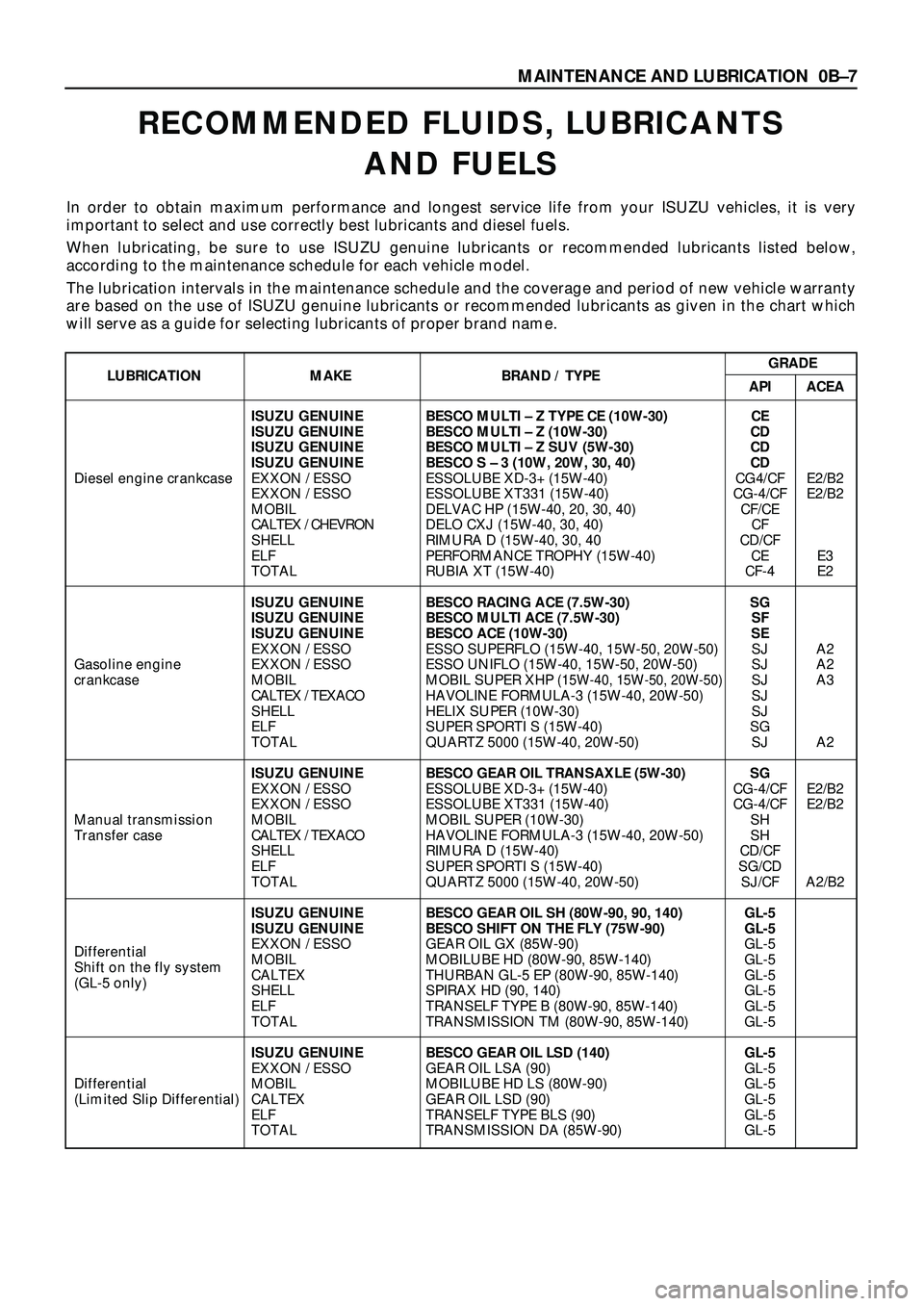
RECOMMENDED FLUIDS, LUBRICANTS
AND FUELS
In order to obtain maximum performance and longest service life from your ISUZU vehicles, it is very
important to select and use correctly best lubricants and diesel fuels.
When lubricating, be sure to use ISUZU genuine lubricants or recommended lubricants listed below,
according to the maintenance schedule for each vehicle model.
The lubrication intervals in the maintenance schedule and the coverage and period of new vehicle warranty
are based on the use of ISUZU genuine lubricants or recommended lubricants as given in the chart which
will serve as a guide for selecting lubricants of proper brand name.
LUBRICATION MAKE BRAND / TYPEGRADE
API ACEA
ISUZU GENUINE BESCO MULTI Ð Z TYPE CE (10W-30) CE
ISUZU GENUINE BESCO MULTI Ð Z (10W-30) CD
ISUZU GENUINE BESCO MULTI Ð Z SUV (5W-30) CD
ISUZU GENUINE BESCO S Ð 3 (10W, 20W, 30, 40) CD
Diesel engine crankcase EXXON / ESSO ESSOLUBE XD-3+ (15W-40) CG4/CF E2/B2
EXXON / ESSO ESSOLUBE XT331 (15W-40) CG-4/CF E2/B2
MOBIL DELVAC HP (15W-40, 20, 30, 40) CF/CE
CALTEX / CHEVRONDELO CXJ (15W-40, 30, 40) CF
SHELL RIMURA D (15W-40, 30, 40 CD/CF
ELF PERFORMANCE TROPHY (15W-40) CE E3
TOTAL RUBIA XT (15W-40) CF-4 E2
ISUZU GENUINE BESCO RACING ACE (7.5W-30) SG
ISUZU GENUINE BESCO MULTI ACE (7.5W-30) SF
ISUZU GENUINE BESCO ACE (10W-30) SE
EXXON / ESSO ESSO SUPERFLO (15W-40, 15W-50, 20W-50) SJ A2
Gasoline engine EXXON / ESSO ESSO UNIFLO (15W-40, 15W-50, 20W-50) SJ A2
crankcase MOBIL MOBIL SUPER XHP
(15W-40, 15W-50, 20W-50)SJ A3
CALTEX / TEXACOHAVOLINE FORMULA-3 (15W-40, 20W-50) SJ
SHELL HELIX SUPER (10W-30) SJ
ELF SUPER SPORTI S (15W-40) SG
TOTAL QUARTZ 5000 (15W-40, 20W-50) SJ A2
ISUZU GENUINE BESCO GEAR OIL TRANSAXLE (5W-30) SG
EXXON / ESSO ESSOLUBE XD-3+ (15W-40) CG-4/CF E2/B2
EXXON / ESSO ESSOLUBE XT331 (15W-40) CG-4/CF E2/B2
Manual transmission MOBIL MOBIL SUPER (10W-30) SH
Transfer caseCALTEX / TEXACOHAVOLINE FORMULA-3 (15W-40, 20W-50) SH
SHELL RIMURA D (15W-40) CD/CF
ELF SUPER SPORTI S (15W-40) SG/CD
TOTAL QUARTZ 5000 (15W-40, 20W-50) SJ/CF A2/B2
ISUZU GENUINE BESCO GEAR OIL SH (80W-90, 90, 140) GL-5
ISUZU GENUINE BESCO SHIFT ON THE FLY (75W-90) GL-5
DifferentialEXXON / ESSO GEAR OIL GX (85W-90) GL-5
Shift on the fly systemMOBIL MOBILUBE HD (80W-90, 85W-140) GL-5
(GL-5 only)CALTEX THURBAN GL-5 EP (80W-90, 85W-140) GL-5
SHELL SPIRAX HD (90, 140) GL-5
ELF TRANSELF TYPE B (80W-90, 85W-140) GL-5
TOTAL TRANSMISSION TM (80W-90, 85W-140) GL-5
ISUZU GENUINE BESCO GEAR OIL LSD (140) GL-5
EXXON / ESSO GEAR OIL LSA (90) GL-5
Differential MOBIL MOBILUBE HD LS (80W-90) GL-5
(Limited Slip Differential) CALTEX GEAR OIL LSD (90) GL-5
ELF TRANSELF TYPE BLS (90) GL-5
TOTAL TRANSMISSION DA (85W-90) GL-5
Page 85 of 3573
00 Ð 46 SERVICE INFORMATION
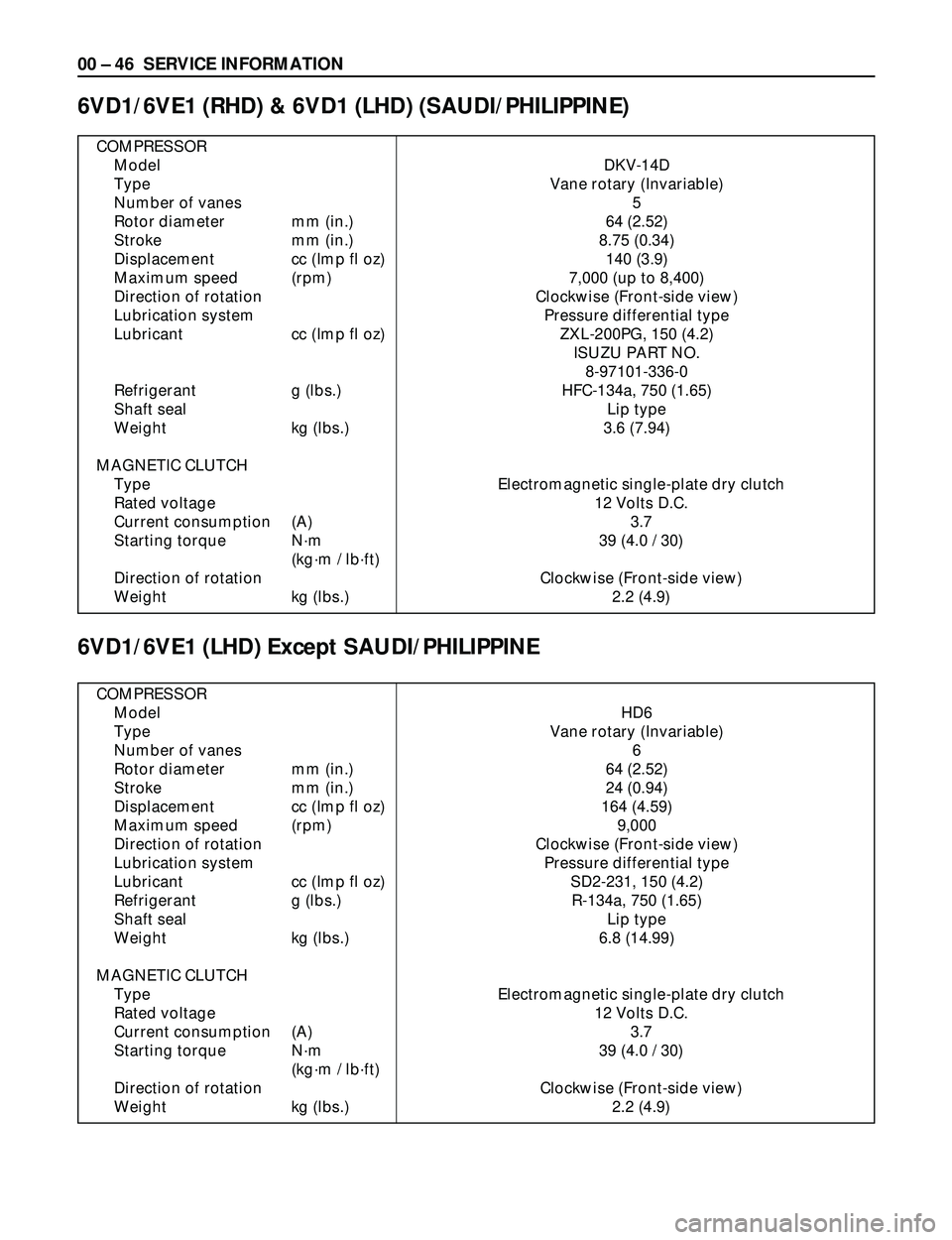
COMPRESSOR
Model DKV-14D
Type Vane rotary (Invariable)
Number of vanes 5
Rotor diameter mm (in.) 64 (2.52)
Stroke mm (in.) 8.75 (0.34)
Displacement cc (Imp fl oz) 140 (3.9)
Maximum speed (rpm) 7,000 (up to 8,400)
Direction of rotation Clockwise (Front-side view)
Lubrication system Pressure differential type
Lubricant cc (Imp fl oz) ZXL-200PG, 150 (4.2)
ISUZU PART NO.
8-97101-336-0
Refrigerant g (lbs.) HFC-134a, 750 (1.65)
Shaft seal Lip type
Weight kg (lbs.) 3.6 (7.94)
MAGNETIC CLUTCH
Type Electromagnetic single-plate dry clutch
Rated voltage 12 Volts D.C.
Current consumption (A) 3.7
Starting torque Nám 39 (4.0 / 30)
(kgám / lbáft)
Direction of rotation Clockwise (Front-side view)
Weight kg (lbs.) 2.2 (4.9)
6VD1/6VE1 (RHD) & 6VD1 (LHD) (SAUDI/PHILIPPINE)
6VD1/6VE1 (LHD) Except SAUDI/PHILIPPINE
COMPRESSOR
Model HD6
Type Vane rotary (Invariable)
Number of vanes 6
Rotor diameter mm (in.) 64 (2.52)
Stroke mm (in.) 24 (0.94)
Displacement cc (Imp fl oz) 164 (4.59)
Maximum speed (rpm) 9,000
Direction of rotation Clockwise (Front-side view)
Lubrication system Pressure differential type
Lubricant cc (Imp fl oz) SD2-231, 150 (4.2)
Refrigerant g (lbs.) R-134a, 750 (1.65)
Shaft seal Lip type
Weight kg (lbs.) 6.8 (14.99)
MAGNETIC CLUTCH
Type Electromagnetic single-plate dry clutch
Rated voltage 12 Volts D.C.
Current consumption (A) 3.7
Starting torque Nám 39 (4.0 / 30)
(kgám / lbáft)
Direction of rotation Clockwise (Front-side view)
Weight kg (lbs.) 2.2 (4.9)
Page 86 of 3573
SERVICE INFORMATION 00 Ð 47
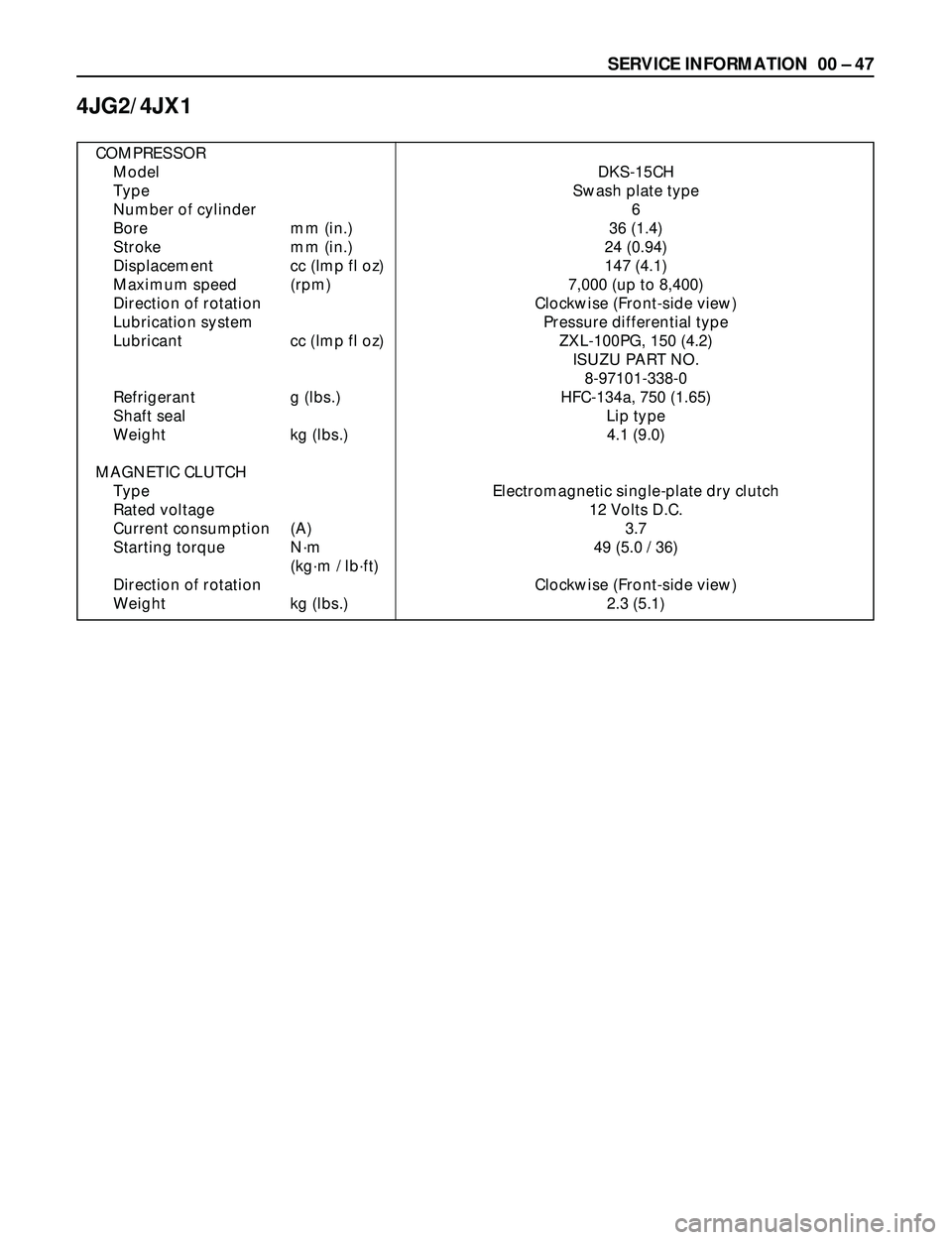
4JG2/4JX1
COMPRESSOR
Model DKS-15CH
Type Swash plate type
Number of cylinder 6
Bore mm (in.) 36 (1.4)
Stroke mm (in.) 24 (0.94)
Displacement cc (Imp fl oz) 147 (4.1)
Maximum speed (rpm) 7,000 (up to 8,400)
Direction of rotation Clockwise (Front-side view)
Lubrication system Pressure differential type
Lubricant cc (Imp fl oz) ZXL-100PG, 150 (4.2)
ISUZU PART NO.
8-97101-338-0
Refrigerant g (lbs.) HFC-134a, 750 (1.65)
Shaft seal Lip type
Weight kg (lbs.) 4.1 (9.0)
MAGNETIC CLUTCH
Type Electromagnetic single-plate dry clutch
Rated voltage 12 Volts D.C.
Current consumption (A) 3.7
Starting torque Nám 49 (5.0 / 36)
(kgám / lbáft)
Direction of rotation Clockwise (Front-side view)
Weight kg (lbs.) 2.3 (5.1)
Page 131 of 3573
AIR CONDITIONING 1B Ð 5
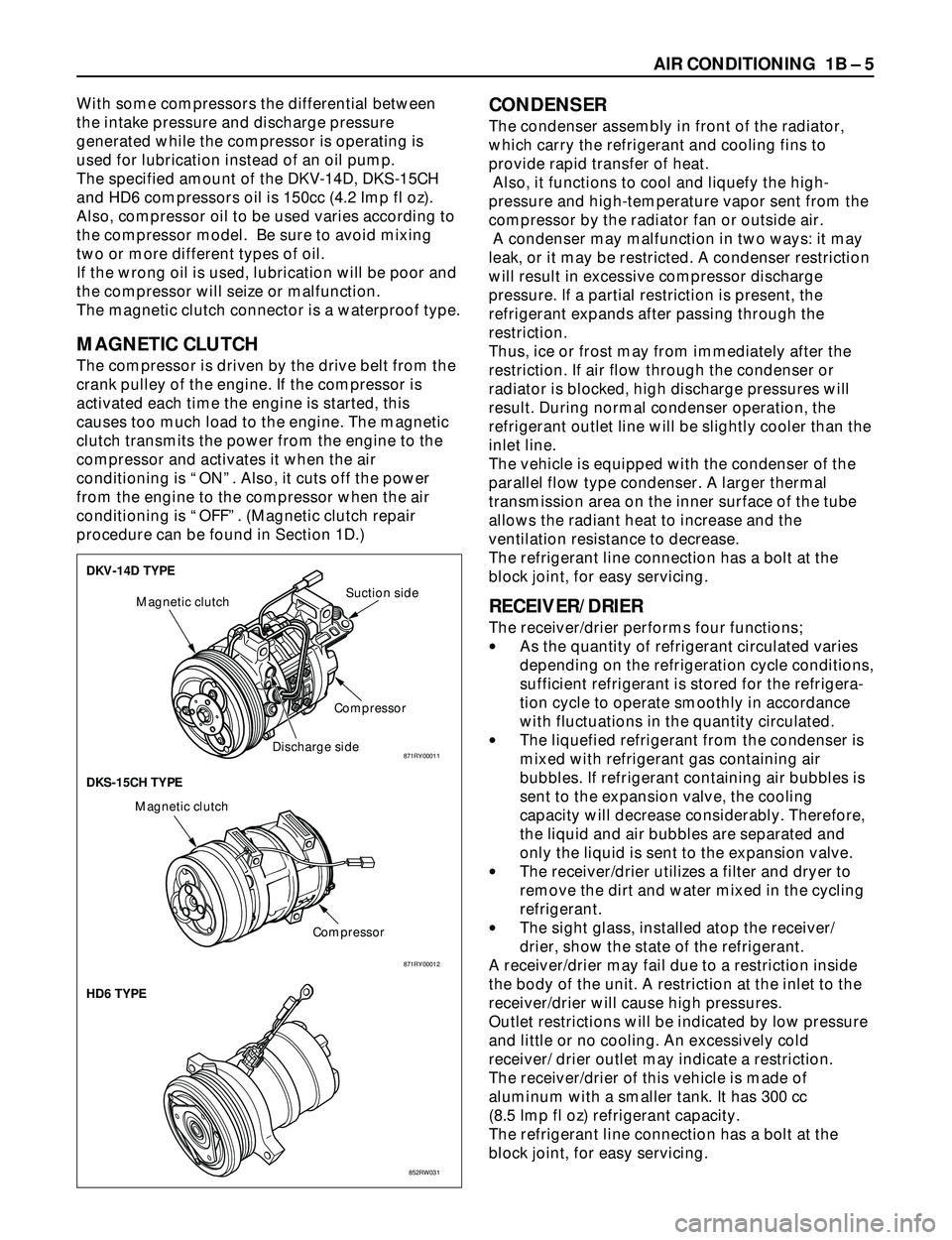
With some compressors the differential between
the intake pressure and discharge pressure
generated while the compressor is operating is
used for lubrication instead of an oil pump.
The specified amount of the DKV-14D, DKS-15CH
and HD6 compressors oil is 150cc (4.2 Imp fl oz).
Also, compressor oil to be used varies according to
the compressor model. Be sure to avoid mixing
two or more different types of oil.
If the wrong oil is used, lubrication will be poor and
the compressor will seize or malfunction.
The magnetic clutch connector is a waterproof type.
MAGNETIC CLUTCH
The compressor is driven by the drive belt from the
crank pulley of the engine. If the compressor is
activated each time the engine is started, this
causes too much load to the engine. The magnetic
clutch transmits the power from the engine to the
compressor and activates it when the air
conditioning is ÒONÓ. Also, it cuts off the power
from the engine to the compressor when the air
conditioning is ÒOFFÓ. (Magnetic clutch repair
procedure can be found in Section 1D.)
CONDENSER
The condenser assembly in front of the radiator,
which carry the refrigerant and cooling fins to
provide rapid transfer of heat.
Also, it functions to cool and liquefy the high-
pressure and high-temperature vapor sent from the
compressor by the radiator fan or outside air.
A condenser may malfunction in two ways: it may
leak, or it may be restricted. A condenser restriction
will result in excessive compressor discharge
pressure. If a partial restriction is present, the
refrigerant expands after passing through the
restriction.
Thus, ice or frost may from immediately after the
restriction. If air flow through the condenser or
radiator is blocked, high discharge pressures will
result. During normal condenser operation, the
refrigerant outlet line will be slightly cooler than the
inlet line.
The vehicle is equipped with the condenser of the
parallel flow type condenser. A larger thermal
transmission area on the inner surface of the tube
allows the radiant heat to increase and the
ventilation resistance to decrease.
The refrigerant line connection has a bolt at the
block joint, for easy servicing.
RECEIVER/DRIER
The receiver/drier performs four functions;
·As the quantity of refrigerant circulated varies
depending on the refrigeration cycle conditions,
sufficient refrigerant is stored for the refrigera-
tion cycle to operate smoothly in accordance
with fluctuations in the quantity circulated.
·The liquefied refrigerant from the condenser is
mixed with refrigerant gas containing air
bubbles. If refrigerant containing air bubbles is
sent to the expansion valve, the cooling
capacity will decrease considerably. Therefore,
the liquid and air bubbles are separated and
only the liquid is sent to the expansion valve.
·The receiver/drier utilizes a filter and dryer to
remove the dirt and water mixed in the cycling
refrigerant.
·The sight glass, installed atop the receiver/
drier, show the state of the refrigerant.
A receiver/drier may fail due to a restriction inside
the body of the unit. A restriction at the inlet to the
receiver/drier will cause high pressures.
Outlet restrictions will be indicated by low pressure
and little or no cooling. An excessively cold
receiver/ drier outlet may indicate a restriction.
The receiver/drier of this vehicle is made of
aluminum with a smaller tank. It has 300 cc
(8.5 Imp fl oz) refrigerant capacity.
The refrigerant line connection has a bolt at the
block joint, for easy servicing.
DKV-14D TYPE
DKS-15CH TYPE
HD6 TYPE
Magnetic clutch
CompressorSuction side
Discharge side
Compressor Magnetic clutch
852RW031 871RY00012
871RY00011
Page 259 of 3573
COMPRESSOR OVERHAUL 1D Ð 3
solvent, and dried with dry air. Use only lint free
cloths to wipe parts.
The operations described below are based on
bench overhaul with compressor removed from the
car, except as noted. They have been prepared in
order of accessibility of the components. When the
compressor is removed from the car for servicing,
the oil remaining in the compressor should be
discarded and new refrigerant oil added to the
compressor.
Magnetic clutch assembly repair procedures require
that the system be discharged of refrigerant. (Refer
to Section 1B for ÒREFRIGERANT RECOVERYÓ.)
Compressor malfunction will appear in one of four
ways: noise, seizure, leakage or low discharge
pressure. Resonant compressor noises are not
cause for alarm; however, irregular noise or rattles
may indicate broken parts or excessive clearances
due to wear. To check seizure, de-energize the
magnetic clutch and check to see if the drive plate
can be rotated. If rotation is impossible, the
compressor is seized. Low discharge pressure may
be due to a faulty internal seal of the compressor,
or a restriction in the compressor. Low discharge
pressure may also be due to an insufficient
refrigerant charge or a restriction elsewhere in the
system. These possibilities should be checked prior
to servicing the compressor. If the compressor is
inoperative, but is not seized, check to see if current
is being supplied to the magnetic clutch coil
terminals.
The compressor has vanes built into a rotor which
is mounted on a shaft.
When the shaft rotates, the vanes built into the
cylinder block assembly are opened by centrifugal
force.
This changes the volume of the space formed by
the rotor and cylinder, resulting in the intake and
compression of the refrigerant gas. The discharge
valve and the valve stopper, which protects the
discharge valve, are built into the cylinder block
assembly. There is no suction valve but a shaft seal
is installed between the shaft and head; a trigger
valve, which applies back pressure to the vanes, is
installed in the cylinder block and a refrigerant gas
temperature sensor is installed in the front head.
The specified quantity of compressor oil is
contained in the compressor to lubricate the various
parts using the refrigerant gas discharge pressure.
6VD1 engine is equipped with an invariable
capacity five-vane rotary compressor (DKV-14D
Type).
The compressor sucks and compresses refrigerant
by the rotation of the vane installed to the shaft,
and always discharges a fixed amount of refrigerant
independent of the load of refrigerant.The thermo sensor is installed to the front head of
the compressor to protect it by stopping its
operation when the refrigerant gas is insufficient or
when the temperature get abnormally high.
·OFF ..... 160 ±5¡C (320.0 ±9.0¡F)
·ON ..... 135 ±5¡C (275.0 ±9.0¡F)
4JG2 Engine are provided with a swash plate type
compressor (DKS-15CH Type)
Swash plate compressors have a swash (slanted)
plate mounted on the shaft. When the shaft turns,
the rotation of the swash plate is converted to
reciprocating piston motion which sucks in and
compresses the refrigerant gas.
Shaft seal (Lip type) is installed between the valve
plate and shaft & cylinder head to prevent
refrigerant gas leaks. A specified amount of
compressor oil is contained in the oil pan.
This oil is supplied to the cylinders, bearings, etc.,
by an oil pump which is connected to the swash
plate shaft.
With some compressors the differential between
the intake pressure and discharge pressure
generated while the compressor is operating is
used for lubrication instead of an oil pump.
Three pistons are arranged at 120g intervals around
the center of the swash plate shaft. These pistons
are connected to the ends of the swash plate
through shoe disks and balls.
The rotation of the swash plate causes
reciprocating movement of the piston inside the
cylinders, with each piston operating as two
cylinders. Because of that, the compressor operates
as though it has 6 cylinders.
The specified amount of the compressors oil is
150cc (4.2 Imp fl oz).
Also, compressor oil to be used varies according to
the compressor model. Be sure to avoid mixing two
or more different types of oil.
If the wrong oil is used, lubrication will be poor and
the compressor will seize or malfunction.