warning light ISUZU TROOPER 1998 Service Repair Manual
[x] Cancel search | Manufacturer: ISUZU, Model Year: 1998, Model line: TROOPER, Model: ISUZU TROOPER 1998Pages: 3573, PDF Size: 60.36 MB
Page 358 of 3573
2A – 56 SUPPLEMENTAL RESTRAINT SYSTEM STEERING WHEEL & COLUMN
3
41
2
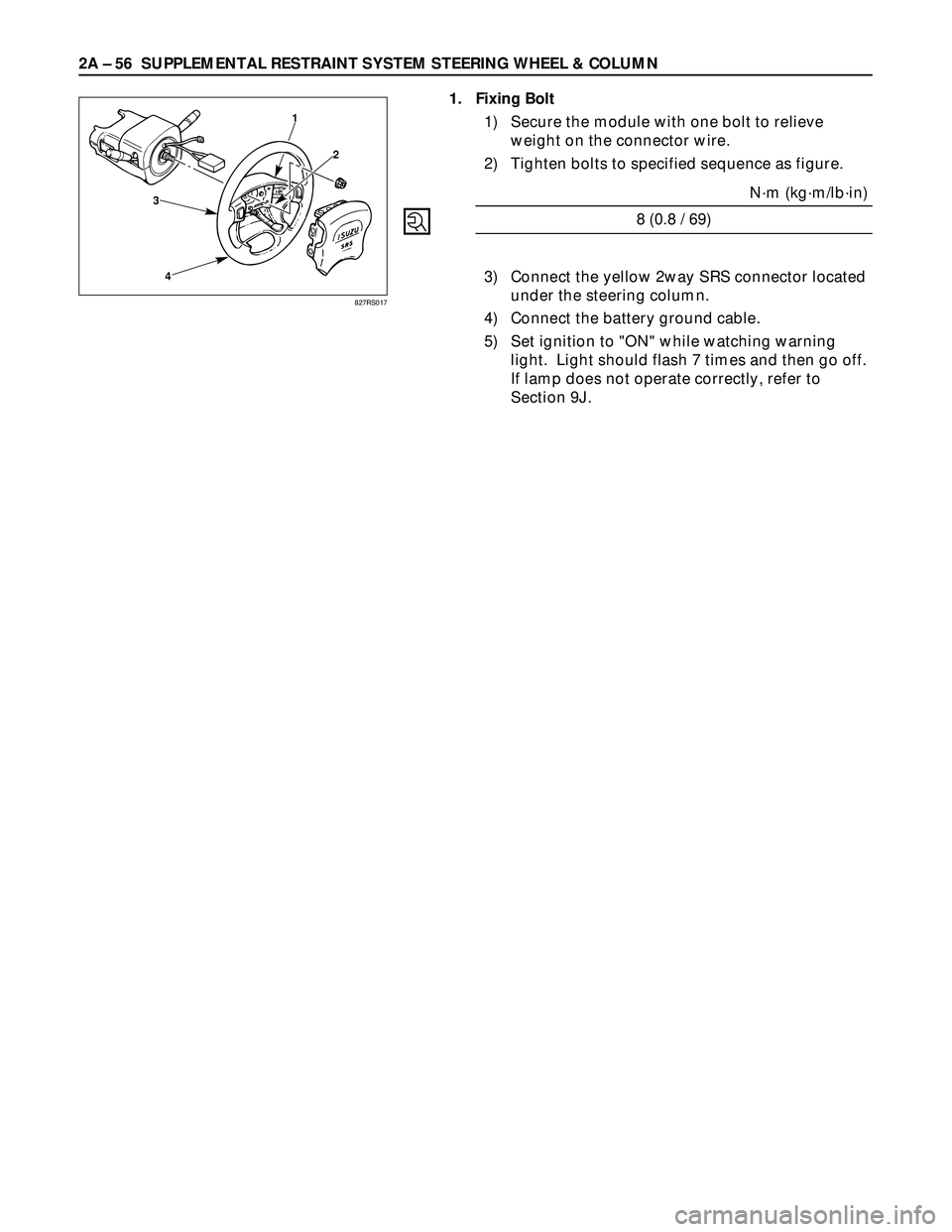
1. Fixing Bolt
1) Secure the module with one bolt to relieve
weight on the connector wire.
2) Tighten bolts to specified sequence as figure.
N·m (kg·m/lb·in)
8 (0.8 / 69)
3) Connect the yellow 2way SRS connector located
under the steering column.
4) Connect the battery ground cable.
5) Set ignition to "ON" while watching warning
light. Light should flash 7 times and then go off.
If lamp does not operate correctly, refer to
Section 9J.
827RS017
Page 361 of 3573
SUPPLEMENTAL RESTRAINT SYSTEM STEERING WHEEL & COLUMN 2A Ð 59
INSTALLATION
4. Steering Wheel
Align the setting marks made when removing.
CAUTION:
Never apply force to the setting wheel in direction of the
shaft by using a hammer or other impact tools in an
attempt to install the steering wheel. The setting shaft is
designed as an energy absorbing unit.
3. Steering Wheel Fixing Nut
Steering Wheel Nut Torque Nám (kgám/lbáft)
34 (3.5 / 25)
2. Horn Lead
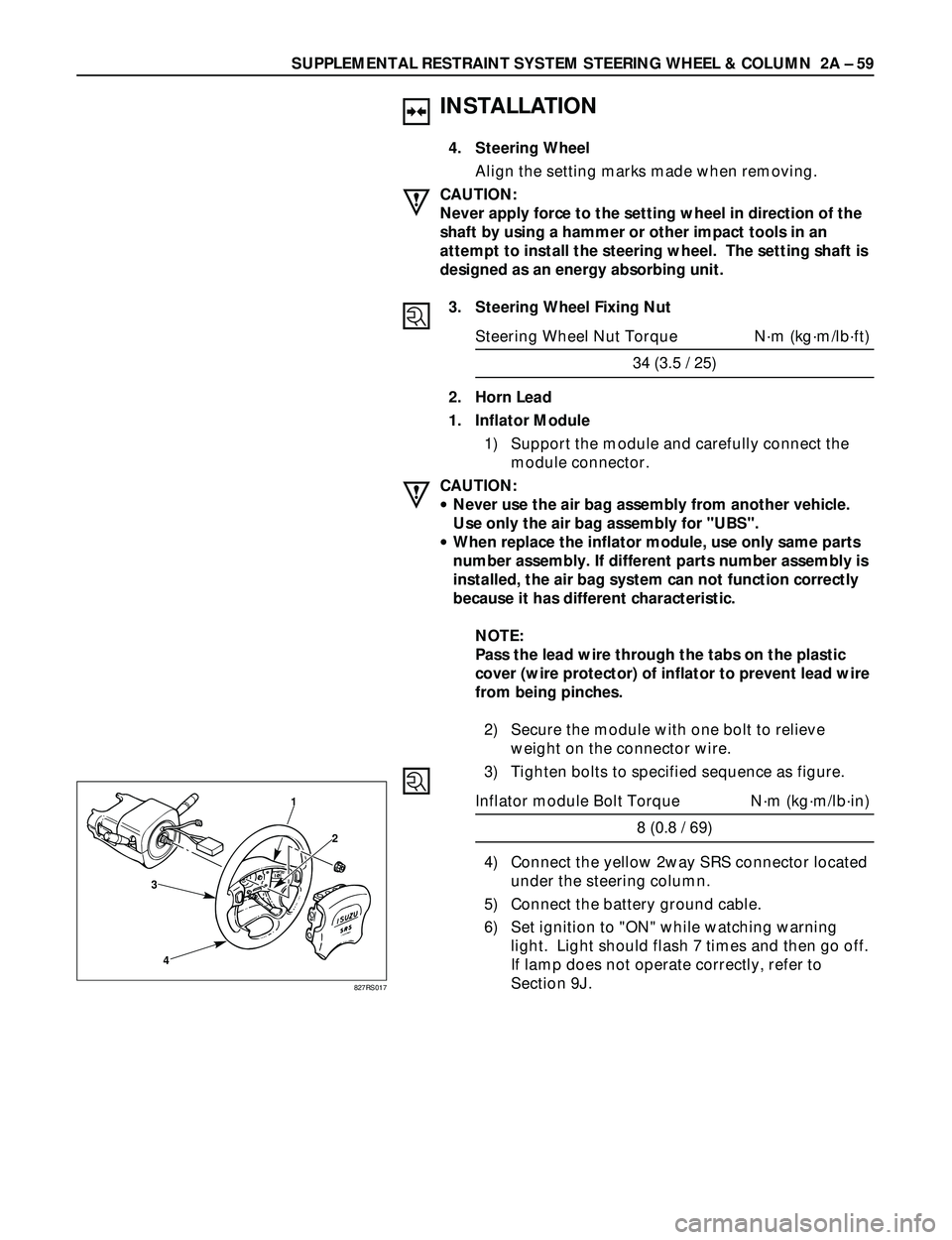
1. Inflator Module
1) Support the module and carefully connect the
module connector.
CAUTION:
·Never use the air bag assembly from another vehicle.
Use only the air bag assembly for "UBS".
·When replace the inflator module, use only same parts
number assembly. If different parts number assembly is
installed, the air bag system can not function correctly
because it has different characteristic.
NOTE:
Pass the lead wire through the tabs on the plastic
cover (wire protector) of inflator to prevent lead wire
from being pinches.
2) Secure the module with one bolt to relieve
weight on the connector wire.
3) Tighten bolts to specified sequence as figure.
Inflator module Bolt Torque Nám (kgám/lbáin)
8 (0.8 / 69)
4) Connect the yellow 2way SRS connector located
under the steering column.
5) Connect the battery ground cable.
6) Set ignition to "ON" while watching warning
light. Light should flash 7 times and then go off.
If lamp does not operate correctly, refer to
Section 9J.
3
41
2
827RS017
Page 365 of 3573
SUPPLEMENTAL RESTRAINT SYSTEM STEERING WHEEL & COLUMN 2A Ð 63
5. Steering Wheel
Align the setting marks made when removing.
CAUTION:
Never apply force to the steering wheel in direction of the
shaft by using a hammer or other impact tools in an
attempt to remove the steering wheel. The steering shaft
is designed as an energy absorbing unit.
Tighten the steering wheel fixing nut to the specified
torque.
Steering Wheel Nut Torque Nám (kgám/lbáft)
34 (3.5 / 25)
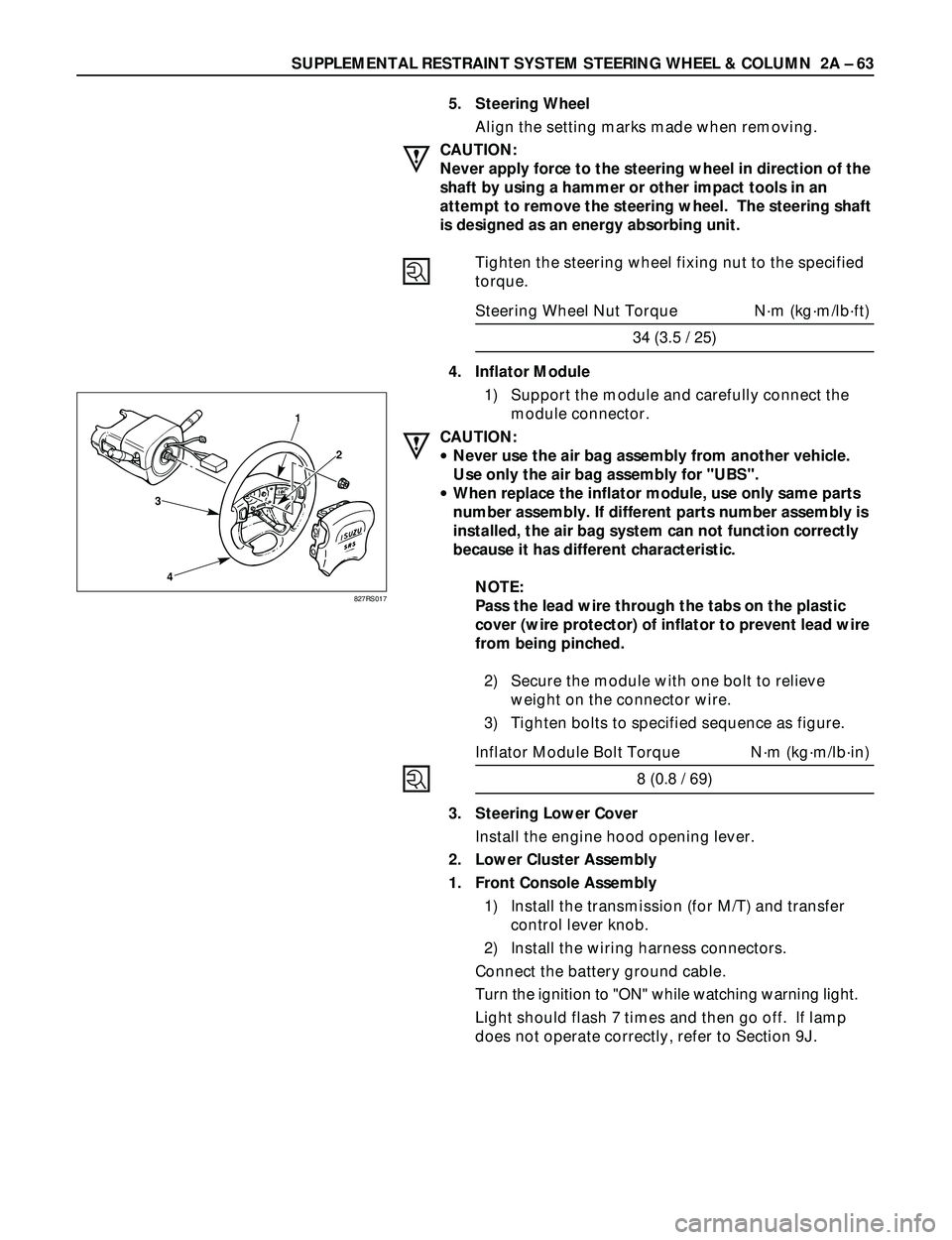
4. Inflator Module
1) Support the module and carefully connect the
module connector.
CAUTION:
·Never use the air bag assembly from another vehicle.
Use only the air bag assembly for "UBS".
·When replace the inflator module, use only same parts
number assembly. If different parts number assembly is
installed, the air bag system can not function correctly
because it has different characteristic.
NOTE:
Pass the lead wire through the tabs on the plastic
cover (wire protector) of inflator to prevent lead wire
from being pinched.
2) Secure the module with one bolt to relieve
weight on the connector wire.
3) Tighten bolts to specified sequence as figure.
Inflator Module Bolt Torque Nám (kgám/lbáin)
8 (0.8 / 69)
3. Steering Lower Cover
Install the engine hood opening lever.
2. Lower Cluster Assembly
1. Front Console Assembly
1) Install the transmission (for M/T) and transfer
control lever knob.
2) Install the wiring harness connectors.
Connect the battery ground cable.
Turn the ignition to "ON" while watching warning light.
Light should flash 7 times and then go off. If lamp
does not operate correctly, refer to Section 9J.
3
41
2
827RS017
Page 370 of 3573
2A Ð 68 SUPPLEMENTAL RESTRAINT SYSTEM STEERING WHEEL & COLUMN
3
41
2
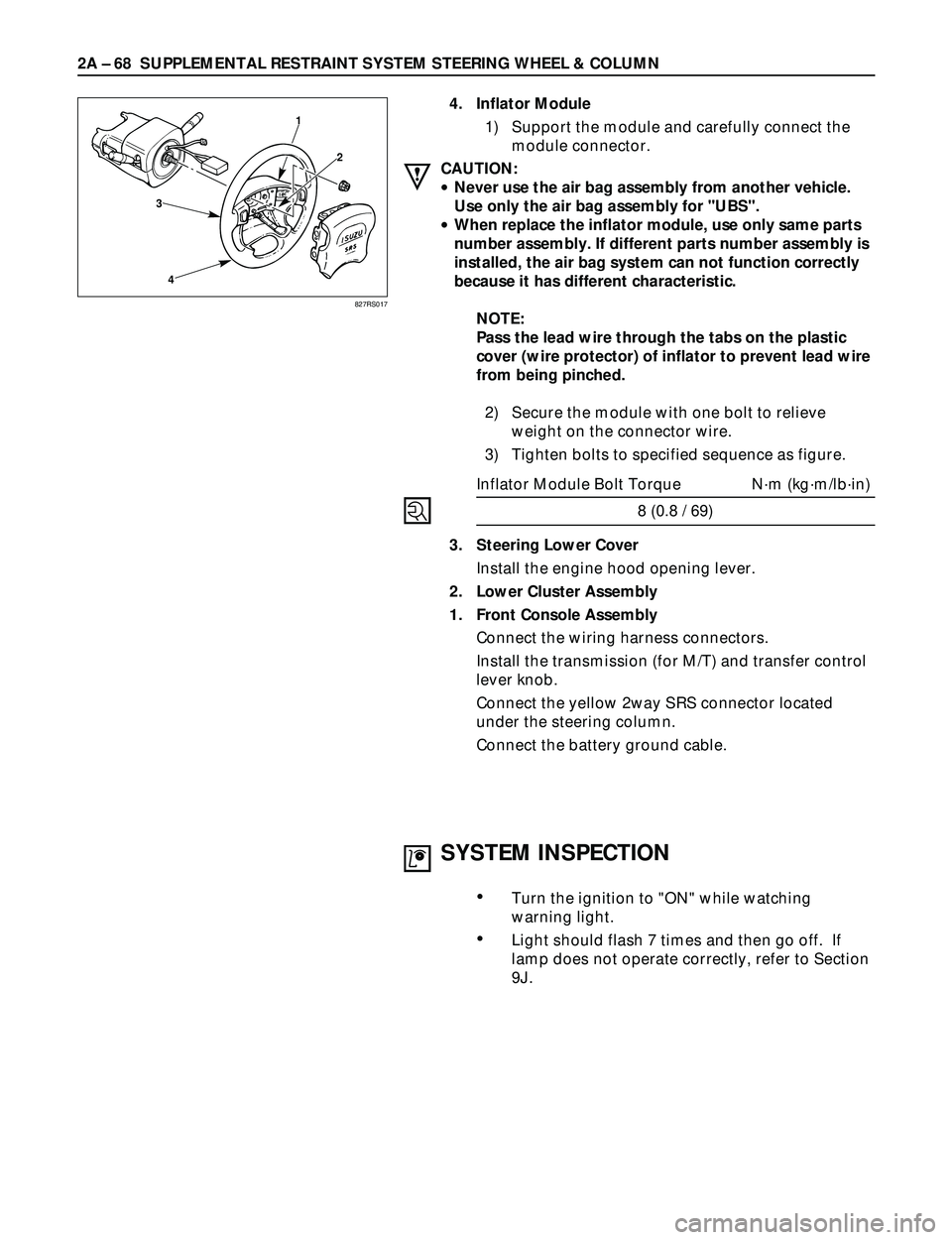
4. Inflator Module
1) Support the module and carefully connect the
module connector.
CAUTION:
·Never use the air bag assembly from another vehicle.
Use only the air bag assembly for "UBS".
·When replace the inflator module, use only same parts
number assembly. If different parts number assembly is
installed, the air bag system can not function correctly
because it has different characteristic.
NOTE:
Pass the lead wire through the tabs on the plastic
cover (wire protector) of inflator to prevent lead wire
from being pinched.
2) Secure the module with one bolt to relieve
weight on the connector wire.
3) Tighten bolts to specified sequence as figure.
Inflator Module Bolt Torque Nám (kgám/lbáin)
8 (0.8 / 69)
3. Steering Lower Cover
Install the engine hood opening lever.
2. Lower Cluster Assembly
1. Front Console Assembly
Connect the wiring harness connectors.
Install the transmission (for M/T) and transfer control
lever knob.
Connect the yellow 2way SRS connector located
under the steering column.
Connect the battery ground cable.
827RS017
SYSTEM INSPECTION
¥Turn the ignition to "ON" while watching
warning light.
¥Light should flash 7 times and then go off. If
lamp does not operate correctly, refer to Section
9J.
Page 376 of 3573
2A – 74 SUPPLEMENTAL RESTRAINT SYSTEM STEERING WHEEL & COLUMN
SYSTEM INSPECTION
Turn the ignition to "ON" while watching warning
light.
Light should flash 7 times and then go off. If lamp
does not operate correctly, refer to Section 9J.
Page 435 of 3573
3E – 4 WHEELS AND TIRES
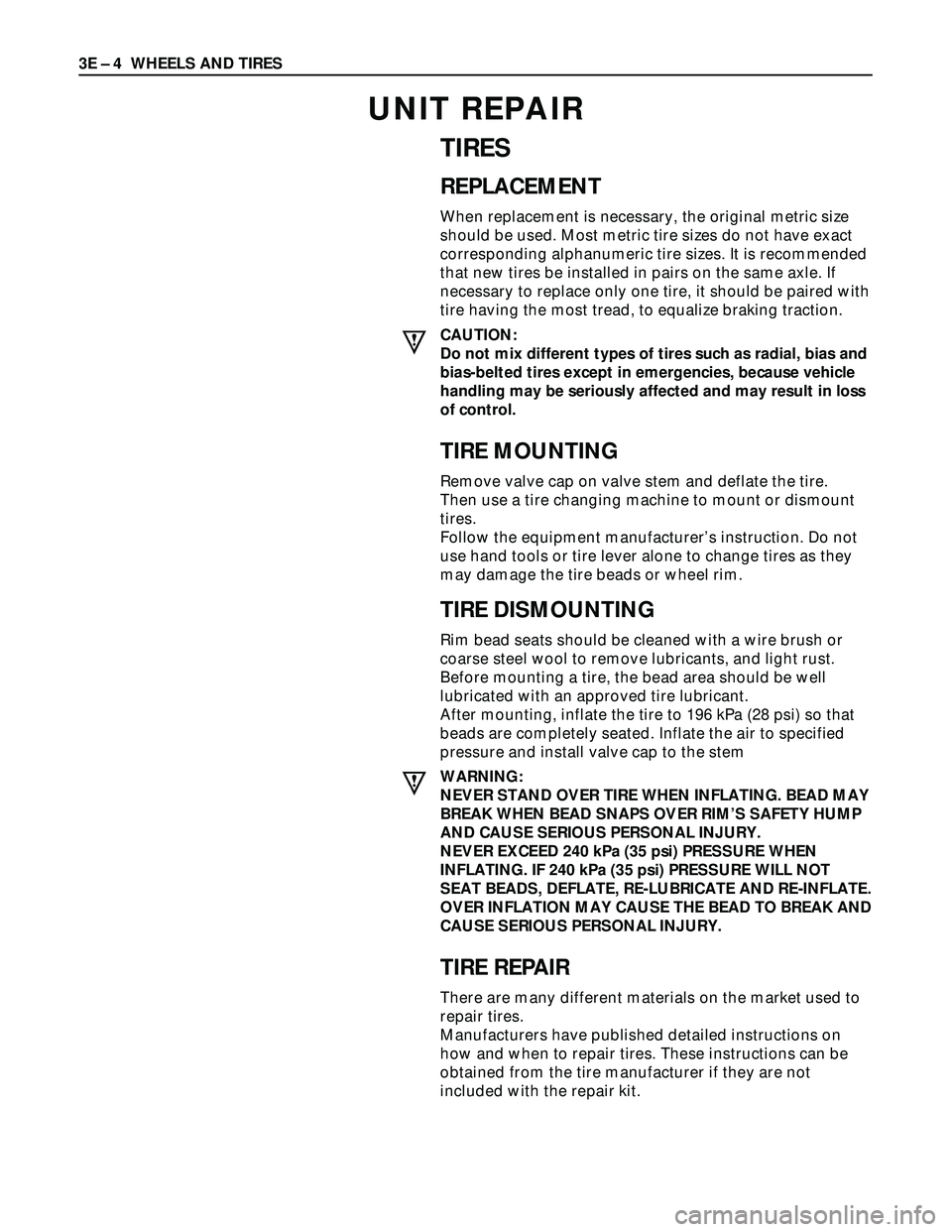
TIRES
REPLACEMENT
When replacement is necessary, the original metric size
should be used. Most metric tire sizes do not have exact
corresponding alphanumeric tire sizes. It is recommended
that new tires be installed in pairs on the same axle. If
necessary to replace only one tire, it should be paired with
tire having the most tread, to equalize braking traction.
CAUTION:
Do not mix different types of tires such as radial, bias and
bias-belted tires except in emergencies, because vehicle
handling may be seriously affected and may result in loss
of control.
TIRE MOUNTING
Remove valve cap on valve stem and deflate the tire.
Then use a tire changing machine to mount or dismount
tires.
Follow the equipment manufacturer’s instruction. Do not
use hand tools or tire lever alone to change tires as they
may damage the tire beads or wheel rim.
TIRE DISMOUNTING
Rim bead seats should be cleaned with a wire brush or
coarse steel wool to remove lubricants, and light rust.
Before mounting a tire, the bead area should be well
lubricated with an approved tire lubricant.
After mounting, inflate the tire to 196 kPa (28 psi) so that
beads are completely seated. Inflate the air to specified
pressure and install valve cap to the stem
WARNING:
NEVER STAND OVER TIRE WHEN INFLATING. BEAD MAY
BREAK WHEN BEAD SNAPS OVER RIM’S SAFETY HUMP
AND CAUSE SERIOUS PERSONAL INJURY.
NEVER EXCEED 240 kPa (35 psi) PRESSURE WHEN
INFLATING. IF 240 kPa (35 psi) PRESSURE WILL NOT
SEAT BEADS, DEFLATE, RE-LUBRICATE AND RE-INFLATE.
OVER INFLATION MAY CAUSE THE BEAD TO BREAK AND
CAUSE SERIOUS PERSONAL INJURY.
TIRE REPAIR
There are many different materials on the market used to
repair tires.
Manufacturers have published detailed instructions on
how and when to repair tires. These instructions can be
obtained from the tire manufacturer if they are not
included with the repair kit.
UNIT REPAIR
Page 595 of 3573
DRIVE LINE CONTROL SYSTEM (TOD) 4B2±24
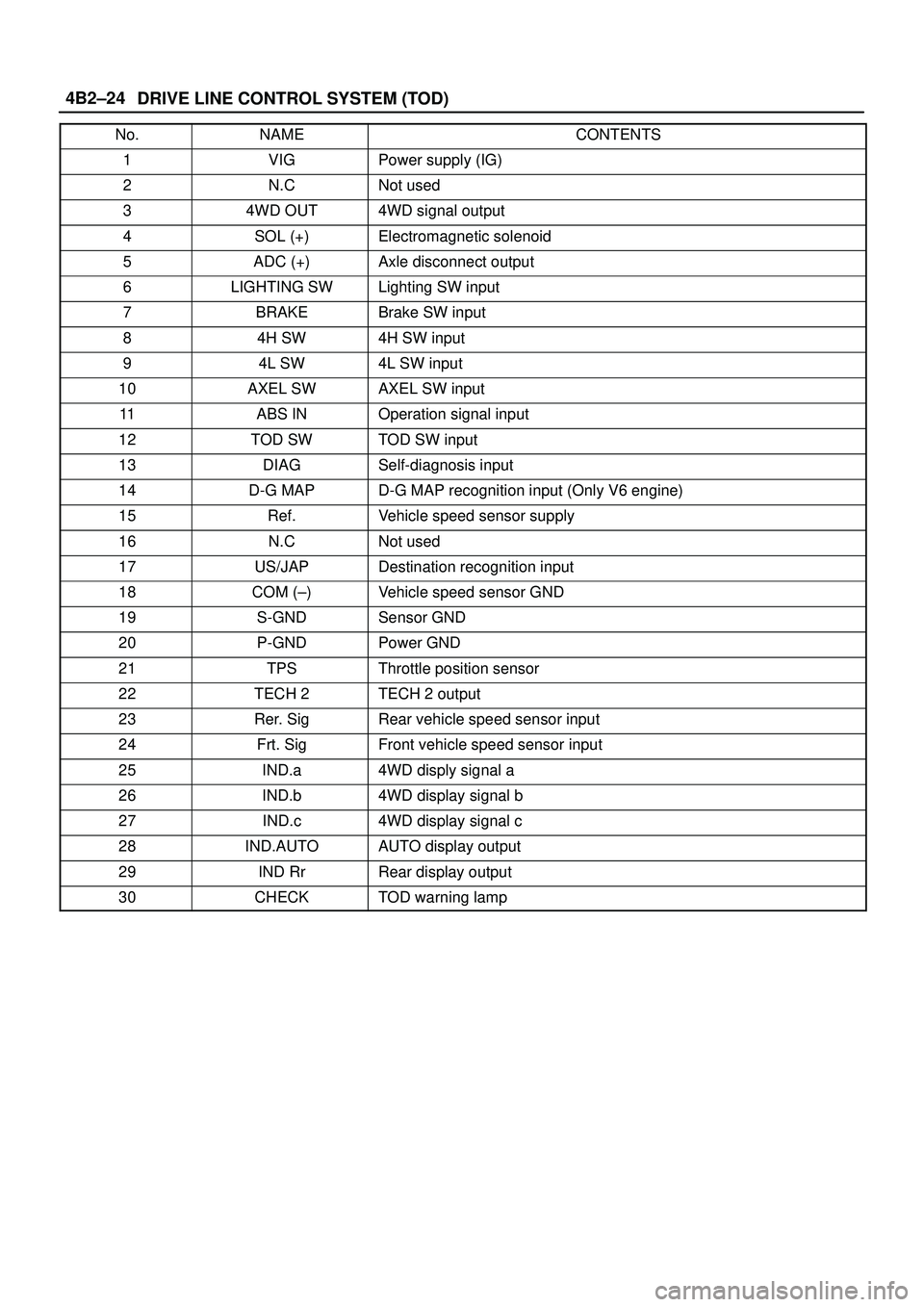
No.NAMECONTENTS
1VIGPower supply (IG)
2N.CNot used
34WD OUT4WD signal output
4SOL (+)Electromagnetic solenoid
5ADC (+)Axle disconnect output
6LIGHTING SWLighting SW input
7BRAKEBrake SW input
84H SW4H SW input
94L SW4L SW input
10AXEL SWAXEL SW input
11ABS INOperation signal input
12TOD SWTOD SW input
13DIAGSelf-diagnosis input
14D-G MAPD-G MAP recognition input (Only V6 engine)
15Ref.Vehicle speed sensor supply
16N.CNot used
17US/JAPDestination recognition input
18COM (±)Vehicle speed sensor GND
19S-GNDSensor GND
20P-GNDPower GND
21TPSThrottle position sensor
22TECH 2TECH 2 output
23Rer. SigRear vehicle speed sensor input
24Frt. SigFront vehicle speed sensor input
25IND.a4WD disply signal a
26IND.b4WD display signal b
27IND.c4WD display signal c
28IND.AUTOAUTO display output
29IND RrRear display output
30CHECKTOD warning lamp
Page 811 of 3573
5A±1 BRAKE CONTROL SYSTEM
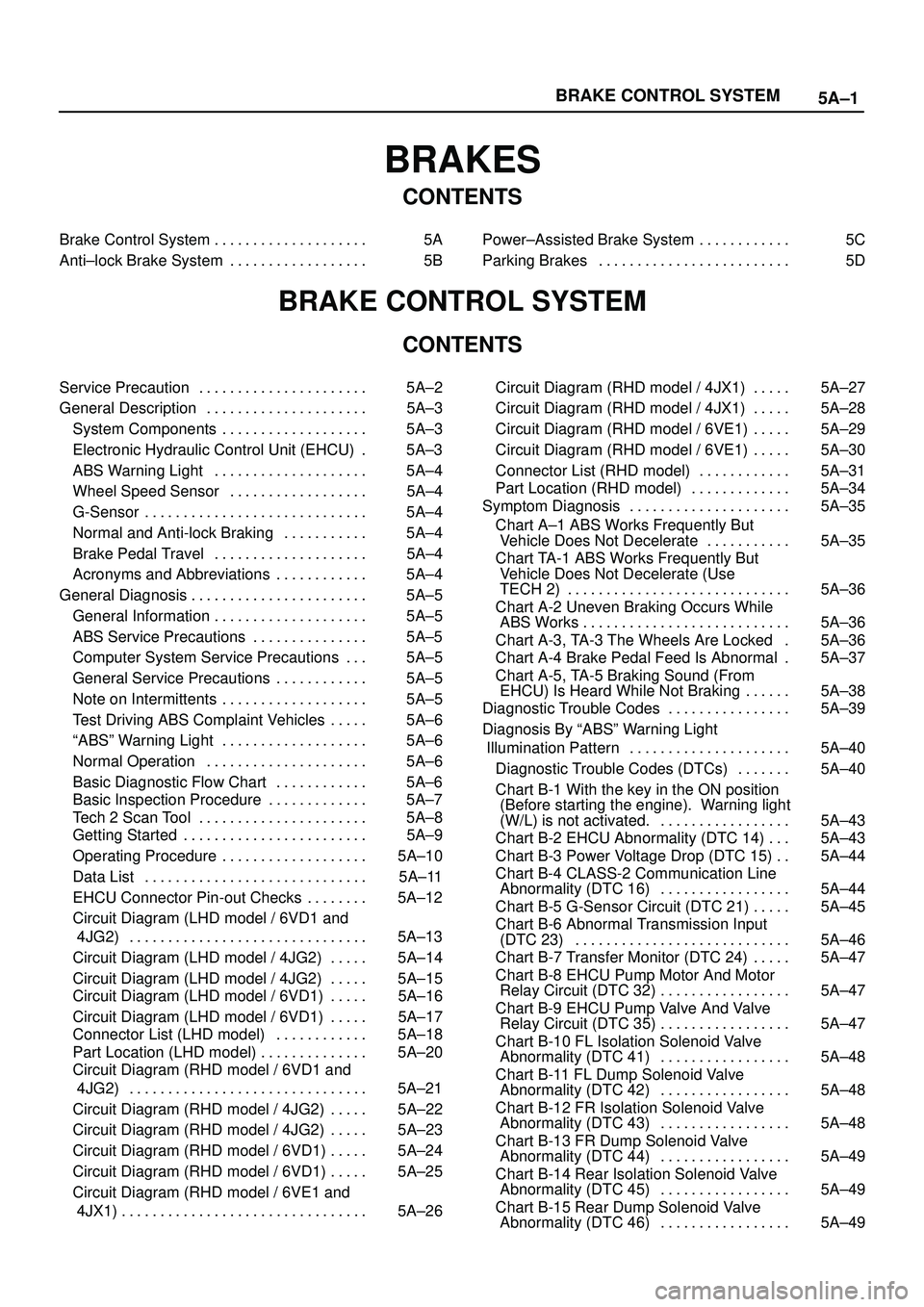
BRAKES
CONTENTS
Brake Control System 5A. . . . . . . . . . . . . . . . . . . .
Anti±lock Brake System 5B. . . . . . . . . . . . . . . . . . Power±Assisted Brake System 5C. . . . . . . . . . . .
Parking Brakes 5D. . . . . . . . . . . . . . . . . . . . . . . . .
BRAKE CONTROL SYSTEM
CONTENTS
Service Precaution 5A±2. . . . . . . . . . . . . . . . . . . . . .
General Description 5A±3. . . . . . . . . . . . . . . . . . . . .
System Components 5A±3. . . . . . . . . . . . . . . . . . .
Electronic Hydraulic Control Unit (EHCU) 5A±3.
ABS Warning Light 5A±4. . . . . . . . . . . . . . . . . . . .
Wheel Speed Sensor 5A±4. . . . . . . . . . . . . . . . . .
G-Sensor 5A±4. . . . . . . . . . . . . . . . . . . . . . . . . . . . .
Normal and Anti-lock Braking 5A±4. . . . . . . . . . .
Brake Pedal Travel 5A±4. . . . . . . . . . . . . . . . . . . .
Acronyms and Abbreviations 5A±4. . . . . . . . . . . .
General Diagnosis 5A±5. . . . . . . . . . . . . . . . . . . . . . .
General Information 5A±5. . . . . . . . . . . . . . . . . . . .
ABS Service Precautions 5A±5. . . . . . . . . . . . . . .
Computer System Service Precautions 5A±5. . .
General Service Precautions 5A±5. . . . . . . . . . . .
Note on Intermittents 5A±5. . . . . . . . . . . . . . . . . . .
Test Driving ABS Complaint Vehicles 5A±6. . . . .
ªABSº Warning Light 5A±6. . . . . . . . . . . . . . . . . . .
Normal Operation 5A±6. . . . . . . . . . . . . . . . . . . . .
Basic Diagnostic Flow Chart 5A±6. . . . . . . . . . . .
Basic Inspection Procedure 5A±7. . . . . . . . . . . . .
Tech 2 Scan Tool 5A±8. . . . . . . . . . . . . . . . . . . . . .
Getting Started 5A±9. . . . . . . . . . . . . . . . . . . . . . . .
Operating Procedure 5A±10. . . . . . . . . . . . . . . . . . .
Data List 5A±11. . . . . . . . . . . . . . . . . . . . . . . . . . . . .
EHCU Connector Pin-out Checks 5A±12. . . . . . . .
Circuit Diagram (LHD model / 6VD1 and
4JG2) 5A±13. . . . . . . . . . . . . . . . . . . . . . . . . . . . . . .
Circuit Diagram (LHD model / 4JG2) 5A±14. . . . .
Circuit Diagram (LHD model / 4JG2) 5A±15. . . . .
Circuit Diagram (LHD model / 6VD1) 5A±16. . . . .
Circuit Diagram (LHD model / 6VD1) 5A±17. . . . .
Connector List (LHD model) 5A±18. . . . . . . . . . . .
Part Location (LHD model) 5A±20. . . . . . . . . . . . . .
Circuit Diagram (RHD model / 6VD1 and
4JG2) 5A±21. . . . . . . . . . . . . . . . . . . . . . . . . . . . . . .
Circuit Diagram (RHD model / 4JG2) 5A±22. . . . .
Circuit Diagram (RHD model / 4JG2) 5A±23. . . . .
Circuit Diagram (RHD model / 6VD1) 5A±24. . . . .
Circuit Diagram (RHD model / 6VD1) 5A±25. . . . .
Circuit Diagram (RHD model / 6VE1 and
4JX1) 5A±26. . . . . . . . . . . . . . . . . . . . . . . . . . . . . . . . Circuit Diagram (RHD model / 4JX1) 5A±27. . . . .
Circuit Diagram (RHD model / 4JX1) 5A±28. . . . .
Circuit Diagram (RHD model / 6VE1) 5A±29. . . . .
Circuit Diagram (RHD model / 6VE1) 5A±30. . . . .
Connector List (RHD model) 5A±31. . . . . . . . . . . .
Part Location (RHD model) 5A±34. . . . . . . . . . . . .
Symptom Diagnosis 5A±35. . . . . . . . . . . . . . . . . . . . .
Chart A±1 ABS Works Frequently But
Vehicle Does Not Decelerate 5A±35. . . . . . . . . . .
Chart TA-1 ABS Works Frequently But
Vehicle Does Not Decelerate (Use
TECH 2) 5A±36. . . . . . . . . . . . . . . . . . . . . . . . . . . . .
Chart A-2 Uneven Braking Occurs While
ABS Works 5A±36. . . . . . . . . . . . . . . . . . . . . . . . . . .
Chart A-3, TA-3 The Wheels Are Locked 5A±36.
Chart A-4 Brake Pedal Feed Is Abnormal 5A±37.
Chart A-5, TA-5 Braking Sound (From
EHCU) Is Heard While Not Braking 5A±38. . . . . .
Diagnostic Trouble Codes 5A±39. . . . . . . . . . . . . . . .
Diagnosis By ªABSº Warning Light
Illumination Pattern 5A±40. . . . . . . . . . . . . . . . . . . . .
Diagnostic Trouble Codes (DTCs) 5A±40. . . . . . .
Chart B-1 With the key in the ON position
(Before starting the engine). Warning light
(W/L) is not activated. 5A±43. . . . . . . . . . . . . . . . .
Chart B-2 EHCU Abnormality (DTC 14) 5A±43. . .
Chart B-3 Power Voltage Drop (DTC 15) 5A±44. .
Chart B-4 CLASS-2 Communication Line
Abnormality (DTC 16) 5A±44. . . . . . . . . . . . . . . . .
Chart B-5 G-Sensor Circuit (DTC 21) 5A±45. . . . .
Chart B-6 Abnormal Transmission Input
(DTC 23) 5A±46. . . . . . . . . . . . . . . . . . . . . . . . . . . .
Chart B-7 Transfer Monitor (DTC 24) 5A±47. . . . .
Chart B-8 EHCU Pump Motor And Motor
Relay Circuit (DTC 32) 5A±47. . . . . . . . . . . . . . . . .
Chart B-9 EHCU Pump Valve And Valve
Relay Circuit (DTC 35) 5A±47. . . . . . . . . . . . . . . . .
Chart B-10 FL Isolation Solenoid Valve
Abnormality (DTC 41) 5A±48. . . . . . . . . . . . . . . . .
Chart B-11 FL Dump Solenoid Valve
Abnormality (DTC 42) 5A±48. . . . . . . . . . . . . . . . .
Chart B-12 FR Isolation Solenoid Valve
Abnormality (DTC 43) 5A±48. . . . . . . . . . . . . . . . .
Chart B-13 FR Dump Solenoid Valve
Abnormality (DTC 44) 5A±49. . . . . . . . . . . . . . . . .
Chart B-14 Rear Isolation Solenoid Valve
Abnormality (DTC 45) 5A±49. . . . . . . . . . . . . . . . .
Chart B-15 Rear Dump Solenoid Valve
Abnormality (DTC 46) 5A±49. . . . . . . . . . . . . . . . .
Page 813 of 3573
5A±3 BRAKE CONTROL SYSTEM
General Description
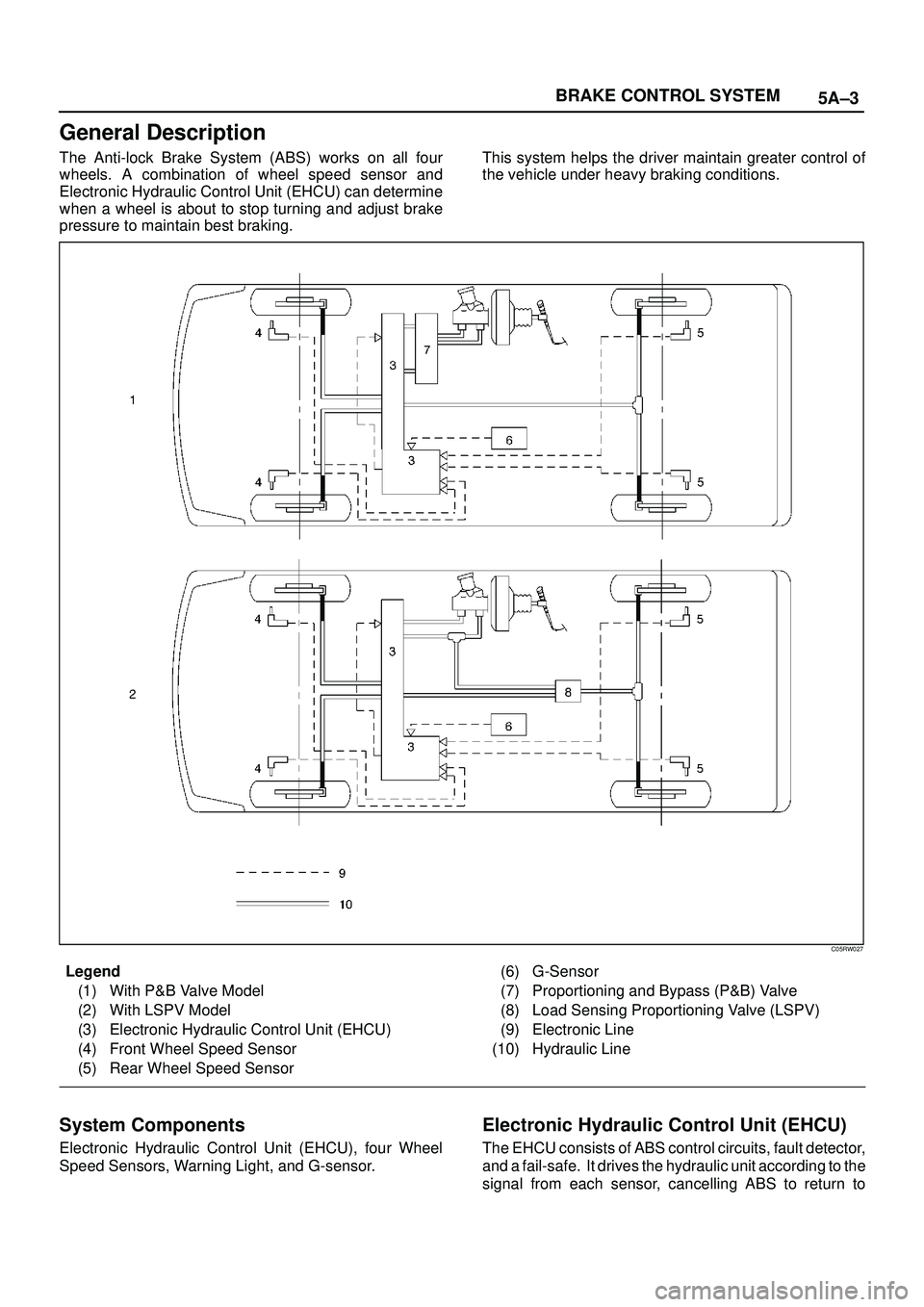
The Anti-lock Brake System (ABS) works on all four
wheels. A combination of wheel speed sensor and
Electronic Hydraulic Control Unit (EHCU) can determine
when a wheel is about to stop turning and adjust brake
pressure to maintain best braking.This system helps the driver maintain greater control of
the vehicle under heavy braking conditions.
C05RW027
Legend
(1) With P&B Valve Model
(2) With LSPV Model
(3) Electronic Hydraulic Control Unit (EHCU)
(4) Front Wheel Speed Sensor
(5) Rear Wheel Speed Sensor(6) G-Sensor
(7) Proportioning and Bypass (P&B) Valve
(8) Load Sensing Proportioning Valve (LSPV)
(9) Electronic Line
(10) Hydraulic Line
System Components
Electronic Hydraulic Control Unit (EHCU), four Wheel
Speed Sensors, Warning Light, and G-sensor.
Electronic Hydraulic Control Unit (EHCU)
The EHCU consists of ABS control circuits, fault detector,
and a fail-safe. It drives the hydraulic unit according to the
signal from each sensor, cancelling ABS to return to
Page 814 of 3573
5A±4
BRAKE CONTROL SYSTEM
normal braking when a malfunction has occurred in the
ABS.
The EHCU has a self-diagnosing function which can
indicate faulty circuits during diagnosis.
The EHCU is mounted on the engine compartment front
right side. It consists of a Motor, Plunger Pump, Solenoid
Valves and Check Valve.
On the outside, the relay box containing a motor relay and
a valve relay is installed.
Solenoid Valves: Reduces or holds the caliper fluid
pressure for each front disc brake or both rear disc brakes
according to the signal sent from the EHCU.
Reservoir: Temporarily holds the brake fluid that returns
from the front and rear disc brake caliper so that pressure
of front disc brake caliper can be reduced smoothly.
Plunger Pump: Feeds the brake fluid held in the reservoir
to the master cylinder.
Motor: Drives the pump according to the signal from
EHCU.
Check Valve: Controls the brake fluid flow.
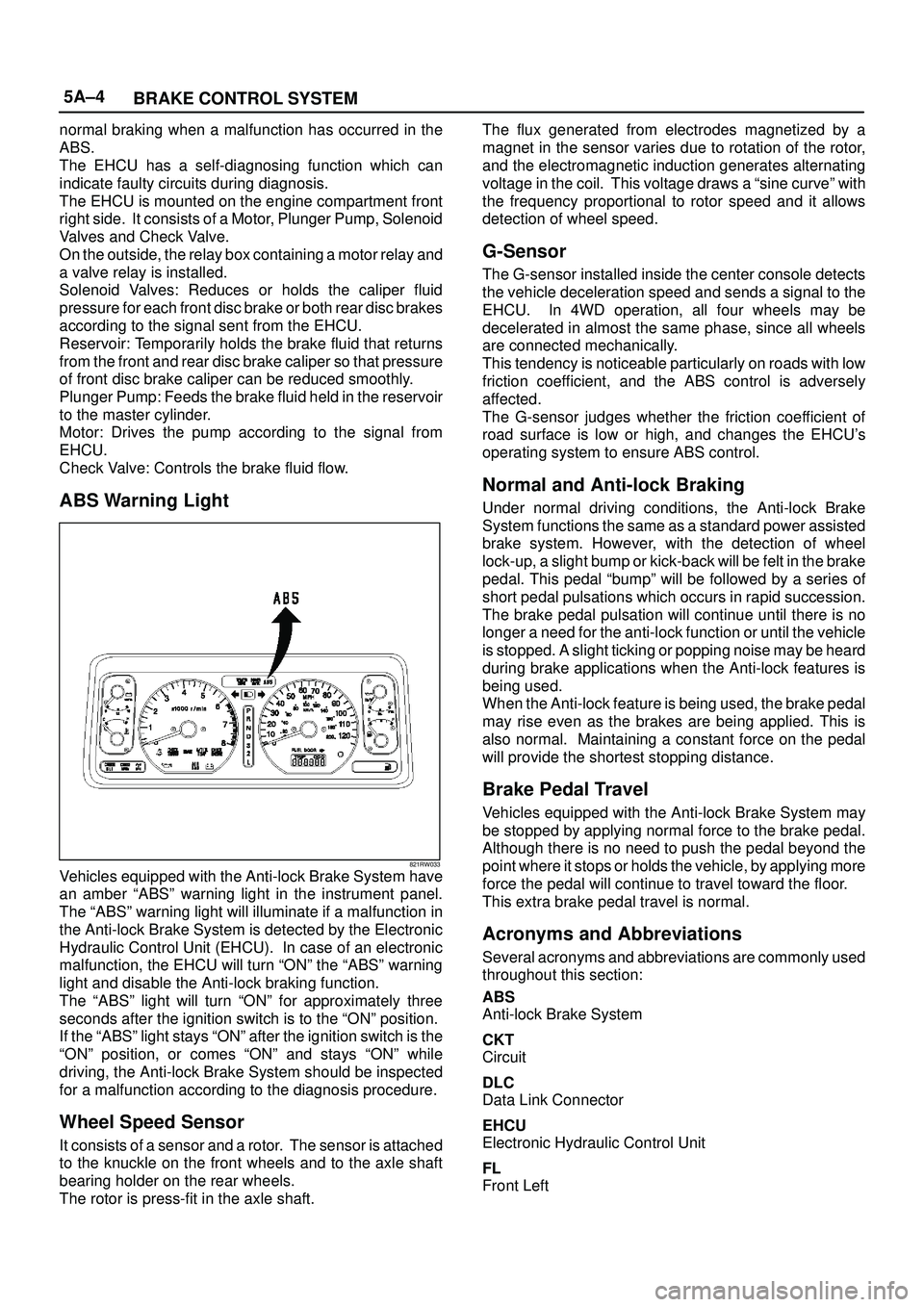
ABS Warning Light
821RW033Vehicles equipped with the Anti-lock Brake System have
an amber ªABSº warning light in the instrument panel.
The ªABSº warning light will illuminate if a malfunction in
the Anti-lock Brake System is detected by the Electronic
Hydraulic Control Unit (EHCU). In case of an electronic
malfunction, the EHCU will turn ªONº the ªABSº warning
light and disable the Anti-lock braking function.
The ªABSº light will turn ªONº for approximately three
seconds after the ignition switch is to the ªONº position.
If the ªABSº light stays ªONº after the ignition switch is the
ªONº position, or comes ªONº and stays ªONº while
driving, the Anti-lock Brake System should be inspected
for a malfunction according to the diagnosis procedure.
Wheel Speed Sensor
It consists of a sensor and a rotor. The sensor is attached
to the knuckle on the front wheels and to the axle shaft
bearing holder on the rear wheels.
The rotor is press-fit in the axle shaft.The flux generated from electrodes magnetized by a
magnet in the sensor varies due to rotation of the rotor,
and the electromagnetic induction generates alternating
voltage in the coil. This voltage draws a ªsine curveº with
the frequency proportional to rotor speed and it allows
detection of wheel speed.
G-Sensor
The G-sensor installed inside the center console detects
the vehicle deceleration speed and sends a signal to the
EHCU. In 4WD operation, all four wheels may be
decelerated in almost the same phase, since all wheels
are connected mechanically.
This tendency is noticeable particularly on roads with low
friction coefficient, and the ABS control is adversely
affected.
The G-sensor judges whether the friction coefficient of
road surface is low or high, and changes the EHCU's
operating system to ensure ABS control.
Normal and Anti-lock Braking
Under normal driving conditions, the Anti-lock Brake
System functions the same as a standard power assisted
brake system. However, with the detection of wheel
lock-up, a slight bump or kick-back will be felt in the brake
pedal. This pedal ªbumpº will be followed by a series of
short pedal pulsations which occurs in rapid succession.
The brake pedal pulsation will continue until there is no
longer a need for the anti-lock function or until the vehicle
is stopped. A slight ticking or popping noise may be heard
during brake applications when the Anti-lock features is
being used.
When the Anti-lock feature is being used, the brake pedal
may rise even as the brakes are being applied. This is
also normal. Maintaining a constant force on the pedal
will provide the shortest stopping distance.
Brake Pedal Travel
Vehicles equipped with the Anti-lock Brake System may
be stopped by applying normal force to the brake pedal.
Although there is no need to push the pedal beyond the
point where it stops or holds the vehicle, by applying more
force the pedal will continue to travel toward the floor.
This extra brake pedal travel is normal.
Acronyms and Abbreviations
Several acronyms and abbreviations are commonly used
throughout this section:
ABS
Anti-lock Brake System
CKT
Circuit
DLC
Data Link Connector
EHCU
Electronic Hydraulic Control Unit
FL
Front Left