oil JAGUAR S TYPE 1999 1.G Powertrain Manual
[x] Cancel search | Manufacturer: JAGUAR, Model Year: 1999, Model line: S TYPE, Model: JAGUAR S TYPE 1999 1.GPages: 75, PDF Size: 3.4 MB
Page 51 of 75
V8 Engine AJ-V6/AJ28
46
Basic Engine
Bottom End
Changes to the cylinder block, connecting rods
and pistons which were introduced for the AJ27
N/A engine are also applicable to the AJ28 unit
and are described in the ÔXK and XJ series 1999
MY updateÕ Technical Guide.
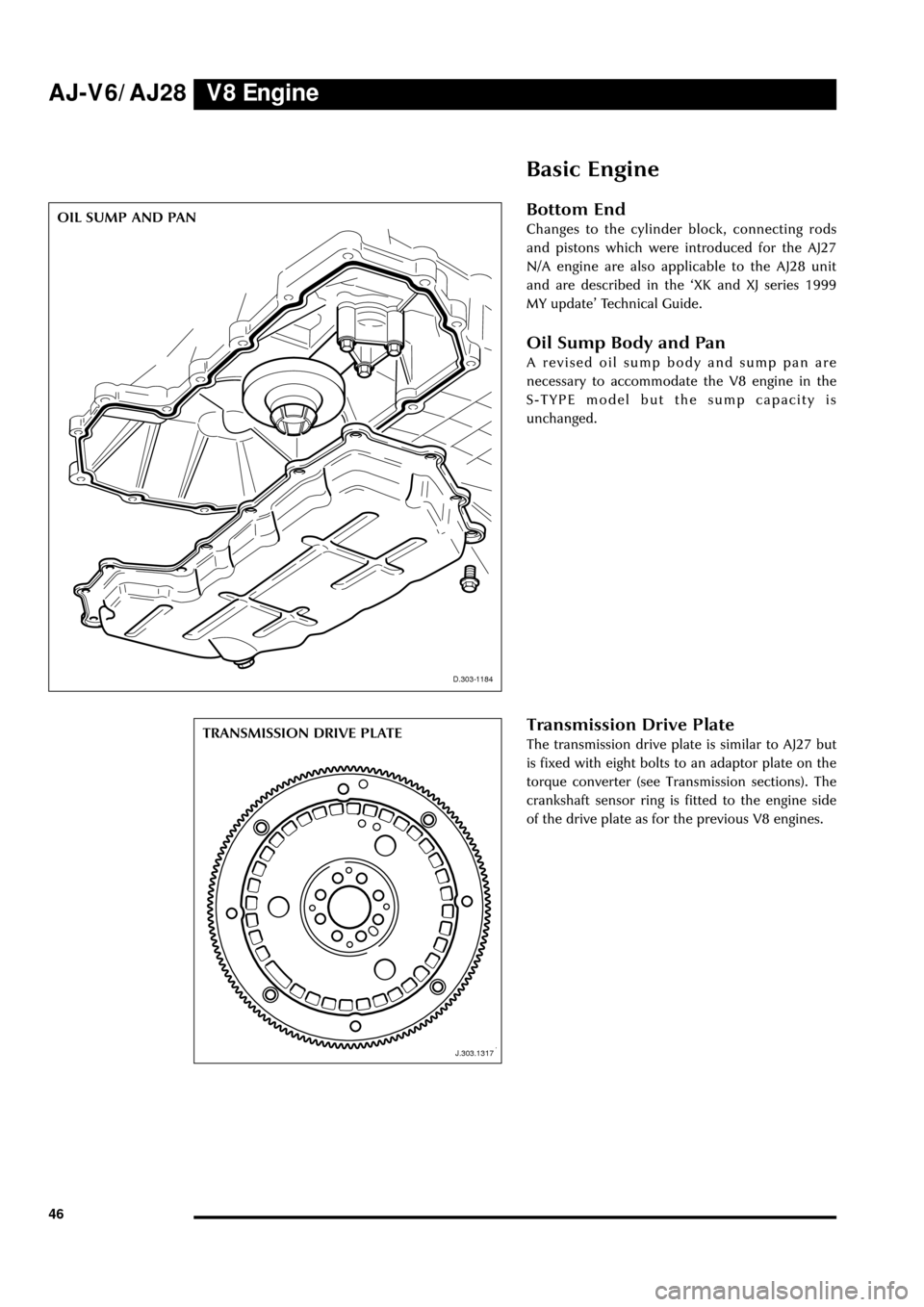
Oil Sump Body and Pan
A revised oil sump body and sump pan are
necessary to accommodate the V8 engine in the
S-TYPE model but the sump capacity is
unchanged.
D.303.1184
OIL SUMP AND PAN
D.303-1184
J.303.1317
TRANSMISSION DRIVE PLATE
J.303.1317
Transmission Drive Plate
The transmission drive plate is similar to AJ27 but
is fixed with eight bolts to an adaptor plate on the
torque converter (see Transmission sections). The
crankshaft sensor ring is fitted to the engine side
of the drive plate as for the previous V8 engines.
Page 52 of 75
V8 EngineAJ-V6/AJ28
47
Cylinder Head
The cylinder head incorporates the modifications
first introduced for the AJ27 engine except for the
camshaft sensor ring and cam cover.
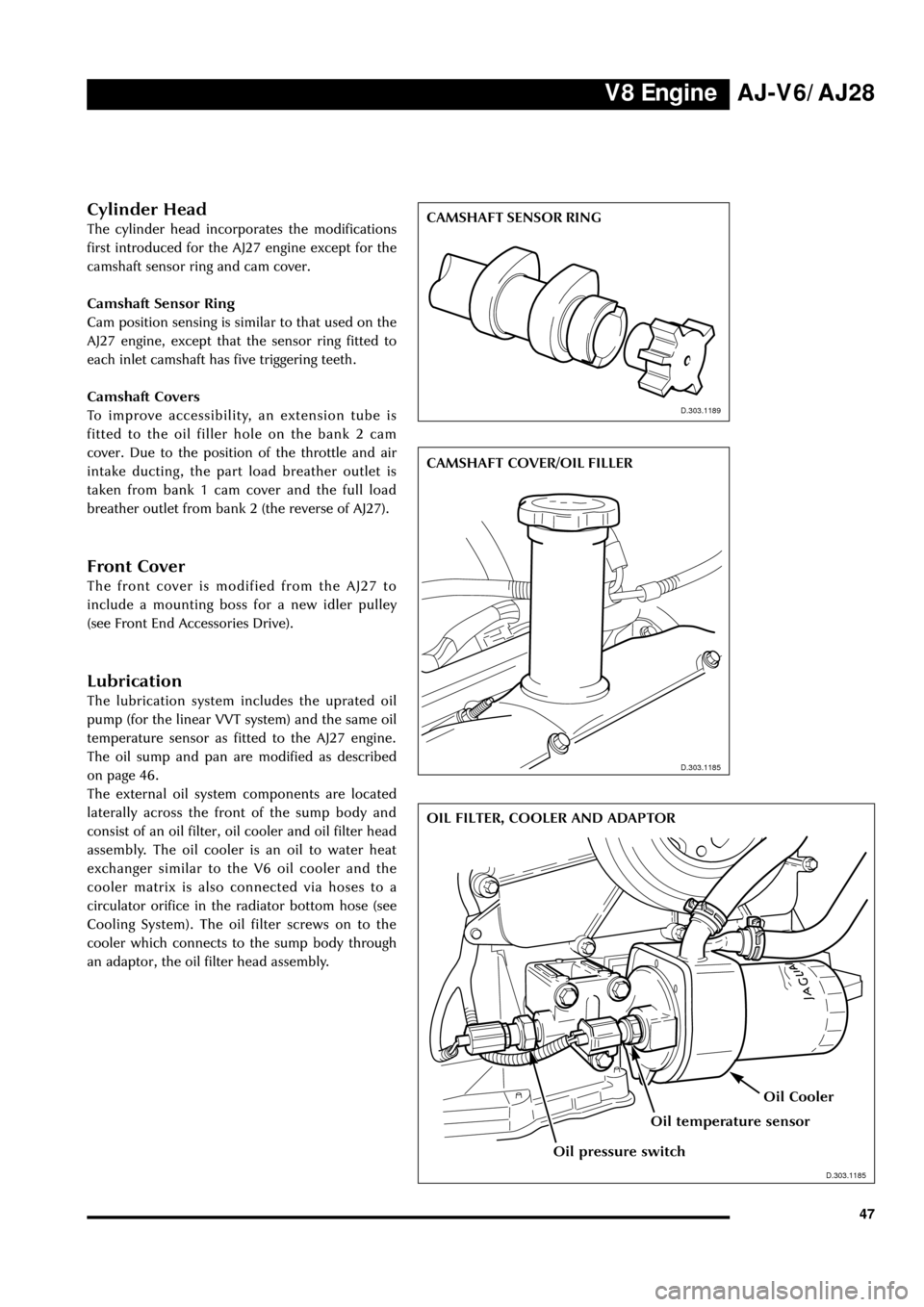
Camshaft Sensor Ring
Cam position sensing is similar to that used on the
AJ27 engine, except that the sensor ring fitted to
each inlet camshaft has five triggering teeth.
Camshaft Covers
To improve accessibility, an extension tube is
fitted to the oil filler hole on the bank 2 cam
cover. Due to the position of the throttle and air
intake ducting, the part load breather outlet is
taken from bank 1 cam cover and the full load
breather outlet from bank 2 (the reverse of AJ27).
Front Cover
The front cover is modified from the AJ27 to
include a mounting boss for a new idler pulley
(see Front End Accessories Drive).
Lubrication
The lubrication system includes the uprated oil
pump (for the linear VVT system) and the same oil
temperature sensor as fitted to the AJ27 engine.
The oil sump and pan are modified as described
on page 46.
The external oil system components are located
laterally across the front of the sump body and
consist of an oil filter, oil cooler and oil filter head
assembly. The oil cooler is an oil to water heat
exchanger similar to the V6 oil cooler and the
cooler matrix is also connected via hoses to a
circulator orifice in the radiator bottom hose (see
Cooling System). The oil filter screws on to the
cooler which connects to the sump body through
an adaptor, the oil filter head assembly.
J.303.1189
CAMSHAFT SENSOR RING
D.303.1189
D.303.1185
CAMSHAFT COVER/OIL FILLER
D.303.1185
D.303.1186
OIL FILTER, COOLER AND ADAPTOR
D.303.1185
Oil temperature sensor
Oil pressure switch
Oil Cooler
Page 54 of 75
V8 EngineAJ-V6/AJ28
49
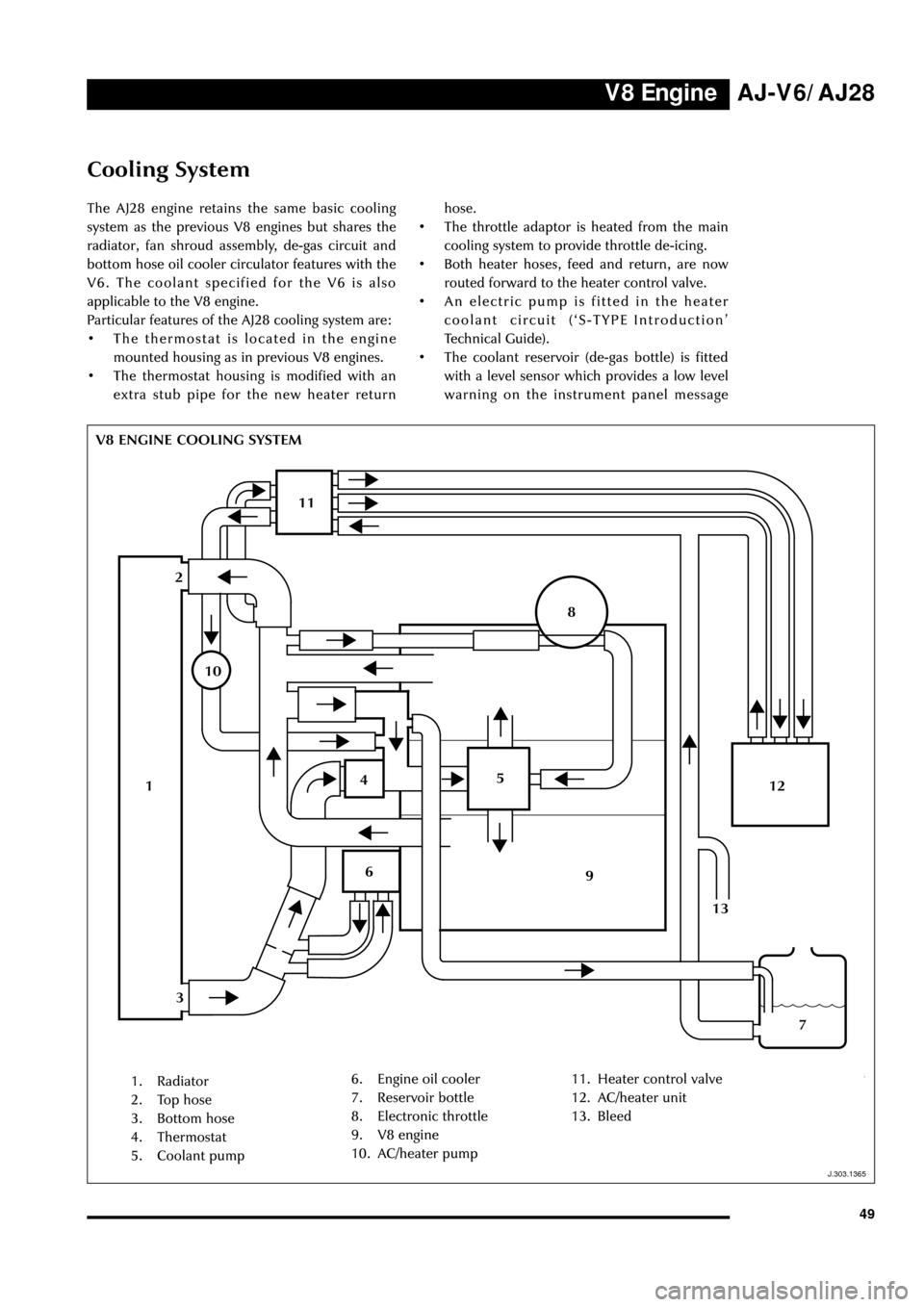
Cooling System
The AJ28 engine retains the same basic cooling
system as the previous V8 engines but shares the
radiator, fan shroud assembly, de-gas circuit and
bottom hose oil cooler circulator features with the
V6. The coolant specified for the V6 is also
applicable to the V8 engine.
Particular features of the AJ28 cooling system are:
¥ The thermostat is located in the engine
mounted housing as in previous V8 engines.
¥ The thermostat housing is modified with an
extra stub pipe for the new heater returnhose.
¥ The throttle adaptor is heated from the main
cooling system to provide throttle de-icing.
¥ Both heater hoses, feed and return, are now
routed forward to the heater control valve.
¥ An electric pump is fitted in the heater
coolant circuit (ÔS-TYPE IntroductionÕ
Technical Guide).
¥ The coolant reservoir (de-gas bottle) is fitted
with a level sensor which provides a low level
warning on the instrument panel message
J.303.1366
V8 ENGINE COOLING SYSTEM
1. Radiator
2. Top hose
3. Bottom hose
4. Thermostat
5. Coolant pump6. Engine oil cooler
7. Reservoir bottle
8. Electronic throttle
9. V8 engine
10. AC/heater pump
110512
9
4
6
2
3
8
7
J.303.1365
11
13
11. Heater control valve
12. AC/heater unit
13. Bleed
Page 55 of 75
V8 Engine AJ-V6/AJ28
50centre if the coolant level drops.
¥ The fail safe cooling strategy described for the
V6 is not applicable to the AJ28 engine.
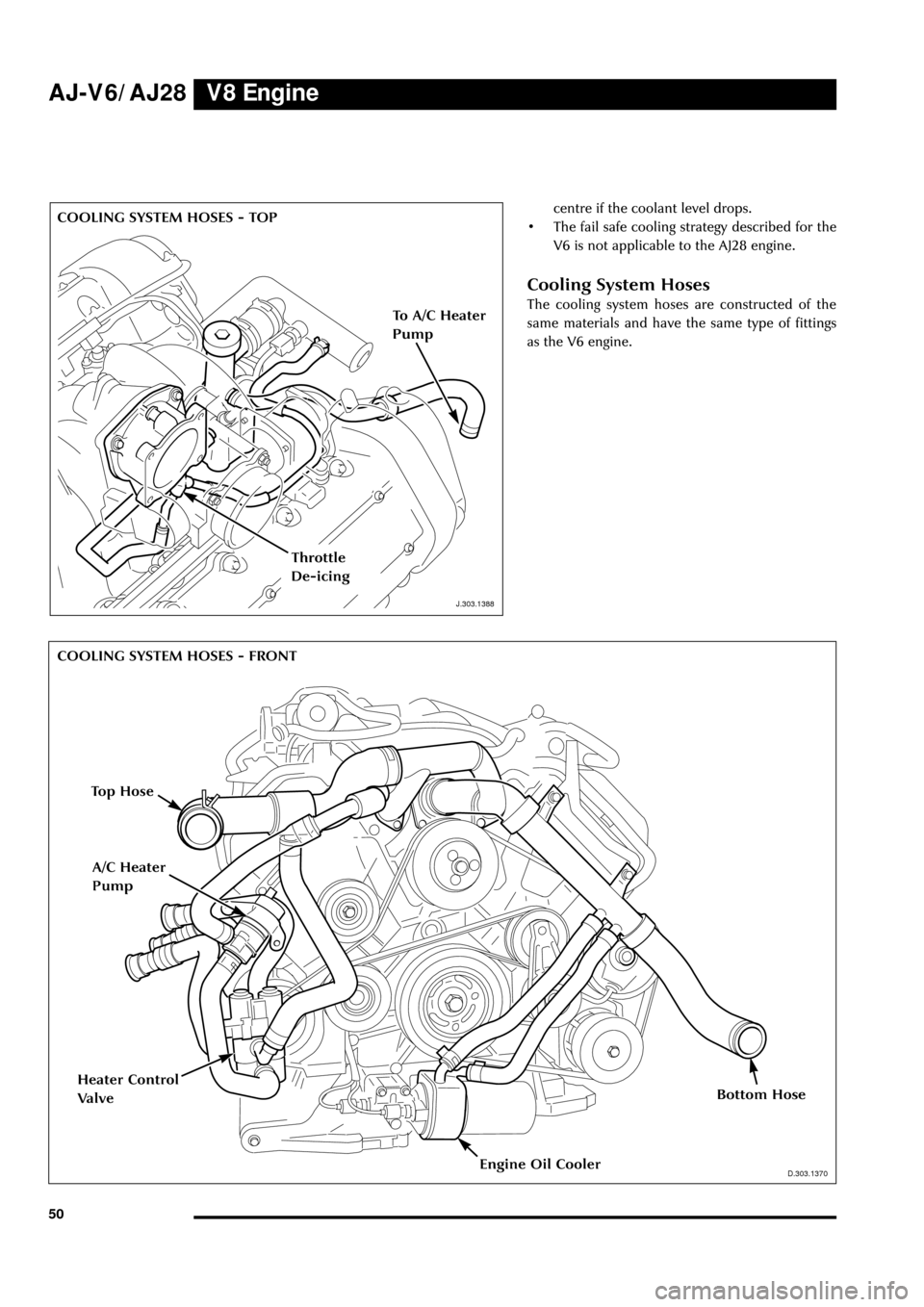
Cooling System Hoses
The cooling system hoses are constructed of the
same materials and have the same type of fittings
as the V6 engine.
D.303.1370
J.303.1388
COOLING SYSTEM HOSES - TOP
J.303.1388
COOLING SYSTEM HOSES - FRONT
D.303.1370
Top Hose
Bottom Hose
A/C Heater
Pump
Heater Control
Valve
Engine Oil Cooler
To A/C Heater
Pump
Throttle
De-icing
Page 59 of 75
V8 Engine AJ-V6/AJ28
54
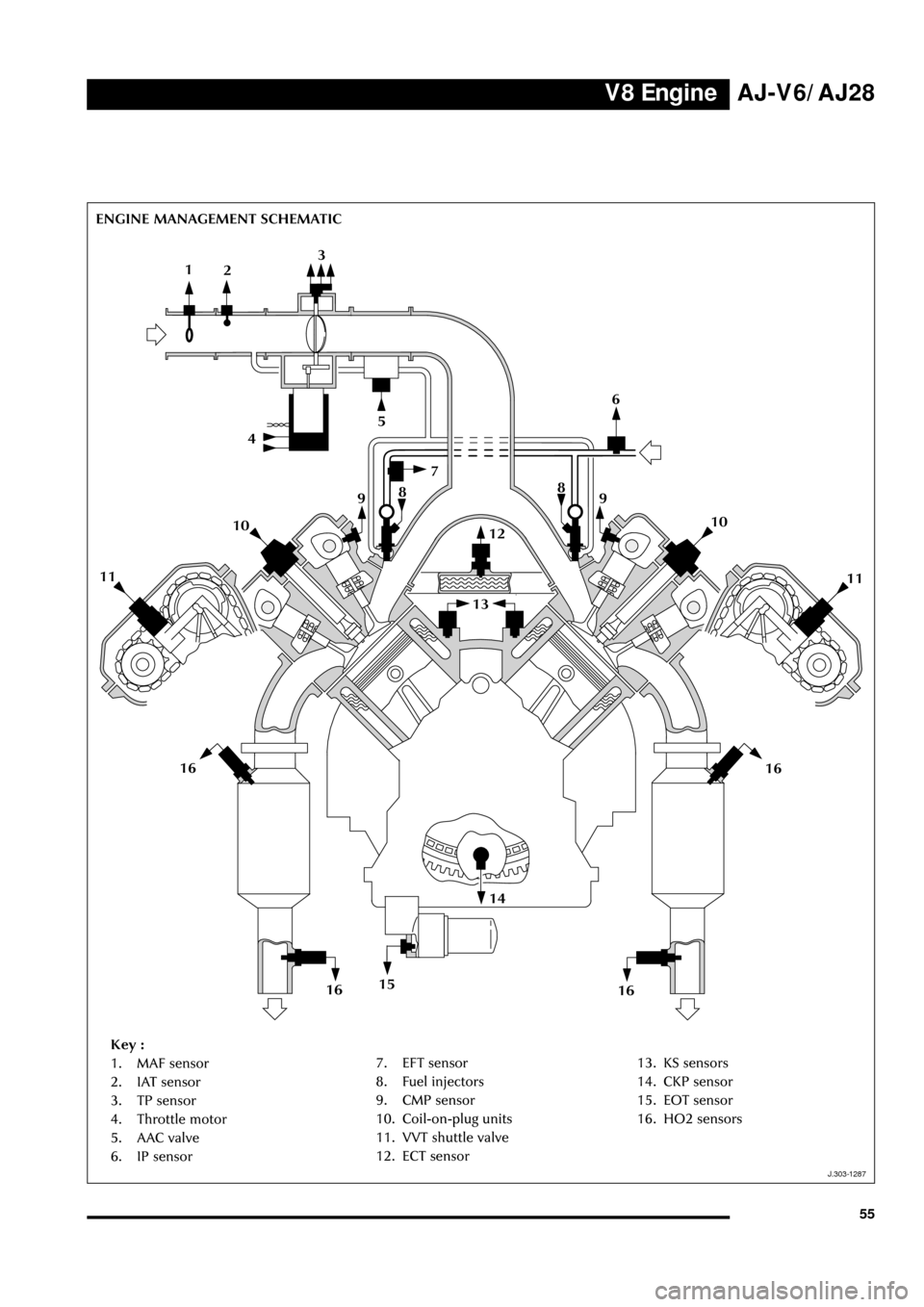
Engine Management Sensors
The configuration of the AJ28 engine management sensors is changed from the previous V8 variants:
¥ New components unique to AJ28 engine are the MAF sensor and engine fuel temperature (EFT)
sensor.
¥ Components in common with the V6 engine are the IAT sensor, KS sensors, injector pressure (IP)
sensor, engine oil temperature (EOT) sensor and HO2 sensors.
¥ The crankshaft (CKP) and camshaft (CMP) sensors are the same as those fitted to the AJ27 engine.
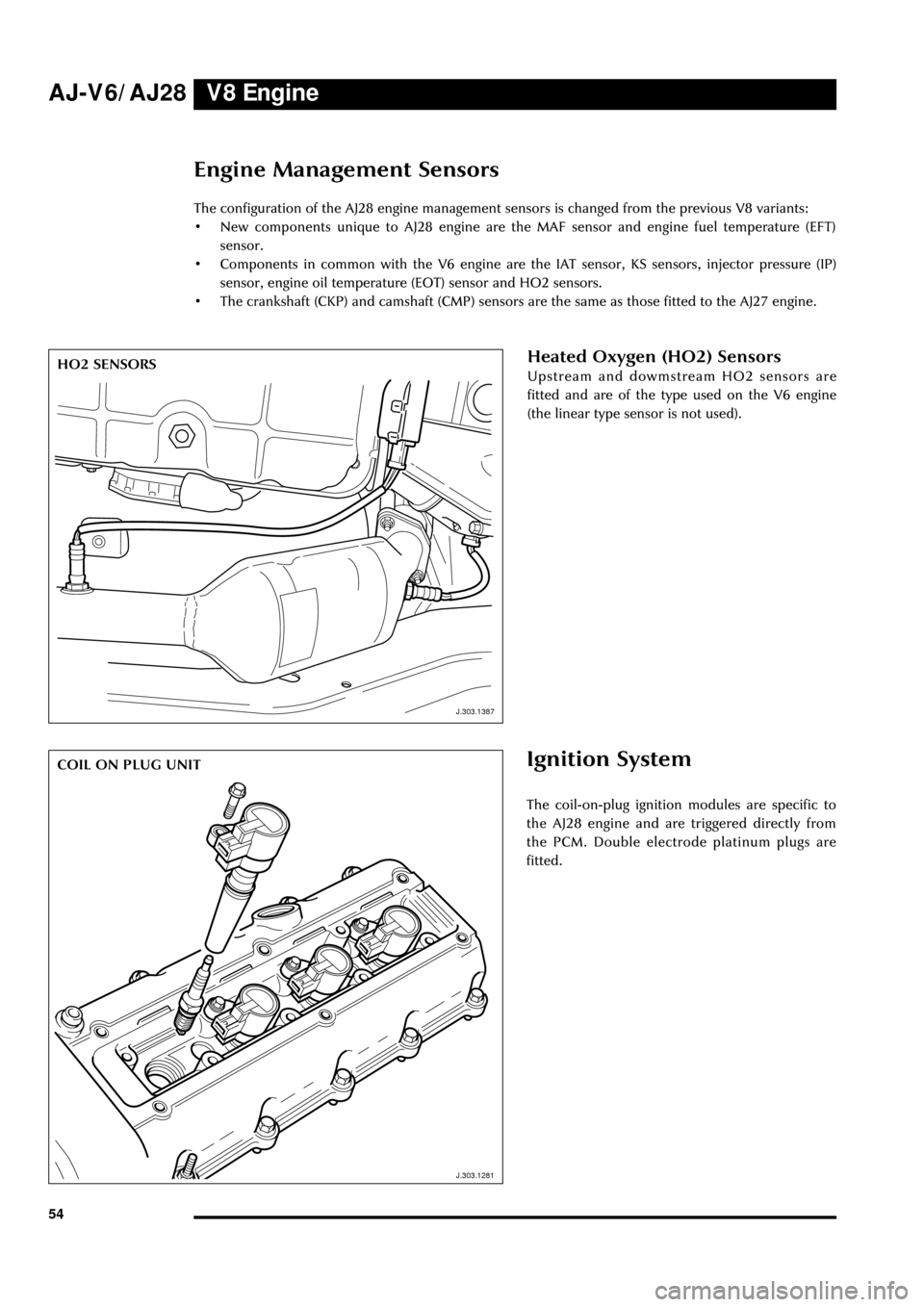
Heated Oxygen (HO2) Sensors
Upstream and dowmstream HO2 sensors are
fitted and are of the type used on the V6 engine
(the linear type sensor is not used).
J.303.1387
HO2 SENSORS
J.303.1387
J.303.1281
COIL ON PLUG UNIT
J.303.1281
Ignition System
The coil-on-plug ignition modules are specific to
the AJ28 engine and are triggered directly from
the PCM. Double electrode platinum plugs are
fitted.
Page 60 of 75
V8 EngineAJ-V6/AJ28
55
J.303.1389
ENGINE MANAGEMENT SCHEMATIC
13
2
45
6
8
157
9
1110
13
16
J.303-1287
9
10
12
14
Key :
1. MAF sensor
2. IAT sensor
3. TP sensor
4. Throttle motor
5. AAC valve
6. IP sensor8
11
16
1616
7. EFT sensor
8. Fuel injectors
9. CMP sensor
10. Coil-on-plug units
11. VVT shuttle valve
12. ECT sensor13. KS sensors
14. CKP sensor
15. EOT sensor
16. HO2 sensors
Page 66 of 75
Automatic TransmissionAJ-V6/AJ28
61
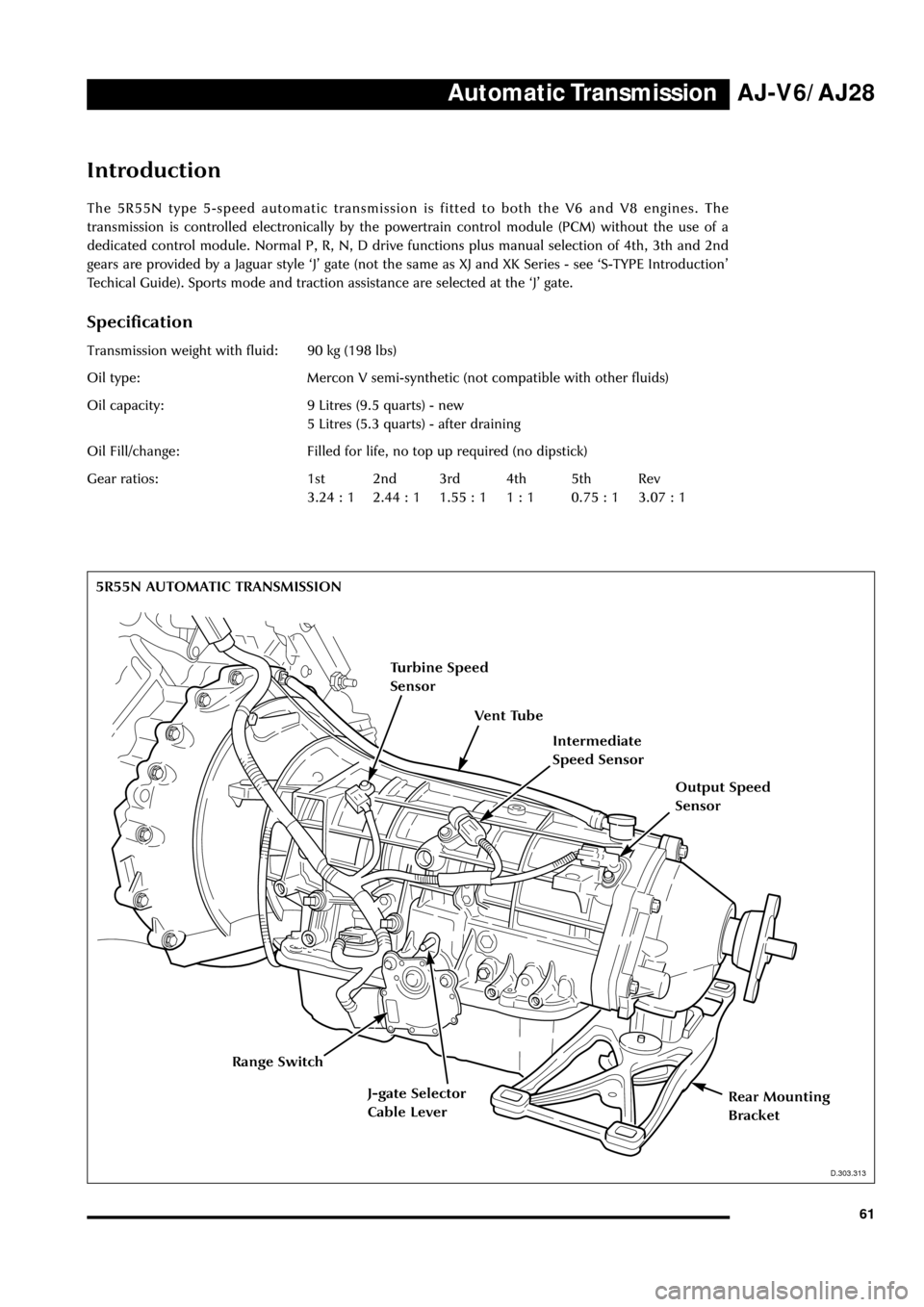
Introduction
The 5R55N type 5-speed automatic transmission is fitted to both the V6 and V8 engines. The
transmission is controlled electronically by the powertrain control module (PCM) without the use of a
dedicated control module. Normal P, R, N, D drive functions plus manual selection of 4th, 3th and 2nd
gears are provided by a Jaguar style ÔJÕ gate (not the same as XJ and XK Series - see ÔS-TYPE IntroductionÕ
Techical Guide). Sports mode and traction assistance are selected at the ÔJÕ gate.
Specification
Transmission weight with fluid: 90 kg (198 lbs)
Oil type: Mercon V semi-synthetic (not compatible with other fluids)
Oil capacity: 9 Litres (9.5 quarts) - new
5 Litres (5.3 quarts) - after draining
Oil Fill/change: Filled for life, no top up required (no dipstick)
Gear ratios: 1st 2nd 3rd 4th 5th Rev
3.24 : 1 2.44 : 1 1.55 : 1 1 : 1 0.75 : 1 3.07 : 1
D.307.313
5R55N AUTOMATIC TRANSMISSION
D.303.313
Vent Tube
Turbine Speed
Sensor
Intermediate
Speed Sensor
Output Speed
Sensor
Range Switch
Rear Mounting
BracketJ-gate Selector
Cable Lever
Page 68 of 75
Automatic TransmissionAJ-V6/AJ28
63 controlled solenoid are mounted on an
integral, replaceable, control module
¥ three speed sensors mounted on the external
casing: turbine speed sensor, intermediate
speed sensor and output speed sensor
¥ an oil temperature sensor is fitted inside the
transmission.
The gear select lever is connected via a Bowden
cable to an operating lever on the left side of the
transmission casing. A digital rotary switch, the
transmission range switch, fits over the shaft of
the operating lever and is fixed by two bolts to
the transmission casing. Selection of a particular
drive function generates a 4 bit binary coded
signal which is transmitted directly to the PCM
over a four wire parallel interface. As on the XK
and XJ Series, lateral movement of the gear select
lever across the gate, D to 4 or 4 to D, operates a
switch which indicates the selected function to
the PCM (the Bowden cable is not actuated
laterally).
The PCM directly controls the transmission
actuators as a response to driver demand, engine
requirements and according to the selected shift
mode. Gear selection is controlled by commands
to the four shift solenoids. If, during gear
selection, the relative speeds monitored by the
speed sensors are not as expected, the PCM
varies the analogue signal to the variable force
solenoids to increase/decrease the clutch pressure
(closed loop control). Increased engagement times
due to ageing are also controlled by adaptive shiftpressure.
Apart from the sports mode and traction mode
selected by the driver, there are pre-programmed
modes selected by the PCM in response to sensed
driving conditions :
¥ increased load such as gradients and trailer
towing
¥ cruise control
¥ hot mode: strategies including clutch lock up
are applied to reduce heat.
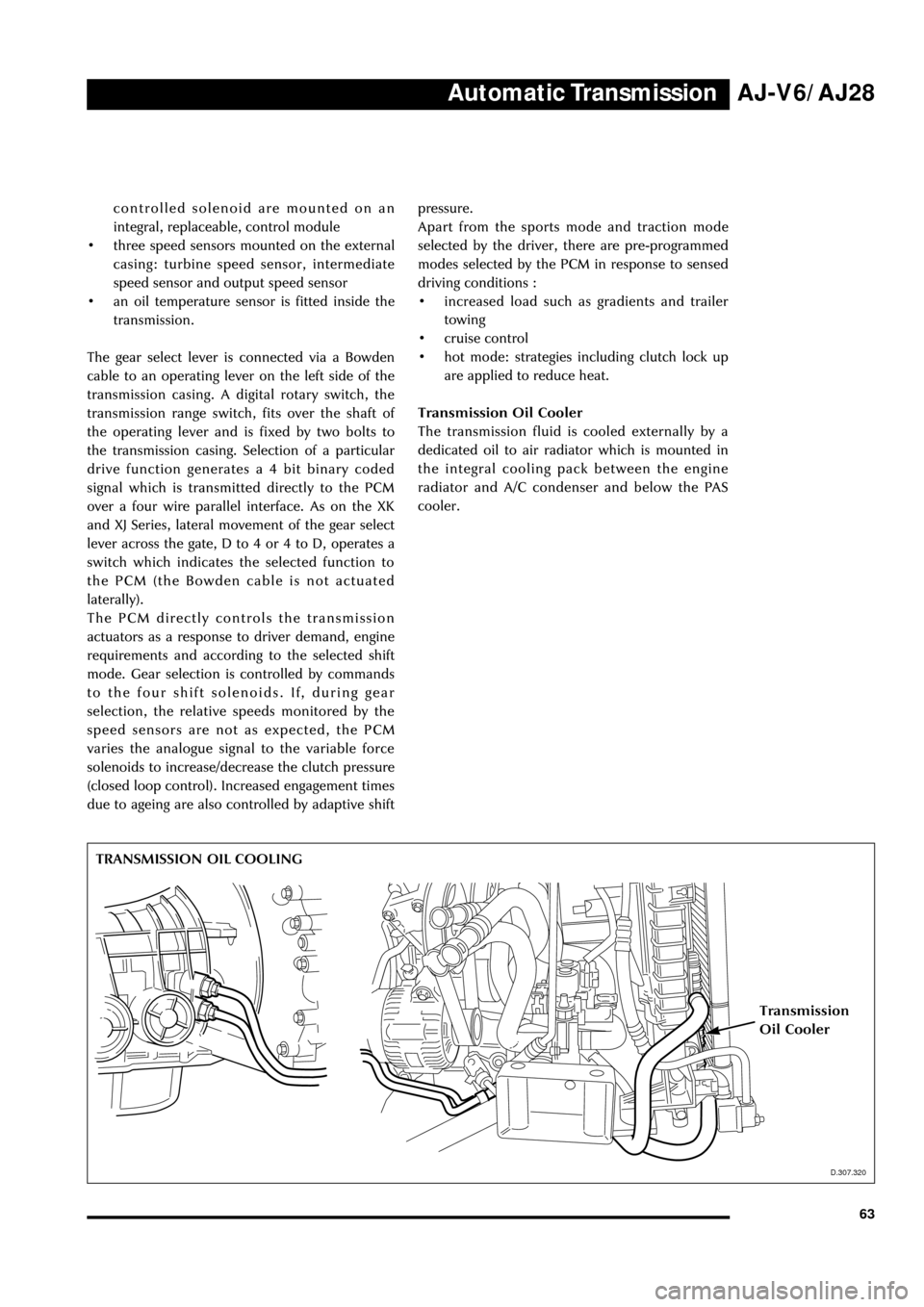
Transmission Oil Cooler
The transmission fluid is cooled externally by a
dedicated oil to air radiator which is mounted in
the integral cooling pack between the engine
radiator and A/C condenser and below the PAS
cooler.
D.307.320
TRANSMISSION OIL COOLING
Transmission
Oil Cooler
D.307.320
Page 69 of 75
Introduction
Manual Transmission AJ-V6/AJ28
64In Europeon markets only, manual transmission is fitted as standard on the V6 entry S-TYPE model and
as an option on the V6 high specification model. Manual transmission is not available for the V8 variant.
The manual transmission is a 5 speed Getrag 221 unit with the following features:
¥ direct gearing (1:1) on 5th gear (it is normally on 4th) reduces losses
¥ twin synchronising cones on 1st and 2nd gears provide a smoother change
¥ four plane shift gate (R-1-3-5) with Ôknock-overÕ protection on the Reverse position.
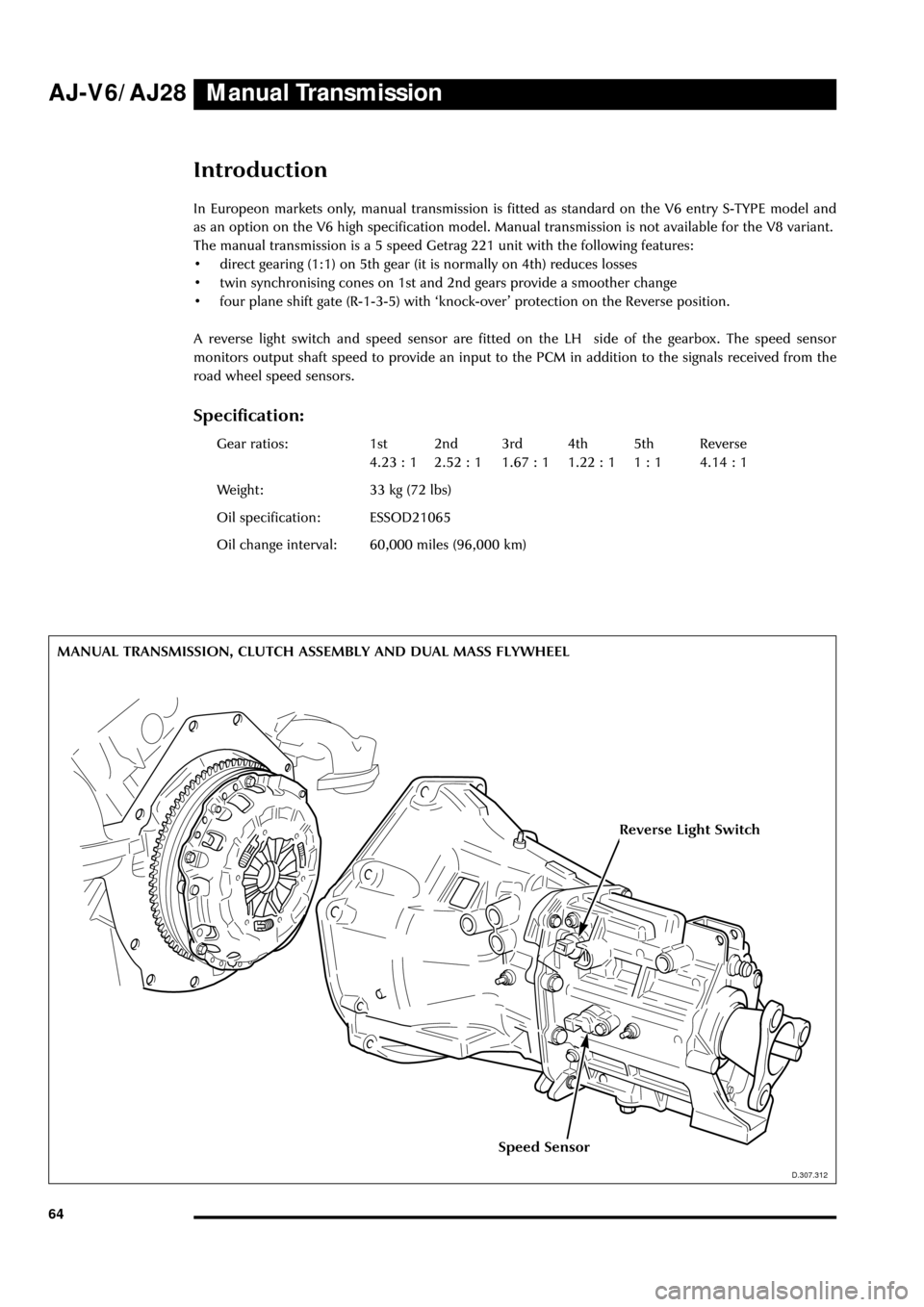
A reverse light switch and speed sensor are fitted on the LH side of the gearbox. The speed sensor
monitors output shaft speed to provide an input to the PCM in addition to the signals received from the
road wheel speed sensors.
Specification:
Gear ratios: 1st 2nd 3rd 4th 5th Reverse
4.23 : 1 2.52 : 1 1.67 : 1 1.22 : 1 1 : 1 4.14 : 1
Weight: 33 kg (72 lbs)
Oil specification: ESSOD21065
Oil change interval: 60,000 miles (96,000 km)
D.307.312
MANUAL TRANSMISSION, CLUTCH ASSEMBLY AND DUAL MASS FLYWHEEL
D.307.312
Reverse Light Switch
Speed Sensor
Page 71 of 75
Manual Transmission AJ-V6/AJ28
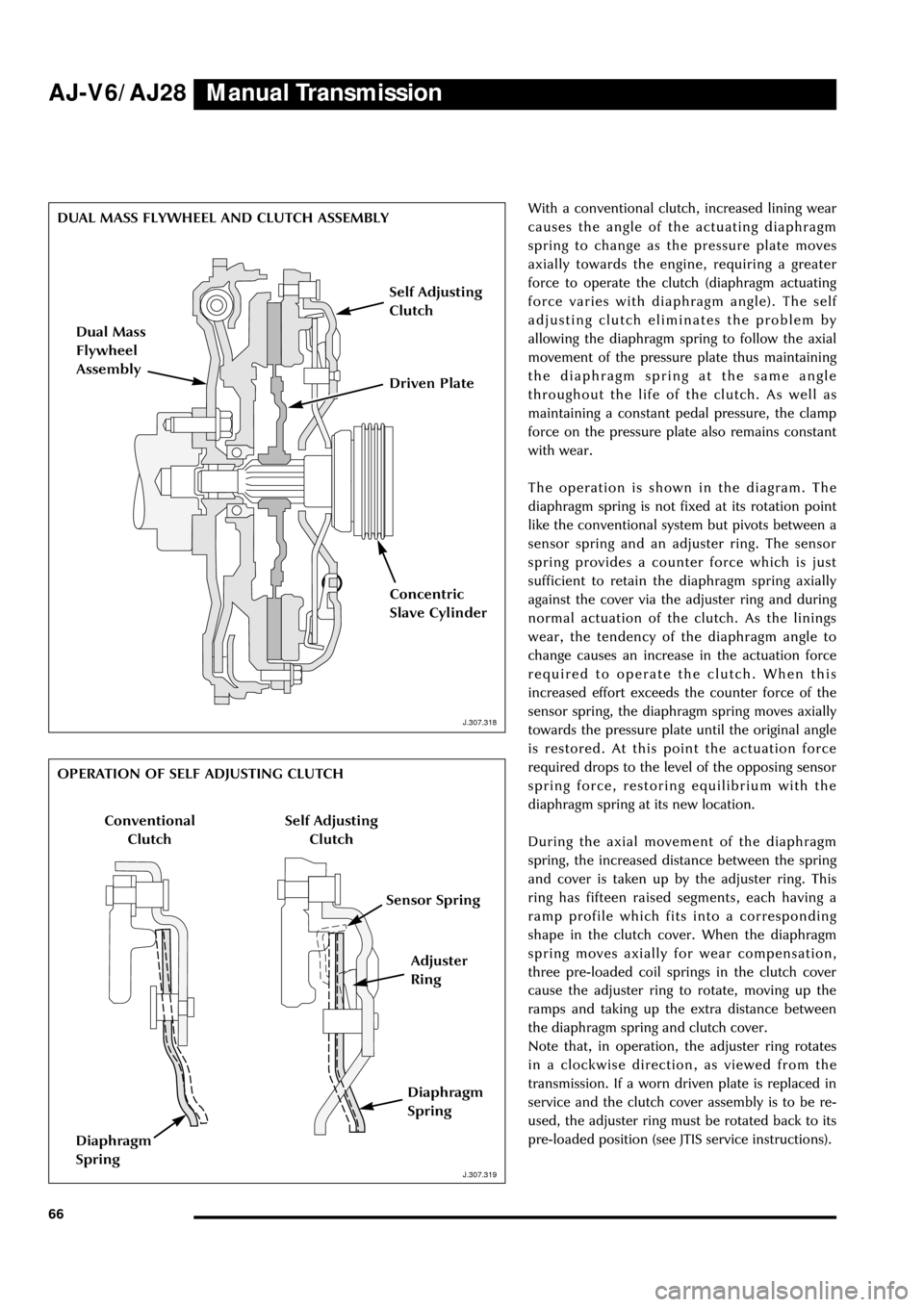
66With a conventional clutch, increased lining wear
causes the angle of the actuating diaphragm
spring to change as the pressure plate moves
axially towards the engine, requiring a greater
force to operate the clutch (diaphragm actuating
force varies with diaphragm angle). The self
adjusting clutch eliminates the problem by
allowing the diaphragm spring to follow the axial
movement of the pressure plate thus maintaining
the diaphragm spring at the same angle
throughout the life of the clutch. As well as
maintaining a constant pedal pressure, the clamp
force on the pressure plate also remains constant
with wear.
The operation is shown in the diagram. The
diaphragm spring is not fixed at its rotation point
like the conventional system but pivots between a
sensor spring and an adjuster ring. The sensor
spring provides a counter force which is just
sufficient to retain the diaphragm spring axially
against the cover via the adjuster ring and during
normal actuation of the clutch. As the linings
wear, the tendency of the diaphragm angle to
change causes an increase in the actuation force
required to operate the clutch. When this
increased effort exceeds the counter force of the
sensor spring, the diaphragm spring moves axially
towards the pressure plate until the original angle
is restored. At this point the actuation force
required drops to the level of the opposing sensor
spring force, restoring equilibrium with the
diaphragm spring at its new location.
During the axial movement of the diaphragm
spring, the increased distance between the spring
and cover is taken up by the adjuster ring. This
ring has fifteen raised segments, each having a
ramp profile which fits into a corresponding
shape in the clutch cover. When the diaphragm
spring moves axially for wear compensation,
three pre-loaded coil springs in the clutch cover
cause the adjuster ring to rotate, moving up the
ramps and taking up the extra distance between
the diaphragm spring and clutch cover.
Note that, in operation, the adjuster ring rotates
in a clockwise direction, as viewed from the
transmission. If a worn driven plate is replaced in
service and the clutch cover assembly is to be re-
used, the adjuster ring must be rotated back to its
pre-loaded position (see JTIS service instructions).
J.307.318
DUAL MASS FLYWHEEL AND CLUTCH ASSEMBLY
J.307.318
J.307.319
OPERATION OF SELF ADJUSTING CLUTCH
J.307.319
Dual Mass
Flywheel
Assembly
Self Adjusting
Clutch
Driven Plate
Concentric
Slave Cylinder
Adjuster
Ring
Conventional
Clutch
Sensor Spring
Diaphragm
Spring
Self Adjusting
Clutch
Diaphragm
Spring