light JAGUAR XF 2011 1.G Owner's Guide
[x] Cancel search | Manufacturer: JAGUAR, Model Year: 2011, Model line: XF, Model: JAGUAR XF 2011 1.GPages: 225, PDF Size: 7.32 MB
Page 155 of 225
R
(FM8) SEMCON JLR OWNER GUIDE VER 1.00 EURO
LANGUAGE: english-en; MARQUE: jaguar; MODEL: XF
Fuel and refuelling
155
To close the filler flap, push the flap until
latched closed.
Note: The filler flap will only be locked closed
when the vehicle is centrally locked.
FUEL FILLER
When refuelling ensure that all
windows, doors, and sunroof are fully
closed, particularly if young children
or animals are in the vehicle.
Do not attempt to fill the tank to its
maximum capacity. If the vehicle is to
be parked on a slope, in direct
sunlight or high am bient temperature,
expansion of the fuel could cause
spillage.
Check the fuel pump information
carefully, to ensure that you are putting
the correct fuel into the vehicle.
If the vehicle is filled with incorrect fuel,
it is essential that you seek qualified
assistance before you start the engine.
Fuel station pumps are equipped with
automatic cut-off sensing, to avoid fuel
spillage. Fill the tank until the filler nozzle
automatically cuts off the supply. Do not
attempt to fill the tank beyond this point.
Note: Filling station pumps used for diesel
commercial vehicles deliver fuel at a higher
rate than normal. The hi gher fill rate can cause
premature cut-off and ma y cause fuel spillage.
Therefore, it is recommended that only
standard light vehicle pumps are used.
DIESEL MISFUELLING PROTECTION
DEVICE
When the misfuelling device is
activated it may cause fuel to be
discharged from the filler neck.
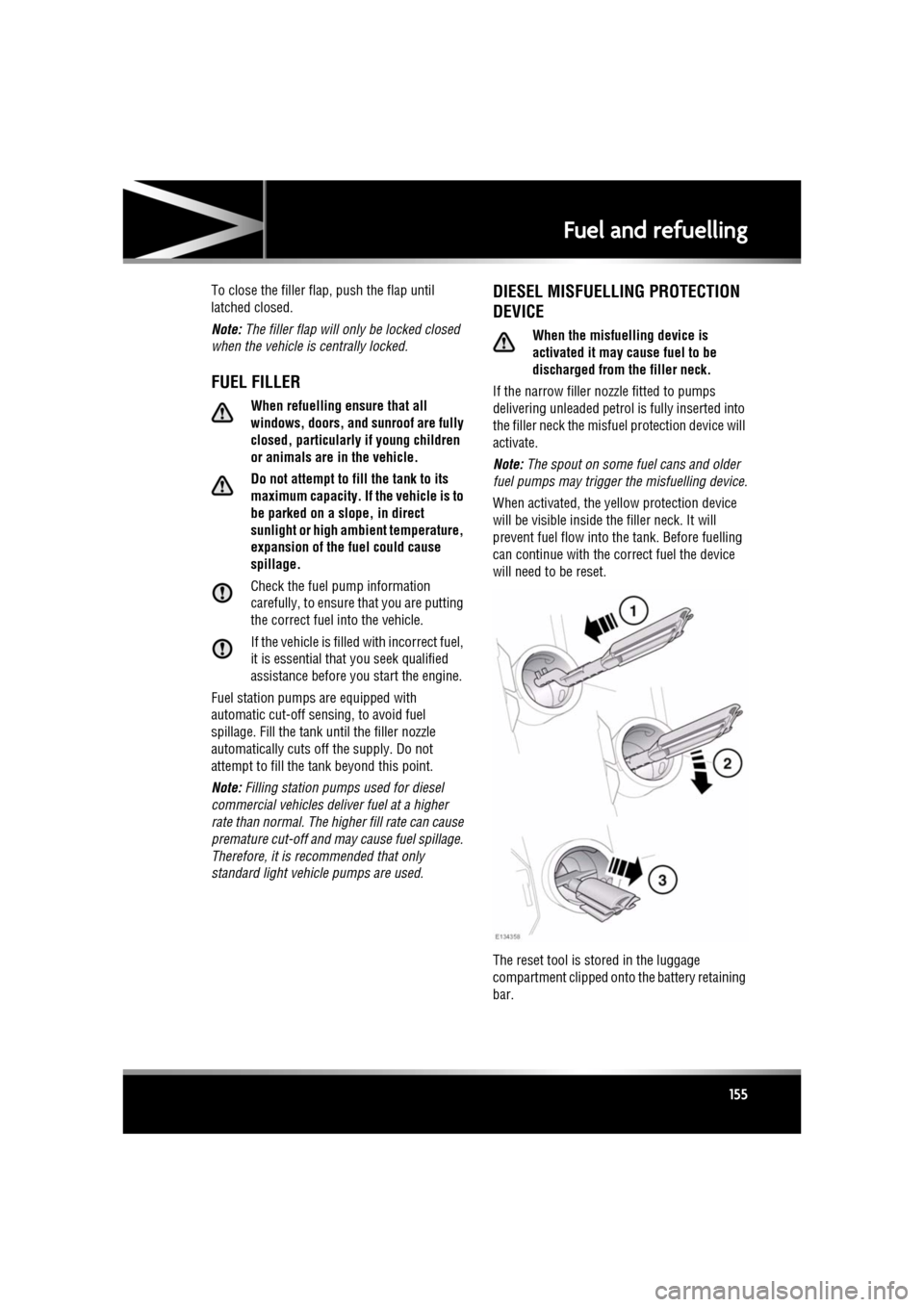
If the narrow filler nozzl e fitted to pumps
delivering unleaded petrol is fully inserted into
the filler neck the misfue l protection device will
activate.
Note: The spout on some fuel cans and older
fuel pumps may trigger the misfuelling device.
When activated, the ye llow protection device
will be visible inside the filler neck. It will
prevent fuel flow into the tank. Before fuelling
can continue with the correct fuel the device
will need to be reset.
The reset tool is stored in the luggage
compartment clipped onto the battery retaining
bar.
Page 160 of 225
L
(FM8) SEMCON JLR OWNER GUIDE VER 1.00 EURO
LANGUAGE: english-en; MARQUE: jaguar; MODEL: XF
Maintenance
160
FUEL SYSTEM
Under no circumst ances should any
part of the fuel system be dismantled
or replaced by anyone other than a
suitably qualified vehi cle technician.
Ensure sparks and naked lights are
kept away from the engine
compartment.
Wear protective clothing, including,
where practicable, gloves made from
an impervious material.
USED ENGINE OIL
Prolonged contact with engine oil may cause
serious skin disorders, including dermatitis
and cancer of the skin. Always wash
thoroughly after contact.
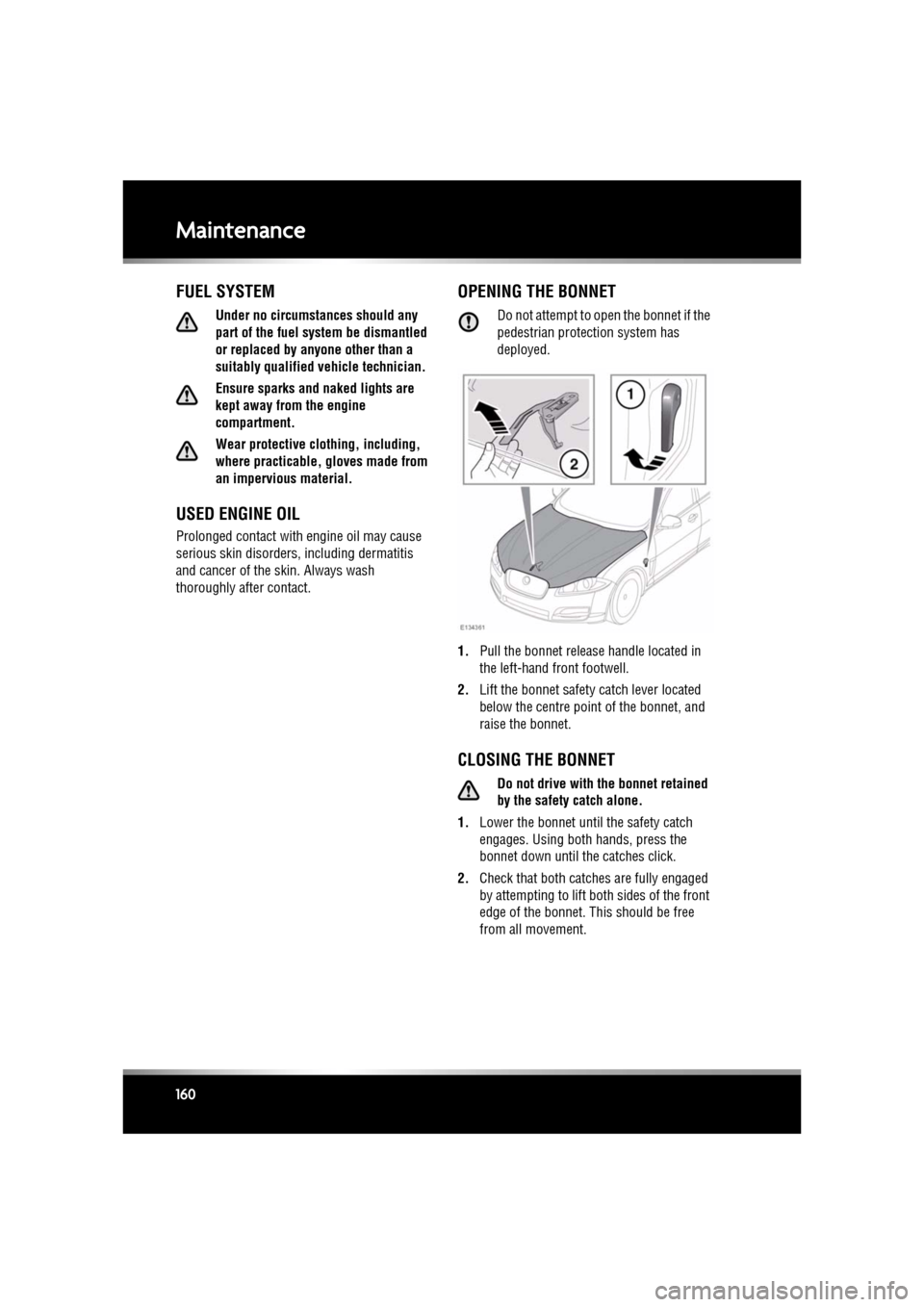
OPENING THE BONNET
Do not attempt to open the bonnet if the
pedestrian protec tion system has
deployed.
1. Pull the bonnet release handle located in
the left-hand front footwell.
2. Lift the bonnet safety catch lever located
below the centre point of the bonnet, and
raise the bonnet.
CLOSING THE BONNET
Do not drive with the bonnet retained
by the safety catch alone.
1. Lower the bonnet until the safety catch
engages. Using bot h hands, press the
bonnet down until the catches click.
2. Check that both catche s are fully engaged
by attempting to lift both sides of the front
edge of the bonnet. This should be free
from all movement.
Page 167 of 225
R
(FM8) SEMCON JLR OWNER GUIDE VER 1.00 EURO
LANGUAGE: english-en; MARQUE: jaguar; MODEL: XF
Maintenance
167
CARPETS AND MATS
Marks or stains can be removed by gentle
scrubbing with a weak solution of soap and
warm water.
For more stubborn stains a commercially
available carpet cleaner should be used.
SEAT BELTS
Do not allow any water, cleaning
products, or fabric from cloths to enter
the seat belt mechanism. Any
substance which enters the
mechanism may affect the
performance of the seat belt in an
impact.
Extend the seat belts fully, then use warm
water and a non-detergent soap to clean. Allow
the seat belts to dry naturally whilst fully
extended and do not allow the belts to retract
until fully dry.
Note: Whilst cleaning the seat belt, take the
opportunity to examine the webbing for
damage and wear. Any wear or damage should
be reported to, and rectified by, a Dealer/
Authorised Repairer.
AIRBAG MODULE COVERS
Airbag covers should only be cleaned
using a slightly dampened cloth, and
a small amount of upholstery cleaner.
Any substance which enters the
mechanism, can prevent correct
deployment of an airbag during an
impact.
Page 168 of 225
L
(FM8) SEMCON JLR OWNER GUIDE VER 1.00 EURO
LANGUAGE: english-en; MARQUE: jaguar; MODEL: XF
Fluid level checks
168
Fluid level checksCHECKING THE ENGINE OIL LEVEL
Check the engine oil weekly. If any
significant or sudden drop in oil level is
noted, seek qualified assistance.
If the message ENGINE OIL PRESSURE
LOW is displayed, stop the engine as
soon as it is safe to do so and seek
qualified assistance. Do not start the
engine until the cause has been
rectified.
Prior to checking the oil level ensure that the
vehicle is on level ground.
All except V6 petrol engines
Ensure that:
• The engine oil has reached working
temperature (oil is hot).
• The engine has been switched off for ten
minutes, as the syst em will not give an
accurate reading until the oil level has
stabilised.
The oil level can then be checked as follows:
1. Switch on the ignition (do not start the
engine).
2. Ensure Park (P ) is selected.
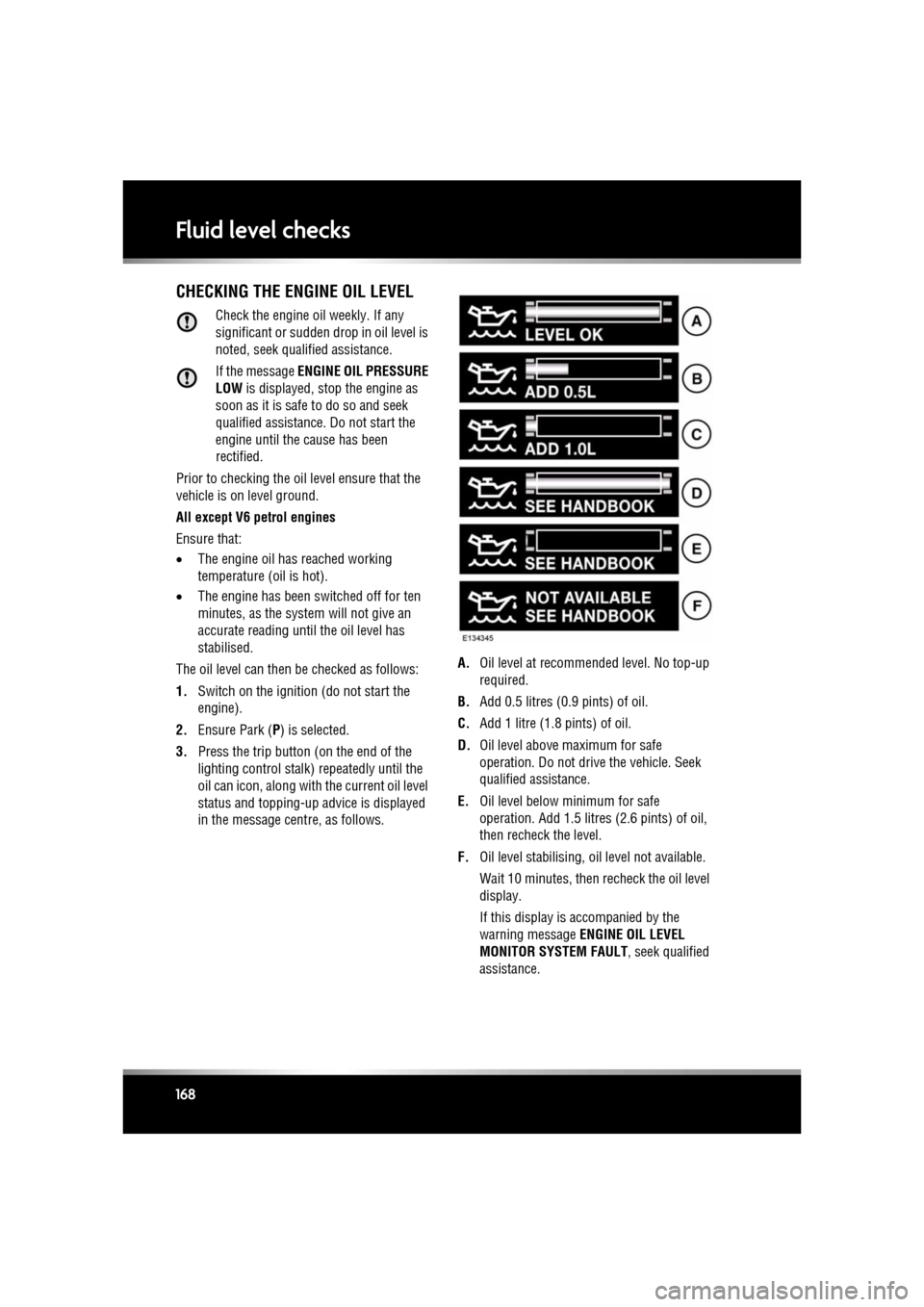
3. Press the trip button (on the end of the
lighting control stalk) repeatedly until the
oil can icon, along with the current oil level
status and topping-up ad vice is displayed
in the message centre, as follows. A.
Oil level at recommended level. No top-up
required.
B. Add 0.5 litres (0.9 pints) of oil.
C. Add 1 litre (1.8 pints) of oil.
D. Oil level above maximum for safe
operation. Do not drive the vehicle. Seek
qualified assistance.
E. Oil level below mi nimum for safe
operation. Add 1.5 litres (2.6 pints) of oil,
then recheck the level.
F. Oil level stabilising, oil level not available.
Wait 10 minutes, then recheck the oil level
display.
If this display is accompanied by the
warning message ENGINE OIL LEVEL
MONITOR SYSTEM FAULT , seek qualified
assistance.
Page 172 of 225
L
(FM8) SEMCON JLR OWNER GUIDE VER 1.00 EURO
LANGUAGE: english-en; MARQUE: jaguar; MODEL: XF
Fluid level checks
172
Do not drive the vehi cle with the fluid
level below the MIN mark.
With the vehicle on level ground, check the
fluid level at least every week (more frequently
in high mileage or arduous operating
conditions).
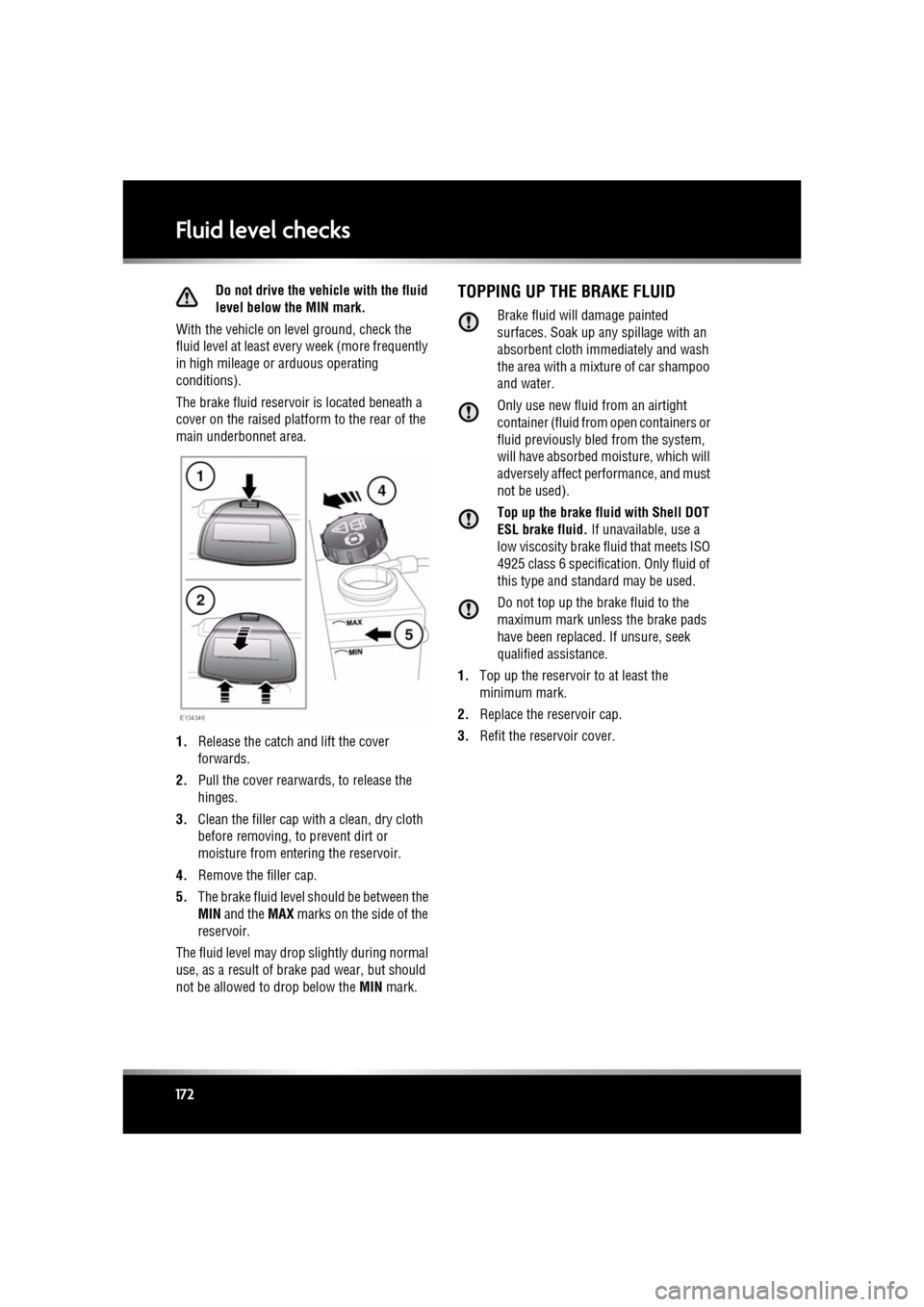
The brake fluid reservoi r is located beneath a
cover on the raised platform to the rear of the
main underbonnet area.
1. Release the catch and lift the cover
forwards.
2. Pull the cover rearwards, to release the
hinges.
3. Clean the filler cap with a clean, dry cloth
before removing, to prevent dirt or
moisture from entering the reservoir.
4. Remove the filler cap.
5. The brake fluid level should be between the
MIN and the MAX marks on the side of the
reservoir.
The fluid level may drop slightly during normal
use, as a result of brake pad wear, but should
not be allowed to drop below the MIN mark.TOPPING UP THE BRAKE FLUID
Brake fluid will damage painted
surfaces. Soak up any spillage with an
absorbent cloth immediately and wash
the area with a mixture of car shampoo
and water.
Only use new fluid from an airtight
container (fluid from open containers or
fluid previously bled from the system,
will have absorbed moisture, which will
adversely affect performance, and must
not be used).
Top up the brake fluid with Shell DOT
ESL brake fluid. If unavailable, use a
low viscosity brake fluid that meets ISO
4925 class 6 specificat ion. Only fluid of
this type and standard may be used.
Do not top up the brake fluid to the
maximum mark unless the brake pads
have been replaced. If unsure, seek
qualified assistance.
1. Top up the reservoir to at least the
minimum mark.
2. Replace the reservoir cap.
3. Refit the reservoir cover.
Page 185 of 225
R
(FM8) SEMCON JLR OWNER GUIDE VER 1.00 EURO
LANGUAGE: english-en; MARQUE: jaguar; MODEL: XF
Tyres
185
TyresTYRE CARE
Do not drive the vehi cle if a tyre is
damaged, excessively worn, or
incorrectly inflated.
Avoid contaminating the tyres with
vehicle fluids as they may cause
damage to the tyre.
Avoid spinning the wheels. The forces
released can damage the structure of
the tyre and cause it to fail.
If wheel spin is unavoidable due to a
loss of traction (in deep snow, for
example), do not exceed 50 km/h (30
mph).
Do not exceed the maximum pressure
stated on the sidewall of the tyre.
TYRE PRESSURES
Never drive your vehicle if the tyre
pressures are incorrect.
Pressure checks should only be
carried out when the tyres are cold,
and the vehicle has been stationary
for more than three hours. A hot tyre at
or below recommended cold inflation
pressure is dangerously
under-inflated.
If the vehicle has been parked in
strong sunlight, or used in high
ambient temperatures, do not reduce
the tyre pressures. Move the vehicle
into the shade and allow the tyres to
cool before re-checking the
pressures.
CHECKING THE TYRE PRESSURES
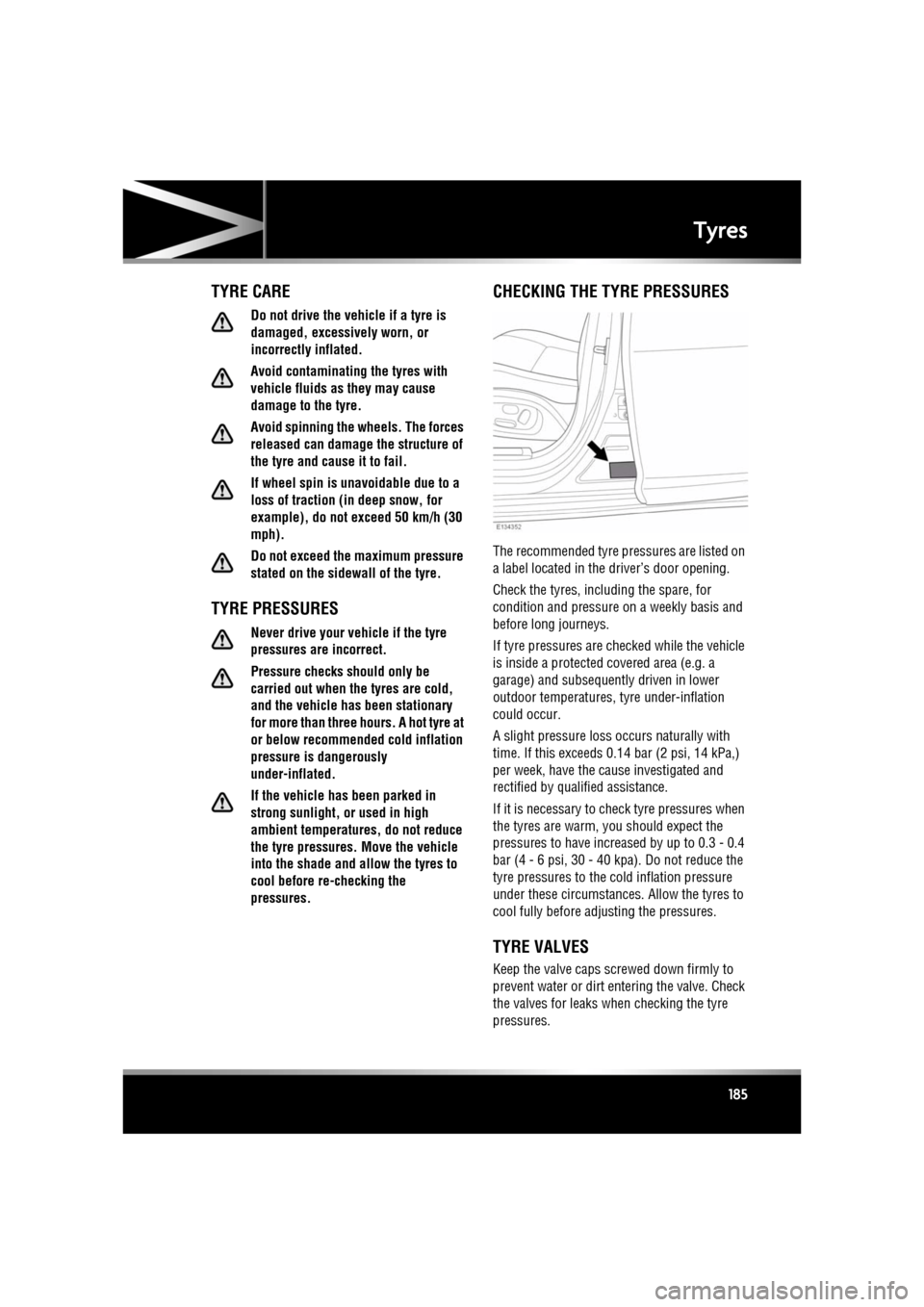
The recommended tyre pressures are listed on
a label located in the driver’s door opening.
Check the tyres, including the spare, for
condition and pressure on a weekly basis and
before long journeys.
If tyre pressures are checked while the vehicle
is inside a protected covered area (e.g. a
garage) and subsequent ly driven in lower
outdoor temperatures, tyre under-inflation
could occur.
A slight pressure loss occurs naturally with
time. If this exceeds 0. 14 bar (2 psi, 14 kPa,)
per week, have the cause investigated and
rectified by qualified assistance.
If it is necessary to check tyre pressures when
the tyres are warm, you should expect the
pressures to have increased by up to 0.3 - 0.4
bar (4 - 6 psi, 30 - 40 kpa). Do not reduce the
tyre pressures to the cold inflation pressure
under these circumstances. Allow the tyres to
cool fully before ad justing the pressures.
TYRE VALVES
Keep the valve caps screwed down firmly to
prevent water or dirt entering the valve. Check
the valves for leaks when checking the tyre
pressures.
Page 186 of 225
L
(FM8) SEMCON JLR OWNER GUIDE VER 1.00 EURO
LANGUAGE: english-en; MARQUE: jaguar; MODEL: XF
Tyres
186
PUNCTURED TYRES
Do not drive the vehicle with a
punctured tyre. Even if the punctured
tyre has not deflated, it is unsafe to
use, as the tyre may deflate suddenly
at any time.
REPLACEMENT TYRES
Always fit replacement tyres of the
same type, and wherever possible of
the same make and tread pattern.
If the use of tyres not recommended by
Jaguar is unavoidable, ensure that
you read, and fully comply with, the
tyre manufacturer’s instructions.
Ideally, tyres should be re placed in sets of four.
If this is not possible, replace the tyres in pairs
(both front or both rear). When tyres are
replaced, the wheels should always be
re-balanced and alignment checked.
The correct tyre specification for your vehicle
can be found on the ty re placard label.
PRESSURE COMPENSATION FOR
TEMPERATURE CHANGES
A colder ambient local temperature will reduce
pressure within the tyre. An effect is to
decrease sidewall height and to increase tyre
shoulder wear with the potential for tyre failure.
Vehicle dynamics could also be adversely
affected.
Tyre pressures can be adjusted to compensate
before the start of the journey. Alternatively,
tyre pressures can be adjusted when the area
of lower ambient temperature is reached.
In this situation, the vehicle must be left in the
ambient local temperature for at least one hour
before tyre pressure is adjusted. To compensate for colder ambient
temperatures, tyre pressures should be
increased by 0.14 bar (2 psi, 14 kPa) for each
10°C (20°F) decrease.
Note:
Ensure that correct tyre pressures are
maintained when moving to areas of differing
ambient temperature.
AVOIDING FLAT SPOTS
In order to minimise fl at spotting, the tyre
pressures can be increased to the maximum as
stated on the tyre sidewall, for the period when
the vehicle is stationary. Tyres must be
returned to the specified running pressures
before driving.
TYRE DEGRADATION
Tyres degrade over time due to the effects of
ultraviolet light, extreme temperatures, high
loads, and environmen tal conditions. It is
recommended that tyres are replaced at least
every six years, but they may require
replacement more frequently.
USING WINTER TYRES
Do not exceed 240 km/h (150 mph) when
using Jaguar approv ed winter tyres.
Winter tyres must be fitted to all four wheels.
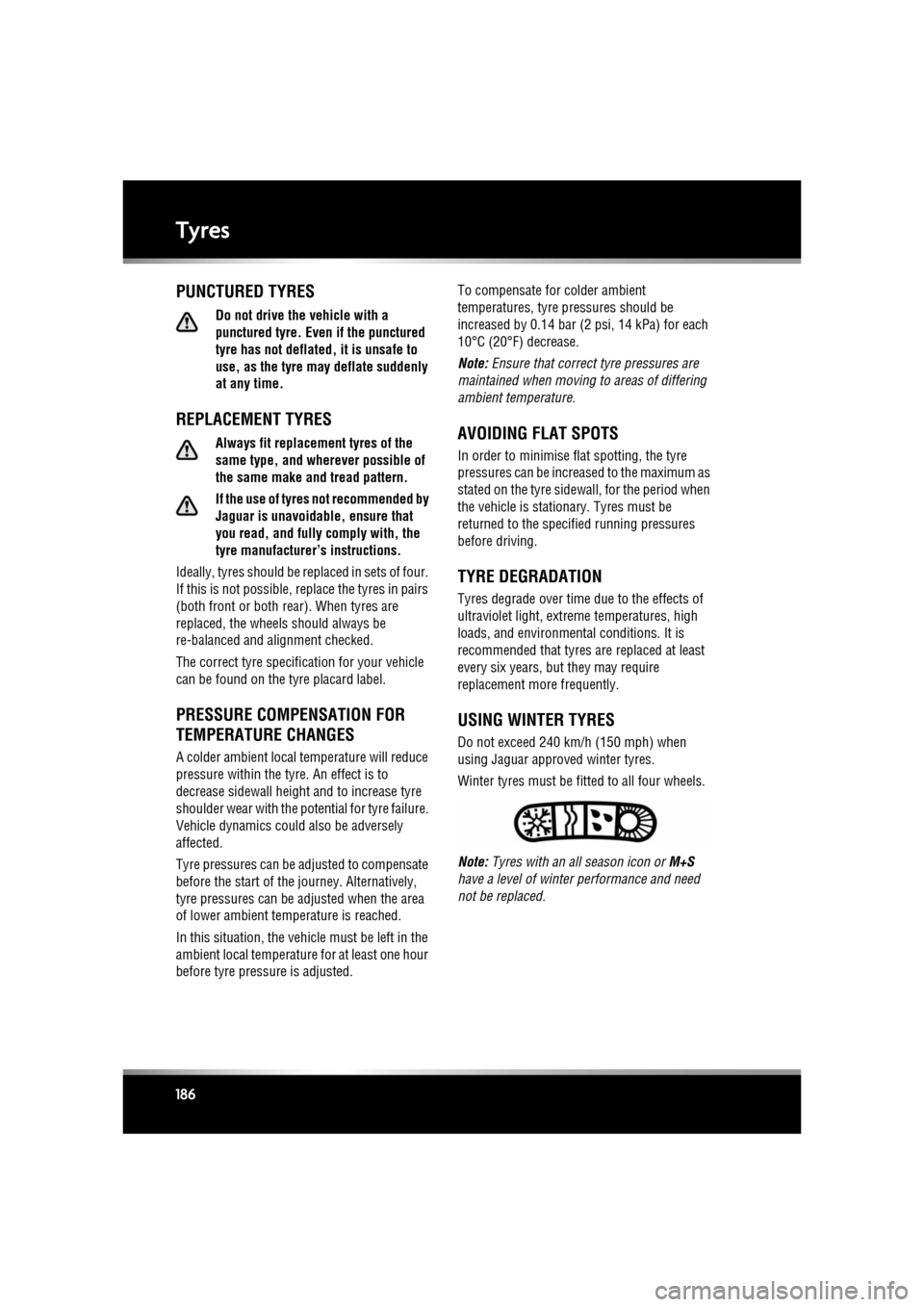
Note: Tyres with an all season icon or M+S
have a level of winter performance and need
not be replaced.
Page 189 of 225

R
(FM8) SEMCON JLR OWNER GUIDE VER 1.00 EURO
LANGUAGE: english-en; MARQUE: jaguar; MODEL: XF
Fuses
189
ENGINE COMPARTMENT FUSE BOX
Fuse No Rating
(amps) Fuse
ColourCircuit
F1 - - -
F2 - - -
F3 20A Yellow Emissions system (petrol only).
F4 20A Yellow Emissions system (petrol only).
F5 40A Orange ABS pump.
F6 30A Green Power wash pump.
F7 50A Red Cigar lighter.
F8 - - -
F9 50A Red Engine management system.
F10 - - -
F11 - - -
F12 50A Red Secondary air inje ction (V6 petrol only).
F13 30A Green Wipers.
F14 30A Green Starter solenoid.
F15 40A Orange Front screen heater - RH.
F16 40A Orange Front screen heater - LH.
F17 80A Natural Radiator fan (V6 petrol only).
F18 60A Aqua Glow pl ugs (diesel only).
F19 5A Tan Adaptive cruise control. FLS.
F20 15A Blue Horn.
F21 25A Clear ABS valves.
F22 - - -
F23 - - -
F24 - - -
F25 10A Red ABS ECM.
F26 10A Red Engine management syst em ECM. Transmission control
module.
F27 5A Tan Secondary air inje ction (V6 petrol only).
F28 5A Tan Adaptive front lighting - LH.
F29 5A Tan Adaptive front lighting - RH.
Page 190 of 225

L
(FM8) SEMCON JLR OWNER GUIDE VER 1.00 EURO
LANGUAGE: english-en; MARQUE: jaguar; MODEL: XF
Fuses
190
F30 - - -
F31 20A Yellow Auxiliary power socket - rear.
F32 20A Yellow Cigar lighter.
F33 - - -
F34 - - -
F35 5A Tan Air conditioning compressor clutch.
F36 15A Blue Engine management system 5 (V6 diesel only).
20A Yellow Engine management system 5 (V8 petrol only).
F37 15A Blue Ignition system (petrol only).
F38 5A Tan Power steering.
F39 5A Tan Headlamp levelling system.
F40 15A Blue Water pump (sup ercharged vehicles only).
F41 5A Tan Engine management system 1 (V6 diesel only). 10A Red Engine management system 1 (petrol and I4 diesel only).
F42 10A Red Engine management system 2 (V8 petrol only). 20A Yellow Engine management sy stem 2 (I4 diesel only).
30A Green Engine management system 2 (V6 petrol and V6 diesel only).
F43 5A Tan Engine management system 3 (diesel only). 10A Red Engine management system 3 (petrol only).
F44 5A Tan Engine management system 4 (V6 diesel only). 10A Red Engine management sy stem 4 (I4 diesel only).
15A Blue Engine management system 4 (V8 petrol only).
F45 100A Violet Radiator fan (d iesel and V8 petrol only).
Fuse No Rating
(amps) Fuse
ColourCircuit
Page 194 of 225
L
(FM8) SEMCON JLR OWNER GUIDE VER 1.00 EURO
LANGUAGE: english-en; MARQUE: jaguar; MODEL: XF
Wheel changing
194
Wheel changingWHEEL CHANGING SAFETY
Before raising the vehicl e, or changing a wheel
ensure that you read, and comply with the
following warnings.
Always find a safe place to stop, off
the highway and aw ay from traffic.
Ensure that the vehicle and jack are
both on firm level ground.
Apply the parking brake, and engage
Park (P).
Switch on the hazard warning lamps.
Ensure that the front wheels are in the
straight ahead position, and engage
the steering lock.
Disconnect trailer/ca ravan from the
vehicle.
Ensure that all passengers, and
animals, are out of the vehicle and in
a safe place away from the highway.
Place a warning triangle at a suitable
distance behind the v ehicle, facing
towards oncoming traffic.
When one rear wheel is lifted off the
ground the selection P (Park) position
will not prevent the vehicle from
moving and possibly slipping off the
jack as the park brake only operates
on the rear wheels. Use the wheel
chock when jacking the vehicle.
Always chock the wheel diagonally
opposite the wheel to be changed,
using the wheel chock supplied in the
tool kit. Chock the front of a front
wheel, or the rear of a rear wheel.
If jacking the vehicle on a slight slope
is unavoidable, place chocks on the
downhill side of the two opposite
wheels. An additional chock will be
needed. Never place anything between the jack
and the ground, or the jack and the
vehicle.
Do not attempt to raise the vehicle
unless the jack head is fully engaged
in the jacking point. Only jack the
vehicle using the approved jacking
points.
Remove the spare wheel prior to
jacking the vehicle, to avoid
destabilising the vehicle when raised.
Take care when lifting the spare
wheel, and removing the punctured
wheel. The wheels are heavy, and can
cause injuries if not handled correctly.
Do not start or run the engine while the
vehicle is support
ed only by a jack.
Do not get under a vehicle that is
supported by a jack.
Never work or allow any person to
place any part of their body beneath
the vehicle with the jack as the only
means of support - use vehicle
support stands.
Take care when loosening the wheel
nuts. The wheel brace may slip off if
not properly attached, and the wheel
nuts may release suddenly. Either
unexpected movement may cause an
injury.
After use, the tool kit should be
returned to the under floor storage
area and correctly stowed.
Always ensure replacement tyres
have the correct rating and
specifications (e.g. load index, size,
speed rating) for your vehicle.