Fan JAGUAR XF 2011 1.G Owners Manual
[x] Cancel search | Manufacturer: JAGUAR, Model Year: 2011, Model line: XF, Model: JAGUAR XF 2011 1.GPages: 225, PDF Size: 7.32 MB
Page 27 of 225
R
(FM8) SEMCON JLR OWNER GUIDE VER 1.00 EURO
LANGUAGE: english-en; MARQUE: jaguar; MODEL: XF
Occupant safety
27
If the vehicle is moving at or above 16 km/h (10
mph) and the seat belt of an occupied front
seat is not fastened, the warning lamp will
flash.
The flashing lasts for 10 seconds and repeats
every 10 seconds for approximately 5 minutes
or until the belt(s) is fastened or the vehicle
stops.
If the warning lamp re mains illuminated after
the seat belt(s) fastened, seek qualified
assistance as soon as pos sible. The vehicle can
still be driven with the warning lamp
illuminated, provided the seat belt(s) is
properly fastened.
Note: If a heavy object is placed on the front
passenger seat, it may activate the Beltminder
feature. It is recomme nded that the object be
placed in the luggage compartment or secured
using the seat belt.
Note: Although not advisable, it is possible to
disable the Beltminder function. Please see
your Dealer/Authorised Repairer to disable or
re-instate the function.
ACTIVE SEAT BELTS
The Active Seat Belt System enhances front
seat occupant support during extreme vehicle
manoeuvres such as understeer, oversteer or
high braking forces by te nsioning the seat belt.
Tension is released when the vehicle
manoeuvre is completed. The occupant may
notice a further slight in crease in tension just
prior to release of th e seat belt, which is
entirely normal.
In the unlikely event that tension is not released
after a manoeuvre is completed, bring the
vehicle to a safe stop. Unbuckle and re-buckle
the seat belt, which should then extract and
retract normally, before continuing with the
journey. Seat belts should be worn by all
vehicle occupants, for every journey,
no matter how short.
If the Active Seat Belts Unavailable message
and the yellow general warning symbol are
displayed in the message centre, contact your
Jaguar Dealer/ Authorised Repairer as soon as
possible. The vehicle is still safe to drive and
the Active Seat Belts will still function as
standard seat belts.
CHILD SEATS
For optimum safety, children should
travel in the rear of the vehicle at all
times; front passenger seat travel is
not recommended. However, if it is
essential that a child travels in the
front (not permitted in Australia), set
the vehicle seat fully rearward and
seat the child in an approved
forward-facing child seat. Do not use
a rear-facing child seat - an inflating
airbag could impact with the seat and
cause serious injury.
Do not use a forward facing child seat
until the child usin g it is above the
minimum weight of 9 kg (20 lb.) and
able to sit up unaided. Up to the age of
two, a child's spine and neck are not
sufficiently developed to avoid injury
in a frontal impact.
Do not allow a baby or infant to be
held or carried on the lap. The force of
a crash can increase effective body
weight by as much as thirty times,
making it impossible to hold onto the
child.
Page 28 of 225
L
(FM8) SEMCON JLR OWNER GUIDE VER 1.00 EURO
LANGUAGE: english-en; MARQUE: jaguar; MODEL: XF
Occupant safety
28
Children typically require the use of a
booster seat appropriate to their age
and size, thereby enabling the seat
belts to be properly fitted, reducing
the risk of injury in a crash. Children
could be endangered in a crash if their
child restraints are not properly
secured in the vehicle.
Do not use a child seat that hooks over
the seat back. This type of seat cannot
be satisfactorily secured and is
unlikely to be safe for your child.
The seat belts fitted to your vehicle are
designed for adults and larger children. It is
very important for all infants and children
under 12 years of age to be restrained in a
suitable child safety seat appropriate to their
age and size.
If it is essential that a child travels in the front
passenger seat (and national legislation
permits this), Jaguar recommends that the
following preparations ar e made before fitting
the child restraint.
• Adjust the front passenger seat fully
rearwards.
• Adjust the lumbar support to its minimum
support position.
• Adjust the seat cushion to its highest
position. If cushion front tilt adjustment is
possible, adjust it to its lowest position.
• Adjust the seat back to the fully upright
position.
• Adjust the seat be lt adjustable upper
anchorage to its lowest position.
Extreme hazard! Do not use a
rearward facing child restraint on a
seat protected by an airbag in front of
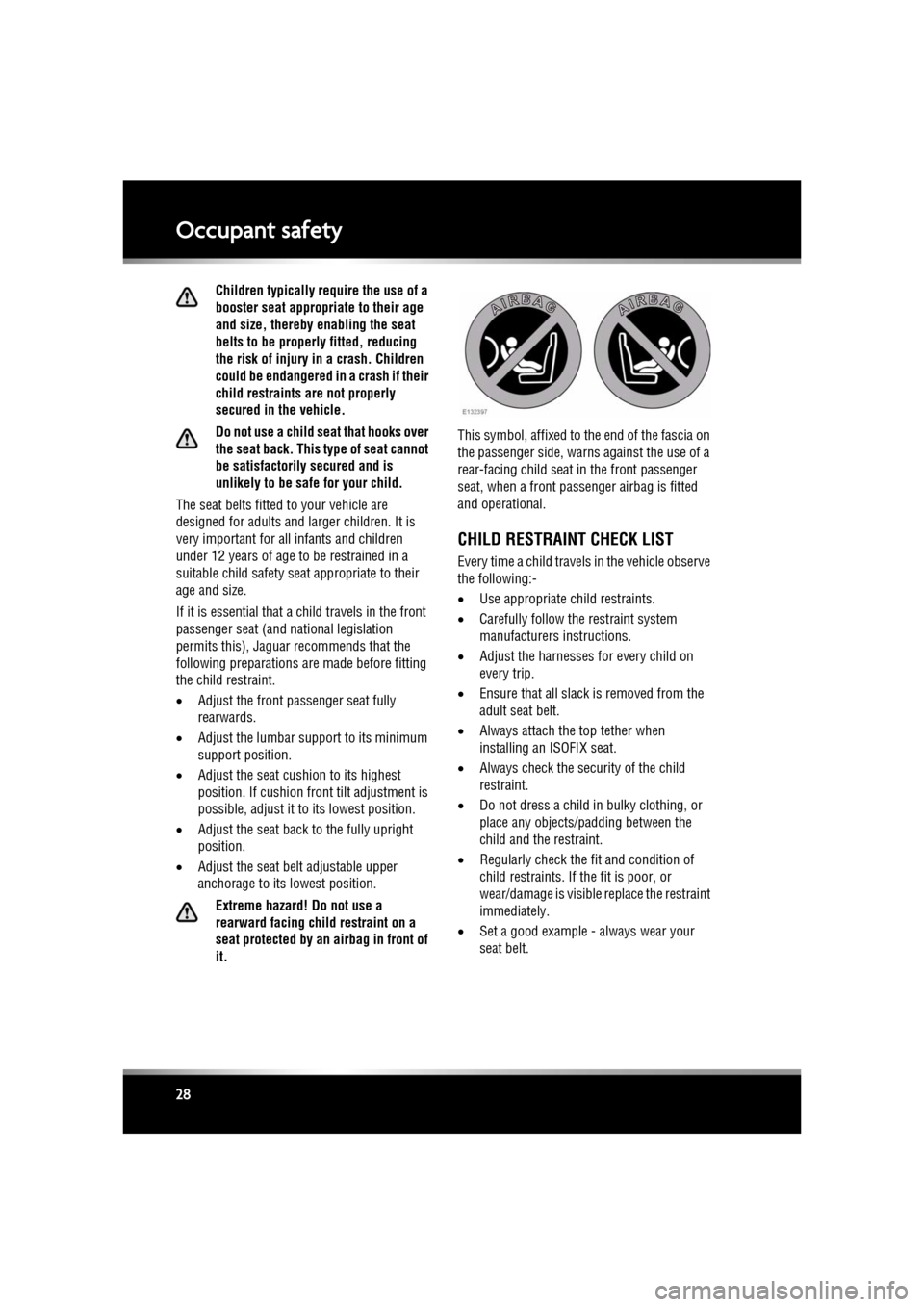
it. This symbol, affixed to th
e end of the fascia on
the passenger side, warn s against the use of a
rear-facing child seat in the front passenger
seat, when a front passenger airbag is fitted
and operational.
CHILD RESTRAINT CHECK LIST
Every time a child travels in the vehicle observe
the following:-
• Use appropriate child restraints.
• Carefully follow the restraint system
manufacturers instructions.
• Adjust the harnesses for every child on
every trip.
• Ensure that all slack is removed from the
adult seat belt.
• Always attach the top tether when
installing an ISOFIX seat.
• Always check the security of the child
restraint.
• Do not dress a child in bulky clothing, or
place any objects/padding between the
child and the restraint.
• Regularly check the fit and condition of
child restraints. If the fit is poor, or
wear/damage is visible replace the restraint
immediately.
• Set a good example - al ways wear your
seat belt.
Page 29 of 225
R
(FM8) SEMCON JLR OWNER GUIDE VER 1.00 EURO
LANGUAGE: english-en; MARQUE: jaguar; MODEL: XF
Occupant safety
29
Child restraint anchorages are
designed to withstand only those
loads imposed by corre ctly fitted child
restraints. Under no circumstances
are they to be used for adult seat
belts, harnesses or for attaching other
items or equipment to the vehicle.BOOSTER SEATS
In a situation where a child is too large to fit
into a child safety seat, but is still too small to
safely fit the three point belt properly, a booster
seat is recommended for maximum safety.
Follow the manufacturer's instructions for
fitting and use, then adjust the seat belt to suit.
CHILD SEAT POSITIONING
Information given wi thin the table is
correct at the time of going to press.
However, availability of child restraints
may change. Please consult your
Dealer/ Authorised Repairer for the
latest recommendation. Note:
The information contained in the
following table may not be applicable to all
countries. If you are in any doubt regarding the
type and fitment of child seats seek advice from
your Dealer/Authorised Repairer.
• U = Suitable for universal category
restraints approved for this mass group.
• UF = Suitable for forward facing Universal
category restraints appr oved for this mass
group.
• X = Not suitable for ch ild restraint fitment
in this mass group.
* Jaguar recommend that the front passenger
seat be positioned fully rearward, with the
cushion adjusted to the highest position when
installing child restraints. Note:
Ages given are approximate. In case of
doubt, the child’s weight , not age, should be
used when considering an appropriate child
seat.
Crash statistics show that children are
safest when properly restrained in a
child or infant rest raint systen that is
secured in a rear seating position.
Mass group Seating positions
Front
passenger* Rear outboard Rear centre
0 = Up to 10 kg (22 lb.) 0 to 9 months XUU
0+ = Up to 13 kg (29 lb.) 0 to 18 months X UU
I = 9 to 18 kg (20 to 40 lb.) 9 months to 4
years UF
UU
II = 15 to 25 kg (33 to 55 lb.) 4 to 9 years U UU
III = 25 to 36 kg (55 to 80 lb.) 8 to 12 years U UU
Page 129 of 225
R
(FM8) SEMCON JLR OWNER GUIDE VER 1.00 EURO
LANGUAGE: english-en; MARQUE: jaguar; MODEL: XF
Telephone
129
BLUETOOTH® INFORMATION
The Jaguar Bluetoot h® system supports
Bluetooth® Hands-Fre e Profile (HFP),
Advanced Audio Distribution Profile (A2DP)
and Audio Video Remote Control Profile
(AVRCP).
Note: HFP and A2DP/AVRCP profiles can be
connected independently, so a phone can be
connected via one, while a media device can be
connected via the other, at the same time.
Before making use of the vehicle’s Bluetooth
phone system, your Bl uetooth phone must be
paired and connected to the vehicle system.
This is done using one of two methods; via
your phone to the vehicl e or from the touch
screen to your phone. If one of these methods
is not successful, try the other option.
Each time the ignition is switched on the
system will attempt to connect with the last
connected phone.
As mobile phones have a wide range of audio
and echo characteristics, it may take a few
seconds for the vehicle system to adapt and
deliver optimum audio performance. To
achieve this, it may be necessary to reduce the
in-vehicle volume a nd ventilation fan speed
slightly.
TELEPHONE SAFETY
Switch off your telephone in areas
with a high explos ion risk. This
includes filling stat ions, fuel storage
areas or chemical factories, as well
as places where the air contains fuel
vapour, chemicals or metal dust. Always stow your mobile phone
securely.
The functioning of cardiac
pacemakers or hearing aids may be
impaired when the phone is in use.
Check with a doctor or manufacturer
whether any such devices you or your
passengers are using, are sufficiently
protected against high-frequency
energy.
The Health Industry Manufacturers'
Association recommends that a minimum
separation of 15 centimetres (six inches) is
maintained between a wireless phone antenna
and a pacemaker, to avoid potential
interference with the pacemaker. These
recommendations are consistent with the
independent research by, and
recommendations of, Wi reless Technology
Research.
Bluetooth® is the name for
short-range radio frequency (RF)
technology that allows electronic
devices to communicate
wirelessly with each other.
Page 159 of 225
R
(FM8) SEMCON JLR OWNER GUIDE VER 1.00 EURO
LANGUAGE: english-en; MARQUE: jaguar; MODEL: XF
Maintenance
159
DIESEL PARTICULATE FILTER (DPF)
Diesel vehicles equipped with a particle filter
have more efficient emission control. The
particles in the exhaust gases are collected in
the filter during normal driving.
When a DPF message is displayed, the filter
requires a regeneration cy cle to clean itself.
This requires the engine to have reached
normal operating temp erature. Regeneration
takes place automatically at an interval of
approximately 300-900 km (190-560 miles)
depending on driving c onditions. Regeneration
normally takes 10-20 minutes and is
automatically requested by the engine control
module if the vehicle is driven steadily at
vehicle speeds between 40mph to 70mph. It is
possible that the rege neration process will
occur at lower vehicle speeds, but the events
may take a little longer at a 50 km/h (30mph)
average speed.
DRIVING SHORT DISTANCES OR IN
COLD WEATHER
If the vehicle is fre quently driven short
distances or in cold weather conditions then
the engine may not re ach normal operating
temperature. This means that regeneration of
the diesel particle filter does not take place and
the filter is not efficiently cleaned. When the
filter reaches a condition when a filter
regeneration is approp riate and the current
drive style is not appropriate, a warning
triangle on the instrument panel illuminates,
and the message DPF Full. See manual is
displayed on the instrument panel. This is not
indicating a fault conditi on with the vehicle and
no dealership support should be required. Start
regeneration of the filter by driving the vehicle,
preferably on a main road or motorway. The
vehicle should then be driven for approximately
20 minutes or more. When regeneration is complete the warning
text is cleared automatically.
Note:
A small increase in fuel consumption
may be noticed temporarily during
regeneration.
ARDUOUS DRIVING CONDITIONS
When a vehicle is operated in severe or
arduous conditions, more frequent attention
must be paid to servic ing requirements. Refer
to your Service Portfolio for details or contact
your Dealer/Authorised Repairer for advice.
SAFETY IN THE GARAGE
If the vehicle has been driven
recently, do not touch exhaust and
cooling system co mponents until the
engine has cooled.
Never leave the engine running in an
unventilated area.
Do not work beneath the vehicle with a
jack as the only means of support.
Keep your hands and clothing away
from drive belts, pulleys and fans.
Some fans may continue to operate
after the engine has stopped.
Remove metal wrist bands and
jewellery, before working in the
engine compartment.
Do not touch electrical leads or
components while the engine is
running, or with the starter switch
turned on.
Do not allow tools or metal parts of the
vehicle to make contact with the
battery leads or terminals.
Page 189 of 225

R
(FM8) SEMCON JLR OWNER GUIDE VER 1.00 EURO
LANGUAGE: english-en; MARQUE: jaguar; MODEL: XF
Fuses
189
ENGINE COMPARTMENT FUSE BOX
Fuse No Rating
(amps) Fuse
ColourCircuit
F1 - - -
F2 - - -
F3 20A Yellow Emissions system (petrol only).
F4 20A Yellow Emissions system (petrol only).
F5 40A Orange ABS pump.
F6 30A Green Power wash pump.
F7 50A Red Cigar lighter.
F8 - - -
F9 50A Red Engine management system.
F10 - - -
F11 - - -
F12 50A Red Secondary air inje ction (V6 petrol only).
F13 30A Green Wipers.
F14 30A Green Starter solenoid.
F15 40A Orange Front screen heater - RH.
F16 40A Orange Front screen heater - LH.
F17 80A Natural Radiator fan (V6 petrol only).
F18 60A Aqua Glow pl ugs (diesel only).
F19 5A Tan Adaptive cruise control. FLS.
F20 15A Blue Horn.
F21 25A Clear ABS valves.
F22 - - -
F23 - - -
F24 - - -
F25 10A Red ABS ECM.
F26 10A Red Engine management syst em ECM. Transmission control
module.
F27 5A Tan Secondary air inje ction (V6 petrol only).
F28 5A Tan Adaptive front lighting - LH.
F29 5A Tan Adaptive front lighting - RH.
Page 190 of 225

L
(FM8) SEMCON JLR OWNER GUIDE VER 1.00 EURO
LANGUAGE: english-en; MARQUE: jaguar; MODEL: XF
Fuses
190
F30 - - -
F31 20A Yellow Auxiliary power socket - rear.
F32 20A Yellow Cigar lighter.
F33 - - -
F34 - - -
F35 5A Tan Air conditioning compressor clutch.
F36 15A Blue Engine management system 5 (V6 diesel only).
20A Yellow Engine management system 5 (V8 petrol only).
F37 15A Blue Ignition system (petrol only).
F38 5A Tan Power steering.
F39 5A Tan Headlamp levelling system.
F40 15A Blue Water pump (sup ercharged vehicles only).
F41 5A Tan Engine management system 1 (V6 diesel only). 10A Red Engine management system 1 (petrol and I4 diesel only).
F42 10A Red Engine management system 2 (V8 petrol only). 20A Yellow Engine management sy stem 2 (I4 diesel only).
30A Green Engine management system 2 (V6 petrol and V6 diesel only).
F43 5A Tan Engine management system 3 (diesel only). 10A Red Engine management system 3 (petrol only).
F44 5A Tan Engine management system 4 (V6 diesel only). 10A Red Engine management sy stem 4 (I4 diesel only).
15A Blue Engine management system 4 (V8 petrol only).
F45 100A Violet Radiator fan (d iesel and V8 petrol only).
Fuse No Rating
(amps) Fuse
ColourCircuit
Page 222 of 225

L
english-en (10, 18, 21 & 25)
Index
222
Windows . . . . . . . . . . . . . . . . . . . . . . . . . . 42anti-trap protection . . . . . . . . . . . . . . . . 43
one-touch operation . . . . . . . . . . . . . . . 43
reset . . . . . . . . . . . . . . . . . . . . . . . . . . 164
sunroofanti-trap mechanism . . . . . . . . . . . . . 43
reset . . . . . . . . . . . . . . . . . . . . . . . . . 164
Windscreen wipers speed-dependent mode . . . . . . . . . . . . . 40
Windscreens (heated) . . . . . . . . . . . . . . . . 64
Wing mirrors BSM (Blind spot monitor)
system fault . . . . . . . . . . . . . . . . . . . . 47
Winter mode . . . . . . . . . . . . . . . . . . . . . . . 83
Winter tyres . . . . . . . . . . . . . . . . . . . . . . . 187
pressures . . . . . . . . . . . . . . . . . . . . . . . 187
Wipers drip wipe . . . . . . . . . . . . . . . . . . . . . . . . 41
operating . . . . . . . . . . . . . . . . . . . . . . . . 40
Wipers and washers fluid
specification. . . . . . . . . . . . . . . . . . . 174
top up . . . . . . . . . . . . . . . . . . . . . . . 174
operating . . . . . . . . . . . . . . . . . . . . . . . . 40
rain sensor. . . . . . . . . . . . . . . . . . . . . . . 40
timed jet function. . . . . . . . . . . . . . . . . . 41
windscreen washers . . . . . . . . . . . . . . . 41
wipers speed-dependent mode . . . . . . . . . . . 40
X
Xenon headlamps wiper detection . . . . . . . . . . . . . . . . . . . 37