oil JAGUAR XJ 1994 2.G AJ16 Engine Manual
[x] Cancel search | Manufacturer: JAGUAR, Model Year: 1994, Model line: XJ, Model: JAGUAR XJ 1994 2.GPages: 73, PDF Size: 2.06 MB
Page 20 of 73
AJ16 Engine Service Manual
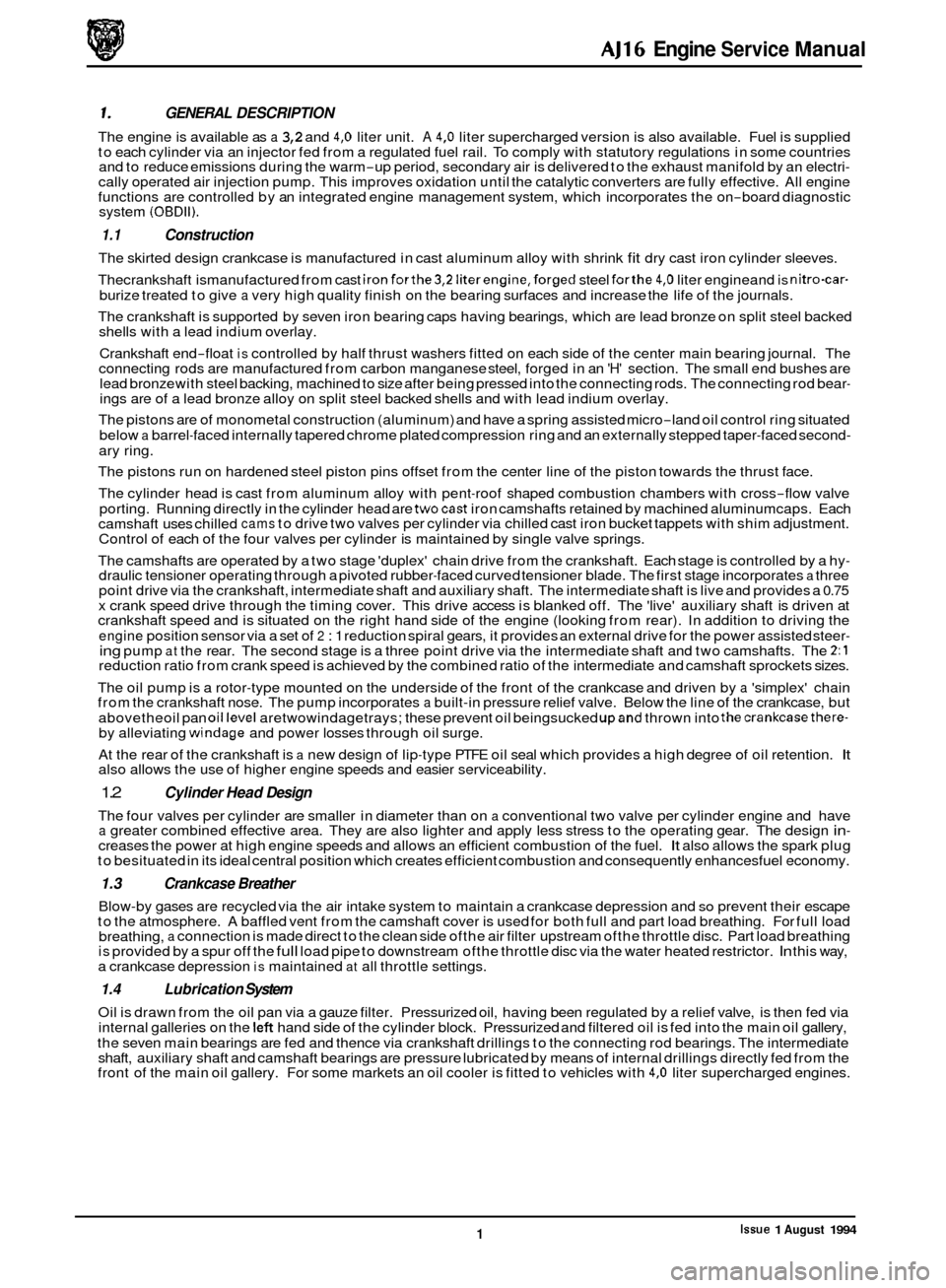
0 GENERAL DESCRIPTION - The engine is available as a 3,2 and 4,O liter unit. A 4,O liter supercharged version is also available. Fuel is supplied
to each cylinder via an injector fed from a regulated fuel rail. To comply with statutory regulations in some countries
and to reduce emissions during the warm
-up period, secondary air is delivered to the exhaust manifold by an electri- cally operated air injection pump. This improves oxidation until the catalytic converters are fully effective. All engine
functions are controlled by an integrated engine management system, which incorporates the on-board diagnostic
system (OBDII).
1.1 Construction
The skirted design crankcase is manufactured in cast aluminum alloy with shrink fit dry cast iron cylinder sleeves.
Thecrankshaft ismanufactured from cast
ironforthe3,2 literengine,forged steel forthe 4,O liter engineand is nitro-car-
burize treated to give a very high quality finish on the bearing surfaces and increase the life of the journals.
The crankshaft is supported by seven iron bearing caps having bearings, which are lead bronze on split steel backed
shells with a lead indium overlay.
Crankshaft end
-float is controlled by half thrust washers fitted on each side of the center main bearing journal. The
connecting rods are manufactured from carbon manganese steel, forged in an 'H' section. The small end bushes are
lead bronze with steel backing, machined to size after being pressed into the connecting rods. The connecting rod bear- ings are of a lead bronze alloy on split steel backed shells and with lead indium overlay.
The pistons are of monometal construction (aluminum) and have a spring assisted micro
-land oil control ring situated
below a barrel-faced internally tapered chrome plated compression ring and an externally stepped taper-faced second-
ary ring.
The cylinder head is cast from aluminum alloy with pent
-roof shaped combustion chambers with cross-flow valve
porting. Running directly in the cylinder head are
twocast iron camshafts retained by machined aluminumcaps. Each
camshaft uses chilled cams to drive two valves per cylinder via chilled cast iron bucket tappets with shim adjustment.
Control of each of the four valves per cylinder is maintained by single valve springs.
The camshafts are operated by a two stage 'duplex' chain drive from the crankshaft. Each stage is controlled by a hy
- draulic tensioner operating through a pivoted rubber-faced curved tensioner blade. The first stage incorporates a three
point drive via the crankshaft, intermediate shaft and auxiliary shaft. The intermediate shaft is live and provides a 0.75 x crank speed drive through the timing cover. This drive access is blanked off. The 'live' auxiliary shaft is driven at
crankshaft speed and is situated on the right hand side of the engine (looking from rear). In addition to driving the
engine position sensor via a set of 2 : 1 reduction spiral gears, it provides an external drive for the power assisted steer- ing pump at the rear. The second stage is a three point drive via the intermediate shaft and two camshafts. The 2:l reduction ratio from crank speed is achieved by the combined ratio of the intermediate and camshaft sprockets sizes.
The oil pump is a rotor
-type mounted on the underside of the front of the crankcase and driven by a 'simplex' chain
from the crankshaft nose. The pump incorporates a built-in pressure relief valve. Below the line of the crankcase, but
abovetheoil pan
oillevel aretwowindagetrays; these prevent oil beingsucked upand thrown into thecrankcasethere- by alleviating windage and power losses through oil surge.
At the rear of the crankshaft is
a new design of lip-type PTFE oil seal which provides a high degree of oil retention. It also allows the use of higher engine speeds and easier serviceability.
1.2 Cylinder Head Design
The four valves per cylinder are smaller in diameter than on a conventional two valve per cylinder engine and have a greater combined effective area. They are also lighter and apply less stress to the operating gear. The design in- creases the power at high engine speeds and allows an efficient combustion of the fuel. It also allows the spark plug
to besituated in its ideal central position which creates efficient combustion and consequently enhancesfuel economy.
1.3 Crankcase Breather
Blow-by gases are recycled via the air intake system to maintain a crankcase depression and so prevent their escape
to the atmosphere. A baffled vent from the camshaft cover is used for both full and part load breathing. For full load
breathing,
a connection is made direct to the clean side ofthe air filter upstream ofthe throttle disc. Part load breathing is provided by a spur off the full load pipe to downstream ofthe throttle disc via the water heated restrictor. In this way,
a crankcase depression is maintained at all throttle settings.
1.4 Lubrication System
Oil is drawn from the oil pan via a gauze filter. Pressurized oil, having been regulated by a relief valve, is then fed via
internal galleries on the left hand side of the cylinder block. Pressurized and filtered oil is fed into the main oil gallery,
the seven main bearings are fed and thence via crankshaft drillings to the connecting rod bearings. The intermediate
shaft, auxiliary shaft and camshaft bearings are pressure lubricated by means of internal drillings directly fed from the
front of the main oil gallery. For some markets an oil cooler is fitted to vehicles with
4,O liter supercharged engines.
The pistons run on hardened steel piston pins offset from the center line of the piston towards the thrust face.
Issue 1 August 1994 1
Page 22 of 73
AJ16 Engine Service Manual
FAULT DIAGNOSIS
3.1 Introduction
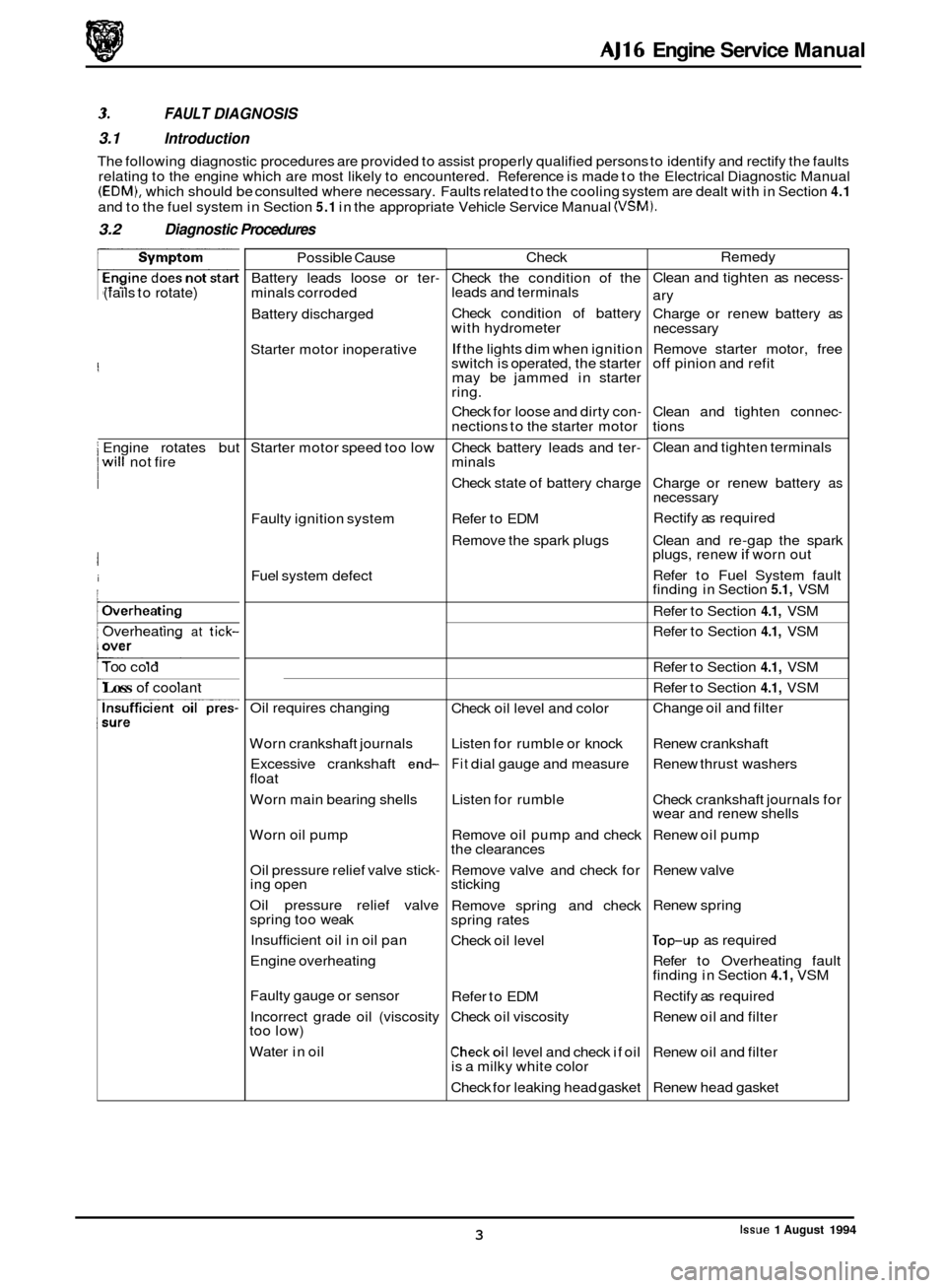
The following diagnostic procedures are provided to assist properly qualified persons to identify and rectify the faults
relating to the engine which are most likely to encountered. Reference is made to the Electrical Diagnostic Manual
(EDM), which should be consulted where necessary. Faults related to the cooling system are dealt with in Section 4.1
and to the fuel system in Section 5.1 in the appropriate Vehicle Service Manual (VSM).
3.2 Diagnostic Procedures
(fails to rotate)
I Engine rotates but 0 I will not fire
I
i
/Overheating
Overheating at tick-
Too cold
Loss of coolant Possible
Cause
Battery leads loose or ter
- minals corroded
Battery discharged
Starter motor inoperative
Starter motor speed too
low
Faulty ignition system
Fuel system defect
Oil requires changing
Worn crankshaft journals
Excessive crankshaft
end- float
Worn main bearing shells
Worn oil pump Oil pressure relief valve stick
- ing open
Oil pressure relief valve
spring too weak
Insufficient oil in oil pan
Engine overheating
Faulty gauge or sensor
Incorrect grade oil (viscosity
too low)
Water in oil Check
Check the condition of the
leads and terminals
Check condition of battery
with hydrometer
If the lights dim when ignition
switch is operated, the starter
may be jammed in starter
ring.
Check for loose and dirty con
- nections to the starter motor
Check battery leads and ter
- minals
Check state of battery charge
Refer to EDM
Remove the spark plugs
Check oil level and color
Listen for rumble or knock
Fit dial gauge and measure
Listen for rumble
Remove oil pump and check
the clearances
Remove valve and check for
sticking
Remove spring and check
spring rates
Check oil level
Refer to EDM
Check oil viscosity
Checkoil level and check if oil
is a milky white color
Check for leaking head gasket Remedy
Clean and tighten as necess
-
ary
Charge or renew battery as
necessary
Remove starter motor, free
off pinion and refit
Clean and tighten connec
- tions
Clean and tighten terminals
Charge or renew battery
as necessary
Rectify as required
Clean and re
-gap the spark
plugs, renew if worn out
Refer to Fuel System fault
finding in Section
5.1, VSM
Refer to Section
4.1, VSM
Refer to Section
4.1, VSM
Refer to Section
4.1, VSM
Refer to Section
4.1, VSM
Change oil and filter
Renew crankshaft
Renew thrust washers
Check crankshaft journals for
wear and renew shells
Renew oil pump
Renew valve
Renew spring
lop-up as required
Refer to Overheating fault
finding in Section
4.1, VSM
Rectify as required
Renew oil and filter
Renew oil and filter
Renew head gasket
Issue 1 August 1994 3
Page 23 of 73
AJ16 Engine Service Manual
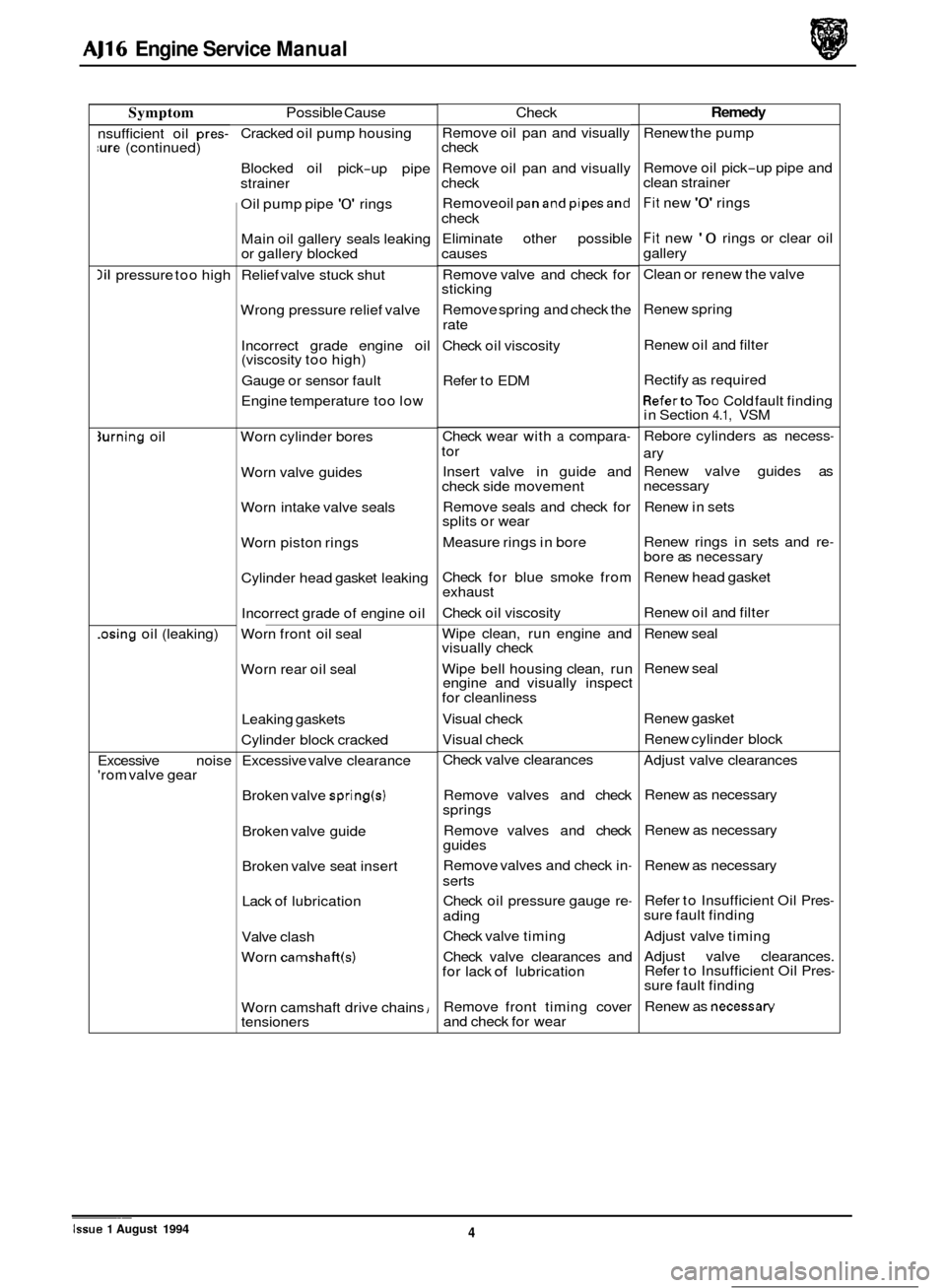
Symptom Possible Cause ~~
nsufficient
oil pres- ure (continued)
lil pressure too high
3urning oil
.osing oil (leaking)
Excessive noise
'rom valve gear Cracked
oil pump housing
Blocked oil pick
-up pipe
strainer
Oil pump pipe
'0' rings
Main oil gallery seals leaking
or gallery blocked
Relief valve stuck shut
Wrong pressure relief valve
Incorrect grade engine oil
(viscosity too high)
Gauge or sensor fault
Engine temperature too low
Worn cylinder bores
Worn valve guides
Worn intake valve seals
Worn piston rings
Cylinder head gasket leaking
Incorrect grade of engine oil
Worn front oil seal
Worn rear oil seal
Leaking gaskets
Cylinder block cracked
Excessive valve clearance
Broken valve
spring(s)
Broken valve guide
Broken valve seat insert
Lack of lubrication
Valve clash
Worn
camshaft(s)
Worn camshaft drive chains i tensioners
Check
Remove oil pan and visually
check
Remove oil pan and visually
check
Removeoil
panand pipesand check Eliminate other possible
causes
Remove valve and check for
sticking
Remove spring and check the
rate
Check oil viscosity
Refer to EDM
Check wear with
a compara- tor
Insert valve in guide and
check side movement
Remove seals and check for
splits or wear
Measure rings in bore
Check for blue smoke from
exhaust
Check oil viscosity
Wipe clean, run engine and
visually check
Wipe bell housing clean, run
engine and visually inspect
for cleanliness
Visual check
Visual check
Check valve clearances
Remove valves and check
springs
Remove valves and check
guides
Remove valves and check in
- serts
Check oil pressure gauge re
- ading
Check valve timing
Check valve clearances and
for lack
of lubrication
Remove front timing cover
and check for wear
Remedy
Renew the pump
Remove oil pick
-up pipe and
clean strainer
Fit new '0' rings
Fit new '0 rings or clear oil
gallery
Clean or renew the valve
Renew spring
Renew oil and filter
Rectify as required
RefertoToo Cold fault finding
in Section 4.1, VSM
Rebore cylinders as necess
-
ary
Renew valve guides as
necessary
Renew in sets
Renew rings in sets and re
- bore as necessary
Renew head gasket
Renew oil and filter
Renew seal
Renew seal
Renew gasket Renew cylinder block
Adjust valve clearances
Renew as necessary
Renew as necessary
Renew as necessary
Refer to Insufficient Oil Pres
- sure fault finding
Adjust valve timing
Adjust valve clearances.
Refer to Insufficient Oil Pres
- sure fault finding
Renew as
necessaw
0
0
0 ~~~
Issue 1 August 1994 4
Page 24 of 73
AJ16 Engine Service Manual
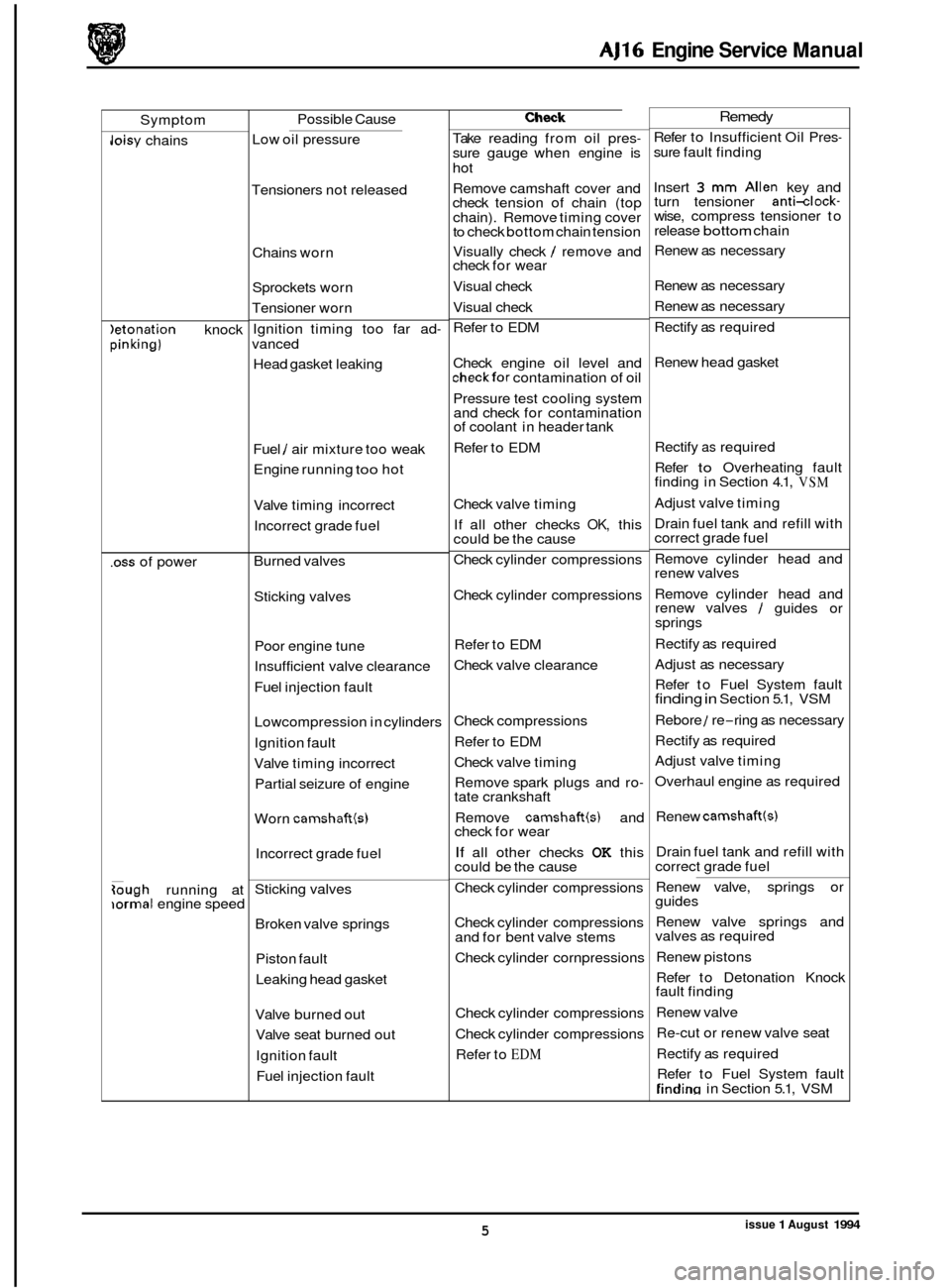
Symptom
Joisy chains
)etonation knock pinking)
.oss of power
Gugh running at iormal engine speed Possible
Cause
Low oil pressure
Tensioners not released
Chains worn
Sprockets worn
Tensioner worn
Ignition timing too far ad
- vanced
Head gasket leaking
Fuel
/ air mixture too weak
Engine running
too hot
Valve timing incorrect
Incorrect grade fuel
Burned valves Sticking valves
Poor engine tune
Insufficient valve clearance
Fuel injection fault
Lowcompression in cylinders
Ignition fault
Valve timing incorrect
Partial seizure of engine
Worn
camshaftb)
Incorrect grade fuel
Sticking valves Broken valve springs Piston fault
Leaking head gasket
Valve burned out
Valve seat burned out
Ignition fault
Fuel injection fault
Check
Take reading from oil pres- sure gauge when engine is
hot
Remove camshaft cover and
check tension of chain (top
chain). Remove timing cover
to check bottom chain tension
Visually check
/ remove and
check for wear
Visual check
Visual check
Refer to EDM
Check engine oil level and
checkfor contamination of oil
Pressure test cooling system
and check for contamination
of coolant in header tank
Refer to EDM
Check valve timing
If all other checks
OK, this
could be the cause
Check cylinder compressions
Check cylinder compressions
Refer to EDM
Check valve clearance
Check compressions
Refer to EDM
Check valve timing
Remove spark plugs and ro
- tate crankshaft
Remove
camshaft(s) and
check for wear
If all other checks OK this
could be the cause
Check cylinder compressions
Check cylinder compressions
and for bent valve stems
Check cylinder cornpressions
Check cylinder compressions
Check cylinder compressions
Refer to
EDM
Remedy
Refer to Insufficient Oil Pres- sure fault finding
Insert
3 mm Allen key and
turn tensioner anti-clock- wise, compress tensioner to
release bottom chain
Renew as necessary
Renew as necessary
Renew as necessary
Rectify as required
Renew head gasket
Rectify
as required
Refer
to Overheating fault
finding in Section 4.1, VSM
Adjust valve timing
Drain fuel tank and refill with
correct grade fuel
Remove cylinder head and
renew valves
Remove cylinder head and
renew valves
/ guides or
springs
Rectify as required
Adjust as necessary
Refer to Fuel System fault
finding in Section 5.1, VSM
Rebore
1 re-ring as necessary
Rectify as required
Adjust valve timing
Overhaul engine as required
Renew
camshaft(s)
Drain fuel tank and refill with
correct grade fuel
Renew valve, springs or
guides
Renew valve springs and
valves as required
Renew pistons
Refer to Detonation Knock
fault finding
Renew valve
Re
-cut or renew valve seat
Rectify as required
Refer to Fuel System fault
Tindim in Section 5.1, VSM
issue 1 August 1994 5
Page 28 of 73

AJ16 Engine Service Manual
4.2 Camshaft Cover Gasket, Renew
SRO 12.29.39
1 Remove the top cover and disconnect the on-plug coils
from the spark plugs.
. Disconnect the camshaft cover breather hose.
1 Remove the camshaft cover to cylinder head securing
Screws (1 Fig. 11, and remove the camshaft cover (2 Fig. 1).
. Remove and discard the camshaft cover gasket (3 Fig. 1).
. Clean the camshaft cover and cylinder head mating faces.
1 Fit a new gasket to the camshaft cover.
. Refit the camshaft cover.
1 Fit and tighten the camshaft cover securing screws.
. Reconnect the breather hose.
1 Reconnect the on-plug coils to the spark plugs and fit the
top cover.
I Fia. I
Issue 1 August 1994 9
Page 36 of 73
AJ16 Engine Service Manual
Note: No attempt should be made to clean up a burnt or
badly pitted valve face by extensive 'grinding in' of
the valve to the seat.
m Lightly lap the valves into the seats with a fine grinding
compound. The reseating operation should leave the fin- ished surfaces smooth. Excessive lapping will groove the
valve face resulting in a poor seat when the engine is hot.
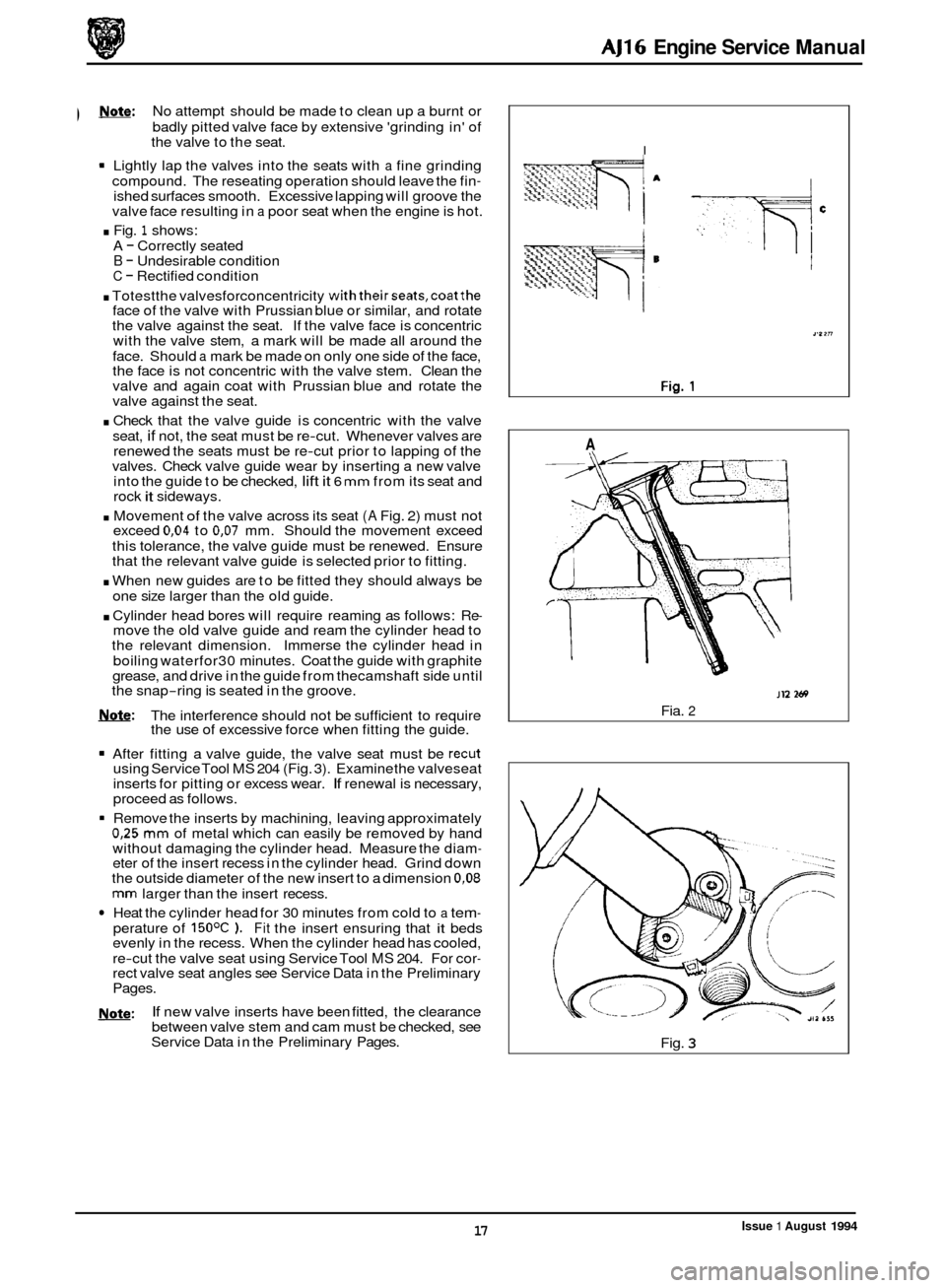
A
- Correctly seated B - Undesirable condition C - Rectified condition
. Totestthe valvesforconcentricity withtheirseats,coatthe face of the valve with Prussian blue or similar, and rotate
the valve against the seat. If the valve face is concentric
with the valve stem, a mark will be made all around the
face. Should
a mark be made on only one side of the face,
the face is not concentric with the valve stem. Clean the
valve and again coat with Prussian blue and rotate the
valve against the seat.
. Check that the valve guide is concentric with the valve
seat,
if not, the seat must be re-cut. Whenever valves are
renewed the seats must be re-cut prior to lapping of the
valves. Check valve guide wear by inserting a new valve
into the guide to be checked,
lift it 6 mm from its seat and
rock it sideways.
. Movement of the valve across its seat (A Fig. 2) must not
exceed 0,04 to 0,07 mm. Should the movement exceed
this tolerance, the valve guide must be renewed. Ensure
that the relevant valve guide is selected prior to fitting.
. When new guides are to be fitted they should always be
one size larger than the old guide.
. Cylinder head bores will require reaming as follows: Re- move the old valve guide and ream the cylinder head to
the relevant dimension. Immerse the cylinder head in
boiling waterfor30 minutes. Coat the guide with graphite
grease, and drive in the guide from thecamshaft side until
the snap
-ring is seated in the groove.
b: The interference should not be sufficient to require
the use of excessive force when fitting the guide.
1 After fitting a valve guide, the valve seat must be recut using Service Tool MS 204 (Fig. 3). Examine the valveseat
inserts for pitting or excess wear. If renewal is necessary,
proceed as follows.
1 Remove the inserts by machining, leaving approximately 0,25 mm of metal which can easily be removed by hand
without damaging the cylinder head. Measure the diam- eter of the insert recess in the cylinder head. Grind down
the outside diameter of the new insert to a dimension 0,08
mm larger than the insert recess.
Heat the cylinder head for 30 minutes from cold to a tem- perature of 15OOC 1, Fit the insert ensuring that it beds
evenly in the recess. When the cylinder head has cooled,
re
-cut the valve seat using Service Tool MS 204. For cor- rect valve seat angles see Service Data in the Preliminary
Pages.
If new valve inserts have been fitted, the clearance
between valve stem and cam must be checked, see
Service Data in the Preliminary Pages.
. Fig. 1 shows:
U:
I
A
JIZ 2M
Fia. 2
Fig. 3
Issue 1 August 1994 17
Page 37 of 73
AJ16 Engine Service Manual
. The dimension must be taken between the valve stem and
the back of the cam. Should
this dimension not be ob-
tained, metal must be ground from thevalveseat of the in-
sert.
&&: Use only suitable grinding equipment.
* Remove only very small amounts of metal from the valve
seat at one time before re-checking the clearance.
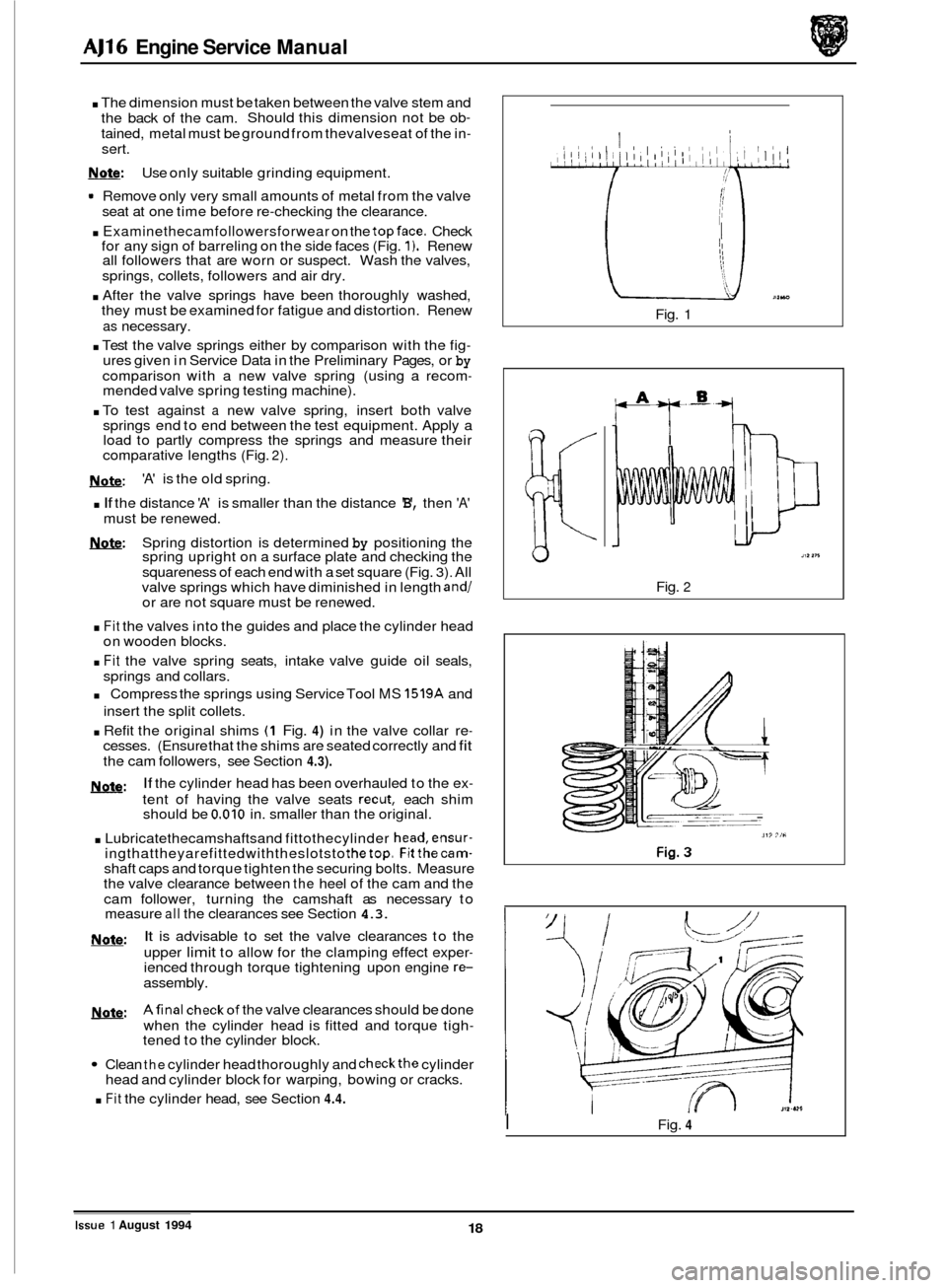
. Examinethecamfollowersforwear on the topface. Check
for any sign of barreling on the side faces (Fig. 1). Renew
all followers that are worn or suspect. Wash the valves,
springs, collets, followers and air dry.
. After the valve springs have been thoroughly washed,
they must be examined for fatigue and distortion. Renew
as necessary.
. Test the valve springs either by comparison with the fig- ures given in Service Data in the Preliminary Pages, or by
comparison with a new valve spring (using a recom- mended valve spring testing machine).
. To test against a new valve spring, insert both valve
springs end to end between the test equipment. Apply a
load to partly compress the springs and measure their
comparative lengths (Fig.
2).
&@:
. If the distance 'A' is smaller than the distance 'B', then 'A'
b: Spring distortion is determined by positioning the
spring upright on a surface plate and checking the
squareness of each end with a set square (Fig.
3). All
valve springs which have diminished in length and/ or are not square must be renewed.
. Fit the valves into the guides and place the cylinder head
on wooden blocks.
. Fit the valve spring seats, intake valve guide oil seals,
springs and collars.
. Compress the springs using Service Tool MS 1519A and
insert the split collets.
. Refit the original shims (1 Fig. 4) in the valve collar re- cesses. (Ensure that the shims are seated correctly and fit
the cam followers, see Section 4.3).
If the cylinder head has been overhauled to the ex-
tent of having the valve seats recut, each shim
should be 0,010 in. smaller than the original.
. Lubricatethecamshaftsand fittothecylinder head,ensur- ingthattheyarefittedwiththeslotsto thetop. Fitthecam- shaft caps and torque tighten the securing bolts. Measure
the valve clearance between the heel of the cam and the
cam follower, turning the camshaft as necessary to
measure
all the clearances see Section 4.3.
It is advisable to set the valve clearances to the
upper
limit to allow for the clamping effect exper- ienced through torque tightening upon engine re- assembly.
Afinal checkof the valve clearances should be done
when the cylinder head is fitted and torque tigh
- tened to the cylinder block.
Clean the cylinder head thoroughly and checkthe cylinder
head and cylinder block for warping, bowing or cracks.
. Fit the cylinder head, see Section 4.4.
'A' is the old spring.
must be renewed.
&&:
m:
&@:
Fig. 1
K
Fig. 2
I Fig. 4
Issue 1 August 1994 18
Page 38 of 73
0 4.6 Cylinder Head Casting, Renew
SRO 12.29.15
1 Remove the cylinder head, see Section 4.4.
1 Place the cylinder head on suitable blocks on a bench.
1 Remove the spark plugs.
1 Remove the intake valve camshaft cap securing bolts.
1 Remove the camshaft caps.
1 Remove the camshaft.
1 Repeat the procedure for the exhaust camshaft.
1 Remove the cam followers and shims, noting the posi-
1 Remove the valves using Service Tool MS 1519A valve
1 Remove the seals from the intake valve guides.
1 Remove the rear blanking plate.
1 Clean all components and examine for wear and damage.
Renew any worn or damaged parts as necessary.
1 Clean thoroughly the new cylinder head casting.
1 Refit the rear blanking plate to the new cylinder head.
0 1 Smearfinegrindingcompound on tothe face ofonevalve.
1 Oil the valve stem.
1 Fit the valve to the head.
1 Lightly lap the valves into the seats, leaving a smooth fin-
ish to both surfaces.
Note: Excessive lapping will groove the valve face, result- ing in poor seating when hot.
1 Clean the valve and seat.
1 Repeat the procedure for the remaining valves.
1 Fit a new seal to the intake valve guide.
1 Lubricate the valve stem. Fit the valve to the guide. Fit the
. Fit Service Tool MS 1519A spring compressor to the valve.
1 Compress the valve spring, fit and seat the collets, and re- lease the clamp.
1 Repeat the procedure for the remaining valves.
. Refit the shims.
1 Ensure that the shims are seated correctly.
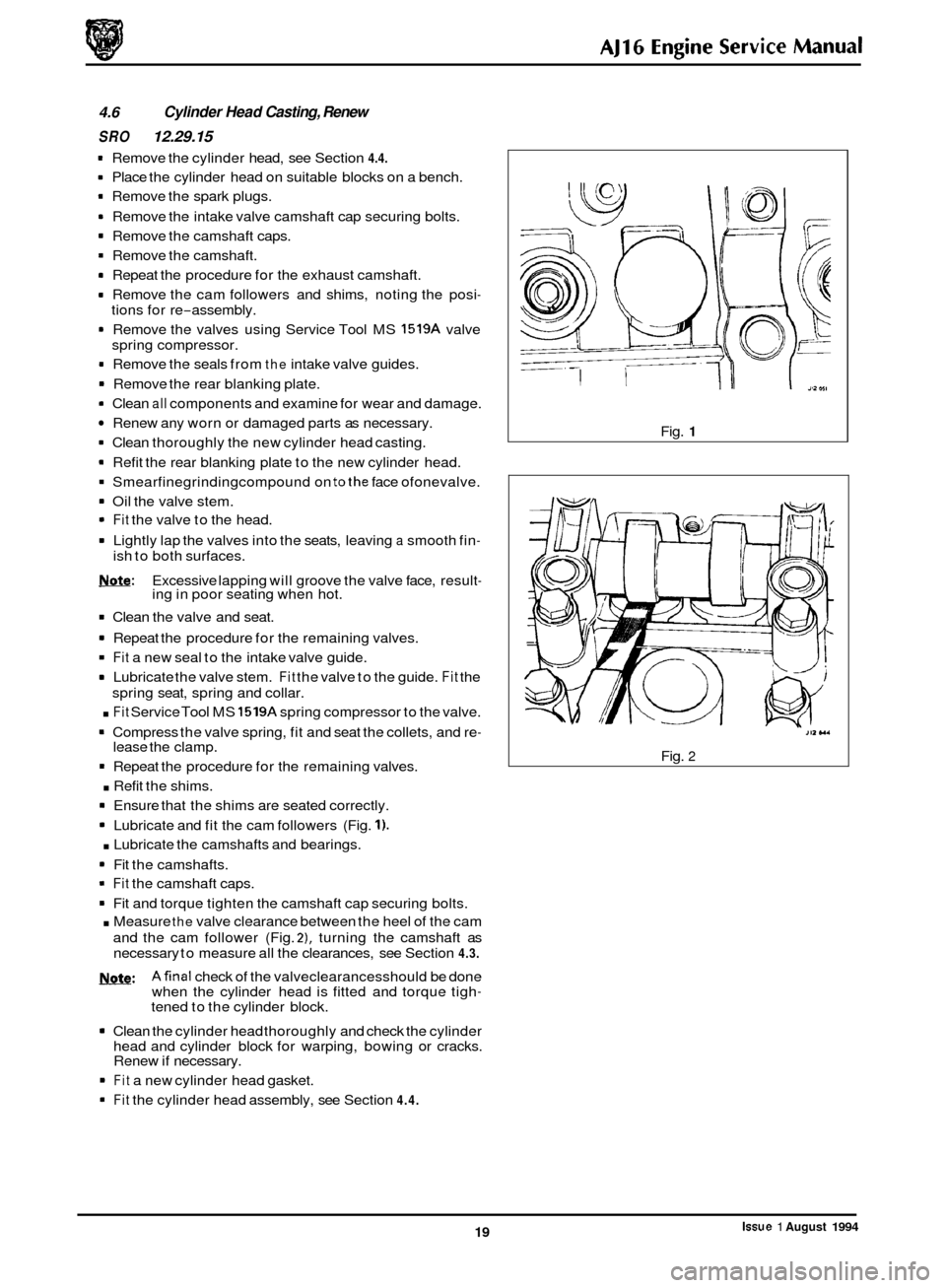
1 Lubricate and fit the cam followers (Fig. 1).
. Lubricate the camshafts and bearings.
1 Fit the camshafts.
1 Fit the camshaft caps.
1 Fit and torque tighten the camshaft cap securing bolts.
. Measure the valve clearance between the heel of the cam
and the cam follower (Fig.
21, turning the camshaft as
necessary to measure all the clearances, see Section 4.3.
Afinal check of the valveclearancesshould be done
when the cylinder head is fitted and torque tigh- tened to the cylinder block.
1 Clean the cylinder head thoroughly and check the cylinder
head and cylinder block for warping, bowing or cracks.
Renew if necessary.
tions
for re
-assembly.
spring compressor.
spring seat, spring and collar.
Note:
1 Fit a new cylinder head gasket.
1 Fit the cylinder head assembly, see Section 4.4.
I II
Fig. 1
JI1 U4
Fig. 2
Issue 1 August 1994 19
Page 39 of 73
AJ16 Engine Service Manual
4.7 Piston
and Connecting Rod, Engine Set, Renew
SRO 12.17.10
. Remove the engine and transmission unit from the ve- hicle, see Section 3.1 in the appropriate Vehicle Service
Manual.
1 Remove the transmission unit from the engine and fit the
engine to a stand.
. Remove the cylinder head, see Section 4.4.
* Remove the oil pan, see Section 4.27.
1 Remove the oil pump, see Section 4.31.
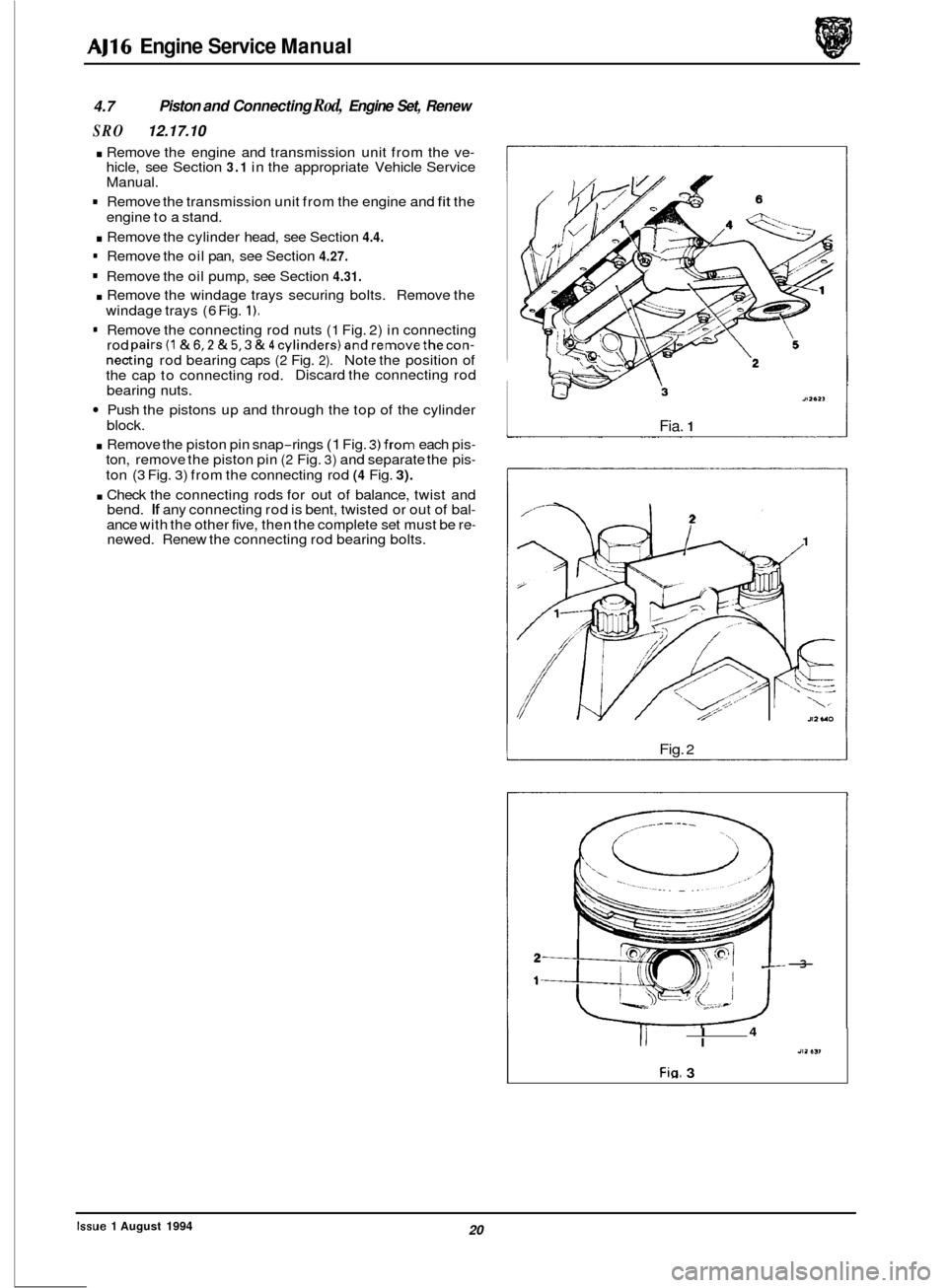
. Remove the windage trays securing bolts. Remove the
windage trays (6 Fig. 1).
* Remove the connecting rod nuts (1 Fig. 2) in connecting
rod pairs(1 &6,2 &5,3&4cylinders)andremovethecon- necting rod bearing caps (2 Fig. 2). Note the position of
the cap to connecting rod. Discard
the connecting rod
bearing nuts.
Push the pistons up and through the top of the cylinder
block.
. Remove the piston pin snap-rings (1 Fig. 3)from each pis- ton, remove the piston pin (2 Fig. 3) and separate the pis-
ton (3 Fig. 3) from the connecting rod (4 Fig. 3).
. Check the connecting rods for out of balance, twist and
bend. If any connecting rod is bent, twisted or out of bal- ance with the other five, then the complete set must be re- newed. Renew
the connecting rod bearing bolts.
.a
Fia. 1
,11613
Fig. 2
I 4 Ii I
Fig. 3
-3
ill 631
Issue 1 August 1994 20
Page 40 of 73
AJ16 Engine Service Manual
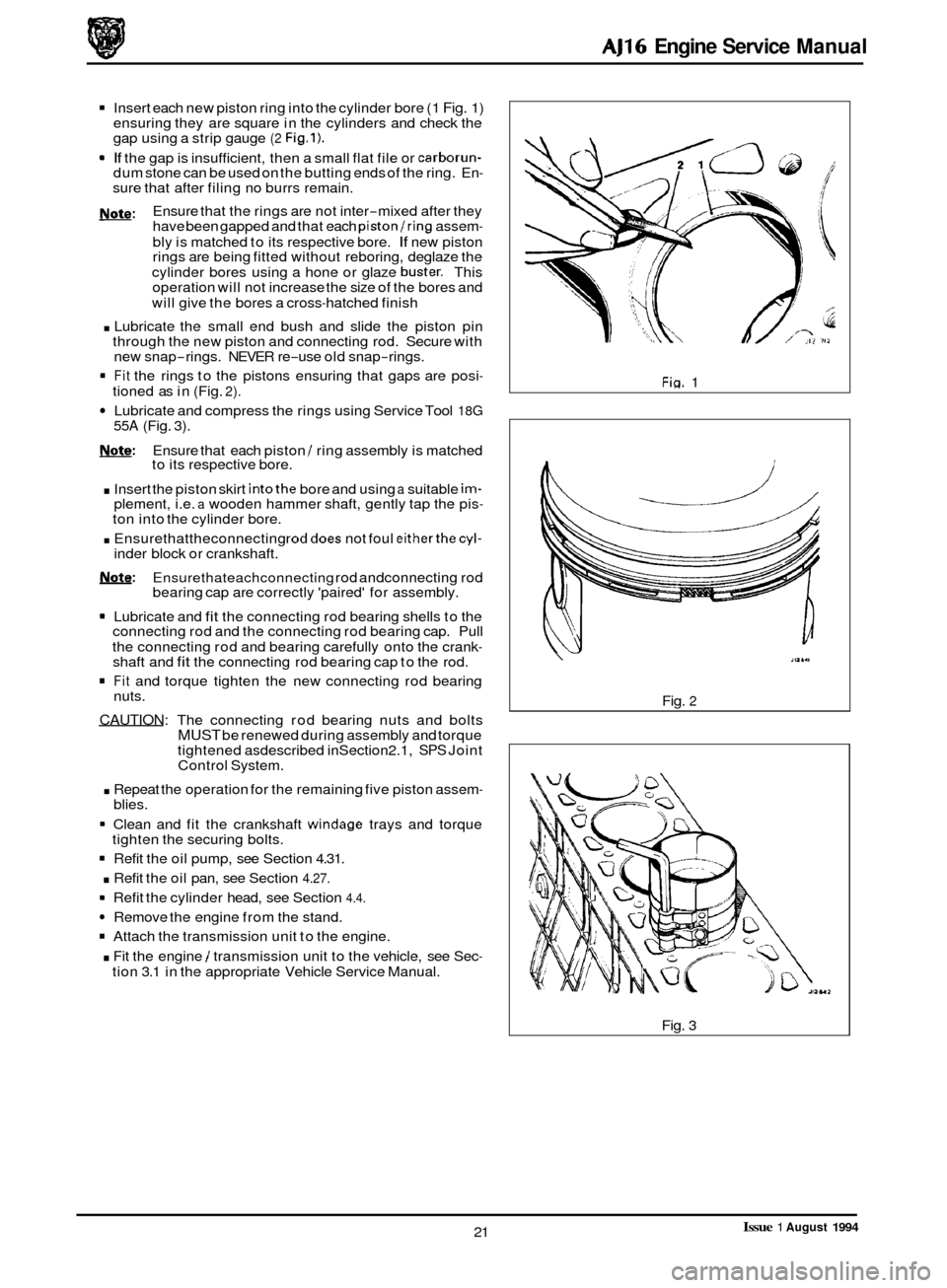
Insert each new piston ring into the cylinder bore (1 Fig. 1)
ensuring they are square in the cylinders and check the
gap using a strip gauge
(2 Fig.1).
9 If the gap is insufficient, then a small flat file or carborun- dum stone can be used on the butting ends of the ring. En- sure that after filing no burrs remain.
Ensure that the rings are not inter
-mixed after they
have been gapped and that each piston/ring assem-
bly is matched to its respective bore. If new piston
rings are being fitted without reboring, deglaze the
cylinder bores using a hone or glaze
buster. This
operation will not increase the size of the bores and
will give the bores a cross
-hatched finish
. Lubricate the small end bush and slide the piston pin
through the new piston and connecting rod. Secure with
new snap
-rings. NEVER re-use old snap-rings.
Fit the rings to the pistons ensuring that gaps are posi- tioned as in (Fig. 2).
Lubricate and compress the rings using Service Tool 18G 55A (Fig. 3).
w:
b: Ensure that each piston / ring assembly is matched
to its respective bore.
. Insert the piston skirt intothe bore and using a suitable im- 0
plement, i.e. a wooden hammer shaft, gently tap the pis- ton into the cylinder bore.
. Ensurethattheconnecting roddoes not foul eitherthecyl- inder block or crankshaft.
Note: Ensurethateachconnecting rod andconnecting rod
m Lubricate and fit the connecting rod bearing shells to the
connecting rod and the connecting rod bearing cap. Pull
the connecting rod and bearing carefully onto the crank
- shaft and fit the connecting rod bearing cap to the rod.
Fit and torque tighten the new connecting rod bearing
nuts.
CAUTION: The connecting rod bearing nuts and bolts MUST be renewed during assembly and torque
tightened asdescribed inSection2.1, SPS Joint
Control System.
. Repeat the operation for the remaining five piston assem-
bearing cap are correctly 'paired' for assembly.
blies.
Clean and fit the crankshaft
windage trays and torque
-
0 - - tighten the securing bolts.
Refit the oil pump, see Section 4.31.
. Refit the oil pan, see Section 4.27.
Refit the cylinder head, see Section 4.4.
Remove the engine from the stand.
Attach the transmission unit to the engine.
. Fit the engine / transmission unit to the vehicle, see Sec- tion 3.1 in the appropriate Vehicle Service Manual.
Fin. 1
itl6.l
Fig. 2
Fig. 3
Issue 1 August 1994 21