keys JAGUAR XJ 2004 X350 / 3.G Owners Manual
[x] Cancel search | Manufacturer: JAGUAR, Model Year: 2004, Model line: XJ, Model: JAGUAR XJ 2004 X350 / 3.GPages: 227, PDF Size: 4.22 MB
Page 16 of 227
Security and Locks
Ignition Switch . . . . . . . . . . . . . . . . . . . . . . . . . . 2 - 3
Vehicle Security . . . . . . . . . . . . . . . . . . . . . . . . . 2 - 4
Key Transmitter . . . . . . . . . . . . . . . . . . . . . . . . . 2 - 4
Keys . . . . . . . . . . . . . . . . . . . . . . . . . . . . . . . . . . 2 - 7
Door Locks and Handles . . . . . . . . . . . . . . . . . . . 2 - 8
Alarms and Audible Signals. . . . . . . . . . . . . . . . 2 - 15
Security Features . . . . . . . . . . . . . . . . . . . . . . . 2 - 17
Luggage Compartment Emergency Release . . . . 2 - 19
Garage Door Opener Transceiver . . . . . . . . . . . 2 - 20
Page 19 of 227
2 - 4 Security and Locks
Vehicle Security
When the vehicle is unoccupied or
unattended, you are advised to do the
following:
• Apply the electronic parkbrake and move the gear selector to the
Park ‘P’ position.
• Do not leave children or pets in the vehicle unattended.
• Do not leave luggage or valuables on display.
• Remove all keys, including remote transmitters, from the vehicle prior to
locking the doors, even when the
vehicle is in your garage.
• Close all windows, hood, luggage compartment and glove
compartment, and lock all the doors.
• Park the vehicle where it can be seen. At night, park in a well-lit area.
• It is important to keep your keys in safe places at all times. Leaving them
in conspicuous places is an invitation
for a thief to steal them and,
consequently, your vehicle or
belongings. Keep them as secure as
you would your wallet or purse, both
at home and away.
Key Transmitter
The security system is controlled
remotely by a radio frequency, battery-
operated, integrated transmitter key.
The transmitter is ac tivated by pressing
one of the operating buttons.
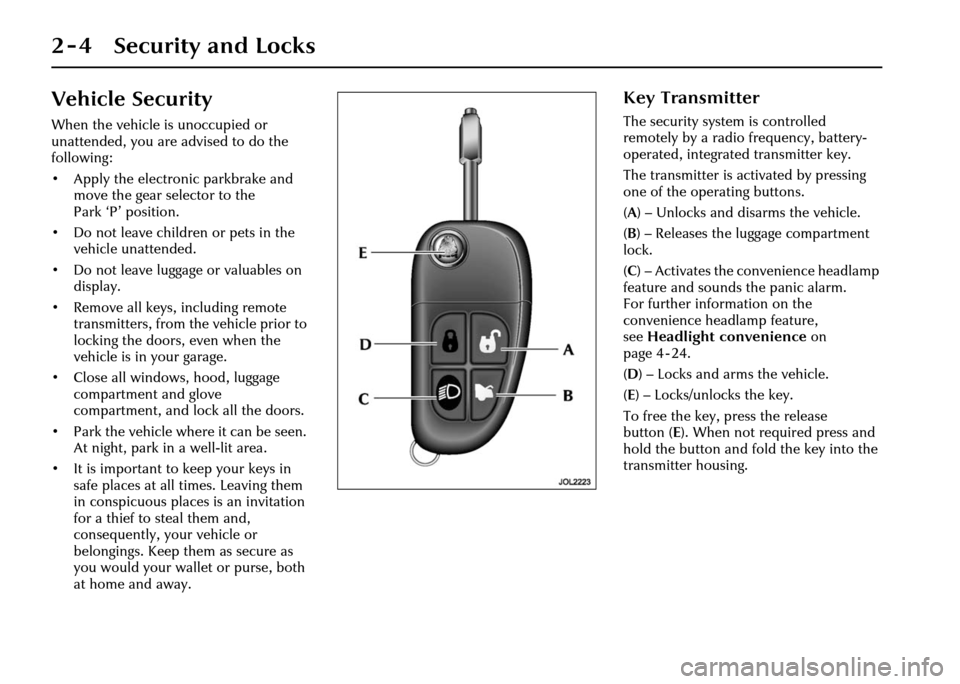
( A ) – Unlocks and disarms the vehicle.
( B ) – Releases the luggage compartment
lock.
( C ) – Activates the convenience headlamp
feature and sounds the panic alarm.
For further information on the
convenience headlamp feature,
see Headlight convenience on
page 4 - 24.
( D ) – Locks and arms the vehicle.
( E ) – Locks/unlocks the key.
To free the key, press the release
button ( E). When not required press and
hold the button and fold the key into the
transmitter housing.
Page 20 of 227
Security and Locks 2 - 5
Note:
1. The key transmitter may not operate correctly in areas which are subject to
interference from other radio
equipment operating on the same
frequency. Interference may emanate
from sources such as amateur radio,
telecommunications devices, medical
equipment, and other remote controls
or alarms. Where such interference is
experienced operate the key
transmitter as close as possible to the
vehicle, or use the key in the drivers
door lock.
2. All buttons on the key transmitter will not operate if a key is in the ignition
switch, however, if the doors, hood or
luggage compartment are open, only
button ( D) will not operate.
Each integrated key will operate all the
locks on your vehicle.
Additional integrated key transmitters
can be ordered from your Jaguar Retailer.
See Additional keys on page 2 - 7. Care of key transmitters
The key transmitters must be treated with
care. Do not expose to extremes of heat,
dust, humidity or fluids. Do not leave the
transmitter exposed to direct sunlight.
The battery is the only serviceable part.
Caution: Should a key transmitter be
lost, a new one can be obtained and
programmed to the vehicle by a
Jaguar Retailer, who will ask for proof
of vehicle ownership. It is advisable
to notify a Retailer as soon as a key
transmitter is lost or stolen and have
the remaining key transmitter(s)
reprogrammed. This will then
prevent the lost or stolen key
transmitter from being used to
disarm and unlock the vehicle.
Note:
Retailers keep a log of all enquiries
for replacement keys and notify
Jaguar Cars Ltd. of any such requests.
Radio Frequency
The radio frequency remote system
operates on a frequency subject to USA
Federal Communications Commission
(FCC) rules.
The device complies with Part 15 of the
FCC rules and RSS–210 of the Industry
Canada. Operation is subject to the two following
conditions:
1. The device may not cause harmful
interference.
2. This device mu st accept any
interference received, including
interference that may cause undesired
operation.
The key transmitter radio frequency
approval numbers for the USA and
Canada are as shown below:
USA – NHVWB1U241.
Canada – 3495 103 2304.
Note: The manufacturer is not
responsible for any radio interference or
TV interference caused by unauthorised
modifications to this equipment. Changes
or modifications not expressly approved
by the party responsible for compliance
could void the user’s authority to operate
the equipment.
Caution: The key-ring transmitter
may suffer interference from other
legal users of this radio frequency
band, such as radio amateurs,
medical equipment, remote controls
or alarm systems. To lock or unlock
the vehicle either use a key or
operate the transmitter as close to the
security antenna as possible.
Page 22 of 227
Security and Locks 2 - 7
Keys
Vehicles are supplied with two integrated
transmitter keys and one green-headed
valet key. Additionally, black-headed keys
are available and for further details,
contact a Jaguar Retailer.
Integrated transmitter key
The integrated tr ansmitter key is
comprised of the key body, which is
integrated with a re mote transmitter.
The key operates all the locks on your
vehicle.
Green-headed valet key
The green-headed valet key is not
integrated with a re mote transmitter.
The key operates the driver’s door lock
and the ignition switch, but does not
operate the luggage compartment lock.
Black-headed key
The black-headed key is not integrated
with a remote transm itter, but it does
operate all the locks and the ignition
switch on your vehicle. The key is not
supplied with your vehicle.
Additional keys
Five additional keys can be programmed
to operate the locks on your vehicle. Note:
A maximum of three additional
integrated transmitter keys can be used.
All additional keys mu st be obtained from
and programmed by, a Jaguar Retailer.
Key number label
The key number is recorded on an
adhesive label which is affixed to the rear
of the integrated transmitter keys.
Peel off the label and keep safely, not in
the vehicle.
Immobilisation System
This vehicle is fitted with an
immobilisation system. The system
prevents the vehicle be ing driven away by
unauthorised persons. The features of the
system include the following:
Programmable key
An electronic device is fitted in the head
of each key which is programmed to the
vehicle electronic systems.
When a programmed key is inserted into
the ignition switch it is recognised and
accepted by the vehicle’s electronic
systems.
The engine cannot be started with a key
that is not programmed to the vehicle
electronic systems. Immobilisation system status light
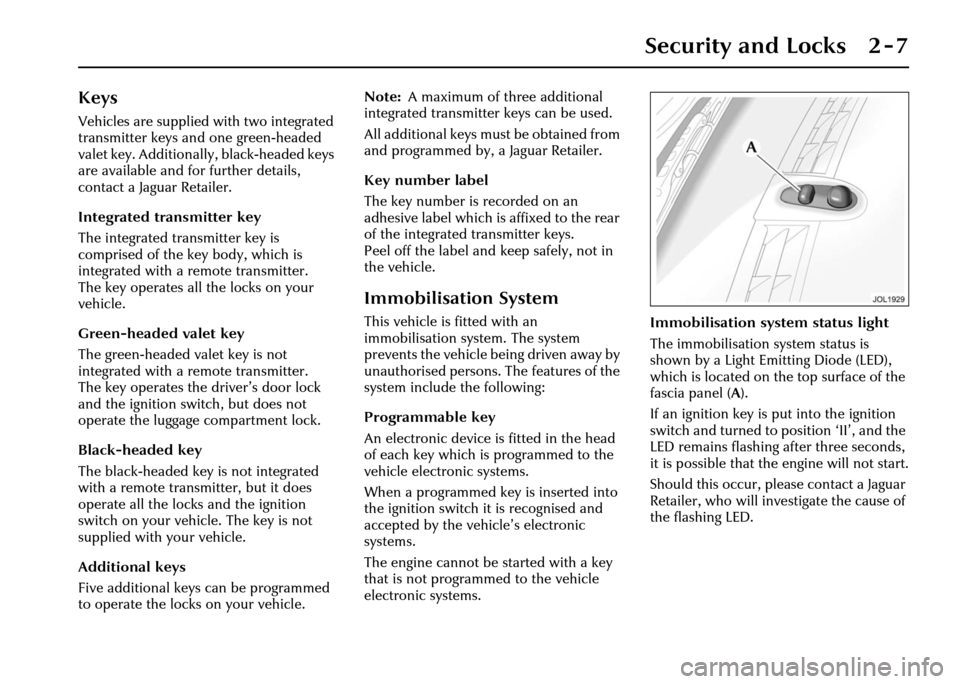
The immobilisation system status is
shown by a Light Emitting Diode (LED),
which is located on the top surface of the
fascia panel (
A).
If an ignition key is put into the ignition
switch and turned to position ‘II’, and the
LED remains flashing af ter three seconds,
it is possible that the engine will not start.
Should this occur, please contact a Jaguar
Retailer, who will inve stigate the cause of
the flashing LED.
Page 34 of 227
Security and Locks 2 - 19
Luggage Compartment Emergency Release
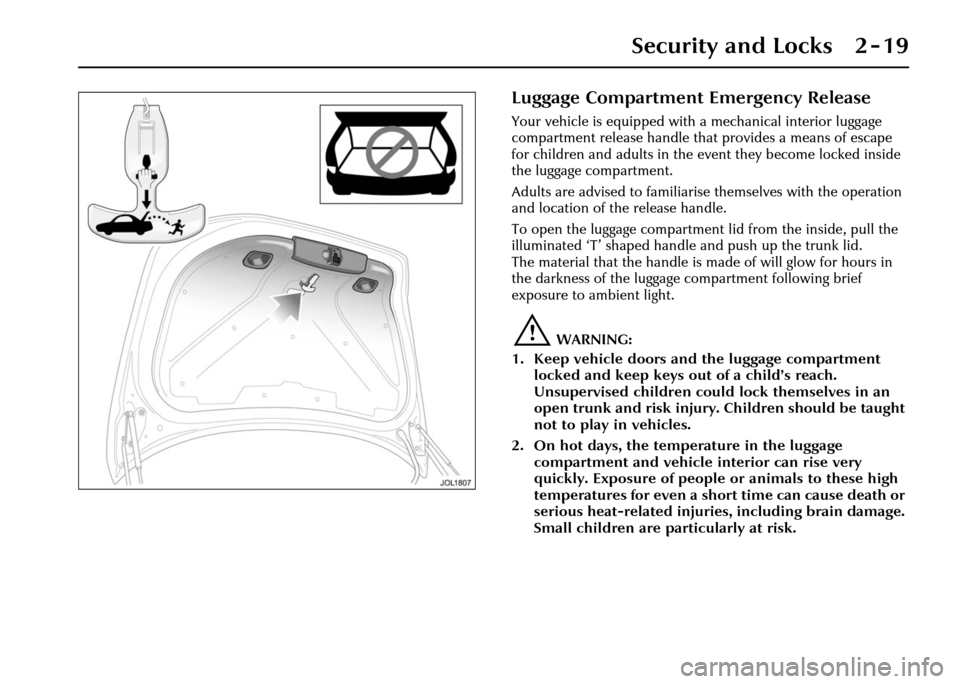
Your vehicle is equipped with a mechanical interior luggage
compartment release handle that provides a means of escape
for children and adults in the event they become locked inside
the luggage compartment.
Adults are advised to familiaris e themselves with the operation
and location of the release handle.
To open the luggage compartment lid from the inside, pull the
illuminated ‘T’ shaped handle and push up the trunk lid.
The material that the handle is made of will glow for hours in
the darkness of the luggage compartment following brief
exposure to ambient light.
!WARNING:
1. Keep vehicle doors and the luggage compartment locked and keep keys out of a child’s reach.
Unsupervised children could lock themselves in an
open trunk and risk injury. Children should be taught
not to play in vehicles.
2. On hot days, the temperature in the luggage compartment and vehicle interior can rise very
quickly. Exposure of people or animals to these high
temperatures for even a short time can cause death or
serious heat-related injuries, including brain damage.
Small children are particularly at risk.
Page 100 of 227
On the Road 4 - 29
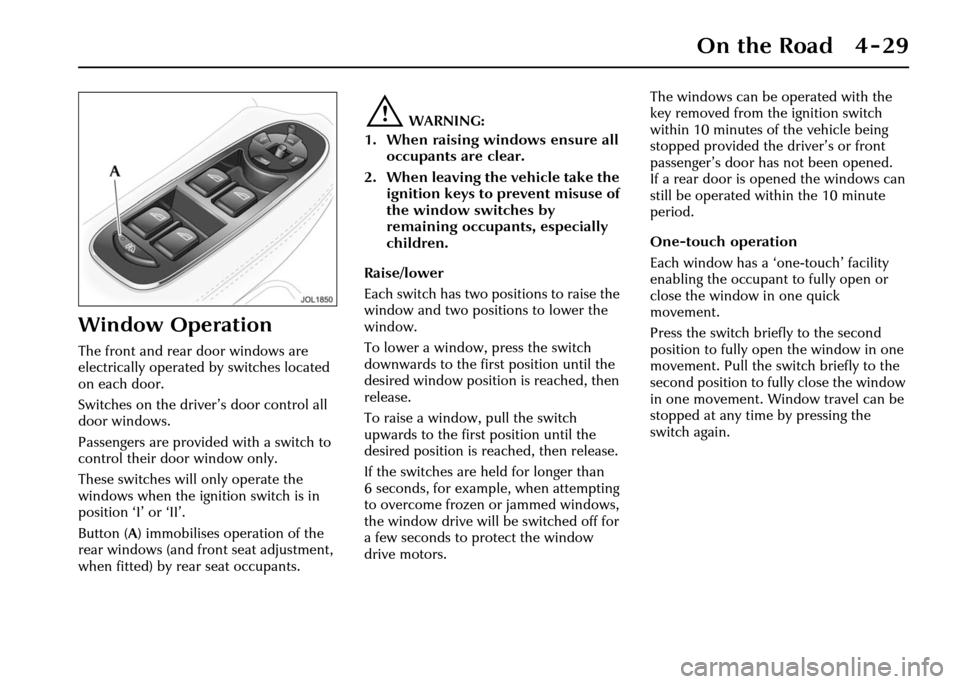
Window Operation
The front and rear door windows are
electrically operated by switches located
on each door.
Switches on the driver’s door control all
door windows.
Passengers are provided with a switch to
control their door window only.
These switches will only operate the
windows when the ignition switch is in
position ‘I’ or ‘II’.
Button (A) immobilises operation of the
rear windows (and front seat adjustment,
when fitted) by rear seat occupants.
!WARNING:
1. When raising windows ensure all occupants are clear.
2. When leaving the vehicle take the ignition keys to prevent misuse of
the window switches by
remaining occupants, especially
children.
Raise/lower
Each switch has two positions to raise the
window and two positions to lower the
window.
To lower a window, press the switch
downwards to the first position until the
desired window position is reached, then
release.
To raise a window, pull the switch
upwards to the first position until the
desired position is re ached, then release.
If the switches are held for longer than
6 seconds, for example, when attempting
to overcome frozen or jammed windows,
the window drive will be switched off for
a few seconds to protect the window
drive motors. The windows can be operated with the
key removed from the ignition switch
within 10 minutes of the vehicle being
stopped provided the driver’s or front
passenger’s door has not been opened.
If a rear door is opened the windows can
still be operated within the 10 minute
period.
One-touch operation
Each window has a ‘one-touch’ facility
enabling the occupant to fully open or
close the window in one quick
movement.
Press the switch briefly to the second
position to fully open the window in one
movement. Pull the swit
ch briefly to the
second position to fully close the window
in one movement. Window travel can be
stopped at any time by pressing the
switch again.
Page 131 of 227
4-60 On the Road
Use of Headlamps In Daylight
When visibility is poor the headlamps
with dipped beam setting should be
switched on so that the vehicle may be
seen more easily by other road users.
The instrument illumination dimmer
control adjusts the brightness of the panel
lighting.
Engine Oil Consumption
A certain amount of oil consumption is
normal. The rate of consumption will
depend on the following:
• The quality and viscosity of the oil.
• The amount of oxidation and dilution of the oil.
• Climatic conditions.
• The speed at which the engine is being operated.
• Road conditions.
Drivers should expect above normal
consumption when the engine is new,
and after running-in if high speeds are
sustained.
Winter Driving
Freeing a frozen door lock
Caution: Do not ap ply a proprietary
lock de-icer through the keyhole.
Should the lock beco me frozen, warm the
end of the key before use.
Windscreen wiper blades
Before driving away, clear any ice from
the windscreen and check that the wiper
blades are free. Switching on the heated
screen will accelerate this process.
The heated wiper park, if fitted, will come
on automatically.
Frost precautions
The correct concentration of coolant
must be maintained at all times when
‘topping up’ or ‘refilling’ the cooling
system.
Parking the Vehicle
When leaving the vehicle, remember the
following:
• Whenever the vehicle is being parked, apply the parkbrake and move the
gear selector to Park ‘P’.
• Do not leave children or pets in the vehicle unattended.
• Do not leave luggage or valuables on view. Always take your valuables with
you or lock them in the luggage
compartment.
• Remove the ignition key and spare keys, even when the vehicle is in your
garage.
• When the vehicle is unoccupied, close
all windows and lock all doors
securely.
• Park the vehicle where it can be seen. At night, park in a well-lit area.
• Ensure that the keys and the key transmitters are removed from the
vehicle before locking the doors,
and that all doors, the luggage
compartment and the hood are
closed.
Page 223 of 227
Index
Jaguar
– diagnostic system . . . . . . . . . . . . . . . . . . . . . . . . . . . . . . 1 - 8
– parts and accessories . . . . . . . . . . . . . . . . . . . . . . . . . . . 1 - 4
K
Key transmitter . . . . . . . . . . . . . . . . . . . . . . . . . . . . . . . . . 2 - 4
Keys . . . . . . . . . . . . . . . . . . . . . . . . . . . . . . . . . . . . . . . . . 2 - 7
– additional keys . . . . . . . . . . . . . . . . . . . . . . . . . . . . . . . . 2 - 7
– black-headed key . . . . . . . . . . . . . . . . . . . . . . . . . . . . . . 2 - 7
– green-headed valet key . . . . . . . . . . . . . . . . . . . . . . . . . 2 - 7
– integrated transmitter key . . . . . . . . . . . . . . . . . . . . . . . 2 - 7
– key number label . . . . . . . . . . . . . . . . . . . . . . . . . . . . . . 2 - 7
L
Leather upholstery – cleaning . . . . . . . . . . . . . . . . . . . . . 7 - 22
Lights
– approach lights . . . . . . . . . . . . . . . . . . . . . . . . . . . . . . 4 - 26
– autolamps . . . . . . . . . . . . . . . . . . . . . . . . . . . . . . . . . . 4 - 23
– battery saver . . . . . . . . . . . . . . . . . . . . . . . . . . . . . . . . 4 - 28
– bulb failure . . . . . . . . . . . . . . . . . . . . . . . . . . . . . . . . . 4 - 26
– daylight running lights . . . . . . . . . . . . . . . . . . . . . . . . . 4 - 24
– door guard/puddle lights . . . . . . . . . . . . . . . . . . . . . . . 4 - 26
– exit delay . . . . . . . . . . . . . . . . . . . . . . . . . . . . . . . . . . . 4 - 24
– exterior lights . . . . . . . . . . . . . . . . . . . . . . . . . . . . . . . . 4 - 23
– front fog lights . . . . . . . . . . . . . . . . . . . . . . . . . . . . . . . 4 - 25
– glove compartment . . . . . . . . . . . . . . . . . . . . . . . . . . . 4 - 26
– hazard warning . . . . . . . . . . . . . . . . . . . . . . . . . . . . . . 4 - 27
– headlight convenience . . . . . . . . . . . . . . . . . . . . . . . . . 4 - 24
– interior lighting . . . . . . . . . . . . . . . . . . . . . . . . . . . . . . 4 - 27
– luggage compartment lighting . . . . . . . . . . . . . . . . . . . 4 - 26
– rear fog lights . . . . . . . . . . . . . . . . . . . . . . . . . . . . . . . . 4 - 25Limp-home mode . . . . . . . . . . . . . . . . . . . . . . . . . . . . . . 4 - 45
Locking and unlocking
– auto-relocking . . . . . . . . . . . . . . . . . . . . . . . . . . . . . . . 2 - 11
– central locking switch . . . . . . . . . . . . . . . . . . . . . . . . . . . 2 - 9
– child safety locks . . . . . . . . . . . . . . . . . . . . . . . . . . . . . 2 - 14
– drive-away door locking . . . . . . . . . . . . . . . . . . . . . . . . . 2 - 8
– global closing . . . . . . . . . . . . . . . . . . . . . . . . . . . . . . . . 2 - 10
– smart locking . . . . . . . . . . . . . . . . . . . . . . . . . . . . . . . . . 2 - 9
– two-stage unlocking . . . . . . . . . . . . . . . . . . . . . . . . . . . 2 - 10
– valet key . . . . . . . . . . . . . . . . . . . . . . . . . . . . . . . . . . . . 2 - 14
– vehicle . . . . . . . . . . . . . . . . . . . . . . . . . . . . . . . . . . . . . . 2 - 8
Luggage compartment . . . . . . . . . . . . . . . . . . . . . . . . . . . 3 - 33
– ski hatch . . . . . . . . . . . . . . . . . . . . . . . . . . . . . . . . . . . . 3 - 34
– tie-down loops . . . . . . . . . . . . . . . . . . . . . . . . . . . . . . . 3 - 33
– underfloor access . . . . . . . . . . . . . . . . . . . . . . . . . . . . . . 6 - 4
Luggage compartment emergency release . . . . . . . . . . . . 2 - 19
M
Maintenance
– regular checks . . . . . . . . . . . . . . . . . . . . . . . . . . . . . . . . 7 - 3
Memory setting – driving positions . . . . . . . . . . . . . . . . . 3 - 31
Message centre . . . . . . . . . . . . . . . . . . . . . . . . . . . . . . . . 4 - 12
– clearing messages . . . . . . . . . . . . . . . . . . . . . . . . . . . . . 4 - 13
– illumination . . . . . . . . . . . . . . . . . . . . . . . . . . . . . . . . . 4 - 12
– language selection . . . . . . . . . . . . . . . . . . . . . . . . . . . . 4 - 12
– messages . . . . . . . . . . . . . . . . . . . . . . . . . . . . . . . . . . . 4 - 16