light JEEP CHEROKEE 1994 Service Repair Manual
[x] Cancel search | Manufacturer: JEEP, Model Year: 1994, Model line: CHEROKEE, Model: JEEP CHEROKEE 1994Pages: 1784, PDF Size: 77.09 MB
Page 1472 of 1784
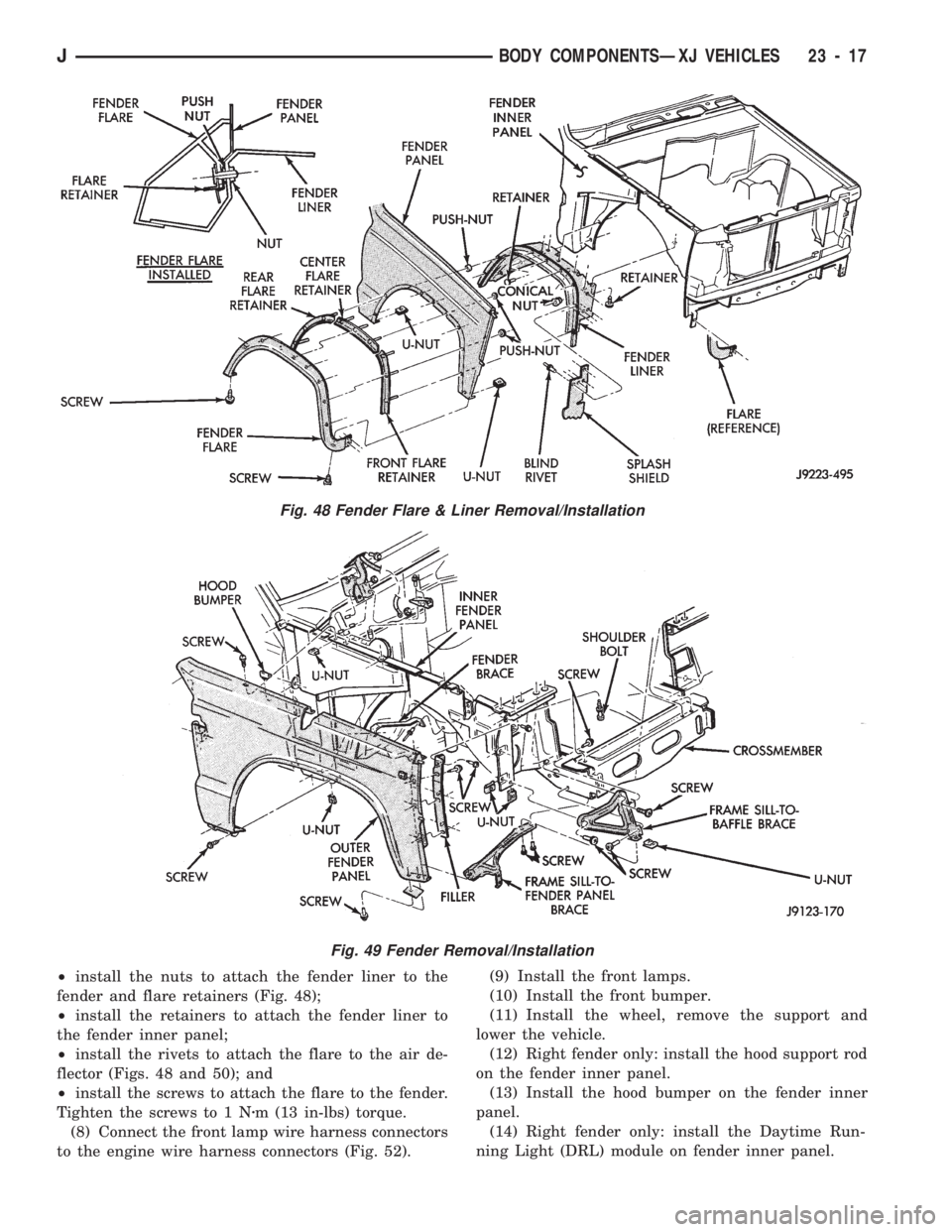
²install the nuts to attach the fender liner to the
fender and flare retainers (Fig. 48);
²install the retainers to attach the fender liner to
the fender inner panel;
²install the rivets to attach the flare to the air de-
flector (Figs. 48 and 50); and
²install the screws to attach the flare to the fender.
Tighten the screws to 1 Nzm (13 in-lbs) torque.
(8) Connect the front lamp wire harness connectors
to the engine wire harness connectors (Fig. 52).(9) Install the front lamps.
(10) Install the front bumper.
(11) Install the wheel, remove the support and
lower the vehicle.
(12) Right fender only: install the hood support rod
on the fender inner panel.
(13) Install the hood bumper on the fender inner
panel.
(14) Right fender only: install the Daytime Run-
ning Light (DRL) module on fender inner panel.
Fig. 48 Fender Flare & Liner Removal/Installation
Fig. 49 Fender Removal/Installation
JBODY COMPONENTSÐXJ VEHICLES 23 - 17
Page 1483 of 1784
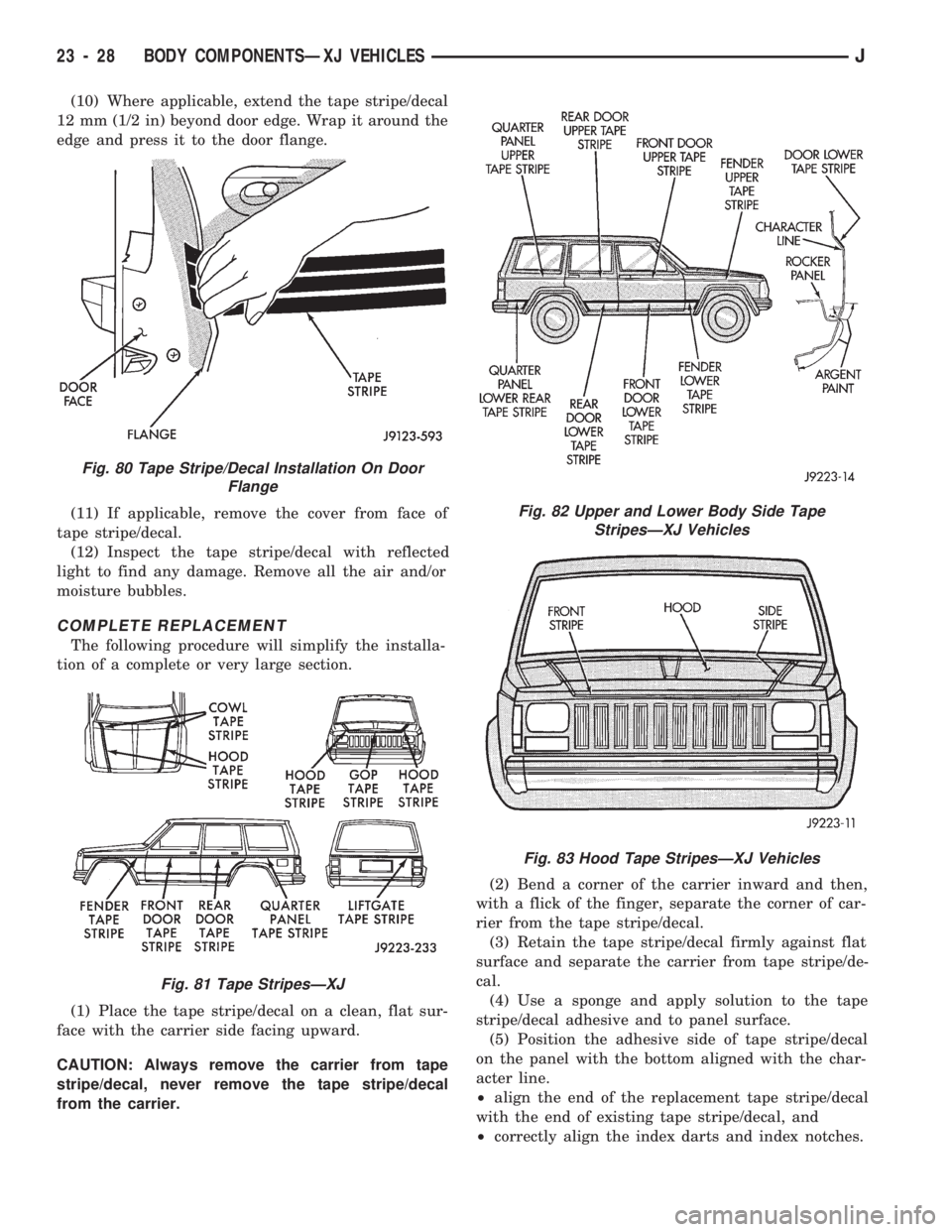
(10) Where applicable, extend the tape stripe/decal
12 mm (1/2 in) beyond door edge. Wrap it around the
edge and press it to the door flange.
(11) If applicable, remove the cover from face of
tape stripe/decal.
(12) Inspect the tape stripe/decal with reflected
light to find any damage. Remove all the air and/or
moisture bubbles.
COMPLETE REPLACEMENT
The following procedure will simplify the installa-
tion of a complete or very large section.
(1) Place the tape stripe/decal on a clean, flat sur-
face with the carrier side facing upward.
CAUTION: Always remove the carrier from tape
stripe/decal, never remove the tape stripe/decal
from the carrier.(2) Bend a corner of the carrier inward and then,
with a flick of the finger, separate the corner of car-
rier from the tape stripe/decal.
(3) Retain the tape stripe/decal firmly against flat
surface and separate the carrier from tape stripe/de-
cal.
(4) Use a sponge and apply solution to the tape
stripe/decal adhesive and to panel surface.
(5) Position the adhesive side of tape stripe/decal
on the panel with the bottom aligned with the char-
acter line.
²align the end of the replacement tape stripe/decal
with the end of existing tape stripe/decal, and
²correctly align the index darts and index notches.
Fig. 80 Tape Stripe/Decal Installation On Door
Flange
Fig. 81 Tape StripesÐXJ
Fig. 82 Upper and Lower Body Side Tape
StripesÐXJ Vehicles
Fig. 83 Hood Tape StripesÐXJ Vehicles
23 - 28 BODY COMPONENTSÐXJ VEHICLESJ
Page 1484 of 1784
(6) If a complete replacement tape stripe/decal is
not being installed:
²position the replacement tape stripe/decal section
at the center of the repair area,
²align it with the existing tape stripe/decal, and
²allow at least 12 mm (1/2 in) of the tape stripe/de-
cal section to overlap the tape stripe/decal edges.
(7) Apply the wetting solution to the outer side of
the tape stripe/decal.
CAUTION: Avoid unnecessary pulling and stretch-
ing at the ends.
(8) Slide a squeegee from the center to the ends of
the tape stripe/decal. Use firm strokes to remove all
of the air bubbles.(9) If a wrinkle is trapped in the tape stripe/decal
stop immediately. Lift the wrinkled area and re-align
it with the character line to remove the wrinkle.Do
not lift the tape stripe/decal if only a few air
bubbles exist.
(10) Where applicable, allow 12 mm (1/2 in) extra
tape stripe/decal to extend beyond edges.
(11) Fold the excess tape onto the inside flange and
adhere it with finger pressure.
(12) Inspect the tape stripe/decal installation with
the reflected light to find any damage.
(13) Remove all the air and moisture bubbles from
the tape stripe/decal with a needle or pin.
(14) Install any removed components and clean the
vehicle as necessary.
QUARTER WINDOW APPLIQUEÐXJ VEHICLES
REMOVAL/INSTALLATION
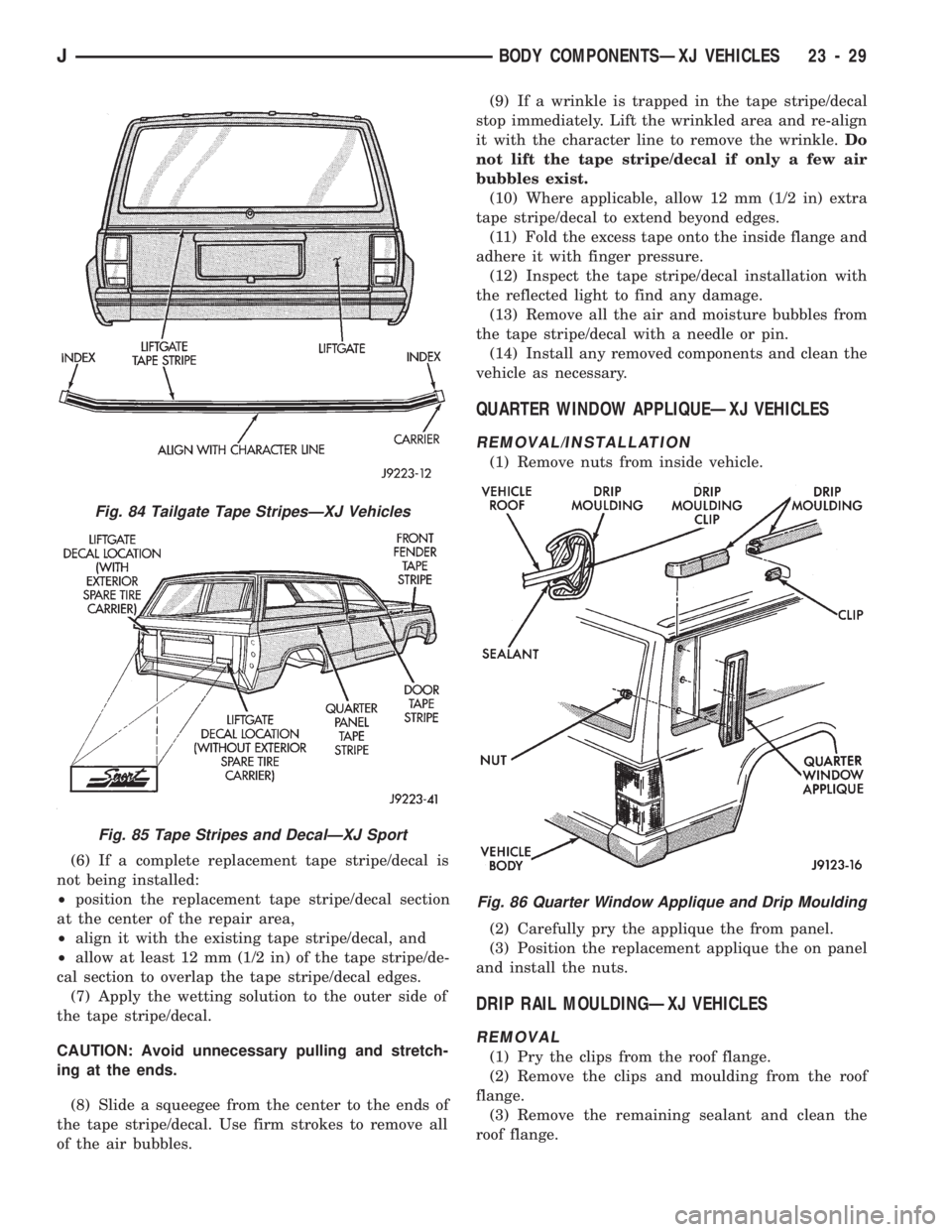
(1) Remove nuts from inside vehicle.
(2) Carefully pry the applique the from panel.
(3) Position the replacement applique the on panel
and install the nuts.
DRIP RAIL MOULDINGÐXJ VEHICLES
REMOVAL
(1) Pry the clips from the roof flange.
(2) Remove the clips and moulding from the roof
flange.
(3) Remove the remaining sealant and clean the
roof flange.
Fig. 84 Tailgate Tape StripesÐXJ Vehicles
Fig. 85 Tape Stripes and DecalÐXJ Sport
Fig. 86 Quarter Window Applique and Drip Moulding
JBODY COMPONENTSÐXJ VEHICLES 23 - 29
Page 1514 of 1784
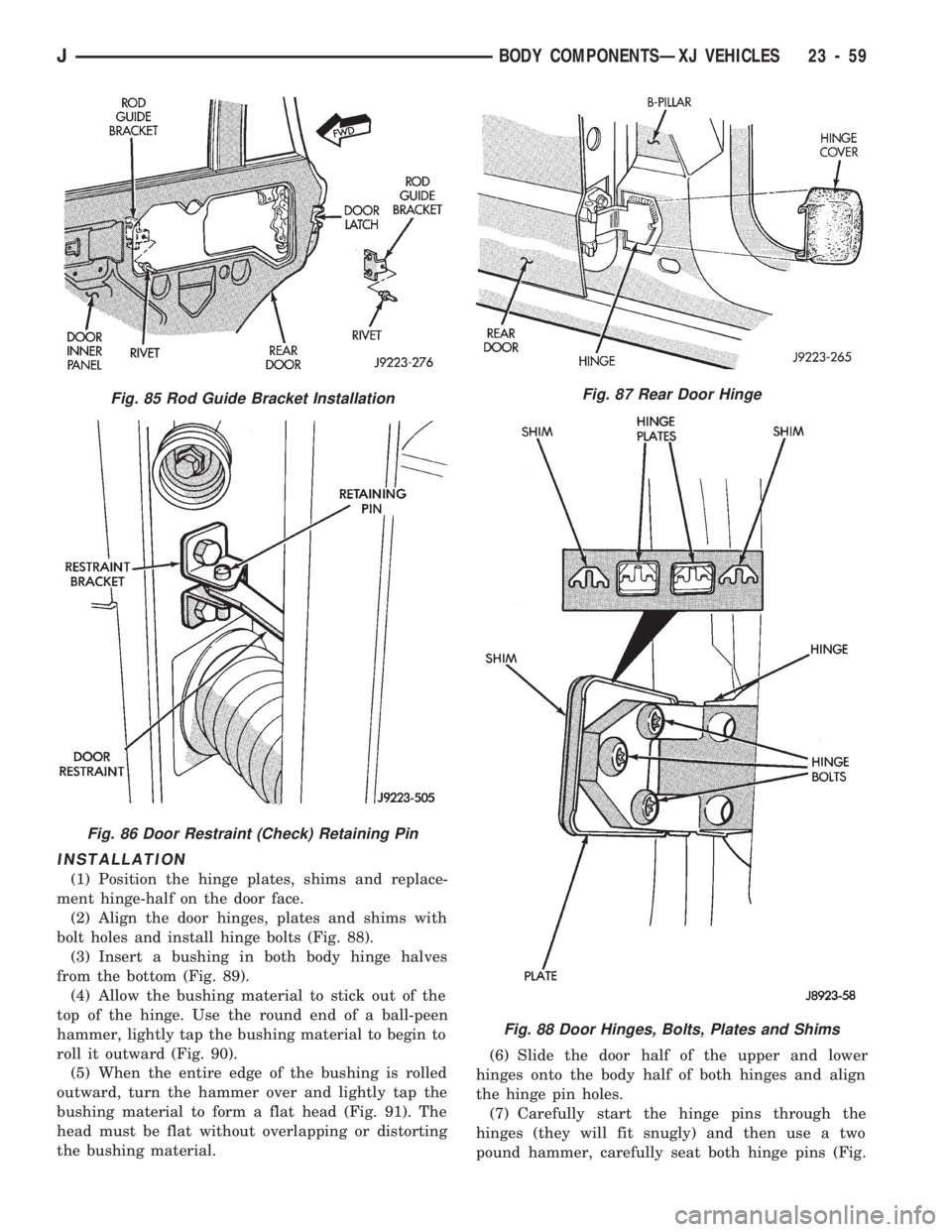
INSTALLATION
(1) Position the hinge plates, shims and replace-
ment hinge-half on the door face.
(2) Align the door hinges, plates and shims with
bolt holes and install hinge bolts (Fig. 88).
(3) Insert a bushing in both body hinge halves
from the bottom (Fig. 89).
(4) Allow the bushing material to stick out of the
top of the hinge. Use the round end of a ball-peen
hammer, lightly tap the bushing material to begin to
roll it outward (Fig. 90).
(5) When the entire edge of the bushing is rolled
outward, turn the hammer over and lightly tap the
bushing material to form a flat head (Fig. 91). The
head must be flat without overlapping or distorting
the bushing material.(6) Slide the door half of the upper and lower
hinges onto the body half of both hinges and align
the hinge pin holes.
(7) Carefully start the hinge pins through the
hinges (they will fit snugly) and then use a two
pound hammer, carefully seat both hinge pins (Fig.
Fig. 85 Rod Guide Bracket Installation
Fig. 86 Door Restraint (Check) Retaining Pin
Fig. 87 Rear Door Hinge
Fig. 88 Door Hinges, Bolts, Plates and Shims
JBODY COMPONENTSÐXJ VEHICLES 23 - 59
Page 1530 of 1784
INTERIOR REARVIEW MIRROR SUPPORT
BRACKET REPLACEMENT
PREPARATION
(1) Mark reference lines for the mirror support
bracket on the outside of windshield glass with a wax
pencil.
(2) If the vinyl pad remained on the windshield
glass, soften and remove it with a heat gun.
(3) Clean the support bracket surface area on the
glass. Use a mild abrasive cleaning powder on a cloth
saturated with isopropyl (rubbing) alcohol.
(4) Lightly sand the contact surface on the support
bracket with fine grit sandpaper. Wipe bracket con-
tact surface clean with a paper towel and alcohol.
INSTALLATION
(1) Apply adhesive to the act surface on the sup-
port bracket according as follows:
²crush the vial in the plastic housing of the accel-
erator to saturate the felt applicator;
²remove the paper sleeve;
²apply a generous amount of accelerator to the con-
tact surface on the mirror support bracket;
²do not touch the support bracket contact surface
after the accelerator has been applied.
²allow the accelerator to dry for at least five min-
utes; and
(2) Apply accelerator to the support bracket con-
tact surface on the windshield glass. Allow the accel-
erator to dry for one minute.
(3) Install the mirror bracket on the windshield
glass follows:
²apply one drop of adhesive at the center of support
bracket contact surface on windshield glass;
²immediately apply an even coat of adhesive to the
contact surface on the support bracket;
²align the support bracket with the position refer-
ence lines on the windshield glass, then
²press and hold the support bracket in-place for at
least one minute.
Ensure that the mirror support bracket is
correctly aligned because the adhesive will
cure rapidly.
(4) Allow the adhesive to cure for 8-10 minutes,
then remove any residue adhesive with an alcohol-
dampened cloth.
(5) Allow the adhesive to cure for an additional
8-10 minutes before installing the mirror base on the
support bracket.
WINDSHIELD SERVICE INFORMATION
URETHANE ADHESIVE BONDING
The windshield glass is bonded to the body pinch-
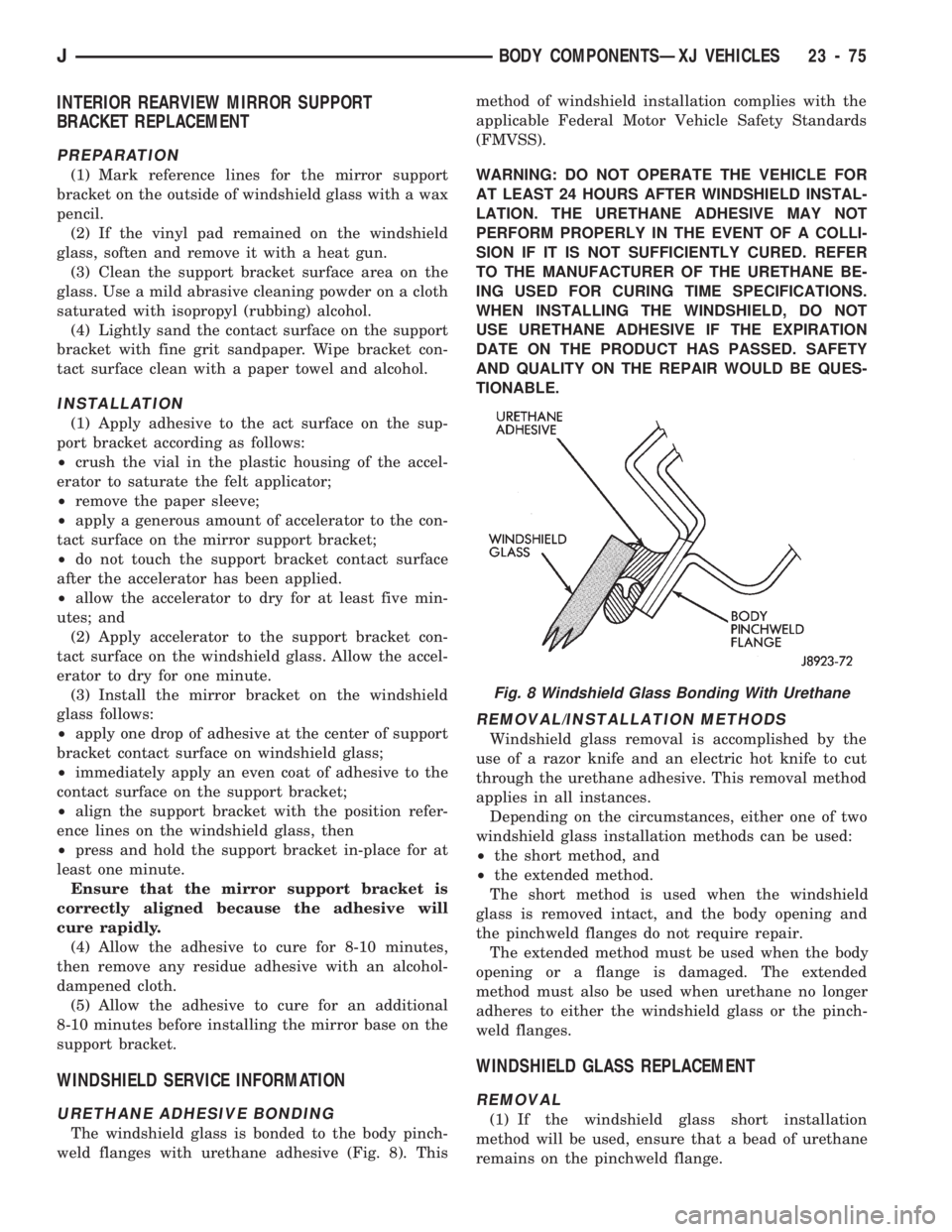
weld flanges with urethane adhesive (Fig. 8). Thismethod of windshield installation complies with the
applicable Federal Motor Vehicle Safety Standards
(FMVSS).
WARNING: DO NOT OPERATE THE VEHICLE FOR
AT LEAST 24 HOURS AFTER WINDSHIELD INSTAL-
LATION. THE URETHANE ADHESIVE MAY NOT
PERFORM PROPERLY IN THE EVENT OF A COLLI-
SION IF IT IS NOT SUFFICIENTLY CURED. REFER
TO THE MANUFACTURER OF THE URETHANE BE-
ING USED FOR CURING TIME SPECIFICATIONS.
WHEN INSTALLING THE WINDSHIELD, DO NOT
USE URETHANE ADHESIVE IF THE EXPIRATION
DATE ON THE PRODUCT HAS PASSED. SAFETY
AND QUALITY ON THE REPAIR WOULD BE QUES-
TIONABLE.
REMOVAL/INSTALLATION METHODS
Windshield glass removal is accomplished by the
use of a razor knife and an electric hot knife to cut
through the urethane adhesive. This removal method
applies in all instances.
Depending on the circumstances, either one of two
windshield glass installation methods can be used:
²the short method, and
²the extended method.
The short method is used when the windshield
glass is removed intact, and the body opening and
the pinchweld flanges do not require repair.
The extended method must be used when the body
opening or a flange is damaged. The extended
method must also be used when urethane no longer
adheres to either the windshield glass or the pinch-
weld flanges.
WINDSHIELD GLASS REPLACEMENT
REMOVAL
(1) If the windshield glass short installation
method will be used, ensure that a bead of urethane
remains on the pinchweld flange.
Fig. 8 Windshield Glass Bonding With Urethane
JBODY COMPONENTSÐXJ VEHICLES 23 - 75
Page 1546 of 1784
INTERIOR COMPONENTS
INDEX
page page
Assist HandleÐXJ Vehicles................ 118
B/C-Pillar and Liftgate Pillar Trim CoversÐ
XJ Vehicles.......................... 116
Bucket Seat Cushion and Cover............. 98
Bucket Seat Platform and Tracks........... 105
Bucket Seatback Cover and Frame.......... 100
Bucket Seatback Reconditioning............ 102
Carpets and Floor Mats................... 129
Dash Panel Insulation Panel................ 95
Front Bucket Seats....................... 97
Front Carpet/MatÐXJ Vehicles............. 129
Front Inner Scuff Plate/Cowl Side Trim PanelÐ
XJ Vehicles.......................... 114
Front Shoulder Belt/BuckleÐXJ Vehicles...... 119
Full Floor ConsoleÐXJ Vehicles............ 125
Headliner.............................. 121
I/P Ash Receiver Tray Lamp................ 92
I/P Tweeter Speaker/Courtesy Lamp Support
Bracket.............................. 95
Instrument Cluster Bezel................... 91
Instrument Cluster/Switch/Lighter/Radio/Hevac . . . 91
Instrument Panel......................... 93
Interior Trim Panels and Scuff PlatesÐXJ Vehicles. 112
Jack StorageÐXJ Vehicles................ 127
Mini-Floor ConsoleÐXJ Vehicles............ 124
Outer Scuff PlatesÐXJ Vehicles............ 118
Power Bucket Seat Components............ 106
Quarter and Wheelhouse Trim PanelsÐ
XJ Vehicles.......................... 115
Quarter Trim Panel ExtensionÐXJ Vehicles . . . 115
Rear Carpet/MatÐXJ Vehicles.............. 130
Rear Seat Cushion CoverÐXJ Vehicles...... 107
Rear Seat Cushion ReconditioningÐXJ Vehicles . 108
Rear Seat CushionÐXJ Vehicles............ 107
Rear Seatback CoverÐXJ Vehicles.......... 111
Rear Seatback Latch Striker and BumperÐ
XJ Vehicles.......................... 111
Rear Seatback ReconditioningÐXJ Vehicles . . . 111
Rear SeatbackÐXJ Vehicles............... 109
Rear Shoulder/Lap Belt/BuckleÐXJ Vehicles . . . 120
Spare Tire/Wheel Holddown and Floor BracketsÐ
XJ Vehicles.......................... 128
Sunvisors............................. 124
Windshield Side MouldingÐXJ Vehicles...... 114
INSTRUMENT CLUSTER BEZEL
REMOVAL
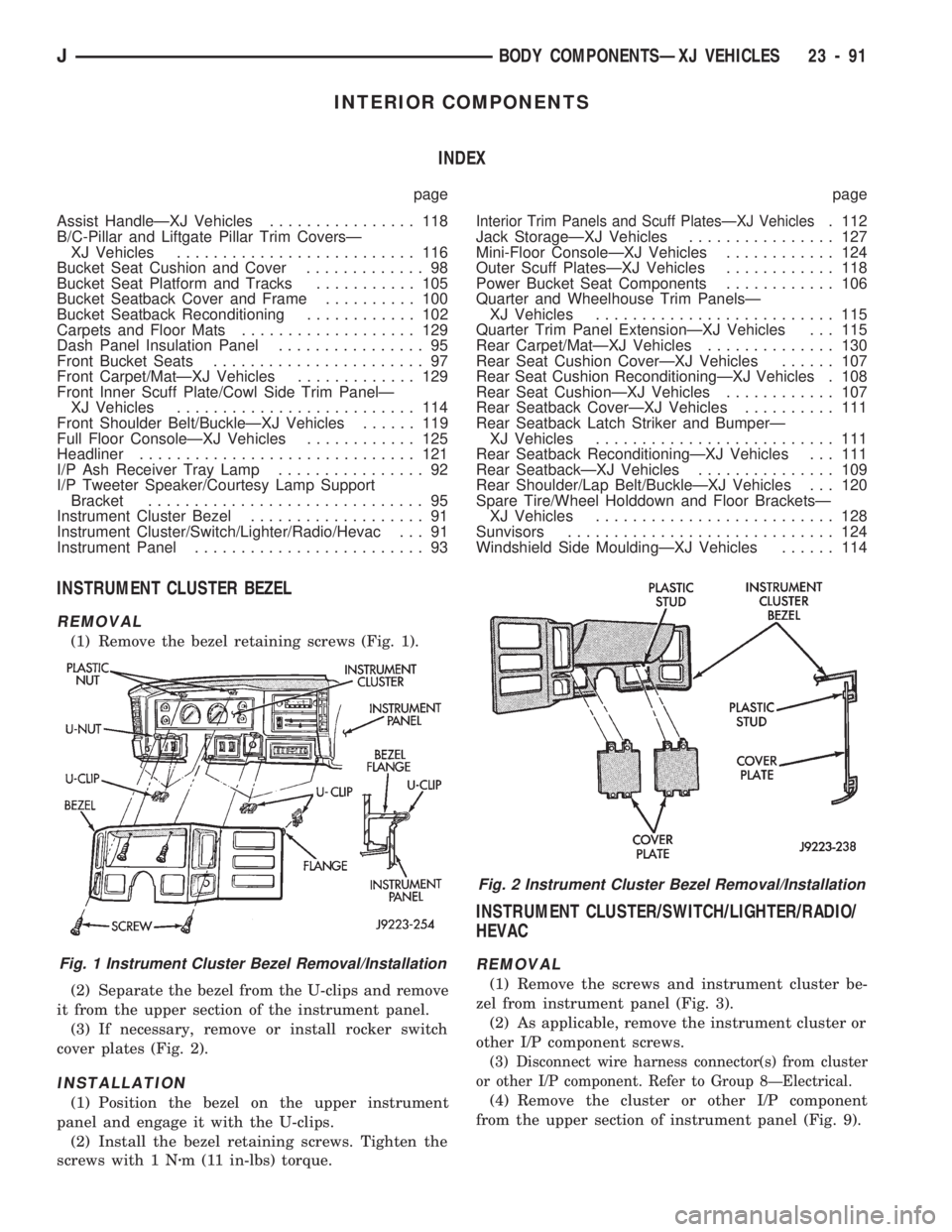
(1) Remove the bezel retaining screws (Fig. 1).
(2) Separate the bezel from the U-clips and remove
it from the upper section of the instrument panel.
(3) If necessary, remove or install rocker switch
cover plates (Fig. 2).
INSTALLATION
(1) Position the bezel on the upper instrument
panel and engage it with the U-clips.
(2) Install the bezel retaining screws. Tighten the
screws with 1 Nzm (11 in-lbs) torque.
INSTRUMENT CLUSTER/SWITCH/LIGHTER/RADIO/
HEVAC
REMOVAL
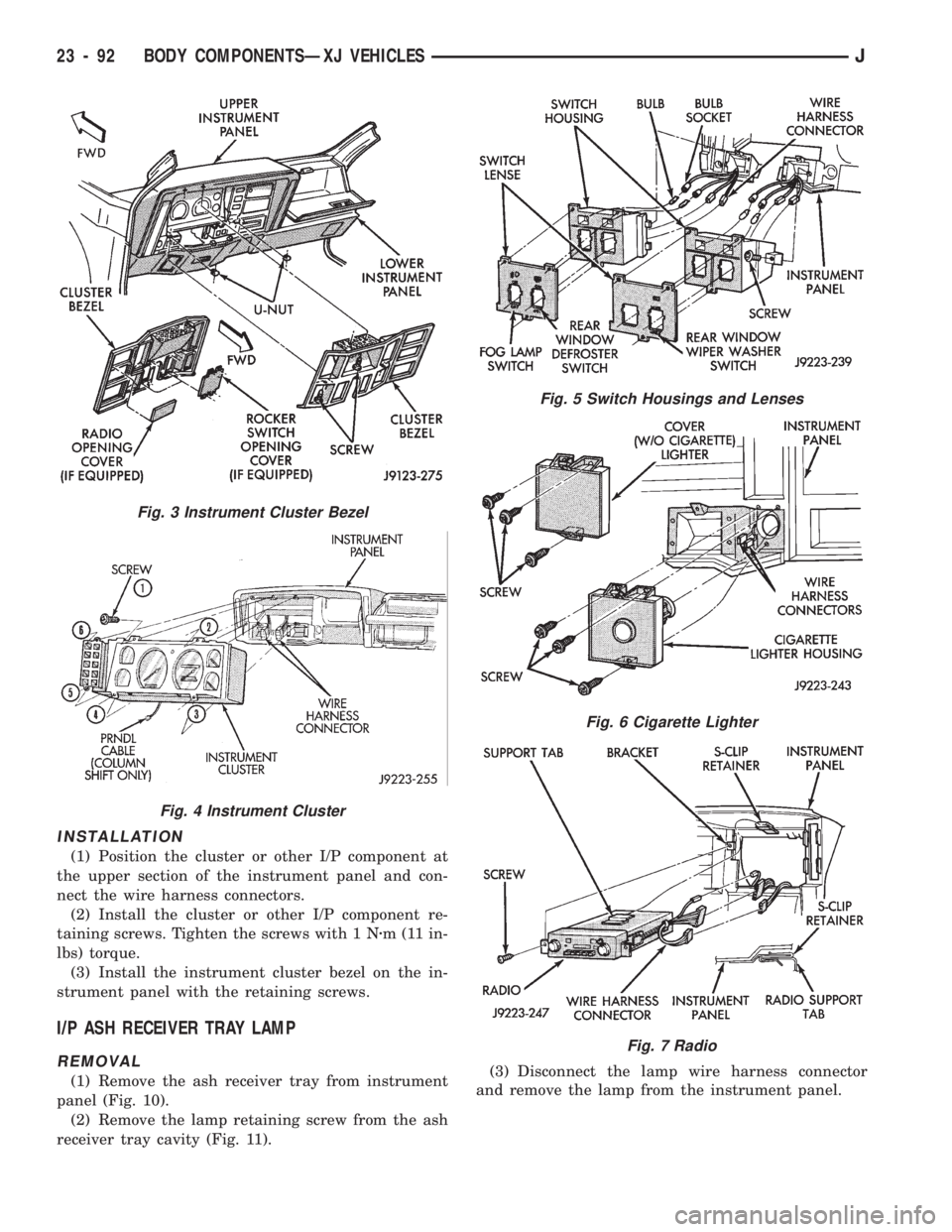
(1) Remove the screws and instrument cluster be-
zel from instrument panel (Fig. 3).
(2) As applicable, remove the instrument cluster or
other I/P component screws.
(3) Disconnect wire harness connector(s) from cluster
or other I/P component. Refer to Group 8ÐElectrical.
(4) Remove the cluster or other I/P component
from the upper section of instrument panel (Fig. 9).
Fig. 1 Instrument Cluster Bezel Removal/Installation
Fig. 2 Instrument Cluster Bezel Removal/Installation
JBODY COMPONENTSÐXJ VEHICLES 23 - 91
Page 1547 of 1784
INSTALLATION
(1) Position the cluster or other I/P component at
the upper section of the instrument panel and con-
nect the wire harness connectors.
(2) Install the cluster or other I/P component re-
taining screws. Tighten the screws with 1 Nzm (11 in-
lbs) torque.
(3) Install the instrument cluster bezel on the in-
strument panel with the retaining screws.
I/P ASH RECEIVER TRAY LAMP
REMOVAL
(1) Remove the ash receiver tray from instrument
panel (Fig. 10).
(2) Remove the lamp retaining screw from the ash
receiver tray cavity (Fig. 11).(3) Disconnect the lamp wire harness connector
and remove the lamp from the instrument panel.
Fig. 5 Switch Housings and Lenses
Fig. 6 Cigarette Lighter
Fig. 7 Radio
Fig. 3 Instrument Cluster Bezel
Fig. 4 Instrument Cluster
23 - 92 BODY COMPONENTSÐXJ VEHICLESJ
Page 1611 of 1784
CAUTION: Always remove the carrier from the tape
stripe/decal, never remove the tape stripe/decal
from the carrier.
(6) Bend a corner of the carrier outward with a
flick of the finger, separate the corner of the carrier
from the tape stripe/decal.
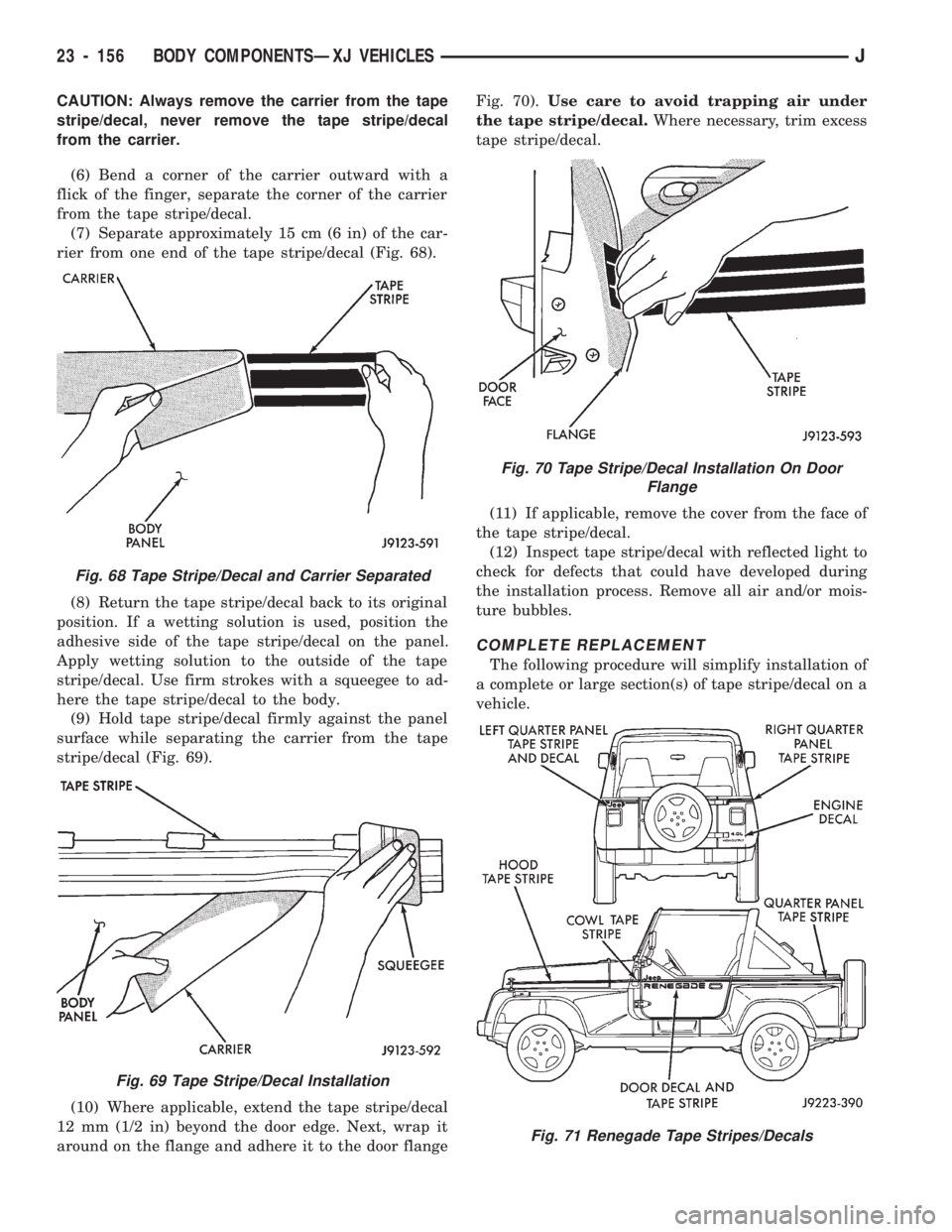
(7) Separate approximately 15 cm (6 in) of the car-
rier from one end of the tape stripe/decal (Fig. 68).
(8) Return the tape stripe/decal back to its original
position. If a wetting solution is used, position the
adhesive side of the tape stripe/decal on the panel.
Apply wetting solution to the outside of the tape
stripe/decal. Use firm strokes with a squeegee to ad-
here the tape stripe/decal to the body.
(9) Hold tape stripe/decal firmly against the panel
surface while separating the carrier from the tape
stripe/decal (Fig. 69).
(10) Where applicable, extend the tape stripe/decal
12 mm (1/2 in) beyond the door edge. Next, wrap it
around on the flange and adhere it to the door flangeFig. 70).Use care to avoid trapping air under
the tape stripe/decal.Where necessary, trim excess
tape stripe/decal.
(11) If applicable, remove the cover from the face of
the tape stripe/decal.
(12) Inspect tape stripe/decal with reflected light to
check for defects that could have developed during
the installation process. Remove all air and/or mois-
ture bubbles.
COMPLETE REPLACEMENT
The following procedure will simplify installation of
a complete or large section(s) of tape stripe/decal on a
vehicle.
Fig. 68 Tape Stripe/Decal and Carrier Separated
Fig. 69 Tape Stripe/Decal Installation
Fig. 70 Tape Stripe/Decal Installation On Door
Flange
Fig. 71 Renegade Tape Stripes/Decals
23 - 156 BODY COMPONENTSÐXJ VEHICLESJ
Page 1612 of 1784
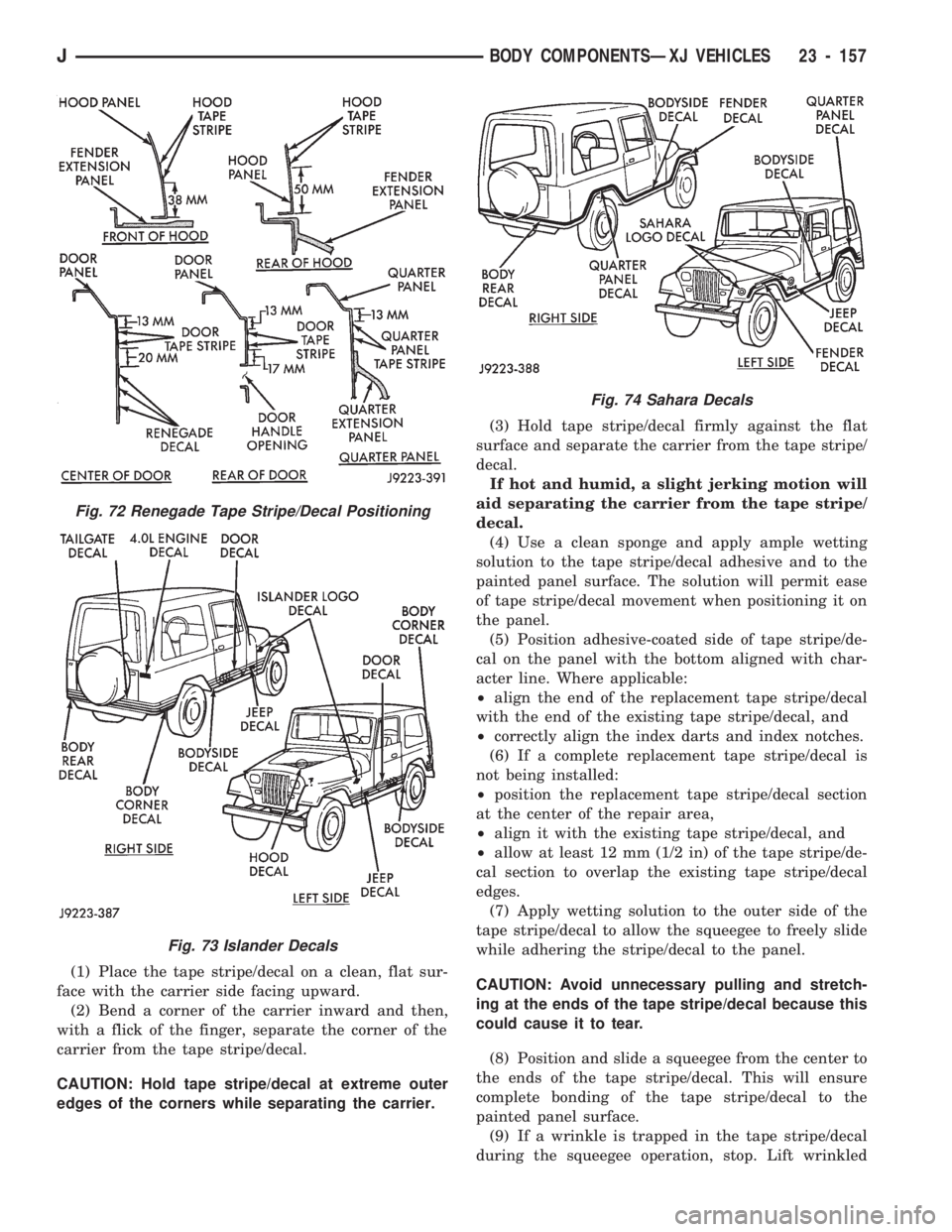
(1) Place the tape stripe/decal on a clean, flat sur-
face with the carrier side facing upward.
(2) Bend a corner of the carrier inward and then,
with a flick of the finger, separate the corner of the
carrier from the tape stripe/decal.
CAUTION: Hold tape stripe/decal at extreme outer
edges of the corners while separating the carrier.(3) Hold tape stripe/decal firmly against the flat
surface and separate the carrier from the tape stripe/
decal.
If hot and humid, a slight jerking motion will
aid separating the carrier from the tape stripe/
decal.
(4) Use a clean sponge and apply ample wetting
solution to the tape stripe/decal adhesive and to the
painted panel surface. The solution will permit ease
of tape stripe/decal movement when positioning it on
the panel.
(5) Position adhesive-coated side of tape stripe/de-
cal on the panel with the bottom aligned with char-
acter line. Where applicable:
²align the end of the replacement tape stripe/decal
with the end of the existing tape stripe/decal, and
²correctly align the index darts and index notches.
(6) If a complete replacement tape stripe/decal is
not being installed:
²position the replacement tape stripe/decal section
at the center of the repair area,
²align it with the existing tape stripe/decal, and
²allow at least 12 mm (1/2 in) of the tape stripe/de-
cal section to overlap the existing tape stripe/decal
edges.
(7) Apply wetting solution to the outer side of the
tape stripe/decal to allow the squeegee to freely slide
while adhering the stripe/decal to the panel.
CAUTION: Avoid unnecessary pulling and stretch-
ing at the ends of the tape stripe/decal because this
could cause it to tear.
(8) Position and slide a squeegee from the center to
the ends of the tape stripe/decal. This will ensure
complete bonding of the tape stripe/decal to the
painted panel surface.
(9) If a wrinkle is trapped in the tape stripe/decal
during the squeegee operation, stop. Lift wrinkled
Fig. 72 Renegade Tape Stripe/Decal Positioning
Fig. 73 Islander Decals
Fig. 74 Sahara Decals
JBODY COMPONENTSÐXJ VEHICLES 23 - 157
Page 1613 of 1784
area and re-align stripe/decal with panel character
line.Do not lift the tape stripe/decal if only a
few air bubbles exist.
(10) Where applicable, allow 12 mm (1/2 in) extra
tape stripe/decal to extend beyond the edges to be
folded over.
(11) Fold the excess tape stripe/decal back onto in-
side flange area.Use care to avoid trapping air
under the tape stripe/decal.Where necessary,
trim excess tape stripe/decal.
(12) Inspect tape installation with reflected light to
detect any defects that could have developed during
the installation.
(13) Remove all air and moisture bubbles from the
tape stripe/decal with a needle or pin.
(14) Install any removed components and clean the
vehicle as necessary.
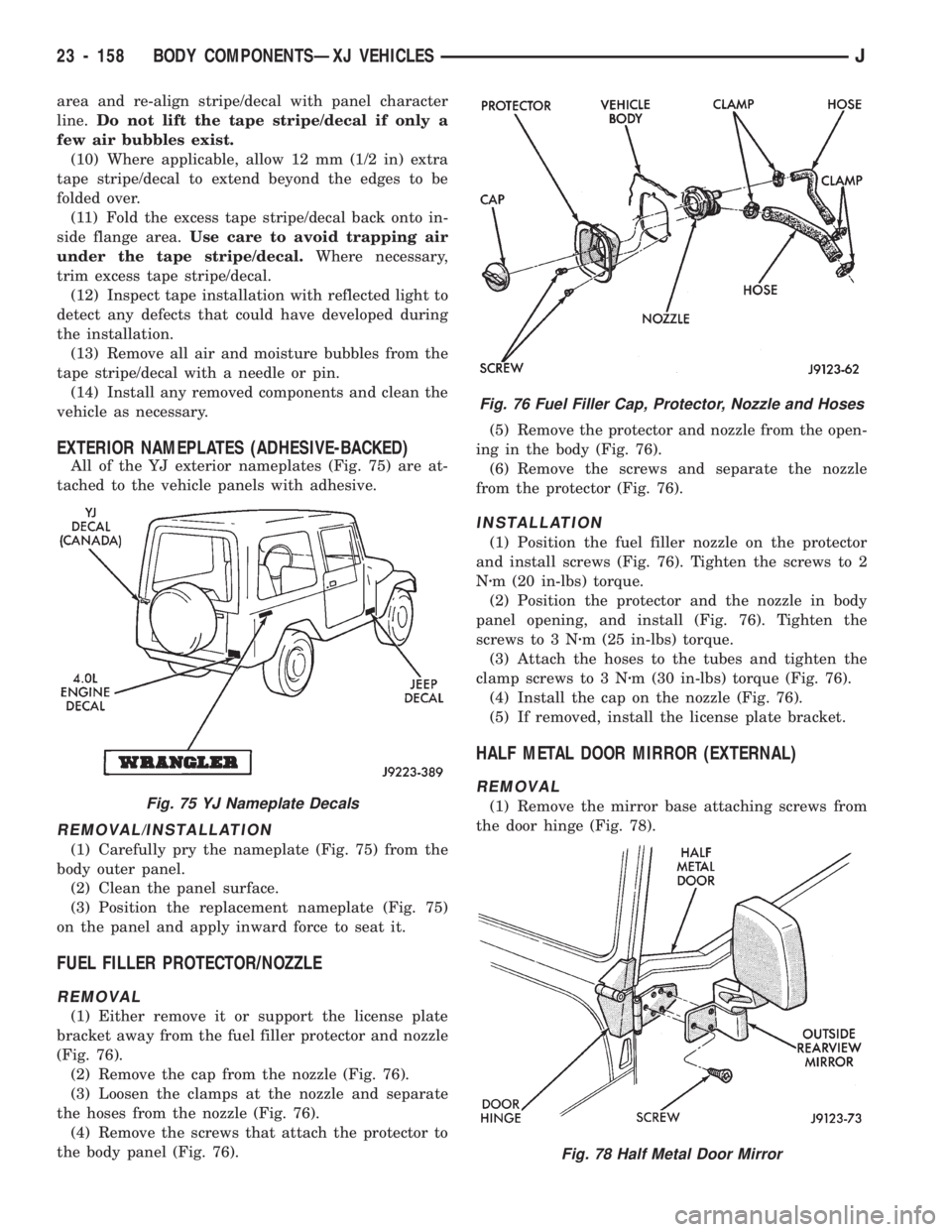
EXTERIOR NAMEPLATES (ADHESIVE-BACKED)
All of the YJ exterior nameplates (Fig. 75) are at-
tached to the vehicle panels with adhesive.
REMOVAL/INSTALLATION
(1) Carefully pry the nameplate (Fig. 75) from the
body outer panel.
(2) Clean the panel surface.
(3) Position the replacement nameplate (Fig. 75)
on the panel and apply inward force to seat it.
FUEL FILLER PROTECTOR/NOZZLE
REMOVAL
(1) Either remove it or support the license plate
bracket away from the fuel filler protector and nozzle
(Fig. 76).
(2) Remove the cap from the nozzle (Fig. 76).
(3) Loosen the clamps at the nozzle and separate
the hoses from the nozzle (Fig. 76).
(4) Remove the screws that attach the protector to
the body panel (Fig. 76).(5) Remove the protector and nozzle from the open-
ing in the body (Fig. 76).
(6) Remove the screws and separate the nozzle
from the protector (Fig. 76).
INSTALLATION
(1) Position the fuel filler nozzle on the protector
and install screws (Fig. 76). Tighten the screws to 2
Nzm (20 in-lbs) torque.
(2) Position the protector and the nozzle in body
panel opening, and install (Fig. 76). Tighten the
screws to 3 Nzm (25 in-lbs) torque.
(3) Attach the hoses to the tubes and tighten the
clamp screws to 3 Nzm (30 in-lbs) torque (Fig. 76).
(4) Install the cap on the nozzle (Fig. 76).
(5) If removed, install the license plate bracket.
HALF METAL DOOR MIRROR (EXTERNAL)
REMOVAL
(1) Remove the mirror base attaching screws from
the door hinge (Fig. 78).
Fig. 76 Fuel Filler Cap, Protector, Nozzle and Hoses
Fig. 78 Half Metal Door Mirror
Fig. 75 YJ Nameplate Decals
23 - 158 BODY COMPONENTSÐXJ VEHICLESJ