fuse JEEP CHEROKEE 1995 Service Repair Manual
[x] Cancel search | Manufacturer: JEEP, Model Year: 1995, Model line: CHEROKEE, Model: JEEP CHEROKEE 1995Pages: 2198, PDF Size: 82.83 MB
Page 950 of 2198
TURN SIGNALS
TURN SIGNAL RELAY
In the RUN position, the ignition switch connects
circuit A1 from fuse 6 in the Power Distribution Cen-
ter (PDC) to circuit A21. Circuit A21 connects to the
turn signal relay.
Circuit L9 from fuse 4 in the PDC supplies battery
voltage to the relay. Circuit Z1 provides ground for
the relay.
Circuit L5 from the relay connects to the multi-
function switch to supply power to the turn signals.
The multi-function switch supplies voltage to the
turn signals and side marker lamps on circuits L60
and L61.
Circuit L12 from the relay connects to the multi-
function switch and the hazard flasher relay.
TURN SIGNALS
When the operator selects the right turn signal, the
multi-function switch connects power from circuit L5
to circuit L60. Circuit L60 feeds the right front and
right rear turn signal lamp. Circuit L60 also splices
to power the right turn signal indicator lamp on the
instrument cluster.
When the operator selects the right turn signal, the
multi-function switch connects power from circuit L5
to circuit L61. Circuit L61 feeds the left front and
left rear turn signal lamp. Circuit L61 also splices to
power the left turn signal indicator lamp on the in-
strument cluster.
Circuit Z1 provides ground for the turn signal
lamps.
HELPFUL INFORMATION
²The turn signal lamps are the same lamps used
for the hazard flasher.
²Check fuse 6 in the PDC.
HAZARD FLASHERS
When the operator selects the hazard flashers, the
multi-function switch connects circuit L12 from the
hazard flasher relay to circuits L60 and L61.
Circuit L60 feeds the right front and right rear
turn signal lamp. Circuit L60 also splices to power
the right turn signal indicator lamp on the instru-
ment cluster.
Circuit L61 feeds the left front and left rear turn
signal lamp. Circuit L61 also splices to power the left
turn signal indicator lamp on the instrument cluster.
Circuit Z1 provides ground for the hazard flasher
lamps.
HELPFUL INFORMATION
²The hazard flasher lamps are the same lamps
used for the turn signals.
DIAGRAM INDEX
Component Page
ABS Control Module......................8W-52-3
Flasher Relay...........................8W-52-2
Fuse 4 (PDC)...........................8W-52-2
Fuse 6 (PDC)...........................8W-52-2
Ignition Switch..........................8W-52-2
Instrument Cluster........................8W-52-2
Powertrain Control Module..................8W-52-3
Stop Lamp Switch........................8W-52-3
Transmission Control Module.................8W-52-3
Telltale Connector (Instrument Cluster)...........8W-52-4
Turn Signal Relay........................8W-52-4
Turn Signal Switch.......................8W-52-2
J8W-52 TURN SIGNALSÐXJ-RHD 8W - 52 - 1
Page 955 of 2198
DIAGRAM INDEX
Component Page
Front Wiper Motor......................8W-53-3, 4
Front Washer Pump Motor................8W-53-3, 5
Fuse 3 (Fuse Block).....................8W-53-3, 4
Fuse 6 (PDC).......................8W-53-3, 4, 6
Fuse 19 (Fuse Block)......................8W-53-6
Ignition Switch......................8W-53-3, 4, 6
Intermittent Wiper Module...................8W-53-5
Rear Washer Pump Motor...................8W-53-6
Rear Wiper Motor........................8W-53-6
Rear Wiper Switch........................8W-53-6
Wiper Switch (Intermittent Wipers).............8W-53-5
Wiper Switch (Standard Wipers)...............8W-53-3
8W - 53 - 2 8W-53 WIPERSÐXJ-RHDJ
Page 960 of 2198
TRAILER TOW
TRAILER TOW
The factory installed trailer tow system in this ve-
hicle uses three relays and a circuit breaker along
with the trailer tow wiring connector located below
the rear bumper.
Battery voltage for the trailer tow circuit breaker
and relays is supplied on circuit A11. This circuit is
HOT at all times and connects to the power accessory
tap in the fuse block. An in line 10 amp circuit pro-
tected breaker protects circuit A11 and the trailer
tow circuits. The trailer tow circuit breaker is located
in the left rear quarter panel.
STOP LAMP RELAY
Power for the coil side of the stop lamp relay is
supplied by circuit L50. This circuit connects to the
stop lamps. Ground for the coil side is supplied on
circuit Z1.
When the operator depresses the brake pedal, volt-
age flows through the coil of the relay to ground
causing the contacts in the relay to close connecting
circuits A11 and 95.
Circuit 95 connects to the left and right turn signal
relays. Voltage flows through the closed contacts in
the relays to the trailer tow connector.
RIGHT TURN RELAY
Power for the coil side of the right turn relay is
supplied by circuit L60. This circuit connects to the
right side turn signal lamps. Ground for the coil side
of the relay is supplied on circuit Z1.
When the operator turns the right turn signal ON,
power flows through the coil in the relay to ground
causing the contacts in the relay to switch from there
normally CLOSED position to connect circuits 94 and
L60.
Circuit 94 is the feed for the contact side of the re-
lay. Circuit L60 connects from the relay to the trailer
tow connector.
Circuit 94 is fed power through the normally
CLOSED side of the stop lamp relay and circuit A11.
The A11 circuit is HOT at all times and protected by
a 10 amp circuit breaker located in the left rear
quarter panel.
LEFT TURN RELAY
Power for the coil side of the left turn relay is sup-
plied by circuit L61. This circuit connects to the left
side turn signal lamps. Ground for the coil side of the
relay is supplied on circuit Z1.
When the operator turns the left turn signal ON,
power flows through the coil in the relay to ground
causing the contacts in the relay to switch from there
normally CLOSED position to connect circuits 94 and
L61.
Circuit 94 is the feed for the contact side of the re-
lay. Circuit L61 connects from the relay to the trailer
tow connector.
Circuit 94 is fed power through the normally
CLOSED side of the stop lamp relay and circuit A11.
The A11 circuit is HOT at all times and protected by
a 10 amp circuit breaker located in the right rear
quarter panel.
HELPFUL INFORMATION
²Check the In-Line circuit breaker
DIAGRAM INDEX
Component Page
Circuit Breaker (In-Line)....................8W-54-4
Electric Brake Provision....................8W-54-2
Fuse 1 (Fuse Block).......................8W-54-4
Fuse 3 (PDC)...........................8W-54-4
Left Turn Signal Relay.....................8W-54-3
Left Back-Up Lamp.......................8W-54-2
Left Side Marker Lamp.....................8W-54-2
Left Tail/Stop Lamp.......................8W-54-2
Left Turn Signal Lamp.....................8W-54-2
Right Turn Signal Relay....................8W-54-3
Stop Lamp Relay.........................8W-54-3
Trailer Tow Connector......................8W-54-2
J8W-54 TRAILER TOWÐXJ-RHD 8W - 54 - 1
Page 964 of 2198
POWER WINDOWS
INDEX
page page
Diagram Index............................ 2
Helpful Information......................... 2Power Windows........................... 1
POWER WINDOWS
When the ignition switch is in the ACCESSORY or
RUN position, it connects circuit A1 from fuse 6 in
the Power Distribution Center (PDC) to circuit A48.
Circuit A48 powers circuit F81 through fuse 12 in the
fuse block. Circuit F81 supplies voltage to the power
window system.
Circuit F81 connects to the master window switch.
Circuit Z1 provides ground for the power windows.
A LOCK-OUT feature is provided on the driver's
door window switch. When this feature is engaged
the other windows in the system will not operate.
RIGHT FRONT WINDOW OPERATION
When the operator selects window DOWN opera-
tion power is supplied on the F81 circuit through the
switch to circuit Q12. Circuit Q12 goes from the
switch to the power window motor. Ground for the
motor is supplied on the Q22 circuit back to the
switch. A bus bar, internal to the switch, connects the
Q22 circuit to the Z1 circuit.
For window UP operation the circuits are reversed.
Circuit Q22 is the feed, and circuit Q12 is the
ground.
LEFT FRONT WINDOW OPERATION
When the DRIVER selects window DOWN opera-
tion, power is supplied on the F81 circuit through the
switch to circuit Q26.
Circuit Q26 goes from the drivers door switch to
the left front door switch. Power is passed through
this switch to circuit Q21. The Q21 circuit then goes
to the right front window motor.
Ground for the window motor is supplied on the
Q11 circuit back to the right door switch. Circuity in-
ternal to the switch then passes the ground to circuit
Q16. Circuit Q16 goes from the right front door
switch to the master switch. A bus bar, internal to
the switch, connects the Q16 circuit to the Z1 circuit.
For window UP operation the circuits are reversed.
Circuits Q16 and Q11 are the feeds, and circuits Q21
and Q26 are the grounds.
If the switch is being operated from the PASSEN-
GER'S front door, and the operator is requesting win-
dow DOWN operation, power is supplied on the Q1
circuit from the driver's master switch circuit
through the switch to the Q21 circuit.Ground for the motor is supplied on the Q11 circuit
through the switch and back to the master switch on
circuit Q16. A bus bar, internal to the switch, con-
nects the Q16 circuit to the Z1 circuit.
For window UP operation, the circuits are reversed.
Circuit Q11 is the power and circuit Q21 is the
ground.
LEFT REAR WINDOW
When the DRIVER selects window DOWN opera-
tion power is supplied on the F81 circuit through the
switch to circuit Q17.
Circuit Q17 goes from the drivers door switch to
the left rear door power window switch. Power is
passed through the switch to circuit Q22. The Q22
circuit then goes to the left rear window motor.
Ground for the window motor is supplied on the
Q12 circuit back to the left rear door switch. Circuity
internal to the switch then passes the ground to cir-
cuit Q27. Circuit Q27 goes from the left rear door
switch to the master switch. A bus bar, internal to
the switch, connects the Q27 circuit to the Z1 circuit.
For window UP operation the circuits are reversed.
Circuits Q27 and Q12 are the feeds, and circuits Q22
and Q17 are the grounds.
If the switch is being operated from the LEFT
REAR door, and the operator is requesting window
DOWN operation, power is supplied on the Q1 circuit
from the driver's master switch circuit through the
switch to the Q22 circuit.
Ground for the motor is supplied on the Q12 circuit
through the switch and to circuit Q27. Circuit Q27
connects to the master window switch. A bus bar, in-
ternal to the switch, connects the Q27 circuit to the
Z1 circuit.
For window UP operation, the circuits are reversed.
Circuit Q12 is the power and circuits Q22, and Q17
are the grounds.
RIGHT REAR WINDOW
When the DRIVER selects window DOWN opera-
tion, power is supplied on the F81 circuit through the
switch to circuit Q18.
Circuit Q18 goes from the drivers door switch to
the right rear door window switch connector. Power
is passed through this switch to circuit Q22. The Q22
circuit then goes to the right rear window motor.
J8W-60 POWER WINDOWSÐXJ-RHD 8W - 60 - 1
Page 965 of 2198
Ground for the window motor is supplied on the
Q12 circuit back to the right rear door switch. Circu-
ity internal to the switch then passes the ground to
circuit Q28. Circuit Q28 goes from the right rear door
switch to the master switch. A bus bar, internal to
the switch, connects the Q28 circuit to the Z1 circuit.
For window UP operation the circuits are reversed.
Circuits Q28 and Q12 are the feeds, and circuits Q22,
Q33 and Q18 are the grounds.
If the switch is being operated from the RIGHT
REAR door, and the operator is requesting window
DOWN operation, power is supplied on the Q1 circuit
from the driver's master switch circuit through the
switch to the Q22 circuit.
Ground for the motor is supplied on the Q12 circuit
through the switch and back to the master switch on
circuit Q28. A bus bar, internal to the switch, con-
nects the Q28 circuit to the Z1 circuit.For window UP operation, the circuits are reversed.
Circuit Q12 is the power and circuits Q22 and Q18
are the ground.
HELPFUL INFORMATION
Refer to the appropriate group of the Service Man-
ual for test procedures.
DIAGRAM INDEX
Component Page
Fuse 6 (PDC)...........................8W-60-3
Fuse 12 (Fuse Block)......................8W-60-3
Ignition Switch..........................8W-60-3
Power Window Door Switches................8W-60-4
Power Window Master Switch................8W-60-3
Power Window Motors.....................8W-60-4
8W - 60 - 2 8W-60 POWER WINDOWSÐXJ-RHDJ
Page 968 of 2198
POWER DOOR LOCKS
POWER DOOR LOCKS
Two relays provide power for the power door lock
motors. The Unlock relay provides power for the un-
lock circuits while the Lock relay powers the lock cir-
cuits. Either power door lock switch can operate the
Unlock and Lock relays.
LOCK RELAY
Circuit A7 from fuse 3 in the Power Distribution
Center (PDC) powers circuits P37 and P38 through
fuse 6 in the fuse block. When either power door lock
switch is put in the LOCK position, the switch con-
nects circuit P38 to circuit P35. Circuit P35 supplies
power to the coil side of the lock relay, causing the
relay contacts to close. Circuit Z1 provides ground for
the coil side of the lock relay.
When the lock relay contacts close, they connect
battery voltage from circuit P37 to circuit P2. Circuit
P2 then supplies battery voltage to the power door
lock motors to LOCK the doors.
When the power doors LOCK, ground for the mo-
tors is on circuit P34 through the normally closed
contacts in the door unlock relay to ground on circuit
Z1.
UNLOCK RELAY
Circuit A7 from fuse 3 in the Power Distribution
Center (PDC) powers circuits P37 and P38 through
fuse 6 in the fuse block. When either power door lock
switch is put in the UNLOCK position, the switch
connects circuit P38 to circuit P36. Circuit P36 sup-
plies power to the coil side of the unlock relay, caus-
ing the relay contacts to close. Circuit Z1 provides
ground for the coil side of the unlock relay.
When the unlock relay contacts close, they connect
battery voltage from circuit P37 to circuit P34. Cir-
cuit P34 then supplies battery voltage to the power
door lock motors to UNLOCK the doors.
When the power doors UNLOCK, ground for the
motors is on circuit P2 through the normally closed
contacts in the door lock relay to ground on circuit
Z1.
DIAGRAM INDEX
Component Page
Fuse 3 (PDC)...........................8W-61-2
Fuse 6 (Fuse Block).......................8W-61-2
Liftgate Lock Motor.......................8W-61-3
Power Door Lock Motors...................8W-61-3
Power Door Lock Relay....................8W-61-2
Power Door Lock Switches..................8W-61-2
Power Door Unlock Relay...................8W-61-2
J8W-61 POWER DOOR LOCKSÐXJ-RHD 8W - 61 - 1
Page 972 of 2198
POWER MIRRORS
INDEX
page page
Diagram Index............................ 1
Heater Elements........................... 1Power Mirrors............................. 1
POWER MIRRORS
Four switches operates the left and right power
mirrors. One switch selects right or left mirror. Each
mirror has two motors; a LEFT/RIGHT motor and a
UP/DOWN motor. The motors switch polarity to al-
low mirror adjustment.
Circuit A7 from fuse 13 in the Power Distribution
Center (PDC) supplies battery voltage to fuse 8 in
the fuse block. Fuse 8 supplies voltage to circuit P60.
Circuit P60 powers the power mirror switch. Circuit
Z1 connects to the power mirror switch and supplies
ground for the power mirror system.
RIGHT POWER MIRROR OPERATION
In the right position, the power mirror switch sup-
plies power to the right mirror LEFT/RIGHT motor
on circuit P79 when a rightward adjustment is made.
Circuit P77 provides the ground path the for right-
ward adjustments.
When the operator makes leftward adjustment, po-
larity reverses. For leftward adjustments, the switch
supplies battery voltage to the right mirror LEFT/
RIGHT motor on circuit P77. Circuit P79 supplies
ground for leftward adjustments.
During upward adjustments, the switch supplies
voltage to the right mirror UP/DOWN motor on cir-
cuit P79. Circuit P80 supplies ground during upward
adjustments.
For downward adjustments, the polarity is re-
versed, the switch powers the right mirror UP/
DOWN motor on circuit P80. Circuit P79 supplies the
ground path.
LEFT POWER MIRROR OPERATION
In the left position, the power mirror switch sup-
plies power to the left mirror LEFT/RIGHT motor on
circuit P79 when a rightward adjustment is made.
Circuit P81 provides the ground path the for right-
ward adjustments.
When the operator makes leftward adjustment, po-
larity reverses. For leftward adjustments, the switch
supplies battery voltage the left mirror LEFT/RIGHT
motor on circuit P81. Circuit P79 supplies ground for
leftward adjustments.
During upward adjustments, the switch supplies
voltage to the left mirror UP/DOWN motor on circuit
P79. Circuit P78 supplies ground during upward ad-
justments.For downward adjustments, the polarity is re-
versed, the switch powers the left mirror UP/DOWN
motor on circuit P78. Circuit P79 supplies the ground
path.
HELPFUL INFORMATION
²Check fuse 3 in the PDC and fuse 8 in the fuse
block in the PDC
HEATER ELEMENTS
The heated rear window relay powers the heater
elements in power mirrors. When the relay energizes,
it supplies power to the heater elements on circuit
C15. Circuit Z1 provides ground for the power mirror
heater elements.
HELPFUL INFORMATION
²Circuit F82 from fuse 2 in the fuse block powers
circuit C15 when the heated rear window relay ener-
gizes.
²Circuit A4 from fuse 7 in the Power Distribution
Center (PDC) supplies battery voltage to the fuse
block for fuse 2 and circuit F85.
²Check fuse 2 in the fuse block.
²Check fuse 7 in the PDC.
DIAGRAM INDEX
Component Page
Fuse 1 (Fuse Block).......................8W-63-2
Fuse 3 (PDC)...........................8W-63-2
Power Seat............................8W-63-2
Power Seat Switch.......................8W-63-2
Fuse 2 (Fuse Block).......................8W-62-3
Fuse 3 (PDC)...........................8W-62-2
Fuse 7 (Fuse Block).......................8W-62-2
Fuse 7 (PDC)...........................8W-62-3
Fuse 8 (Fuse Block).......................8W-62-2
Fuse 16 (PDC)..........................8W-62-2
Heated Rear Window Relay..................8W-62-3
Power Mirrors..........................8W-62-2
Power Mirror Heater Elements................8W-62-3
Power Mirror Switch......................8W-62-2
J8W-62 POWER MIRRORSÐXJ-RHD 8W - 62 - 1
Page 976 of 2198
POWER SEAT
POWER SEAT
Battery voltage for the power seat system is sup-
plied by circuit A11 from fuse 1 in the fuse block. Cir-
cuit A11 is HOT at all times and supplies battery
voltage to the power seat switch.
A BUS bar internal to the power seat switch con-
nects the power from circuit A11 to the switches.
Grounding for the seat system is supplied on circuit
Z1.
The motors located under the seat are protected by
circuit breakers wired in with the motors. Each mo-
tor has its own circuit breaker.
When the operator selects the FRONT VERTICAL
UP function, power is passed on the A11 circuit
through the closed contacts in the switch to the S5
circuit. The S5 circuit connects to the motor. Ground
is provided on the S6 circuit back to the switch. A
ground BUS bar internal to the switch then connects
to the Z1 circuit.
For FRONT VERTICAL DOWN function the cir-
cuits are reversed. S6 is the feed and S5 is the
ground.
When the operator selects the SEAT FORWARD
function, power is passed on the A11 circuit through
the closed contacts in the switch to the S3 circuit.
The S3 circuit connects to the motor. Ground is pro-
vided on the S4 circuit back to the switch. A ground
BUS bar internal to the switch then connects to the
Z1 circuit.
For SEAT REARWARD function the circuits are re-
versed. S4 is the feed and S3 is the ground.When the operator selects the REAR VERTICAL
UP function, power is passed on the A11 circuit
through the closed contacts in the switch to the S1
circuit. The S1 circuit connects to the motor. Ground
is provided on the S2 circuit back to the switch. A
ground BUS bar internal to the switch then connects
to the Z1 circuit.
For REAR VERTICAL DOWN function the circuits
are reversed. S2 is the feed and S1 is the ground.
When the operator selects the SEAT UP function
power is passed on the A11 circuit through the closed
contacts in the switch to the S1 and S5 circuits. The
S1 circuit connects to the rear UP/DOWN motor, and
S5 connects to the front UP/DOWN motor. Ground is
provided on the S2 and S6 circuits back to the
switch. A ground BUS bar internal to the switch then
connects to the Z1 circuit.
For SEAT DOWN function the circuits are re-
versed. S2 and S6 circuits are the feeds and S1 and
S5 are the grounds.
DIAGRAM INDEX
Component Page
Fuse 1 (Fuse Block).......................8W-63-2
Fuse 3 (PDC)...........................8W-63-2
Power Seat............................8W-63-2
Power Seat Switch.......................8W-63-2
J8W-63 POWER SEATÐXJ-RHD 8W - 63 - 1
Page 1072 of 2198
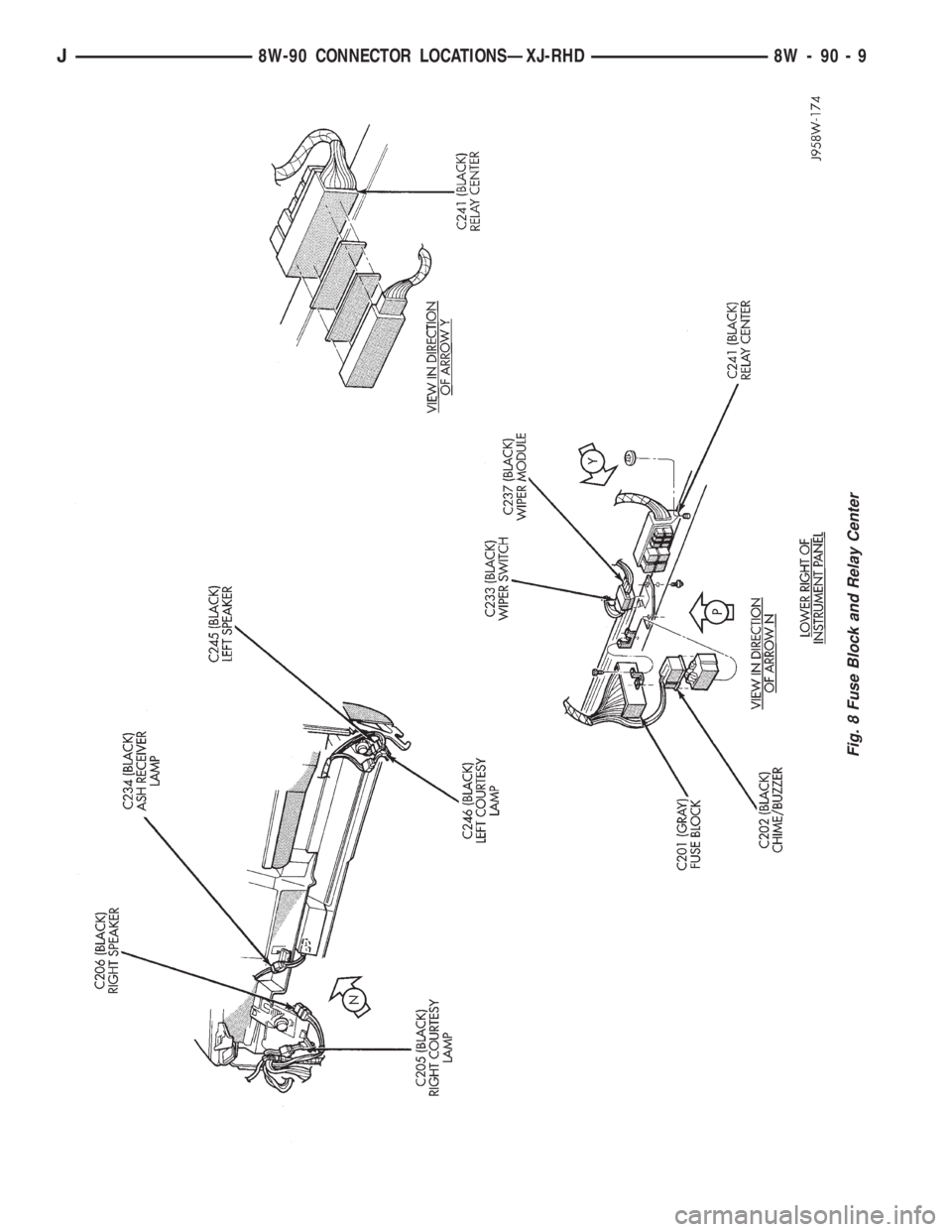
Fig. 8 Fuse Block and Relay Center
J8W-90 CONNECTOR LOCATIONSÐXJ-RHD 8W - 90 - 9
Page 1543 of 2198
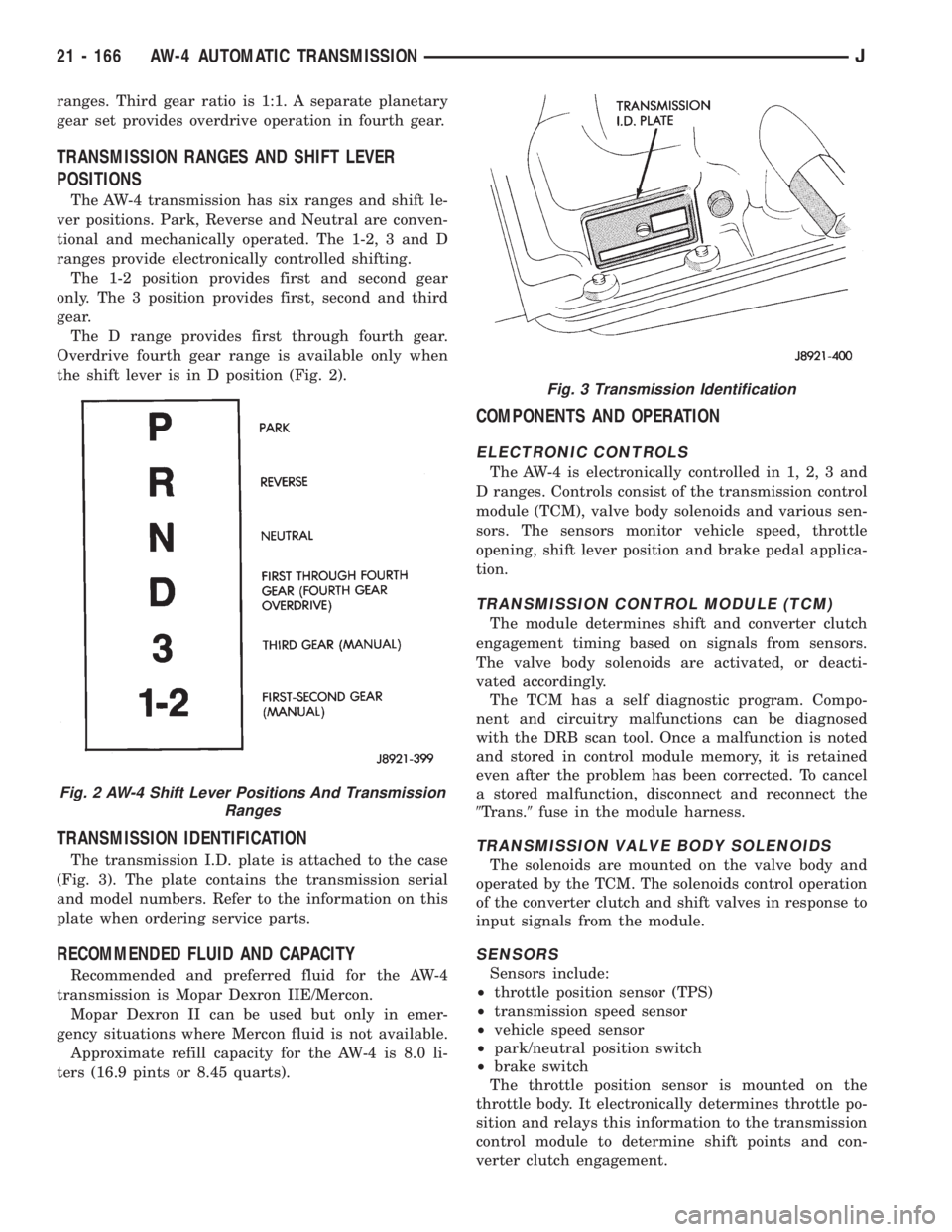
ranges. Third gear ratio is 1:1. A separate planetary
gear set provides overdrive operation in fourth gear.
TRANSMISSION RANGES AND SHIFT LEVER
POSITIONS
The AW-4 transmission has six ranges and shift le-
ver positions. Park, Reverse and Neutral are conven-
tional and mechanically operated. The 1-2, 3 and D
ranges provide electronically controlled shifting.
The 1-2 position provides first and second gear
only. The 3 position provides first, second and third
gear.
The D range provides first through fourth gear.
Overdrive fourth gear range is available only when
the shift lever is in D position (Fig. 2).
TRANSMISSION IDENTIFICATION
The transmission I.D. plate is attached to the case
(Fig. 3). The plate contains the transmission serial
and model numbers. Refer to the information on this
plate when ordering service parts.
RECOMMENDED FLUID AND CAPACITY
Recommended and preferred fluid for the AW-4
transmission is Mopar Dexron IIE/Mercon.
Mopar Dexron II can be used but only in emer-
gency situations where Mercon fluid is not available.
Approximate refill capacity for the AW-4 is 8.0 li-
ters (16.9 pints or 8.45 quarts).
COMPONENTS AND OPERATION
ELECTRONIC CONTROLS
The AW-4 is electronically controlled in 1, 2, 3 and
D ranges. Controls consist of the transmission control
module (TCM), valve body solenoids and various sen-
sors. The sensors monitor vehicle speed, throttle
opening, shift lever position and brake pedal applica-
tion.
TRANSMISSION CONTROL MODULE (TCM)
The module determines shift and converter clutch
engagement timing based on signals from sensors.
The valve body solenoids are activated, or deacti-
vated accordingly.
The TCM has a self diagnostic program. Compo-
nent and circuitry malfunctions can be diagnosed
with the DRB scan tool. Once a malfunction is noted
and stored in control module memory, it is retained
even after the problem has been corrected. To cancel
a stored malfunction, disconnect and reconnect the
9Trans.9fuse in the module harness.
TRANSMISSION VALVE BODY SOLENOIDS
The solenoids are mounted on the valve body and
operated by the TCM. The solenoids control operation
of the converter clutch and shift valves in response to
input signals from the module.
SENSORS
Sensors include:
²throttle position sensor (TPS)
²transmission speed sensor
²vehicle speed sensor
²park/neutral position switch
²brake switch
The throttle position sensor is mounted on the
throttle body. It electronically determines throttle po-
sition and relays this information to the transmission
control module to determine shift points and con-
verter clutch engagement.
Fig. 2 AW-4 Shift Lever Positions And Transmission
Ranges
Fig. 3 Transmission Identification
21 - 166 AW-4 AUTOMATIC TRANSMISSIONJ