filter JEEP CHEROKEE 2014 KL / 5.G User Guide
[x] Cancel search | Manufacturer: JEEP, Model Year: 2014, Model line: CHEROKEE, Model: JEEP CHEROKEE 2014 KL / 5.GPages: 204, PDF Size: 3.84 MB
Page 175 of 204
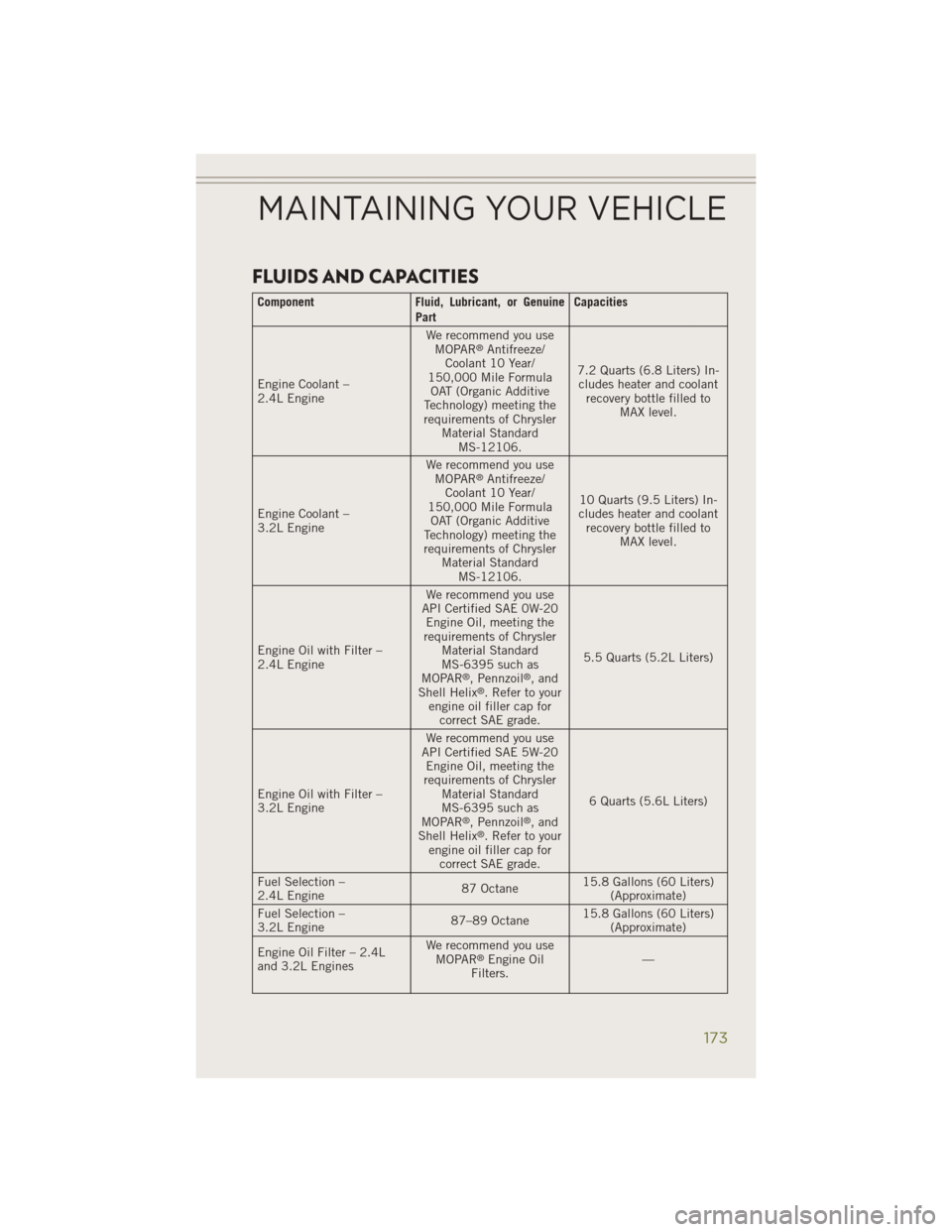
FLUIDS AND CAPACITIES
ComponentFluid, Lubricant, or Genuine
Part Capacities
Engine Coolant –
2.4L Engine We recommend you use
MOPAR
®Antifreeze/
Coolant 10 Year/
150,000 Mile Formula OAT (Organic Additive
Technology) meeting the
requirements of Chrysler Material StandardMS-12106. 7.2 Quarts (6.8 Liters) In-
cludes heater and coolant recovery bottle filled to MAX level.
Engine Coolant –
3.2L Engine We recommend you use
MOPAR
®Antifreeze/
Coolant 10 Year/
150,000 Mile Formula OAT (Organic Additive
Technology) meeting the
requirements of Chrysler Material StandardMS-12106. 10 Quarts (9.5 Liters) In-
cludes heater and coolant recovery bottle filled to MAX level.
Engine Oil with Filter –
2.4L Engine We recommend you use
API Certified SAE 0W-20 Engine Oil, meeting the
requirements of Chrysler Material Standard
MS-6395 such as
MOPAR
®, Pennzoil®,and
Shell Helix®. Refer to your
engine oil filler cap for correct SAE grade. 5.5 Quarts (5.2L Liters)
Engine Oil with Filter –
3.2L Engine We recommend you use
API Certified SAE 5W-20 Engine Oil, meeting the
requirements of Chrysler Material Standard
MS-6395 such as
MOPAR
®, Pennzoil®,and
Shell Helix®. Refer to your
engine oil filler cap for correct SAE grade. 6 Quarts (5.6L Liters)
Fuel Selection –
2.4L Engine 87 Octane15.8 Gallons (60 Liters)
(Approximate)
Fuel Selection –
3.2L Engine 87–89 Octane15.8 Gallons (60 Liters)
(Approximate)
Engine Oil Filter – 2.4L
and 3.2L Engines We recommend you use
MOPAR
®Engine Oil
Filters. —
MAINTAINING YOUR VEHICLE
173
Page 178 of 204
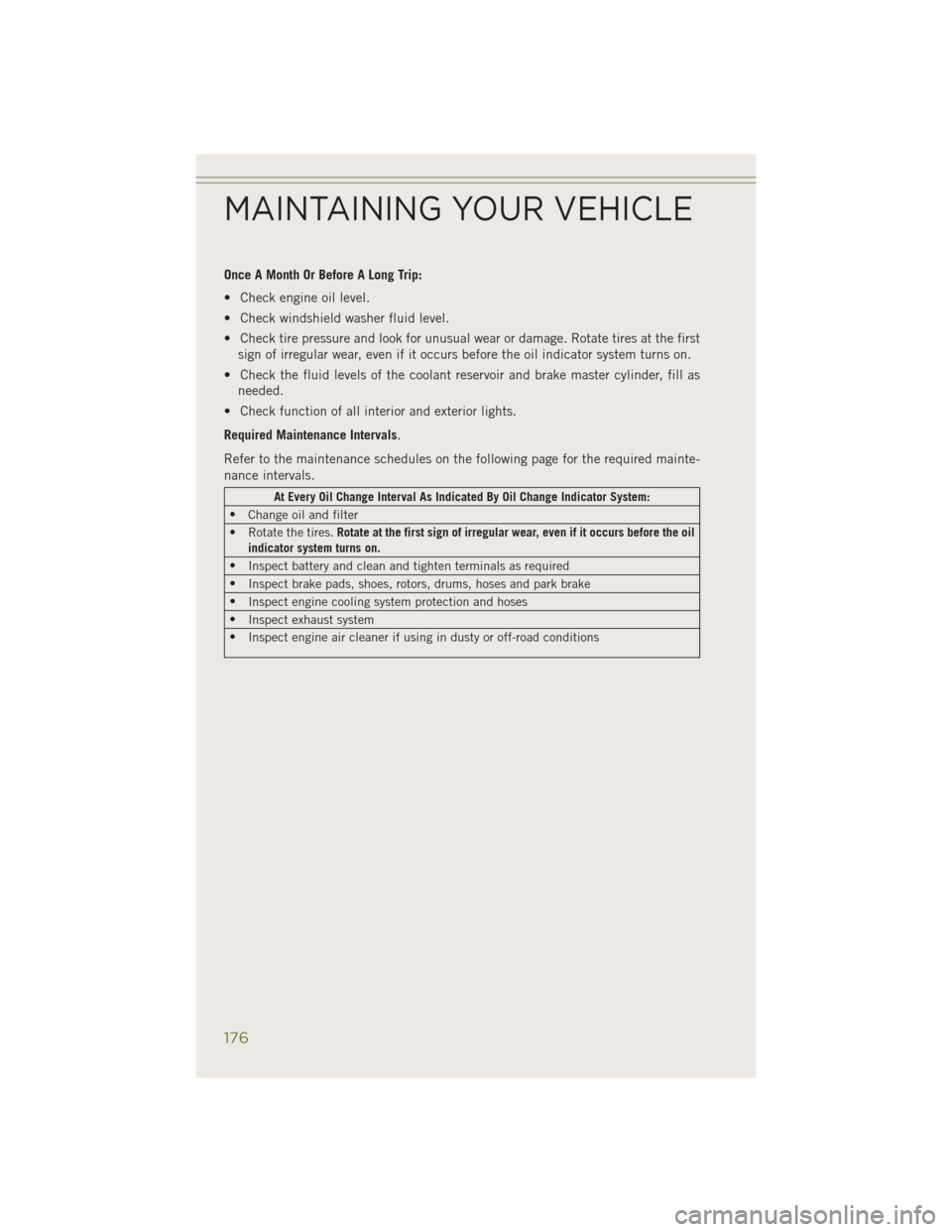
Once A Month Or Before A Long Trip:
• Check engine oil level.
• Check windshield washer fluid level.
• Check tire pressure and look for unusual wear or damage. Rotate tires at the firstsign of irregular wear, even if it occurs before the oil indicator system turns on.
• Check the fluid levels of the coolant reservoir and brake master cylinder, fill as needed.
• Check function of all interior and exterior lights.
Required Maintenance Intervals.
Refer to the maintenance schedules on the following page for the required mainte-
nance intervals.
At Every Oil Change Interval As Indicated By Oil Change Indicator System:
• Change oil and filter
• Rotate the tires. Rotate at the first sign of irregular wear, even if it occurs before the oil
indicator system turns on.
• Inspect battery and clean and tighten terminals as required
• Inspect brake pads, shoes, rotors, drums, hoses and park brake
• Inspect engine cooling system protection and hoses
• Inspect exhaust system
• Inspect engine air cleaner if using in dusty or off-road conditions
MAINTAINING YOUR VEHICLE
176
Page 179 of 204
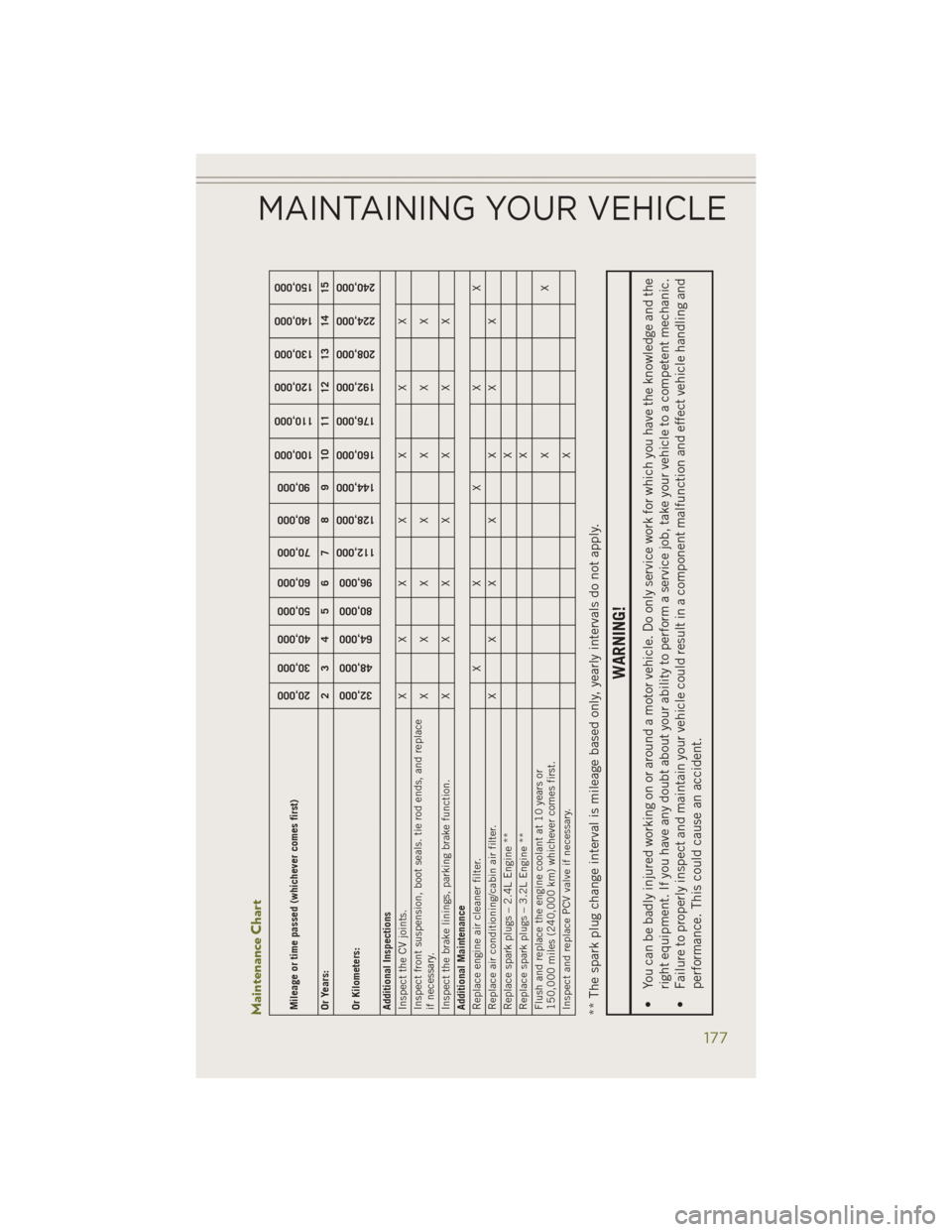
Maintenance ChartMileage or time passed (whichever comes first)
20,000
30,000
40,000
50,000
60,000
70,000
80,000
90,000
100,000
110,000
120,000
130,000
140,000
150,000
Or Years: 2 3 4 5 6 7 8 9 10 11 12 13 14 15
Or Kilometers:
32,000
48,000
64,000
80,000
96,000
112,000
128,000
144,000
160,000
176,000
192,000
208,000
224,000
240,000
Additional Inspections
Inspect the CV joints. X X XXX XX
Inspect front suspension, boot seals. tie rod ends, and replace
if necessary. XXX X X X X
Inspect the brake linings, parking brake function. X X XXX XX
Additional Maintenance
Replace engine air cleaner filter. XX X XX
Replace air conditioning/cabin air filter. X X XXX XX
Replace spark plugs – 2.4L Engine ** X
Replace spark plugs – 3.2L Engine ** X
Flush and replace the engine coolant at 10 years or
150,000 miles (240,000 km) whichever comes first. XX
Inspect and replace PCV valve if necessary. X** The spark plug change interval is mileage based only, yearly intervals do not apply.
WARNING!
• You can be badly injured working on or around a motor vehicle. Do only service work for which you have the knowledge and the
right equipment. If you have any doubt about your ability to perform a service job, take your vehicle to a competent mechanic.
• Failure to properly inspect and maintain your vehicle could result in a component malfunction and effect vehicle handling and
performance. This could cause an accident.
MAINTAINING YOUR VEHICLE
177