trailer JEEP CHEROKEE 2015 KL / 5.G User Guide
[x] Cancel search | Manufacturer: JEEP, Model Year: 2015, Model line: CHEROKEE, Model: JEEP CHEROKEE 2015 KL / 5.GPages: 772, PDF Size: 18.21 MB
Page 357 of 772
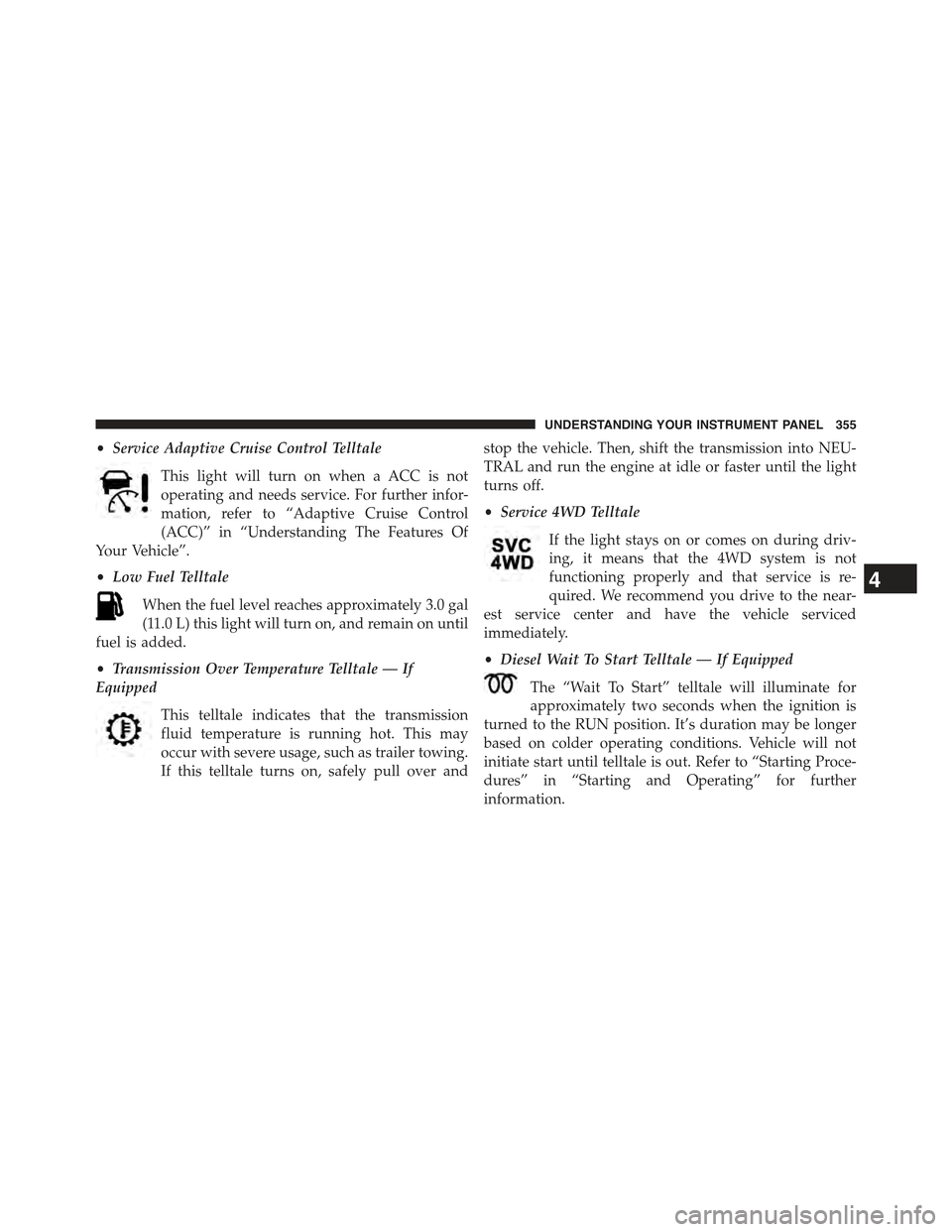
•Service Adaptive Cruise Control Telltale
This light will turn on when a ACC is not
operating and needs service. For further infor-
mation, refer to “Adaptive Cruise Control
(ACC)” in “Understanding The Features Of
Your Vehicle”.
•Low Fuel Telltale
When the fuel level reaches approximately 3.0 gal
(11.0 L) this light will turn on, and remain on until
fuel is added.
•Transmission Over Temperature Telltale — If
Equipped
This telltale indicates that the transmission
fluid temperature is running hot. This may
occur with severe usage, such as trailer towing.
If this telltale turns on, safely pull over and
stop the vehicle. Then, shift the transmission into NEU-
TRAL and run the engine at idle or faster until the light
turns off.
•Service 4WD Telltale
If the light stays on or comes on during driv-
ing, it means that the 4WD system is not
functioning properly and that service is re-
quired. We recommend you drive to the near-
est service center and have the vehicle serviced
immediately.
•Diesel Wait To Start Telltale — If Equipped
The “Wait To Start” telltale will illuminate for
approximately two seconds when the ignition is
turned to the RUN position. It’s duration may be longer
based on colder operating conditions. Vehicle will not
initiate start until telltale is out. Refer to “Starting Proce-
dures” in “Starting and Operating” for further
information.
4
UNDERSTANDING YOUR INSTRUMENT PANEL 355
Page 370 of 772
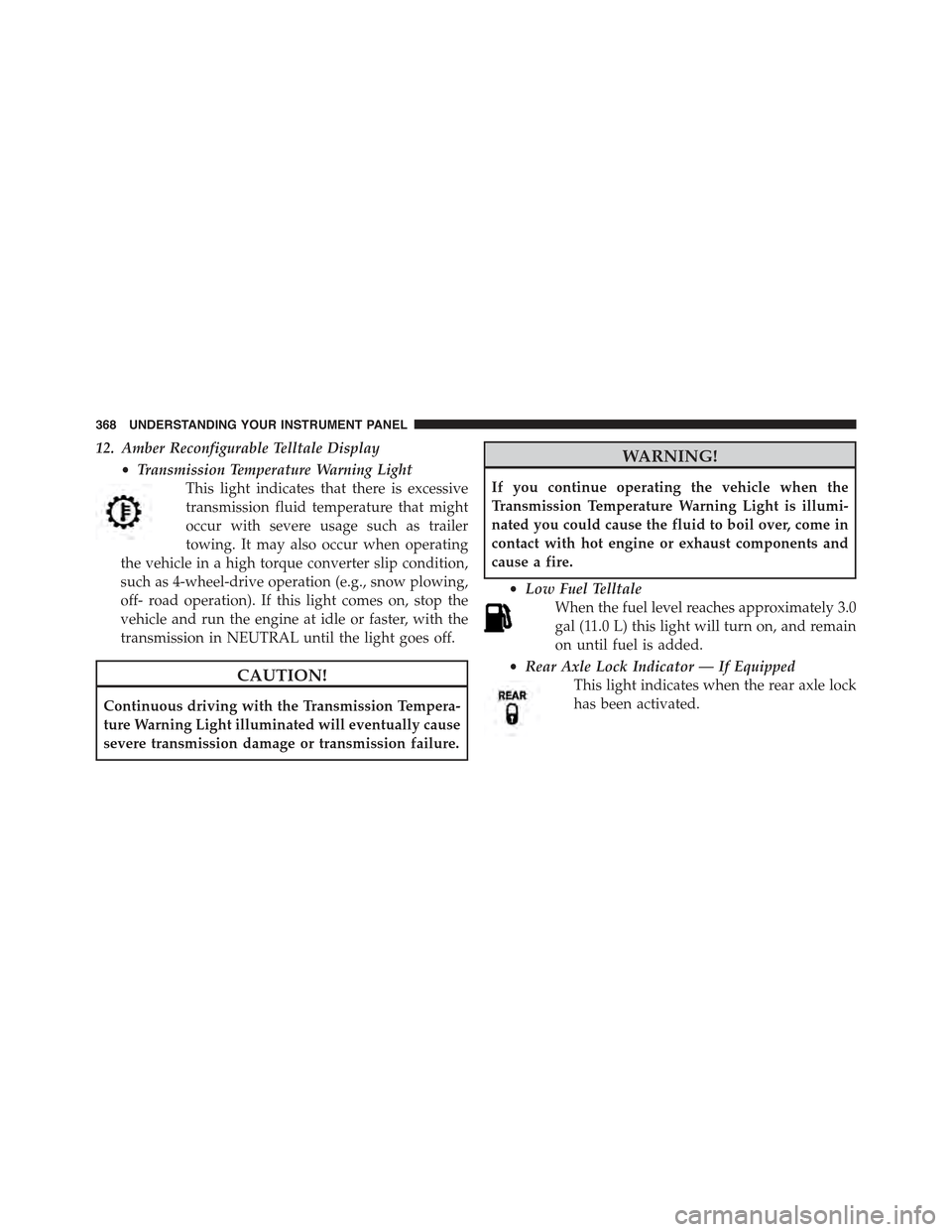
12. Amber Reconfigurable Telltale Display
•Transmission Temperature Warning Light
This light indicates that there is excessive
transmission fluid temperature that might
occur with severe usage such as trailer
towing. It may also occur when operating
the vehicle in a high torque converter slip condition,
such as 4-wheel-drive operation (e.g., snow plowing,
off- road operation). If this light comes on, stop the
vehicle and run the engine at idle or faster, with the
transmission in NEUTRAL until the light goes off.
CAUTION!
Continuous driving with the Transmission Tempera-
ture Warning Light illuminated will eventually cause
severe transmission damage or transmission failure.
WARNING!
If you continue operating the vehicle when the
Transmission Temperature Warning Light is illumi-
nated you could cause the fluid to boil over, come in
contact with hot engine or exhaust components and
cause a fire.
•Low Fuel Telltale
When the fuel level reaches approximately 3.0
gal (11.0 L) this light will turn on, and remain
on until fuel is added.
•Rear Axle Lock Indicator — If Equipped
This light indicates when the rear axle lock
has been activated.
368 UNDERSTANDING YOUR INSTRUMENT PANEL
Page 372 of 772
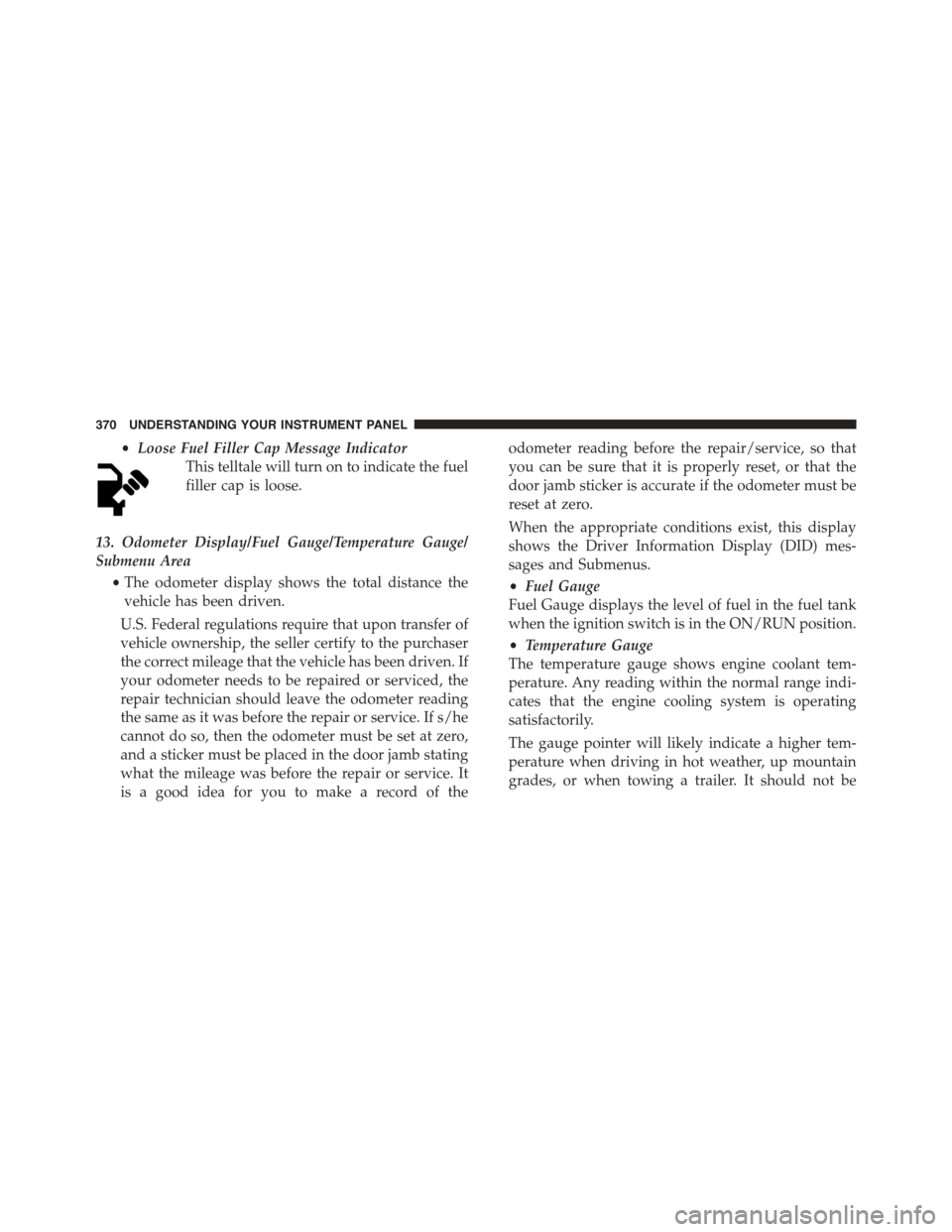
•Loose Fuel Filler Cap Message Indicator
This telltale will turn on to indicate the fuel
filler cap is loose.
13. Odometer Display/Fuel Gauge/Temperature Gauge/
Submenu Area
•The odometer display shows the total distance the
vehicle has been driven.
U.S. Federal regulations require that upon transfer of
vehicle ownership, the seller certify to the purchaser
the correct mileage that the vehicle has been driven. If
your odometer needs to be repaired or serviced, the
repair technician should leave the odometer reading
the same as it was before the repair or service. If s/he
cannot do so, then the odometer must be set at zero,
and a sticker must be placed in the door jamb stating
what the mileage was before the repair or service. It
is a good idea for you to make a record of the
odometer reading before the repair/service, so that
you can be sure that it is properly reset, or that the
door jamb sticker is accurate if the odometer must be
reset at zero.
When the appropriate conditions exist, this display
shows the Driver Information Display (DID) mes-
sages and Submenus.
•Fuel Gauge
Fuel Gauge displays the level of fuel in the fuel tank
when the ignition switch is in the ON/RUN position.
•Temperature Gauge
The temperature gauge shows engine coolant tem-
perature. Any reading within the normal range indi-
cates that the engine cooling system is operating
satisfactorily.
The gauge pointer will likely indicate a higher tem-
perature when driving in hot weather, up mountain
grades, or when towing a trailer. It should not be
370 UNDERSTANDING YOUR INSTRUMENT PANEL
Page 380 of 772
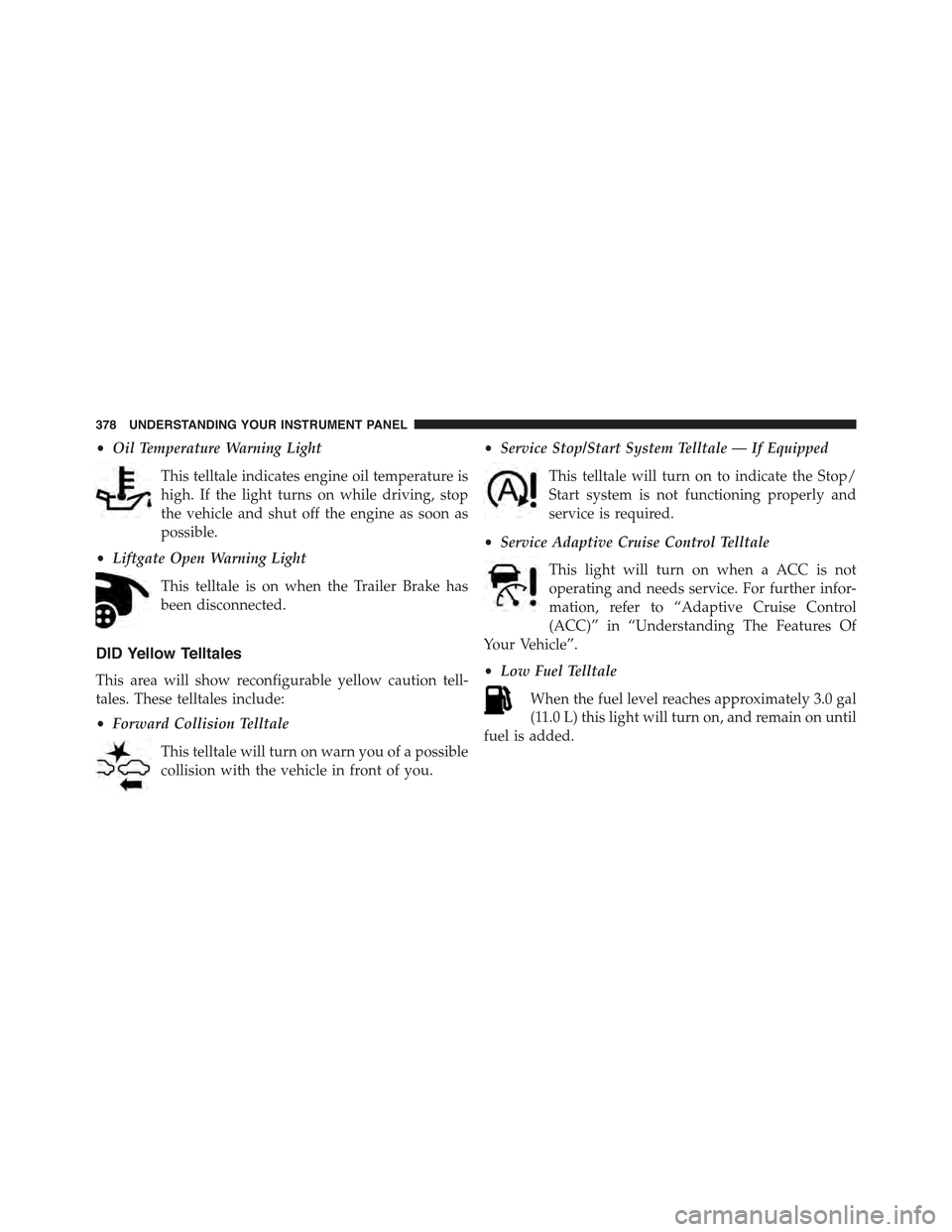
•Oil Temperature Warning Light
This telltale indicates engine oil temperature is
high. If the light turns on while driving, stop
the vehicle and shut off the engine as soon as
possible.
•Liftgate Open Warning Light
This telltale is on when the Trailer Brake has
been disconnected.
DID Yellow Telltales
This area will show reconfigurable yellow caution tell-
tales. These telltales include:
•Forward Collision Telltale
This telltale will turn on warn you of a possible
collision with the vehicle in front of you.
•Service Stop/Start System Telltale — If Equipped
This telltale will turn on to indicate the Stop/
Start system is not functioning properly and
service is required.
•Service Adaptive Cruise Control Telltale
This light will turn on when a ACC is not
operating and needs service. For further infor-
mation, refer to “Adaptive Cruise Control
(ACC)” in “Understanding The Features Of
Your Vehicle”.
•Low Fuel Telltale
When the fuel level reaches approximately 3.0 gal
(11.0 L) this light will turn on, and remain on until
fuel is added.
378 UNDERSTANDING YOUR INSTRUMENT PANEL
Page 381 of 772
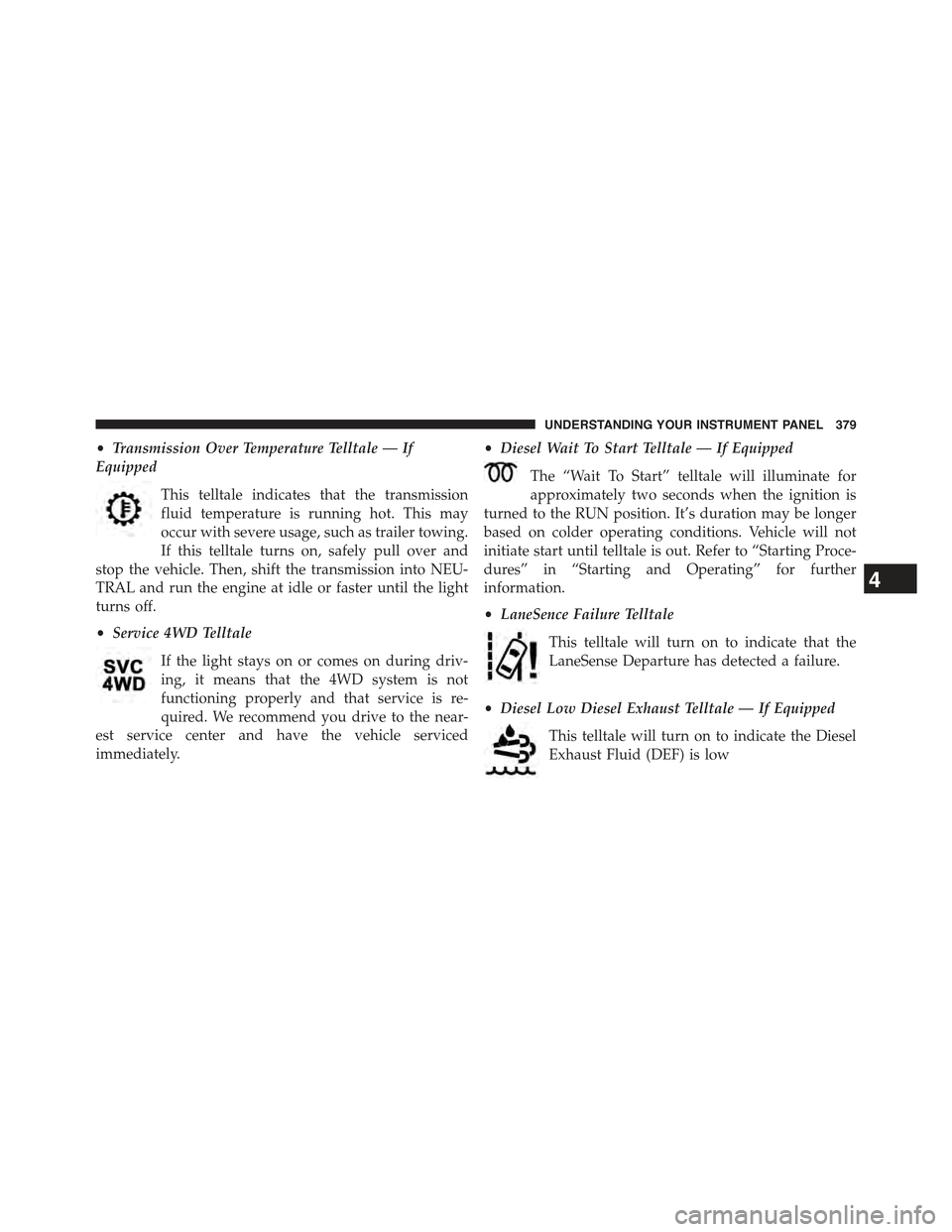
•Transmission Over Temperature Telltale — If
Equipped
This telltale indicates that the transmission
fluid temperature is running hot. This may
occur with severe usage, such as trailer towing.
If this telltale turns on, safely pull over and
stop the vehicle. Then, shift the transmission into NEU-
TRAL and run the engine at idle or faster until the light
turns off.
•Service 4WD Telltale
If the light stays on or comes on during driv-
ing, it means that the 4WD system is not
functioning properly and that service is re-
quired. We recommend you drive to the near-
est service center and have the vehicle serviced
immediately.
•Diesel Wait To Start Telltale — If Equipped
The “Wait To Start” telltale will illuminate for
approximately two seconds when the ignition is
turned to the RUN position. It’s duration may be longer
based on colder operating conditions. Vehicle will not
initiate start until telltale is out. Refer to “Starting Proce-
dures” in “Starting and Operating” for further
information.
•LaneSence Failure Telltale
This telltale will turn on to indicate that the
LaneSense Departure has detected a failure.
•Diesel Low Diesel Exhaust Telltale — If Equipped
This telltale will turn on to indicate the Diesel
Exhaust Fluid (DEF) is low
4
UNDERSTANDING YOUR INSTRUMENT PANEL 379
Page 471 of 772
!BRAKE SYSTEM.......................518
!ELECTRONIC BRAKE CONTROL SYSTEM . . . .519
▫Anti-Lock Brake System................519
▫Traction Control System (TCS)............521
▫Brake Assist System (BAS)...............522
▫Electronic Roll Mitigation (ERM)..........523
▫Hill Start Assist (HSA).................523
▫Hill Descent Control (HDC) — If Equipped . . .526
▫Selec Speed Control (SSC) — If Equipped . . . .530
▫Electronic Stability Control (ESC)..........533
▫ESC Activation/Malfunction Indicator Light And
ESC OFF Indicator Light................538
▫Trailer Sway Control (TSC)...............539
▫Ready Alert Braking (RAB)...............540
▫Rain Brake Support (RBS)................540
!TIRE SAFETY INFORMATION.............540
▫Tire Markings........................540
▫Tire Identification Number (TIN)...........544
▫Tire Terminology And Definitions..........546
▫Tire Loading And Tire Pressure...........547
!TIRES — GENERAL INFORMATION........552
▫Tire Pressure........................552
▫Tire Inflation Pressures.................553
▫Tire Pressures For High Speed Operation . . . .555
▫Radial Ply Tires......................555
▫Tire Types...........................556
5
STARTING AND OPERATING 469
Page 473 of 772
▫Starting............................587
▫Cruising Range.......................587
▫Replacement Parts....................588
▫Maintenance........................588
!ADDING FUEL........................588
▫Emergency Fuel Filler Door Release.........590
▫Loose Fuel Filler Cap Message............590
!VEHICLE LOADING....................591
▫Certification Label....................591
!TRAILER TOWING.....................593
▫Common Towing Definitions.............593
▫Trailer Hitch Classification...............597
▫Trailer Towing Weights (Maximum Trailer Weight
Ratings)............................598
▫Trailer And Tongue Weight..............599
▫Towing Requirements..................600
▫Towing Tips.........................605
!RECREATIONAL TOWING (BEHIND
MOTORHOME, ETC.)...................606
▫Towing This Vehicle Behind Another Vehicle . .606
▫Recreational Towing — Front-Wheel Drive (FWD)
Models............................606
▫Recreational Towing — 4X4 Models With 1-Speed
Power Transfer Unit....................607
▫Recreational Towing — 4X4 Models With 2-Speed
Power Transfer Unit....................607
5
STARTING AND OPERATING 471
Page 492 of 772
WARNING!
Do not coast in NEUTRAL and never turn off the
ignition to coast down a hill. These are unsafe
practices that limit your response to changing traffic
or road conditions. You might lose control of the
vehicle and have a collision.
CAUTION!
Towing the vehicle, coasting, or driving for any other
reason with the transmission in NEUTRAL can cause
severe transmission damage. Refer to “Recreational
Towing” in “Starting And Operating” and “Towing A
Disabled Vehicle” in “What To Do In Emergencies”
for further information.
DRIVE (D)
This range should be used for most city and highway
driving. It provides the smoothest upshifts and down-
shifts, and the best fuel economy. The transmission
automatically upshifts through all forward gears. The
DRIVE position provides optimum driving characteris-
tics under all normal operating conditions.
When frequent transmission shifting occurs (such as
when operating the vehicle under heavy loading condi-
tions, in hilly terrain, traveling into strong head winds, or
while towing heavy trailers), use the Electronic Range
Select (ERS) shift control (refer to#Electronic Range Select
(ERS) Operation#in this section for further information)
to select a lower gear range. Under these conditions,
using a lower gear range will improve performance and
extend transmission life by reducing excessive shifting
and heat buildup.
490 STARTING AND OPERATING
Page 521 of 772
ELECTRONIC BRAKE CONTROL SYSTEM
Your vehicle is equipped with an advanced electronic
brake control system commonly referred to as ESC. This
system includes Anti-Lock Brake System (ABS), Traction
Control System (TCS), Brake Assist System (BAS), Hill
Start Assist (HSA), Electronic Roll Mitigation (ERM), and
Electronic Stability Control (ESC). These systems work
together to enhance both vehicle stability and control in
various driving conditions.
Your vehicle is also equipped with Trailer Sway Control
(TSC), Ready Alert Braking (RAB) and Rain Brake Sup-
port (RBS). Further, all vehicles equipped with a two-
speed power transfer unit have Hill Descent Control
(HDC) and some vehicles may also be equipped with
Selec Speed Control (SSC).
Anti-Lock Brake System
The Anti-Lock Brake System (ABS) is designed to aid the
driver in maintaining vehicle control under adverse
braking conditions. The system operates with a separate
computer to modulate hydraulic pressure, to prevent
wheel lock-up and help avoid skidding on slippery
surfaces.
All vehicle wheels and tires must be the same size and
type, and tires must be properly inflated, to produce
accurate signals for the computer.
WARNING!
Significant over or under-inflation of tires or mixing
sizes of tires or wheels on the vehicle can lead to loss
of braking effectiveness.
The ABS conducts a low-speed self-test at about 12 mph
(20 km/h). If you have your foot lightly on the brake
while this test is occurring, you may feel slight pedal
movement. The movement can be more apparent on ice
and snow. This is normal.
5
STARTING AND OPERATING 519
Page 526 of 772
time expires, the system will release brake pressure and
the vehicle will roll down the hill as normal. The system
will release brake pressure in proportion to amount of
throttle applied.
The following conditions must be met in order for HSA to
activate:
•The vehicle must be stopped.
•The vehicle must be on a 7% (approximate) grade or
greater hill.
•The gear selection must match vehicle uphill direction
(i.e., vehicle facing uphill is in forward gear; vehicle
backing uphill is in REVERSE gear).
•For vehicles equipped with an automatic transmission,
the HSA will work in REVERSE gear and all forward
gears. The system will not activate if the transmission
is in PARK.
WARNING!
There may be situations where the Hill Start Assist
(HSA) will not activate and slight rolling may occur,
such as on minor hills or with a loaded vehicle, or
while pulling a trailer. HSA is not a substitute for
active driving involvement. It is always the driver ’s
responsibility to be attentive to distance to other
vehicles, people, and objects, and most importantly
brake operation to ensure safe operation of the ve-
hicle under all road conditions. Your complete atten-
tion is always required while driving to maintain
safe control of your vehicle. Failure to follow these
warnings can result in a collision or serious personal
injury.
524 STARTING AND OPERATING