neutral JEEP CHEROKEE 2015 KL / 5.G Owner's Manual
[x] Cancel search | Manufacturer: JEEP, Model Year: 2015, Model line: CHEROKEE, Model: JEEP CHEROKEE 2015 KL / 5.GPages: 772, PDF Size: 18.21 MB
Page 498 of 772
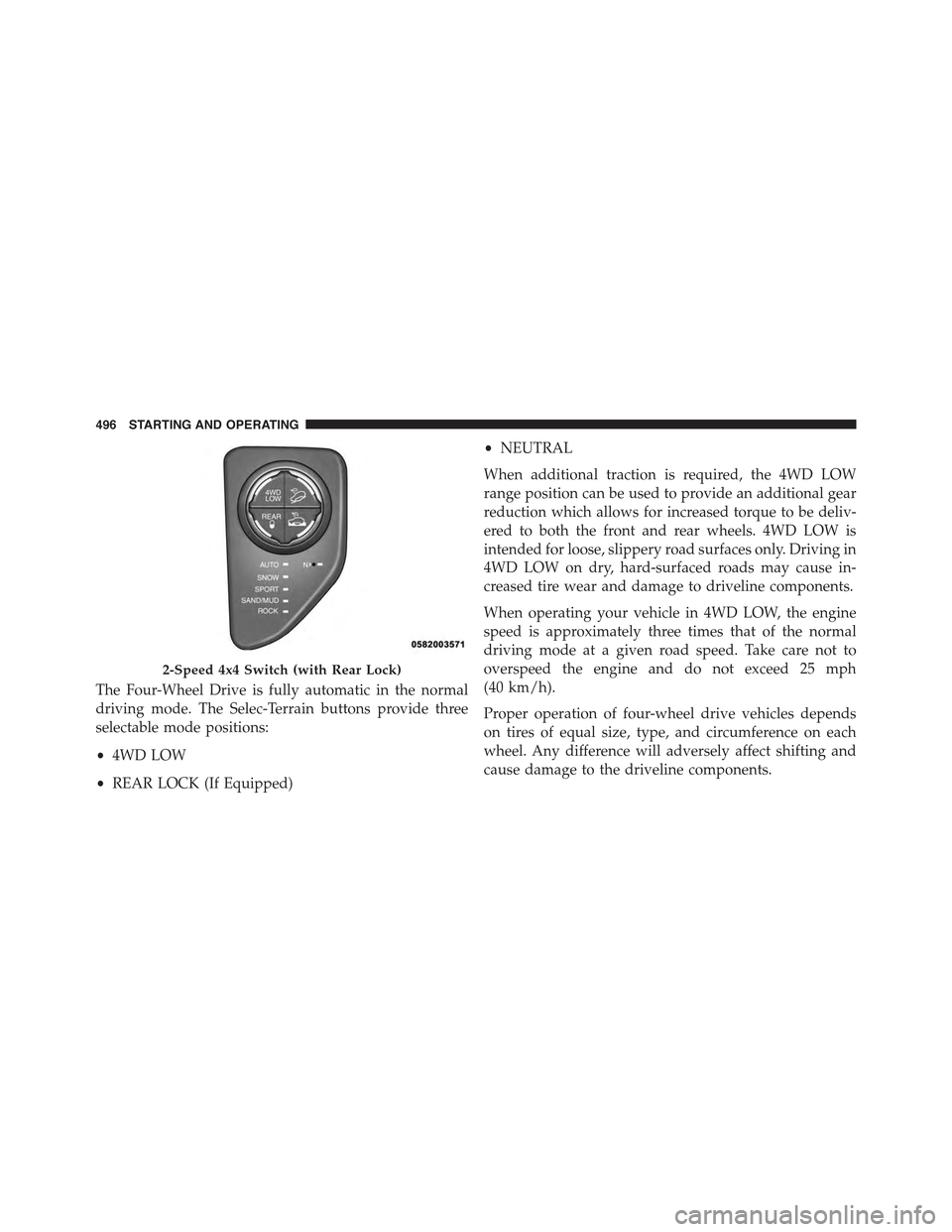
The Four-Wheel Drive is fully automatic in the normal
driving mode. The Selec-Terrain buttons provide three
selectable mode positions:
•4WD LOW
•REAR LOCK (If Equipped)
•NEUTRAL
When additional traction is required, the 4WD LOW
range position can be used to provide an additional gear
reduction which allows for increased torque to be deliv-
ered to both the front and rear wheels. 4WD LOW is
intended for loose, slippery road surfaces only. Driving in
4WD LOW on dry, hard-surfaced roads may cause in-
creased tire wear and damage to driveline components.
When operating your vehicle in 4WD LOW, the engine
speed is approximately three times that of the normal
driving mode at a given road speed. Take care not to
overspeed the engine and do not exceed 25 mph
(40 km/h).
Proper operation of four-wheel drive vehicles depends
on tires of equal size, type, and circumference on each
wheel. Any difference will adversely affect shifting and
cause damage to the driveline components.
2-Speed 4x4 Switch (with Rear Lock)
496 STARTING AND OPERATING
Page 499 of 772
Because four-wheel drive provides improved traction,
there is a tendency to exceed safe turning and stopping
speeds. Do not go faster than road conditions permit.
Shift Positions
For additional information on the appropriate use of each
4WD system mode position, see the information below:
NEUTRAL
This range disengages the driveline from the powertrain.
It is to be used for flat towing behind another vehicle.
Refer to “Recreational Towing” in “Starting and Operat-
ing” for further information.
WARNING!
You or others could be injured or killed if you leave
the vehicle unattended with the power transfer unit
(Continued)
WARNING!(Continued)
in the NEUTRAL (N) position without first fully
engaging the parking brake. The NEUTRAL (N)
position disengages both the front and rear drive
shafts from the powertrain and will allow the vehicle
to roll, even if the transmission is in PARK. The
parking brake should always be applied when the
driver is not in the vehicle.
4WD LOW
This range is for low speed four-wheel drive. It provides
an additional gear reduction which allows for increased
torque to be delivered to both the front and rear wheels
while providing maximum pulling power for loose,
slippery road surfaces only. Do not exceed 25 mph
(40 km/h).
5
STARTING AND OPERATING 497
Page 500 of 772
NOTE:Refer to “Selec-Terrain® – If Equipped” for fur-
ther information on the various positions and their
intended usages.
Shifting Procedures
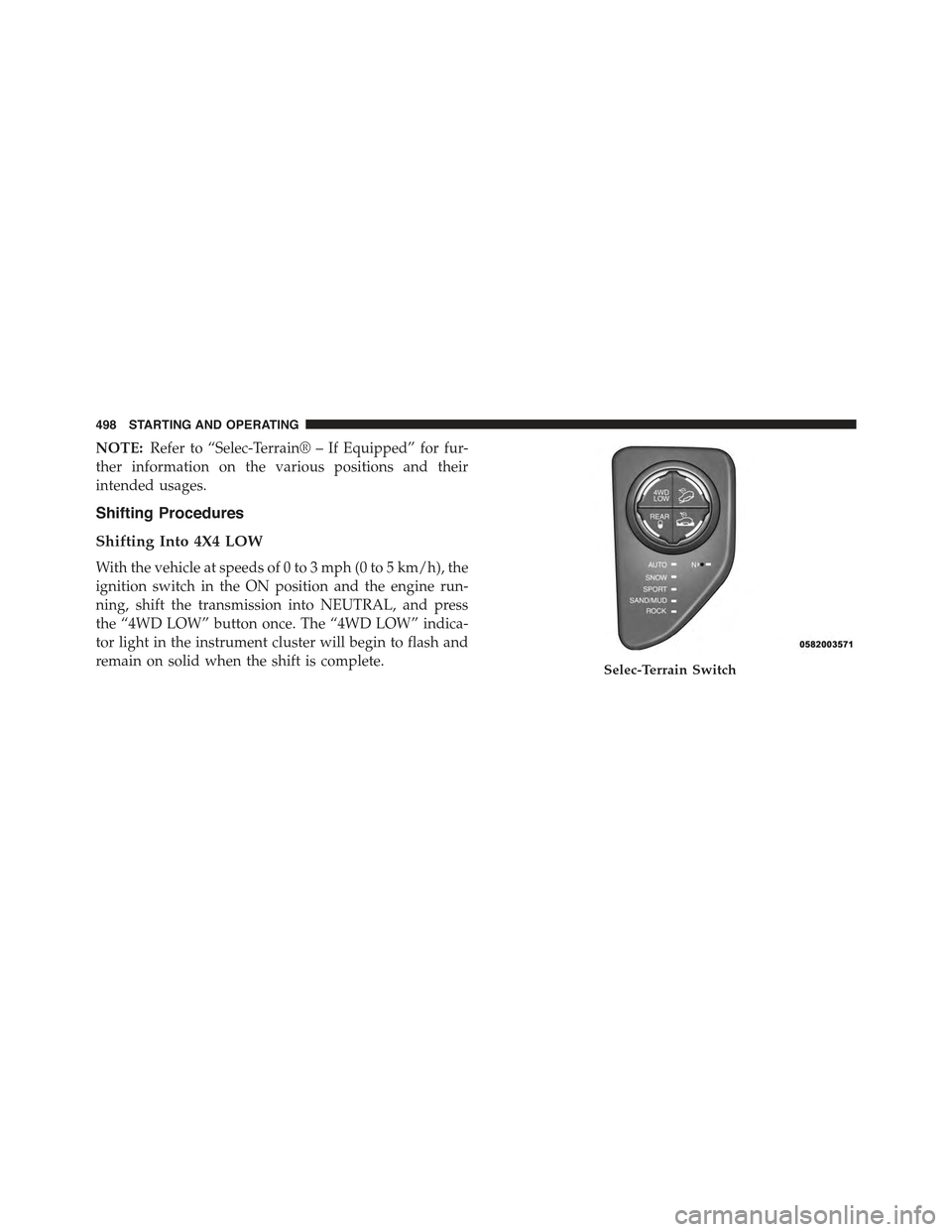
Shifting Into 4X4 LOW
With the vehicle at speeds of 0 to 3 mph (0 to 5 km/h), the
ignition switch in the ON position and the engine run-
ning, shift the transmission into NEUTRAL, and press
the “4WD LOW” button once. The “4WD LOW” indica-
tor light in the instrument cluster will begin to flash and
remain on solid when the shift is complete.Selec-Terrain Switch
498 STARTING AND OPERATING
Page 501 of 772
NOTE:If shift conditions/interlocks are not met a mes-
sage will flash from the Electronic Vehicle Information
Center (EVIC)/Driver Information Display (DID) with
instructions on how to complete the requested shift.
Refer to “Electronic Vehicle Information Center (EVIC)/
Driver Information Display (DID) in “Understanding
Your Instrument Panel” for further information.
Shifting Out Of 4X4 LOW
With the vehicle at speeds of 0 to 3 mph (0 to 5 km/h), the
ignition switch in the ON position and the engine run-
ning, shift the transmission into NEUTRAL, and press
the “4WD LOW” button once. The “4WD LOW” indica-
tor light in the instrument cluster will flash and go out
when the shift is complete.
NOTE:
•If shift conditions/interlocks are not met, a message
will flash from the Electronic Vehicle Information
Center (EVIC)/Driver Information Display (DID) with
instructions on how to complete the requested shift.
Refer to “Electronic Vehicle Information Center
(EVIC)/Driver Information Display (DID) in “Under-
standing Your Instrument Panel” for further informa-
tion.
•Shifting into or out of 4WD LOW is possible with the
vehicle completely stopped; however, difficulty may
occur due to the mating clutch teeth not being prop-
erly aligned. Several attempts may be required for
clutch teeth alignment and shift completion to occur.
The preferred method is with the vehicle rolling 0 to
3 mph (0 to 5 km/h). If the vehicle is moving faster
than 3 mph (5 km/h), the 4WD system will not allow
the shift.
5
STARTING AND OPERATING 499
Page 502 of 772
NEUTRAL Shift Procedure
WARNING!
You or others could be injured or killed if you leave
the vehicle unattended with the power transfer unit
in the NEUTRAL (N) position without first fully
engaging the parking brake. The NEUTRAL (N)
position disengages both the front and rear drive
shafts from the powertrain and will allow the vehicle
to roll, even if the transmission is in PARK. The
parking brake should always be applied when the
driver is not in the vehicle.
1. Bring the vehicle to a complete stop and shift the
transmission to PARK.
2. Turn the engine OFF.
3. Turn the ignition switch to the ON/RUN position, but
do not start the engine.
4. Press and hold the brake pedal.
5. Shift the transmission into NEUTRAL.
6. Using a ballpoint pen or similar object, press and hold
the recessed power transfer unit NEUTRAL (N) button
(located by the selector switch) for four seconds. The
light behind the NEUTRAL (N) symbol will blink,
indicating shift in progress. The light will stop blink-
ing (stay on solid) when the shift to NEUTRAL (N) is
complete.
500 STARTING AND OPERATING
Page 503 of 772
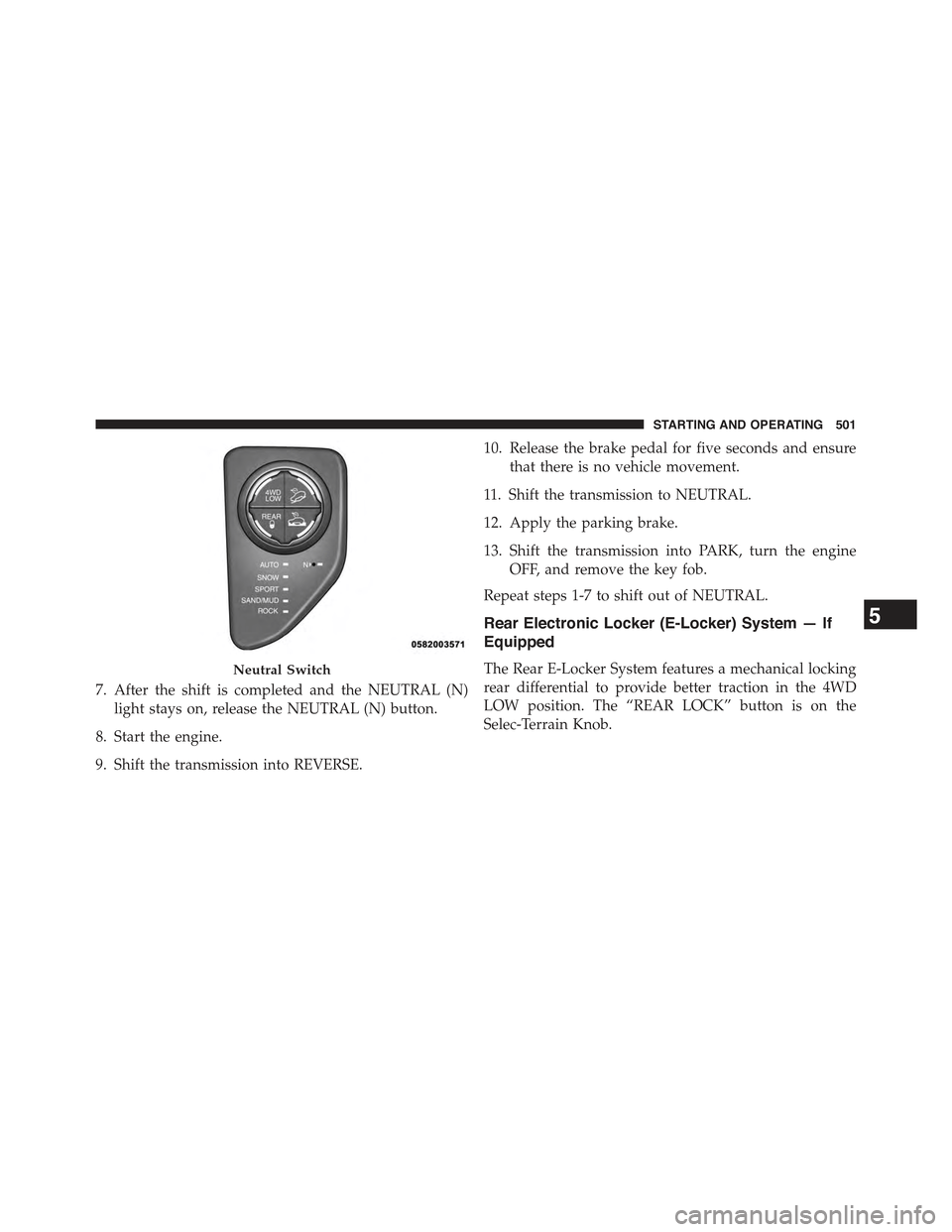
7. After the shift is completed and the NEUTRAL (N)
light stays on, release the NEUTRAL (N) button.
8. Start the engine.
9. Shift the transmission into REVERSE.
10. Release the brake pedal for five seconds and ensure
that there is no vehicle movement.
11. Shift the transmission to NEUTRAL.
12. Apply the parking brake.
13. Shift the transmission into PARK, turn the engine
OFF, and remove the key fob.
Repeat steps 1-7 to shift out of NEUTRAL.
Rear Electronic Locker (E-Locker) System — If
Equipped
The Rear E-Locker System features a mechanical locking
rear differential to provide better traction in the 4WD
LOW position. The “REAR LOCK” button is on the
Selec-Terrain Knob.
Neutral Switch
5
STARTING AND OPERATING 501
Page 510 of 772
WARNING!
If the engine stalls or you lose headway or cannot
make it to the top of a steep hill or grade, never
attempt to turn around. To do so may result in
tipping and rolling the vehicle. Always back straight
down a hill in REVERSE gear carefully. Never back
down a hill in NEUTRAL using only the brake.
Remember, never drive diagonally across a hill - drive
straight up or down.
If the wheels start to slip as you approach the crest of a
hill, ease off the accelerator and maintain headway by
turning the front wheels slowly left and right. This may
provide a fresh “bite” into the surface and will usually
provide traction to complete the climb.
Traction Downhill
Shift the transmission into a low gear and the 4WD
System to 4WD LOW range or Select Hill Descent
Control if equipped (refer to#Electronic Brake Control
System#in this section for further information). Let the
vehicle go slowly down the hill with all four wheels
turning against engine compression drag. This will per-
mit you to control the vehicle speed and direction.
When descending mountains or hills, repeated braking
can cause brake fade with loss of braking control. Avoid
repeated heavy braking by downshifting the transmis-
sion whenever possible.
After Driving Off-Road
Off-road operation puts more stress on your vehicle than
does most on-road driving. After going off-road, it is
always a good idea to check for damage. That way you
can get any problems taken care of right away and have
your vehicle ready when you need it.
508 STARTING AND OPERATING
Page 519 of 772
When servicing your rear brakes, it may be necessary for
you or your technician to push the rear piston into the
rear caliper bore. With the electric parking brake system,
this can only be done after retracting the Electric Parking
Brake actuator. Fortunately, actuator retraction can be
done easily by entering the Brake Service Mode through
the Uconnect® Settings in your vehicle. This menu based
system will guide you through the steps necessary to
retract the EPB actuator in order to perform rear brake
service.
Service Mode has requirements that must be met in order
to be activated:
•The vehicle must be at a standstill.
•The parking brake must be unapplied.
•The transmission must be in Park or Neutral.
While in service mode, the Electric Parking Brake fault lamp
will flash continuously while the ignition switch is ON.
When brake service work is complete, the following steps
must be followed to reset the parking brake system to
normal operation:
•Ensure the vehicle is at a standstill.
•Press the brake pedal with moderate force.
•Apply the Electric Parking Brake Switch.
WARNING!
You can be badly injured working on or around a
motor vehicle. Do only that service work for which
you have the knowledge and the right equipment. If
you have any doubt about your ability to perform a
service job, take your vehicle to a competent me-
chanic.
5
STARTING AND OPERATING 517
Page 533 of 772
Activating SSC
Once SSC is enabled it will activate automatically once
the following conditions are met:
•Driver releases throttle
•Driver releases brake
•Transmission is in any selection other than P
•Vehicle speed is below 20 mph (32 km/h)
The set speed for SSC is selectable by the driver, and can
be adjusted by using the gear shift lever. Additionally, the
SSC set speed is automatically reduced when climbing a
grade and the level of set speed reduction depends on the
magnitude of grade. The following summarizes the SSC
set speeds:
4WD Low Range Set Speeds
•1st = .6 mph (1 km/h)
•2nd = 1.2 mph (2 km/h)
•3rd = 4 mph (3 km/h)
•4th = 2.5 mph (4 km/h)
•5th = 3.1 mph (5 km/h)
•6th = 3.7 mph (6 km/h)
•7th = 4.3 mph (7 km/h)
•8th = 5 mph (8 km/h)
•9th = 5.6 mph (9 km/h)
•REVERSE = .6 mph (1 km/h)
•NEUTRAL = 1.2 mph (2 km/h)
•PARK = SSC remains enabled but not active
5
STARTING AND OPERATING 531
Page 607 of 772
Towing Tips
Before setting out on a trip, practice turning, stopping,
and backing the trailer in an area located away from
heavy traffic.
Automatic Transmission — If Equipped
The DRIVE range can be selected when towing. The
transmission controls include a drive strategy to avoid
frequent shifting when towing. However, if frequent
shifting does occur while in DRIVE, use the Electronic
Range Select (ERS) shift control to select a lower gear
range.
NOTE:Using a lower gear range while operating the
vehicle under heavy loading conditions will improve
performance and extend transmission life by reducing
excessive shifting and heat build up. This action will also
provide better engine braking.
Electronic Speed Control — If Equipped
•Do not use in hilly terrain or with heavy loads.
•When using the speed control, if you experience speed
drops greater than 10 mph (16 km/h), disengage until
you can get back to cruising speed.
•Use speed control in flat terrain and with light loads to
maximize fuel efficiency.
Cooling System
To reduce potential for engine and transmission over-
heating, take the following actions:
City Driving
When stopped for short periods of time, shift the trans-
mission into NEUTRAL and increase engine idle speed.
5
STARTING AND OPERATING 605