oil JEEP CHEROKEE 2015 KL / 5.G Owner's Guide
[x] Cancel search | Manufacturer: JEEP, Model Year: 2015, Model line: CHEROKEE, Model: JEEP CHEROKEE 2015 KL / 5.GPages: 772, PDF Size: 18.21 MB
Page 629 of 772
If the tire pressure is 19 psi (1.3 Bar) or higher:
1. Press the Power Button (4) to turn on Tire Service Kit
and inflate the tire to the pressure indicated on the tire
and loading information label on the driver-side door
opening.
NOTE:If the tire becomes over-inflated, press the Defla-
tion Button to reduce the tire pressure to the recom-
mended inflation pressure before continuing.
2. Disconnect the Tire Service Kit from the valve stem,
reinstall the cap on the valve stem and unplug from 12
Volt outlet.
3. Place the Tire Service Kit in its proper storage area in
the vehicle.
4. Have the tire inspected and repaired or replaced at the
earliest opportunity at an authorized dealer or tire
service center.
5. Remove the Speed Limit sticker from the instrument
panel after the tire has been repaired.
6. Replace the Sealant Bottle (1) and Sealant Hose (6)
assembly at your authorized dealer as soon as pos-
sible. Refer to (F) “Sealant Bottle and Hose Replace-
ment”.
NOTE:When having the tire serviced, advise the autho-
rized dealer or service center that the tire has been sealed
using the Tire Service Kit.
(F) Sealant Bottle And Hose Replacement:
1. Uncoil the Sealant Hose (6) (clear in color).
2. Locate the round Sealant Bottle release button in the
recessed area under the sealant bottle.
6
WHAT TO DO IN EMERGENCIES 627
Page 648 of 772
WARNING!
Fast spinning tires can be dangerous. Forces gener-
ated by excessive wheel speeds may cause damage, or
even failure, of the axle and tires. A tire could
explode and injure someone. Do not spin your vehi-
cle’s wheels faster than 30 mph (48 km/h) or for
longer than 30 seconds continuously without stop-
ping when you are stuck and do not let anyone near
a spinning wheel, no matter what the speed.
RECOVERY STRAP — IF EQUIPPED
Your vehicle may be included with a recovery strap.
Recovery straps do not act like traditional tow straps,
chains, or winch cables.
WARNING!
Recovery straps should only be used in emergencies
to rescue stranded vehicles. Only use Recovery straps
on vehicles that fit within the recommended GVW of
your recovery strap. Only attach recovery straps to
OE recommended anchor points or emergency tow-
ing anchor points. Never attach to tow ball or vehicle
tie down point, these are not designed for this
purpose. Never attach to vehicle steering, drive train,
or any other suspension components. NEVER pull a
strap over sharp edges or abrasive surfaces that can
damage the recovery strap. NEVER use a damaged
strap, it has reduced strength. DO NOT attempt to
repair straps. ONLY persons involved in the recovery
should be in either vehicle. No passengers. Anyone
inside the vehicles can be struck by strap recoil,
causing serious injury. MOVE bystanders at least 40
feet from the recovery area when using the recovery
strap.
646 WHAT TO DO IN EMERGENCIES
Page 655 of 772
MAINTAINING YOUR VEHICLE
CONTENTS
!ENGINE COMPARTMENT — 2.4L..........655
!ENGINE COMPARTMENT — 3.2L..........656
!ONBOARD DIAGNOSTIC SYSTEM — OBD II . .657
▫Loose Fuel Filler Cap Message............657
!EMISSIONS INSPECTION AND MAINTENANCE
PROGRAMS..........................658
!REPLACEMENT PARTS..................659
!DEALER SERVICE......................659
!MAINTENANCE PROCEDURES...........660
▫Engine Oil..........................661
▫Engine Oil Filter......................664
▫Engine Air Cleaner Filter................664
▫Accessory Drive Belt Inspection...........668
▫Maintenance-Free Battery...............669
▫Air Conditioner Maintenance.............670
▫Body Lubrication.....................675
▫Windshield Wiper Blades...............676
▫Adding Washer Fluid..................683
▫Exhaust System......................684
▫Cooling System......................686
7
Page 657 of 772
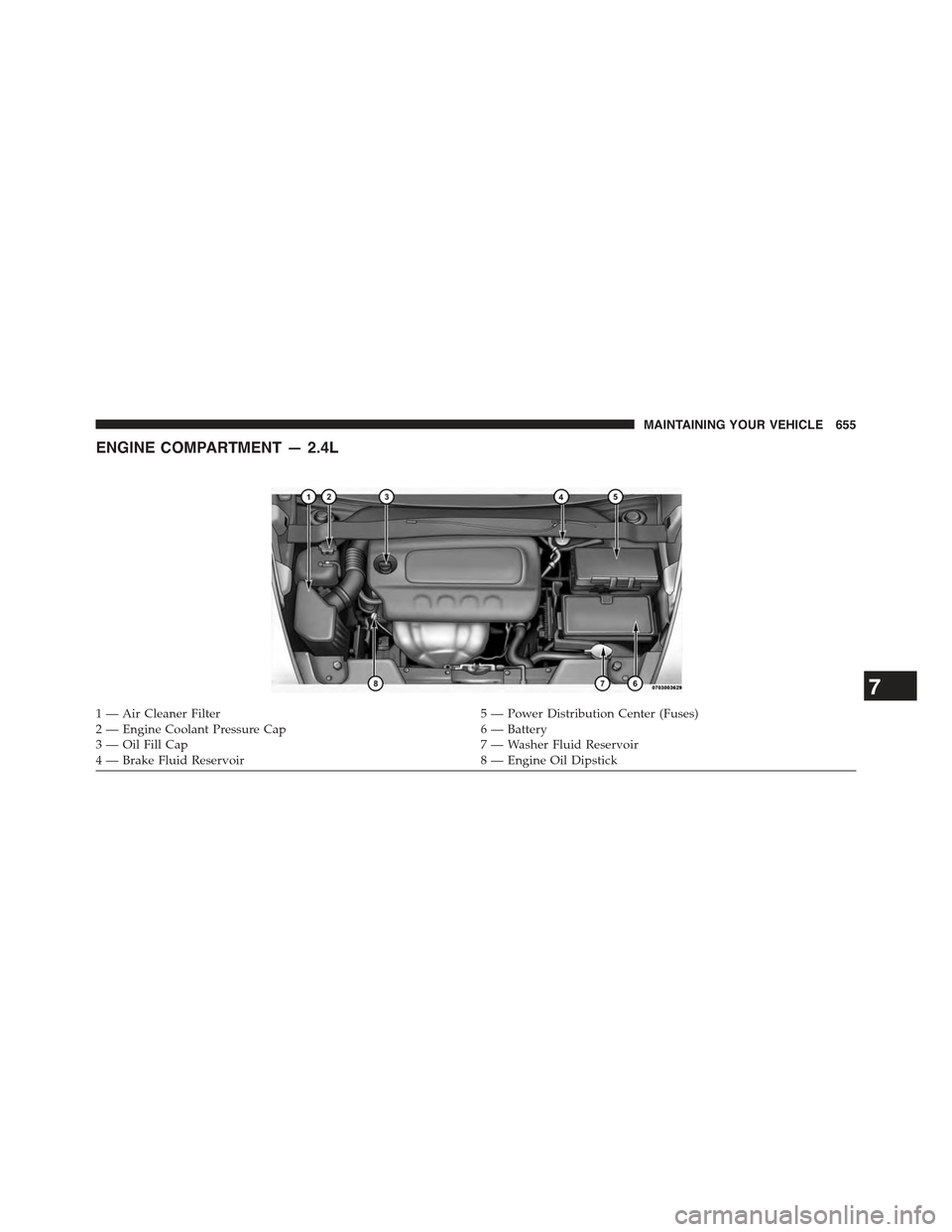
ENGINE COMPARTMENT — 2.4L
1 — Air Cleaner Filter5 — Power Distribution Center (Fuses)2 — Engine Coolant Pressure Cap6 — Battery3 — Oil Fill Cap7 — Washer Fluid Reservoir4 — Brake Fluid Reservoir8 — Engine Oil Dipstick
7
MAINTAINING YOUR VEHICLE 655
Page 658 of 772
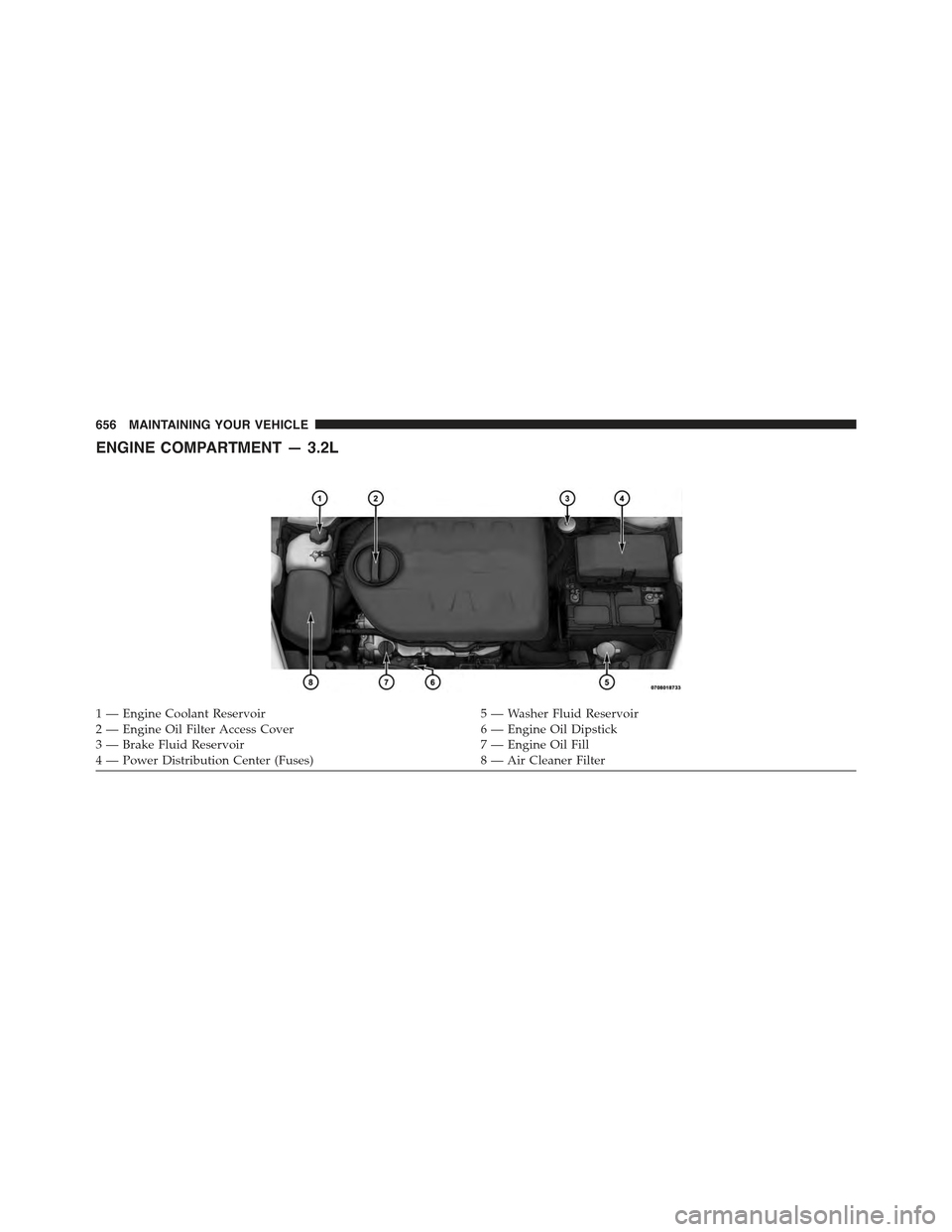
ENGINE COMPARTMENT — 3.2L
1 — Engine Coolant Reservoir5 — Washer Fluid Reservoir2 — Engine Oil Filter Access Cover6 — Engine Oil Dipstick3 — Brake Fluid Reservoir7 — Engine Oil Fill4 — Power Distribution Center (Fuses)8 — Air Cleaner Filter
656 MAINTAINING YOUR VEHICLE
Page 663 of 772
CAUTION!(Continued)
•Your vehicle has been built with improved fluids
that protect the performance and durability of your
vehicle and also allow extended maintenance inter-
vals. Do not use chemical flushes in these compo-
nents as the chemicals can damage your engine,
transmission or air conditioning. Such damage is
not covered by the New Vehicle Limited Warranty.
If a flush is needed because of component malfunc-
tion, use only the specified fluid for the flushing
procedure.
Engine Oil
Checking Oil Level
To assure proper engine lubrication, the engine oil must
be maintained at the correct level. Check the oil level at
regular intervals, such as every fuel stop. The best time to
check the engine oil level is about five minutes after a
fully warmed up engine is shut off.
Checking the oil while the vehicle is on level ground will
improve the accuracy of the oil level readings. Always
maintain the oil level within the SAFE zone on the
dipstick. Adding 1 quart (0.9 L) of oil when the reading is
at the bottom of the SAFE zone will result in a reading at
the top of the safe zone on these engines.
CAUTION!
Overfilling or underfilling the crankcase will cause
aeration or loss of oil pressure. This could damage
your engine.
7
MAINTAINING YOUR VEHICLE 661
Page 664 of 772
Change Engine Oil
The oil change indicator system will remind you that it is
time to take your vehicle in for scheduled maintenance.
Refer to the “Maintenance Schedule” for further informa-
tion.
NOTE: Under no circumstances should oil change in-
tervals exceed 10,000 miles (16,000 km) or twelve
months, whichever occurs first.
Engine Oil Selection
For best performance and maximum protection under all
types of operating conditions, the manufacturer only
recommends engine oils that are API Certified and meet
the requirements of Chrysler Material Standard MS-6395.
American Petroleum Institute (API) Engine Oil
Identification Symbol
This symbol means that the oil has
been certified by the American
Petroleum Institute (API). The
manufacturer only recommends
API Certified engine oils.
CAUTION!
Do not use chemical flushes in your engine oil as the
chemicals can damage your engine. Such damage is
not covered by the New Vehicle Limited Warranty.
662 MAINTAINING YOUR VEHICLE
Page 665 of 772
Engine Oil Viscosity (SAE Grade) — 2.4L Engine
MOPAR® SAE 0W-20 engine oil or equivalent Pennzoil®
or Shell Helix® is recommended for all operating tem-
peratures. This engine oil improves low temperature
starting and vehicle fuel economy. Your engine oil filler
cap also states the recommended engine oil viscosity
grade for your engine.
Lubricants which do not have both the engine oil certi-
fication mark and the correct SAE viscosity grade num-
ber should not be used.
Engine Oil Viscosity (SAE Grade) — 3.2L Engine
MOPAR® SAE 5W-20 engine oil or equivalent Pennzoil®
or Shell Helix® is recommended for all operating tem-
peratures. This engine oil improves low temperature
starting and vehicle fuel economy. The engine oil filler
cap also shows the recommended engine oil viscosity for
your engine. For information on engine oil filler cap
location, refer to “Engine Compartment” in “Maintaining
Your Vehicle” for further information.
Lubricants which do not have both the engine oil certi-
fication mark and the correct SAE viscosity grade num-
ber should not be used.
Synthetic Engine Oils
You may use synthetic engine oils provided the recom-
mended oil quality requirements are met, and the recom-
mended maintenance intervals for oil and filter changes
are followed.
Materials Added To Engine Oil
The manufacturer strongly recommends against the ad-
dition of any additives (other than leak detection dyes) to
the engine oil. Engine oil is an engineered product and its
performance may be impaired by supplemental addi-
tives.
7
MAINTAINING YOUR VEHICLE 663
Page 666 of 772
Disposing Of Used Engine Oil And Oil Filters
Care should be taken in disposing of used engine oil and
oil filters from your vehicle. Used oil and oil filters,
indiscriminately discarded, can present a problem to the
environment. Contact your authorized dealer, service
station or governmental agency for advice on how and
where used oil and oil filters can be safely discarded in
your area.
Engine Oil Filter
The engine oil filter should be replaced with a new filter
at every engine oil change.
NOTE:For best access to the oil filter, a drive on hoist
should be used instead of a chassis hoist.
Engine Oil Filter Selection
This manufacturer’s engines have a full-flow type dispos-
able oil filter. Use a filter of this type for replacement. The
quality of replacement filters varies considerably. Only
high quality filters should be used to assure most efficient
service. MOPAR® engine oil filters are high quality oil
filters and are recommended.
Engine Air Cleaner Filter
Refer to the “Maintenance Schedule” for the proper
maintenance intervals.
NOTE:Be sure to follow the “dusty or off-road condi-
tions” maintenance interval if applicable.
WARNING!
The air induction system (air cleaner, hoses, etc.) can
provide a measure of protection in the case of engine
backfire. Do not remove the air induction system (air
cleaner, hoses, etc.) unless such removal is necessary
for repair or maintenance. Make sure that no one is
near the engine compartment before starting the
(Continued)
664 MAINTAINING YOUR VEHICLE
Page 673 of 772
WARNING!
•Use only refrigerants and compressor lubricants
approved by the manufacturer for your air condi-
tioning system. Some unapproved refrigerants are
flammable and can explode, injuring you. Other
unapproved refrigerants or lubricants can cause the
system to fail, requiring costly repairs. Refer to
Warranty Information Book, located on the DVD,
for further warranty information.
•The air conditioning system contains refrigerant
under high pressure. To avoid risk of personal
injury or damage to the system, adding refrigerant
or any repair requiring lines to be disconnected
should be done by an experienced technician.
CAUTION!
Do not use chemical flushes in your air conditioning
system as the chemicals can damage your air condi-
tioning components. Such damage is not covered by
the New Vehicle Limited Warranty.
Refrigerant Recovery And Recycling R134a — If
Equipped
R-134a Air Conditioning Refrigerant is a hydrofluoro-
carbon (HFC) that is endorsed by the Environmental
Protection Agency and is an ozone-saving product. How-
ever, the manufacturer recommends that air conditioning
service be performed by authorized dealer or other
service facilities using recovery and recycling equipment.
NOTE:Use only manufacturer approved A/C system
PAG compressor oil, and refrigerants.
7
MAINTAINING YOUR VEHICLE 671