trailer JEEP CHEROKEE 2023 Owner's Manual
[x] Cancel search | Manufacturer: JEEP, Model Year: 2023, Model line: CHEROKEE, Model: JEEP CHEROKEE 2023Pages: 276, PDF Size: 12.55 MB
Page 152 of 276
150SAFETY
Disabling SSC
SSC will deactivate and be disabled if any of the following
conditions occur:
The driver pushes the SSC button.
The driveline is shifted out of 4WD Low.
The parking brake is applied.
The driver door opens.
The vehicle is driven greater than 20 mph (32 km/h)
for greater than 70 seconds.
The vehicle is driven greater than 40 mph (64 km/h)
(SSC exits immediately).
Feedback To The Driver:
The instrument cluster has an SSC icon and the SSC
button has an LED which offers feedback to the driver
about the state SSC is in.
The cluster icon and button lamp will illuminate and
remain on solid when SSC is enabled or activated. This
is the normal operating condition for SSC.
The cluster icon and button lamp will flash for several
seconds then extinguish when the driver pushes the
SSC button but enable conditions are not met.
The cluster icon and button lamp will flash for several
seconds then extinguish when SSC disables due to
excess speed.
The cluster icon and button lamp will flash then extin -
guish when SSC deactivates due to overheated brakes.
Traction Control System (TCS)
The TCS monitors the amount of wheel spin of each of the
driven wheels. If wheel spin is detected, the TCS may apply
brake pressure to the spinning wheel(s) and/or reduce
engine power to provide enhanced acceleration and
stability. A feature of the TCS, Brake Limited Differential
(BLD) functions similarly to a limited slip differential and
controls the wheel spin across a driven axle. If one wheel
on a driven axle is spinning faster than the other, the
system will apply the brake of the spinning wheel. This will
allow more engine torque to be applied to the wheel that
is not spinning. BLD may remain enabled even if TCS and
Electronic Stability Control (ESC) are in reduced modes.
Trailer Sway Control (TSC)
TSC uses sensors in the vehicle to recognize an
excessively swaying trailer and will take the appropriate
actions to attempt to stop the sway.
NOTE:
TSC cannot stop all trailers from swaying. Always use
caution when towing a trailer and follow the trailer tongue
weight recommendations
Úpage 114.
When TSC is functioning, the ESC Activation/Malfunction
Indicator Light will flash, the engine power may be reduced
and you may feel the brakes being applied to individual wheels to attempt to stop the trailer from swaying. TSC is
disabled when the ESC system is in the “Partial Off” or
“Full Off” modes.
AUXILIARY DRIVING SYSTEMS
BLIND SPOT MONITORING (BSM) —
I
F EQUIPPED
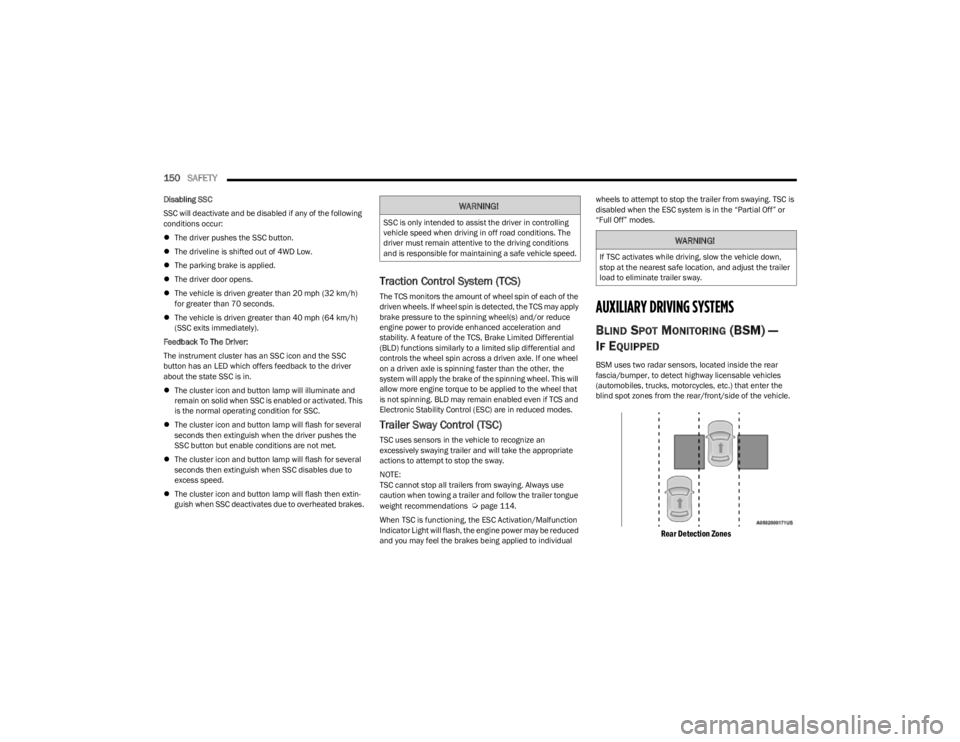
BSM uses two radar sensors, located inside the rear
fascia/bumper, to detect highway licensable vehicles
(automobiles, trucks, motorcycles, etc.) that enter the
blind spot zones from the rear/front/side of the vehicle.
Rear Detection Zones
WARNING!
SSC is only intended to assist the driver in controlling
vehicle speed when driving in off road conditions. The
driver must remain attentive to the driving conditions
and is responsible for maintaining a safe vehicle speed.
WARNING!
If TSC activates while driving, slow the vehicle down,
stop at the nearest safe location, and adjust the trailer
load to eliminate trailer sway.
23_KL_OM_EN_USC_t.book Page 150
Page 153 of 276
SAFETY151
When the vehicle is started, the BSM Warning Light will
momentarily illuminate in both outside rearview mirrors to
let the driver know that the system is operational. The
BSM system sensors operate when the vehicle is in any
forward gear and enters standby mode when the vehicle is
in PARK (P).
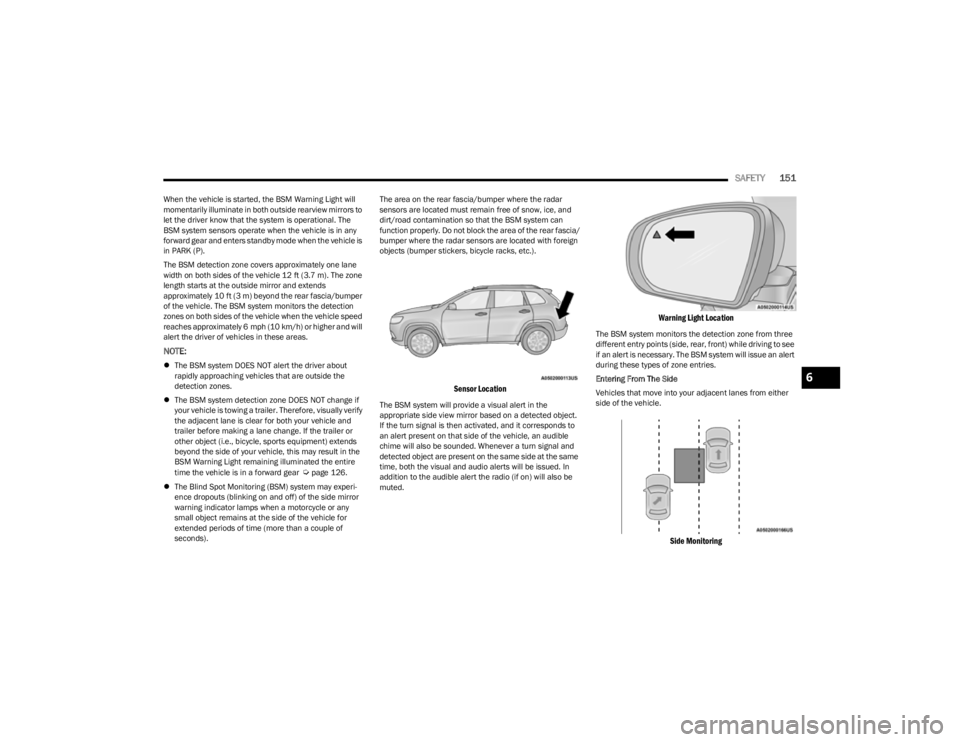
The BSM detection zone covers approximately one lane
width on both sides of the vehicle 12 ft (3.7 m). The zone
length starts at the outside mirror and extends
approximately 10 ft (3 m) beyond the rear fascia/bumper
of the vehicle. The BSM system monitors the detection
zones on both sides of the vehicle when the vehicle speed
reaches approximately 6 mph (10 km/h) or higher and will
alert the driver of vehicles in these areas.
NOTE:
The BSM system DOES NOT alert the driver about
rapidly approaching vehicles that are outside the
detection zones.
The BSM system detection zone DOES NOT change if
your vehicle is towing a trailer. Therefore, visually verify
the adjacent lane is clear for both your vehicle and
trailer before making a lane change. If the trailer or
other object (i.e., bicycle, sports equipment) extends
beyond the side of your vehicle, this may result in the
BSM Warning Light remaining illuminated the entire
time the vehicle is in a forward gear
Úpage 126.
The Blind Spot Monitoring (BSM) system may experi -
ence dropouts (blinking on and off) of the side mirror
warning indicator lamps when a motorcycle or any
small object remains at the side of the vehicle for
extended periods of time (more than a couple of
seconds). The area on the rear fascia/bumper where the radar
sensors are located must remain free of snow, ice, and
dirt/road contamination so that the BSM system can
function properly. Do not block the area of the rear fascia/
bumper where the radar sensors are located with foreign
objects (bumper stickers, bicycle racks, etc.).
Sensor Location
The BSM system will provide a visual alert in the
appropriate side view mirror based on a detected object.
If the turn signal is then activated, and it corresponds to
an alert present on that side of the vehicle, an audible
chime will also be sounded. Whenever a turn signal and
detected object are present on the same side at the same
time, both the visual and audio alerts will be issued. In
addition to the audible alert the radio (if on) will also be
muted.
Warning Light Location
The BSM system monitors the detection zone from three
different entry points (side, rear, front) while driving to see
if an alert is necessary. The BSM system will issue an alert
during these types of zone entries.
Entering From The Side
Vehicles that move into your adjacent lanes from either
side of the vehicle.
Side Monitoring
6
23_KL_OM_EN_USC_t.book Page 151
Page 210 of 276
208
SERVICING AND MAINTENANCE
SCHEDULED SERVICING
Your vehicle is equipped with an automatic oil change
indicator system. The oil change indicator system will
remind you that it is time to take your vehicle in for
scheduled maintenance.
Based on engine operation conditions, the oil change
indicator message will illuminate. This means that service
is required for your vehicle. Operating conditions such as
frequent short-trips, trailer tow, or extremely hot or cold
ambient temperatures will influence when the “Oil Change
Required” message is displayed. Have your vehicle
serviced as soon as possible, within the next 500 miles
(805 km).An authorized dealer will reset the oil change indicator
message after completing the scheduled oil change. If a
scheduled oil change is performed by someone other than
an authorized dealer, the message can be reset by
referring to the steps described under Instrument Cluster
Display
Úpage 64.
NOTE:Under no circumstances should oil change intervals
exceed 10,000 miles (16,000 km), 12 months or
350 hours of engine run time, whichever comes first. The
350 hours of engine run or idle time is generally only a
concern for fleet customers.
At Every Fuel Stop:
Check engine oil level.
Check windshield washer fluid level.
Check tire pressure and look for unusual wear or
damage. Rotate tires at the first sign of irregular wear,
even if it occurs before the oil indicator system turns
on.
Check the fluid levels of the coolant reservoir and
brake master cylinder; fill as needed.
Check function of all interior and exterior lights.
23_KL_OM_EN_USC_t.book Page 208
Page 231 of 276

SERVICING AND MAINTENANCE229
F21––Not Used
F22 5 Amp Tan –Radiator Fan (PWM) Enable
F23 50 Amp Red –Voltage Stability Module (VSM) #2
F24 20 Amp Yellow –Rear Wiper
F25B 20 Amp Yellow –FT/RR Washer
F26 –30 Amp Pink Fuel Heater *
F27 ––Not Used
F28 15 Amp Blue –Transmission Control Module (TCM/Shifter)
F29 ––Not Used
F30 10 Amp Red –Engine Control Module (ECM) / EPS / PCM / Gas Particulate Filter (GPF)
F31 ––Not Used
F32 ––Not Used
F33 ––Not Used
F34 ––Not Used
F35 ––Not Used
F36 ––Not Used
F37 ––Not Used
F38 –60 Amp Yellow Glow Plug *
F39 –40 Amp Green HVAC Blower Motor
F40 –20 Amp Blue Trailer Tow Park Light *
F41 –50 Amp Red Voltage Stability Module (VSM) #1
F42 –30 Amp Pink Trailer Tow Module *
Cavity
Blade Fuse Cartridge Fuse Description
* If Equipped
8
23_KL_OM_EN_USC_t.book Page 229
Page 232 of 276

230SERVICING AND MAINTENANCE
F4320 Amp Yellow –Fuel Pump Motor
F44 –30 Amp Pink Trailer Tow Receptacle *
F45 –30 Amp Pink Passenger Door Module (PDM) *
F46 –25 Amp Clear Sunroof Control Module *
F47 ––Not Used
F48 –30 Amp Pink Driver Door Module *
F49 –30 Amp Pink Power Inverter (115 Volt/220 Volt A/C) *
F50 –30 Amp Pink Power Liftgate Module *
F51 ––Not Used
F52 –30 Amp Pink Front Wipers
F53 –30 Amp Pink Brake System Module (BSM) - ECU And Valves
F54 –30 Amp Pink Body Control Module (BCM) Feed 3
F55 10 Amp Red –Blind Spot Sensors*/Rearview Camera*/ Rear Heated Seat Switch *
F56 15 Amp Blue –Ignition Node Module (IGNM) / KIN / RF Hub / Electric Steering Column Lock (ESCL) /USB Port
F57 20 Amp Yellow –Trailer Tow Left Stop/Turn Lights *
F58 10 Amp Red –Occupant Classification Module/VSM/ESCL/TT Mod
F59 –30 Amp Pink Drivetrain Control Module (DTCM) *
F60 20 Amp Yellow –Power Outlet – Center Console
F61 20 Amp Yellow –Trailer Tow Right Stop/Turn Lights *
F62 20 Amp Yellow –Windshield De-Icer *
F63 20 Amp Yellow –Front Heated/Ventilated Seats *
F64 20 Amp Yellow –Rear Heated Seats *
Cavity
Blade Fuse Cartridge Fuse Description
* If Equipped
23_KL_OM_EN_USC_t.book Page 230
Page 233 of 276

SERVICING AND MAINTENANCE231
F6510 Amp Red –In Vehicle Temperature Sensor*/Humidity Sensor*/Driver Assist System Module (DASM)*/
Park Assist (PAM) *
F66 15 Amp Blue –HVAC (ECC)/Instrument Panel Cluster (IPC)/Gateway Module
F67 ––Not Used
F68 ––Not Used
F69 10 Amp Red –Transfer Case Switch (TSBM)/Active Grill Shutter (AGS) *
F70 5 Amp Tan –Intelligent Battery Sensor (IBS)
F71 ––Not Used
F72 10 Amp Red –Heated Mirrors * / PM Sensor *
F73 –20 Amp Blue NOX Sensors*/ Trailer Tow Backup *
F74 –30 Amp Pink Rear Defroster (EBL)
F75 20 Amp Yellow –Cigar Lighter *
F76 20 Amp Yellow –Rear Differential Module (RDM) 4WD *
F77 10 Amp Red –Hands Free Release */ Brake Pedal Switch *
F78 10 Amp Red –DTV / TBM / OBD Port
F79 10 Amp Red –Integrated Center Stack (ICS) / HVAC /Electric Park Brake (EPB) SW Steering Control Mod
(SCCM) /Instrument Panel Cluster (IPC)
F80 20 Amp Yellow –Radio
F81 ––Not Used
F82 5 Amp Tan –Gateway Module
F83 –20 Amp Blue Engine Controller Module (ECM)*
30 Amp Pink SCU Module *
F84 –30 Amp Pink Electric Park Brake (EPB) – Left
Cavity
Blade Fuse Cartridge Fuse Description
* If Equipped
8
23_KL_OM_EN_USC_t.book Page 231
Page 241 of 276
SERVICING AND MAINTENANCE239
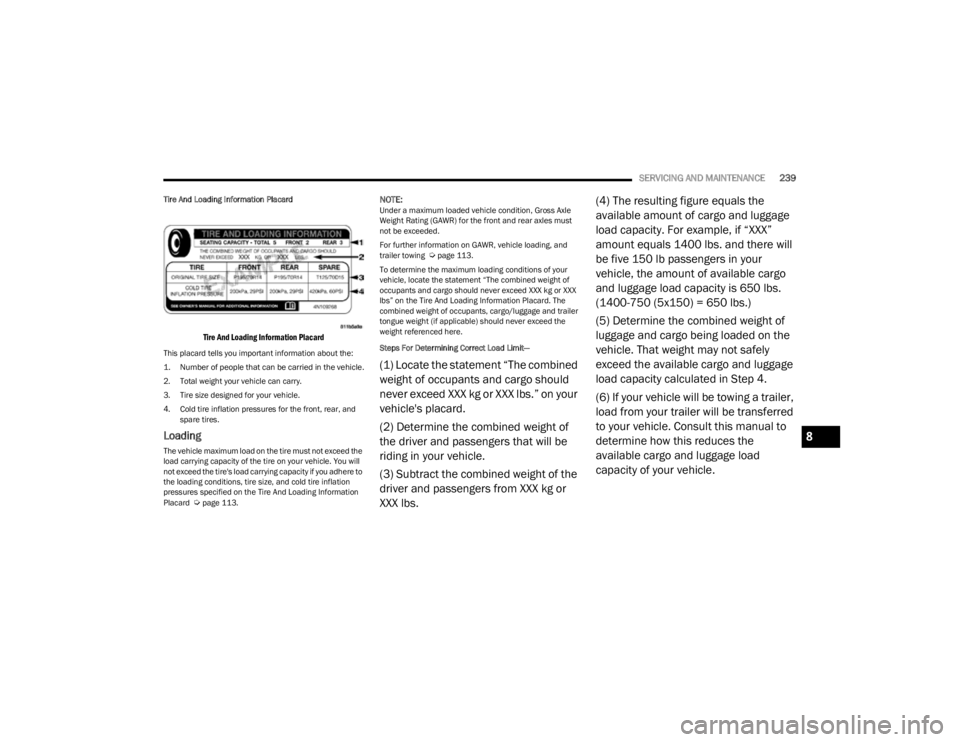
Tire And Loading Information Placard
Tire And Loading Information Placard
This placard tells you important information about the:
1. Number of people that can be carried in the vehicle.
2. Total weight your vehicle can carry.
3. Tire size designed for your vehicle.
4. Cold tire inflation pressures for the front, rear, and
spare tires.
Loading
The vehicle maximum load on the tire must not exceed the
load carrying capacity of the tire on your vehicle. You will
not exceed the tire's load carrying capacity if you adhere to
the loading conditions, tire size, and cold tire inflation
pressures specified on the Tire And Loading Information
Placard
Úpage 113.
NOTE:Under a maximum loaded vehicle condition, Gross Axle
Weight Rating (GAWR) for the front and rear axles must
not be exceeded.
For further information on GAWR, vehicle loading, and
trailer towing
Úpage 113.
To determine the maximum loading conditions of your
vehicle, locate the statement “The combined weight of
occupants and cargo should never exceed XXX kg or XXX
lbs” on the Tire And Loading Information Placard. The
combined weight of occupants, cargo/luggage and trailer
tongue weight (if applicable) should never exceed the
weight referenced here.
Steps For Determining Correct Load Limit—
(1) Locate the statement “The combined
weight of occupants and cargo should
never exceed XXX kg or XXX lbs.” on your
vehicle's placard.
(2) Determine the combined weight of
the driver and passengers that will be
riding in your vehicle.
(3) Subtract the combined weight of the
driver and passengers from XXX kg or
XXX lbs. (4) The resulting figure equals the
available amount of cargo and luggage
load capacity. For example, if “XXX”
amount equals 1400 lbs. and there will
be five 150 lb passengers in your
vehicle, the amount of available cargo
and luggage load capacity is 650 lbs.
(1400-750 (5x150) = 650 lbs.)
(5) Determine the combined weight of
luggage and cargo being loaded on the
vehicle. That weight may not safely
exceed the available cargo and luggage
load capacity calculated in Step 4.
(6) If your vehicle will be towing a trailer,
load from your trailer will be transferred
to your vehicle. Consult this manual to
determine how this reduces the
available cargo and luggage load
capacity of your vehicle.
8
23_KL_OM_EN_USC_t.book Page 239
Page 242 of 276
240SERVICING AND MAINTENANCE
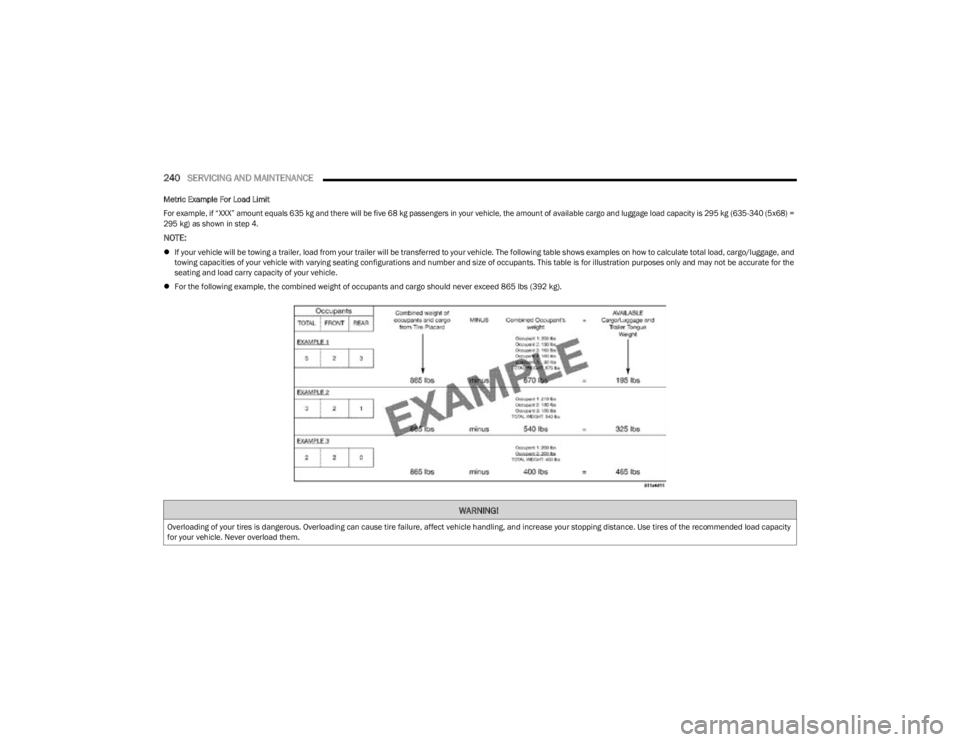
Metric Example For Load Limit
For example, if “XXX” amount equals 635 kg and there will be five 68 kg passengers in your vehicle, the amount of available cargo and luggage load capacity is 295 kg (635-340 (5x68) =
295 kg) as shown in step 4.
NOTE:
If your vehicle will be towing a trailer, load from your trailer will be transferred to your vehicle. The following table shows examples on how to calculate total load, cargo/luggage, and
towing capacities of your vehicle with varying seating configurations and number and size of occupants. This table is for illustration purposes only and may not be accurate for the
seating and load carry capacity of your vehicle.
For the following example, the combined weight of occupants and cargo should never exceed 865 lbs (392 kg).
WARNING!
Overloading of your tires is dangerous. Overloading can cause tire failure, affect vehicle handling, and increase your stopping distance. Use tires of the recommended load capacity
for your vehicle. Never overload them.
23_KL_OM_EN_USC_t.book Page 240
Page 244 of 276

242SERVICING AND MAINTENANCE
Example: If garage temperature = 68°F (20°C) and the
outside temperature = 32°F (0°C) then the cold tire
inflation pressure should be increased by 3 psi (21 kPa),
which equals 1 psi (7 kPa) for every 12°F (7°C) for this
outside temperature condition.
Tire pressure may increase from 2 to 6 psi (13 to 40 kPa)
during operation. DO NOT reduce this normal pressure
build up or your tire pressure will be too low.
Tire Pressures For High Speed Operation
The manufacturer advocates driving at safe speeds and
within posted speed limits. Where speed limits or
conditions are such that the vehicle can be driven at high
speeds, maintaining correct tire inflation pressure is very
important. Increased tire pressure and reduced vehicle
loading may be required for high-speed vehicle operation.
Refer to an authorized tire dealer or original equipment
vehicle dealer for recommended safe operating speeds,
loading and cold tire inflation pressures.
Radial Ply Tires
Tire Repair
If your tire becomes damaged, it may be repaired if it
meets the following criteria:
The tire has not been driven on when flat.
The damage is only on the tread section of your tire
(sidewall damage is not repairable).
The puncture is no greater than ¼ of an inch (6 mm).
Consult an authorized tire dealer for tire repairs and
additional information.
Damaged Run Flat tires, or Run Flat tires that have
experienced a loss of pressure should be replaced
immediately with another Run Flat tire of identical size and
service description (Load Index and Speed Symbol).
Replace the tire pressure sensor as well as it is not
designed to be reused.
Run Flat Tires — If Equipped
Run Flat tires allow you the capability to drive 50 miles
(80 km) at 50 mph (80 km/h) after a rapid loss of inflation
pressure. This rapid loss of inflation is referred to as the
Run Flat mode. A Run Flat mode occurs when the tire
inflation pressure is of/or below 14 psi (96 kPa). Once a Run Flat tire reaches the Run Flat mode it has limited
driving capabilities and needs to be replaced immediately.
A Run Flat tire is not repairable. When a Run Flat tire is
changed after being driven under a Run Flat mode 14 psi
(96 kPa) condition, please replace the TPMS sensor as it
is not designed to be reused.
NOTE:TPMS sensor must be replaced after driving the vehicle on
a flat tire condition.
It is not recommended driving a vehicle loaded at full
capacity or to tow a trailer while a tire is in the Run Flat
mode.
See the Tire Pressure Monitoring System section for more
information
Úpage 155.
Tire Spinning
When stuck in mud, sand, snow, or ice conditions, do not
spin your vehicle's wheels above 30 mph (48 km/h) or for
longer than 30 seconds continuously without stopping.
WARNING!
High speed driving with your vehicle under maximum
load is dangerous. The added strain on your tires could
cause them to fail. You could have a serious collision.
Do not drive a vehicle loaded to the maximum capacity
at continuous speeds above 75 mph (120 km/h).
WARNING!
Combining radial ply tires with other types of tires on
your vehicle will cause your vehicle to handle poorly.
The instability could cause a collision. Always use radial
ply tires in sets of four. Never combine them with other
types of tires.
WARNING!
Fast spinning tires can be dangerous. Forces generated
by excessive wheel speeds may cause tire damage or
failure. A tire could explode and injure someone. Do not
spin your vehicle's wheels faster than 30 mph (48 km/h)
for more than 30 seconds continuously when you are
stuck, and do not let anyone near a spinning wheel, no
matter what the speed.
23_KL_OM_EN_USC_t.book Page 242
Page 267 of 276

265
Oil Selection ............................................................ 215
Oil Synthetic ............................................................ 215
Overheating ............................................................. 203
Engine Fluids And Lubricants...................................... 256
Enhanced Accident Response Feature ............. 175
, 207
Ethanol.......................................................................... 254
Exhaust Gas Cautions.................................................. 188
Exhaust System ............................................................ 222
Exterior Lights........................................................ 39
, 188
FFilters Air Cleaner ............................................................... 216Air Conditioning................................................ 48
, 218
Engine Oil ................................................................ 216 Engine Oil Disposal ................................................. 215
Flashers Hazard Warning ...................................................... 189
Turn Signals ..................................................... 74
, 188
Flash-To-Pass ..................................................................40
Flat Tire Changing ............................................... 235
, 244
Flat Tire Stowage ................................................ 235, 244
Flooded Engine Starting .................................................78
Fluid Capacities ............................................................ 256
Fluid Leaks ................................................................... 188
Fluid Level Checks Brake ....................................................................... 225Engine Oil ................................................................ 214
Fob, Key ...........................................................................13
Fog Lights ........................................................................41 Fold-Flat Seats ................................................................28Folding Rear Seats..........................................................29Forward Collision Warning ........................................... 154
Four Wheel Drive............................................................. 85 Freeing A Stuck Vehicle................................................ 204
Fuel
Additives...................................................................255Clean Air ...................................................................254Ethanol .....................................................................254
Light............................................................................ 71
Materials Added ...................................................... 255
Methanol .................................................................. 254
Tank Capacity .......................................................... 256
Fueling ...........................................................................113
Fuses .............................................................................226
GGarage Door Opener (HomeLink®) ............................... 35 Gasoline, Clean Air ....................................................... 254
Gasoline, Reformulated ............................................... 254
Gear Ranges ................................................................... 82Gear Selector Override ................................................. 203
Glass Cleaning .............................................................. 252
Gross Axle Weight Rating ............................................. 115
Gross Combination Weight Rating............................... 115
Gross Trailer Weight ..................................................... 115
Gross Vehicle Weight Rating ........................................ 114
GVWR.............................................................................113
HHazard Warning Flashers ............................................. 189
Head Restraint Removal ................................................ 32
Head Restraints .............................................................. 32
Head Rests...................................................................... 32
Headlights ....................................................................... 39 Automatic ................................................................... 40
Automatic High Beam ............................................... 40 Cleaning ................................................................... 250
High Beam .......................................................... 39
, 40
High Beam/Low Beam Select Switch ...................... 40
On With Wipers.......................................................... 41
Passing ............................................................... 39
, 40
Switch ........................................................................ 39
Time Delay ................................................................. 41
Heated Mirrors ............................................................... 35 Heated Seats .................................................................. 31
Heated Steering Wheel .................................................. 24
Hill Descent Control ..................................................... 146
Hill Descent Control Indicator...................................... 146
Hill Start Assist ............................................................. 148
Hitches Trailer Towing .......................................................... 116
HomeLink® (Garage Door Opener)............................... 35
Hood Prop ....................................................................... 56
Hood Release ................................................................. 56
IIgnition ............................................................................ 16 Switch ........................................................................ 16
Ignition Pak Interlock ..................................................... 81
Illuminated Entry ............................................................ 43
Indicator light Blue ............................................................................ 75
Green ......................................................................... 73
White .......................................................................... 74
Yellow......................................................................... 73
Inside Rearview Mirror .......................................... 34
, 189
Instrument Cluster Descriptions
S
.......................................... 61, 63, 74
Display ....................................................................... 63
Display Controls ........................................................ 6311
23_KL_OM_EN_USC_t.book Page 265