steering JEEP CHEROKEE 2023 Workshop Manual
[x] Cancel search | Manufacturer: JEEP, Model Year: 2023, Model line: CHEROKEE, Model: JEEP CHEROKEE 2023Pages: 276, PDF Size: 12.55 MB
Page 209 of 276
IN CASE OF EMERGENCY207
NOTE:For off-road recovery, it is recommended to use both of the
front tow hooks to minimize the risk of damage to the
vehicle.
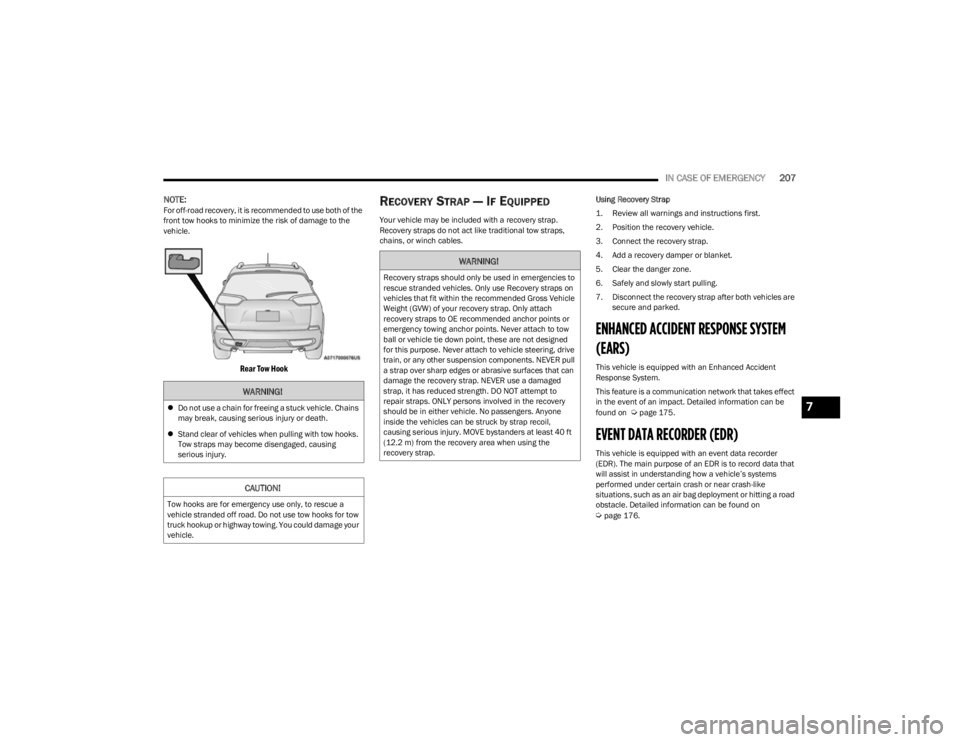
Rear Tow Hook
RECOVERY STRAP — IF EQUIPPED
Your vehicle may be included with a recovery strap.
Recovery straps do not act like traditional tow straps,
chains, or winch cables. Using Recovery Strap
1. Review all warnings and instructions first.
2. Position the recovery vehicle.
3. Connect the recovery strap.
4. Add a recovery damper or blanket.
5. Clear the danger zone.
6. Safely and slowly start pulling.
7. Disconnect the recovery strap after both vehicles are
secure and parked.
ENHANCED ACCIDENT RESPONSE SYSTEM
(EARS)
This vehicle is equipped with an Enhanced Accident
Response System.
This feature is a communication network that takes effect
in the event of an impact. Detailed information can be
found on
Úpage 175.
EVENT DATA RECORDER (EDR)
This vehicle is equipped with an event data recorder
(EDR). The main purpose of an EDR is to record data that
will assist in understanding how a vehicle’s systems
performed under certain crash or near crash-like
situations, such as an air bag deployment or hitting a road
obstacle. Detailed information can be found on
Úpage 176.
WARNING!
Do not use a chain for freeing a stuck vehicle. Chains
may break, causing serious injury or death.
Stand clear of vehicles when pulling with tow hooks.
Tow straps may become disengaged, causing
serious injury.
CAUTION!
Tow hooks are for emergency use only, to rescue a
vehicle stranded off road. Do not use tow hooks for tow
truck hookup or highway towing. You could damage your
vehicle.
WARNING!
Recovery straps should only be used in emergencies to
rescue stranded vehicles. Only use Recovery straps on
vehicles that fit within the recommended Gross Vehicle
Weight (GVW) of your recovery strap. Only attach
recovery straps to OE recommended anchor points or
emergency towing anchor points. Never attach to tow
ball or vehicle tie down point, these are not designed
for this purpose. Never attach to vehicle steering, drive
train, or any other suspension components. NEVER pull
a strap over sharp edges or abrasive surfaces that can
damage the recovery strap. NEVER use a damaged
strap, it has reduced strength. DO NOT attempt to
repair straps. ONLY persons involved in the recovery
should be in either vehicle. No passengers. Anyone
inside the vehicles can be struck by strap recoil,
causing serious injury. MOVE bystanders at least 40 ft
(12.2 m) from the recovery area when using the
recovery strap.
7
23_KL_OM_EN_USC_t.book Page 207
Page 228 of 276
226SERVICING AND MAINTENANCE
Fluid And Filter Changes
Under normal operating conditions, the fluid installed at
the factory will provide satisfactory lubrication for the life
of the vehicle.
Routine fluid and filter changes are not required. However,
change the fluid and filter if the fluid becomes
contaminated (with water, etc.), or if the transmission is
disassembled for any reason.
Selection Of Lubricant
It is important to use the proper transmission fluid to
ensure optimum transmission performance and life. Use
only the manufacturer's specified transmission fluid
Úpage 256. It is important to maintain the transmission
fluid at the correct level using the recommended fluid.
NOTE:No chemical flushes should be used in any transmission;
only the approved lubricant should be used.
FUSES
General Information
The fuses protect electrical systems against excessive
current.
When a device does not work, you must check the fuse
element inside the blade fuse for a break/melt.
Also, please be aware that when using power outlets for
extended periods of time with the engine off may result in
vehicle battery discharge.
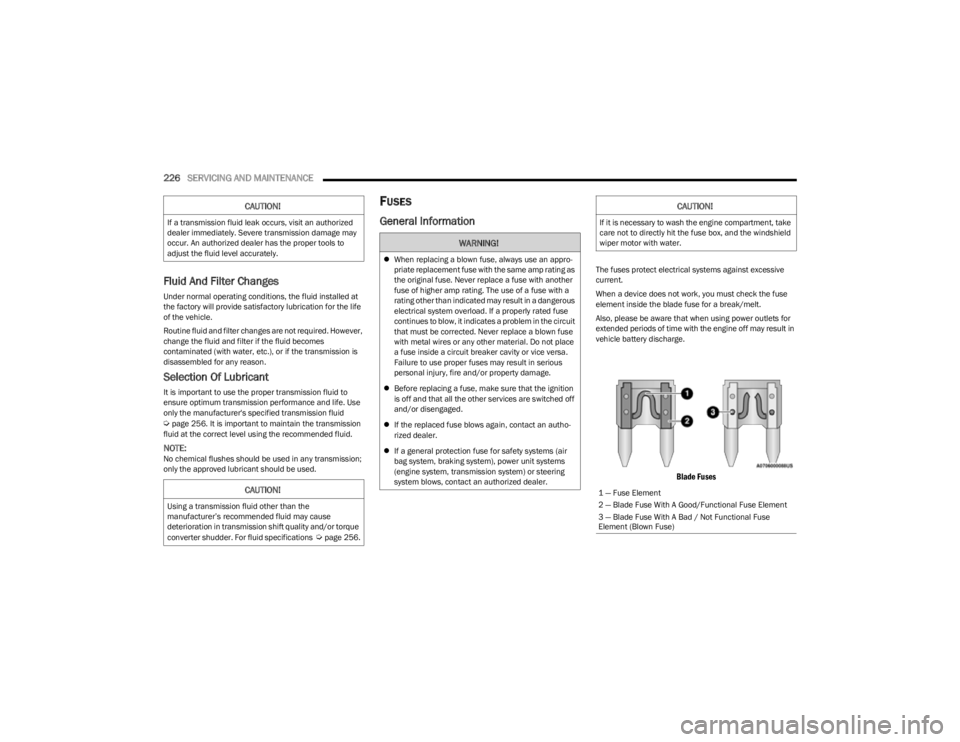
Blade Fuses
CAUTION!
If a transmission fluid leak occurs, visit an authorized
dealer immediately. Severe transmission damage may
occur. An authorized dealer has the proper tools to
adjust the fluid level accurately.
CAUTION!
Using a transmission fluid other than the
manufacturer’s recommended fluid may cause
deterioration in transmission shift quality and/or torque
converter shudder. For fluid specifications
Úpage 256.
WARNING!
When replacing a blown fuse, always use an appro -
priate replacement fuse with the same amp rating as
the original fuse. Never replace a fuse with another
fuse of higher amp rating. The use of a fuse with a
rating other than indicated may result in a dangerous
electrical system overload. If a properly rated fuse
continues to blow, it indicates a problem in the circuit
that must be corrected. Never replace a blown fuse
with metal wires or any other material. Do not place
a fuse inside a circuit breaker cavity or vice versa.
Failure to use proper fuses may result in serious
personal injury, fire and/or property damage.
Before replacing a fuse, make sure that the ignition
is off and that all the other services are switched off
and/or disengaged.
If the replaced fuse blows again, contact an autho -
rized dealer.
If a general protection fuse for safety systems (air
bag system, braking system), power unit systems
(engine system, transmission system) or steering
system blows, contact an authorized dealer.
CAUTION!
If it is necessary to wash the engine compartment, take
care not to directly hit the fuse box, and the windshield
wiper motor with water.
1 — Fuse Element
2 — Blade Fuse With A Good/Functional Fuse Element
3 — Blade Fuse With A Bad / Not Functional Fuse
Element (Blown Fuse)
23_KL_OM_EN_USC_t.book Page 226
Page 232 of 276

230SERVICING AND MAINTENANCE
F4320 Amp Yellow –Fuel Pump Motor
F44 –30 Amp Pink Trailer Tow Receptacle *
F45 –30 Amp Pink Passenger Door Module (PDM) *
F46 –25 Amp Clear Sunroof Control Module *
F47 ––Not Used
F48 –30 Amp Pink Driver Door Module *
F49 –30 Amp Pink Power Inverter (115 Volt/220 Volt A/C) *
F50 –30 Amp Pink Power Liftgate Module *
F51 ––Not Used
F52 –30 Amp Pink Front Wipers
F53 –30 Amp Pink Brake System Module (BSM) - ECU And Valves
F54 –30 Amp Pink Body Control Module (BCM) Feed 3
F55 10 Amp Red –Blind Spot Sensors*/Rearview Camera*/ Rear Heated Seat Switch *
F56 15 Amp Blue –Ignition Node Module (IGNM) / KIN / RF Hub / Electric Steering Column Lock (ESCL) /USB Port
F57 20 Amp Yellow –Trailer Tow Left Stop/Turn Lights *
F58 10 Amp Red –Occupant Classification Module/VSM/ESCL/TT Mod
F59 –30 Amp Pink Drivetrain Control Module (DTCM) *
F60 20 Amp Yellow –Power Outlet – Center Console
F61 20 Amp Yellow –Trailer Tow Right Stop/Turn Lights *
F62 20 Amp Yellow –Windshield De-Icer *
F63 20 Amp Yellow –Front Heated/Ventilated Seats *
F64 20 Amp Yellow –Rear Heated Seats *
Cavity
Blade Fuse Cartridge Fuse Description
* If Equipped
23_KL_OM_EN_USC_t.book Page 230
Page 233 of 276

SERVICING AND MAINTENANCE231
F6510 Amp Red –In Vehicle Temperature Sensor*/Humidity Sensor*/Driver Assist System Module (DASM)*/
Park Assist (PAM) *
F66 15 Amp Blue –HVAC (ECC)/Instrument Panel Cluster (IPC)/Gateway Module
F67 ––Not Used
F68 ––Not Used
F69 10 Amp Red –Transfer Case Switch (TSBM)/Active Grill Shutter (AGS) *
F70 5 Amp Tan –Intelligent Battery Sensor (IBS)
F71 ––Not Used
F72 10 Amp Red –Heated Mirrors * / PM Sensor *
F73 –20 Amp Blue NOX Sensors*/ Trailer Tow Backup *
F74 –30 Amp Pink Rear Defroster (EBL)
F75 20 Amp Yellow –Cigar Lighter *
F76 20 Amp Yellow –Rear Differential Module (RDM) 4WD *
F77 10 Amp Red –Hands Free Release */ Brake Pedal Switch *
F78 10 Amp Red –DTV / TBM / OBD Port
F79 10 Amp Red –Integrated Center Stack (ICS) / HVAC /Electric Park Brake (EPB) SW Steering Control Mod
(SCCM) /Instrument Panel Cluster (IPC)
F80 20 Amp Yellow –Radio
F81 ––Not Used
F82 5 Amp Tan –Gateway Module
F83 –20 Amp Blue Engine Controller Module (ECM)*
30 Amp Pink SCU Module *
F84 –30 Amp Pink Electric Park Brake (EPB) – Left
Cavity
Blade Fuse Cartridge Fuse Description
* If Equipped
8
23_KL_OM_EN_USC_t.book Page 231
Page 234 of 276

232SERVICING AND MAINTENANCE
* 30 Amp mini fuse is substituted for 25 Amp Circuit Breaker.F85
15 Amp Blue –(CSWM) Heated Steering Wheel *
F86 20 Amp Yellow –Horn
F87 ––Not Used
F88 10 Amp Red –Seat Belt Reminder (SBR)*/Smart Camera *
F89 10 Amp Red –Auto/Manual Headlight Leveling*
F90 ––Not Used
F91 20 Amp Yellow –Power Outlet (Rear Seats Customer Selectable) *
F92 ––Not Used
F93 –40 Amp Green Brake System Module (BSM) – Pump Motor
F94 –30 Amp Pink Electric Park Brake (EPB) – Right
F95 10 Amp Red –Sunroof Module */ Rain Sensor Module (LRSM) */ ECMM /Passenger Window SW/ Power
Outlet Console/ Illumination / DTV
F96 10 Amp Red –Airbag
F97 10 Amp Red –Airbag
F98 25 Amp Clear –Audio Amplifier / ANC *
F99 ––Not Used
F100 ––Not Used
Circuit Breakers
CB1 25 AmpPower Seat (Driver)
CB2 25 AmpPower Seat (Pass)
CB3 25 AmpPower Window
Cavity
Blade Fuse Cartridge Fuse Description
* If Equipped
23_KL_OM_EN_USC_t.book Page 232
Page 243 of 276

SERVICING AND MAINTENANCE241
(Continued)
TIRES — GENERAL INFORMATION
Tire Pressure
Proper tire inflation pressure is essential to the safe and
satisfactory operation of your vehicle. Four primary areas
are affected by improper tire pressure:
Safety
Fuel Economy
Tread Wear
Ride Comfort and Vehicle Stability
Safety Both underinflation and overinflation affect the stability of
the vehicle and can produce a feeling of sluggish response
or over responsiveness in the steering.
NOTE:
Unequal tire pressures from side to side may cause
erratic and unpredictable steering response.
Unequal tire pressure from side to side may cause the
vehicle to drift left or right.
Fuel Economy
Underinflated tires will increase tire rolling resistance
resulting in higher fuel consumption.
Tread Wear
Improper cold tire inflation pressures can cause abnormal
wear patterns and reduced tread life, resulting in the need
for earlier tire replacement.
Ride Comfort And Vehicle Stability
Proper tire inflation contributes to a comfortable ride.
Overinflation produces a jarring and uncomfortable ride.
Tire Inflation Pressures
The proper cold tire inflation pressure is listed on the
driver's side B-pillar or rear edge of the driver's side door. At least once a month:
Check and adjust tire pressure with a good quality
pocket-type pressure gauge. Do not make a visual judg -
ment when determining proper inflation. Tires may look
properly inflated even when they are underinflated.
Inspect tires for signs of tire wear or visible damage.
Inflation pressures specified on the placard are always
“cold tire inflation pressure”. Cold tire inflation pressure is
defined as the tire pressure after the vehicle has not been
driven for at least three hours, or driven less than 1 mile
(1.6 km) after sitting for a minimum of three hours. The
cold tire inflation pressure must not exceed the maximum
inflation pressure molded into the tire sidewall.
Check tire pressures more often if subject to a wide range
of outdoor temperatures, as tire pressures vary with
temperature changes.
Tire pressures change by approximately 1 psi (7 kPa) per
12°F (7°C) of air temperature change. Keep this in mind
when checking tire pressure inside a garage, especially in
the Winter.
WARNING!
Improperly inflated tires are dangerous and can
cause collisions.
Underinflation increases tire flexing and can result in
overheating and tire failure.
Overinflation reduces a tire's ability to cushion shock.
Objects on the road and chuckholes can cause
damage that result in tire failure.
Overinflated or underinflated tires can affect vehicle
handling and can fail suddenly, resulting in loss of
vehicle control.
Unequal tire pressures can cause steering problems.
You could lose control of your vehicle.
Unequal tire pressures from one side of the vehicle
to the other can cause the vehicle to drift to the right
or left.
Always drive with each tire inflated to the recom -
mended cold tire inflation pressure.
WARNING!
CAUTION!
After inspecting or adjusting the tire pressure, always
reinstall the valve stem cap. This will prevent moisture
and dirt from entering the valve stem, which could
damage the valve stem.
8
23_KL_OM_EN_USC_t.book Page 241
Page 245 of 276
SERVICING AND MAINTENANCE243
(Continued)
Tread Wear Indicators
Tread wear indicators are in the original equipment tires to
help you in determining when your tires should be
replaced.
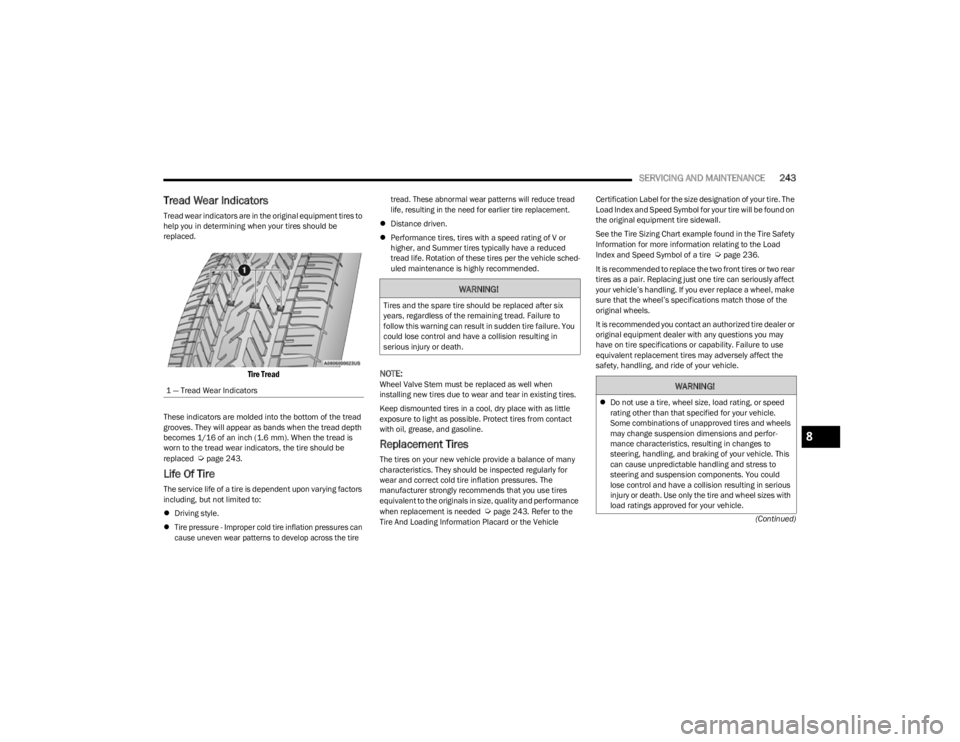
Tire Tread
These indicators are molded into the bottom of the tread
grooves. They will appear as bands when the tread depth
becomes 1/16 of an inch (1.6 mm). When the tread is
worn to the tread wear indicators, the tire should be
replaced
Úpage 243.
Life Of Tire
The service life of a tire is dependent upon varying factors
including, but not limited to:
Driving style.
Tire pressure - Improper cold tire inflation pressures can
cause uneven wear patterns to develop across the tire tread. These abnormal wear patterns will reduce tread
life, resulting in the need for earlier tire replacement.
Distance driven.
Performance tires, tires with a speed rating of V or
higher, and Summer tires typically have a reduced
tread life. Rotation of these tires per the vehicle sched-
uled maintenance is highly recommended.
NOTE:Wheel Valve Stem must be replaced as well when
installing new tires due to wear and tear in existing tires.
Keep dismounted tires in a cool, dry place with as little
exposure to light as possible. Protect tires from contact
with oil, grease, and gasoline.
Replacement Tires
The tires on your new vehicle provide a balance of many
characteristics. They should be inspected regularly for
wear and correct cold tire inflation pressures. The
manufacturer strongly recommends that you use tires
equivalent to the originals in size, quality and performance
when replacement is needed
Úpage 243. Refer to the
Tire And Loading Information Placard or the Vehicle Certification Label for the size designation of your tire. The
Load Index and Speed Symbol for your tire will be found on
the original equipment tire sidewall.
See the Tire Sizing Chart example found in the Tire Safety
Information for more information relating to the Load
Index and Speed Symbol of a tire
Úpage 236.
It is recommended to replace the two front tires or two rear
tires as a pair. Replacing just one tire can seriously affect
your vehicle’s handling. If you ever replace a wheel, make
sure that the wheel’s specifications match those of the
original wheels.
It is recommended you contact an authorized tire dealer or
original equipment dealer with any questions you may
have on tire specifications or capability. Failure to use
equivalent replacement tires may adversely affect the
safety, handling, and ride of your vehicle.
1 — Tread Wear Indicators
WARNING!
Tires and the spare tire should be replaced after six
years, regardless of the remaining tread. Failure to
follow this warning can result in sudden tire failure. You
could lose control and have a collision resulting in
serious injury or death.
WARNING!
Do not use a tire, wheel size, load rating, or speed
rating other than that specified for your vehicle.
Some combinations of unapproved tires and wheels
may change suspension dimensions and perfor -
mance characteristics, resulting in changes to
steering, handling, and braking of your vehicle. This
can cause unpredictable handling and stress to
steering and suspension components. You could
lose control and have a collision resulting in serious
injury or death. Use only the tire and wheel sizes with
load ratings approved for your vehicle.
8
23_KL_OM_EN_USC_t.book Page 243
Page 250 of 276
248SERVICING AND MAINTENANCE
(Continued)
TIRE ROTATION RECOMMENDATIONS
The tires on the front and rear of your vehicle operate at
different loads and perform different steering, handling,
and braking functions. For these reasons, they wear at
unequal rates.
These effects can be reduced by timely rotation of tires.
The benefits of rotation are especially worthwhile with
aggressive tread designs such as those on On/Off Road
type tires. Rotation will increase tread life, help to
maintain mud, snow, and wet traction levels, and
contribute to a smooth, quiet ride. Refer to the Maintenance Plan for the proper
maintenance intervals
Úpage 209. The reasons for any
rapid or unusual wear should be corrected prior to rotation
being performed.
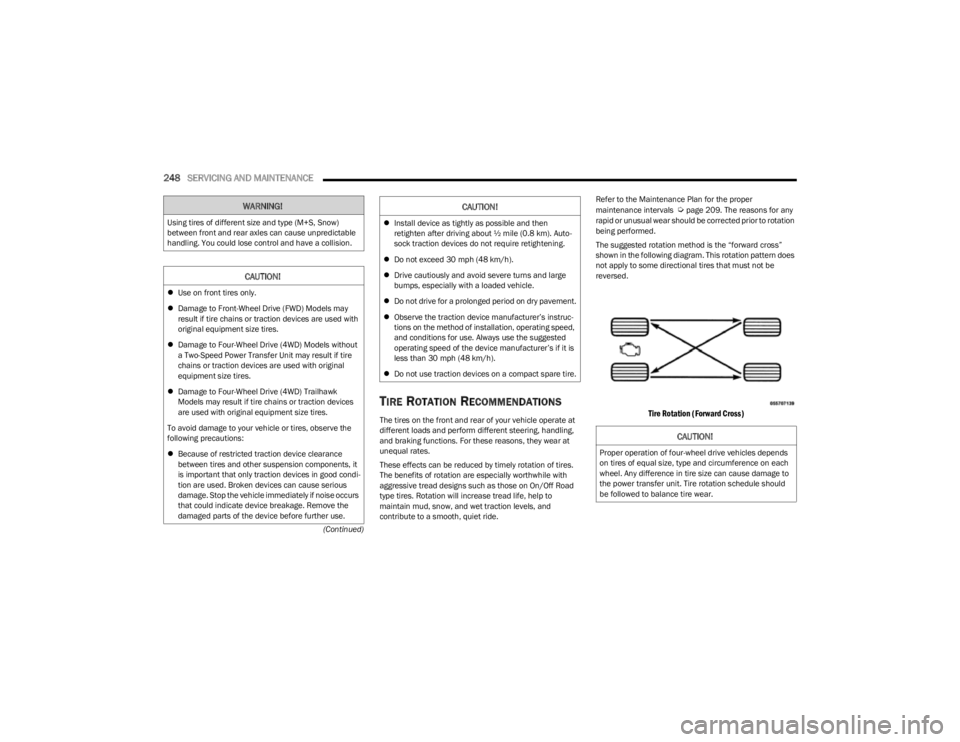
The suggested rotation method is the “forward cross”
shown in the following diagram. This rotation pattern does
not apply to some directional tires that must not be
reversed.
Tire Rotation (Forward Cross)
WARNING!
Using tires of different size and type (M+S, Snow)
between front and rear axles can cause unpredictable
handling. You could lose control and have a collision.
CAUTION!
Use on front tires only.
Damage to Front-Wheel Drive (FWD) Models may
result if tire chains or traction devices are used with
original equipment size tires.
Damage to Four-Wheel Drive (4WD) Models without
a Two-Speed Power Transfer Unit may result if tire
chains or traction devices are used with original
equipment size tires.
Damage to Four-Wheel Drive (4WD) Trailhawk
Models may result if tire chains or traction devices
are used with original equipment size tires.
To avoid damage to your vehicle or tires, observe the
following precautions:
Because of restricted traction device clearance
between tires and other suspension components, it
is important that only traction devices in good condi -
tion are used. Broken devices can cause serious
damage. Stop the vehicle immediately if noise occurs
that could indicate device breakage. Remove the
damaged parts of the device before further use.
Install device as tightly as possible and then
retighten after driving about ½ mile (0.8 km). Auto -
sock traction devices do not require retightening.
Do not exceed 30 mph (48 km/h).
Drive cautiously and avoid severe turns and large
bumps, especially with a loaded vehicle.
Do not drive for a prolonged period on dry pavement.
Observe the traction device manufacturer’s instruc -
tions on the method of installation, operating speed,
and conditions for use. Always use the suggested
operating speed of the device manufacturer’s if it is
less than 30 mph (48 km/h).
Do not use traction devices on a compact spare tire.
CAUTION!
CAUTION!
Proper operation of four-wheel drive vehicles depends
on tires of equal size, type and circumference on each
wheel. Any difference in tire size can cause damage to
the power transfer unit. Tire rotation schedule should
be followed to balance tire wear.
23_KL_OM_EN_USC_t.book Page 248
Page 267 of 276

265
Oil Selection ............................................................ 215
Oil Synthetic ............................................................ 215
Overheating ............................................................. 203
Engine Fluids And Lubricants...................................... 256
Enhanced Accident Response Feature ............. 175
, 207
Ethanol.......................................................................... 254
Exhaust Gas Cautions.................................................. 188
Exhaust System ............................................................ 222
Exterior Lights........................................................ 39
, 188
FFilters Air Cleaner ............................................................... 216Air Conditioning................................................ 48
, 218
Engine Oil ................................................................ 216 Engine Oil Disposal ................................................. 215
Flashers Hazard Warning ...................................................... 189
Turn Signals ..................................................... 74
, 188
Flash-To-Pass ..................................................................40
Flat Tire Changing ............................................... 235
, 244
Flat Tire Stowage ................................................ 235, 244
Flooded Engine Starting .................................................78
Fluid Capacities ............................................................ 256
Fluid Leaks ................................................................... 188
Fluid Level Checks Brake ....................................................................... 225Engine Oil ................................................................ 214
Fob, Key ...........................................................................13
Fog Lights ........................................................................41 Fold-Flat Seats ................................................................28Folding Rear Seats..........................................................29Forward Collision Warning ........................................... 154
Four Wheel Drive............................................................. 85 Freeing A Stuck Vehicle................................................ 204
Fuel
Additives...................................................................255Clean Air ...................................................................254Ethanol .....................................................................254
Light............................................................................ 71
Materials Added ...................................................... 255
Methanol .................................................................. 254
Tank Capacity .......................................................... 256
Fueling ...........................................................................113
Fuses .............................................................................226
GGarage Door Opener (HomeLink®) ............................... 35 Gasoline, Clean Air ....................................................... 254
Gasoline, Reformulated ............................................... 254
Gear Ranges ................................................................... 82Gear Selector Override ................................................. 203
Glass Cleaning .............................................................. 252
Gross Axle Weight Rating ............................................. 115
Gross Combination Weight Rating............................... 115
Gross Trailer Weight ..................................................... 115
Gross Vehicle Weight Rating ........................................ 114
GVWR.............................................................................113
HHazard Warning Flashers ............................................. 189
Head Restraint Removal ................................................ 32
Head Restraints .............................................................. 32
Head Rests...................................................................... 32
Headlights ....................................................................... 39 Automatic ................................................................... 40
Automatic High Beam ............................................... 40 Cleaning ................................................................... 250
High Beam .......................................................... 39
, 40
High Beam/Low Beam Select Switch ...................... 40
On With Wipers.......................................................... 41
Passing ............................................................... 39
, 40
Switch ........................................................................ 39
Time Delay ................................................................. 41
Heated Mirrors ............................................................... 35 Heated Seats .................................................................. 31
Heated Steering Wheel .................................................. 24
Hill Descent Control ..................................................... 146
Hill Descent Control Indicator...................................... 146
Hill Start Assist ............................................................. 148
Hitches Trailer Towing .......................................................... 116
HomeLink® (Garage Door Opener)............................... 35
Hood Prop ....................................................................... 56
Hood Release ................................................................. 56
IIgnition ............................................................................ 16 Switch ........................................................................ 16
Ignition Pak Interlock ..................................................... 81
Illuminated Entry ............................................................ 43
Indicator light Blue ............................................................................ 75
Green ......................................................................... 73
White .......................................................................... 74
Yellow......................................................................... 73
Inside Rearview Mirror .......................................... 34
, 189
Instrument Cluster Descriptions
S
.......................................... 61, 63, 74
Display ....................................................................... 63
Display Controls ........................................................ 6311
23_KL_OM_EN_USC_t.book Page 265
Page 270 of 276

268
Remote Sound System (Radio) Control ...................... 140
Remote Starting
Exit Remote Start Mode ............................................18
Uconnect Customer Programmable Features .........19
Uconnect Settings...................................................... 19
Remote Starting System.................................................18
Replacement Keys ..........................................................15 Replacement Tires ....................................................... 243
Reporting Safety Defects............................................. 261
Restraints, Child ........................................................... 176
Restraints, Head ............................................................. 32
Roll Over Warning ............................................................. 8
Roof Type Carrier ............................................................60
Rotation, Tires .............................................................. 248
SSafety Checks Inside Vehicle ...................................... 187
Safety Checks Outside Vehicle ................................... 188
Safety Defects, Reporting............................................ 261
Safety Information, Tire ............................................... 235
Safety Tips .................................................................... 186
Schedule, Maintenance............................................... 208
Seat Belt Reminder.........................................................68 Seat Belts ............................................................ 159
, 187
Adjustable Shoulder Belt........................................ 162
Adjustable Upper Shoulder Anchorage ................. 162
Adjustable Upper Shoulder Belt Anchorage.......... 162
Automatic Locking Retractor (ALR)........................ 165
Child Restraints ...................................................... 176
Energy Management Feature ................................ 165
Extender .................................................................. 164
Front Seat..............................................159
, 160, 161
Inspection................................................................ 187 Lap/Shoulder Belt Operation ................................. 161
Lap/Shoulder Belt Untwisting ................................ 162
Lap/Shoulder Belts ................................................. 160
Operating Instructions............................................. 161Pregnant Women..................................................... 165Pretensioners .......................................................... 165
Rear Seat ................................................................. 160
Reminder ................................................................. 159
Seat Belt Extender...................................................164
Seat Belt Pretensioner ............................................165
Untwisting Procedure .............................................. 162
Seat Belts Maintenance ............................................... 251
Seats................................................................................ 28 Adjustment.......................................................... 28
, 30
Easy Entry .................................................................. 31
Head Restraints......................................................... 32
Heated........................................................................ 31
Memory ...................................................................... 26
Rear Folding............................................................... 28
Tilting .......................................................................... 28
Vented ........................................................................ 32
Ventilated ................................................................... 32
Security Alarm .......................................................... 20
, 70
Arm The System......................................................... 20
Disarm The System ................................................... 20
Selec-Terrain ................................................................... 88 Sentry Key (Immobilizer) ................................................ 16
Sentry Key Replacement................................................ 15
Service Assistance........................................................ 258
Service Contract ...........................................................260
Service Manuals ...........................................................261
Settings ......................................................................... 126
Shift Lever Override ...................................................... 203 Shifting
Automatic Transmission ........................................... 81
Power Transfer Unit, Shifting Into PowerTransfer Unit Neutral (N) ..........................122
, 123
Transfer Case, Shifting Into Transfer Case Neutral (N) .......................................................... 122
Transfer Case, Shifting Out Of Transfer Case Neutral (N) .......................................................... 123
Shoulder Belts .............................................................. 160
Side Distance Warning System ................................... 104
Side View Mirror Adjustment ......................................... 34 Signals, Turn .......................................................... 74
, 188
Snow Chains (Tire Chains) ........................................... 246
Snow Tires .................................................................... 244
Spare Tires ...........................................................244
, 245
Speed Control Cancel ........................................................................ 92
Resume...................................................................... 91
Starting............................................................................ 77 Button ........................................................................ 16
Cold Weather............................................................. 77
Engine Fails To Start ................................................. 78
Remote ...................................................................... 18
Starting Procedures ....................................................... 77 Steering Tilt Column................................................................. 24
Wheel, Heated .................................................... 24
, 25
Steering Wheel Audio Controls .................................... 140
Steering Wheel Mounted Sound System Controls ..... 140
Stop/Start ................................................................ 74
, 89
Storage ..................................................................... 49, 50
Console ...................................................................... 50
Storage Compartment, Center Seat.............................. 50
Storage, Vehicle..................................................... 48
, 250
23_KL_OM_EN_USC_t.book Page 268