transmission JEEP COMMANDER 2007 1.G Owner's Manual
[x] Cancel search | Manufacturer: JEEP, Model Year: 2007, Model line: COMMANDER, Model: JEEP COMMANDER 2007 1.GPages: 456, PDF Size: 6.85 MB
Page 261 of 456
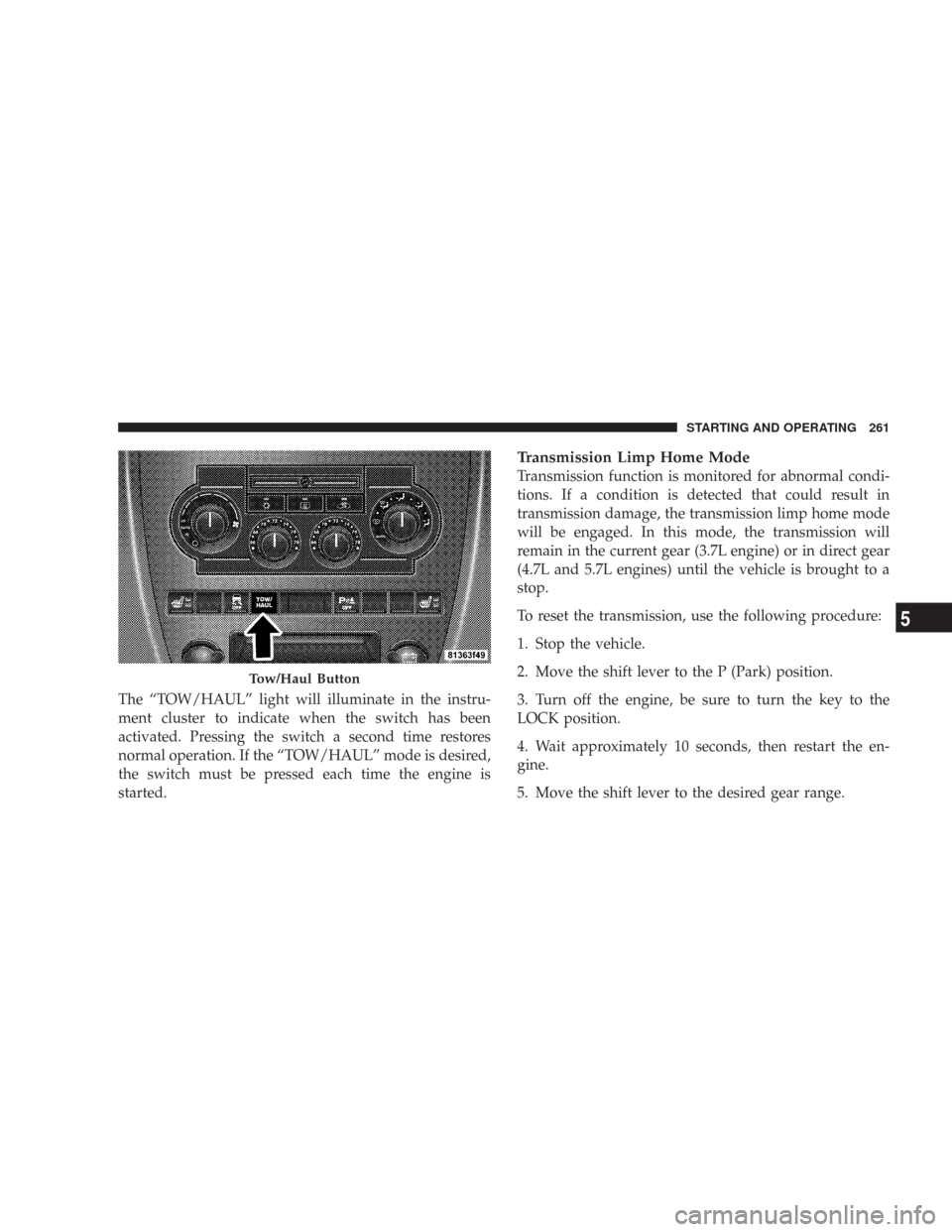
The “TOW/HAUL” light will illuminate in the instru-
ment cluster to indicate when the switch has been
activated. Pressing the switch a second time restores
normal operation. If the “TOW/HAUL” mode is desired,
the switch must be pressed each time the engine is
started.
Transmission Limp Home Mode
Transmission function is monitored for abnormal condi-
tions. If a condition is detected that could result in
transmission damage, the transmission limp home mode
will be engaged. In this mode, the transmission will
remain in the current gear (3.7L engine) or in direct gear
(4.7L and 5.7L engines) until the vehicle is brought to a
stop.
To reset the transmission, use the following procedure:
1. Stop the vehicle.
2. Move the shift lever to the P (Park) position.
3. Turn off the engine, be sure to turn the key to the
LOCK position.
4. Wait approximately 10 seconds, then restart the en-
gine.
5. Move the shift lever to the desired gear range.
Tow/Haul Button
STARTING AND OPERATING 261
5
Page 262 of 456
If the problem is no longer detected, the transmission will
return to normal operation. If the problem persists, P
(Park), R (Reverse), and N (Neutral) will continue to
operate. Only Second gear range will operate in the D
(Drive) shifter position. Have the transmission checked at
your authorized dealer as soon as possible.
Torque Converter Clutch
A feature, designed to improve fuel economy, has been
included in the automatic transmission on your vehicle.
A clutch within the torque converter engages automati-
cally at a calibrated speed at light throttle. It engages at
higher speeds under heavier acceleration. This may re-
sult in a slightly different feeling or response during
normal operation in high gear. When the vehicle speed
drops below a calibrated speed, or during acceleration,
the clutch automatically and smoothly disengages. The
feature is operational in Overdrive and in Drive.NOTE:The torque converter clutch will not engage
until the transmission fluid and engine coolant are warm
[usually after 1-3 miles (1.6 - 4.8 km) of driving]. Because
the engine speed is higher when the torque converter
clutch is not engaged, it may seem as if the transmission
is not shifting into Overdrive when cold. This is normal.
Manually shifting (using the ERS shift control) between 4
(direct gear) and 5/D (Overdrive gear) positions will
demonstrate that the transmission is able to shift into and
out of Overdrive.
NOTE:If the vehicle has not been driven in several
days, the first few seconds of operation after shifting the
transmission into gear may seem sluggish. This is due to
the fluid partially draining from the torque converter into
the transmission. This condition is normal and will not
cause damage to the transmission. The torque converter
will refill within five seconds of shifting from Park into
any other gear position.
262 STARTING AND OPERATING
Page 263 of 456
Rocking the Vehicle
If the vehicle becomes stuck in snow, sand, or mud, it can
often be moved by a rocking motion. Move the gear
selector rhythmically between D (Drive) and R (Reverse),
while applying slight pressure to the accelerator.
NOTE:The Electronic Stability Program (ESP) and
Traction Control (if equipped) should be turned OFF
before attempting to rock the vehicle. Refer to Section 3 of
this manual.
The least amount of accelerator pedal pressure to main-
tain the rocking motion without spinning the wheels or
racing the engine is most effective. Racing the engine or
spinning the wheels, due to the frustration of not freeing
the vehicle, may lead to transmission overheating and
failure. Allow the engine to idle with the transmission
selector in N (Neutral) for at least one minute after everyfive rocking-motion cycles. This will minimize overheat-
ing and reduce the risk of transmission failure during
prolonged efforts to free a stuck vehicle.
CAUTION!
When “rocking” a stuck vehicle by moving between
“First” and R (Reverse), do not spin the wheels faster
than 15 mph (24 km/h), or drivetrain damage may
result.
STARTING AND OPERATING 263
5
Page 265 of 456
road surfaces only. Driving in the 4 LOW position on dry
hard surfaced roads may cause increased tire wear and
damage to driveline components.
When operating your vehicle in 4 LOW, the engine speed
is approximately three times that of the 4 HI position at a
given road speed. Take care not to overspeed the engine
and do not exceed 25 mph (40 km/h).
Proper operation of four wheel drive vehicles depends on
tires of equal size, type, and circumference on each
wheel. Any difference will adversely affect shifting and
cause damage to the transfer case.
Because four wheel drive provides improved traction,
there is a tendency to exceed safe turning and stopping
speeds. Do not go faster than road conditions permit.WARNING!
You or others could be injured if you leave the
vehicle unattended with the transfer case in the N
(Neutral) position without first fully engaging the
parking brake. The transfer case N (Neutral) position
disengages both the front and rear driveshafts from
the powertrain and will allow the vehicle to move
regardless of the transmission position. The parking
brake should always be applied when the driver is
not in the vehicle.
Shift Positions
For additional information on the appropriate use of each
transfer case mode position, see the information below:
4HI
Four Wheel Drive High Range — All roads surfaces such
as ice, snow, gravel, sand, and dry hard pavement.
STARTING AND OPERATING 265
5
Page 266 of 456
N (Neutral)
Neutral — Disengages both the front and rear driveshafts
from the powertrain. To be used for flat towing behind
another vehicle. Refer to “Recreational Towing” in Sec-
tion 5 of this manual.
4 LOW
Four Wheel Drive Low Range — Low speed 4 wheel
drive. Locks the front and rear driveshafts together.
Forces the front and rear wheels to rotate at the same
speed. Additional traction and maximum pulling power
for loose, slippery road surfaces only. Do not exceed 25
mph (40 km/h).
Shifting Procedures
4HIto4LOW
With the vehicle at speeds of 0 to 3 mph (0 to 5 km/h),
key ON or engine running, shift the transmission into N
(Neutral), and raise the transfer case T-handle. “The 4WD
LOW Indicator Lamp” in the instrument cluster will
begin to flash and remain on solid when the shift is
complete. Release the T-handle.
NOTE:If shift conditions/interlocks are not met, or a
transfer case motor temperature protection condition
exists, a “CHECK SHIFT PROCEDURES” message will
flash from the EVIC (Electronic Vehicle Information Cen-
ter). Refer to “Electronic Vehicle Information Center
(EVIC)” in Section 4 of this manual. (See page 184 for
more information.)
266 STARTING AND OPERATING
Page 267 of 456
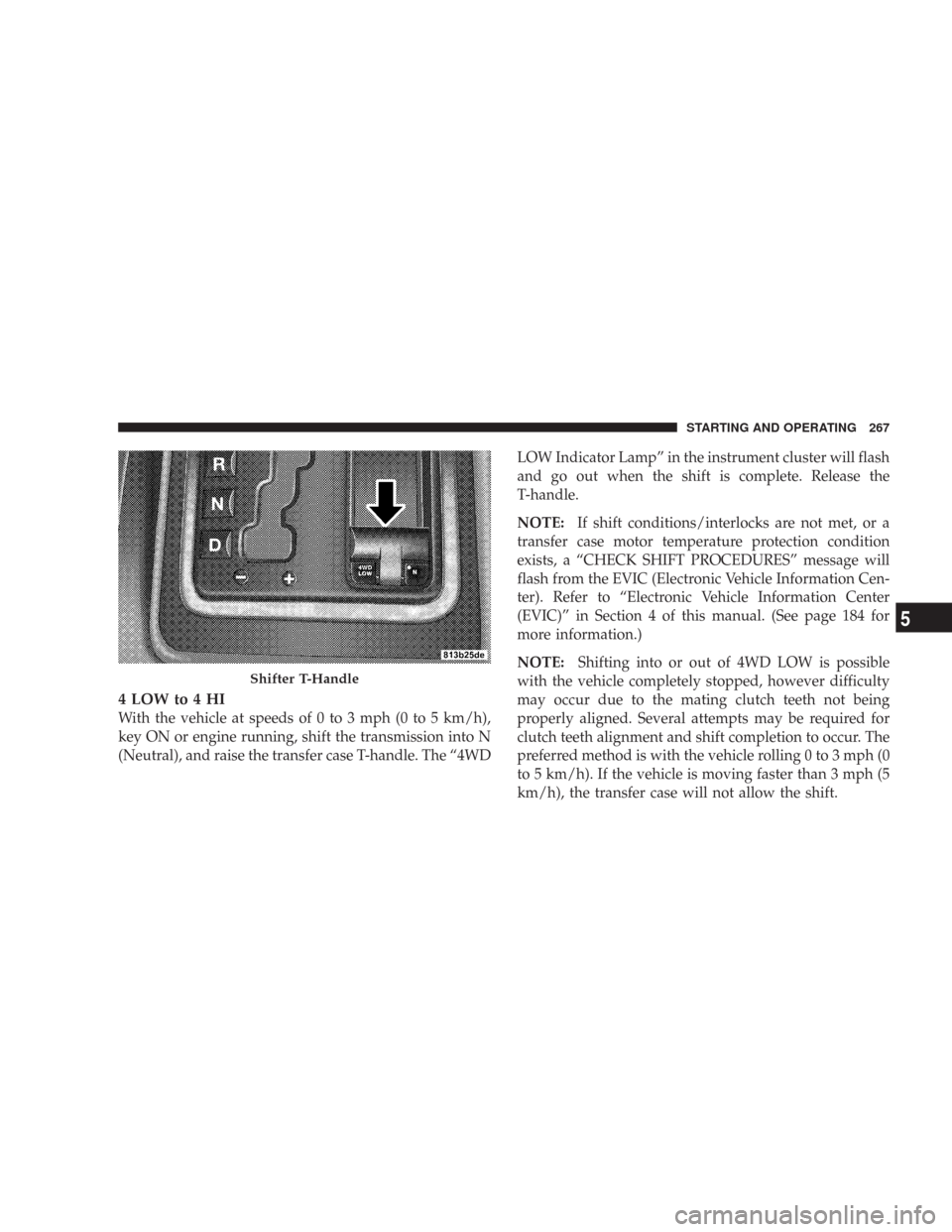
4 LOW to 4 HI
With the vehicle at speeds of 0 to 3 mph (0 to 5 km/h),
key ON or engine running, shift the transmission into N
(Neutral), and raise the transfer case T-handle. The “4WDLOW Indicator Lamp” in the instrument cluster will flash
and go out when the shift is complete. Release the
T-handle.
NOTE:If shift conditions/interlocks are not met, or a
transfer case motor temperature protection condition
exists, a “CHECK SHIFT PROCEDURES” message will
flash from the EVIC (Electronic Vehicle Information Cen-
ter). Refer to “Electronic Vehicle Information Center
(EVIC)” in Section 4 of this manual. (See page 184 for
more information.)
NOTE:Shifting into or out of 4WD LOW is possible
with the vehicle completely stopped, however difficulty
may occur due to the mating clutch teeth not being
properly aligned. Several attempts may be required for
clutch teeth alignment and shift completion to occur. The
preferred method is with the vehicle rolling 0 to 3 mph (0
to 5 km/h). If the vehicle is moving faster than 3 mph (5
km/h), the transfer case will not allow the shift.
Shifter T-Handle
STARTING AND OPERATING 267
5
Page 268 of 456
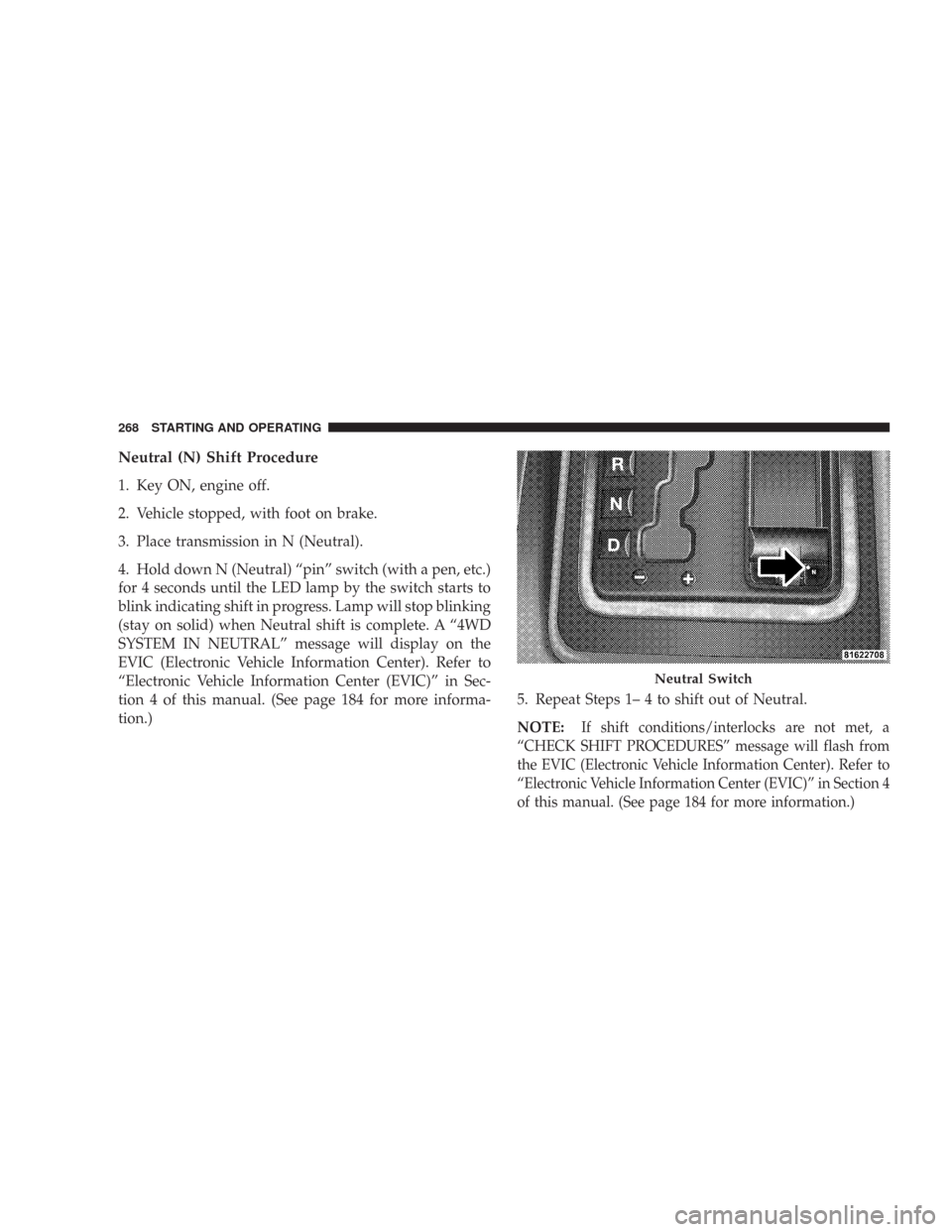
Neutral (N) Shift Procedure
1. Key ON, engine off.
2. Vehicle stopped, with foot on brake.
3. Place transmission in N (Neutral).
4. Hold down N (Neutral) “pin” switch (with a pen, etc.)
for 4 seconds until the LED lamp by the switch starts to
blink indicating shift in progress. Lamp will stop blinking
(stay on solid) when Neutral shift is complete. A “4WD
SYSTEM IN NEUTRAL” message will display on the
EVIC (Electronic Vehicle Information Center). Refer to
“Electronic Vehicle Information Center (EVIC)” in Sec-
tion 4 of this manual. (See page 184 for more informa-
tion.)5. Repeat Steps 1– 4 to shift out of Neutral.
NOTE:
If shift conditions/interlocks are not met, a
“CHECK SHIFT PROCEDURES” message will flash from
the EVIC (Electronic Vehicle Information Center). Refer to
“Electronic Vehicle Information Center (EVIC)” in Section 4
of this manual. (See page 184 for more information.)
Neutral Switch
268 STARTING AND OPERATING
Page 271 of 456
and/or the flow rate is reduced. If you must cross
flowing water avoid depths in excess of 9 inches. The
flowing water can erode the streambed causing your
vehicle to sink into deeper water. Determine exit point(s)
that are downstream of your entry point to allow for
drifting.
Standing Water
Avoid driving in standing water deeper than 20 inches,
and reduce speed appropriately to minimize wave ef-
fects. Maximum speed in 20 inches of water is less than 5
mph (8 km/h).
Maintenance
After driving through deep water, inspect your vehicle
fluids and lubricants (engine oil, transmission oil, axle,
transfer case) to assure the fluids have not been contami-
nated. Contaminated fluid (milky, foamy in appearance)
should be flushed/changed as soon as possible to pre-
vent component damage.Driving In Snow, Mud and Sand
In heavy snow, when pulling a load, or for additional
control at slower speeds, shift the transmission to a low
gear and shift the transfer case to 4WD LOW if necessary.
Refer to “Four-Wheel Drive Operation” in this section.
Do not shift to a lower gear than necessary to maintain
headway. Over-revving the engine can spin the wheels
and traction will be lost.
Avoid abrupt downshifts on icy or slippery roads, be-
cause engine braking may cause skidding and loss of
control.
Hill Climbing
NOTE:Before attempting to climb a hill, determine the
conditions at the crest and/or on the other side.
Before climbing a steep hill,shift the transmission to a
lower gear and shift the transfer case to 4WD LOW. Use
first gear and 4WD LOW for very steep hills.
STARTING AND OPERATING 271
5
Page 272 of 456
If you stall or begin to lose headwaywhile climbing a
steep hill, allow your vehicle to come to a stop and
immediately apply the brakes. Restart the engine and
shift to R (Reverse). Back slowly down the hill allowing
the compression braking of the engine to help regulate
your speed. If the brakes are required to control vehicle
speed, apply them lightly and avoid locking or skidding
the tires.
WARNING!
If the engine stalls or you lose headway or cannot
make it to the top of a steep hill or grade, never
attempt to turn around. To do so may result in
tipping and rolling the vehicle. Always back care-
fully straight down a hill in R (Reverse) gear. Never
back down a hill in N (Neutral) using only the brake.
Remember, never drive diagonally across a hill-always
drive straight up or down.
If the wheels start to slip as you approach the crest of a
hill, ease off the accelerator and maintain headway by
turning the front wheels slowly. This may provide a fresh
“bite” into the surface and will usually provide traction
to complete the climb.
Traction Downhill
Shift the transmission into a low gear and the transfer
case to 4WD LOW range. Let the vehicle go slowly down
the hill with all four wheels turning against engine
compression drag. This will permit you to control the
vehicle speed and direction.
When descending mountains or hills, repeated braking
can cause brake fade with loss of braking control. Avoid
repeated heavy braking by downshifting the transmis-
sion whenever possible.
272 STARTING AND OPERATING
Page 274 of 456
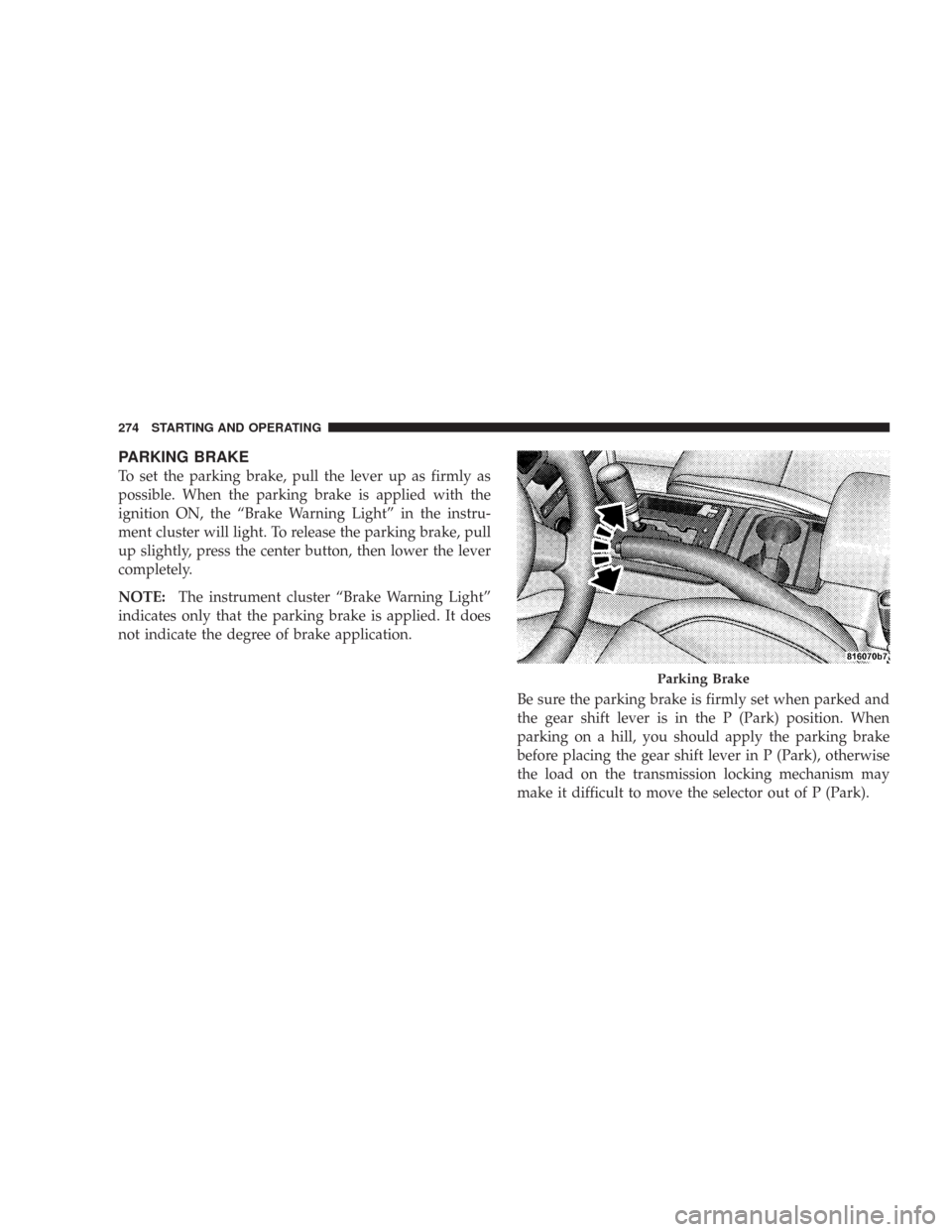
PARKING BRAKE
To set the parking brake, pull the lever up as firmly as
possible. When the parking brake is applied with the
ignition ON, the “Brake Warning Light” in the instru-
ment cluster will light. To release the parking brake, pull
up slightly, press the center button, then lower the lever
completely.
NOTE:The instrument cluster “Brake Warning Light”
indicates only that the parking brake is applied. It does
not indicate the degree of brake application.
Be sure the parking brake is firmly set when parked and
the gear shift lever is in the P (Park) position. When
parking on a hill, you should apply the parking brake
before placing the gear shift lever in P (Park), otherwise
the load on the transmission locking mechanism may
make it difficult to move the selector out of P (Park).
Parking Brake
274 STARTING AND OPERATING