transmission oil JEEP COMMANDER 2007 1.G Owners Manual
[x] Cancel search | Manufacturer: JEEP, Model Year: 2007, Model line: COMMANDER, Model: JEEP COMMANDER 2007 1.GPages: 456, PDF Size: 6.85 MB
Page 245 of 456
Regular cleaning of the inside of the windows with a
non-filming cleaning solution (vinegar and water works
very well) will help prevent contaminates (cigarette
smoke, perfumes, etc.) from sticking to the windows.
Contaminates increase the rate of window fogging.
Summer Operation
Air conditioned vehicles must be protected with a high
quality antifreeze coolant during summer to provide
proper corrosion protection and to raise the boiling point
of the coolant for protection against overheating. A 50 %
concentration is recommended. Refer to Recommended
Fluids and Genuine Parts for the proper coolant type.
When using the air conditioner in extremely heavy traffic
in hot weather especially when towing a trailer, addi-
tional engine cooling may be required. If this situation is
encountered, operate the transmission in a lower gear to
increase engine RPM, coolant flow and fan speed. When
stopped in heavy traffic, it may be necessary to shift intoN (Neutral) and depress the accelerator slightly for fast
idle operation to increase coolant flow and fan speed.
Your air conditioning system is also equipped with an
automatic recirculation system. When the system senses
a heavy load or high heat conditions, it may use partial
Recirculation A/C mode to provide additional comfort.Winter Operation
When operating the system during the winter months,
make sure the air intake, located directly in front of the
windshield, is free of ice, slush, snow, or other obstruc-
tions.
Vacation Storage
Anytime you store your vehicle, or keep it out of service
(i.e. vacation) for two weeks or more, run the air condi-
tioning system at idle for about five minutes in the fresh
air and high blower setting. This will insure adequate
system lubrication to minimize the possibility of com-
pressor damage when the system is started again.
UNDERSTANDING YOUR INSTRUMENT PANEL 245
4
Page 255 of 456
ENGINE BLOCK HEATER — IF EQUIPPED
The engine block heater warms engine coolant and
permits quicker starts in cold weather. Connect the cord
to a standard 110-115 volt AC electrical outlet with
grounded, three wire extension cord.
Use the heater when temperatures below 0°F (-18°C) are
expected to last for several days.
The engine block heater cord is located:
•3.7L/4.7L Engine — coiled and strapped to the engine
oil dipstick tube.
•5.7L Engine — bundled and fastened to the injector
harness.
WARNING!
Remember to disconnect the cord before driving.
Damage to the 110-115 volt AC electrical cord could
cause electrocution.
AUTOMATIC TRANSMISSION
CAUTION!
Damage to the transmission may occur if the follow-
ing precautions are not observed:
•Shift into P (Park) only after the vehicle has come
to a complete stop.
•Shift into or out of R (Reverse) only after the
vehicle has come to a complete stop and the
engine is at idle speed.
•Do not shift from R (Reverse), P (Park), or N
(Neutral) into any forward gear when the engine
is above idle speed.
•Before shifting into any gear, make sure your foot
is firmly on the brake pedal.
STARTING AND OPERATING 255
5
Page 271 of 456
and/or the flow rate is reduced. If you must cross
flowing water avoid depths in excess of 9 inches. The
flowing water can erode the streambed causing your
vehicle to sink into deeper water. Determine exit point(s)
that are downstream of your entry point to allow for
drifting.
Standing Water
Avoid driving in standing water deeper than 20 inches,
and reduce speed appropriately to minimize wave ef-
fects. Maximum speed in 20 inches of water is less than 5
mph (8 km/h).
Maintenance
After driving through deep water, inspect your vehicle
fluids and lubricants (engine oil, transmission oil, axle,
transfer case) to assure the fluids have not been contami-
nated. Contaminated fluid (milky, foamy in appearance)
should be flushed/changed as soon as possible to pre-
vent component damage.Driving In Snow, Mud and Sand
In heavy snow, when pulling a load, or for additional
control at slower speeds, shift the transmission to a low
gear and shift the transfer case to 4WD LOW if necessary.
Refer to “Four-Wheel Drive Operation” in this section.
Do not shift to a lower gear than necessary to maintain
headway. Over-revving the engine can spin the wheels
and traction will be lost.
Avoid abrupt downshifts on icy or slippery roads, be-
cause engine braking may cause skidding and loss of
control.
Hill Climbing
NOTE:Before attempting to climb a hill, determine the
conditions at the crest and/or on the other side.
Before climbing a steep hill,shift the transmission to a
lower gear and shift the transfer case to 4WD LOW. Use
first gear and 4WD LOW for very steep hills.
STARTING AND OPERATING 271
5
Page 386 of 456
Check the fluid level while the transmission is at normal
operating temperature. This occurs after at least 15 miles
(25 km) of driving. At normal operating temperature the
fluid cannot be held comfortably between the fingertips.
To check the automatic transmission fluid level properly,
the following procedure must be used:
1. Operate the engine at idle speed and normal operating
temperature.
2. The vehicle must be on level ground.
3. Fully apply the parking brake and press the brake
pedal.
4. Place the gear selector momentarily in each gear
position ending with the lever in P (Park).
5. Remove the dipstick, wipe it clean and reinsert it until
seated.6. Remove the dipstick again and note the fluid level on
both sides. The fluid level should be between the “HOT”
(upper) reference holes on the dipstick at normal operat-
ing temperature. The fluid level is only valid if there is a
solid coating of oil is seen on both sides of the dipstick. If
the fluid is low, add as required into the dipstick tube.Do
not overfill.After adding any quantity of oil through the
oil fill tube, wait a minimum of two (2) minutes for the oil
to fully drain into the transmission before rechecking the
fluid level.
NOTE:If it is necessary to check the transmissionbelow
the operating temperature, the fluid level should be
between the two “COLD” (lower) holes on the dipstick
with the fluid at approximately 70°F (21°C) (room tem-
perature). If the fluid level is correctly established at
room temperature, it should be between the “HOT”
(upper) reference holes when the transmission reaches
180°F (82°C). Remember it is best to check the level at the
normal operating temperature.
386 MAINTAINING YOUR VEHICLE
Page 408 of 456
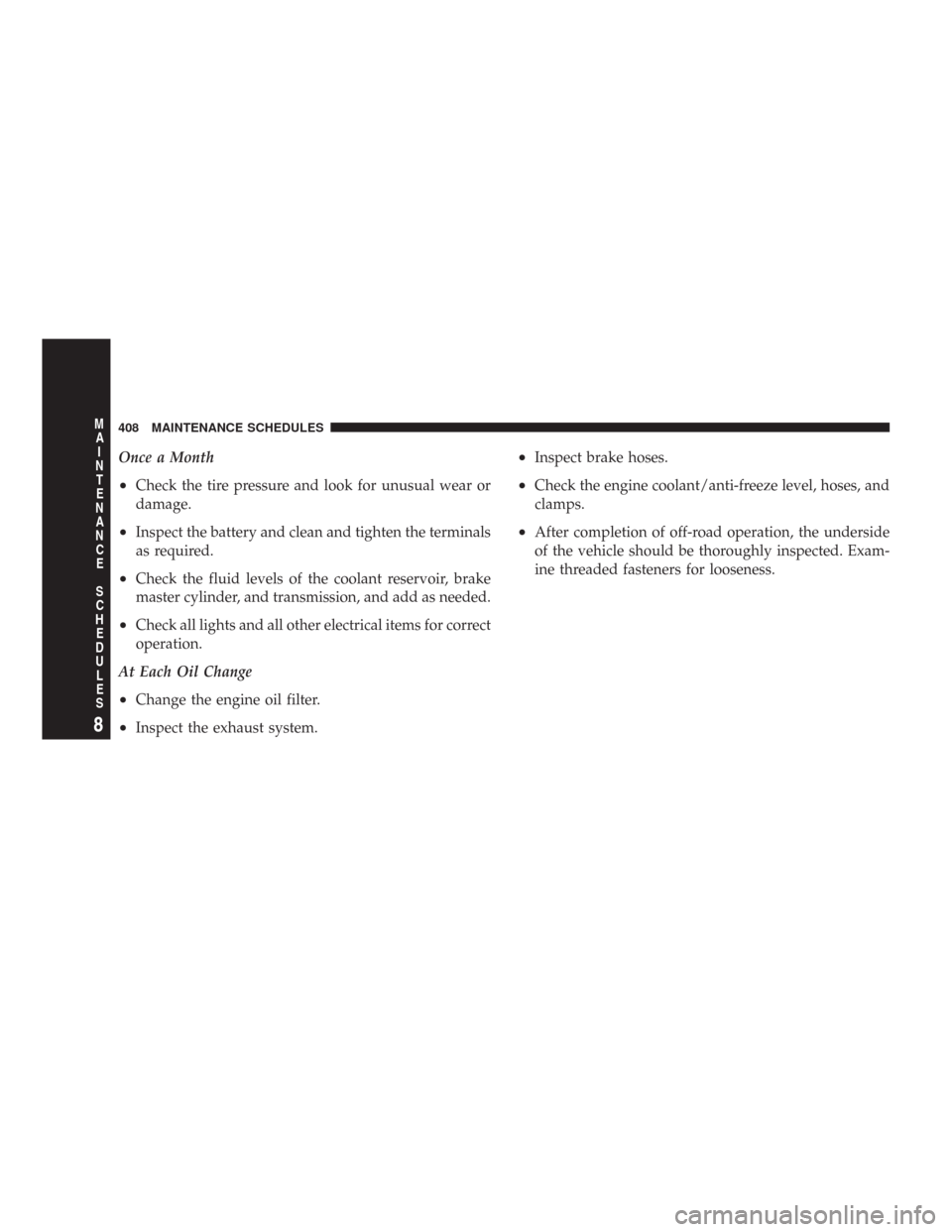
Once a Month
•Check the tire pressure and look for unusual wear or
damage.
•Inspect the battery and clean and tighten the terminals
as required.
•Check the fluid levels of the coolant reservoir, brake
master cylinder, and transmission, and add as needed.
•Check all lights and all other electrical items for correct
operation.
At Each Oil Change
•Change the engine oil filter.
•Inspect the exhaust system.
•Inspect brake hoses.
•Check the engine coolant/anti-freeze level, hoses, and
clamps.
•After completion of off-road operation, the underside
of the vehicle should be thoroughly inspected. Exam-
ine threaded fasteners for looseness.
408 MAINTENANCE SCHEDULES
8
M
A
I
N
T
E
N
A
N
C
E
S
C
H
E
D
U
L
E
S
Page 413 of 456
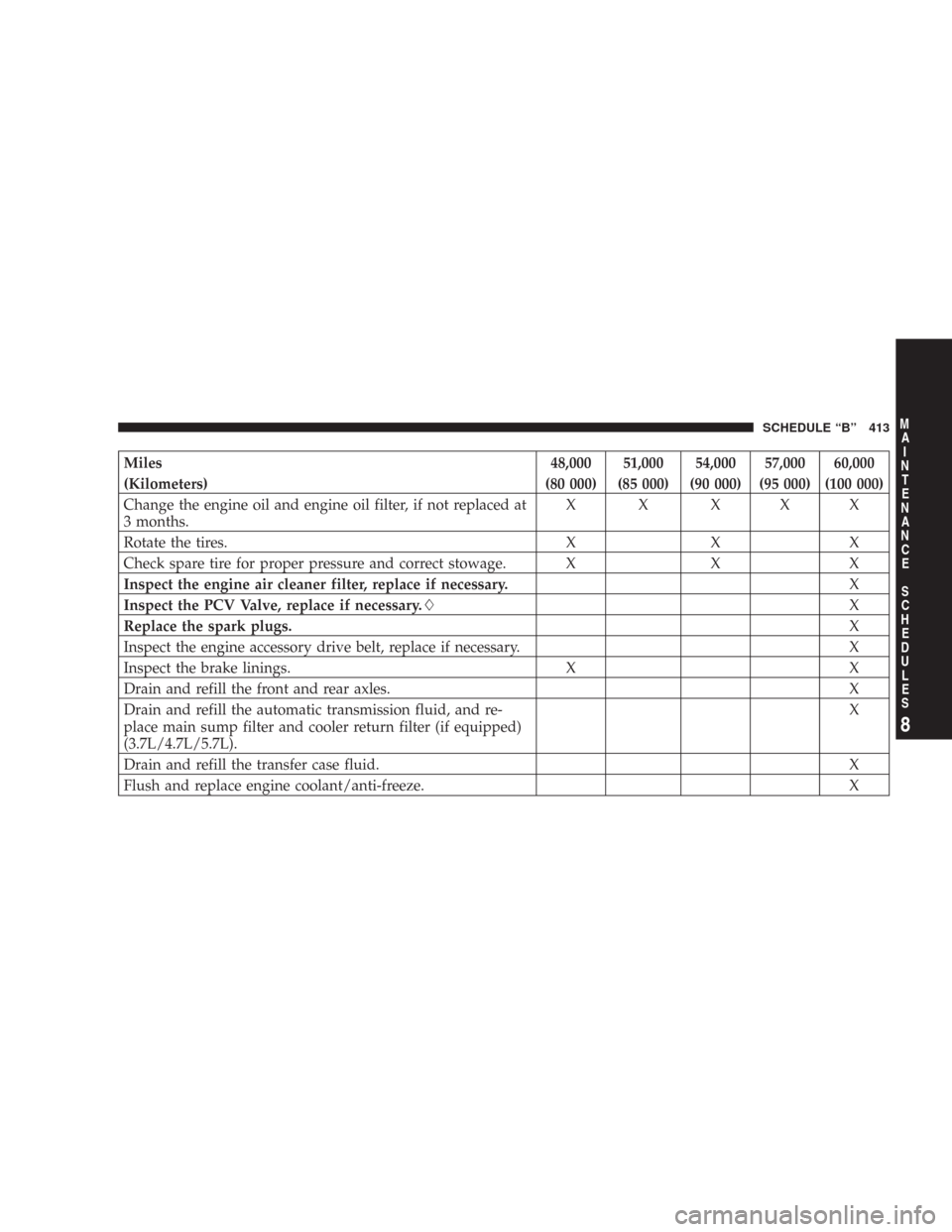
Miles 48,000 51,000 54,000 57,000 60,000
(Kilometers) (80 000) (85 000) (90 000) (95 000) (100 000)
Change the engine oil and engine oil filter, if not replaced at
3 months.XXXXX
Rotate the tires. X X X
Check spare tire for proper pressure and correct stowage. X X X
Inspect the engine air cleaner filter, replace if necessary.X
Inspect the PCV Valve, replace if necessary.
X
Replace the spark plugs.X
Inspect the engine accessory drive belt, replace if necessary. X
Inspect the brake linings. X X
Drain and refill the front and rear axles. X
Drain and refill the automatic transmission fluid, and re-
place main sump filter and cooler return filter (if equipped)
(3.7L/4.7L/5.7L).X
Drain and refill the transfer case fluid. X
Flush and replace engine coolant/anti-freeze. X
SCHEDULE “B” 413
8
M
A
I
N
T
E
N
A
N
C
E
S
C
H
E
D
U
L
E
S
Page 417 of 456
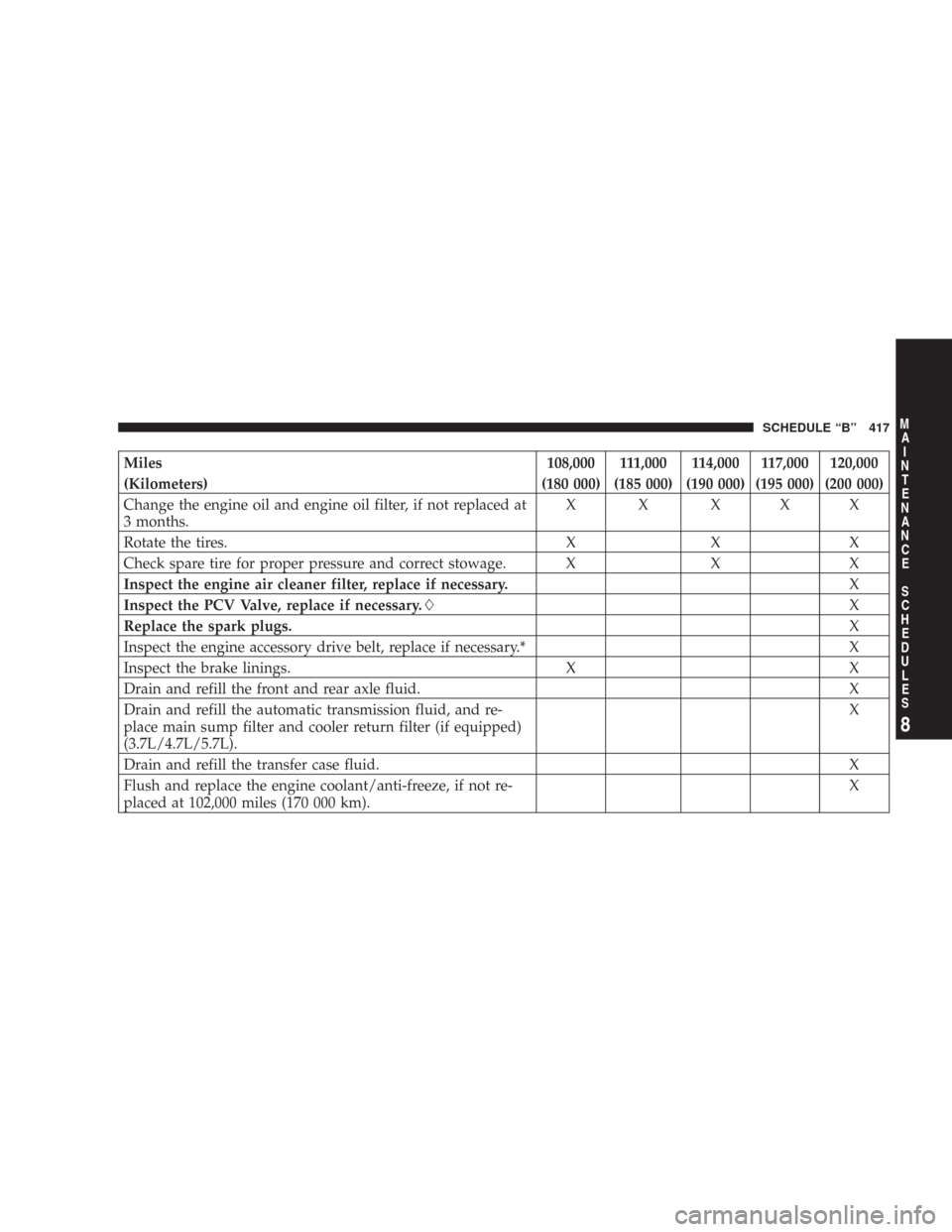
Miles 108,000 111,000 114,000 117,000 120,000
(Kilometers) (180 000) (185 000) (190 000) (195 000) (200 000)
Change the engine oil and engine oil filter, if not replaced at
3 months.XXXXX
Rotate the tires. X X X
Check spare tire for proper pressure and correct stowage. X X X
Inspect the engine air cleaner filter, replace if necessary.X
Inspect the PCV Valve, replace if necessary.
X
Replace the spark plugs.X
Inspect the engine accessory drive belt, replace if necessary.* X
Inspect the brake linings. X X
Drain and refill the front and rear axle fluid. X
Drain and refill the automatic transmission fluid, and re-
place main sump filter and cooler return filter (if equipped)
(3.7L/4.7L/5.7L).X
Drain and refill the transfer case fluid. X
Flush and replace the engine coolant/anti-freeze, if not re-
placed at 102,000 miles (170 000 km).X
SCHEDULE “B” 417
8
M
A
I
N
T
E
N
A
N
C
E
S
C
H
E
D
U
L
E
S
Page 441 of 456
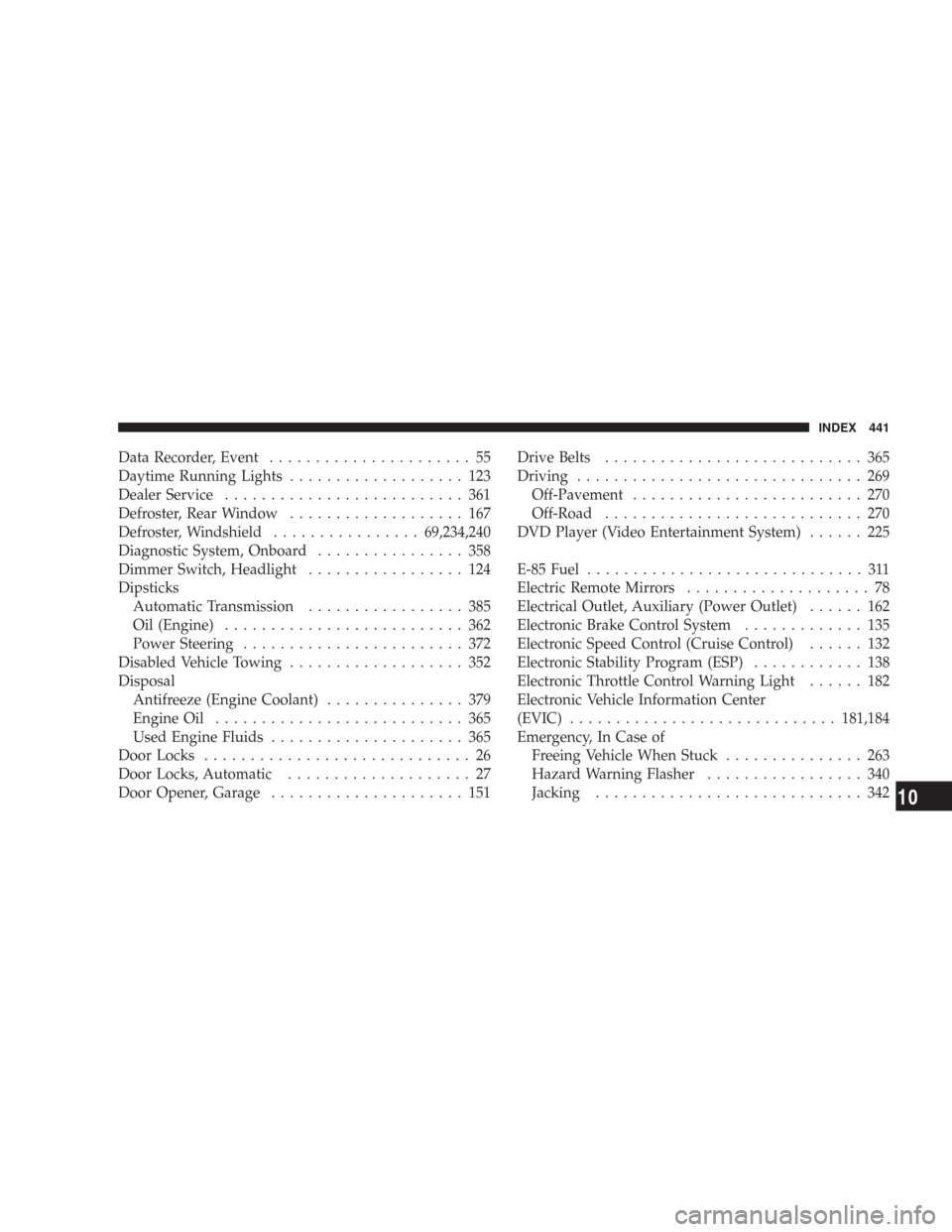
Data Recorder, Event...................... 55
Daytime Running Lights................... 123
Dealer Service.......................... 361
Defroster, Rear Window................... 167
Defroster, Windshield................69,234,240
Diagnostic System, Onboard................ 358
Dimmer Switch, Headlight................. 124
Dipsticks
Automatic Transmission................. 385
Oil (Engine).......................... 362
Power Steering........................ 372
Disabled Vehicle Towing................... 352
Disposal
Antifreeze (Engine Coolant)............... 379
Engine Oil........................... 365
Used Engine Fluids..................... 365
Door Locks............................. 26
Door Locks, Automatic.................... 27
Door Opener, Garage..................... 151Drive Belts............................ 365
Driving............................... 269
Off-Pavement......................... 270
Off-Road............................ 270
DVD Player (Video Entertainment System)...... 225
E-85 Fuel.............................. 311
Electric Remote Mirrors.................... 78
Electrical Outlet, Auxiliary (Power Outlet)...... 162
Electronic Brake Control System............. 135
Electronic Speed Control (Cruise Control)...... 132
Electronic Stability Program (ESP)............ 138
Electronic Throttle Control Warning Light...... 182
Electronic Vehicle Information Center
(EVIC).............................181,184
Emergency, In Case of
Freeing Vehicle When Stuck............... 263
Hazard Warning Flasher................. 340
Jacking............................. 342
INDEX 441
10
Page 443 of 456
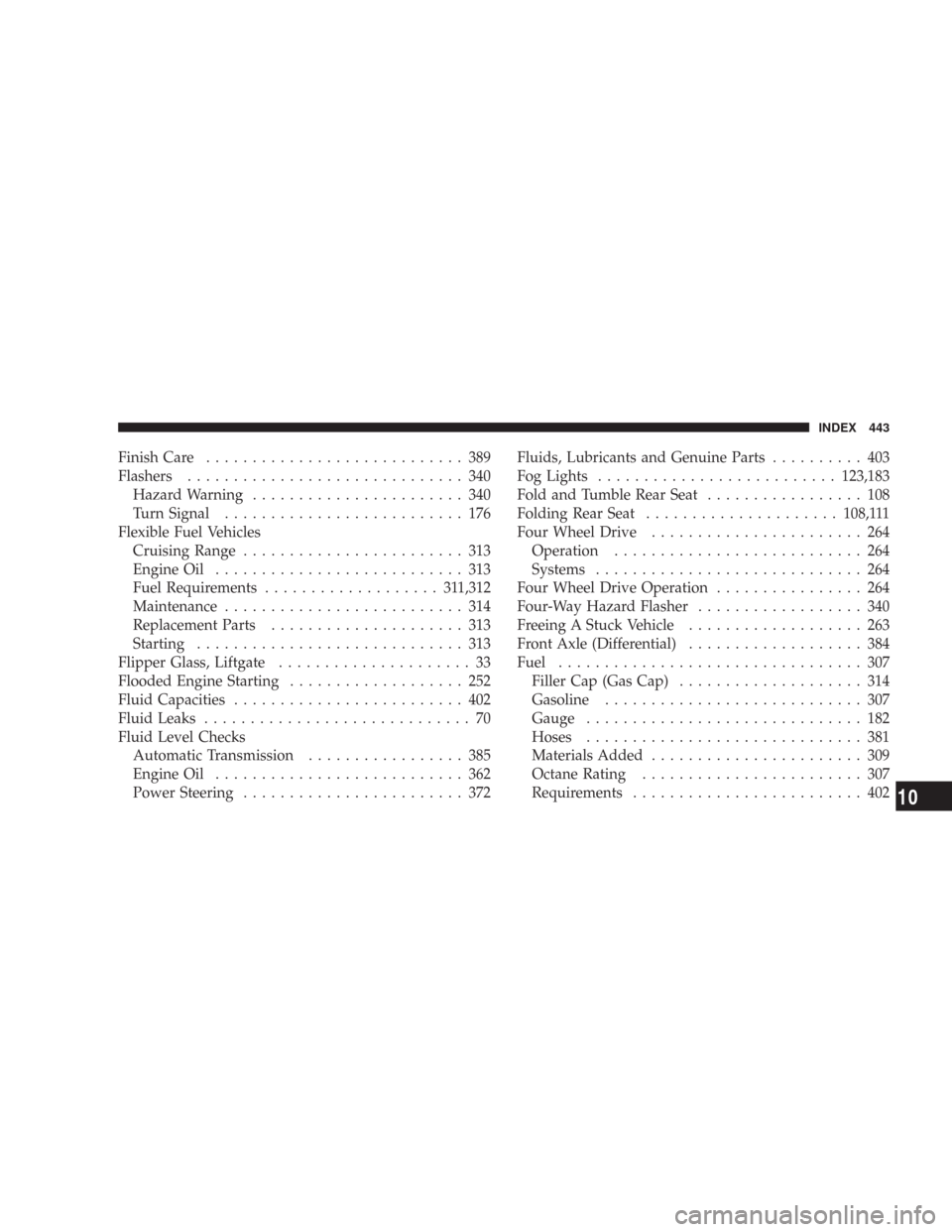
Finish Care............................ 389
Flashers.............................. 340
Hazard Warning....................... 340
Turn Signal.......................... 176
Flexible Fuel Vehicles
Cruising Range........................ 313
Engine Oil........................... 313
Fuel Requirements................... 311,312
Maintenance.......................... 314
Replacement Parts..................... 313
Starting............................. 313
Flipper Glass, Liftgate..................... 33
Flooded Engine Starting................... 252
Fluid Capacities......................... 402
Fluid Leaks............................. 70
Fluid Level Checks
Automatic Transmission................. 385
Engine Oil........................... 362
Power Steering........................ 372Fluids, Lubricants and Genuine Parts.......... 403
Fog Lights..........................123,183
Fold and Tumble Rear Seat................. 108
Folding Rear Seat.....................108,111
Four Wheel Drive....................... 264
Operation........................... 264
Systems............................. 264
Four Wheel Drive Operation................ 264
Four-Way Hazard Flasher.................. 340
Freeing A Stuck Vehicle................... 263
Front Axle (Differential)................... 384
Fuel................................. 307
Filler Cap (Gas Cap).................... 314
Gasoline............................ 307
Gauge.............................. 182
Hoses.............................. 381
Materials Added....................... 309
Octane Rating........................ 307
Requirements......................... 402
INDEX 443
10
Page 452 of 456
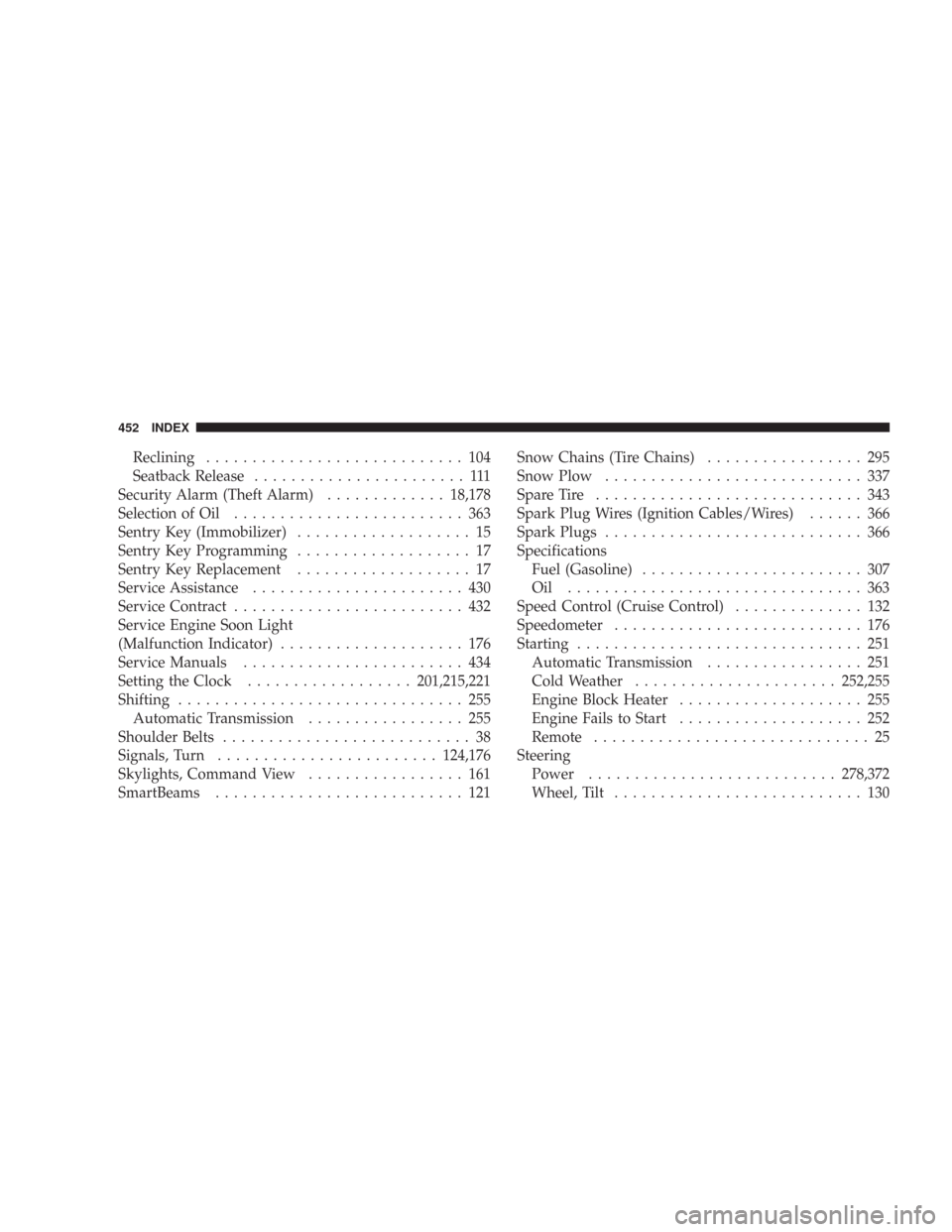
Reclining............................ 104
Seatback Release....................... 111
Security Alarm (Theft Alarm).............18,178
Selection of Oil......................... 363
Sentry Key (Immobilizer)................... 15
Sentry Key Programming................... 17
Sentry Key Replacement................... 17
Service Assistance....................... 430
Service Contract......................... 432
Service Engine Soon Light
(Malfunction Indicator).................... 176
Service Manuals........................ 434
Setting the Clock..................201,215,221
Shifting............................... 255
Automatic Transmission................. 255
Shoulder Belts........................... 38
Signals, Turn........................124,176
Skylights, Command View................. 161
SmartBeams........................... 121Snow Chains (Tire Chains)................. 295
Snow Plow............................ 337
Spare Tire............................. 343
Spark Plug Wires (Ignition Cables/Wires)...... 366
Spark Plugs............................ 366
Specifications
Fuel (Gasoline)........................ 307
Oil ................................ 363
Speed Control (Cruise Control).............. 132
Speedometer........................... 176
Starting............................... 251
Automatic Transmission................. 251
Cold Weather......................252,255
Engine Block Heater.................... 255
Engine Fails to Start.................... 252
Remote.............................. 25
Steering
Power...........................278,372
Wheel, Tilt........................... 130
452 INDEX