lock JEEP COMMANDER 2008 1.G Owners Manual
[x] Cancel search | Manufacturer: JEEP, Model Year: 2008, Model line: COMMANDER, Model: JEEP COMMANDER 2008 1.GPages: 478, PDF Size: 6.97 MB
Page 370 of 478
CAUTION!
The winch mechanism is designed for use with the
jack extension tube only. Use of an air wrench or
other power tools is not recommended and can dam-
age the winch.
When the spare is clear, tilt the retainer at the end of the
cable and pull it through the center of the wheel.
Preparations For Jacking
Park the vehicle on a firm level surface, avoid ice or
slippery areas,set the parking brakeand place the gear
selector in P (Park). Turn OFF the ignition.
WARNING!
Do not attempt to change a tire on the side of the
vehicle close to moving traffic. Pull far enough off
the road to avoid being hit when operating the jack
or changing the wheel.
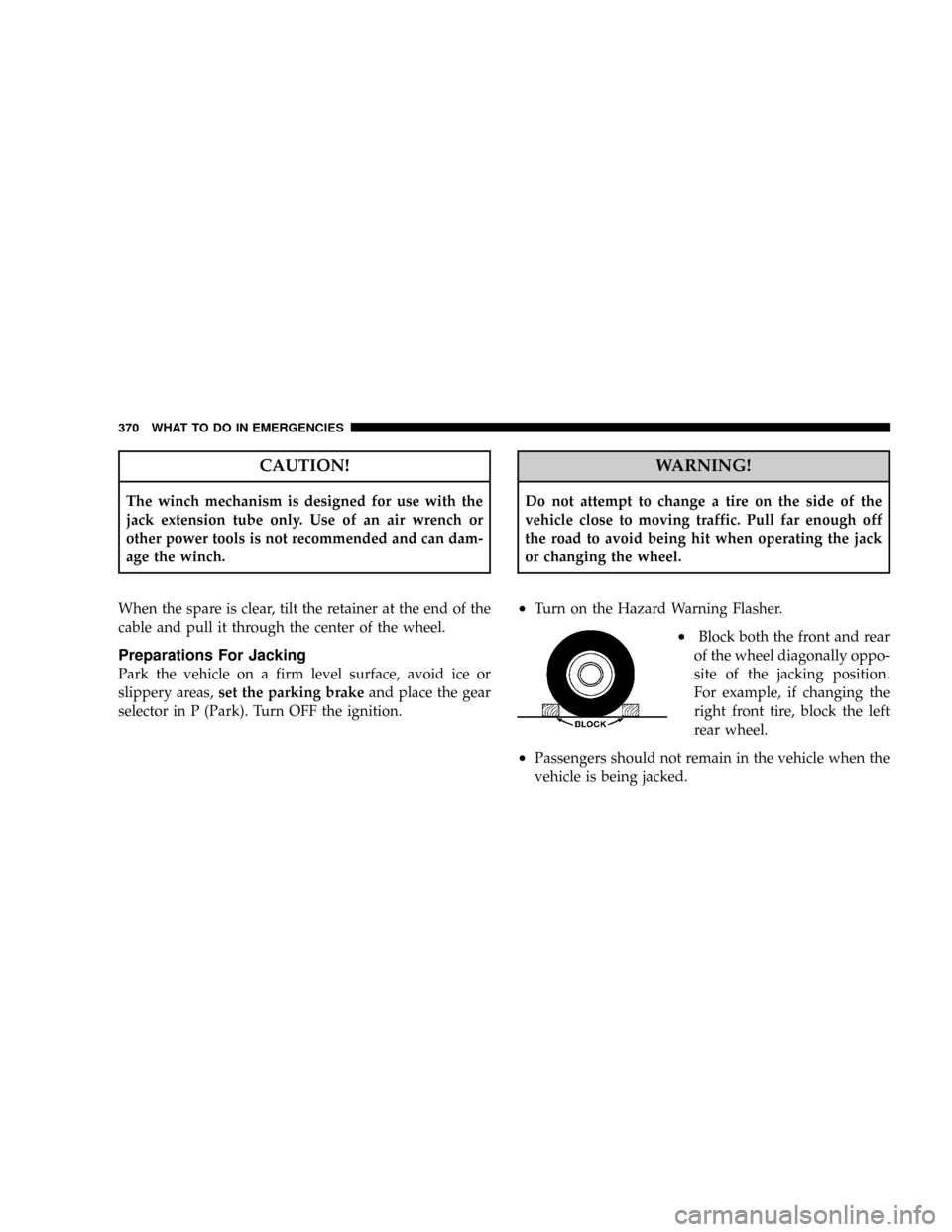
²Turn on the Hazard Warning Flasher.
²Block both the front and rear
of the wheel diagonally oppo-
site of the jacking position.
For example, if changing the
right front tire, block the left
rear wheel.
²Passengers should not remain in the vehicle when the
vehicle is being jacked.
370 WHAT TO DO IN EMERGENCIES
Page 372 of 478

4. Locate the jack as shown. For the front axle, place it
under the front lower control arm as shown. For the rear
axle, place it under the axle near the wheel to be changed.
Ensure the jack is closest to the inside of the wheel when
jacking on the rear axle.Do not raise the vehicle until
you are sure the jack is fully engaged.
5. Raise the vehicle by turning the jack screw clockwise.
Raise the vehicle only until the tire just clears the surface
and enough clearance is obtained to install the spare tire.
Minimum tire lift provides maximum stability.
Front Jacking Location
Rear Jacking Location
372 WHAT TO DO IN EMERGENCIES
Page 373 of 478

WARNING!
Raising the vehicle higher than necessary can make
the vehicle less stable. It could slip off the jack and
hurt someone near it. Raise the vehicle only enough
to remove the tire.
6. Remove the lug nuts and wheel.
7. Position the spare wheel/tire on the vehicle and install
the lug nuts with the cone-shaped end toward the wheel.
Lightly tighten the nuts. To avoid the risk of forcing the
vehicle off the jack, do not tighten the nuts fully until the
vehicle has been lowered.
8. Lower the vehicle by turning the jack screw counter
clockwise, and remove the jack and wheel blocks.9. Finish tightening the lug nuts. Push down on the
wrench while tightening for increased leverage. Alternate
nuts until each nut has been tightened twice. Correct
wheel nut tightness is 130 N´m (95 ft. lbs). If in doubt
about the correct tightness, have them checked with a
torque wrench by your authorized dealer or at a service
station.
10. Lower the jack to it's fully closed position.
WARNING!
A loose tire or jack, thrown forward in a collision or
hard stop could endanger the occupants of the ve-
hicle. Always stow the jack parts and the spare tire in
the places provided.
11. Secure the tire, jack, and tools in their proper loca-
tions.
WHAT TO DO IN EMERGENCIES 373
6
Page 399 of 478
WARNING!
Fluid level should be checked on a level surface with
the engine off to prevent injury from moving parts,
and to insure accurate fluid level reading. Do not
overfill. Use only the manufacturer's recommended
fluid.
If necessary, add fluid to restore to the proper indicated
level. With a clean cloth, wipe any spilled fluid from all
surfaces. Refer to Fluids, Lubricants, and Genuine Parts
for correct fluid type.
NOTE:Upon initial start-up in cold weather, the power
steering pump may make noise for a short period of time.
This is due to the cold, thick fluid in the steering system.
This noise should be considered normal, and does not in
any way damage the steering system.
Body Lubrication
Locks and all body pivot points, including such items as
seat tracks, doors, tailgate and hood hinges, should be
lubricated periodically to assure quiet, easy operation
and to protect against rust and wear. Prior to the appli-
cation of any lubricant, the parts concerned should be
wiped clean to remove dust and grit; after lubricating
excess oil and grease should be removed. Particular
attention should also be given to hood latching compo-
nents to insure proper function. When performing other
underhood services, the hood latch, release mechanism
and safety catch should be cleaned and lubricated.
The external lock cylinders should be lubricated twice a
year, preferably in the fall and spring. Apply a small
amount of a high quality lubricant such as MopartLock
Cylinder Lubricant directly into the lock cylinder.
MAINTAINING YOUR VEHICLE 399
7
Page 420 of 478
Cav-
ityCartridge
FuseMini Fuse Description
1 30 Amp
GreenAudio Amp (B+)
2 15 Amp
BlueSunroof (B+)
3 10 Amp
RedHtd Mirror (EBL)
4 20 Amp
YellowRr Pwr Out (B+)
5 10 Amp
RedRr HVAC (R/O)
(Commander Only)
6 Spare (B+)
7 20 Amp
YellowDoor Locks (B+)
8 15 Amp
BlueSteer Col Lock (B+)
(ELV)Cav-
ityCartridge
FuseMini Fuse Description
9 20 Amp
YellowPwr Outlet (B+)
10 10 Amp
RedFinal Drive Control
Module (FDCM),
Heater Ventilation, Air
Conditioning (HVAC),
Switch Bank, Transfer
Case Switch, O/H,
Heater Ventilation, Air
Conditioning (HVAC)
Relay, Rear Park As-
sist
11 Spare (B+)
12 10 Amp
RedDoor Mods, Mem. Sw,
O/H Lamps, IP Cour-
tesy Lamps, Glove
Box Lamp (B+)
420 MAINTAINING YOUR VEHICLE
Page 428 of 478

BULB REPLACEMENT
Head Light
1. Open the hood.
2. Remove the headlamp cover.
Insert a finger into each hole of the headlamp cover, and
pull upward to unsnap the rear edge of the cover from
the two upper lamp mounting brackets. Slide the cover
rearward to disengage the front edge from beneath the
tab on the top near the front of the lamp housing.
3. Disconnect the electrical connector.
4. Turn the low or high beam bulb 1/4 turn counter
clockwise to unlock it from the housing.
428 MAINTAINING YOUR VEHICLE
Page 431 of 478

4. Turn the socket on the bottom of the front lamp unit
housing 1/4 turn counter clockwise to unlock it.
5. Pull the socket and bulb straight out from the opening
in the housing.
6. Disconnect the electrical connector.
7. Pull the base of the bulb straight out of the socket.
CAUTION!
Do not touch the new bulb with your fingers. Oil
contamination will severely shorten bulb life. If the
bulb comes in contact with any oily surface, clean the
bulb with rubbing alcohol.
Front Fog Light
1. Turn the steering wheel all the way to the left or right.
2. Reach into the front wheel house ahead of the front
wheel to unsnap and lift the cover over the access hole in
the front of the wheel house splash shield. Access to the
bulb can be gained through the wheel liner hole.
MAINTAINING YOUR VEHICLE 431
7
Page 432 of 478

3. Reach through the access hole to access the back of the
front fog light housing on the back of the front fascia.
4. Disconnect the electrical connector.
5. Turn the socket on the back of the housing 1/4 turn
counter clockwise to unlock it.
6. Pull the socket and bulb straight out from the opening
in the housing.
7. Pull the base of the bulb straight out of the socket.
CAUTION!
Do not touch the new bulb with your fingers. Oil
contamination will severely shorten bulb life. If the
bulb comes in contact with any oily surface, clean the
bulb with rubbing alcohol.
Rear Tail, Stop, Turn Signal, and Back-Up Lights
1. Raise the liftgate.
2. Remove the two push-pins that secure the rear lamp
unit to the side of the liftgate opening.
432 MAINTAINING YOUR VEHICLE
Page 433 of 478

3. Pull the outboard side of the rear lamp unit rearward
far enough to unsnap the two ball studs on the outboard
side of the lamp housing from the two plastic grommets
in the quarter outer panel. Pull the lamp unit rearward
far enough away to access the bulbs.
4. Firmly grasp the appropriate bulb socket on the back
of the rear lamp unit housing, and turn 1/4 turn counter
clockwise to unlock it.
5. Disconnect the electrical connector.
6. Pull the socket and bulb straight out from the opening
in the housing.
1 Ð Rear Backup Lamp Bulb
2 Ð Rear Park/Stop Lamp Bulb
3 Ð Rear Park/Turn Signal Bulb
4 Ð Rear Side Marker Lamp BulbMAINTAINING YOUR VEHICLE 4337
Page 458 of 478

ABS (Anti-Lock Brake System)............188,302
Adding Fuel........................... 341
Adding Washer Fluid..................... 177
Adjustable Pedals....................... 135
Air Cleaner, Engine (Engine Air Cleaner Filter) . . . 393
Air Conditioner Maintenance............... 397
Air Conditioning........................ 259
Air Conditioning, Operating Tips............ 269
Air Conditioning, Rear Zone................ 267
Air Conditioning Refrigerant............... 398
Air Conditioning System.................. 259
Air Filter.............................. 393
Air Pressure, Tires....................... 316
Airbag................................ 48
Airbag Deployment....................... 55
Airbag Light.......................57,71,188
Airbag Maintenance....................... 57
Alarm, Panic............................ 24
Alarm (Security Alarm).................20,189Alarm System (Security Alarm)............... 20
Alignment and Balance................... 321
Alterations/Modifications, Vehicle............. 9
Antenna, Satellite Radio................... 250
Antifreeze (Engine Coolant)................ 435
Disposal............................ 405
Anti-Lock Brake System (ABS)............139,302
Anti-Lock Warning Light.................. 188
Anti-Theft System.....................20,189
Appearance Care........................ 415
Assist, Hill Start........................ 148
Audio Systems (Radio).................... 239
Auto Down Power Windows................ 32
Automatic Dimming Mirror................. 78
Automatic Door Locks..................... 29
Automatic Headlights.................... 126
Automatic Temperature Control (ATC)......... 260
Automatic Transmission................283,411
Adding Fluid......................... 412
458 INDEX