automatic transmission JEEP COMMANDER 2008 1.G User Guide
[x] Cancel search | Manufacturer: JEEP, Model Year: 2008, Model line: COMMANDER, Model: JEEP COMMANDER 2008 1.GPages: 478, PDF Size: 6.97 MB
Page 286 of 478

NOTE:To select the proper gear position for maximum
deceleration (engine braking), move the shift lever to the
left ªD(-)º and hold it there. The transmission will shift to
the range from which the vehicle can best be slowed
down.
Overdrive Operation
The automatic transmission includes an electronically
controlled Overdrive (5th gear for 3.7L engine, 4th and
5th gears for 4.7L and 5.7L engines). The transmission
will automatically shift from direct gear to Overdrive if
the following conditions are present:
²the transmission selector is in D (Drive);
²the engine coolant has reached normal operating tem-
perature;
²vehicle speed is above approximately 30 mph (48
km/h);
²the ªTOW/HAULº switch has not been activated;
²transmission has reached normal operating tempera-
ture.
NOTE:If the vehicle is started in extremely cold tem-
peratures, the transmission may not shift into Overdrive
and will automatically select the most desirable gear for
operation at this temperature. Normal operation will
resume when the transmission fluid temperature has
risen to a suitable level. Refer also to the Note under
torque converter clutch, later in this section.
During cold temperature operation you may notice de-
layed upshifts depending on engine and transmission
temperature. This feature improves the warm up time of
the engine and transmission.
If the transmission temperature gets extremely hot, the
transmission will automatically select the most desirable
gear for operation at this temperature. If the transmission
temperature becomes hot enough, the ªTRANSMISSION
286 STARTING AND OPERATING
Page 288 of 478

activated. Pressing the switch a second time restores
normal operation. If the ªTOW/HAULº mode is desired,
the switch must be pressed each time the engine is
started.
Transmission Limp Home Mode
Transmission function is monitored for abnormal condi-
tions. If a condition is detected that could result in
transmission damage, the transmission limp home mode
will be engaged. In this mode, the transmission will
remain in the current gear (3.7L engine) or in direct gear
(4.7L and 5.7L engines) until the vehicle is brought to a
stop.
To reset the transmission, use the following procedure:
1. Stop the vehicle.
2. Move the shift lever to the P (Park) position.
3. Turn off the engine, be sure to turn the key to the
LOCK position.4. Wait approximately 10 seconds, then restart the en-
gine.
5. Move the shift lever to the desired gear range.
If the problem is no longer detected, the transmission will
return to normal operation. If the problem persists, P
(Park), R (Reverse), and N (Neutral) will continue to
operate. Only 2nd gear (3.7L engine) or 3rd gear (4.7L
and 5.7L engines) will be available in the D (Drive)
position. Have the transmission checked at your autho-
rized dealer as soon as possible.
Torque Converter Clutch
A feature, designed to improve fuel economy, has been
included in the automatic transmission on your vehicle.
A clutch within the torque converter engages automati-
cally at a calibrated speed at light throttle. It engages at
higher speeds under heavier acceleration. This may re-
sult in a slightly different feeling or response during
normal operation in high gear. When the vehicle speed
288 STARTING AND OPERATING
Page 289 of 478

drops below a calibrated speed, or during acceleration,
the clutch automatically and smoothly disengages. The
feature is operational in Overdrive and in Drive.
NOTE:The torque converter clutch will not engage
until the transmission fluid and engine coolant are warm
[usually after 1-3 miles (1.6 - 4.8 km) of driving]. Because
the engine speed is higher when the torque converter
clutch is not engaged, it may seem as if the transmission
is not shifting into Overdrive when cold. This is normal.
Manually shifting (using the ERS shift control) between 4
(direct gear) and 5/D (Overdrive gear) positions will
demonstrate that the transmission is able to shift into and
out of Overdrive.
NOTE:If the vehicle has not been driven in several
days, the first few seconds of operation after shifting the
transmission into gear may seem sluggish. This is due to
the fluid partially draining from the torque converter into
the transmission. This condition is normal and will notcause damage to the transmission. The torque converter
will refill within five seconds of shifting from Park into
any other gear position.
Rocking the Vehicle
If the vehicle becomes stuck in snow, sand, or mud, it can
often be moved by a rocking motion. Move the gear
selector rhythmically between D (Drive) and R (Reverse),
while applying slight pressure to the accelerator.
NOTE:The Electronic Stability Program (ESP) and
Traction Control (if equipped) should be turned OFF
before attempting to rock the vehicle. Refer to ªElectronic
Brake Control Systemº in Section 3 of this manual.
The least amount of accelerator pedal pressure to main-
tain the rocking motion without spinning the wheels or
racing the engine is most effective. Racing the engine or
spinning the wheels, due to the frustration of not freeing
the vehicle, may lead to transmission overheating and
failure. Allow the engine to idle with the transmission
STARTING AND OPERATING 289
5
Page 351 of 478
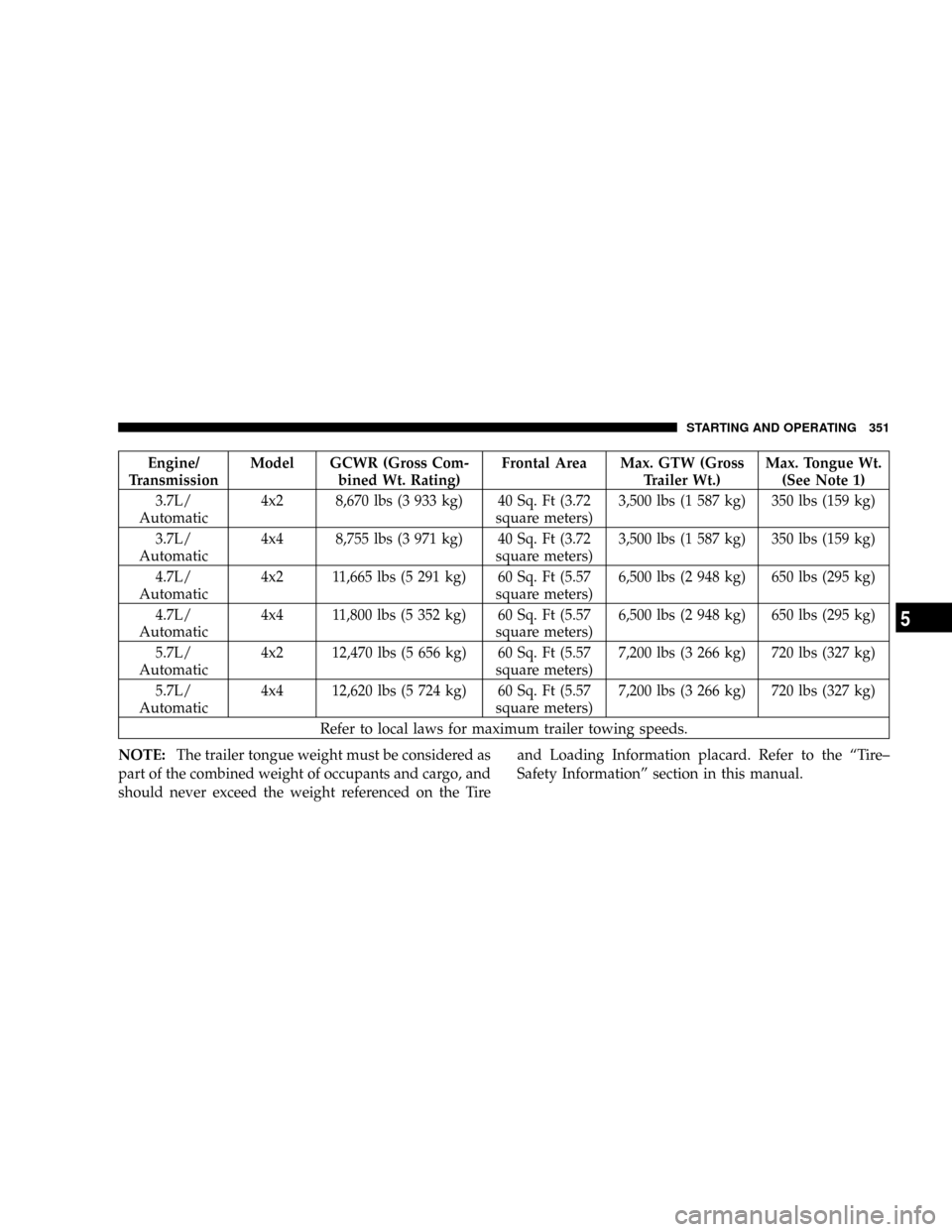
Engine/
TransmissionModel GCWR (Gross Com-
bined Wt. Rating)Frontal Area Max. GTW (Gross
Trailer Wt.)Max. Tongue Wt.
(See Note 1)
3.7L/
Automatic4x2 8,670 lbs (3 933 kg) 40 Sq. Ft (3.72
square meters)3,500 lbs (1 587 kg) 350 lbs (159 kg)
3.7L/
Automatic4x4 8,755 lbs (3 971 kg) 40 Sq. Ft (3.72
square meters)3,500 lbs (1 587 kg) 350 lbs (159 kg)
4.7L/
Automatic4x2 11,665 lbs (5 291 kg) 60 Sq. Ft (5.57
square meters)6,500 lbs (2 948 kg) 650 lbs (295 kg)
4.7L/
Automatic4x4 11,800 lbs (5 352 kg) 60 Sq. Ft (5.57
square meters)6,500 lbs (2 948 kg) 650 lbs (295 kg)
5.7L/
Automatic4x2 12,470 lbs (5 656 kg) 60 Sq. Ft (5.57
square meters)7,200 lbs (3 266 kg) 720 lbs (327 kg)
5.7L/
Automatic4x4 12,620 lbs (5 724 kg) 60 Sq. Ft (5.57
square meters)7,200 lbs (3 266 kg) 720 lbs (327 kg)
Refer to local laws for maximum trailer towing speeds.
NOTE:The trailer tongue weight must be considered as
part of the combined weight of occupants and cargo, and
should never exceed the weight referenced on the Tireand Loading Information placard. Refer to the ªTire±
Safety Informationº section in this manual.
STARTING AND OPERATING 351
5
Page 358 of 478

Towing Tips Ð Automatic Transmission
The ªDº range can be selected when towing. However, if
frequent shifting occurs while in this range, the ºTow/
Haulº mode (if equipped) or a lower gear range should
be selected.
NOTE:Using the ºTow/Haulº mode (if equipped) or a
lower gear range while operating the vehicle under
heavy operating conditions will improve performance
and extend transmission life by reducing excessive shift-
ing and heat build up. This action will also provide better
engine braking.
The automatic transmission fluid and filter should be
changed if you REGULARLY tow a trailer for more than
45 minutes of continuous operation. Refer to the ªMain-
tenance Scheduleº in Section 8 of this manual for trans-
mission fluid change intervals.
NOTE:Check the automatic transmission fluid level
before towing.
Towing Tips Ð Electronic Speed Control (If
Equipped)
þ
Don't use in hilly terrain or with heavy loads.
þWhen using the speed control, if you experience speed
drops greater than 10 mph (16 km/h), disengage until
you can get back to cruising speed.
þUse speed control in flat terrain and with light loads to
maximize fuel efficiency.
Towing Tips Ð Cooling System
To reduce potential for engine and transmission over-
heating, take the following actions:
þCity Driving
When stopped for short periods of time, put transmission
in N (Neutral) and increase engine idle speed.
þHighway Driving
Reduce speed.
358 STARTING AND OPERATING
Page 380 of 478

NAir Conditioner Maintenance.............397
NPower Steering Fluid Check..............398
NBody Lubrication.....................399
NWindshield Wiper Blades................400
NWindshield Washers Ð Front And Rear.....400
NExhaust System......................401
NCooling System.......................401
NHoses And Vacuum/Vapor Harnesses.......406
NFuel System Connections................407
NBrake System........................407
NFront/Rear Axle Fluid..................410
NTransfer Case........................410
NAutomatic Transmission................411NMaintenance After Off-Road Driving........414
NAppearance Care And Protection From
Corrosion...........................415
mFuse Panel...........................419
NInterior Fuses........................419
NUnderhood Fuses (Power Distribution
Center)............................422
NUnderhood Fuses (Integrated Power
Module)............................425
mVehicle Storage........................426
mReplacement Bulbs......................427
mBulb Replacement......................428
NHead Light..........................428
NFront Turn Signal.....................430
380 MAINTAINING YOUR VEHICLE
Page 385 of 478

ONBOARD DIAGNOSTIC SYSTEM Ð OBD II
Your vehicle is equipped with a sophisticated onboard
diagnostic system called OBD II. This system monitors
the performance of the emissions, engine, and automatic
transmission control systems. When these systems are
operating properly, your vehicle will provide excellent
performance and fuel economy, as well as engine emis-
sions well within current government regulations.
If any of these systems require service, the OBD II system
will turn on the ªMalfunction Indicator Light.º It will
also store diagnostic codes and other information to
assist your service technician in making repairs. Al-
though your vehicle will usually be drivable and not
need towing, see your dealer for service as soon as
possible.CAUTION!
²Prolonged driving with the ªMalfunction Indica-
tor Lightº on could cause further damage to the
emission control system. It could also affect fuel
economy and driveability. The vehicle must be
serviced before any emissions tests can be per-
formed.
²If the ªMalfunction Indicator Lightº is flashing
while the engine is running, severe catalytic con-
verter damage and power loss will soon occur.
Immediate service is required.
MAINTAINING YOUR VEHICLE 385
7
Page 398 of 478

NOTE:Use only manufacturer approved A/C System
Sealers, Stop Leak Products, Seal Conditioners, Compres-
sor Oil, and Refrigerants.
Refrigerant Recovery and Recycling
R-134a Air Conditioning Refrigerant is a hydrofluorocar-
bon (HFC) that is endorsed by the Environmental Pro-
tection Agency and is an ozone-saving product. How-
ever, the manufacturer recommends that air conditioning
service be performed by dealers or other service facilities
using recovery and recycling equipment.
Power Steering Fluid Check
The power steering system requires the use of Mopart
Hydraulic System Power Steering Fluid (P/N
05142893AA), or equivalent, which meets
DaimlerChrysler Material Standard MS-10838.
CAUTION!
Do not use Automatic Transmission Fluid (ATF) or
other types of power steering fluids when servicing
the power steering system of this vehicle. Damage to
the power steering system can result from the use of
the wrong power steering fluid.
Checking the power steering fluid level at a defined
service interval is not required. The fluid should only be
checked if a leak is suspected, abnormal noises are
apparent, and/or the system is not functioning as antici-
pated. Coordinate inspection efforts through a certified
ªDaimlerChrysler Dealership.º
398 MAINTAINING YOUR VEHICLE
Page 411 of 478

CAUTION!
When installing plugs, do not overtighten. You could
damage them and cause them to leak.
Selection of Lubricant
Use only manufacturer's recommended fluid, refer to
Fluids, Lubricants, and Genuine Parts for correct fluid
type.
Automatic Transmission
Selection of Lubricant
It is important that the proper lubricant is used in the
transmission to assure optimum transmission perfor-
mance. Use only manufacturer's recommended transmis-
sion fluid, refer to Fluids, Lubricants, and Genuine Partsfor correct fluid type. It is important that the transmission
fluid be maintained at the prescribed level using the
recommended fluid.
CAUTION!
Using a transmission fluid other than the manufac-
turer's recommended fluid may cause deterioration
in transmission shift quality and/or torque converter
shudder. Using a transmission fluid other than the
manufacturer's recommended fluid will result in
more frequent fluid and filter changes. Refer to
Fluids, Lubricants, and Genuine Parts for correct
fluid type.
Fluid Level Check (3.7L Engine)
Regular automatic transmission fluid level checks are not
required. For this reason, the dipstick is omitted.
MAINTAINING YOUR VEHICLE 411
7
Page 412 of 478

If you notice fluid loss or gear shift malfunction, have
your authorized dealer check the transmission fluid level.
CAUTION!
The fluid level is preset at the factory and it does not
require adjustment under normal operating condi-
tions. If a transmission fluid leak occurs, visit your
authorized dealer immediately. Severe damage to the
transmission may occur. Your authorized dealer has
the proper tools to adjust the fluid level accurately.
Fluid Level Check (4.7L and 5.7L Engine)
Check the fluid level while the transmission is at normal
operating temperature. This occurs after at least 15 miles
(25 km) of driving. At normal operating temperature the
fluid cannot be held comfortably between the fingertips.To check the automatic transmission fluid level properly,
the following procedure must be used:
1. Operate the engine at idle speed and normal operating
temperature.
2. The vehicle must be on level ground.
3. Fully apply the parking brake and press the brake
pedal.
4. Place the gear selector momentarily in each gear
position ending with the lever in P (Park).
5. Remove the dipstick, wipe it clean and reinsert it until
seated.
6. Remove the dipstick again and note the fluid level on
both sides. The fluid level should be between the ªHOTº
(upper) reference holes on the dipstick at normal operat-
ing temperature. The fluid level is only valid if there is a
solid coating of oil is seen on both sides of the dipstick. If
412 MAINTAINING YOUR VEHICLE