cooling JEEP COMMANDER 2008 1.G User Guide
[x] Cancel search | Manufacturer: JEEP, Model Year: 2008, Model line: COMMANDER, Model: JEEP COMMANDER 2008 1.GPages: 478, PDF Size: 6.97 MB
Page 380 of 478

NAir Conditioner Maintenance.............397
NPower Steering Fluid Check..............398
NBody Lubrication.....................399
NWindshield Wiper Blades................400
NWindshield Washers Ð Front And Rear.....400
NExhaust System......................401
NCooling System.......................401
NHoses And Vacuum/Vapor Harnesses.......406
NFuel System Connections................407
NBrake System........................407
NFront/Rear Axle Fluid..................410
NTransfer Case........................410
NAutomatic Transmission................411NMaintenance After Off-Road Driving........414
NAppearance Care And Protection From
Corrosion...........................415
mFuse Panel...........................419
NInterior Fuses........................419
NUnderhood Fuses (Power Distribution
Center)............................422
NUnderhood Fuses (Integrated Power
Module)............................425
mVehicle Storage........................426
mReplacement Bulbs......................427
mBulb Replacement......................428
NHead Light..........................428
NFront Turn Signal.....................430
380 MAINTAINING YOUR VEHICLE
Page 401 of 478
WARNING!
Commercially available windshield washer solvents
are flammable. They could ignite and burn you. Care
must be exercised when filling or working around
the washer solution.
Exhaust System
The best protection against carbon monoxide entry into
the vehicle body is a properly maintained engine exhaust
system.
If you notice a change in the sound of the exhaust system;
or if the exhaust fumes can be detected inside the vehicle;
or when the underside or rear of the vehicle is damaged;
have an authorized technician inspect the complete ex-
haust system and adjacent body areas for broken, dam-
aged, deteriorated, or mispositioned parts. Open seams
or loose connections could permit exhaust fumes to seepinto the passenger compartment. In addition, inspect the
exhaust system each time the vehicle is raised for lubri-
cation or oil change. Replace as required.
Cooling System
WARNING!
You or others can be badly burned by hot antifreeze/
coolant or steam from your radiator. If you see or hear
steam coming from under the hood, don't open the
hood until the radiator has had time to cool. Never
try to open a cooling system pressure cap when the
radiator or coolant bottle is hot.
Engine Coolant Checks
Check antifreeze/coolant protection every 12 months
(before the onset of freezing weather, where applicable).
If antifreeze/coolant is dirty or rusty in appearance, the
MAINTAINING YOUR VEHICLE 401
7
Page 402 of 478

system should be drained, flushed and refilled with fresh
antifreeze/coolant. Check the front of the A/C condenser
for any accumulation of bugs, leaves, etc. If dirty, clean by
gently spraying water from a garden hose vertically
down the face of the condenser.
Check the engine cooling system hoses for brittle rubber,
cracking, tears, cuts, and tightness of the connection at
the coolant recovery bottle and radiator. Inspect the
entire system for leaks.
With the engine at normal operating temperature (but
not running), check the cooling system pressure cap for
proper vacuum sealing by draining a small amount of
coolant from the radiator drain cock. If the cap is sealing
properly, the antifreeze/coolant will begin to drain from
the coolant recovery bottle. DO NOT REMOVE THE
COOLANT PRESSURE CAP WHEN THE COOLING
SYSTEM IS HOT.Cooling System Ð Drain, Flush, And Refill
At the intervals shown on the Maintenance Schedule, the
system should be drained, flushed and refilled.
If the solution is dirty and contains a considerable
amount of sediment, clean and flush with reliable cooling
system cleaner. Follow with a thorough rinsing to remove
all deposits and chemicals. Properly dispose of old
antifreeze/coolant solution.
Selection Of Coolant
Use only the manufacturer's recommended antifreeze/
coolant, refer to Fluids, Lubricants, and Genuine Parts for
correct antifreeze/coolant type.
402 MAINTAINING YOUR VEHICLE
Page 404 of 478
²Use only high purity water such as distilled or deion-
ized water when mixing the water/antifreeze (cool-
ant) solution. The use of lower quality water will
reduce the amount of corrosion protection in the
engine cooling system.
Please note that it is the owner's responsibility to main-
tain the proper level of protection against freezing ac-
cording to the temperatures occurring in the area where
the vehicle is operated.
NOTE:Mixing antifreeze/coolant types will decrease
the life of the antifreeze/coolant and will require more
frequent antifreeze/coolant changes.
Cooling System Pressure Cap
The cap must be fully tightened to prevent loss of
antifreeze/coolant, and to insure that antifreeze/coolant
will return to the radiator from the coolant recovery tank.The cap should be inspected and cleaned if there is any
accumulation of foreign material on the sealing surfaces.
WARNING!
²The warning words DO NOT OPEN HOT on the
cooling system pressure cap are a safety precau-
tion. Never add antifreeze/coolant when the en-
gine is overheated. Do not loosen or remove the
cap to cool an overheated engine. Heat causes
pressure to build up in the cooling system. To
prevent scalding or injury, do not remove the
pressure cap while the system is hot or under
pressure.
²Do not use a pressure cap other than the one
specified for your vehicle. Personal injury or en-
gine damage may result.
404 MAINTAINING YOUR VEHICLE
Page 406 of 478

If an examination of your engine compartment shows no
evidence of radiator or hose leaks, the vehicle may be
safely driven. The vapor will soon dissipate.
²Do not overfill the coolant recovery bottle.
²Check antifreeze/coolant freeze point in the radiator
and in the coolant recovery bottle. If antifreeze/
coolant needs to be added, contents of coolant recov-
ery bottle must also be protected against freezing.
²If frequent antifreeze/coolant additions are required,
or if the level in the coolant recovery bottle does not
drop when the engine cools, the cooling system should
be pressure tested for leaks.
²Maintain antifreeze/coolant concentration at 50%
HOAT antifreeze/coolant (minimum) and distilled
water for proper corrosion protection of your engine
which contains aluminum components.
²Make sure that the radiator and coolant recovery
bottle hoses are not kinked or obstructed.
²Keep the front of the radiator clean. If your vehicle is
equipped with air conditioning, keep the front of the
condenser clean, also.
²Do not change the thermostat for summer or winter
operation. If replacement is ever necessary, install
ONLY the correct type thermostat. Other designs may
result in unsatisfactory cooling performance, poor gas
mileage, and increased emissions.
Hoses and Vacuum/Vapor Harnesses
Inspect surfaces of hoses and nylon tubing for evidence
of heat and mechanical damage. Hard or soft spots,
brittle rubber, cracking, tears, cuts, abrasions, and exces-
sive swelling indicate deterioration of the rubber.
406 MAINTAINING YOUR VEHICLE
Page 435 of 478
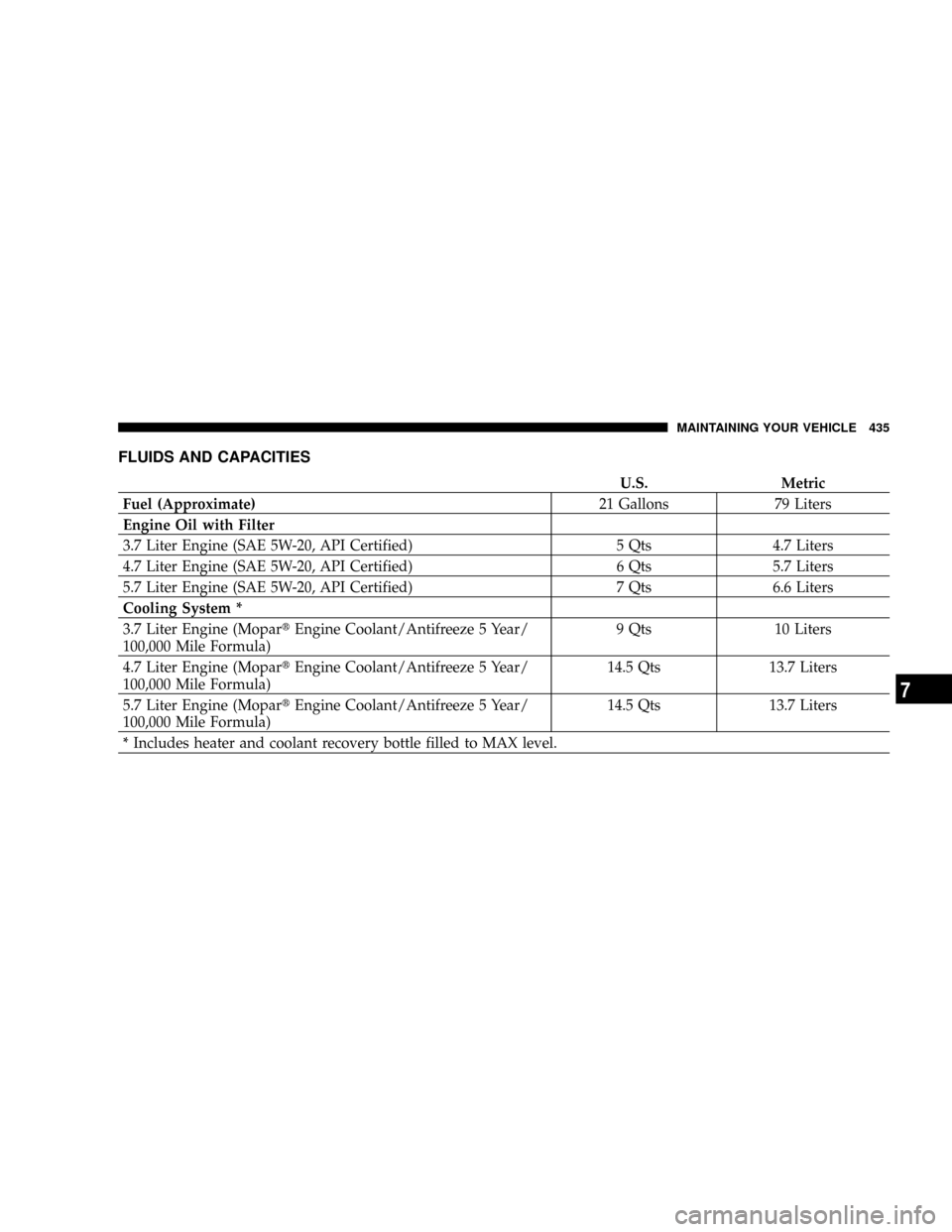
FLUIDS AND CAPACITIES
U.S. Metric
Fuel (Approximate)21 Gallons 79 Liters
Engine Oil with Filter
3.7 Liter Engine (SAE 5W-20, API Certified) 5 Qts 4.7 Liters
4.7 Liter Engine (SAE 5W-20, API Certified) 6 Qts 5.7 Liters
5.7 Liter Engine (SAE 5W-20, API Certified) 7 Qts 6.6 Liters
Cooling System *
3.7 Liter Engine (MopartEngine Coolant/Antifreeze 5 Year/
100,000 Mile Formula)9 Qts 10 Liters
4.7 Liter Engine (MopartEngine Coolant/Antifreeze 5 Year/
100,000 Mile Formula)14.5 Qts 13.7 Liters
5.7 Liter Engine (MopartEngine Coolant/Antifreeze 5 Year/
100,000 Mile Formula)14.5 Qts 13.7 Liters
* Includes heater and coolant recovery bottle filled to MAX level.
MAINTAINING YOUR VEHICLE 435
7
Page 460 of 478

Cargo Compartment...................... 174
Luggage Carrier....................... 177
Cargo Load Floor........................ 174
Catalytic Converter...................... 393
CD (Compact Disc) Player................. 239
Cellular Phone.......................... 82
Center High Mounted Stop Light............ 434
Certification Label....................... 344
Chains, Tire............................ 322
Changing A Flat Tire..................... 368
Chart, Tire Sizing........................ 308
Checks, Safety.........................71,72
Child Restraint....................60,61,65,67
Child Restraint Tether Anchors.............64,65
Child Safety Locks........................ 30
Climate Control......................... 257
Clock........................213,229,240,243
Cold Weather Operation................... 278
Command View Skylights.................. 168Compact Disc (CD) Maintenance............. 256
Compass.............................. 203
Compass Calibration..................... 204
Compass Variance....................... 204
Computer, Trip/Travel.................... 200
Connector
UCI ................................ 244
Universal Consumer Interface (UCI)......... 244
Console, Overhead....................... 158
Contract, Service........................ 450
Converter, Catalytic...................... 393
Cooling System......................... 401
Adding Coolant (Antifreeze).............. 403
Coolant Capacity...................... 435
Coolant Level......................... 405
Disposal of Used Coolant................ 405
Drain, Flush, and Refill.................. 402
Inspection........................401,405
Points to Remember.................... 405
460 INDEX
Page 462 of 478

Electronic Brake Control System............. 139
Anti-Lock Brake System................. 139
Brake Assist System.................... 141
Electronic Roll Mitigation................ 142
Electronic Stability Program............... 143
Traction Control System................. 140
Electronic Roll Mitigation (ERM)............. 142
Electronic Speed Control (Cruise Control)...... 136
Electronic Stability Program (ESP)............ 143
Electronic Throttle Control Warning Light...... 194
Electronic Vehicle Information Center
(EVIC).............................192,195
Emergency, In Case of
Freeing Vehicle When Stuck............... 289
Hazard Warning Flasher................. 366
Jacking............................. 368
Jump Starting......................... 374
Tow Hooks.......................... 377
Emission Control System Maintenance......386,440Engine
Air Cleaner.......................... 393
Block Heater......................... 280
Break-In Recommendations................ 69
Compartment...................382,383,384
Compartment Identification.........382,383,384
Cooling............................. 401
Exhaust Gas Caution................38,70,337
Fails to Start.......................... 279
Fuel Requirements..................333,435
Multi-Displacement..................... 306
Oil ..............................389,435
Oil Change Interval.................... 390
Oil Disposal.......................... 391
Oil Filter............................ 391
Oil Filter Disposal...................... 391
Oil Selection.......................... 435
Oil Synthetic......................... 391
Overheating.......................... 367
462 INDEX
Page 475 of 478

Life of Tires.......................... 320
Load Capacity...................... 311,312
Pressure Monitor System (TPMS)........... 323
Pressure Warning Light.................. 190
Quality Grading....................... 454
Radial.............................. 318
Replacement......................... 320
Rotation............................. 322
Safety............................72,306
Sizes............................... 308
Spare Tire........................... 369
Spinning............................ 318
Tread Wear Indicators................... 319
Wheel Mounting....................... 373
Tongue Weight/Trailer Weight.............. 352
Torque Converter Clutch.................. 288
Tow Hooks, Emergency................... 377
Tow/Haul Indicator Light................. 192
Towing............................346,378Disabled Vehicle....................... 378
Guide.............................. 350
Recreational.......................... 359
Weight.............................. 350
Traction Control......................... 140
Traction Control Light.................... 189
Trailer Sway Control (TSC)................. 147
Trailer Towing.......................... 346
Cooling System Tips.................... 358
Hitches............................. 350
Minimum Requirements................. 353
Trailer and Tongue Weight................ 352
Wiring.............................. 356
Trailer Towing Guide..................... 350
Trailer Weight.......................... 350
Transfer Case........................... 410
Maintenance.......................... 410
Transmission
Automatic........................283,411
INDEX 475
10
Page 478 of 478
INTRODUCTION INTRODUCTION ROLLOVER WARNING HOW TO USE THIS MANUAL WARNINGS AND CAUTIONS VEHICLE IDENTIFICATION NUMBER VEHICLE MODIFICATIONS/ALTERATIONS THINGS TO KNOW BEFORE STARTING YOUR VEHICLE A WORD
ABOUT YOUR KEYS Wireless Ignition Node (WIN)Fob with Integrated Key (FOBIK)Ignition Key RemovalKey-In-Ignition ReminderSENTRY KEY Replacement KeysCustomer Key (Fob) ProgrammingGeneral InformationSECURITY ALARM SYSTEM - IF EQUIPPED To Set
the AlarmTo Disarm the SystemILLUMINATED ENTRY REMOTE KEYLESS ENTRY To Unlock the DoorsTo Lock the DoorsTo Release the Liftgate Flipper GlassUsing The Panic AlarmProgramming Additional TransmittersTransmitter Battery ServiceGeneral Information
REMOTE STARTING SYSTEM - IF EQUIPPED DOOR LOCKS Manual Door LocksPower Door LocksChild Protection Door LockWINDOWS Power WindowsWind BuffetingLIFTGATE Liftgate Flipper GlassPower Liftgate - If EquippedOCCUPANT RESTRAINTS Lap/Shoulder
BeltsLap/Shoulder Belt Operating InstructionsAdjustable Upper Shoulder Belt AnchorageAutomatic Locking Mode - If EquippedEnergy Management FeatureSeat Belt PretensionersEnhanced Seat Belt Use Reminder System (BeltAlert)Seat Belts and Pregnant WomenSeat
Belt ExtenderDriver And Front Passenger Supplemental Restraint Systems (SRS) Child RestraintENGINE BREAK-IN RECOMMENDATIONS SAFETY TIPS Exhaust GasSafety Checks You Should Make Inside The VehicleSafety Checks You Should Make Outside The Vehicle
UNDERSTANDING THE FEATURES OF YOUR VEHICLE MIRRORS Inside Day/Night MirrorAutomatic Dimming Mirror - If EquippedOutside MirrorsExterior MirrorsFolding FeatureDrivers and Front Passenger Outside Automatic Dimming Mirror - If EquippedPower Remote
Control Outside Mirrors - If EquippedHeated Remote Control Mirrors - If EquippedLighted Vanity Mirrors - If EquippedHANDS-FREE COMMUNICATION (UConnect) - IF EQUIPPED OperationPhone Call FeaturesUConnect System FeaturesAdvanced Phone Connectivity
Things You Should Know About Your UConnect SystemGeneral InformationSEATS Front Manual Seat AdjustmentFront Seat Adjustment - ReclineManual Lumbar Support Adjustment8 - Way Drivers Power Seat4 - Way Passengers Power Seat - If EquippedHead Restraints
Front Heated Seats-If Equipped40/20/40 Second Row Folding Seat50/50 Third Row Folding Seat - If EquippedDRIVER MEMORY SEAT - IF EQUIPPED Setting Memory Positions and Linking Remote Keyless Entry Transmitter to MemoryMemory Position RecallTo Disable
A Transmitter Linked to MemoryEasy Entry/Exit SeatTO OPEN AND CLOSE THE HOOD LIGHTS Multi-Function Control LeverBattery Saver Feature-Exterior/Interior LightsHeadlights and Parking LightsAutomatic Headlight System - If EquippedSmartBeams - If Equipped
Instrument Panel and Interior LightsDaytime Running Lights - If EquippedLights-On ReminderFog Lights - If EquippedTurn SignalsHigh Beam SwitchPassing LightHeadlight Time DelayInterior LightsCourtesy/Reading LightsWINDSHIELD WIPERS AND WASHERS MistSpeed
Sensitive Intermittent Wiper SystemRain Sensing Wipers-If EquippedTILT/TELESCOPING STEERING COLUMN ADJUSTABLE PEDALS - IF EQUIPPED ELECTRONICSPEED CONTROL - IF EQUIPPED Electronic Speed Control OperationTo ActivateTo Set At A Desired
SpeedTo DeactivateTo Resume SpeedTo Vary The Speed SettingTo Accelerate For PassingELECTRONIC BRAKE CONTROL SYSTEM ABS (Anti-Lock Brake System)TCS (Traction Control System)BAS (Brake Assist System)ERM (Electronic Roll Mitigation)ESP (Electronic
Stability Program)TSC (Trailer Sway Control)HSA (Hill Start Assist) (4WD Models with NV245 Two-Speed Transfer Case Only)HDC (Hill Descent Control) (4WD Models with NV245 Two-Speed Transfer Case Only)ESP/BAS Warning Lamp and ESP/TCS Indicator LightREAR
PARK ASSIST SYSTEM- IF EQUIPPED Rear Park Assist SensorsRear Park Assist Warning DisplayEnable/Disable the Rear Park Assist SystemService the RearPark Assist SystemCleaning the Rear Park Assist SystemREAR CAMERA - IF EQUIPPED Turning the Rear
Camera OnTurning the Rear Camera OffOVERHEAD CONSOLE - IF EQUIPPED GARAGE DOOR OPENER - IF EQUIPPED Programming HomeLinkGate Operator/Canadian ProgrammingUsing HomeLinkReprogramming a Single HomeLink ButtonSecurityTroubleshooting
TipsGeneral InformationPOWER SUNROOF - IF EQUIPPED Opening Sunroof - ExpressClosing Sunroof - ExpressPinch Protect FeaturePinch Protect OverrideVenting Sunroof - ExpressSunshade OperationWind BuffetingSunroof MaintenanceIgnition Off OperationSunroof
Fully ClosedCOMMAND-VIEW SKYLIGHTS - IF EQUIPPED POWER OUTLET Front Power OutletRear Power Outlet - If EquippedPOWER INVERTER - IF EQUIPPED CUP HOLDERS CARGO AREA FEATURES Cargo Load FloorREAR WINDOW FEATURES Rear Window
Wiper/WasherRear Window Defroster - If EquippedROOF LUGGAGE RACK - IF EQUIPPED UNDERSTANDING YOUR INSTRUMENT PANEL INSTRUMENT PANEL AND CONTROLS INSTRUMENT CLUSTER INSTRUMENT CLUSTER DESCRIPTION ELECTRONIC
VEHICLE INFORMATION CENTER (EVIC) Electronic Vehicle Information Center (EVIC) DisplaysEngine Oil Change Indicator SystemTrip FunctionsCompass DisplayPersonal Settings (Customer Programmable Features)System StatusRADIO GENERAL INFORMATION
Radio Broadcast SignalsTwo Types of SignalsElectrical DisturbancesAM ReceptionFM ReceptionSALES CODE REQ - AM/FM STEREO RADIO AND 6-DISC CD/DVD CHANGER (MP3/WMA AUX JACK) Operating Instructions - Radio ModeOperation Instructions - (DISC
MODE for CD and MP3/WMA Audio Play, DVD-VIDEO)Notes On Playing MP3/WMA FilesLIST Button (DISC Mode for MP3/WMA Play)INFO Button (DISC Mode for MP3/WMA Play)SALES CODE RES - AM/FM STEREO RADIO WITH CD PLAYER (MP3 AUX JACK) Operating
Instructions - Radio ModeOperation Instructions - CD MODE for CD and MP3 Audio PlayNotes On Playing MP3 FilesLIST Button (CD Mode for MP3 Play)INFO Button (CD Mode for MP3 Play)SALES CODE REN - MULTIMEDIA SYSTEM - IF EQUIPPED Operating Instructions
- Satellite Radio (If Equipped)Operating Instructions - Hands-Free Communication (UConnect) (If Equipped)Clock Setting ProcedureSALES CODE RER- AM/FM/CD/DVD RADIO WITH NAVIGATION SYSTEM - IF EQUIPPED Operating Instructions - Satellite RadioClock
Setting ProcedureUNIVERSAL CONSUMER INTERFACE (UCI) - IF EQUIPPED Connecting the iPodControlling the iPod using Radio ButtonsPlay ModeList or Browse ModeSATELLITE RADIO (RSC) - IF EQUIPPED (REQ AND RES RADIOS ONLY) System Activation
Electronic Serial Number/Sirius Identification Number (ENS/SID)Selecting Satellite ModeSatellite AntennaReception QualityOperating Instructions - Satellite ModeOperating Instructions - Hands Free Phone (If Equipped)Operating Instructions - Video Entertainment System
(VES) (If Equipped)VIDEO ENTERTAINMENT SYSTEM (SALES CODE XRV) - IF EQUIPPED REMOTE SOUND SYSTEM CONTROLS - IF EQUIPPED Radio OperationCD PlayerCD/DVD DISC MAINTENANCE RADIO OPERATION AND CELLULAR PHONES CLIMATE
CONTROLS Manual Air Conditioning and Heating System - If EquippedAutomatic Temperature Control - If EquippedRear Climate Control - If EquippedOperating TipsOperating Tips Chart STARTING AND OPERATING STARTING PROCEDURES Normal StartingExtremely
Cold Weather (below -20 degrees F or -29 degrees C)If Engine Fails to StartAfter StartingENGINE BLOCK HEATER - IF EQUIPPED AUTOMATIC TRANSMISSION Shift Lock Manual Override - If EquippedBrake/Transmission Interlock System5-Speed Automatic Transmission
Gear RangesRocking the VehicleFOUR-WHEEL DRIVE OPERATION Quadra-Trac I Operating Instructions/Precautions - If EquippedQuadra-Trac II Operating Instructions/Precautions - If EquippedShift PositionsShifting ProceduresQuadra-Drive II System - If Equipped
ON-ROAD DRIVING TIPS OFF-ROAD DRIVING TIPS When To Use 4WD LOW Range - If EquippedDriving Through WaterDriving In Snow, Mud and SandHill ClimbingTraction DownhillAfter Driving Off-RoadPARKING BRAKE ANTI-LOCK BRAKE SYSTEM POWER
STEERING MULTI DISPLACEMENT SYSTEM (MDS) - 5.7L Engine Only TIRE SAFETY INFORMATION Tire Markings Tire Identification Number (TIN)Tire Loading andTire PressureTIRES - GENERAL INFORMATION Tire PressureTire Inflation PressuresTire Pressures
for High Speed OperationRadial-Ply TiresTire SpinningTread Wear IndicatorsLife of TireReplacement TiresAlignment and BalanceTIRE CHAINS TIRE ROTATION RECOMMENDATIONS TIRE PRESSURE MONITOR SYSTEM (TPMS) Base System - If EquippedPremium
System - If EquippedGeneral InformationFUEL REQUIREMENTS 3.7/4.7L Engines (If Equipped)5.7L Engines (If Equipped)Reformulated GasolineGasoline/Oxygenate BlendsMMT In GasolineMaterials Added To FuelFuel System CautionsCarbon Monoxide Warnings
FLEXIBLE FUEL (4.7L ENGINE ONLY) - IF EQUIPPED E-85 General InformationETHANOL FUEL (E-85)Fuel RequirementsSelection Of Engine Oil For Flexible Fuel Vehicles (E-85) and Gasoline VehiclesStartingCruising RangeReplacement PartsADDING FUEL Fuel Filler
Cap (Gas Cap)VEHICLE LOADING Certification LabelTRAILER TOWING Common Towing DefinitionsTrailer Hitch ClassificationTrailer Towing Weights (Maximum Trailer Weight Ratings)Trailer and Tongue WeightTowing RequirementsTowing TipsRECREATIONAL TOWING
(BEHIND MOTORHOME, ETC.) Towing - 2WD ModelsTowing - Quadra-Trac I (Single-Speed Transfer Case) 4WD ModelsTowing - Quadra-Trac II /Quadra-Drive II4WD ModelsSNOW PLOW WHAT TO DO IN EMERGENCIES HAZARD WARNING FLASHERS IF YOUR
ENGINE OVERHEATS JACKING AND TIRE CHANGING Jack LocationSpare Tire StowageSpare Tire RemovalPreparations For JackingJacking InstructionsJUMP STARTING EMERGENCY TOW HOOKS - IF EQUIPPED TOWING A DISABLED VEHICLE 2WD Models Only
4WD Models OnlyMAINTAINING YOUR VEHICLE ENGINE COMPARTMENT - 3.7L ENGINE COMPARTMENT - 4.7L ENGINE COMPARTMENT - 5.7L ONBOARD DIAGNOSTIC SYSTEM - OBD II Loose Fuel Filler Cap MessageEMISSIONS INSPECTION AND
MAINTENANCE PROGRAMS REPLACEMENT PARTS DEALER SERVICE MAINTENANCE PROCEDURES Engine OilDrive Belts - Check Condition and TensionSpark PlugsSpark Plug WiresEngine Air Cleaner FilterCatalytic ConverterCrankcase Emission Control System
Maintenance-Free BatteryAir Conditioner MaintenancePower Steering Fluid CheckBody LubricationWindshield Wiper BladesWindshield Washers - Front and RearExhaust SystemCooling SystemHoses and Vacuum/Vapor HarnessesFuel System ConnectionsBrake System
Front/Rear Axle FluidTransfer CaseAutomatic TransmissionMaintenance After Off-Road DrivingAppearance Care And Protection From CorrosionFUSEPANEL Interior FusesUnderhood Fuses (Power Distribution Center) Underhood Fuses (Integrated Power Module) VEHICLE
STORAGE REPLACEMENT BULBS BULB REPLACEMENT Head LightFront Turn SignalFront Fog LightRear Tail, Stop, Turn Signal, and Back-Up LightsCenter High Mounted Stop Light (CHMSL)FLUIDS AND CAPACITIES FLUIDS, LUBRICANTS, AND GENUINE PARTS
EngineChassisMAINTENANCE SCHEDULES EMISSION CONTROL SYSTEM MAINTENANCE MAINTENANCE SCHEDULE - GASOLINE ENGINES Required Maintenance IntervalsIF YOU NEED CONSUMER ASSISTANCE SUGGESTIONS FOR OBTAINING SERVICE
FOR YOUR VEHICLE Prepare For The AppointmentPrepare A ListBe Reasonable With RequestsIF YOU NEED ASSISTANCE WARRANTY INFORMATION (U.S. Vehicles Only) MOPAR PARTS REPORTING SAFETY DEFECTS In CanadaPUBLICATION ORDER FORMS
DEPARTMENT OF TRANSPORTATION UNIFORM TIRE QUALITY GRADES TreadwearTraction GradesTemperature GradesINDEX