battery JEEP COMMANDER 2008 1.G Owner's Manual
[x] Cancel search | Manufacturer: JEEP, Model Year: 2008, Model line: COMMANDER, Model: JEEP COMMANDER 2008 1.GPages: 478, PDF Size: 6.97 MB
Page 374 of 478

NOTE:Tire should be stowed with the ªbeautyº side
up. Storing the tire upside down may result in scratching
or damage to the wheel face. Continue winching up the
tire until you hear the winch ªratchetº three times.
Double check to ensure the tire is snug against the
underbody of the vehicle. Damage to the winch cable
may result if the vehicle is driven with the tire loose.
WARNING!
Do not use power tools to winch the tire up or down.
Impact type tools may damage the winch mechanism.
12. Reinstall the rubber plug into the floor of the cargo
area.
JUMP STARTING
If the vehicle has a discharged battery, booster cables may
be used to obtain a start from a booster battery or the
battery in another vehicle. This type of start can be
dangerous if done improperly, so follow this procedure
carefully.
374 WHAT TO DO IN EMERGENCIES
Page 375 of 478
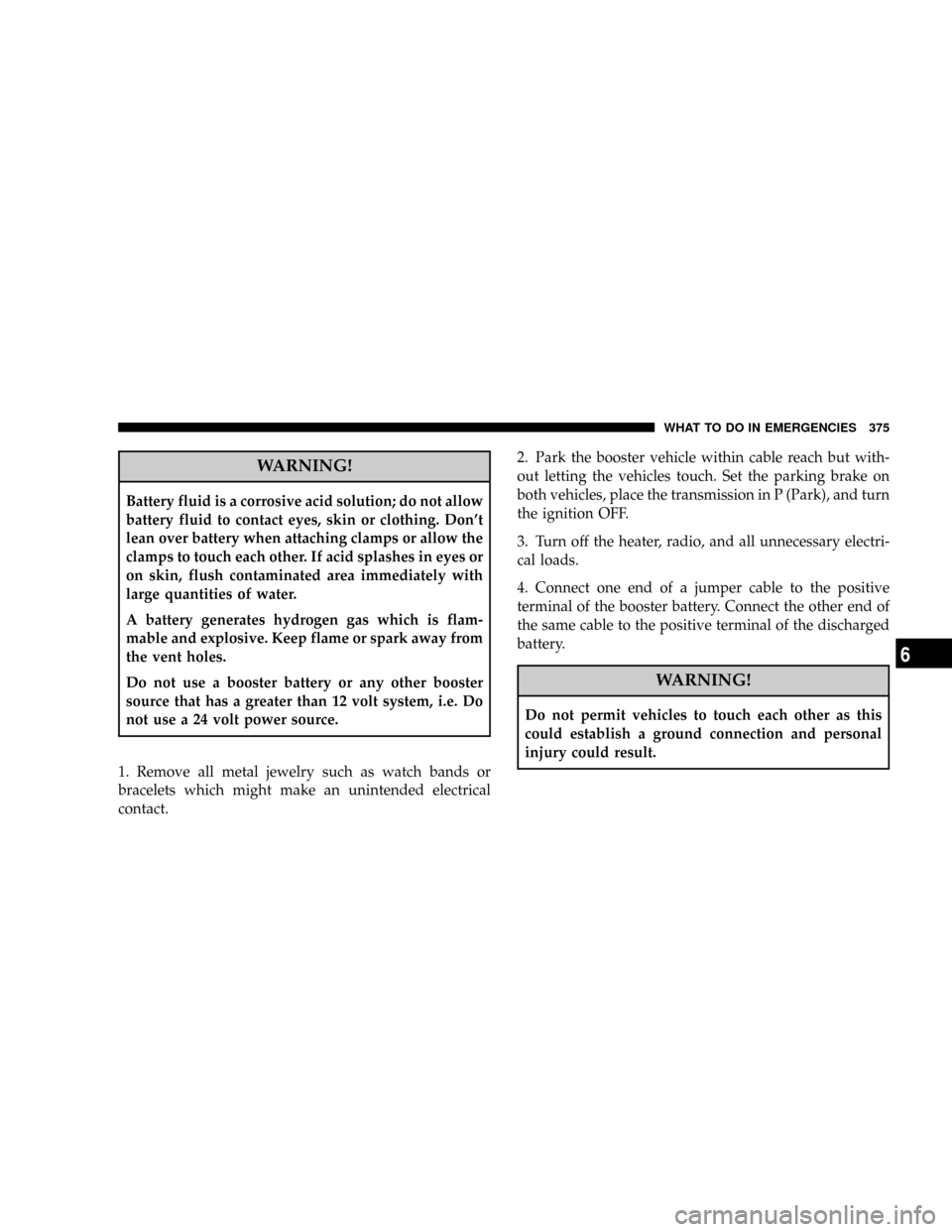
WARNING!
Battery fluid is a corrosive acid solution; do not allow
battery fluid to contact eyes, skin or clothing. Don't
lean over battery when attaching clamps or allow the
clamps to touch each other. If acid splashes in eyes or
on skin, flush contaminated area immediately with
large quantities of water.
A battery generates hydrogen gas which is flam-
mable and explosive. Keep flame or spark away from
the vent holes.
Do not use a booster battery or any other booster
source that has a greater than 12 volt system, i.e. Do
not use a 24 volt power source.
1. Remove all metal jewelry such as watch bands or
bracelets which might make an unintended electrical
contact.2. Park the booster vehicle within cable reach but with-
out letting the vehicles touch. Set the parking brake on
both vehicles, place the transmission in P (Park), and turn
the ignition OFF.
3. Turn off the heater, radio, and all unnecessary electri-
cal loads.
4. Connect one end of a jumper cable to the positive
terminal of the booster battery. Connect the other end of
the same cable to the positive terminal of the discharged
battery.
WARNING!
Do not permit vehicles to touch each other as this
could establish a ground connection and personal
injury could result.
WHAT TO DO IN EMERGENCIES 375
6
Page 376 of 478

5. Connect the other cable, first to the negative terminal
of the booster battery and then to the engine of the
vehicle with the discharged battery. Make sure you have
a good contact on the engine.
6. Start the engine in the vehicle which has the booster
battery, let the engine idle a few minutes, then start the
engine in the vehicle with the discharged battery.
7. When removing the jumper cables, reverse the above
sequence exactly. Be careful of the moving belts and fan.WARNING!
Any procedure other than above could result in:
1. Personal injury caused by electrolyte squirting out
the battery vent;
2. Personal injury or property damage due to battery
explosion;
3. Damage to charging system of booster vehicle or
of immobilized vehicle.
376 WHAT TO DO IN EMERGENCIES
Page 377 of 478
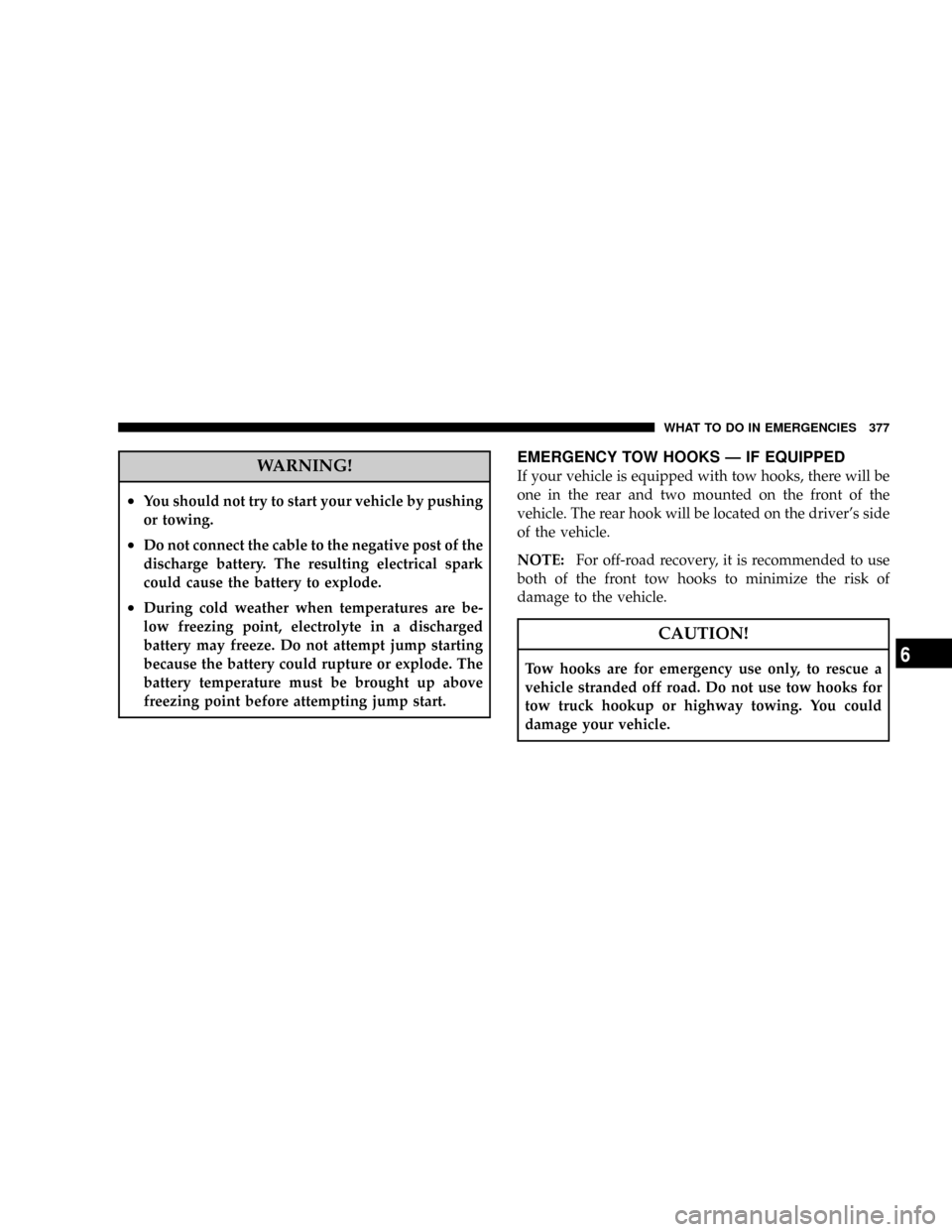
WARNING!
²You should not try to start your vehicle by pushing
or towing.
²Do not connect the cable to the negative post of the
discharge battery. The resulting electrical spark
could cause the battery to explode.
²During cold weather when temperatures are be-
low freezing point, electrolyte in a discharged
battery may freeze. Do not attempt jump starting
because the battery could rupture or explode. The
battery temperature must be brought up above
freezing point before attempting jump start.
EMERGENCY TOW HOOKS Ð IF EQUIPPED
If your vehicle is equipped with tow hooks, there will be
one in the rear and two mounted on the front of the
vehicle. The rear hook will be located on the driver's side
of the vehicle.
NOTE:For off-road recovery, it is recommended to use
both of the front tow hooks to minimize the risk of
damage to the vehicle.
CAUTION!
Tow hooks are for emergency use only, to rescue a
vehicle stranded off road. Do not use tow hooks for
tow truck hookup or highway towing. You could
damage your vehicle.
WHAT TO DO IN EMERGENCIES 377
6
Page 379 of 478

MAINTAINING YOUR VEHICLE
CONTENTS
mEngine Compartment ± 3.7L...............382
mEngine Compartment ± 4.7L...............383
mEngine Compartment ± 5.7L...............384
mOnboard Diagnostic System Ð OBD II........385
NLoose Fuel Filler Cap Message............386
mEmissions Inspection And Maintenance
Programs............................386
mReplacement Parts......................388
mDealer Service.........................388mMaintenance Procedures..................389
NEngine Oil..........................389
NDrive Belts Ð Check Condition And Tension . . 392
NSpark Plugs.........................392
NSpark Plug Wires.....................392
NEngine Air Cleaner Filter................393
NCatalytic Converter....................393
NCrankcase Emission Control System........395
NMaintenance-Free Battery................395
7
Page 387 of 478

is functioning and is not on when the engine is running,
and that the OBD (On Board Diagnostic) system is ready
for testing.
Normally, the OBD system will be ready. The OBD
system maynotbe ready if your vehicle was recently
serviced, if you recently had a dead battery, or a battery
replacement. If the OBD system should be determined
not ready for the I/M test, your vehicle may fail the test.
Your vehicle has a simple ignition key actuated test
which you can use prior to going to the test station. To
check if your vehicle's OBD system is ready, you must do
the following:
1. Insert your ignition key into the ignition switch.
2. Turn the ignition to the ON position, but do not crank
or start the engine.
3. If you crank or start the engine, you will have to start
this test over.4. As soon as you turn your key to the ON position, you
will see your MIL symbol come on as part of a normal
bulb check.
5. Approximately 15 seconds later, one of two things will
happen:
a. The MIL will flash for about 10 seconds and then
return to being fully illuminated until you turn off the
ignition key or start the engine. This means that your
vehicle's OBD system isnot readyand you shouldnot
proceed to the I/M station.
b. The MIL will not flash at all and will remain fully
illuminated until you turn off the ignition key or start
the engine. This means that your vehicle's OBD system
isreadyand you can proceed to the I/M station.
If your OBD system isnot ready,you should see your
authorized dealer or repair facility. If your vehicle was
recently serviced or had a battery failure or replacement,
MAINTAINING YOUR VEHICLE 387
7
Page 392 of 478

Engine Oil Filter Selection
All of the manufacturer's engines have a full-flow type
disposable oil filter. Use a filter of this type for replace-
ment. The quality of replacement filters varies consider-
ably. Only high quality filters should be used to assure
most efficient service. Mopartengine oil filters are high
quality oil filters and are recommended.
Drive Belts Ð Check Condition and Tension
Belt tension is controlled by means of an automatic
tensioner. No belt tension adjustments are required.
However, belt and belt tensioner condition should be
inspected at the specified intervals, and replaced if re-
quired. See your authorized dealer for service.
At the mileage indicated in the Maintenance Schedule, all
belts and tensioner should be checked for condition.
Improper belt tension can cause belt slippage and failure.
Belts should be inspected for evidence of cuts, cracks,
glazing, or frayed cords and replaced if there is indicationof damage which could result in belt failure. Low gen-
erator belt tension can cause battery failure.
Also, check belt routing to make sure there is no inter-
ference between the belts and other engine components.
Spark Plugs
Spark plugs must fire properly to assure engine perfor-
mance and emission control. New spark plugs should be
installed at the specified mileage. The entire set should be
replaced if there is any malfunction due to a faulty spark
plug. Refer to ªFluids, Lubricants, and Genuine Partsº in
this section for spark plug information.
Spark Plug Wires
The spark plug wires should be kept clean and properly
connected. Terminals should be fully seated. Cracked,
damaged, or faulty wires should be replaced.
392 MAINTAINING YOUR VEHICLE
Page 395 of 478

To minimize the possibility of catalytic converter dam-
age:
²Do not shut off the engine or interrupt the ignition
when the transmission is in gear and the vehicle is in
motion.
²Do not try to start the engine by pushing or towing the
vehicle.
²Do not idle the engine with any spark plug wires
disconnected or removed, such as when diagnostic
testing, or for prolonged periods during very rough
idle or malfunctioning operating conditions.
Crankcase Emission Control System
Proper operation of this system depends on freedom
from sticking or plugging due to deposits. As vehicle
mileage builds up, the PCV valve and passages may
accumulate deposits. If a valve is not working properly,
replace it with a new valve. DO NOT ATTEMPT TO
CLEAN THE OLD PCV VALVE!
Check ventilation hose for indication of damage or
plugging deposits. Replace if necessary.
Maintenance-Free Battery
Your vehicle is equipped with a maintenance-free battery.
You will never have to add water, nor is periodic main-
tenance required.
MAINTAINING YOUR VEHICLE 395
7
Page 396 of 478
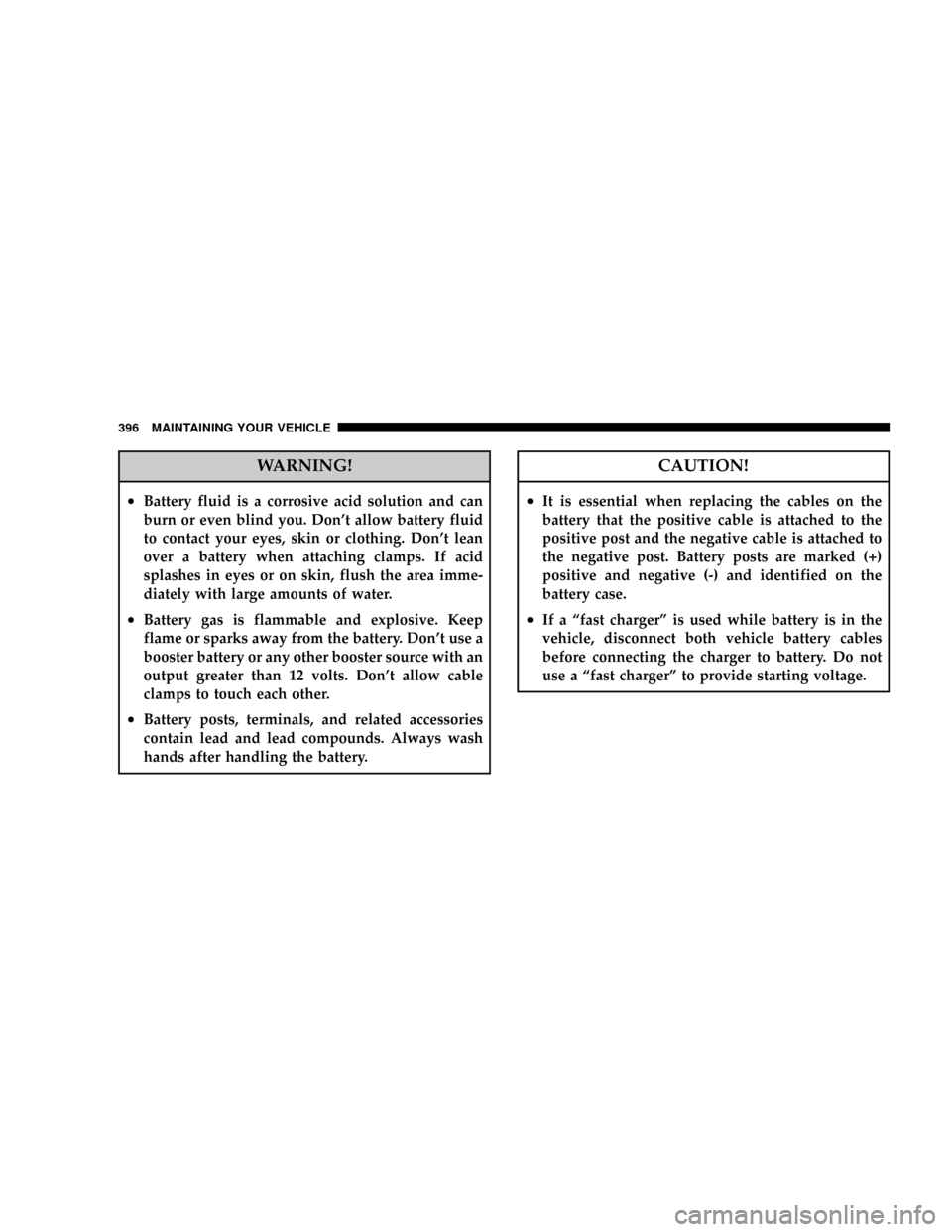
WARNING!
²Battery fluid is a corrosive acid solution and can
burn or even blind you. Don't allow battery fluid
to contact your eyes, skin or clothing. Don't lean
over a battery when attaching clamps. If acid
splashes in eyes or on skin, flush the area imme-
diately with large amounts of water.
²Battery gas is flammable and explosive. Keep
flame or sparks away from the battery. Don't use a
booster battery or any other booster source with an
output greater than 12 volts. Don't allow cable
clamps to touch each other.
²Battery posts, terminals, and related accessories
contain lead and lead compounds. Always wash
hands after handling the battery.
CAUTION!
²It is essential when replacing the cables on the
battery that the positive cable is attached to the
positive post and the negative cable is attached to
the negative post. Battery posts are marked (+)
positive and negative (-) and identified on the
battery case.
²If a ªfast chargerº is used while battery is in the
vehicle, disconnect both vehicle battery cables
before connecting the charger to battery. Do not
use a ªfast chargerº to provide starting voltage.
396 MAINTAINING YOUR VEHICLE
Page 426 of 478
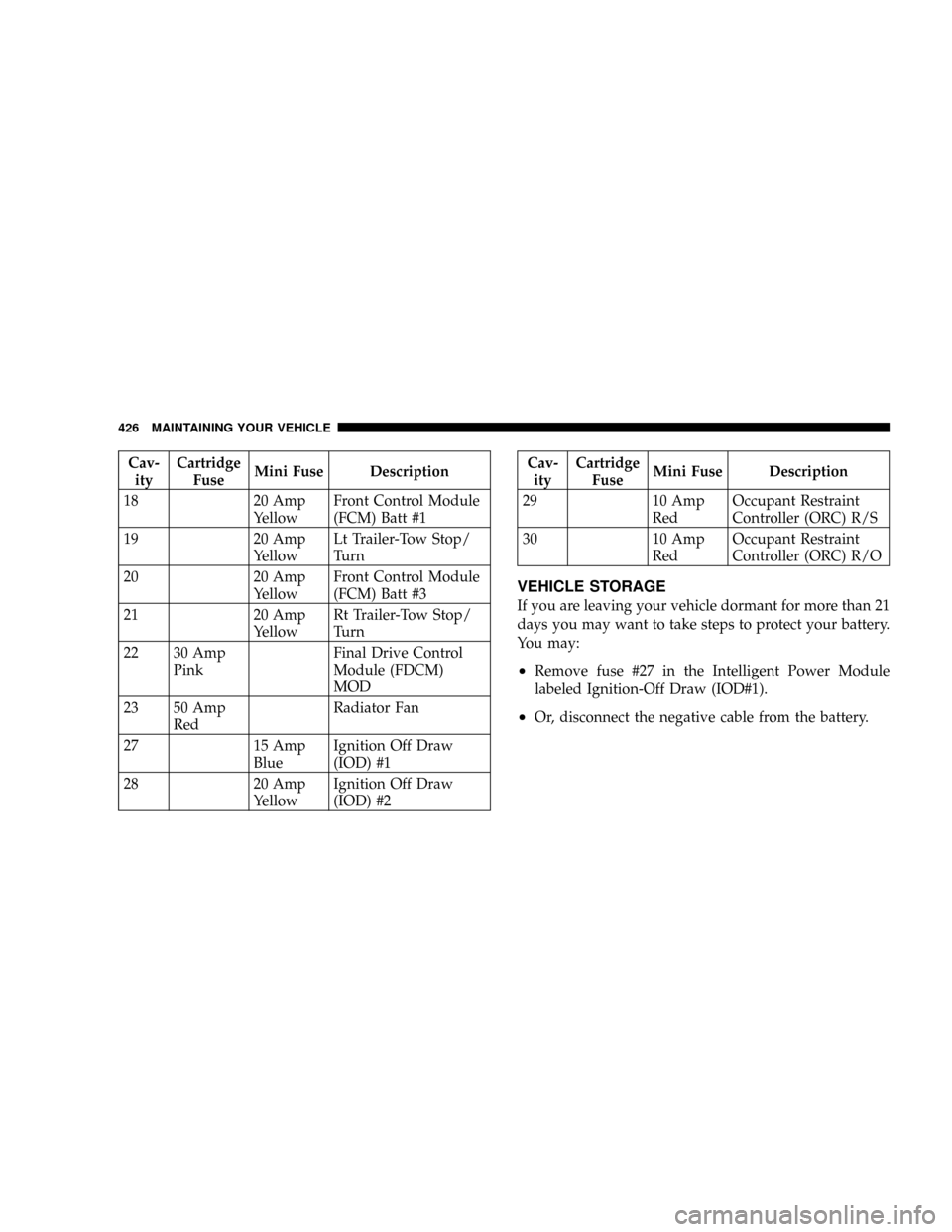
Cav-
ityCartridge
FuseMini Fuse Description
18 20 Amp
YellowFront Control Module
(FCM) Batt #1
19 20 Amp
YellowLt Trailer-Tow Stop/
Turn
20 20 Amp
YellowFront Control Module
(FCM) Batt #3
21 20 Amp
YellowRt Trailer-Tow Stop/
Turn
22 30 Amp
PinkFinal Drive Control
Module (FDCM)
MOD
23 50 Amp
RedRadiator Fan
27 15 Amp
BlueIgnition Off Draw
(IOD) #1
28 20 Amp
YellowIgnition Off Draw
(IOD) #2Cav-
ityCartridge
FuseMini Fuse Description
29 10 Amp
RedOccupant Restraint
Controller (ORC) R/S
30 10 Amp
RedOccupant Restraint
Controller (ORC) R/O
VEHICLE STORAGE
If you are leaving your vehicle dormant for more than 21
days you may want to take steps to protect your battery.
You may:
²Remove fuse #27 in the Intelligent Power Module
labeled Ignition-Off Draw (IOD#1).
²Or, disconnect the negative cable from the battery.
426 MAINTAINING YOUR VEHICLE