steering JEEP COMMANDER 2008 1.G Owner's Guide
[x] Cancel search | Manufacturer: JEEP, Model Year: 2008, Model line: COMMANDER, Model: JEEP COMMANDER 2008 1.GPages: 478, PDF Size: 6.97 MB
Page 398 of 478

NOTE:Use only manufacturer approved A/C System
Sealers, Stop Leak Products, Seal Conditioners, Compres-
sor Oil, and Refrigerants.
Refrigerant Recovery and Recycling
R-134a Air Conditioning Refrigerant is a hydrofluorocar-
bon (HFC) that is endorsed by the Environmental Pro-
tection Agency and is an ozone-saving product. How-
ever, the manufacturer recommends that air conditioning
service be performed by dealers or other service facilities
using recovery and recycling equipment.
Power Steering Fluid Check
The power steering system requires the use of Mopart
Hydraulic System Power Steering Fluid (P/N
05142893AA), or equivalent, which meets
DaimlerChrysler Material Standard MS-10838.
CAUTION!
Do not use Automatic Transmission Fluid (ATF) or
other types of power steering fluids when servicing
the power steering system of this vehicle. Damage to
the power steering system can result from the use of
the wrong power steering fluid.
Checking the power steering fluid level at a defined
service interval is not required. The fluid should only be
checked if a leak is suspected, abnormal noises are
apparent, and/or the system is not functioning as antici-
pated. Coordinate inspection efforts through a certified
ªDaimlerChrysler Dealership.º
398 MAINTAINING YOUR VEHICLE
Page 399 of 478
WARNING!
Fluid level should be checked on a level surface with
the engine off to prevent injury from moving parts,
and to insure accurate fluid level reading. Do not
overfill. Use only the manufacturer's recommended
fluid.
If necessary, add fluid to restore to the proper indicated
level. With a clean cloth, wipe any spilled fluid from all
surfaces. Refer to Fluids, Lubricants, and Genuine Parts
for correct fluid type.
NOTE:Upon initial start-up in cold weather, the power
steering pump may make noise for a short period of time.
This is due to the cold, thick fluid in the steering system.
This noise should be considered normal, and does not in
any way damage the steering system.
Body Lubrication
Locks and all body pivot points, including such items as
seat tracks, doors, tailgate and hood hinges, should be
lubricated periodically to assure quiet, easy operation
and to protect against rust and wear. Prior to the appli-
cation of any lubricant, the parts concerned should be
wiped clean to remove dust and grit; after lubricating
excess oil and grease should be removed. Particular
attention should also be given to hood latching compo-
nents to insure proper function. When performing other
underhood services, the hood latch, release mechanism
and safety catch should be cleaned and lubricated.
The external lock cylinders should be lubricated twice a
year, preferably in the fall and spring. Apply a small
amount of a high quality lubricant such as MopartLock
Cylinder Lubricant directly into the lock cylinder.
MAINTAINING YOUR VEHICLE 399
7
Page 408 of 478
Brake and Power Steering System Hoses
When servicing the vehicle for scheduled maintenance,
inspect surface of hoses for evidence of heat and me-
chanical damage. Hard and brittle rubber, cracking, tears,
cuts, abrasion, and excessive swelling suggest deteriora-
tion of the rubber. Particular attention should be made to
examining those hose surfaces nearest to high heat
sources, such as the exhaust manifold.
Inspect all hose clamps and couplings to make sure they
are secure and no leaks are present.
NOTE:Often fluids such as oil, power steering fluid,
and brake fluid are used during assembly plant opera-
tions to ease the assembly of hoses to couplings. There-
fore, oil wetness at the hose-coupling area is not neces-
sarily an indication of leakage. Actual dripping of hot
fluid when systems are under pressure (during vehicle
operation) should be noted before hose is replaced based
on leakage.NOTE:Inspection of brake hoses should be done when-
ever the brake system is serviced and every engine oil
change.
WARNING!
Worn brake hoses can burst and cause brake failure.
You could have an accident. If you see any signs of
cracking, scuffing, or worn spots, have the brake
hoses replaced immediately.
Brake Master Cylinder Ð Brake Fluid Level Check
The fluid level in the master cylinder should be checked
when performing under hood services, or immediately if
the brake system warning lamp shows system failure
Be sure to clean the top of the master cylinder area before
removing the cap. If necessary, add fluid to bring the
fluid level up to the requirements described on the brake
408 MAINTAINING YOUR VEHICLE
Page 414 of 478

Special Additives
Automatic Transmission Fluid (ATF) is an engineered
product and its performance may be impaired by supple-
mental additives. Therefore, do not add any fluid addi-
tives to the transmission. The only exception to this
policy is the use of special dyes to aid in detecting fluid
leaks. In addition, avoid using transmission sealers as
they may adversely affect seals.
Maintenance After Off-Road Driving
After extended operation in mud, sand or water, or
similar dirty conditions, have your brake discs, brake
linings, and axle joints inspected and cleaned as soon as
possible. This will prevent any abrasive material from
causing excessive wear or unpredictable braking action.After off-road driving, completely inspect the underbody
of your vehicle. Check tires, body structure, steering,
suspension and exhaust system for damage. Check
threaded fasteners for looseness, particularly on the
chassis, drivetrain components, steering and suspension.
Retighten, if required, to torque values specified in the
Service Manual. Also check for accumulations of vegeta-
tion or brush that could become a fire hazard, or conceal
damage to fuel lines, brake hoses, axle pinion seals, and
propeller shafts.
CAUTION!
Under frequent heavy-duty driving conditions,
change all lubricants and lubricate body compo-
nents, all driveline joints and steering linkage more
often than in normal service to prevent excessive
wear.
414 MAINTAINING YOUR VEHICLE
Page 419 of 478

2. Dry with a soft tissue.
Seat Belt Maintenance
Do not bleach, dye or clean the belts with chemical
solvents or abrasive cleaners. This will weaken the fabric.
Sun damage will also weaken the fabric.
If the belts need cleaning, use MopartTotal Clean, a mild
soap solution, or lukewarm water. Do not remove the
belts from the vehicle to wash them.
Replace the belts if they appear frayed or worn or if the
buckles do not work properly.
Dry with a soft tissue.
FUSE PANEL
Interior Fuses
The fuse panel is on the lower instrument panel just to
the left of the steering column.
Fuse Panel
MAINTAINING YOUR VEHICLE 419
7
Page 421 of 478
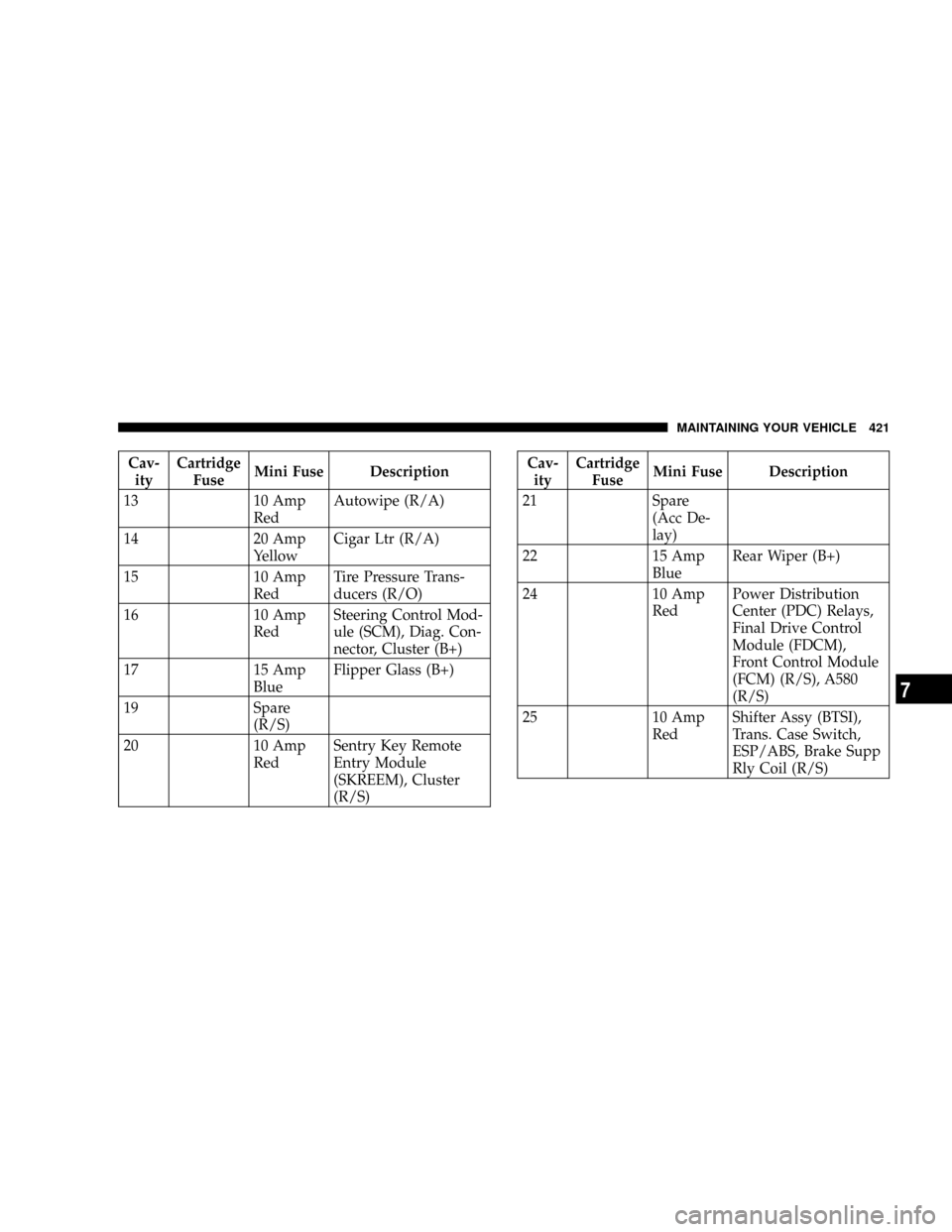
Cav-
ityCartridge
FuseMini Fuse Description
13 10 Amp
RedAutowipe (R/A)
14 20 Amp
YellowCigar Ltr (R/A)
15 10 Amp
RedTire Pressure Trans-
ducers (R/O)
16 10 Amp
RedSteering Control Mod-
ule (SCM), Diag. Con-
nector, Cluster (B+)
17 15 Amp
BlueFlipper Glass (B+)
19 Spare
(R/S)
20 10 Amp
RedSentry Key Remote
Entry Module
(SKREEM), Cluster
(R/S)Cav-
ityCartridge
FuseMini Fuse Description
21 Spare
(Acc De-
lay)
22 15 Amp
BlueRear Wiper (B+)
24 10 Amp
RedPower Distribution
Center (PDC) Relays,
Final Drive Control
Module (FDCM),
Front Control Module
(FCM) (R/S), A580
(R/S)
25 10 Amp
RedShifter Assy (BTSI),
Trans. Case Switch,
ESP/ABS, Brake Supp
Rly Coil (R/S)
MAINTAINING YOUR VEHICLE 421
7
Page 430 of 478

Front Turn Signal
1. Turn the steering wheel all the way to the left or right.
2. Reach into the front wheel house ahead of the front
wheel to unsnap and lift the cover over the access hole in
the front of the wheel house splash shield. Access to the
bulb can be gained through the wheel liner hole.3. Reach through the access hole to access the park/turn
signal bulb socket on the bottom of the front lamp unit
housing.
1 Ð Low Beam Bulb
2 Ð High Beam Bulb
3 Ð Front Park/Turn Signal Bulb 430 MAINTAINING YOUR VEHICLE
Page 431 of 478
4. Turn the socket on the bottom of the front lamp unit
housing 1/4 turn counter clockwise to unlock it.
5. Pull the socket and bulb straight out from the opening
in the housing.
6. Disconnect the electrical connector.
7. Pull the base of the bulb straight out of the socket.
CAUTION!
Do not touch the new bulb with your fingers. Oil
contamination will severely shorten bulb life. If the
bulb comes in contact with any oily surface, clean the
bulb with rubbing alcohol.
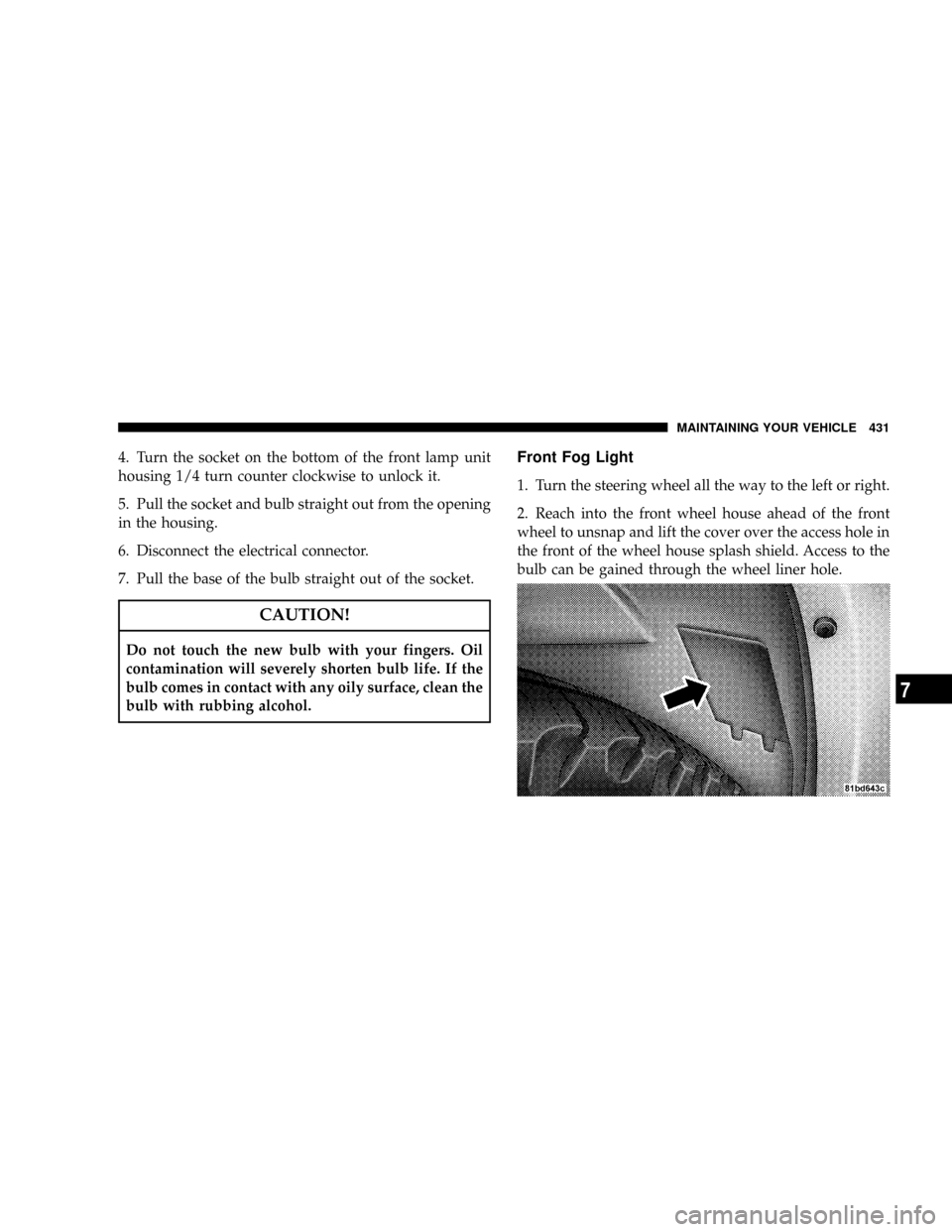
Front Fog Light
1. Turn the steering wheel all the way to the left or right.
2. Reach into the front wheel house ahead of the front
wheel to unsnap and lift the cover over the access hole in
the front of the wheel house splash shield. Access to the
bulb can be gained through the wheel liner hole.
MAINTAINING YOUR VEHICLE 431
7
Page 437 of 478
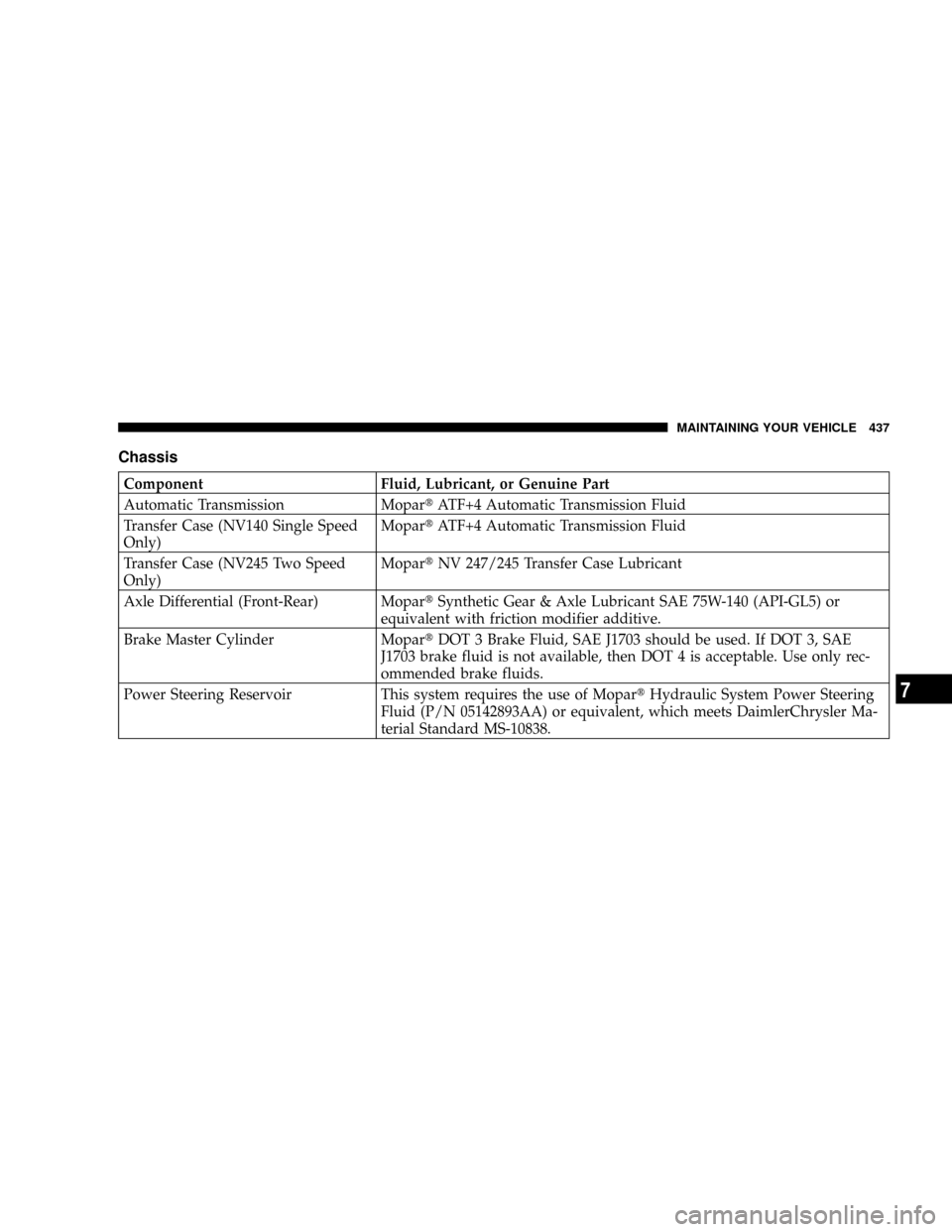
Chassis
Component Fluid, Lubricant, or Genuine Part
Automatic Transmission MopartATF+4 Automatic Transmission Fluid
Transfer Case (NV140 Single Speed
Only)MopartATF+4 Automatic Transmission Fluid
Transfer Case (NV245 Two Speed
Only)MopartNV 247/245 Transfer Case Lubricant
Axle Differential (Front-Rear) MopartSynthetic Gear & Axle Lubricant SAE 75W-140 (API-GL5) or
equivalent with friction modifier additive.
Brake Master Cylinder MopartDOT 3 Brake Fluid, SAE J1703 should be used. If DOT 3, SAE
J1703 brake fluid is not available, then DOT 4 is acceptable. Use only rec-
ommended brake fluids.
Power Steering Reservoir This system requires the use of MopartHydraulic System Power Steering
Fluid (P/N 05142893AA) or equivalent, which meets DaimlerChrysler Ma-
terial Standard MS-10838.
MAINTAINING YOUR VEHICLE 437
7
Page 441 of 478
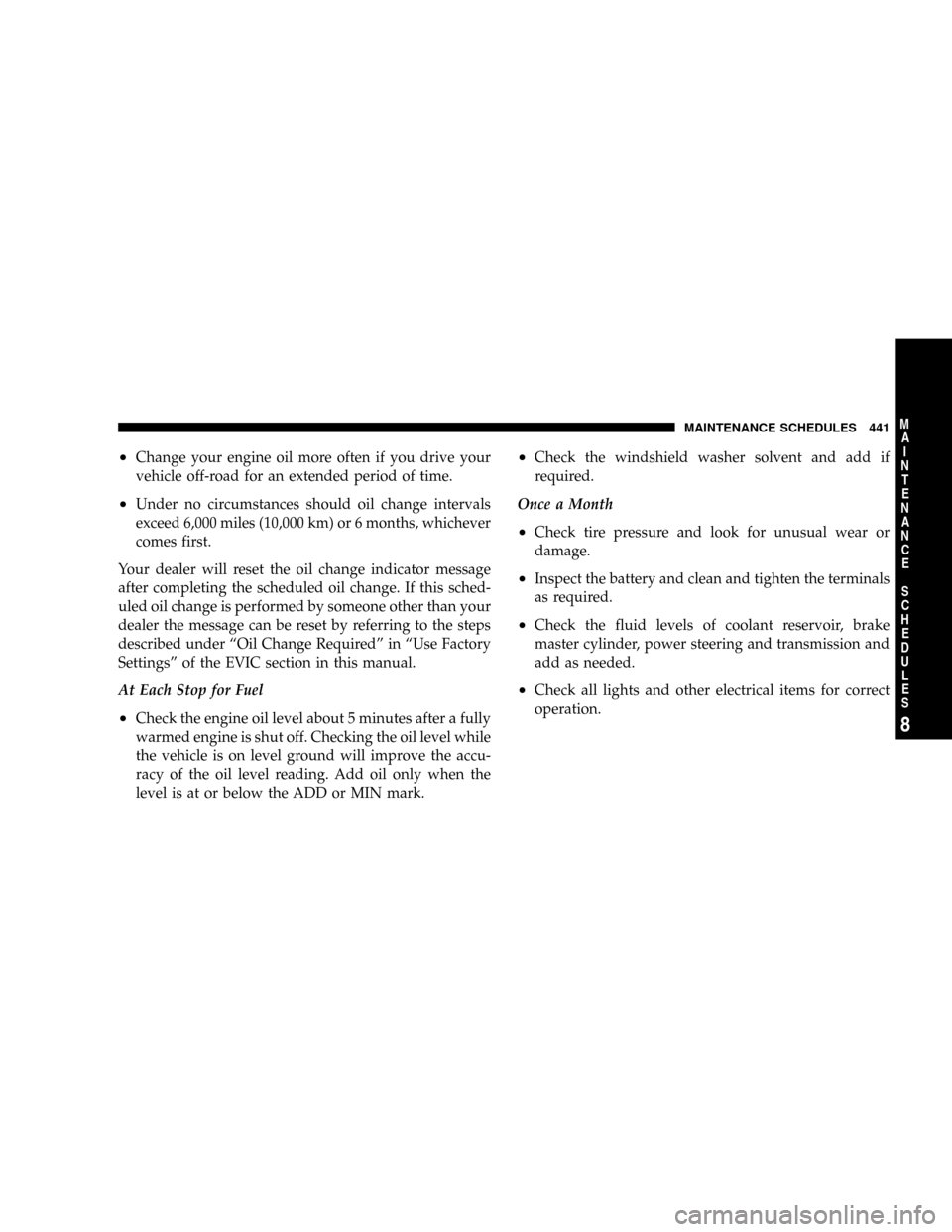
²Change your engine oil more often if you drive your
vehicle off-road for an extended period of time.
²Under no circumstances should oil change intervals
exceed 6,000 miles (10,000 km) or 6 months, whichever
comes first.
Your dealer will reset the oil change indicator message
after completing the scheduled oil change. If this sched-
uled oil change is performed by someone other than your
dealer the message can be reset by referring to the steps
described under ªOil Change Requiredº in ªUse Factory
Settingsº of the EVIC section in this manual.
At Each Stop for Fuel
²Check the engine oil level about 5 minutes after a fully
warmed engine is shut off. Checking the oil level while
the vehicle is on level ground will improve the accu-
racy of the oil level reading. Add oil only when the
level is at or below the ADD or MIN mark.
²Check the windshield washer solvent and add if
required.
Once a Month
²Check tire pressure and look for unusual wear or
damage.
²Inspect the battery and clean and tighten the terminals
as required.
²Check the fluid levels of coolant reservoir, brake
master cylinder, power steering and transmission and
add as needed.
²Check all lights and other electrical items for correct
operation.
MAINTENANCE SCHEDULES 441
8
M
A
I
N
T
E
N
A
N
C
E
S
C
H
E
D
U
L
E
S