ECU JEEP COMMANDER 2009 1.G Owner's Manual
[x] Cancel search | Manufacturer: JEEP, Model Year: 2009, Model line: COMMANDER, Model: JEEP COMMANDER 2009 1.GPages: 519, PDF Size: 9.78 MB
Page 184 of 519
rack system or a number of aftermarket rails that are
tailored to your life style or activities.
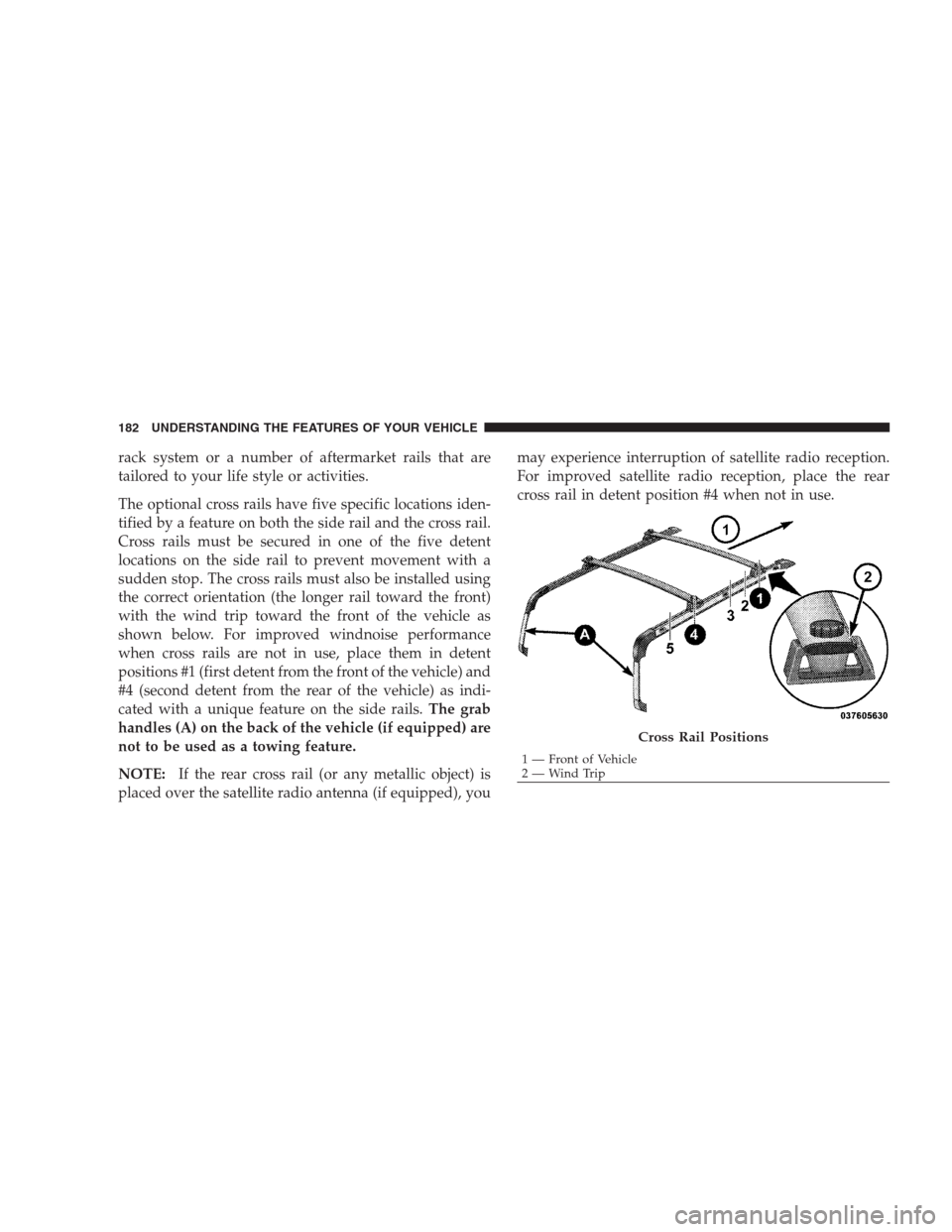
The optional cross rails have five specific locations iden-
tified by a feature on both the side rail and the cross rail.
Cross rails must be secured in one of the five detent
locations on the side rail to prevent movement with a
sudden stop. The cross rails must also be installed using
the correct orientation (the longer rail toward the front)
with the wind trip toward the front of the vehicle as
shown below. For improved windnoise performance
when cross rails are not in use, place them in detent
positions #1 (first detent from the front of the vehicle) and
#4 (second detent from the rear of the vehicle) as indi-
cated with a unique feature on the side rails.The grab
handles (A) on the back of the vehicle (if equipped) are
not to be used as a towing feature.
NOTE:If the rear cross rail (or any metallic object) is
placed over the satellite radio antenna (if equipped), youmay experience interruption of satellite radio reception.
For improved satellite radio reception, place the rear
cross rail in detent position #4 when not in use.
Cross Rail Positions
1 — Front of Vehicle
2 — Wind Trip 182 UNDERSTANDING THE FEATURES OF YOUR VEHICLE
Page 185 of 519
CAUTION!
•To prevent damage to the roof of your vehicle, DO
NOT carry any loads on the roof rack without
cross rails installed. The load should be secured
and placed on top of the cross rails, not directly on
the roof. If it is necessary to place the load on the
roof, place a blanket or some other protection
between the load and the roof surface.
•To avoid damage to the roof rack and vehicle, do
not exceed the rated load capacity of your cross rail
system or the roof rack system maximum load
capacity of 150 lbs (68 kg). Always distribute
heavy loads as evenly as possible and secure the
load appropriately.
•Long loads which extend over the windshield,
such as wood panels or surfboards, should be
secured to both the front and rear of the vehicle.
(Continued)
CAUTION! (Continued)
•Travel at reduced speeds and turn corners care-
fully when carrying large or heavy loads on the
roof rack. Wind forces, due to natural causes or
nearby truck traffic, can add sudden upward loads.
This is especially true on large flat loads and may
result in damage to the cargo or your vehicle.
WARNING!
Cargo must be securely tied before driving your
vehicle. Improperly secured loads can fly off the
vehicle, particularly at high speeds, resulting in per-
sonal injury or property damage. Follow the roof rack
“Cautions” when carrying cargo on your roof rack.
UNDERSTANDING THE FEATURES OF YOUR VEHICLE 183
3
Page 196 of 519
If the ABS light is on, the brake system should be serviced
as soon as possible to restore the benefits of Anti-Lock
brakes. If the ABS light does not turn on when the
Ignition switch is turned to the ON position, have the
light inspected by an authorized dealer.
8. Tachometer
Indicates the engine speed in revolutions per minute
(RPM).
9. Vehicle Security Light
This light will flash rapidly for approximately
15 seconds when the vehicle theft alarm is
arming. The light will flash at a slower speed
continuously after the alarm is set. The security
light will also come on for about three seconds when the
ignition is first turned on.10. Oil Pressure Warning Light
This light indicates low engine oil pressure. The
light should turn on momentarily when the engine
is started. If the light turns on while driving, stop the
vehicle and shut off the engine as soon as possible. A
chime will sound for four minutes when this light turns
on.
Do not operate the vehicle until the cause is corrected.
This light does not show how much oil is in the engine.
The engine oil level must be checked under the hood.
11. Electronic Stability Program (ESP) Indicator
Light/Traction Control System (TCS) Indicator Light
If this indicator light flashes during accelera-
tion, apply as little throttle as possible. While
driving, ease up on the accelerator. Adapt your
speed and driving to the prevailing road con-
ditions, and do not switch off the Electronic Stability
Program (ESP), or Traction Control System (TCS).
194 UNDERSTANDING YOUR INSTRUMENT PANEL
Page 204 of 519
•DAMAGED KEY — KEY DOES NOT COMMUNI-
CATE
•KEY NOT PROGRAMMED — KEY NOT PRO-
GRAMMED
•WRONG KEY — KEY DOES NOT BELONG TO
VEHICLE
•KEY NOT PROGRAMMED — EXCEEDED KEY PRO-
GRAM LIMIT
•PROGRAMMING ACTIVE — NEW KEY PRO-
GRAMMED
•SERVICE SECURITY KEY
•DRIVER/PASSENGER DOOR OPEN (with graphic)
•LEFT/RIGHT REAR DOOR OPEN (with graphic)
•X DOORS OPEN (with graphic)
•LIFTGATE OPEN (with graphic)
•LIFTGATE/DOOR OPEN (with graphic)
•LIFTGATE/DOORS OPEN (with graphic)
•LIFTGLASS OPEN (with graphic)
•HOOD OPEN (with graphic)
•HOOD/DOOR OPEN (with graphic)
•HOOD/DOORS OPEN (with graphic)
•LIFTGATE/HOOD OPEN (with graphic)
•HOOD/GLASS/DOOR OPEN (with graphic)
•HOOD/GLASS/DOORS OPEN (with graphic)
•HOOD/GATE/DOOR OPEN (with graphic)
•HOOD/GATE/DOORS OPEN (with graphic)
•LIFTGLASS/DOOR OPEN (with graphic)
•LIFTGLASS/DOORS OPEN (with graphic)
202 UNDERSTANDING YOUR INSTRUMENT PANEL
Page 381 of 519
Tire Size
The tire size on the label represents the actual tire size on
your vehicle. Replacement tires must be equal to the load
capacity of this tire size.
Rim Size
This is the rim size that is appropriate for the tire size
listed.
Inflation Pressure
This is the cold tire inflation pressure for your vehicle for
all loading conditions up to full GAWR.
Curb Weight
The curb weight of a vehicle is defined as the total weight
of the vehicle with all fluids, including vehicle fuel, at full
capacity conditions, and with no occupants or cargo
loaded into the vehicle. The front and rear curb weight
values are determined by weighing your vehicle on a
commercial scale before any occupants or cargo are
added.
Loading
The actual total weight and the weight of the front and
rear of your vehicle at the ground can best be determined
by weighing it when it is loaded and ready for operation.
The entire vehicle should first be weighed on a commer-
cial scale to ensure that the GVWR has not been ex-
ceeded. The weight on the front and rear of the vehicle
should then be determined separately to be sure that the
load is properly distributed over front and rear axle.
Weighing the vehicle may show that the GAWR of either
the front or rear axles has been exceeded, but the total
load is within the specified GVWR. If so, weight must be
shifted from front to rear, or rear to front, as appropriate
until the specified weight limitations are met. Store the
heavier items down low and be sure that the weight is
distributed equally. Stow all loose items securely before
driving.
STARTING AND OPERATING 379
5
Page 388 of 519
NOTE:Remember that everything put into or on the
trailer adds to the load on your vehicle. Also, additional
factory-installed options, or dealer-installed options,
must be considered as part of the total load on your
vehicle. Refer to the Tire and Loading Information plac-
ard in the “Tire—Safety Information” section of this
manual for the maximum combined weight of occupants
and cargo for your vehicle.
Towing Requirements
To promote proper break-in of your new vehicle driv-
etrain components the following guidelines are recom-
mended:
CAUTION!
•Avoid towing a trailer for the first 500 miles
(805 km) of vehicle operation. Doing so may dam-
age your vehicle.
(Continued)
CAUTION! (Continued)
•During the first 500 miles (805 km) of trailer
towing, limit your speed to 50 mph (80 km/h).
WARNING!
Improper towing can lead to an injury accident.
Follow these guidelines to make your trailer towing
as safe as possible:
Make certain that the load is secured in the trailer
and will not shift during travel. When trailering
cargo that is not fully secured, dynamic load shifts
can occur that may be difficult for the driver to
control. You could lose control of your vehicle and
have an accident.
386 STARTING AND OPERATING
Page 407 of 519
WARNING! (Continued)
•Always park on a firm, level surface as far from
the edge of the roadway as possible before raising
the vehicle.
•Block the wheel diagonally opposite the wheel to
be raised.
•Set the parking brake firmly, and shift a automatic
transmission into PARK; or a manual transmission
into REVERSE.
•Never start or run the engine with the vehicle on a
jack.
•Do not let anyone sit in the vehicle when it is on a
jack.
•Do not get under the vehicle when it is on a jack.
•Only use the jack in the positions indicated and
for lifting this vehicle during a tire change.
(Continued)
WARNING! (Continued)
•If working on or near a roadway, be extremely
careful of motor traffic.
•To assure that spare tires, flat or inflated are
securely stowed, spares must be stowed with the
valve stem facing the ground.
•Turn on the Hazard warning flasher.
1. Remove the spare tire, jack, and tools from storage.
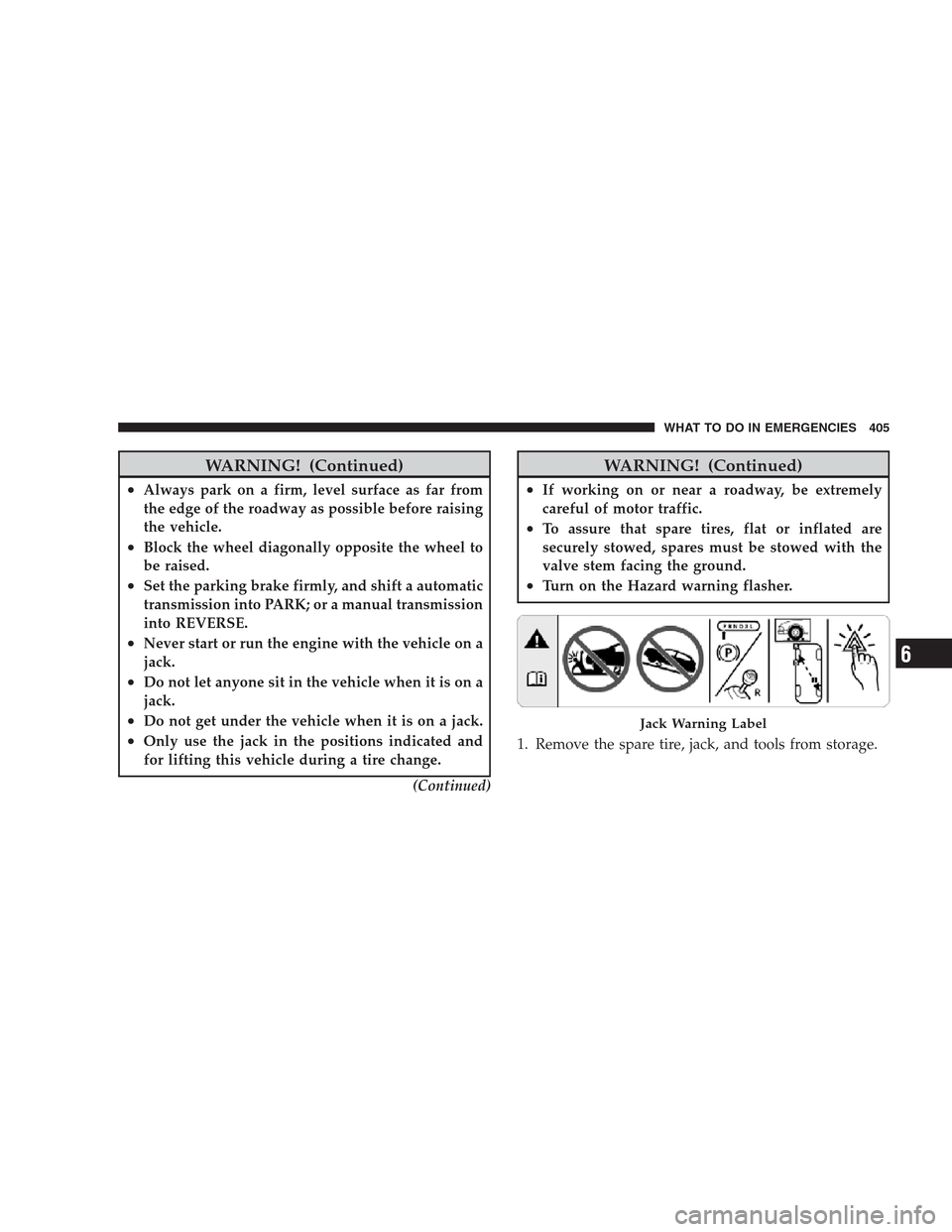
Jack Warning Label
WHAT TO DO IN EMERGENCIES 405
6
Page 410 of 519
WARNING!
Raising the vehicle higher than necessary can make
the vehicle less stable. It could slip off the jack and
hurt someone near it. Raise the vehicle only enough
to remove the tire.
6. Remove the lug nuts and wheel.
7. Position the spare wheel/tire on the vehicle and install
the lug nuts with the cone-shaped end toward the wheel.
Lightly tighten the nuts. To avoid the risk of forcing the
vehicle off the jack, do not tighten the nuts fully until the
vehicle has been lowered.
8. Lower the vehicle by turning the jack screw counter-
clockwise, and remove the jack and wheel blocks.
9. Finish tightening the lug nuts. Push down on the
wrench while tightening for increased leverage. Alternate
nuts until each nut has been tightened twice. Correctwheel nut tightness is 95 ft lbs (130 N·m). If in doubt
about the correct tightness, have them checked with a
torque wrench by your authorized dealer or at a service
station.
10. Lower the jack to it’s fully closed position.
WARNING!
A loose tire or jack, thrown forward in a collision or
hard stop could endanger the occupants of the ve-
hicle. Always stow the jack parts and the spare tire in
the places provided.
11. Secure the tire, jack, and tools in their proper loca-
tions.
NOTE:Tire should be stowed with the “beauty” side
up. Storing the tire upside down may result in scratching
or damage to the wheel face. Continue winching up the
tire until you hear the winch “ratchet” three times.
408 WHAT TO DO IN EMERGENCIES
Page 464 of 519
5. Turn the socket on the back of the housing 1/4 turn
counterclockwise to unlock it.
6. Pull the socket and bulb straight out from the opening
in the housing.
7. Pull the base of the bulb straight out of the socket.
CAUTION!
Do not touch the new bulb with your fingers. Oil
contamination will severely shorten bulb life. If the
bulb comes in contact with any oily surface, clean the
bulb with rubbing alcohol.
Rear Tail, Stop, Turn Signal, and Backup Lights
1. Raise the liftgate.
2. Remove the two push-pins that secure the rear lamp
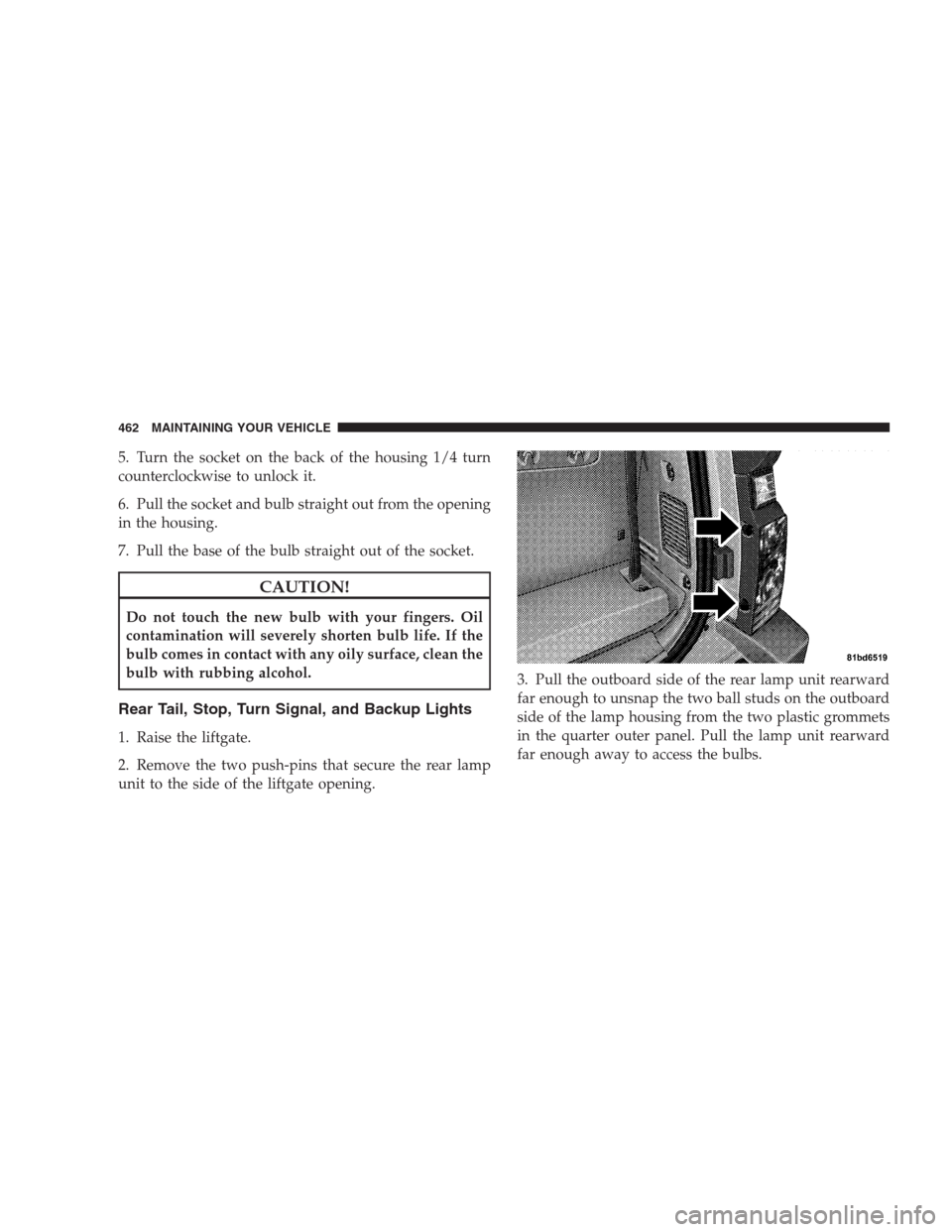
unit to the side of the liftgate opening.3. Pull the outboard side of the rear lamp unit rearward
far enough to unsnap the two ball studs on the outboard
side of the lamp housing from the two plastic grommets
in the quarter outer panel. Pull the lamp unit rearward
far enough away to access the bulbs.
462 MAINTAINING YOUR VEHICLE
Page 466 of 519
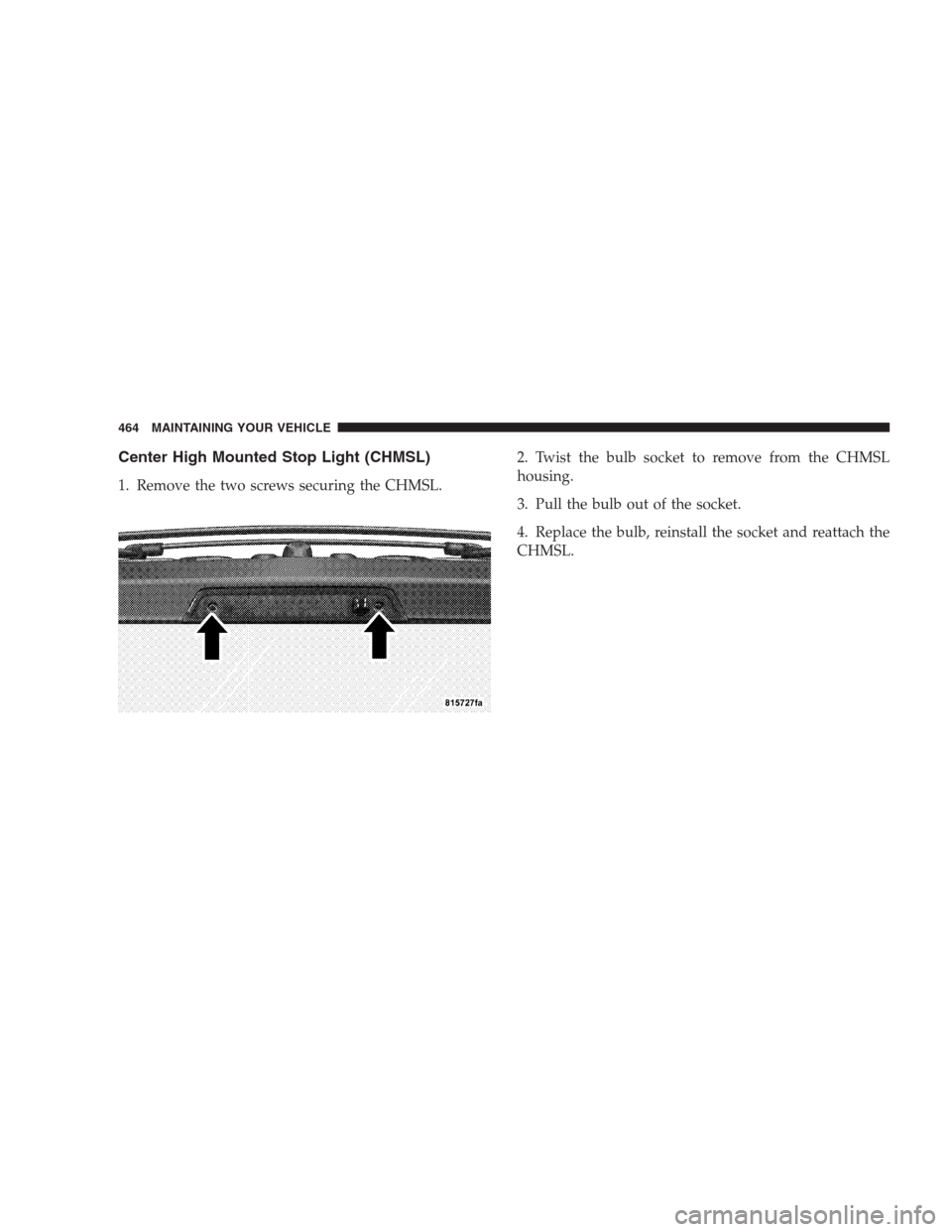
Center High Mounted Stop Light (CHMSL)
1. Remove the two screws securing the CHMSL.2. Twist the bulb socket to remove from the CHMSL
housing.
3. Pull the bulb out of the socket.
4. Replace the bulb, reinstall the socket and reattach the
CHMSL.
464 MAINTAINING YOUR VEHICLE