automatic transmission JEEP COMPASS 2008 1.G User Guide
[x] Cancel search | Manufacturer: JEEP, Model Year: 2008, Model line: COMPASS, Model: JEEP COMPASS 2008 1.GPages: 399, PDF Size: 6.59 MB
Page 234 of 399

Gear Ranges For Continuously Variable
Automatic Transaxle (CVT)
DO NOT race the engine when shifting from P (Park) or
N (Neutral) positions into another gear range.
P (Park)
Supplements the parking brake by locking the transmis-
sion. The engine can be started in this range. Never use P
(Park) while the vehicle is in motion. Apply the parking
brake when leaving the vehicle in this range. Always
apply the parking brake first, and then place the selector
in P (Park) position.
WARNING!
Unintended movement of a vehicle could injure
those in and near the vehicle. As with all vehicles,
you should never exit a vehicle while the engine is
running. Before exiting a vehicle, you should always
shift the vehicle into P (Park), remove the key from
the ignition, and apply the parking brake. Once the
key is removed from the ignition, the transmission
shift lever is locked in the P (Park) position, securing
the vehicle against unwanted movement. Further-
more, you should never leave children unattended
inside a vehicle.
234 STARTING AND OPERATING
Page 236 of 399

AUTOSTICK Ð IF EQUIPPED
Autostick is a driver-interactive transmission that offers
six manual ratio changes to provide you with more
control. Autostick allows you to maximize engine brak-
ing, eliminate undesirable upshifts and downshifts, and
improve overall vehicle performance. This system can
also provide you with more control during passing, city
driving, cold slippery conditions, mountain driving,
trailer towing, and many other situations. Automatic
ratio changes upward will only occur to protect the
Continuously Variable Automatic Transaxle (CVT) and or
the engine from overspeed and changes down will only
happen at minimum engine speed to prevent stalling.
Autostick Operation
NOTE:Autostick is not functional until the CVT warms
up in cold weather.
Autostick Shifter
236 STARTING AND OPERATING
Page 237 of 399

Autostick operation is activated in the9D9position by
moving the shift lever side to side. Moving the lever to
the (+) side will activate Autostick and shift up to the
next higher manual ratio, unless you are already operat-
ing in or near overdrive in which case, 6th ratio will be
selected. In like manner, moving the lever to (-) will
activate Autostick and shift to the next lower manual
ratio. After Autostick is activated, the manual ratio
selected is displayed in the transmission ratio display
and tipping the lever to the (+) or (-) direction will cause
an upshift or downshift by one ratio.
Autostick is deactivated:
²By holding the lever to (+) momentarily.
²When the shift lever is shifted out of9D.9
²When in 6 position, touching the lever to the right.
²When heavy Anti-lock brake system (ABS) application
is detected.
Autostick General Information
²
If a ratio other than 1st is selected and the vehicle is
brought to a stop, the transaxle control logic will
automatically select the 1st gear ratio.
²If a low range is selected and the engine accelerates to
the rev limit, the transaxle will automatically select the
next higher ratio.
²If a downshift would cause the engine to overspeed,
that shift will not occur until it is safe for the engine.
Mostly the CVT will stay in the manually selected
ratio, however.
²If the system detects powertrain overheating, the
transmission will revert to the automatic shift mode
and remain in that mode until the powertrain cools off.
²If the system detects a problem it will disable the
Autostick mode and the transmission will return to the
automatic mode until the problem is corrected.
STARTING AND OPERATING 237
5
Page 288 of 399

WARNING!
Improper towing can lead to an injury accident.
Follow these guidelines to make your trailer towing
as safe as possible:
Make certain that the load is secured in the trailer
and will not shift during travel. When trailering
cargo that is not fully secured, dynamic load shifts
can occur that may be difficult for the driver to
control. You could lose control of your vehicle and
have an accident.
²When hauling cargo or towing a trailer, do not over-
load your vehicle or trailer. Overloading can cause a
loss of control, poor performance or damage to brakes,
axle, engine, transmission, steering, suspension, chas-
sis structure or tires.
²Safety chains must always be used between your
vehicle and trailer. Always connect the chains to the
frame or hook retainers of the vehicle hitch. Cross the
chains under the trailer tongue and allow enough
slack for turning corners.
²Vehicles with trailers should not be parked on a grade.
When parking, apply the parking brake on the tow
vehicle. Put the tow vehicle automatic transmission in
P for Park. Always, block or9chock9the trailer wheels.
²GCWR must not be exceeded.
²Total weight must be distributed between the tow
vehicle and the trailer such that the following four
ratings are not exceeded:
1. GVWR
2. GTW
3. GAWR
288 STARTING AND OPERATING
Page 292 of 399

Towing Tips
Before setting out on a trip, practice turning, stopping
and backing the trailer in an area away from heavy
traffic.
Towing Tips Ð Automatic Transmission
The automatic transmission fluid and filter should be
changed if you REGULARLY tow a trailer for more than
45 minutes of continuous operation. Refer to the ªMain-
tenance Scheduleº in Section 8 for transmission fluid
change intervals.
NOTE:Check the automatic transmission fluid level
before towing.
Towing Tips Ð Electronic Speed Control (If
Equipped)
þ
Don't use in hilly terrain or with heavy loads.
þWhen using the speed control, if you experience speed
drops greater than 10 mph (16 km/h), disengage until
you can get back to cruising speed.
þUse speed control in flat terrain and with light loads to
maximize fuel efficiency.
7- Pin Connector
292 STARTING AND OPERATING
Page 298 of 399
WARNING!
A hot engine cooling system is dangerous. You or
others could be badly burned by steam or boiling
coolant. You may want to call a service center if your
vehicle overheats. If you decide to look under the
hood yourself, refer to Section 7, Maintenance, of this
manual. Follow the warnings under the Cooling
System Pressure Cap paragraph.
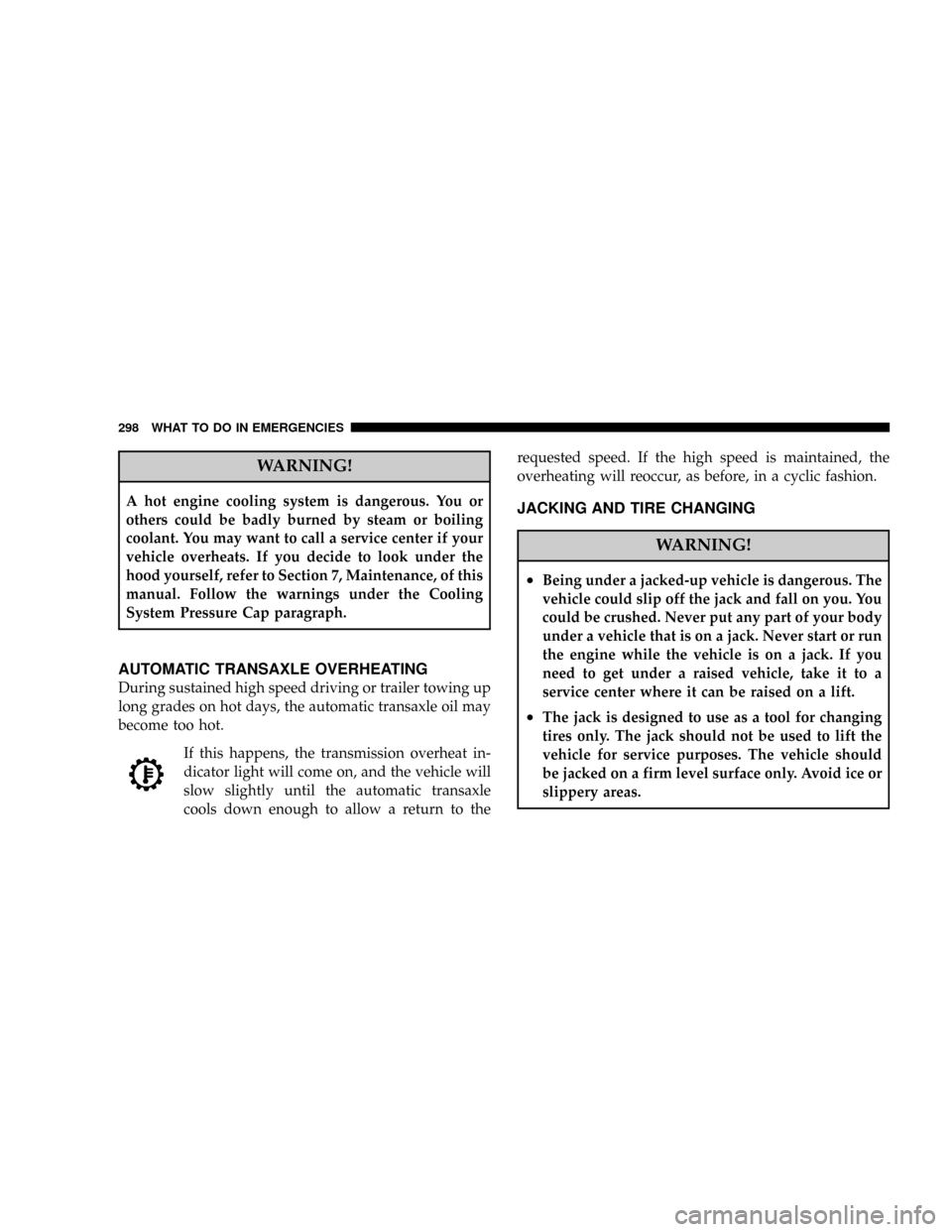
AUTOMATIC TRANSAXLE OVERHEATING
During sustained high speed driving or trailer towing up
long grades on hot days, the automatic transaxle oil may
become too hot.
If this happens, the transmission overheat in-
dicator light will come on, and the vehicle will
slow slightly until the automatic transaxle
cools down enough to allow a return to therequested speed. If the high speed is maintained, the
overheating will reoccur, as before, in a cyclic fashion.
JACKING AND TIRE CHANGING
WARNING!
²Being under a jacked-up vehicle is dangerous. The
vehicle could slip off the jack and fall on you. You
could be crushed. Never put any part of your body
under a vehicle that is on a jack. Never start or run
the engine while the vehicle is on a jack. If you
need to get under a raised vehicle, take it to a
service center where it can be raised on a lift.
²The jack is designed to use as a tool for changing
tires only. The jack should not be used to lift the
vehicle for service purposes. The vehicle should
be jacked on a firm level surface only. Avoid ice or
slippery areas.
298 WHAT TO DO IN EMERGENCIES
Page 339 of 399

Automatic Transaxle (CVT)
Selection Of Lubricant
It is important that the proper lubricant is used in the
transaxle to assure optimum transaxle performance. Use
only the manufacturer's recommended transmission
fluid which has been formulated with special metal to
metal friction coefficient additives to provide the proper
steel belt traction on the drive and driven pulleys. Refer
to ªFluids, Lubricants and Genuine Partsº for correct
fluid type.
CAUTION!
Using a transmission fluid other than the manufac-
turers recommended fluid will cause belt slip and
result in a complete transmission failure! Refer to
ªFluids, Lubricants, and Genuine Partsº for correct
fluid type.
Fluid Level Check
The fluid level in the automatic transaxle should be
checked only by a trained technician.
Fluid and Filter Changes
Refer to the ªMaintenance Scheduleº in Section 8 of this
manual for the correct change interval.
Special Additives
Do not add any materials (other than leak detection dyes)
to Continuously Variable Transaxle (CVT) Fluid
(CVTF+4). CVTF+4 is an engineered product and its
performance may be impaired by supplemental addi-
tives.
Manual Transaxle
Lubricant Selection
Use only the manufacturers recommended transmission
fluid. Refer to ªFluids, Lubricants, and Genuine Partsº
for correct fluid type.
MAINTAINING YOUR VEHICLE 339
7
Page 368 of 399
Perform Maintenance Every(Where time and mileage
are listed, follow the interval that occurs first.)
Maintenance Items Miles Kilometers or Months
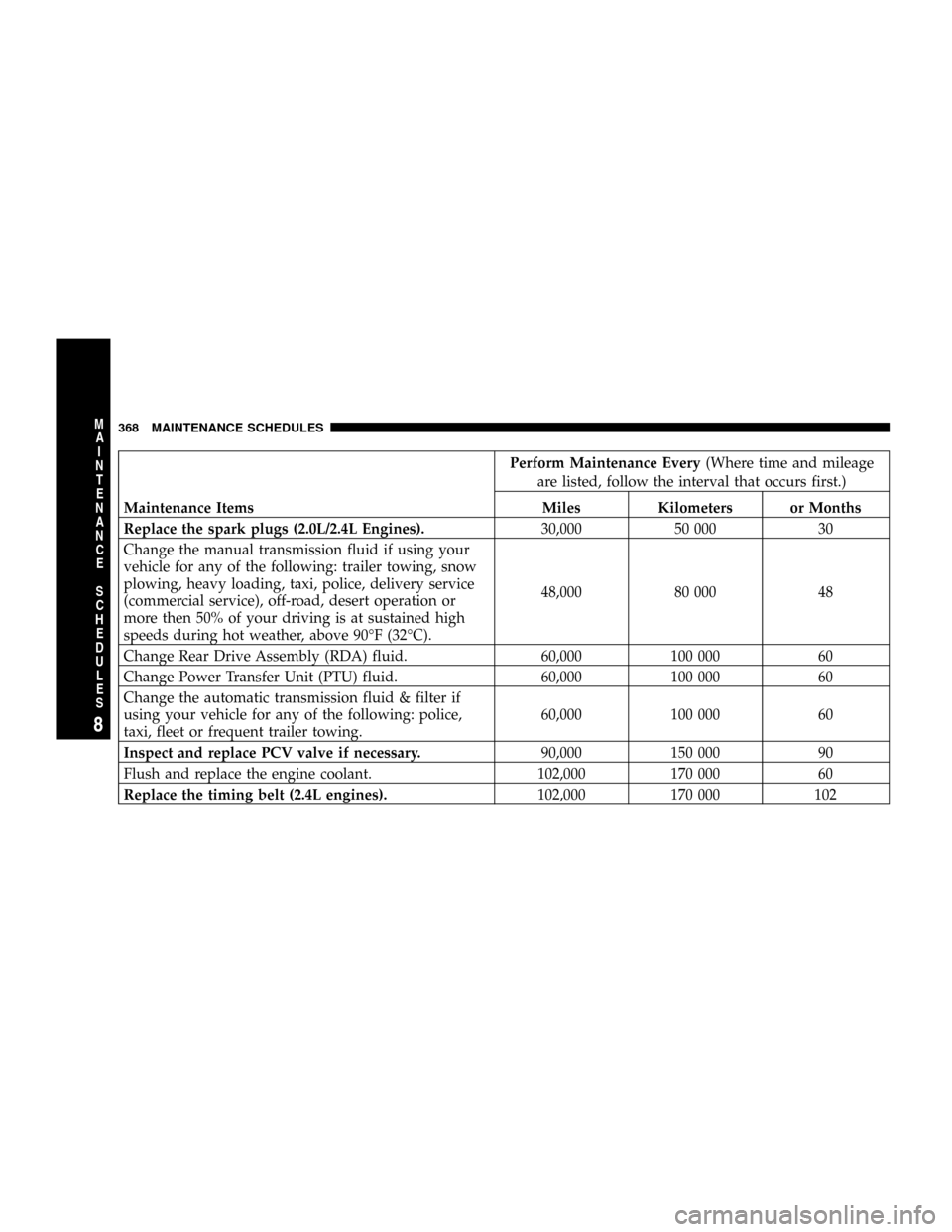
Replace the spark plugs (2.0L/2.4L Engines).30,000 50 000 30
Change the manual transmission fluid if using your
vehicle for any of the following: trailer towing, snow
plowing, heavy loading, taxi, police, delivery service
(commercial service), off-road, desert operation or
more then 50% of your driving is at sustained high
speeds during hot weather, above 90ÉF (32ÉC).48,000 80 000 48
Change Rear Drive Assembly (RDA) fluid. 60,000 100 000 60
Change Power Transfer Unit (PTU) fluid. 60,000 100 000 60
Change the automatic transmission fluid & filter if
using your vehicle for any of the following: police,
taxi, fleet or frequent trailer towing.60,000 100 000 60
Inspect and replace PCV valve if necessary.90,000 150 000 90
Flush and replace the engine coolant. 102,000 170 000 60
Replace the timing belt (2.4L engines).102,000 170 000 102
368 MAINTENANCE SCHEDULES
8
M
A
I
N
T
E
N
A
N
C
E
S
C
H
E
D
U
L
E
S
Page 369 of 399
Perform Maintenance Every(Where time and mileage
are listed, follow the interval that occurs first.)
Maintenance Items Miles Kilometers or Months
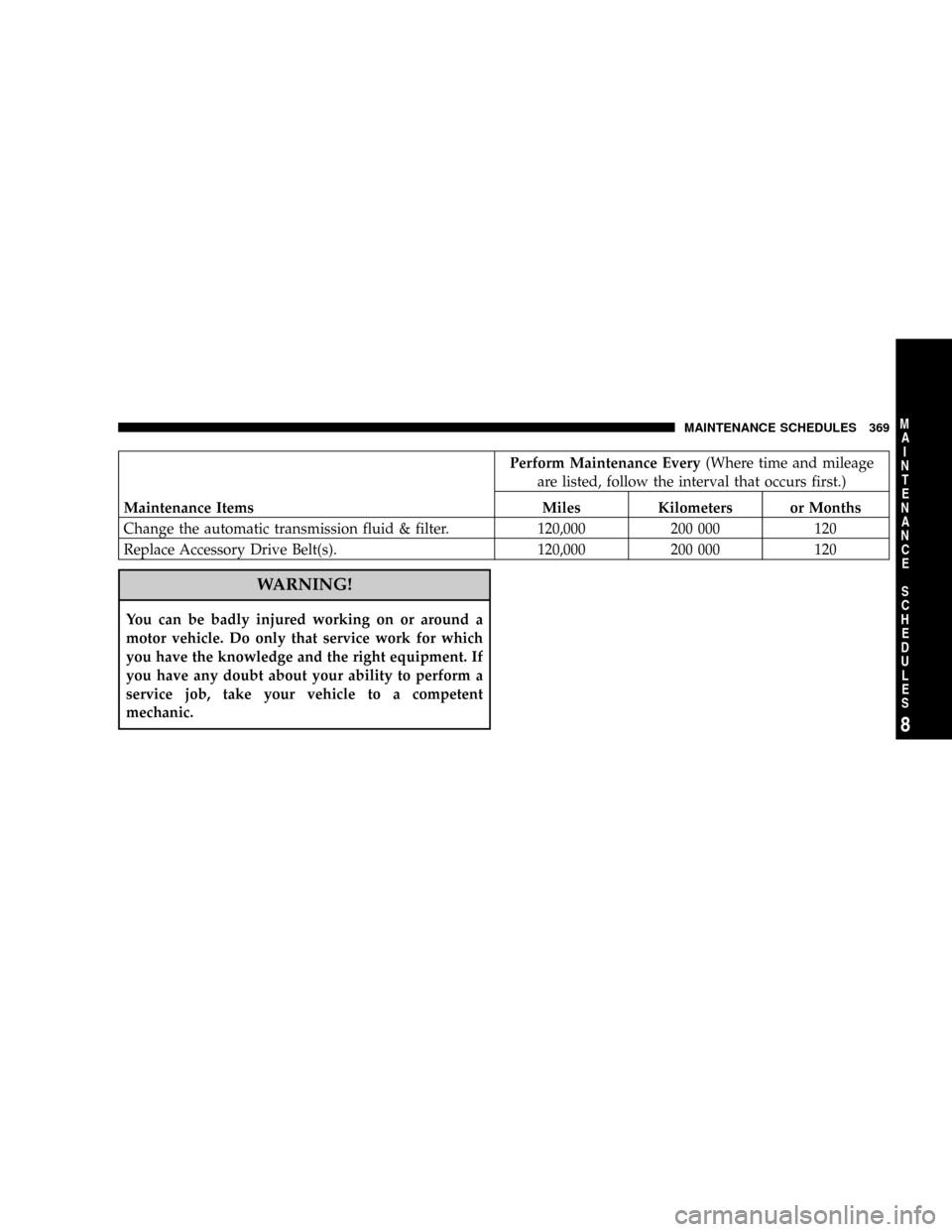
Change the automatic transmission fluid & filter. 120,000 200 000 120
Replace Accessory Drive Belt(s). 120,000 200 000 120
WARNING!
You can be badly injured working on or around a
motor vehicle. Do only that service work for which
you have the knowledge and the right equipment. If
you have any doubt about your ability to perform a
service job, take your vehicle to a competent
mechanic.
MAINTENANCE SCHEDULES 369
8
M
A
I
N
T
E
N
A
N
C
E
S
C
H
E
D
U
L
E
S
Page 395 of 399

Service Assistance....................... 372
Service Contract......................... 374
Service Manuals........................ 376
Setting the Clock................182,185,193,205
Settings, Personal........................ 175
Shift Speeds, Manual Transaxle.............. 231
Shoulder Belts........................... 35
Side Airbag............................. 52
Side Window Demisters (Defrosters).......... 222
Signals, Turn........................... 354
Slippery Surfaces, Driving On............... 238
Snow Chains (Tire Chains)................. 265
Snow Tires............................ 275
Spare Tire..........................260,299
Spark Plugs............................ 320
Speakers, Fold Down..................... 152
Specifications
Oil ................................ 318
Speed Control (Cruise Control)...........123,165Speedometer........................... 161
Starting............................... 227
Automatic Transmission................. 227
Engine Fails to Start.................... 228
Manual Transmission................... 227
Starting Procedures...................... 227
Steering
Power...........................246,326
Tilt Column.......................... 122
Wheel Lock........................... 14
Steering Wheel Mounted Sound System
Controls.............................. 212
Storage............................... 350
Stuck, Freeing.......................... 305
Sun Roof.............................. 141
Sun Visor Extension....................... 76
Supplemental Restraint System - Airbag........ 46
Synthetic Engine Oil...................... 319
System, Navigation...................... 204
INDEX 395
10