brake light JEEP COMPASS 2008 1.G User Guide
[x] Cancel search | Manufacturer: JEEP, Model Year: 2008, Model line: COMPASS, Model: JEEP COMPASS 2008 1.GPages: 399, PDF Size: 6.59 MB
Page 242 of 399

NOTE:The parking brake lever will not release unless
the lever is pulled up slightly past its applied position.
When parking on a hill, it is important to set the parking
brake before placing the gear selector in Park, otherwise
the load on the automatic transaxle locking mechanism
may make it difficult to move the selector out of Park. Asan added precaution, turn the front wheels toward the
curb on a downhill grade and away from the curb on a
uphill grade.
You should always apply the parking brake before leav-
ing the vehicle.
WARNING!
²Never leave children alone in a vehicle. Leaving
children in a vehicle unattended is dangerous for a
number of reasons. A child or others could be
seriously or fatally injured. Don't leave the keys in
the ignition. A child could operate power win-
dows, other controls, or move the vehicle.
²Be sure the parking brake is fully disengaged
before driving; failure to do so can lead to brake
failure and an accident.Parking Brake Lever
242 STARTING AND OPERATING
Page 243 of 399
BRAKE SYSTEM
Your vehicle is equipped with power assisted brakes as
standard equipment. In the event power assist is lost for
any reason (for example, repeated brake applications
with the engine off), the brakes will still function. How-
ever, the effort required to brake the vehicle will be much
greater than that required with the power system oper-
ating.
WARNING!
Riding the brakes can lead to brake failure and
possibly an accident. Driving with your foot resting
or riding on the brake pedal can result in abnormally
high brake temperatures, excessive lining wear, and
possible brake damage. You wouldn't have your full
braking capacity in an emergency.If either of the two hydraulic systems lose normal capa-
bility, the remaining system will still function with some
loss of overall braking effectiveness. This will be evident
by increased pedal travel during application and greater
pedal force required to slow or stop. In addition, if the
malfunction is caused by an internal leak, as the brake
fluid in the master cylinder drops, the brake warning
indicator will light.
WARNING!
Driving a vehicle with the brake light on is danger-
ous. A significant decrease in braking performance or
vehicle stability during braking may occur. It will
take you longer to stop the vehicle or will make your
vehicle harder to control. You could have an accident.
Have the vehicle checked immediately.
STARTING AND OPERATING 243
5
Page 245 of 399

The ABS light monitors the Anti-Lock Brake
System. The light will come on when the
ignition switch is turned to the ON position
and may stay on for as long as four seconds.
If the ABS light remains on or comes on while driving, it
indicates that the Anti-Lock portion of the brake system
is not functioning and that service is required. However,
the conventional brake system will continue to operate
normally if the BRAKE warning light is not on.
If the ABS light is on, the brake system should be serviced
as soon as possible to restore the benefits of Anti-Lock
brakes. If the ABS light does not come on when the
Ignition switch is turned to the ON position, have the
bulb repaired as soon as possible.
If both the Brake Warning Light and the ABS Light
remain on, the Anti-Lock brakes (ABS) and Electronic
Brake Force Distribution (EBD) systems are not function-
ing. Immediate repair to the ABS system is required.When the vehicle is driven over 7 mph (11 km/h), you
may also hear a slight clicking sound as well as some
related motor noises. These noises are the system per-
forming its self check cycle to ensure that the ABS system
is working properly. This self check occurs each time the
vehicle is started and accelerated past 7 mph (11 km/h).
ABS is activated during braking under certain road or
stopping conditions. ABS-inducing conditions can in-
clude ice, snow, gravel, bumps, railroad tracks, loose
debris, or panic stops.
You also may experience the following when the brake
system goes into Anti-lock:
²The ABS motor running (it may continue to run for a
short time after the stop),
²the clicking sound of solenoid valves,
²brake pedal pulsations,
STARTING AND OPERATING 245
5
Page 246 of 399

²and a slight drop or fall away of the brake pedal at the
end of the stop.
These are all normal characteristics of ABS.
WARNING!
The Anti-Lock Brake System contains sophisticated
electronic equipment that may be susceptible to
interference caused by improperly installed or high
output radio transmitting equipment. This interfer-
ence can cause possible loss of anti-lock braking
capability. Installation of such equipment should be
performed by qualified professionals.
All vehicle wheels and tires must be the same size and
type and tires must be properly inflated to produce
accurate signals for the computer.
POWER STEERING
The standard power steering system will give you good
vehicle response and increased ease of maneuverability
in tight spaces. The system will provide mechanical
steering capability if power assist is lost.
If for some reason the power assist is interrupted, it will
still be possible to steer your vehicle. Under these condi-
tions, you will observe a substantial increase in steering
effort, especially at very low vehicle speeds and during
parking maneuvers.
NOTE:Increased noise levels at the end of the steering
wheel travel are considered normal and do not indicate
that there is a problem with the power steering system.
Upon initial start-up in cold weather, the power steering
pump may make noise for a short amount of time. This is
due to the cold, thick fluid in the steering system. This
noise should be considered normal, and it does not in any
way damage the steering system.
246 STARTING AND OPERATING
Page 284 of 399
WARNING!
An improperly adjusted Weight Distributing Hitch
system may reduce handling, stability, braking per-
formance, and could result in an accident.
Weight Distributing Systems may not be compatible
with Surge Brake Couplers. Consult with your hitch
and trailer manufacturer or a reputable Recreational
Vehicle dealer for additional information.
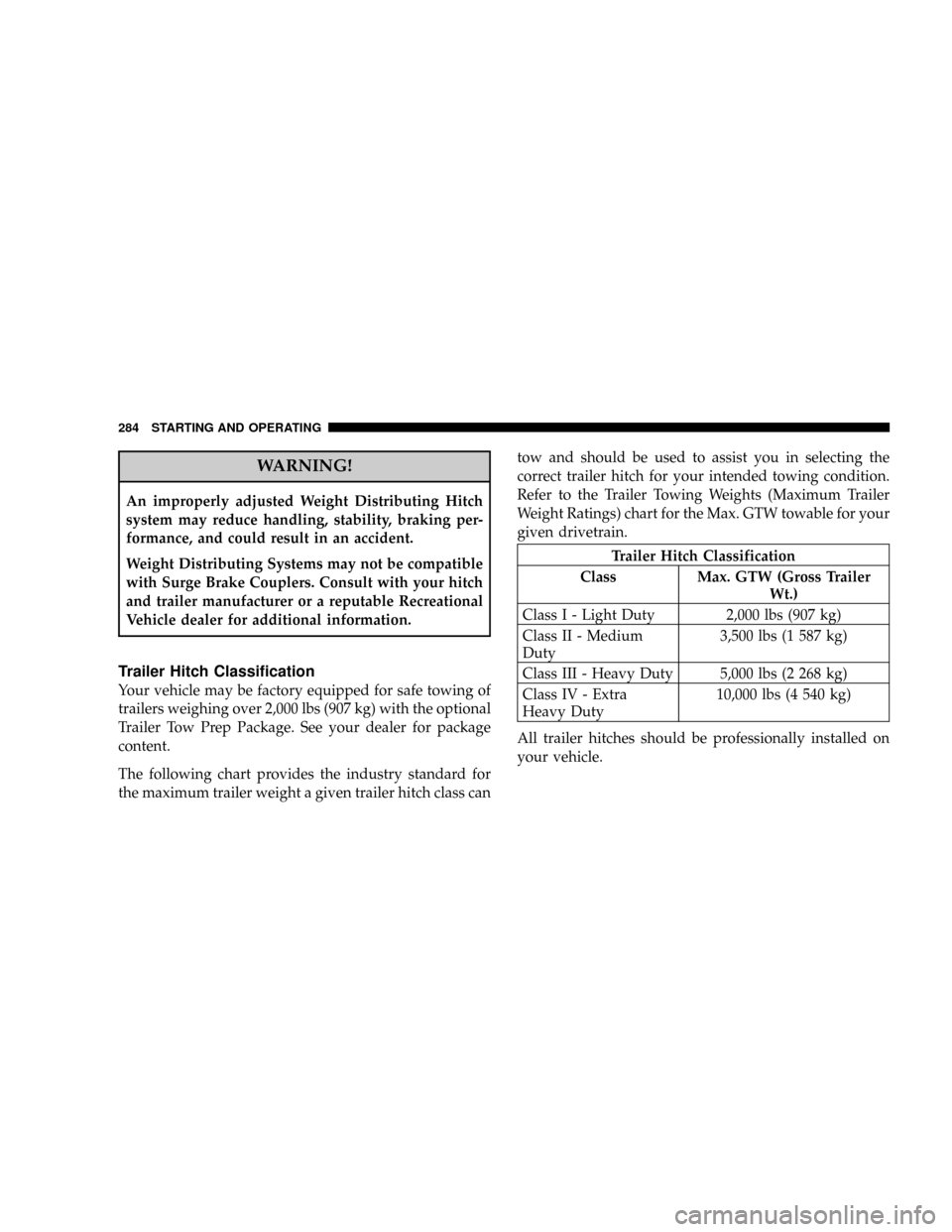
Trailer Hitch Classification
Your vehicle may be factory equipped for safe towing of
trailers weighing over 2,000 lbs (907 kg) with the optional
Trailer Tow Prep Package. See your dealer for package
content.
The following chart provides the industry standard for
the maximum trailer weight a given trailer hitch class cantow and should be used to assist you in selecting the
correct trailer hitch for your intended towing condition.
Refer to the Trailer Towing Weights (Maximum Trailer
Weight Ratings) chart for the Max. GTW towable for your
given drivetrain.
Trailer Hitch Classification
Class Max. GTW (Gross Trailer
Wt.)
Class I - Light Duty 2,000 lbs (907 kg)
Class II - Medium
Duty3,500 lbs (1 587 kg)
Class III - Heavy Duty 5,000 lbs (2 268 kg)
Class IV - Extra
Heavy Duty10,000 lbs (4 540 kg)
All trailer hitches should be professionally installed on
your vehicle.
284 STARTING AND OPERATING
Page 304 of 399

WARNING!
Wear eye protection and remove any metal jewelry
such as watch bands or bracelets that might make an
inadvertent electrical contact. You could be seriously
injured.
NOTE: Disconnecting the battery with the ignition in
the On position will cause vehicles with an automatic
transaxle (CVT2) to go into ªdefault modeº and turn on
the malfunction indicator light. See your authorized
dealer to correct this condition.
1. Wear eye protection and remove any metal jewelry
such as watch bands or bracelets that might make an
inadvertent electrical contact.2. When boosting from a battery in another vehicle, park
that vehicle within booster cable reach but without
letting the vehicles touch. Set parking brake, place auto-
matic transaxle in PARK (manual transaxle in NEU-
TRAL) and turn ignition to OFF for both vehicles.
3. Turn off the heater, radio and all unnecessary electrical
loads.
4. Remove the air intake duct covering the battery, using
the two finger screws on the cover.
5. Connect one end of a jumper cable to the positive
terminal of the booster battery. Connect the other end of
the jumper cable to the positive terminal of the dis-
charged battery.
304 WHAT TO DO IN EMERGENCIES
Page 310 of 399

NFront Suspension Ball Joints..............327
NBody Lubrication.....................327
NWindshield Wiper Blades................328
NWindshield Washer Reservoir.............328
NExhaust System......................328
NCooling System.......................329
NHoses And Vacuum/Vapor Harnesses.......335
NFuel System Connections................335
NBrake System........................335
NAutomatic Transaxle (CVT)..............339
NManual Transaxle.....................339
NRear Drive Assembly (RDA) ± AWD/4WD
Models Only........................340NPower Transfer Unit (PTU) ± AWD/4WD
Models Only........................341
NAppearance Care And Protection From
Corrosion...........................341
mFuses/Integrated Power Module (IPM).......347
mVehicle Storage........................350
mReplacement Bulbs......................350
mBulb Replacement......................351
NHeadlamps..........................351
NFog Lights..........................353
NTail Lights, Rear Turn Signals And Backup
Lights Ð Replacement..................354
NLicense Lights........................356
NCenter High-Mounted Stoplight...........358
310 MAINTAINING YOUR VEHICLE
Page 366 of 399
At Each Stop for Fuel
²Check the engine oil level about 5 minutes after a fully
warmed engine is shut off. Checking the oil level while
the vehicle is on level ground will improve the accu-
racy of the oil level reading. Add oil only when the
level is at or below the ADD or MIN mark.
²Check the windshield washer solvent and add if
required.
Once a Month
²Check tire pressure and look for unusual wear or
damage.
²Inspect the battery and clean and tighten the terminals
as required.
²Check the fluid levels of coolant reservoir, brake
master cylinder, power steering and transmission and
add as needed.
²Check all lights and other electrical items for correct
operation.
At Each Oil Change
²Change the engine oil filter.
²Inspect the brake hoses and lines.
²Check the Manual Transmission fluid level.
CAUTION!
Failure to perform the required maintenance items
may result in damage to the vehicle.
366 MAINTENANCE SCHEDULES
8
M
A
I
N
T
E
N
A
N
C
E
S
C
H
E
D
U
L
E
S
Page 382 of 399

ABS (Anti-Lock Brake System).............. 244
Adding Engine Coolant (Antifreeze).......... 331
Adding Fuel........................... 279
Adding Washer Fluid..................122,153
Additives, Fuel......................... 277
Air Cleaner, Engine (Engine Air Cleaner Filter) . . . 323
Air Conditioner Maintenance............... 325
Air Conditioning Controls................. 214
Air Conditioning, Operating Tips............ 220
Air Conditioning Refrigerant.............325,326
Air Conditioning System................214,325
Air Pressure, Tires....................... 257
Airbag................................ 46
Airbag Deployment.....................50,52
Airbag Light.....................51,54,67,161
Airbag Maintenance....................... 54
Airbag, Side............................ 52
Airbag, Window (Side Curtain).............46,52
Alarm System (Security Alarm)............18,164Alignment and Balance................... 264
Alterations/Modifications, Vehicle............. 8
Antenna, Satellite Radio................... 211
Antifreeze (Engine Coolant)...........330,360,361
Capacities........................... 360
Disposal............................ 333
Anti-Lock Brake System (ABS)............126,244
Anti-Theft Security Alarm (Theft Alarm)........ 18
Appearance Care........................ 341
Automatic Door Locks...................27,28
Automatic Transaxle...........12,227,232,298,339
Fluid Level Check...................... 339
Interlock System....................... 233
Overheating.......................... 298
Selection Of Lubricant................... 339
Shifting............................. 234
Special Additives...................... 339
Autostick............................. 236
382 INDEX
Page 383 of 399

Ball Joints............................. 327
Battery............................... 324
Keyless Transmitter Replacement (RKE)....... 24
Belts, Drive............................ 320
Body Mechanism Lubrication............... 327
B-Pillar Location........................ 252
Brake Assist System...................... 128
Brake Control System, Electronic............. 127
Brake Fluid............................ 362
Brake, Parking.......................... 241
Brake System........................243,335
Anti-Lock (ABS).................126,127,244
Hoses.............................. 336
Master Cylinder....................... 337
Parking............................. 241
Warning Light........................ 163
Brakes.............................243,335
Brake/Transmission Interlock............... 233
Break-In Recommendations, New Vehicle........ 65Bulb Replacement.....................350,351
Bulbs, Light............................ 350
Calibration, Compass..................... 180
Capacities, Antifreeze (Engine Coolant)........ 360
Capacities, Fluid........................ 360
Caps, Filler
Fuel................................ 279
Oil (Engine).......................312,319
Car Washes............................ 342
Carbon Monoxide Warning................. 278
Cargo Area Cover....................... 150
Cargo Area Features...................... 148
Cargo Compartment
Light............................... 148
Luggage Carrier....................... 154
Cargo Light............................ 148
Cargo Load Floor........................ 150
Cargo Tie-Downs........................ 151
INDEX 383
10