fuel JEEP COMPASS 2008 1.G Owner's Guide
[x] Cancel search | Manufacturer: JEEP, Model Year: 2008, Model line: COMPASS, Model: JEEP COMPASS 2008 1.GPages: 399, PDF Size: 6.59 MB
Page 314 of 399

Loose Fuel Filler Cap Message
After fuel is added, the vehicle diagnostic system can
determine if the fuel filler cap is possible loose or
improperly installed. A GASCAP message will be dis-
played in the instrument cluster. Tighten the gas cap until
a9clicking9sound is heard. This is an indication that the
gas cap is properly tightened. Press the trip odometer
reset button to turn off the message. If the problem
persists, the message will appear the next time the
vehicle is started. This might indicate a damaged cap. If
the problem is detected twice in a row, the system will
turn on the Malfunction Indicator Light (MIL). Resolving
the problem will turn the MIL light off.
EMISSIONS INSPECTION AND MAINTENANCE
PROGRAMS
In some localities, it may be a legal requirement to pass
an inspection of your vehicle's emissions control system.
Failure to pass could prevent vehicle registration.
For states, which have an I/M (Inspection and
Maintenance) requirement, this check verifies the
following: the MIL (Malfunction Indicator Light)
is functioning and is not on when the engine is running,
and that the OBD (On Board Diagnostic) system is ready
for testing.
Normally, the OBD system will be ready. The OBD
system maynotbe ready if your vehicle was recently
serviced, if you recently had a dead battery, or a battery
replacement. If the OBD system should be determined
not ready for the I/M test, your vehicle may fail the test.
314 MAINTAINING YOUR VEHICLE
Page 317 of 399

MAINTENANCE PROCEDURES
The pages that follow contain therequiredmaintenance
services determined by the engineers who designed your
vehicle.
Besides the maintenance items for which there are fixed
maintenance intervals, there are other items that should
operate satisfactorily without periodic maintenance.
However, if a malfunction of these items does occur, it
could adversely affect the engine or vehicle performance.
These items should be inspected if a malfunction is
observed or suspected.
Engine Oil
Checking Oil Level
To assure proper engine lubrication, the engine oil must
be maintained at the correct level. Check the oil level at
regular intervals, such as every fuel stop.The best time to check the engine oil level is about 5
minutes after a fully warmed engine is shut off. Do not
check oil level before starting the engine after it has sat
overnight. Checking engine oil level when the engine is
cold will give you an incorrect reading.
Engine Oil Dipstick
MAINTAINING YOUR VEHICLE 317
7
Page 319 of 399

American Petroleum Institute (API) Engine Oil
Identification Symbol
This symbol means that the oil has
been certified by the American
Petroleum Institute (API). The
manufacturer only recommends
API Certified engine oils.
Engine Oil Viscosity (SAE Grade)
SAE 5W-20 engine oil is recommended for all operating
temperatures. This engine oil improves low tempera-
ture starting and vehicle fuel economy. Your engine oil
filler cap also states the recommended engine oil vis-
cosity grade for your engine.Lubricants which do not have both, the engine oil certi-
fication mark and the correct SAE viscosity grade num-
ber should not be used.
Synthetic Engine Oils
You may use synthetic engine oils provided the recom-
mended oil quality requirements are met, and the recom-
mended maintenance intervals for oil and filter changes
are followed.
Materials Added To Engine Oils
The manufacture strongly recommends against the addi-
tion of any additives (other than leak detection dyes) to
the engine oil. Engine oil is an engineered product and
it's performance may be impaired by supplemental ad-
ditives.
MAINTAINING YOUR VEHICLE 319
7
Page 321 of 399

Catalytic Converter
The catalytic converter requires the use of unleaded fuel
only. Leaded gasoline will destroy the effectiveness of the
catalyst as an emission control device.
Under normal operating conditions, the catalytic con-
verter will not require maintenance. However, it is im-
portant to keep the engine properly tuned to assure
proper catalyst operation and prevent possible catalyst
damage.CAUTION!
Damage to the catalytic converter can result if your
vehicle is not kept in proper operating condition. In
the event of engine malfunction, particularly involv-
ing engine misfire or other apparent loss of perfor-
mance, have your vehicle serviced promptly. Contin-
ued operation of your vehicle with a severe
malfunction could cause the converter to overheat,
resulting in possible damage to the converter and the
vehicle.
MAINTAINING YOUR VEHICLE 321
7
Page 323 of 399

Fuel Filter
A plugged fuel filter can cause hard starting or limit the
speed at which a vehicle can be driven. Should an
excessive amount of dirt accumulate in the fuel tank,
frequent filter replacement may be necessary. The fuel
filters are located inside the fuel tank. See your dealer for
service.
Air Cleaner Element (Filter)
Replace the filter at the intervals shown in the ªMainte-
nance Schedule.º Refer to Section 8 of this manual.
WARNING!
The air cleaner can provide a measure of protection
in the case of engine backfire. Do not remove the air
cleaner unless such removal is necessary for repair or
maintenance. Make sure that no one is near the
engine compartment before starting the vehicle with
the air cleaner removed. Failure to do so can result in
serious personal injury.
MAINTAINING YOUR VEHICLE 323
7
Page 335 of 399

Hoses And Vacuum/Vapor Harnesses
Inspect surfaces of hoses and nylon tubing for evidence
of heat and mechanical damage. Hard or soft spots,
brittle rubber, cracking, tears, cuts, abrasions, and exces-
sive swelling indicate deterioration of the rubber
Pay particular attention to the hoses nearest to high heat
sources such as the exhaust manifold. Inspect hose rout-
ing to be sure hoses do not touch any heat source or
moving component that may cause heat damage or
mechanical wear.
Insure nylon tubing in these areas has not melted or
collapsed
Inspect all hose connections such as clamps and cou-
plings to make sure the are secure and no leaks are
present.
Components should be replaced immediately if there is
any evidence of degradation that could cause failure.
Fuel System Connections
Electronic Fuel Injection high pressure fuel systems are
designed with tubes and special connects, connections
and clamps which have unique material characteristics to
provide adequate sealing and resist attack by deterio-
rated gasoline.
You are urged to use only the manufactures-specified
tubes, connections and clamps, or their equivalent in
material and specification, in any fuel system servicing.
Brake System
In order to assure brake system performance, all brake
system components should be inspected periodically.
Suggested service intervals can be found in the Mainte-
nance Section.
MAINTAINING YOUR VEHICLE 335
7
Page 360 of 399
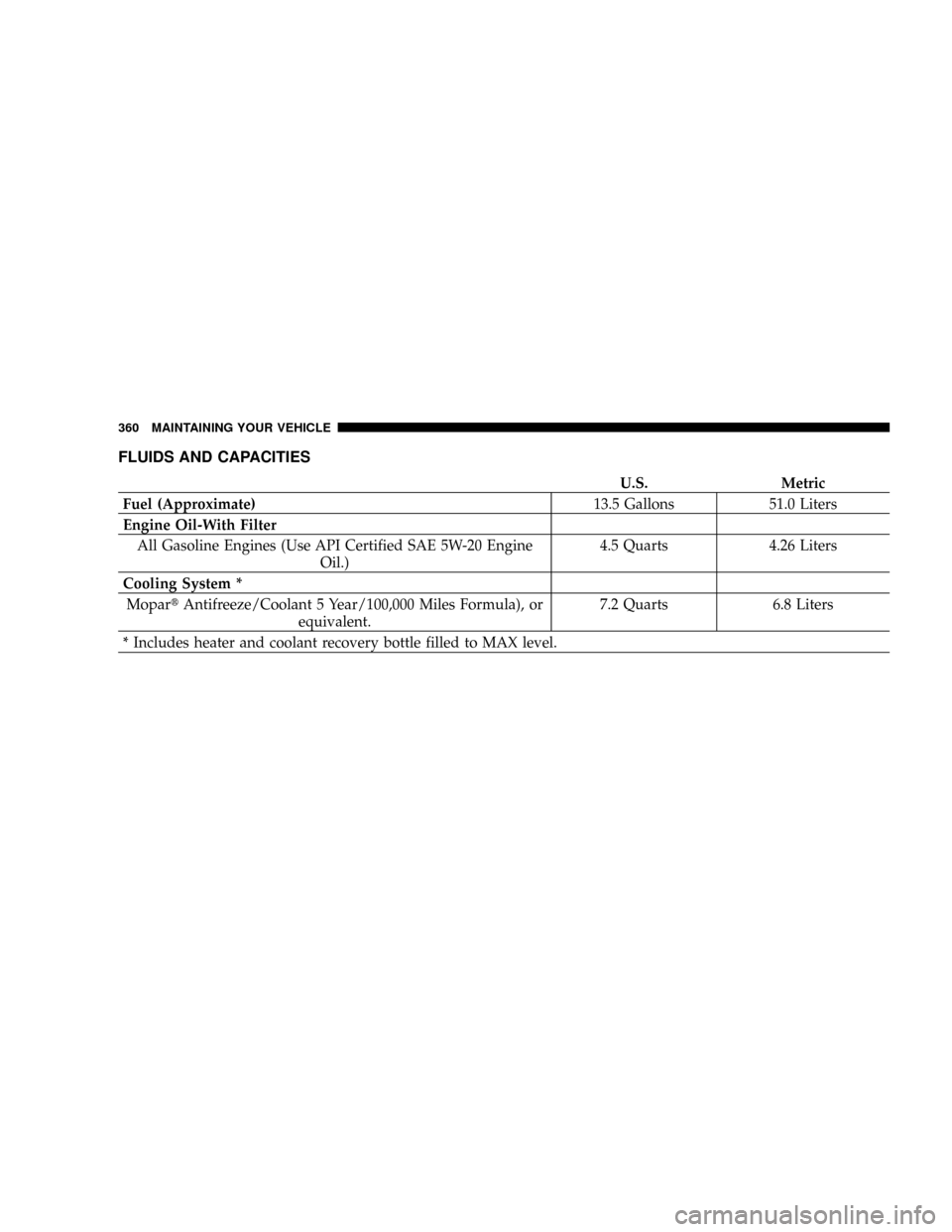
FLUIDS AND CAPACITIES
U.S. Metric
Fuel (Approximate)13.5 Gallons 51.0 Liters
Engine Oil-With Filter
All Gasoline Engines (Use API Certified SAE 5W-20 Engine
Oil.)4.5 Quarts 4.26 Liters
Cooling System *
MopartAntifreeze/Coolant 5 Year/100,000 Miles Formula), or
equivalent.7.2 Quarts 6.8 Liters
* Includes heater and coolant recovery bottle filled to MAX level.
360 MAINTAINING YOUR VEHICLE
Page 361 of 399
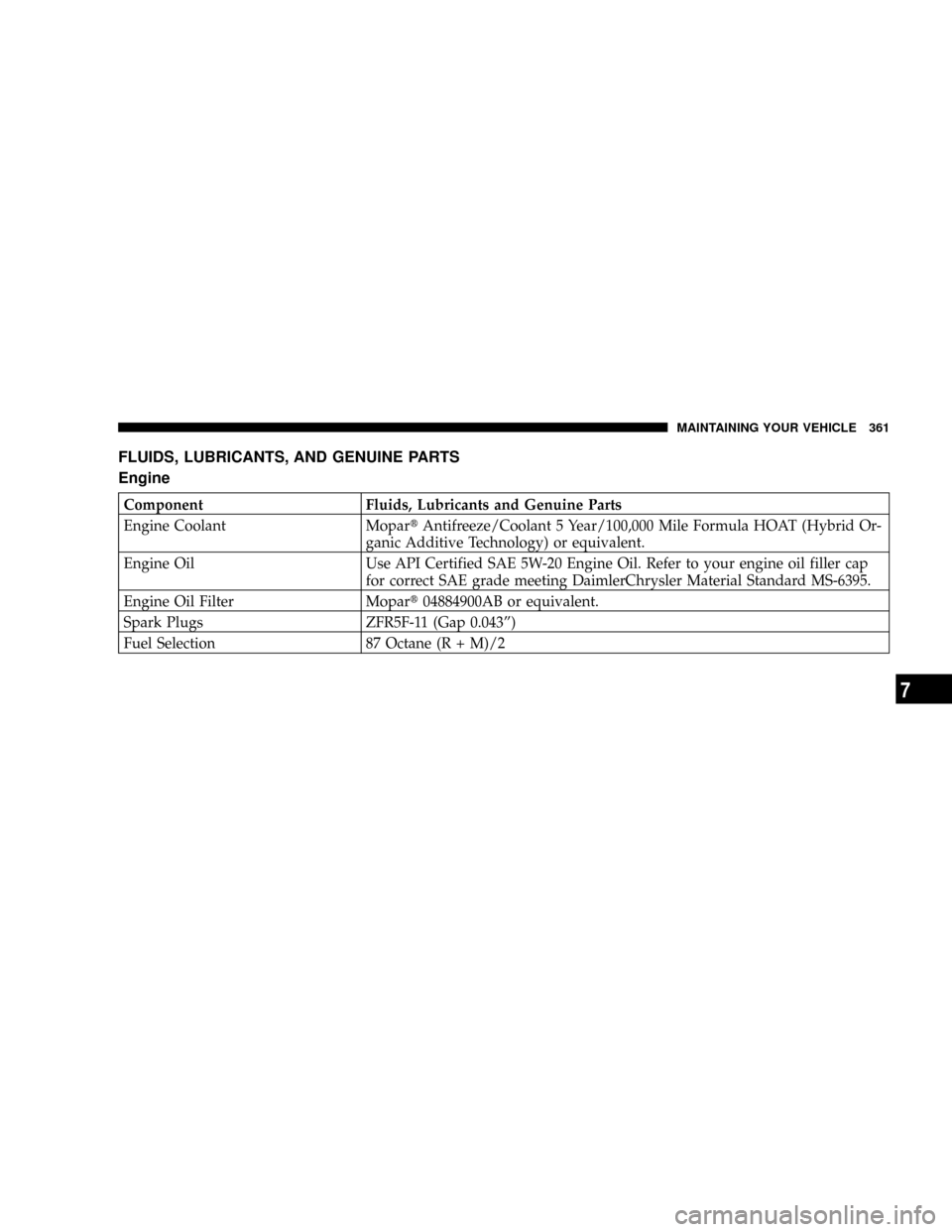
FLUIDS, LUBRICANTS, AND GENUINE PARTS
Engine
Component Fluids, Lubricants and Genuine Parts
Engine Coolant MopartAntifreeze/Coolant 5 Year/100,000 Mile Formula HOAT (Hybrid Or-
ganic Additive Technology) or equivalent.
Engine Oil Use API Certified SAE 5W-20 Engine Oil. Refer to your engine oil filler cap
for correct SAE grade meeting DaimlerChrysler Material Standard MS-6395.
Engine Oil Filter Mopart04884900AB or equivalent.
Spark Plugs ZFR5F-11 (Gap 0.043º)
Fuel Selection 87 Octane (R + M)/2
MAINTAINING YOUR VEHICLE 361
7
Page 366 of 399

At Each Stop for Fuel
²Check the engine oil level about 5 minutes after a fully
warmed engine is shut off. Checking the oil level while
the vehicle is on level ground will improve the accu-
racy of the oil level reading. Add oil only when the
level is at or below the ADD or MIN mark.
²Check the windshield washer solvent and add if
required.
Once a Month
²Check tire pressure and look for unusual wear or
damage.
²Inspect the battery and clean and tighten the terminals
as required.
²Check the fluid levels of coolant reservoir, brake
master cylinder, power steering and transmission and
add as needed.
²Check all lights and other electrical items for correct
operation.
At Each Oil Change
²Change the engine oil filter.
²Inspect the brake hoses and lines.
²Check the Manual Transmission fluid level.
CAUTION!
Failure to perform the required maintenance items
may result in damage to the vehicle.
366 MAINTENANCE SCHEDULES
8
M
A
I
N
T
E
N
A
N
C
E
S
C
H
E
D
U
L
E
S
Page 382 of 399

ABS (Anti-Lock Brake System).............. 244
Adding Engine Coolant (Antifreeze).......... 331
Adding Fuel........................... 279
Adding Washer Fluid..................122,153
Additives, Fuel......................... 277
Air Cleaner, Engine (Engine Air Cleaner Filter) . . . 323
Air Conditioner Maintenance............... 325
Air Conditioning Controls................. 214
Air Conditioning, Operating Tips............ 220
Air Conditioning Refrigerant.............325,326
Air Conditioning System................214,325
Air Pressure, Tires....................... 257
Airbag................................ 46
Airbag Deployment.....................50,52
Airbag Light.....................51,54,67,161
Airbag Maintenance....................... 54
Airbag, Side............................ 52
Airbag, Window (Side Curtain).............46,52
Alarm System (Security Alarm)............18,164Alignment and Balance................... 264
Alterations/Modifications, Vehicle............. 8
Antenna, Satellite Radio................... 211
Antifreeze (Engine Coolant)...........330,360,361
Capacities........................... 360
Disposal............................ 333
Anti-Lock Brake System (ABS)............126,244
Anti-Theft Security Alarm (Theft Alarm)........ 18
Appearance Care........................ 341
Automatic Door Locks...................27,28
Automatic Transaxle...........12,227,232,298,339
Fluid Level Check...................... 339
Interlock System....................... 233
Overheating.......................... 298
Selection Of Lubricant................... 339
Shifting............................. 234
Special Additives...................... 339
Autostick............................. 236
382 INDEX