tire type JEEP COMPASS 2009 1.G User Guide
[x] Cancel search | Manufacturer: JEEP, Model Year: 2009, Model line: COMPASS, Model: JEEP COMPASS 2009 1.GPages: 439, PDF Size: 12.51 MB
Page 322 of 439
Note 1 – The trailer tongue weight must be considered as
part of the combined weight of occupants and cargo, and
should never exceed the weight referenced on the Tire
and Loading Information placard. Refer to “Tire–Safety
Information” in this section.
Trailer and Tongue Weight
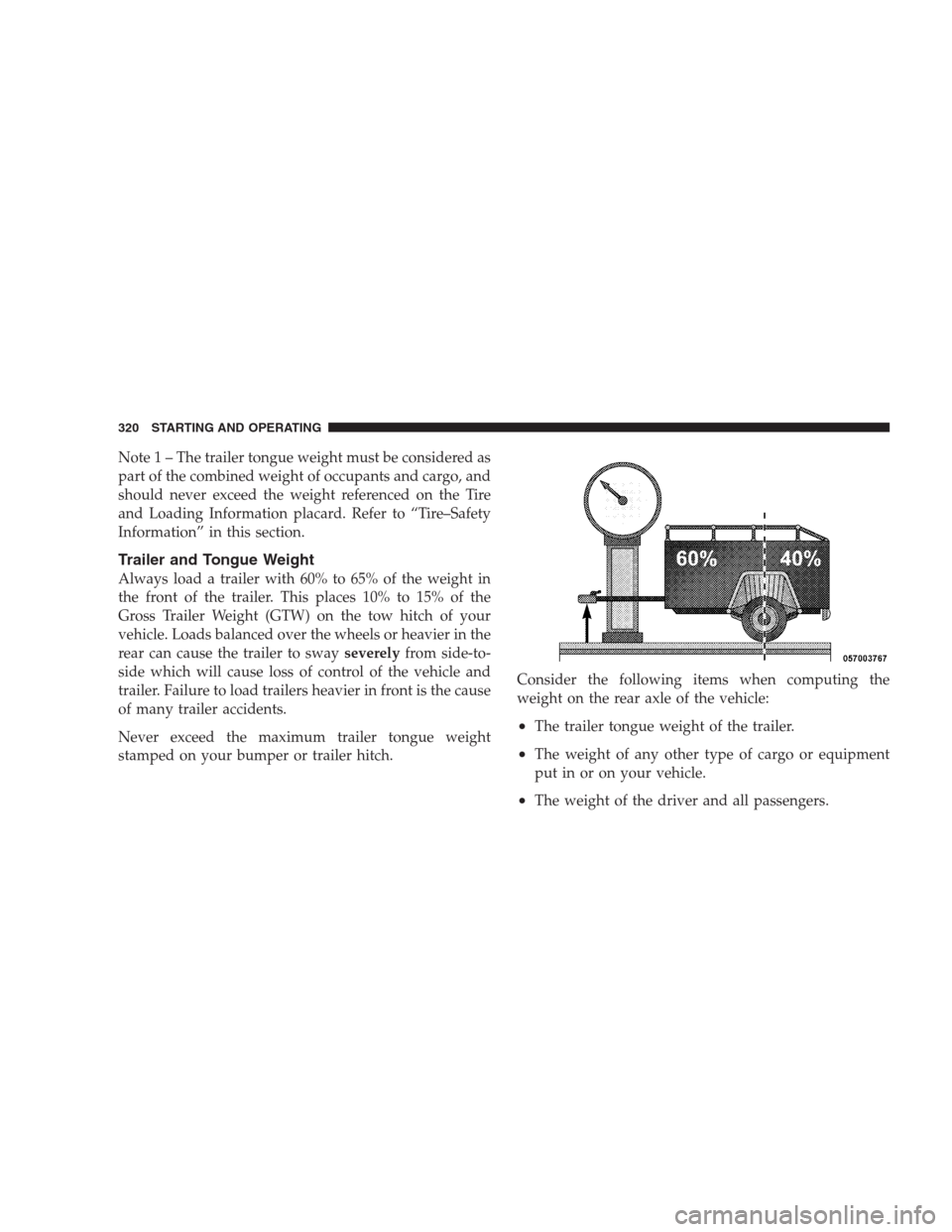
Always load a trailer with 60% to 65% of the weight in
the front of the trailer. This places 10% to 15% of the
Gross Trailer Weight (GTW) on the tow hitch of your
vehicle. Loads balanced over the wheels or heavier in the
rear can cause the trailer to swayseverelyfrom side-to-
side which will cause loss of control of the vehicle and
trailer. Failure to load trailers heavier in front is the cause
of many trailer accidents.
Never exceed the maximum trailer tongue weight
stamped on your bumper or trailer hitch.Consider the following items when computing the
weight on the rear axle of the vehicle:
•The trailer tongue weight of the trailer.
•The weight of any other type of cargo or equipment
put in or on your vehicle.
•The weight of the driver and all passengers.
320 STARTING AND OPERATING
Page 340 of 439
WARNING!
A loose tire thrown forward in a collision or hard
stop could injure the occupants in the vehicle. Have
the deflated (flat) tire repaired or replaced immedi-
ately.
11. Check the tire pressure as soon as possible. Correct
the tire pressure as required.
JUMP-STARTING PROCEDURES
WARNING!
•Take care to avoid the radiator cooling fan when-
ever the hood is raised. It can start anytime the
ignition switch is on. You can be hurt by the fan.
(Continued)
WARNING! (Continued)
•Do not attempt to push or tow your vehicle to get
it started. Vehicles equipped with an automatic
transaxle cannot be started this way and may be
damaged. Unburned fuel could enter the catalytic
converter and once the engine has started, ignite
and damage the converter and vehicle. If the
vehicle has a discharged battery, booster cables
may be used to obtain a start from another vehicle.
This type of start can be dangerous if done im-
properly, so follow this procedure carefully.
•Wear eye protection and remove any metal jewelry
such as watch bands or bracelets that might make
an inadvertent electrical contact. You could be
seriously injured.
NOTE: Disconnecting the battery with the ignition in
the ON position will cause vehicles with an automatic
338 WHAT TO DO IN EMERGENCIES
Page 361 of 439
WARNING! (Continued)
•You or others can be badly burned by hot coolant
or steam from your radiator. If you see or hear
steam coming from under the hood, do not open
the hood until the radiator has had time to cool.
Never try to open a cooling system pressure cap
when the radiator is hot.
Coolant Checks
Check engine coolant (antifreeze) protection every
12 months (before the onset of freezing weather, where
applicable). If the engine coolant (antifreeze) is dirty or
rusty in appearance, the system should be drained,
flushed and refilled with fresh engine coolant (anti-
freeze). Check the front of the A/C condenser for any
accumulation of bugs, leaves, etc. If dirty, clean by gently
spraying water from a garden hose vertically down the
face of the condenser.Check the coolant recovery bottle tubing for brittle rub-
ber, cracking, tears, cuts and tightness of the connection
at the bottle and radiator. Inspect the entire system for
leaks.
Cooling System — Drain, Flush And Refill
Refer to the “Maintenance Schedule” in Section 8 for
proper maintenance intervals.
If the engine coolant (antifreeze) is dirty or contains a
considerable amount of sediment, clean and flush with a
reliable cooling system cleaner. Follow with a thorough
rinsing to remove all deposits and chemicals. Properly
dispose of old engine coolant (antifreeze).
Selection Of Coolant
Refer to “Fluids, Lubricants, and Genuine Parts” in this
section for the correct fluid type.
MAINTAINING YOUR VEHICLE 359
7