ECO mode JEEP COMPASS 2010 1.G Workshop Manual
[x] Cancel search | Manufacturer: JEEP, Model Year: 2010, Model line: COMPASS, Model: JEEP COMPASS 2010 1.GPages: 474, PDF Size: 6.9 MB
Page 272 of 474
Window Fogging
Interior fogging on the windshield can be quickly re-
moved by turning the mode selector to Defrost. The
Defrost/Floor mode can be used to maintain a clear
windshield and provide sufficient heating. If side win-
dow fogging becomes a problem, increase blower speed.
Vehicle windows tend to fog on the inside in mild but
rainy or humid weather.
NOTE:Recirculate without A/C should not be used for
long periods as fogging may occur.
Side Window Demisters
A side window demister outlet is located at each end of
the instrument panel. These non-adjustable outlets direct
air toward the side windows when the system is in the
FLOOR, MIX, or DEFROST mode. The air is directed at
the area of the windows through which you view the
outside mirrors.
Outside Air Intake
Make sure the air intake, located directly in front of the
windshield, is free of obstructions such as leaves. Leaves
collected in the air intake may reduce airflow, and if they
enter the plenum, they could plug the water drains. In
winter months, make sure the air intake is clear of ice,
slush, and snow.
A/C Air Filter — If Equipped
The A/C Filter prevents most dust and pollen from
entering the cabin. The filter acts on air coming from
outside the vehicle and recirculated air within the pas-
senger compartment. Refer to “Maintenance Procedures”
in “Maintaining Your Vehicle” for A/C Air Filter service
information or see your authorized dealer for service.
Refer to “Maintenance Schedules” for filter service
intervals.
4
UNDERSTANDING YOUR INSTRUMENT PANEL 271
Page 306 of 474
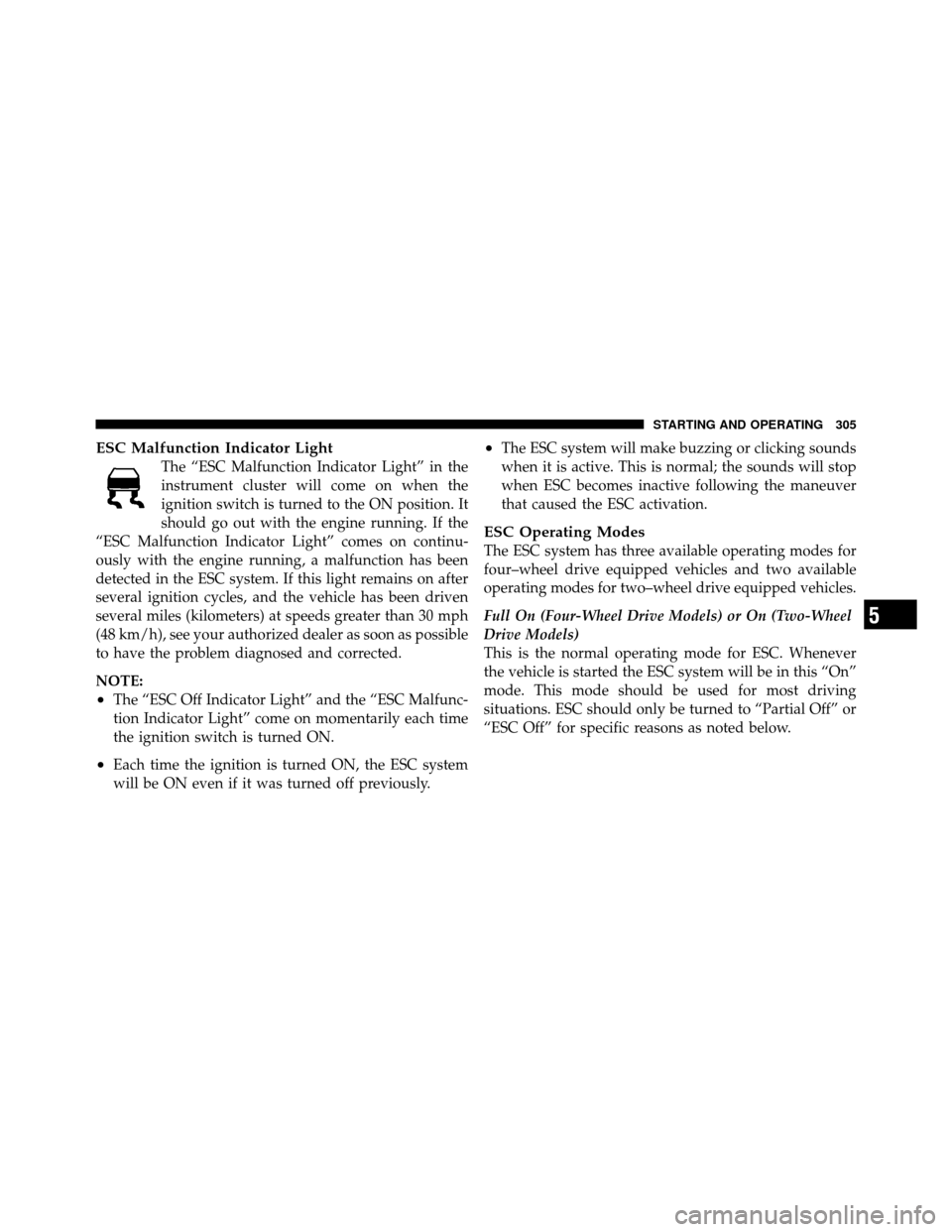
ESC Malfunction Indicator Light
The “ESC Malfunction Indicator Light” in the
instrument cluster will come on when the
ignition switch is turned to the ON position. It
should go out with the engine running. If the
“ESC Malfunction Indicator Light” comes on continu-
ously with the engine running, a malfunction has been
detected in the ESC system. If this light remains on after
several ignition cycles, and the vehicle has been driven
several miles (kilometers) at speeds greater than 30 mph
(48 km/h), see your authorized dealer as soon as possible
to have the problem diagnosed and corrected.
NOTE:
•The “ESC Off Indicator Light” and the “ESC Malfunc-
tion Indicator Light” come on momentarily each time
the ignition switch is turned ON.
•Each time the ignition is turned ON, the ESC system
will be ON even if it was turned off previously.
•The ESC system will make buzzing or clicking sounds
when it is active. This is normal; the sounds will stop
when ESC becomes inactive following the maneuver
that caused the ESC activation.
ESC Operating Modes
The ESC system has three available operating modes for
four–wheel drive equipped vehicles and two available
operating modes for two–wheel drive equipped vehicles.
Full On (Four-Wheel Drive Models) or On (Two-Wheel
Drive Models)
This is the normal operating mode for ESC. Whenever
the vehicle is started the ESC system will be in this “On”
mode. This mode should be used for most driving
situations. ESC should only be turned to “Partial Off” or
“ESC Off” for specific reasons as noted below.
5
STARTING AND OPERATING 305
Page 307 of 474
Partial Off (Four-Wheel Drive Models) or On
(Two-Wheel Drive Models)
This mode is entered by momentarily pressing the “ESC
Off” switch. When in “Partial Off” mode, the TCS portion
of ESC, except for the “limited slip” feature described in
the TCS section, has been disabled and the “ESP/TCS
Indicator Light” will be illuminated. All other stability
features of ESC function normally. This mode is intended
to be used if the vehicle is in deep snow, sand or gravel
conditions and more wheel spin than ESC would nor-
mally allow is required to gain traction.
To turn ESC on again, momentarily press the “ESC Off”
switch. This will restore the normal “ESC On” mode of
operation.
NOTE:To improve the vehicle’s traction when driving
with snow chains, or starting off in deep snow, sand or
gravel, it may be desirable to switch to the “Partial Off” mode by pressing the “ESC Off” switch. Once the situa-
tion requiring ESC to be switched to the “Partial Off”
mode is overcome, turn ESC back on by momentarily
pressing the “ESC Off” switch. This may be done while
the vehicle is in motion.
Full Off (Four-Wheel Drive Models Only)
This mode is intended for off-highway or off-road use
when ESC stability features could inhibit vehicle maneu-
verability due to trail conditions. This mode is entered by
pressing and holding the “ESC Off” switch for five
seconds when the vehicle is stopped and the engine is
running. After five seconds, the “ESP/TCS Indicator
Light” will illuminate and the “ESC OFF” message will
appear in the odometer. Press and release the Trip
Odometer button located on the instrument cluster to
clear this message.
In this mode, ESC and TCS, except for the “limited slip”
feature described in the TCS section, are turned off until
306 STARTING AND OPERATING
Page 403 of 474
Fluid Level Check
Check the fluid level by removing the fill plug. The fluid
level should be between the bottom of the fill hole and a
point not more than 3/16 in (4.7 mm) below the bottom
of the hole.
Add fluid, if necessary, to maintain the proper level.
Frequency Of Fluid Change
Under normal operating conditions, the fluid installed at
the factory will give satisfactory lubrication for the life of
the vehicle. Fluid changes are not necessary unless lubri-
cant has become contaminated with water.
NOTE:If contaminated with water, the fluid should be
changed immediately.
Rear Drive Assembly (RDA) – AWD/4WD Models
Only
Lubricant Selection
Use only the manufacturer’s recommended fluid. Refer
to “Fluids, Lubricants, and Genuine Parts” in “Maintain-
ing Your Vehicle” for further information.
Fluid Level Check
Visually inspect the unit at each oil change for leakage. If
leakage is detected, check the fluid level by removing the
fill plug. The fluid level should be maintained between
the bottom of the fill hole to 1/8 in (4 mm) below the fill
hole.
Add fluid, if necessary, to maintain the proper level.
Frequency Of Fluid Change
Refer to “Maintenance Schedule” for further information.
402 MAINTAINING YOUR VEHICLE
Page 404 of 474
Power Transfer Unit (PTU) – AWD/4WD Models
Only
Lubricant Selection
Use only the manufacturer’s recommended fluid. Refer
to “Fluids, Lubricants, and Genuine Parts” in “Maintain-
ing Your Vehicle” for further information.
Fluid Level Check
Visually inspected the unit at each oil change for leakage.
If leakage is detected, Check the fluid level by removing
the fill plug. The fluid level should be maintained be-
tween the bottom of the fill hole to 1/8 in (4 mm) below
the fill hole.
Add fluid, if necessary, to maintain the proper level.
Frequency Of Fluid Change
Refer to “Maintenance Schedule” for further information.
Appearance Care and Protection from Corrosion
Protection of Body and Paint from Corrosion
Vehicle body care requirements vary according to geo-
graphic locations and usage. Chemicals that make roads
passable in snow and ice and those that are sprayed on
trees and road surfaces during other seasons, are highly
corrosive to the metal in your vehicle. Outside parking,
which exposes your vehicle to airborne contaminants,
road surfaces on which the vehicle is operated, extreme
hot or cold weather and other extreme conditions will
have an adverse effect on paint, metal trim, and under-
body protection.
The following maintenance recommendations will enable
you to obtain maximum benefit from the corrosion
resistance built into your vehicle.
What Causes Corrosion?
Corrosion is the result of deterioration or removal of
paint and protective coatings from your vehicle.
7
MAINTAINING YOUR VEHICLE 403