Brakes JEEP COMPASS 2011 1.G User Guide
[x] Cancel search | Manufacturer: JEEP, Model Year: 2011, Model line: COMPASS, Model: JEEP COMPASS 2011 1.GPages: 490, PDF Size: 4.21 MB
Page 359 of 490
Curb Weight
The curb weight of a vehicle is defined as the total weight
of the vehicle with all fluids, including vehicle fuel, at full
capacity conditions, and with no occupants or cargo
loaded into the vehicle. The front and rear curb weight
values are determined by weighing your vehicle on a
commercial scale before any occupants or cargo are
added.
Overloading
The load carrying components (springs, tires, wheels,
etc.) of your vehicle will provide satisfactory service as
long as you do not exceed the GVWR.
The best way to figure out the total weight of your
vehicle is to weigh it when it is fully loaded and ready for
operation. Weigh it on a commercial scale to ensure that
it is not over the GVWR.Overloading can cause potential safety hazards and
shorten useful service life. Heavier suspension compo-
nents do not necessarily increase the vehicle’s GVWR.
Loading
To load your vehicle properly, first figure out its empty
weight. Store heavier items down low and be sure you
distribute their weight as evenly as possible. Stow all
loose items securely before driving. Improper weight
distribution can have an adverse effect on the way your
vehicle steers and handles, and the way the brakes
operate.
CAUTION!
Do not load your vehicle any heavier than the
GVWR. If you do, parts on your vehicle can break, or
it can change the way your vehicle handles. This
could cause you to lose control. Also, overloading can
shorten the life of your vehicle.
5
STARTING AND OPERATING 357
Page 366 of 490
CAUTION! (Continued)
•Then, during the first 500 miles (805 km) that a
trailer is towed, do not drive over 50 mph
(80 km/h) and do not make starts at full throttle.
This helps the engine and other parts of the
vehicle wear in at the heavier loads.
Perform the maintenance listed in the “Maintenance
Schedule.” Refer to “Maintenance Schedule” for further
information. When towing a trailer, never exceed the
GAWR, or GCWR, ratings.
WARNING!
Improper towing can lead to a collision. Follow these
guidelines to make your trailer towing as safe as
possible: (Continued)
WARNING! (Continued)
•Make certain that the load is secured in the trailer
and will not shift during travel. When trailering
cargo that is not fully secured, dynamic load shifts
can occur that may be difficult for the driver to
control. You could lose control of your vehicle and
have a collision.
•When hauling cargo or towing a trailer, do not
overload your vehicle or trailer. Overloading can
cause a loss of control, poor performance or dam-
age to brakes, axle, engine, transmission, steering,
suspension, chassis structure or tires.
•Safety chains must always be used between your
vehicle and trailer. Always connect the chains to
the frame or hook retainers of the vehicle hitch.
Cross the chains under the trailer tongue and
allow enough slack for turning corners.(Continued)
364 STARTING AND OPERATING
Page 368 of 490
replacement procedures. Replacing tires with a higher
load carrying capacity will not increase the vehicle’s
GVWR and GAWR limits.
Towing Requirements – Trailer Brakes
Donot interconnect the hydraulic brake system or
vacuum system of your vehicle with that of the trailer.
This could cause inadequate braking and possible
personal injury.
An electronically actuated trailer brake controller is
required when towing a trailer with electronically
actuated brakes. When towing a trailer equipped with
a hydraulic surge actuated brake system, an electronic
brake controller is not required.
Trailer brakes are recommended for trailers over
1,000 lbs (454 kg) and required for trailers in excess of
2,000 lbs (907 kg).
CAUTION!
If the trailer weighs more than 1,000 lbs (454 kg)
loaded, it should have its own brakes and they
should be of adequate capacity. Failure to do this
could lead to accelerated brake lining wear, higher
brake pedal effort, and longer stopping distances.
WARNING!
•Do not connect trailer brakes to your vehicle’s
hydraulic brake lines. It can overload your brake
system and cause it to fail. You might not have
brakes when you need them and could have a
collision.
(Continued)
366 STARTING AND OPERATING
Page 370 of 490
Towing Tips
Before setting out on a trip, practice turning, stopping
and backing the trailer in an area away from heavy
traffic.
Manual Transmission – If Equipped
If using a manual transmission vehicle for trailer towing,
all starts must be in first gear to avoid excessive clutch
slippage.
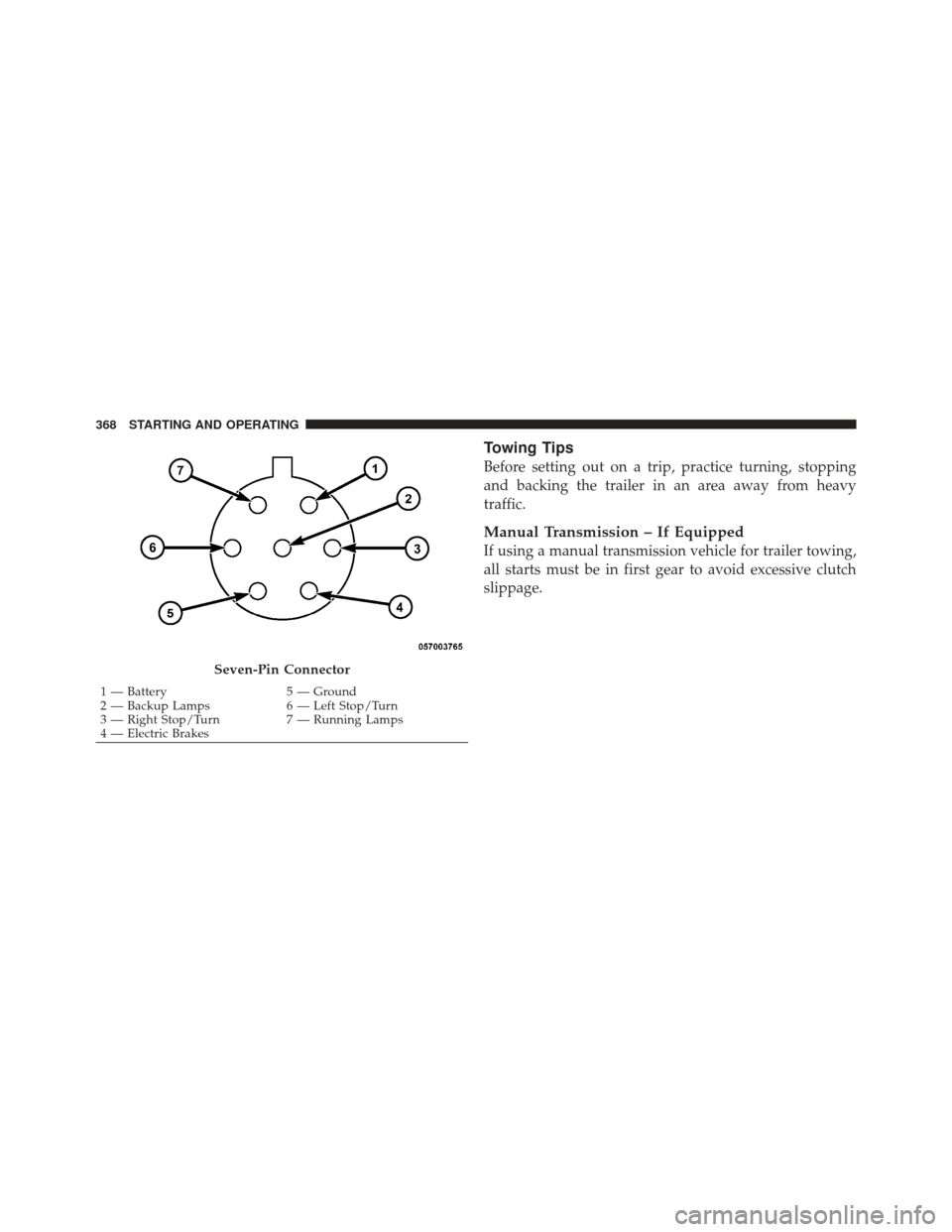
Seven-Pin Connector
1 — Battery5 — Ground
2 — Backup Lamps 6 — Left Stop/Turn
3 — Right Stop/Turn 7 — Running Lamps
4 — Electric Brakes
368 STARTING AND OPERATING
Page 421 of 490
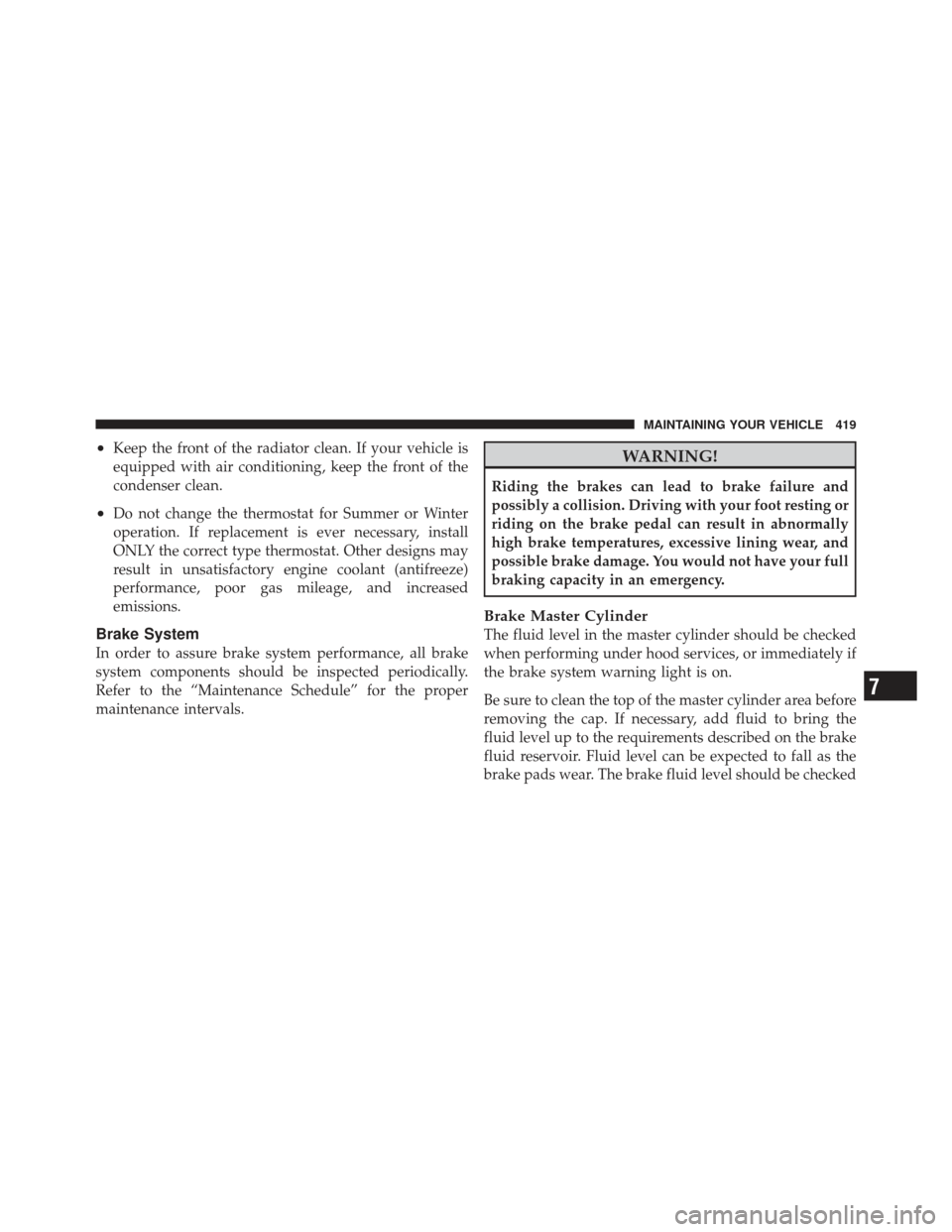
•Keep the front of the radiator clean. If your vehicle is
equipped with air conditioning, keep the front of the
condenser clean.
•Do not change the thermostat for Summer or Winter
operation. If replacement is ever necessary, install
ONLY the correct type thermostat. Other designs may
result in unsatisfactory engine coolant (antifreeze)
performance, poor gas mileage, and increased
emissions.
Brake System
In order to assure brake system performance, all brake
system components should be inspected periodically.
Refer to the “Maintenance Schedule” for the proper
maintenance intervals.
WARNING!
Riding the brakes can lead to brake failure and
possibly a collision. Driving with your foot resting or
riding on the brake pedal can result in abnormally
high brake temperatures, excessive lining wear, and
possible brake damage. You would not have your full
braking capacity in an emergency.
Brake Master Cylinder
The fluid level in the master cylinder should be checked
when performing under hood services, or immediately if
the brake system warning light is on.
Be sure to clean the top of the master cylinder area before
removing the cap. If necessary, add fluid to bring the
fluid level up to the requirements described on the brake
fluid reservoir. Fluid level can be expected to fall as the
brake pads wear. The brake fluid level should be checked
7
MAINTAINING YOUR VEHICLE 419
Page 448 of 490
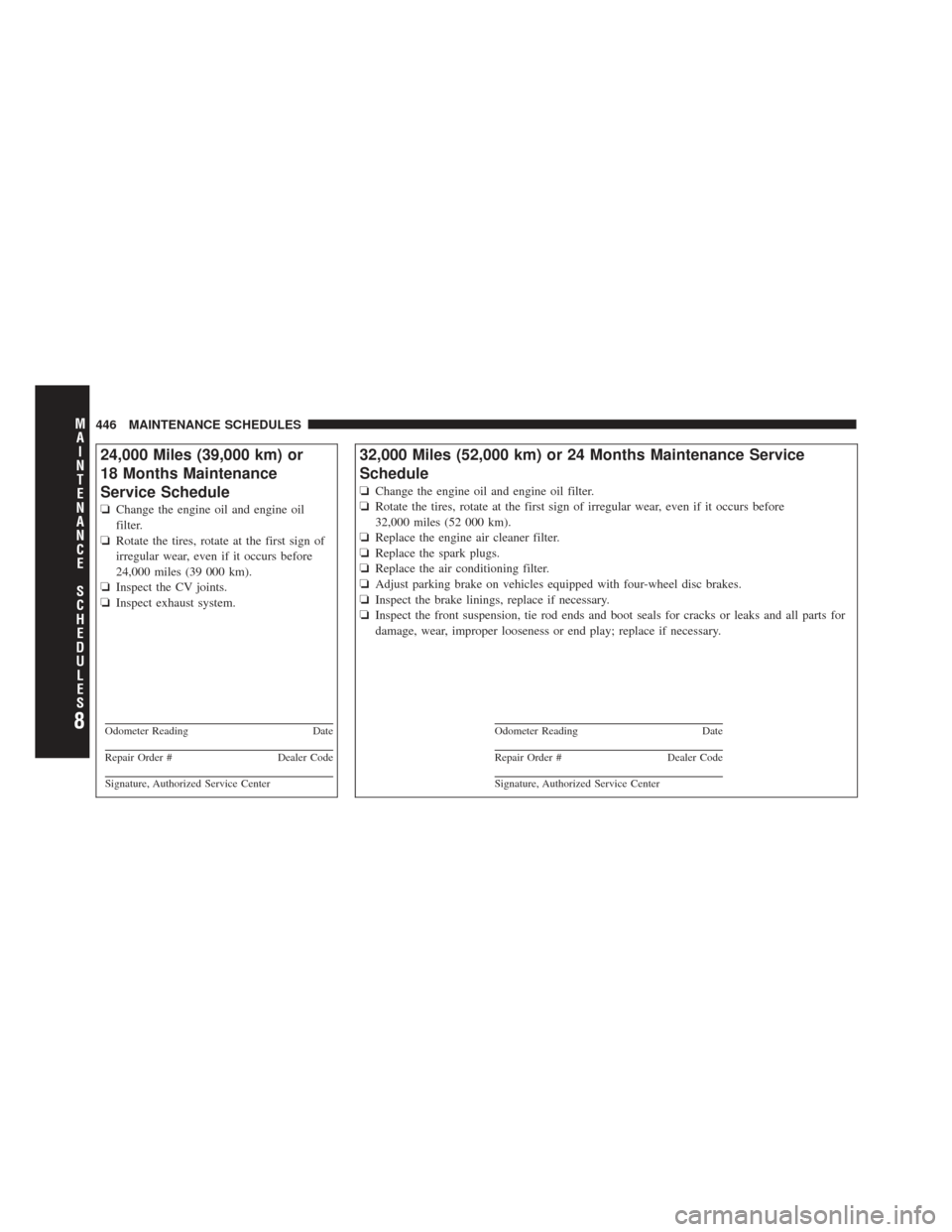
24,000 Miles (39,000 km) or
18 Months Maintenance
Service Schedule
❏Change the engine oil and engine oil
filter.
❏ Rotate the tires, rotate at the first sign of
irregular wear, even if it occurs before
24,000 miles (39 000 km).
❏ Inspect the CV joints.
❏ Inspect exhaust system.
Odometer Reading Date
Repair Order #Dealer Code
Signature, Authorized Service Center
32,000 Miles (52,000 km) or 24 Months Maintenance Service
Schedule
❏Change the engine oil and engine oil filter.
❏ Rotate the tires, rotate at the first sign of irregular wear, even if it occurs before
32,000 miles (52 000 km).
❏ Replace the engine air cleaner filter.
❏ Replace the spark plugs.
❏ Replace the air conditioning filter.
❏ Adjust parking brake on vehicles equipped with four-wheel disc brakes.
❏ Inspect the brake linings, replace if necessary.
❏ Inspect the front suspension, tie rod ends and boot seals for cracks or leaks and all parts for
damage, wear, improper looseness or end play; replace if necessary.
Odometer Reading Date
Repair Order #Dealer Code
Signature, Authorized Service Center
8
M
A I
N T
E
N A
N CE
S
C
H E
D
U L
E
S446 MAINTENANCE SCHEDULES
Page 451 of 490
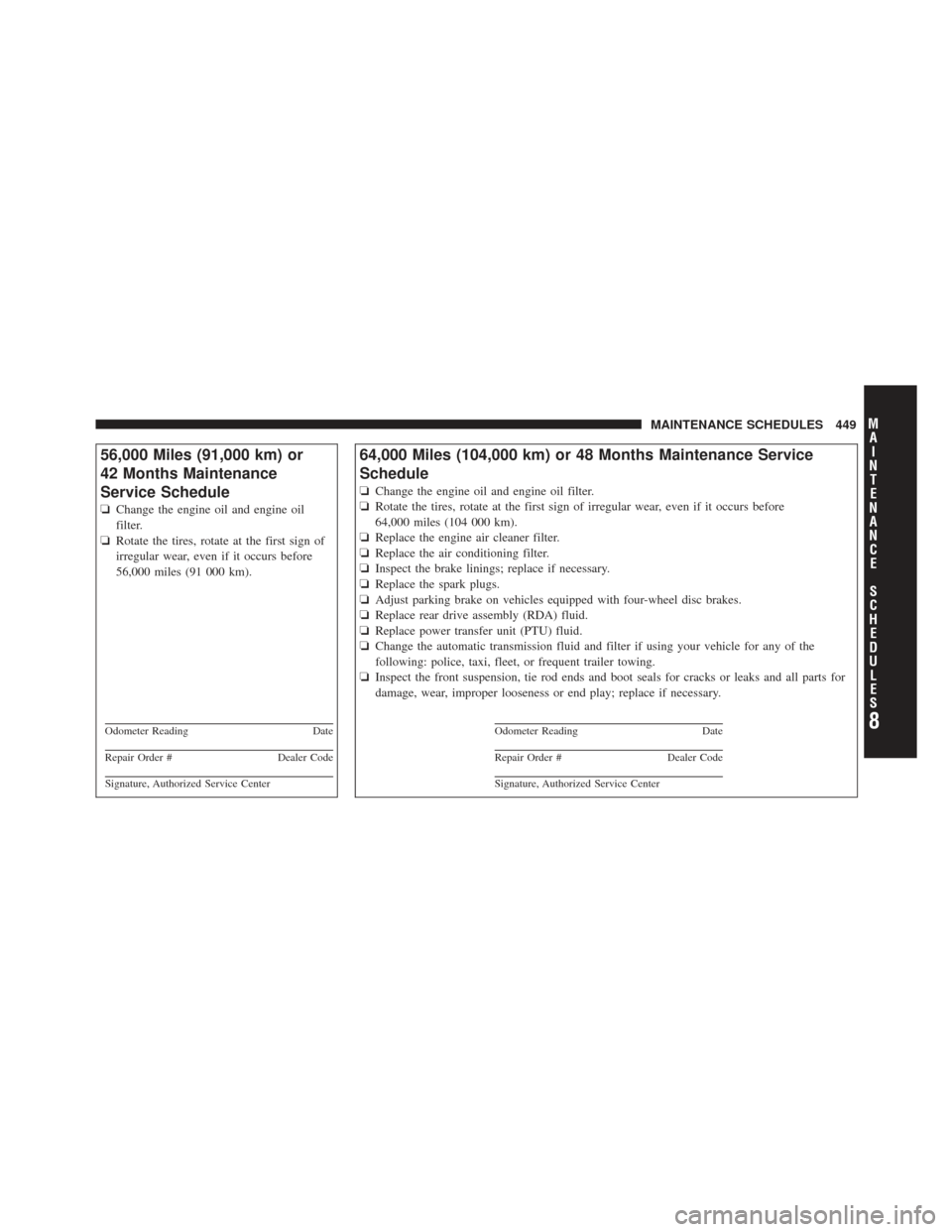
56,000 Miles (91,000 km) or
42 Months Maintenance
Service Schedule
❏Change the engine oil and engine oil
filter.
❏ Rotate the tires, rotate at the first sign of
irregular wear, even if it occurs before
56,000 miles (91 000 km).
Odometer Reading Date
Repair Order #Dealer Code
Signature, Authorized Service Center
64,000 Miles (104,000 km) or 48 Months Maintenance Service
Schedule
❏Change the engine oil and engine oil filter.
❏ Rotate the tires, rotate at the first sign of irregular wear, even if it occurs before
64,000 miles (104 000 km).
❏ Replace the engine air cleaner filter.
❏ Replace the air conditioning filter.
❏ Inspect the brake linings; replace if necessary.
❏ Replace the spark plugs.
❏ Adjust parking brake on vehicles equipped with four-wheel disc brakes.
❏ Replace rear drive assembly (RDA) fluid.
❏ Replace power transfer unit (PTU) fluid.
❏ Change the automatic transmission fluid and filter if using your vehicle for any of the
following: police, taxi, fleet, or frequent trailer towing.
❏ Inspect the front suspension, tie rod ends and boot seals for cracks or leaks and all parts for
damage, wear, improper looseness or end play; replace if necessary.
Odometer Reading Date
Repair Order #Dealer Code
Signature, Authorized Service Center
8
M
A I
N T
E
N A
N CE
S
C
H E
D
U L
E
SMAINTENANCE SCHEDULES 449
Page 454 of 490
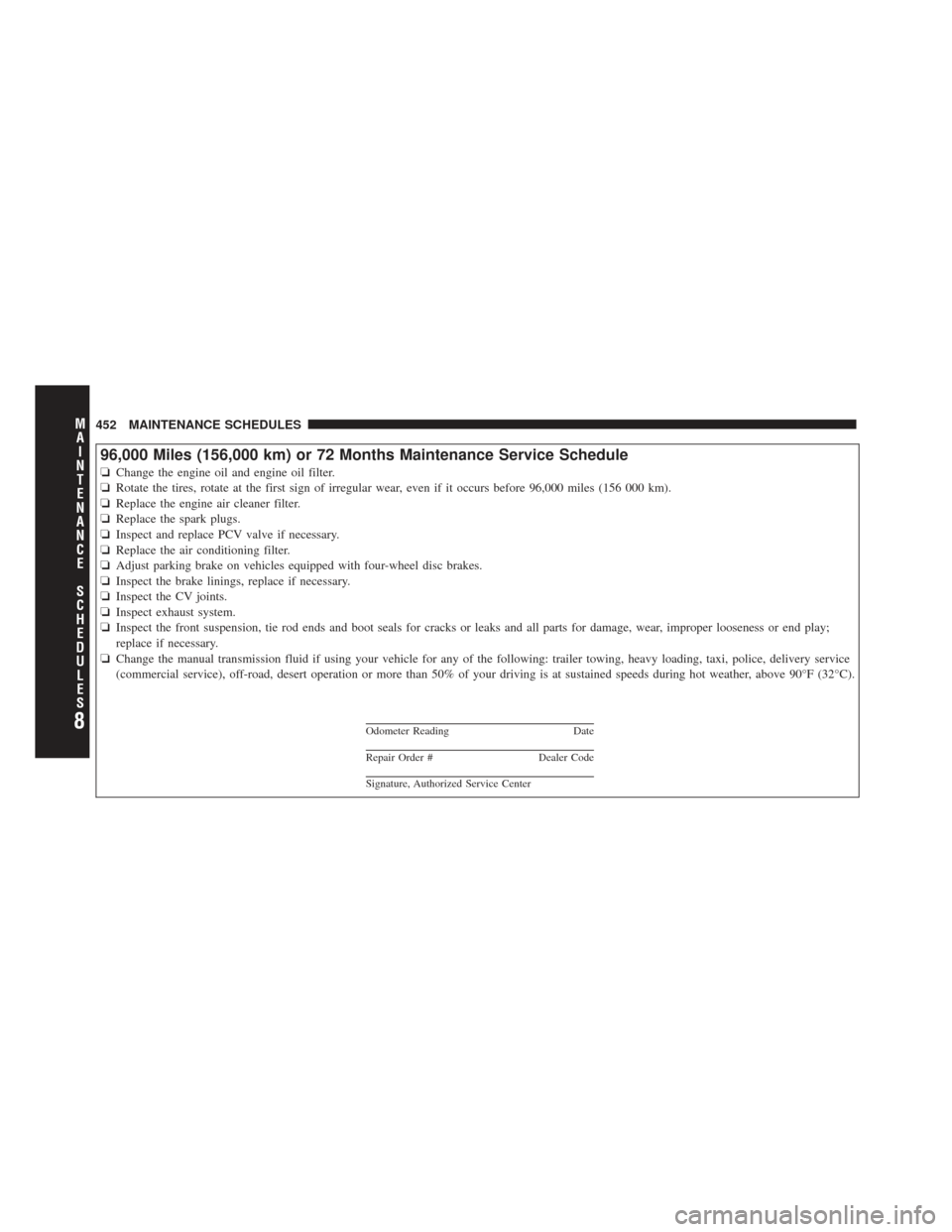
96,000 Miles (156,000 km) or 72 Months Maintenance Service Schedule
❏Change the engine oil and engine oil filter.
❏ Rotate the tires, rotate at the first sign of irregular wear, even if it occurs before 96,000 miles (156 000 km).
❏ Replace the engine air cleaner filter.
❏ Replace the spark plugs.
❏ Inspect and replace PCV valve if necessary.
❏ Replace the air conditioning filter.
❏ Adjust parking brake on vehicles equipped with four-wheel disc brakes.
❏ Inspect the brake linings, replace if necessary.
❏ Inspect the CV joints.
❏ Inspect exhaust system.
❏ Inspect the front suspension, tie rod ends and boot seals for cracks or leaks and all parts for damage, wear, improper looseness or end play;
replace if necessary.
❏ Change the manual transmission fluid if using your vehicle for any of the following: trailer towing, heavy loading, taxi, police, delivery service
(commercial service), off-road, desert operation or more than 50% of your driving is at sustained speeds during hot weather, above 90°F (32°C).
Odometer Reading Date
Repair Order #Dealer Code
Signature, Authorized Service Center
8
M
A I
N T
E
N A
N CE
S
C
H E
D
U L
E
S452 MAINTENANCE SCHEDULES
Page 456 of 490
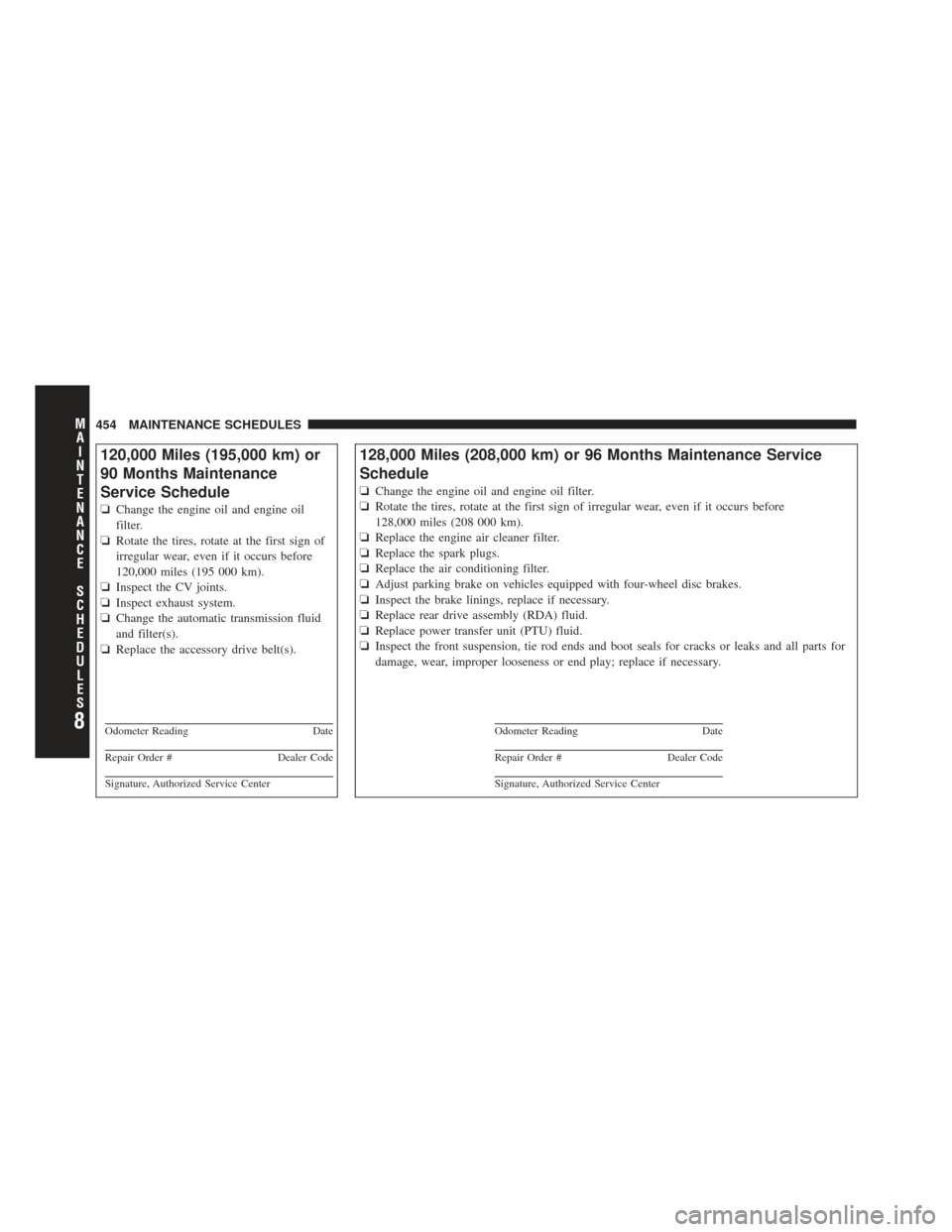
120,000 Miles (195,000 km) or
90 Months Maintenance
Service Schedule
❏Change the engine oil and engine oil
filter.
❏ Rotate the tires, rotate at the first sign of
irregular wear, even if it occurs before
120,000 miles (195 000 km).
❏ Inspect the CV joints.
❏ Inspect exhaust system.
❏ Change the automatic transmission fluid
and filter(s).
❏ Replace the accessory drive belt(s).
Odometer Reading Date
Repair Order #Dealer Code
Signature, Authorized Service Center
128,000 Miles (208,000 km) or 96 Months Maintenance Service
Schedule
❏Change the engine oil and engine oil filter.
❏ Rotate the tires, rotate at the first sign of irregular wear, even if it occurs before
128,000 miles (208 000 km).
❏ Replace the engine air cleaner filter.
❏ Replace the spark plugs.
❏ Replace the air conditioning filter.
❏ Adjust parking brake on vehicles equipped with four-wheel disc brakes.
❏ Inspect the brake linings, replace if necessary.
❏ Replace rear drive assembly (RDA) fluid.
❏ Replace power transfer unit (PTU) fluid.
❏ Inspect the front suspension, tie rod ends and boot seals for cracks or leaks and all parts for
damage, wear, improper looseness or end play; replace if necessary.
Odometer Reading Date
Repair Order #Dealer Code
Signature, Authorized Service Center
8
M
A I
N T
E
N A
N CE
S
C
H E
D
U L
E
S454 MAINTENANCE SCHEDULES
Page 473 of 490
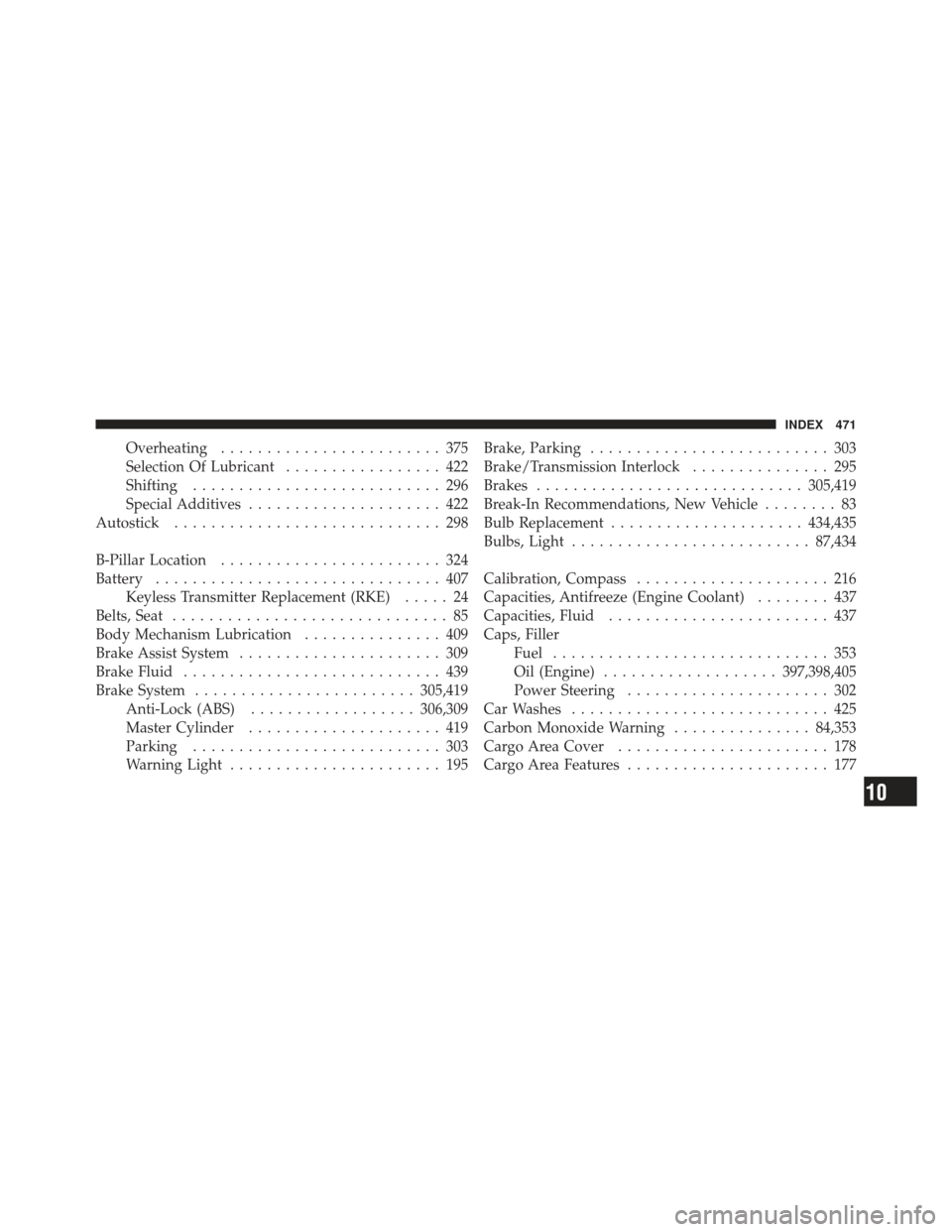
Overheating........................ 375
Selection Of Lubricant ................. 422
Shifting ........................... 296
Special Additives ..................... 422
Autostick ............................. 298
B-Pillar Location ........................ 324
Battery ............................... 407
Keyless Transmitter Replacement (RKE) ..... 24
Belts, Seat .............................. 85
Body Mechanism Lubrication ............... 409
Brake Assist System ...................... 309
Brake Fluid ............................ 439
Brake System ........................ 305,419
Anti-Lock (ABS) .................. 306,309
Master Cylinder ..................... 419
Parking ........................... 303
Warning Light ....................... 195 Brake, Parking
.......................... 303
Brake/Transmission Interlock ............... 295
Brakes ............................. 305,419
Break-In Recommendations, New Vehicle ........ 83
Bulb Replacement ..................... 434,435
Bulbs, Light .......................... 87,434
Calibration, Compass ..................... 216
Capacities, Antifreeze (Engine Coolant) ........ 437
Capacities, Fluid ........................ 437
Caps, Filler Fuel .............................. 353
Oil (Engine) ................... 397,398,405
Power Steering ...................... 302
Car Washes ............................ 425
Carbon Monoxide Warning ...............84,353
Cargo Area Cover ....................... 178
Cargo Area Features ...................... 177
10
INDEX 471