lock JEEP COMPASS 2015 1.G Owners Manual
[x] Cancel search | Manufacturer: JEEP, Model Year: 2015, Model line: COMPASS, Model: JEEP COMPASS 2015 1.GPages: 560, PDF Size: 11.51 MB
Page 436 of 560
3. Set the parking brake.
4. Place the shift lever in PARK (automatic transmission)
or REVERSE (manual transmission).
5. Turn OFF the ignition.
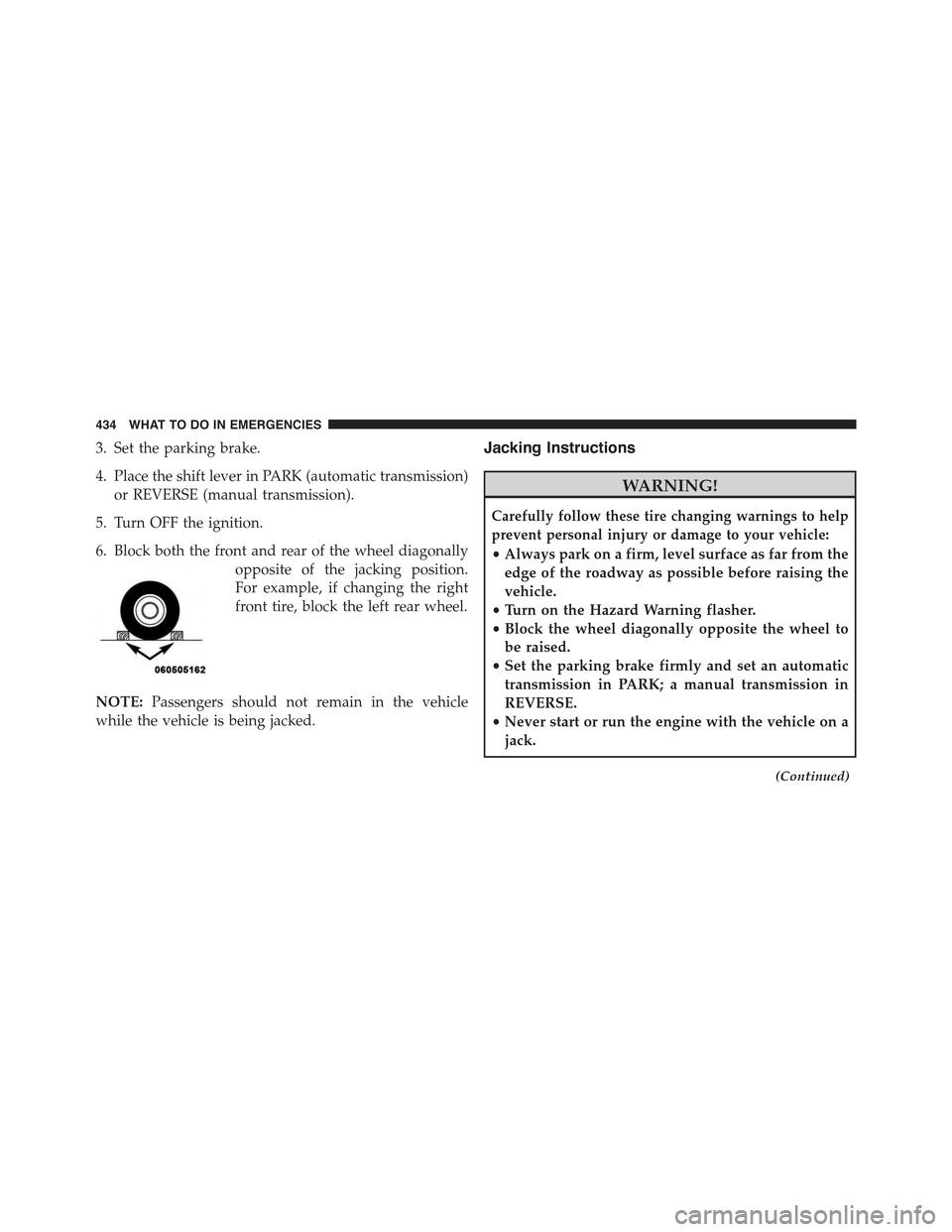
6. Block both the front and rear of the wheel diagonally
opposite of the jacking position.
For example, if changing the right
front tire, block the left rear wheel.
NOTE:Passengers should not remain in the vehicle
while the vehicle is being jacked.
Jacking Instructions
WARNING!
Carefully follow these tire changing warnings to help
prevent personal injury or damage to your vehicle:
•Always park on a firm, level surface as far from the
edge of the roadway as possible before raising the
vehicle.
•Turn on the Hazard Warning flasher.
•Block the wheel diagonally opposite the wheel to
be raised.
•Set the parking brake firmly and set an automatic
transmission in PARK; a manual transmission in
REVERSE.
•Never start or run the engine with the vehicle on a
jack.
(Continued)
434 WHAT TO DO IN EMERGENCIES
Page 442 of 560
7.Finish tightening the lug nuts. Push down on the
wrench while at the end of the handle for increased
leverage. Tighten the lug nuts in a star pattern until each
lug nut has been tightened twice. Refer to “Torque
Specifications” in this section for proper lug nut torque.
8.Remove the wheel blocks and lower the jack until it is
free. Release the parking brake. Reassemble the lug
wrench to the jack assembly and stow it in the spare tire
area. Secure the assembly using the means provided.
WARNING!
A loose tire or jack thrown forward in a collision or
hard stop could endanger the occupants of the ve-
hicle. Always stow the jack parts and the spare tire in
the places provided.
9. Place the deflated (flat) tire in the cargo area,have the
tire repaired or replaced as soon as possible.
WARNING!
A loose tire thrown forward in a collision or hard stop
could injure the occupants in the vehicle. Have the
deflated (flat) tire repaired or replaced immediately.
10. Check the spare tire pressure as soon as possible.
Correct the tire pressure as required.
11. After 25 miles (40 km) check the lug nut torque with
a torque wrench to ensure that all lug nuts are
properly seated against the wheel.
Road Tire Installation
Vehicles Equipped With Wheel Covers
1. Mount the road tire on the axle.
2.Align the valve notch in the wheel cover with the valve
stem on the wheel. Install the cover by hand. Do not use
a hammer or excessive force to install the cover.
440 WHAT TO DO IN EMERGENCIES
Page 443 of 560
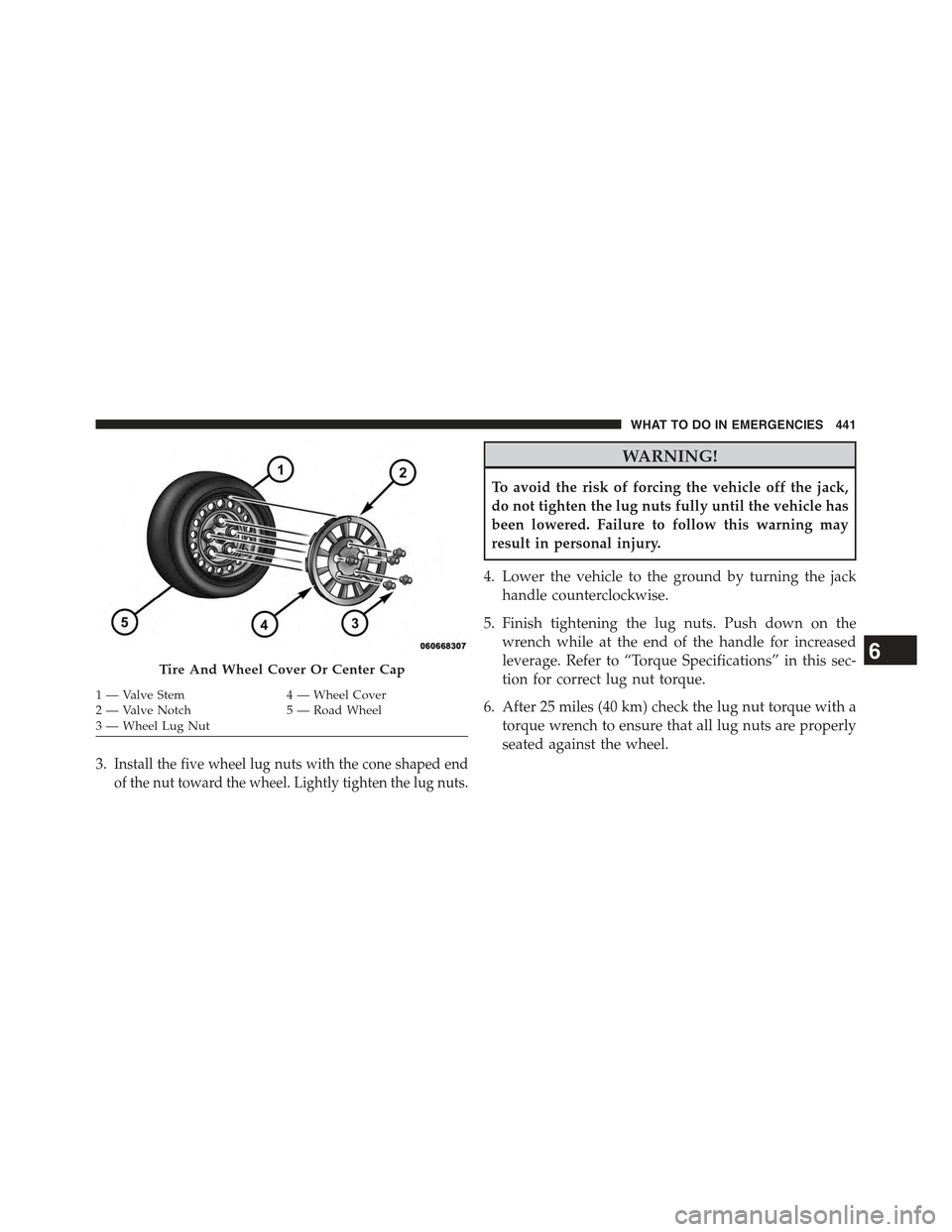
3.Install the five wheel lug nuts with the cone shaped end
of the nut toward the wheel. Lightly tighten the lug nuts.
WARNING!
To avoid the risk of forcing the vehicle off the jack,
do not tighten the lug nuts fully until the vehicle has
been lowered. Failure to follow this warning may
result in personal injury.
4. Lower the vehicle to the ground by turning the jack
handle counterclockwise.
5. Finish tightening the lug nuts. Push down on the
wrench while at the end of the handle for increased
leverage. Refer to “Torque Specifications” in this sec-
tion for correct lug nut torque.
6. After 25 miles (40 km) check the lug nut torque with a
torque wrench to ensure that all lug nuts are properly
seated against the wheel.
Tire And Wheel Cover Or Center Cap
1 — Valve Stem4 — Wheel Cover2—ValveNotch5—RoadWheel3—WheelLugNut
6
WHAT TO DO IN EMERGENCIES 441
Page 444 of 560
Vehicles Without Wheel Covers
1. Mount the road tire on the axle.
2.Install the remaining lug nuts with the cone shaped end
of the nut toward the wheel. Lightly tighten the lug nuts.
WARNING!
To avoid the risk of forcing the vehicle off the jack,
do not fully tighten the lug nuts until the vehicle has
been lowered. Failure to follow this warning may
result in personal injury.
3. Lower the vehicle to the ground by turning the jack
handle counterclockwise.
4. Finish tightening the lug nuts. Push down on the
wrench while at the end of the handle for increased
leverage. Refer to “Torque Specifications” in this sec-
tion for correct lug nut torque.
5. After 25 miles (40 km) check the lug nut torque with a
torque wrench to ensure that all lug nuts are properly
seated against the wheel.
TIRE SERVICE KIT — IF EQUIPPED
Small punctures up to¼” (6 mm) in the tire tread can be
sealed with Tire Service Kit. Foreign objects (e.g., screws
or nails) should not be removed from the tire. Tire Service
Kit can be used in outside temperatures down to approxi-
mately -4°F (-20°C).
This kit will provide a temporary tire seal, allowing you
to drive your vehicle up to 100 miles (160 km) with a
maximum speed of 55 mph (90 km/h).
Tire Service Kit Storage
The Tire Service Kit is located under the load floor in the
cargo area.
442 WHAT TO DO IN EMERGENCIES
Page 454 of 560
4. Clean any remaining sealant from the Tire Service Kit
housing.
5. Position the new Sealant Bottle (1) in the housing so
that the Sealant Hose (6) aligns with the hose slot in
the front of the housing. Press the bottle into the
housing. An audible click will be heard indicating the
bottle is locked into place.
6. Verify that the cap is installed on the fitting at the end
of the Sealant Hose (6) and return the hose to its
storage area (located on the bottom of the air pump).
7. Return the Tire Service Kit to its storage location in the
vehicle.
JUMP-STARTING PROCEDURES
If your vehicle has a discharged battery it can be jump-
started using a set of jumper cables and a battery in
another vehicle or by using a portable battery booster
pack. Jump-starting can be dangerous if done improperly
so please follow the procedures in this section carefully.
NOTE:When using a portable battery booster pack
follow the manufacturer ’s operating instructions and
precautions.
CAUTION!
Do not use a portable battery booster pack or any
other booster source with a system voltage greater
than 12 Volts or damage to the battery, starter motor,
alternator or electrical system may occur.
WARNING!
Do not attempt jump-starting if the battery is frozen.
It could rupture or explode and cause personal injury.
452 WHAT TO DO IN EMERGENCIES
Page 456 of 560
WARNING!
•Take care to avoid the radiator cooling fan when-
ever the hood is raised. It can start anytime the
ignition switch is ON. You can be injured by
moving fan blades.
•Remove any metal jewelry such as rings, watch
bands and bracelets that could make an inadvertent
electrical contact. You could be seriously injured.
•Batteries contain sulfuric acid that can burn your
skin or eyes and generate hydrogen gas which is
flammable and explosive. Keep open flames or
sparks away from the battery.
1. Set the parking brake, shift the automatic transmission
into PARK (manual transmission to NEUTRAL) and
turn the ignition to LOCK.
2. Turn off the heater, radio, and all unnecessary electri-
cal accessories.
3. If using another vehicle to jump-start the battery, park
the vehicle within the jumper cables reach, set the
parking brake and make sure the ignition is OFF.
WARNING!
Do not allow vehicles to touch each other as this
could establish a ground connection and personal
injury could result.
Jump-Starting Procedure
WARNING!
Failure to follow this jump-starting procedure could
result in personal injury or property damage due to
battery explosion.
454 WHAT TO DO IN EMERGENCIES
Page 465 of 560
CAUTION!
•Do not use sling-type equipment when towing.
Vehicle damage may occur.
•When securing the vehicle to a flatbed truck, do not
attach to front or rear suspension components.
Damage to your vehicle may result from improper
towing.
Without The Ignition Key
Special care must be taken when the vehicle is towed
with the ignition in the LOCK/OFF position. The only
approved method of towing without the ignition key is
with a flatbed truck. Proper towing equipment is neces-
sary to prevent damage to the vehicle.
6
WHAT TO DO IN EMERGENCIES 463
Page 483 of 560
CAUTION!
The A/C air filter is identified with an arrow to
indicate airflow direction through the filter. Failure
to properly install the filter will result in the need to
replace it more often.
7. Rotate the glove compartment door back into position.
Body Lubrication
Locks and all body pivot points, including such items as
seat tracks, door hinge pivot points and rollers, liftgate,
tailgate, decklid, sliding doors and hood hinges, should
be lubricated periodically with a lithium based grease,
such as MOPAR® Spray White Lube to assure quiet, easy
operation and to protect against rust and wear. Prior to
the application of any lubricant, the parts concerned
should be wiped clean to remove dust and grit; after
lubricating excess oil and grease should be removed.
Particular attention should also be given to hood latching
components to ensure proper function. When performing
other underhood services, the hood latch, release mecha-
nism and safety catch should be cleaned and lubricated.
The external lock cylinders should be lubricated twice a
year, preferably in the Fall and Spring. Apply a small
amount of a high quality lubricant, such as MOPAR®
Lock Cylinder Lubricant directly into the lock cylinder.
Windshield Wiper Blades
Clean the rubber edges of the wiper blades and the
windshield periodically with a sponge or soft cloth and a
mild nonabrasive cleaner. This will remove accumula-
tions of salt or road film.
Operation of the wipers on dry glass for long periods
may cause deterioration of the wiper blades. Always use
washer fluid when using the wipers to remove salt or dirt
from a dry windshield.
7
MAINTAINING YOUR VEHICLE 481
Page 510 of 560
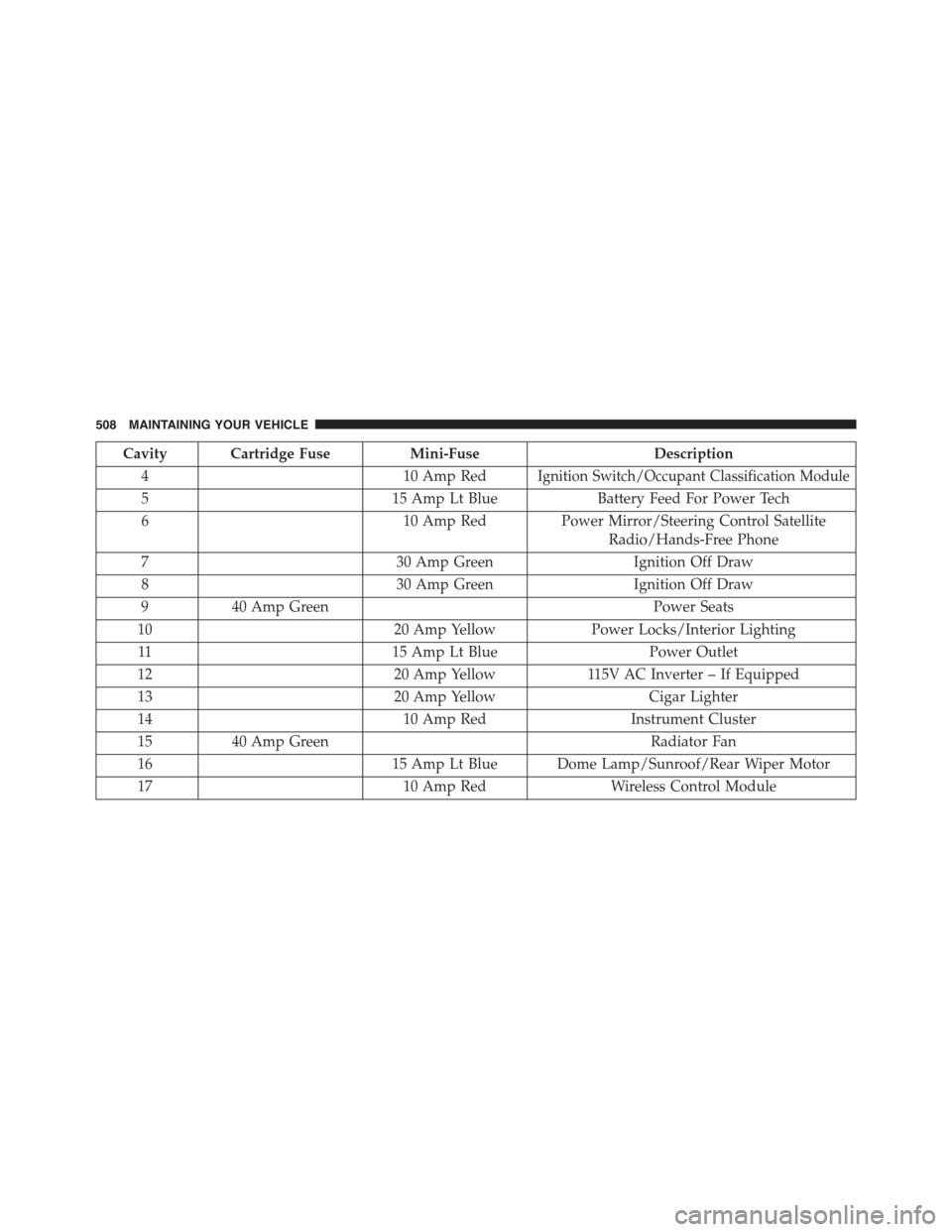
Cavity Cartridge FuseMini-FuseDescription
410 Amp RedIgnition Switch/Occupant Classification Module
515 Amp Lt BlueBattery Feed For Power Tech
610 Amp RedPower Mirror/Steering Control Satellite
Radio/Hands-Free Phone
730 Amp GreenIgnition Off Draw
830 Amp GreenIgnition Off Draw
940 Amp GreenPower Seats
1020 Amp YellowPower Locks/Interior Lighting
1115 Amp Lt BluePower Outlet
1220 Amp Yellow115V AC Inverter – If Equipped
1320 Amp YellowCigar Lighter
1410 Amp RedInstrument Cluster
1540 Amp GreenRadiator Fan
1615 Amp Lt Blue Dome Lamp/Sunroof/Rear Wiper Motor
1710 Amp RedWireless Control Module
508 MAINTAINING YOUR VEHICLE
Page 512 of 560
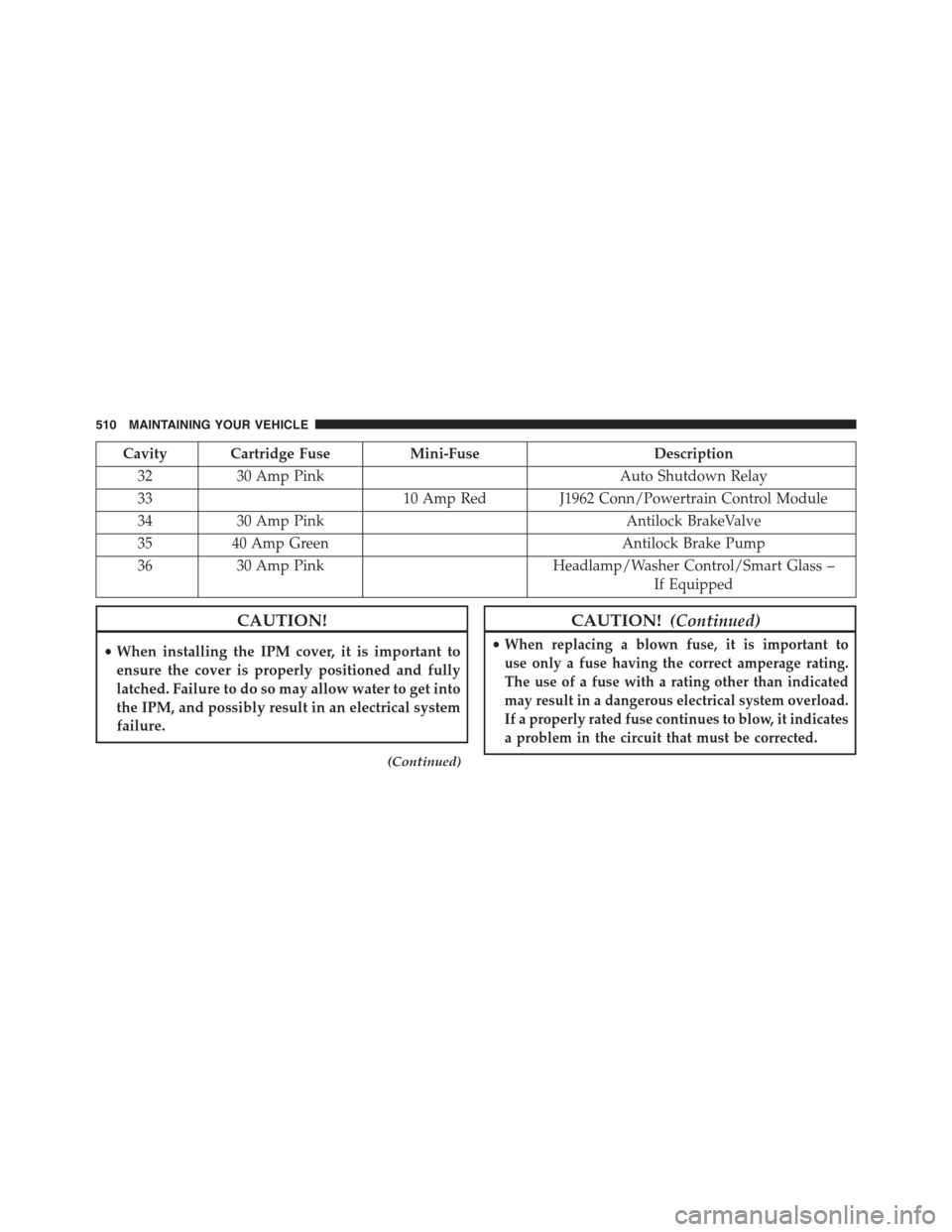
Cavity Cartridge FuseMini-FuseDescription
3230 Amp PinkAuto Shutdown Relay
3310 Amp Red J1962 Conn/Powertrain Control Module
3430 Amp PinkAntilock BrakeValve
3540 Amp GreenAntilock Brake Pump
3630 Amp PinkHeadlamp/Washer Control/Smart Glass –
If Equipped
CAUTION!
•When installing the IPM cover, it is important to
ensure the cover is properly positioned and fully
latched. Failure to do so may allow water to get into
the IPM, and possibly result in an electrical system
failure.
(Continued)
CAUTION!(Continued)
•When replacing a blown fuse, it is important to
use only a fuse having the correct amperage rating.
The use of a fuse with a rating other than indicated
may result in a dangerous electrical system overload.
If a properly rated fuse continues to blow, it indicates
a problem in the circuit that must be corrected.
510 MAINTAINING YOUR VEHICLE