engine oil JEEP COMPASS 2015 1.G User Guide
[x] Cancel search | Manufacturer: JEEP, Model Year: 2015, Model line: COMPASS, Model: JEEP COMPASS 2015 1.GPages: 560, PDF Size: 11.51 MB
Page 227 of 560
oil change indicator system (after performing the sched-
uled maintenance), refer to the following procedure:
1. Turn the ignition switch to the ON/RUN position (do
not start the engine).
2. Fully depress the accelerator pedal, slowly, three times
within 10 seconds.
3. Turn the ignition switch to the OFF/LOCK position.
NOTE:If the indicator message illuminates when you
start the engine, the oil change indicator system did not
reset. If necessary, repeat this procedure.
24. Malfunction Indicator Light (MIL)
The Malfunction Indicator Light (MIL) is part of
an Onboard Diagnostic system called OBD II that
monitors emissions, engine, and automatic trans-
mission control systems. The light will illuminate when
the key is in the ON/RUN position before engine start.
If the bulb does not come on when turning the key from
OFF to ON/RUN, have the condition checked promptly.
Certain conditions, such as a loose or missing gas cap,
poor fuel quality, etc., may illuminate the light after
engine start. The vehicle should be serviced if the light
stays on through several of your typical driving cycles. In
most situations, the vehicle will drive normally and will
not require towing.
CAUTION!
Prolonged driving with the Malfunction Indicator
Light (MIL) on could cause damage to the engine
control system. It also could affect fuel economy and
driveability. If the MIL is flashing, severe catalytic
converter damage and power loss will soon occur.
Immediate service is required.
4
UNDERSTANDING YOUR INSTRUMENT PANEL 225
Page 235 of 560
•Low Tire
•Low Tire Pressure Display for Premium TPM System
•Service TPM System
Engine Oil Change Indicator System —
If Equipped
Oil Change Required
Your vehicle is equipped with an engine oil change
indicator system. The “Oil Change Required” message
will display in the EVIC display for approximately five
seconds after a single chime has sounded, to indicate the
next scheduled oil change interval. The engine oil change
indicator system is duty-cycle based, which means the
engine oil change interval may fluctuate dependent upon
your personal driving style.
Unless reset, this message will continue to display each
time you turn the ignition switch to the ON/RUN
position. To turn off the message temporarily, push and
release the Trip Odometer button on the instrument
cluster. To reset the oil change indicator system (after
performing the scheduled maintenance) refer to the fol-
lowing procedure.
1. Turn the ignition switch to the ON position.Do not
start the engine.
2. Fully push the accelerator pedal, slowly, three times
within 10 seconds.
3. Turn the ignition switch to the OFF/LOCK position.
NOTE:If the indicator message illuminates when you
start the vehicle, the oil change indicator system did not
reset. If necessary repeat this procedure.
4
UNDERSTANDING YOUR INSTRUMENT PANEL 233
Page 339 of 560
During sustained high speed driving or trailer
towing up long grades on hot days, the auto-
matic transmission oil may become too hot. If
this happens, the transmission overheat indica-
tor light will come on, and the vehicle will slow slightly
until the transmission cools down enough to allow a
return to the requested speed. This is done to prevent
transmission damage due to overheating. If the high
speed is maintained, the overheating may reoccur, as
before, in a cyclic fashion.
LOW (L) — If Equipped
Use this range for engine braking when descending very
steep grades. In this range, the transmission will down-
shift for maximum engine braking, and upshifts will
occur only to prevent engine overspeed.
AUTOSTICK® (SIX-SPEED AUTOMATIC
TRANSMISSION)
AutoStick® is a driver-interactive transmission feature
providing manual shift control, giving you more control
of the vehicle. AutoStick® allows you to maximize en-
gine braking, eliminate undesirable upshifts and down-
shifts, and improve overall vehicle performance. This
system can also provide you with more control during
passing, city driving, cold slippery conditions, mountain
driving, trailer towing, and many other situations.
Operation
When the shift lever is in the DRIVE position, the
transmission will operate automatically, shifting between
the six available gears. To engage AutoStick®, simply tap
the shift lever to the right or left (+/-) while in the DRIVE
position. Tapping (-) to enter AutoStick® mode will
5
STARTING AND OPERATING 337
Page 349 of 560
Driving Down Hill
Before driving down a steep hill you need to determine if
it is too steep for a safe descent. What is the surface
traction? Is the grade too steep to maintain a slow
controlled descent? Are there obstacles? Is it a straight
descent? Is there plenty of distance at the base of the hill
to regain control if the vehicle descends to fast? If you feel
confident in your ability to proceed then make sure you
are in low (L Off-Road) with the 4WD LOCK engaged
and proceed with caution. Allow engine and hill descent
braking to control the descent and apply your brakes if
necessary, but do not allow the tires to lock.
WARNING!
Do not descend a steep grade in NEUTRAL. Use
vehicle brakes in conjunction with engine braking.
Descending a grade too fast could cause you to lose
control and be seriously injured or killed.
Driving Across An Incline
If at all possible avoid driving across an incline. If it is
necessary, know your vehicle’s abilities. Driving across
an incline places more weight on the down-hill wheels,
which increases the possibilities of a down-hill slide or
rollover. Make sure the surface has good traction with
firm and stable soils. If possible transverse the incline at
an angle heading slightly up or down.
WARNING!
Driving across an incline increases the risk of a
rollover , which may result in severe injury.
If You Stall Or Begin To Lose Headway
If you stall or begin to lose headway while climbing a
steep hill, allow your vehicle to come to a stop and
immediately apply the brake. Restart the engine and shift
5
STARTING AND OPERATING 347
Page 407 of 560
To fix a Non-FFV vehicle inadvertently fueled once with
E-85 perform the following:
•Drain the fuel tank (see your authorized dealer).
•Change the engine oil and oil filter.
•Disconnect and reconnect the battery to reset the
engine controller memory.
More extensive repairs will be required for prolonged
exposure to E-85 fuel.
MMT In Gasoline
Methylcyclopentadienyl Manganese Tricarbonyl (MMT)
is a manganese-containing metallic additive that is
blended into some gasoline to increase octane. Gasoline
blended with MMT provides no performance advantage
beyond gasoline of the same octane number without
MMT. Gasoline blended with MMT reduces spark plug
life and reduces emissions system performance in some
vehicles. The manufacturer recommends that gasoline
without MMT be used in your vehicle. The MMT content
of gasoline may not be indicated on the gasoline pump,
therefore, you should ask your gasoline retailer whether
the gasoline contains MMT. MMT is prohibited in Federal
and California reformulated gasoline.
Materials Added To Fuel
All gasoline sold in the United States is required to
contain effective detergent additives. Use of additional
detergents or other additives is not needed under normal
conditions and they would result in additional cost.
Therefore, you should not have to add anything to the
fuel.
5
STARTING AND OPERATING 405
Page 432 of 560
CAUTION!
Driving with a hot cooling system could damage your
vehicle. If the pointer rises to the H (red) mark, the
instrument cluster will sound a chime. When safe,
pull over and stop the vehicle with the engine at idle.
Turn off the air conditioning and wait until the pointer
drops back into the normal range. If the pointer
remains on the H (red) mark for more than a minute,
turn the engine off immediately and call for service.
WARNING!
You or others can be badly burned by hot engine
coolant (antifreeze) or steam from your radiator. If
you see or hear steam coming from under the hood,
do not open the hood until the radiator has had time
to cool. Never try to open a cooling system pressure
cap when the radiator or coolant bottle is hot.
WHEEL AND TIRE TORQUE SPECIFICATIONS
Proper lug nut/bolt torque is very important to ensure
that the wheel is properly mounted to the vehicle. Any
time a wheel has been removed and reinstalled on the
vehicle the lug nuts/bolts should be torqued using a
properly calibrated torque wrench.
Torque Specifications
Lug Nut/Bolt
Torque
**Lug Nut/
Bolt Size
Lug Nut/Bolt
Socket Size
100 Ft-Lbs
(135 N·m)
M12 x 1.25 19 mm
**Use only Chrysler recommended lug nuts/bolts and
clean or remove any dirt or oil before tightening.
430 WHAT TO DO IN EMERGENCIES
Page 449 of 560
on the ground. This will provide the best positioning
of the kit when injecting the sealant into the deflated
tire and running the air pump. Move the vehicle as
necessary to place the valve stem in this position
before proceeding.
3. Place the transmission in PARK (auto transmission) or
in Gear (manual transmission) and turn Off the igni-
tion.
4. Set the parking brake.
(B) Setting Up To Use Tire Service Kit:
1. Push in the Mode Select Knob (5) and turn to the
Sealant Mode position.
2. Uncoil the Sealant Hose (6) and then remove the cap
from the fitting at the end of the hose.
3. Place the Tire Service Kit flat on the ground next to the
deflated tire.
4. Remove the cap from the valve stem and then screw
the fitting at the end of the Sealant Hose (6) onto the
valve stem.
5. Uncoil the Power Plug (8) and insert the plug into the
vehicle’s 12 Volt power outlet.
NOTE:Do not remove foreign objects (e.g., screws or
nails) from the tire.
(C) Injecting Tire Service Kit Sealant Into The
Deflated Tire:
•Always start the engine before turning ON the Tire
Service Kit.
NOTE:Manual transmission vehicles must have the
parking brake engaged and the shift lever in NEUTRAL.
•After pressing the Power Button (4), the sealant (white
fluid) will flow from the Sealant Bottle (1) through the
Sealant Hose (6) and into the tire.
6
WHAT TO DO IN EMERGENCIES 447
Page 467 of 560
MAINTAINING YOUR VEHICLE
CONTENTS
!ENGINE COMPARTMENT — 2.0L..........467
!ENGINE COMPARTMENT — 2.4L..........468
!ONBOARD DIAGNOSTIC SYSTEM — OBD II . . .469
▫Loose Fuel Filler Cap Message............469
!EMISSIONS INSPECTION AND
MAINTENANCE PROGRAMS.............470
!REPLACEMENT PARTS..................471
!DEALER SERVICE......................471
!MAINTENANCE PROCEDURES...........472
▫Engine Oil..........................473
▫Engine Oil Filter......................476
▫Engine Air Cleaner Filter................476
▫Maintenance-Free Battery...............477
▫Air Conditioner Maintenance.............478
▫Body Lubrication.....................481
▫Windshield Wiper Blades...............481
▫Adding Washer Fluid..................482
▫Exhaust System......................482
▫Cooling System......................485
▫Brake System........................491
7
Page 469 of 560
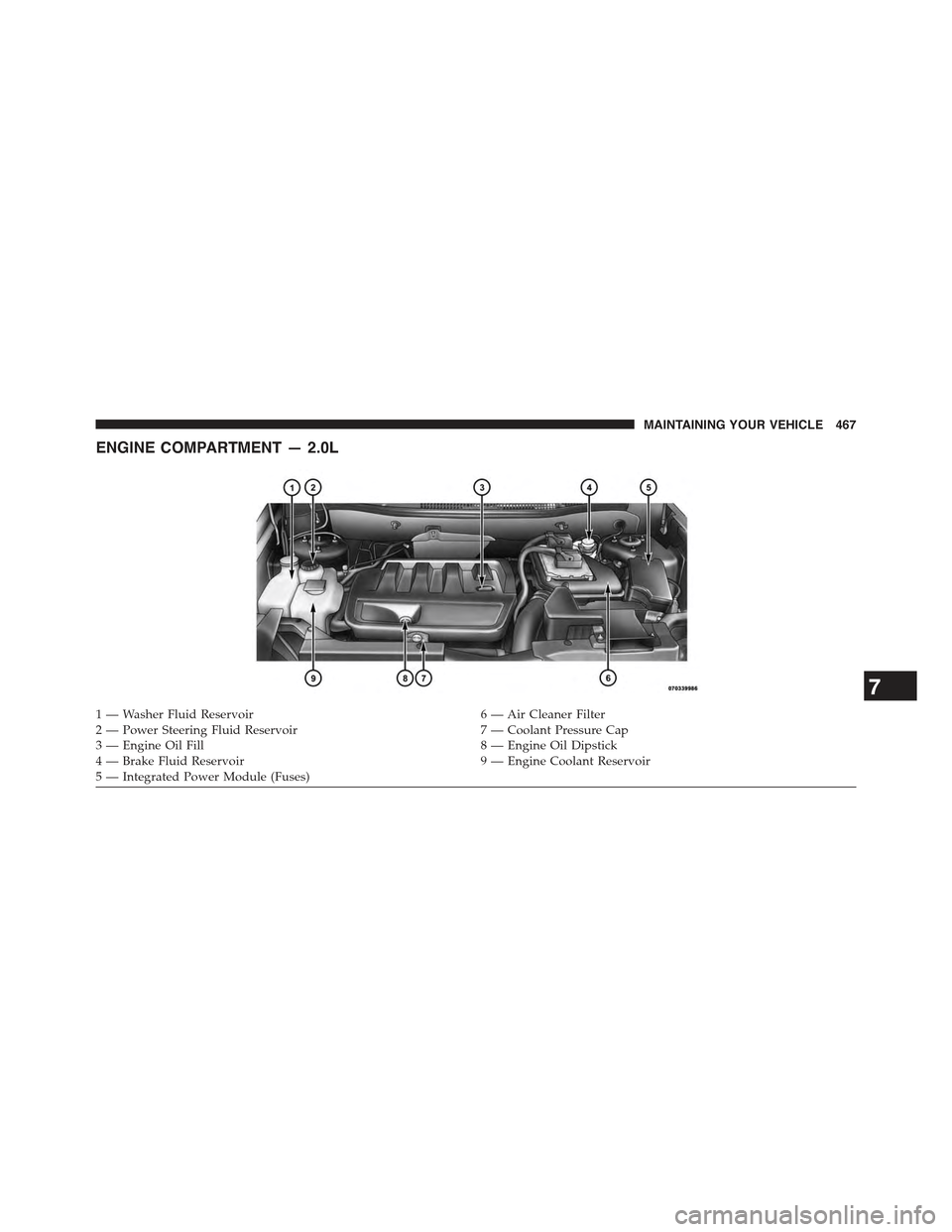
ENGINE COMPARTMENT — 2.0L
1 — Washer Fluid Reservoir6 — Air Cleaner Filter2 — Power Steering Fluid Reservoir7 — Coolant Pressure Cap3—EngineOilFill8—EngineOilDipstick4—BrakeFluidReservoir9—EngineCoolantReservoir5 — Integrated Power Module (Fuses)
7
MAINTAINING YOUR VEHICLE 467
Page 470 of 560
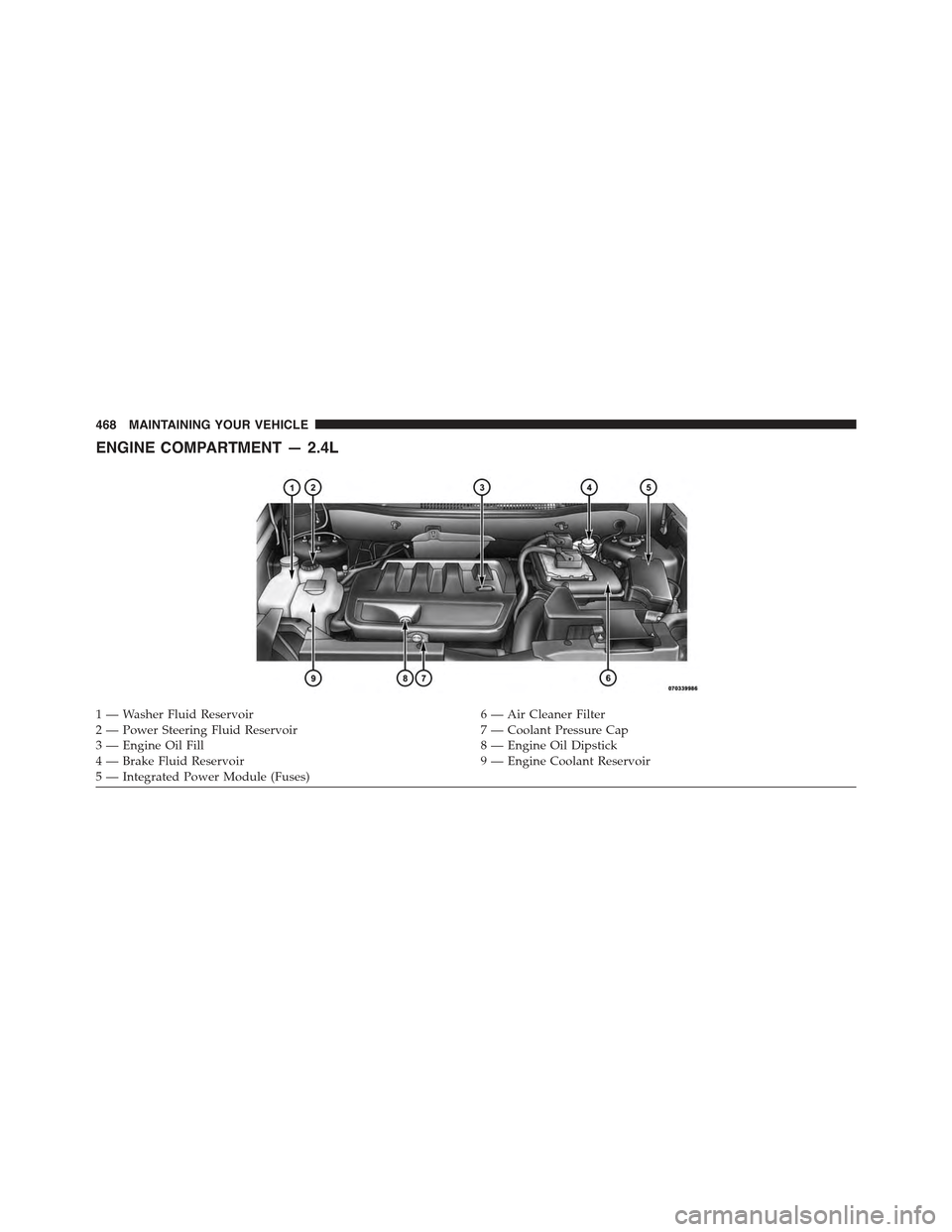
ENGINE COMPARTMENT — 2.4L
1 — Washer Fluid Reservoir6 — Air Cleaner Filter2 — Power Steering Fluid Reservoir7 — Coolant Pressure Cap3—EngineOilFill8—EngineOilDipstick4—BrakeFluidReservoir9—EngineCoolantReservoir5 — Integrated Power Module (Fuses)
468 MAINTAINING YOUR VEHICLE