manual transmission JEEP COMPASS 2015 1.G User Guide
[x] Cancel search | Manufacturer: JEEP, Model Year: 2015, Model line: COMPASS, Model: JEEP COMPASS 2015 1.GPages: 560, PDF Size: 11.51 MB
Page 334 of 560
Continuously Variable Automatic Transmission
(CVT) — If Equipped
The transmission gear position display (located in the
instrument cluster) indicates the transmission gear range.
You must press the brake pedal to move the shift lever
out of PARK (refer to “Brake/Transmission Shift Inter-
lock System” in this section). To drive, move the shift
lever from PARK or NEUTRAL to the DRIVE position.
NOTE:The Continuously Variable Automatic Transmis-
sion (CVT) changes ratios in a continuous manner. This
may sometimes#feel#as if it is slipping, but this is normal
and does not harm anything.
Only shift from DRIVE to PARK or REVERSE when the
accelerator pedal is released and the vehicle is stopped.
Be sure to keep your foot on the brake pedal when
shifting between these gears.
The transmission shift lever has PARK, REVERSE, NEU-
TRAL, and DRIVE shift positions. Some models include a
LOW position (the LOW position manually downshifts
the transmission to a lower available ratio based on
vehicle speed); in others, manual shifts are made using
the Autostick® shift control (refer to#AutoStick®#in this
section). Moving the shift lever to the left or right (-/+)
while in the DRIVE position (if equipped with
AutoStick®) will manually select from a set of predefined
transmission gear ratios, and will display the current
gear in the instrument cluster as 1, 2, 3, etc.
Gear Ranges
DO NOT race the engine when shifting from PARK or
NEUTRAL into another gear range.
NOTE:After selecting any gear range, wait a moment to
allow the selected gear to engage before accelerating.
This is especially important when the engine is cold.
332 STARTING AND OPERATING
Page 339 of 560
During sustained high speed driving or trailer
towing up long grades on hot days, the auto-
matic transmission oil may become too hot. If
this happens, the transmission overheat indica-
tor light will come on, and the vehicle will slow slightly
until the transmission cools down enough to allow a
return to the requested speed. This is done to prevent
transmission damage due to overheating. If the high
speed is maintained, the overheating may reoccur, as
before, in a cyclic fashion.
LOW (L) — If Equipped
Use this range for engine braking when descending very
steep grades. In this range, the transmission will down-
shift for maximum engine braking, and upshifts will
occur only to prevent engine overspeed.
AUTOSTICK® (SIX-SPEED AUTOMATIC
TRANSMISSION)
AutoStick® is a driver-interactive transmission feature
providing manual shift control, giving you more control
of the vehicle. AutoStick® allows you to maximize en-
gine braking, eliminate undesirable upshifts and down-
shifts, and improve overall vehicle performance. This
system can also provide you with more control during
passing, city driving, cold slippery conditions, mountain
driving, trailer towing, and many other situations.
Operation
When the shift lever is in the DRIVE position, the
transmission will operate automatically, shifting between
the six available gears. To engage AutoStick®, simply tap
the shift lever to the right or left (+/-) while in the DRIVE
position. Tapping (-) to enter AutoStick® mode will
5
STARTING AND OPERATING 337
Page 340 of 560
downshift the transmission to the next lower gear, while
using (+) to enter AutoStick® mode will retain the
current gear. When AutoStick® is active, the current
transmission gear is displayed in the instrument cluster.
In AutoStick® mode, the transmission will shift up or
down when the driver moves the shift lever to the
right (+) or left (-), unless an engine lugging or overspeed
condition would result. It will remain in the selected gear
until another upshift or downshift is chosen, except as
described below:
•The transmission will automatically upshift when nec-
essary to prevent engine over-speed.
•The transmission will automatically downshift as the
vehicle slows (to prevent engine lugging) and will
display the current gear.
•The transmission will automatically downshift to first
gear when coming to a stop. After a stop, the driver
should manually upshift (+) the transmission as the
vehicle is accelerated.
•You can start out, from a stop, in first or second gear.
Tapping (+) (at a stop) will allow starting in second
gear. Starting out in second gear can be helpful in
snowy or icy conditions.
•If a requested downshift would cause the engine to
overspeed, that shift will not occur.
•Avoid using speed control when AutoStick® is engaged.
•Transmission shifting will be more noticeable when
AutoStick® is engaged.
•The system may revert to automatic shift mode if a
fault or overheat condition is detected.
338 STARTING AND OPERATING
Page 341 of 560
To disengage AutoStick® mode, hold the shift lever to the
right (+) until “D” is once again displayed in the instru-
ment cluster. You can shift in or out of the AutoStick®
mode at any time without taking your foot off the
accelerator pedal.
WARNING!
Do not downshift for additional engine braking on a
slippery surface. The drive wheels could lose their
grip and the vehicle could skid, causing a collision or
personal injury.
AutoStick® (CVT)
AutoStick® is a driver-interactive transmission feature
providing six manually selectable gear ratios, giving you
more control of the vehicle. AutoStick® allows you to
maximize engine braking, eliminate undesirable upshifts
and downshifts, and improve overall vehicle perfor-
mance. This system can also provide you with more
control during passing, city driving, cold slippery condi-
tions, mountain driving, trailer towing, and many other
situations.
Operation
NOTE:AutoStick® is not available until the CVT warms
up in cold weather.
When the shift lever is in the DRIVE position, AutoStick®
is activated by moving the shift lever side-to-side. Mov-
ing the shift lever to the right (+) will activate AutoStick®
and shift up to the next higher manual ratio, unless you
are already operating in or near Overdrive, in which case
sixth gear ratio will be selected. In like manner, moving
the shift lever to the left (-) will activate AutoStick® and
shift to the next lower manual ratio. The manually-
selected gear will be displayed in the instrument cluster.
5
STARTING AND OPERATING 339
Page 342 of 560
In AutoStick® mode, the transmission will shift up or
down when (+/-) is manually selected by the driver,
unless an engine lugging or overspeed condition would
result. It will remain in the selected gear until another
upshift or downshift is chosen, except as described
below:
•The transmission will automatically upshift when nec-
essary to prevent engine over-speed.
•The transmission will automatically downshift as the
vehicle slows (to prevent engine lugging) and will
display the current gear.
•The transmission will automatically downshift to first
gear when coming to a stop. After a stop, the driver
should manually upshift (+) the transmission as the
vehicle is accelerated.
•If a requested downshift would cause the engine to
overspeed, that shift will not occur.
•Transmission shifting will be more noticeable when
AutoStick® is engaged.
•Heavy Anti-Lock Brake System (ABS) application will
disengage AutoStick® mode.
•The system may revert to automatic shift mode if a
fault or overheat condition is detected.
To disengage AutoStick® mode, hold the shift lever to the
right (+) until “D” is once again displayed in the instru-
ment cluster. You can shift in or out of the AutoStick®
mode at any time without taking your foot off the
accelerator pedal.
WARNING!
Do not downshift for additional engine braking on a
slippery surface. The drive wheels could lose their
grip and the vehicle could skid, causing a collision or
personal injury.
340 STARTING AND OPERATING
Page 355 of 560
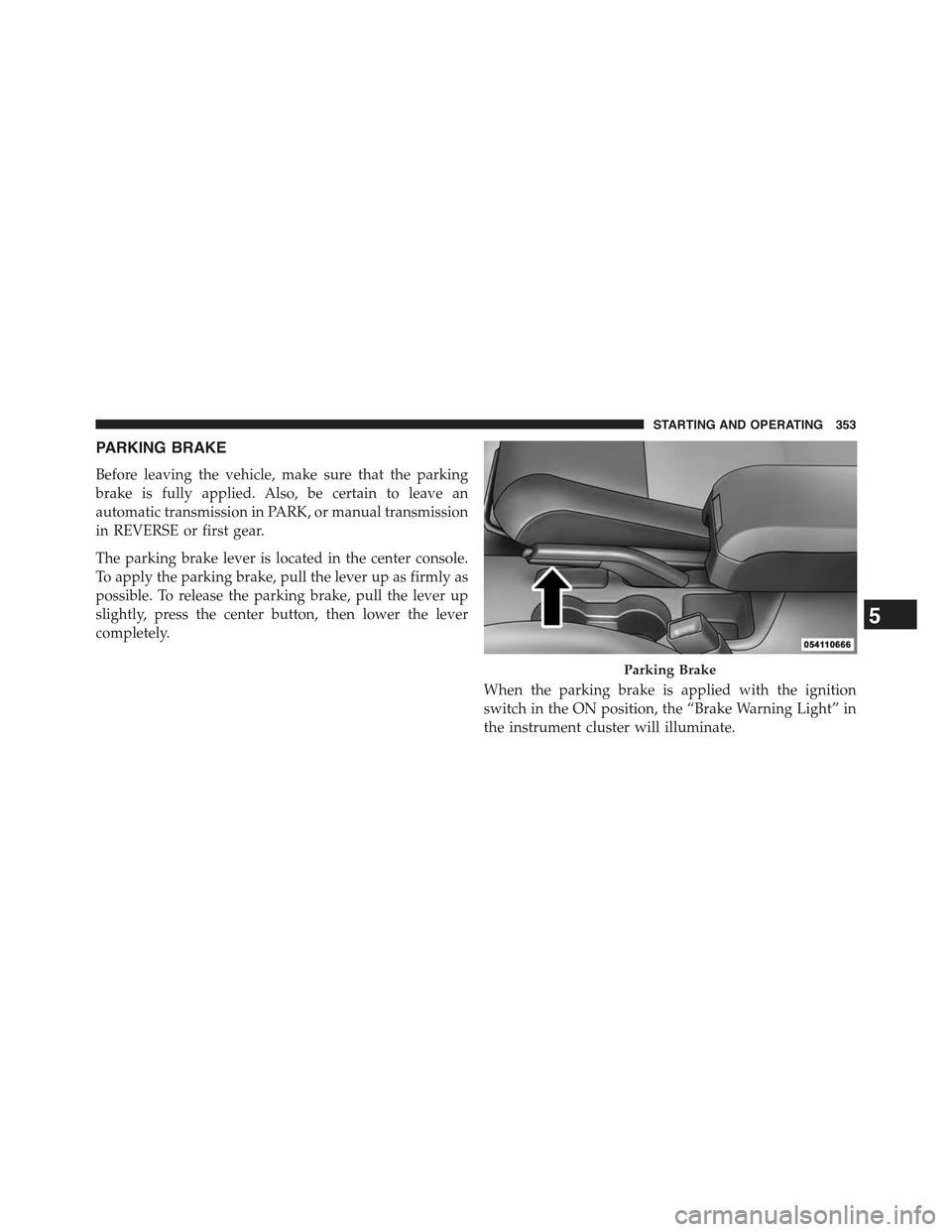
PARKING BRAKE
Before leaving the vehicle, make sure that the parking
brake is fully applied. Also, be certain to leave an
automatic transmission in PARK, or manual transmission
in REVERSE or first gear.
The parking brake lever is located in the center console.
To apply the parking brake, pull the lever up as firmly as
possible. To release the parking brake, pull the lever up
slightly, press the center button, then lower the lever
completely.
When the parking brake is applied with the ignition
switch in the ON position, the “Brake Warning Light” in
the instrument cluster will illuminate.
Parking Brake
5
STARTING AND OPERATING 353
Page 357 of 560
WARNING!(Continued)
•Always fully apply the parking brake when leav-
ing your vehicle or it may roll and cause damage or
injury. Also, be certain to leave an automatic trans-
mission in PARK, a manual transmission in RE-
VERSE or first gear. Failure to do so may cause the
vehicle to roll and cause damage or injury.
CAUTION!
If the Brake System Warning Light remains on with
the parking brake released, a brake system malfunc-
tion is indicated. Have the brake system serviced by
an authorized dealer immediately.
BRAKE SYSTEM
Your vehicle is equipped with power assisted brakes as
standard equipment. In the event power assist is lost for
any reason (for example, repeated brake applications
with the engine off), the brakes will still function. How-
ever, the effort required to brake the vehicle will be much
greater than that required with the power system oper-
ating.
WARNING!
Riding the brakes can lead to brake failure and
possibly a collision. Driving with your foot resting or
riding on the brake pedal can result in abnormally
high brake temperatures, excessive lining wear, and
possible brake damage. You would not have your full
braking capacity in an emergency.
5
STARTING AND OPERATING 355
Page 425 of 560
Towing Tips
Before setting out on a trip, practice turning, stopping,
and backing up the trailer in an area located away from
heavy traffic.
Manual Transmission — If Equipped
If using a manual transmission vehicle for trailer towing,
all starts must be in first gear to avoid excessive clutch
slippage.
Automatic Transmission
The DRIVE range can be selected when towing. How-
ever, if frequent shifting or changes in engine speed occur
while in this range, use the AutoStick® shift control (if
equipped) to select a lower gear ratio.
NOTE:Using a lower gear ratio while operating the
vehicle under heavy loading conditions, will improve
performance and extend transmission life by reducing
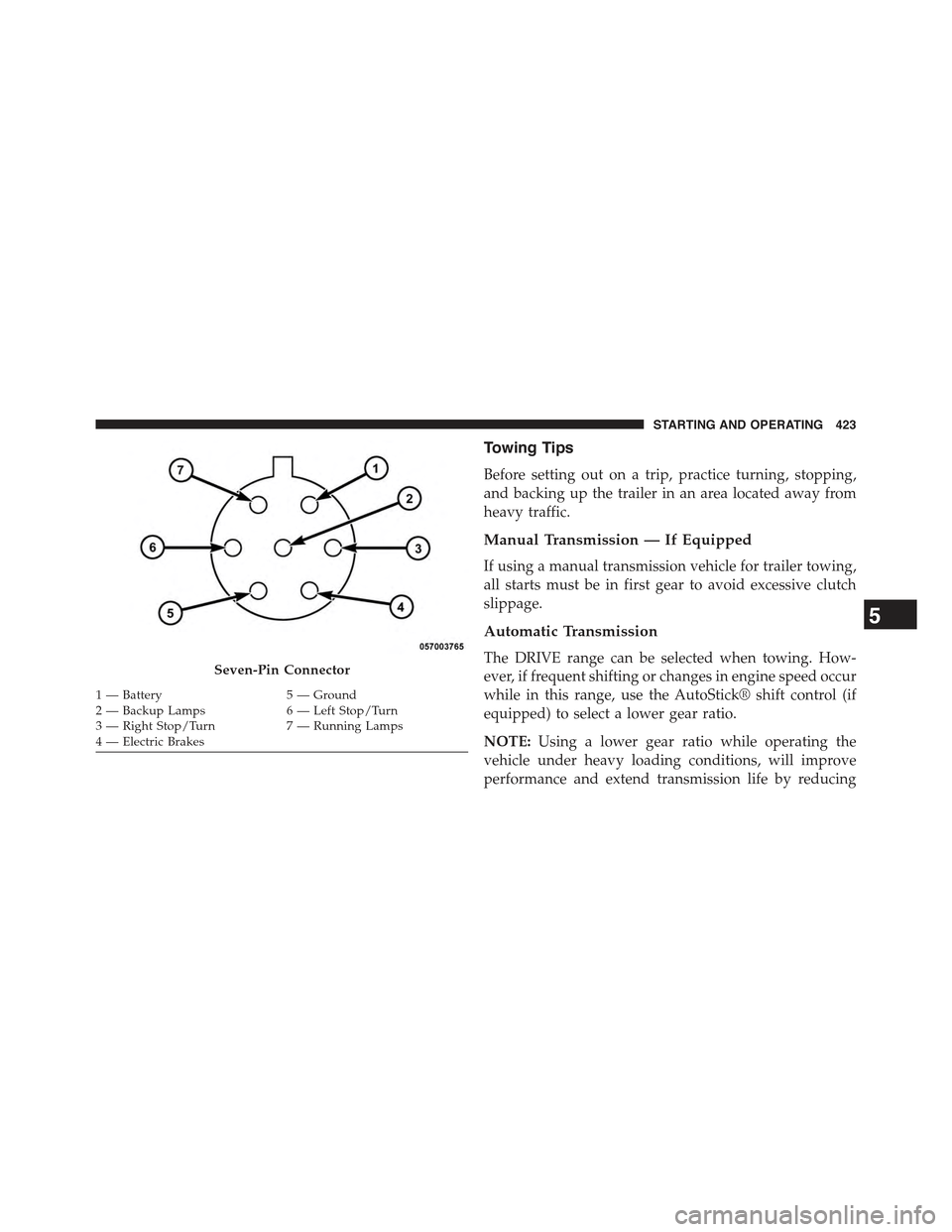
Seven-Pin Connector
1—Battery5—Ground2—BackupLamps6—LeftStop/Turn3—RightStop/Turn7—RunningLamps4 — Electric Brakes
5
STARTING AND OPERATING 423
Page 427 of 560
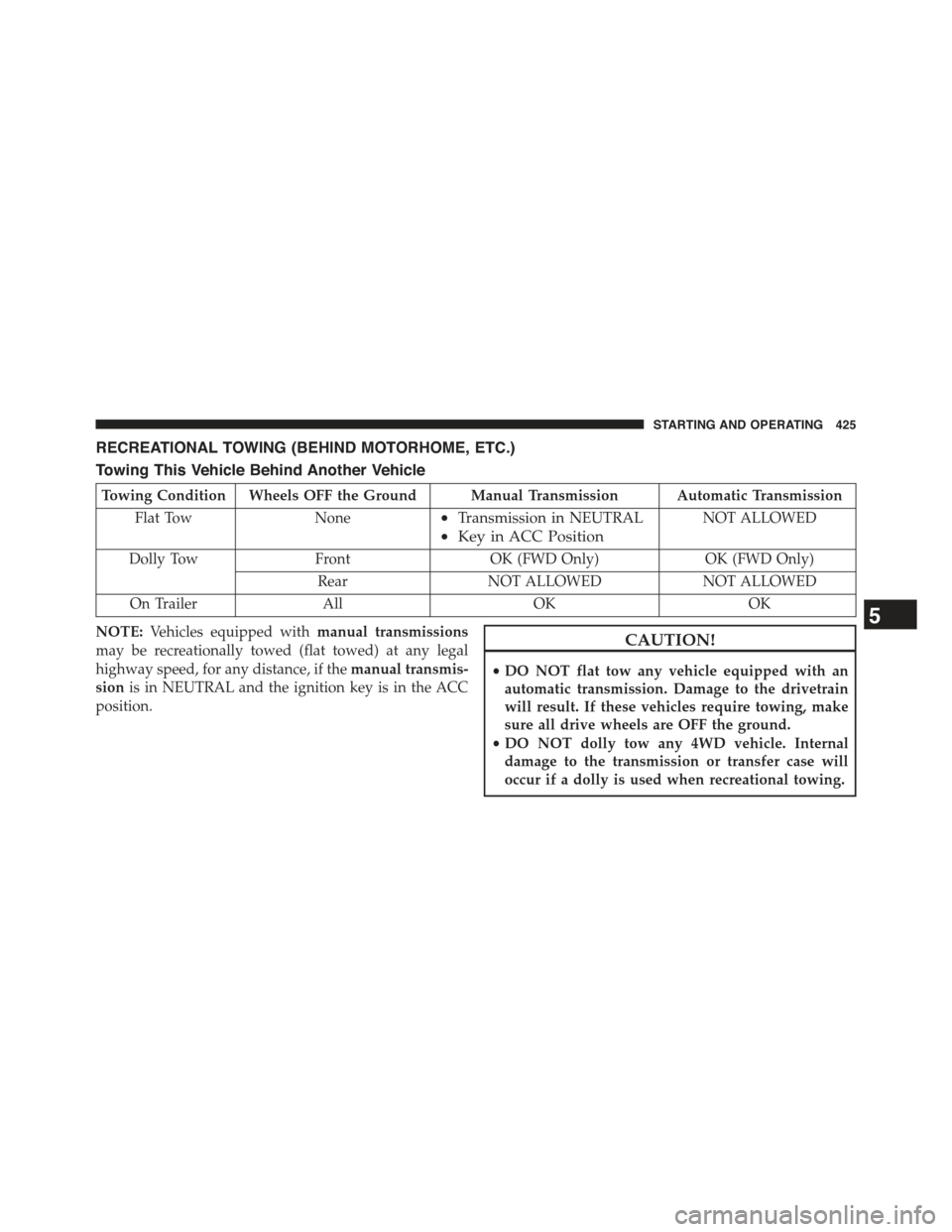
RECREATIONAL TOWING (BEHIND MOTORHOME, ETC.)
Towing This Vehicle Behind Another Vehicle
Towing Condition Wheels OFF the Ground Manual Transmission Automatic Transmission
Flat TowNone•Transmission in NEUTRAL
•Key in ACC Position
NOT ALLOWED
Dolly Tow Front OK (FWD Only) OK (FWD Only)
Rear NOT ALLOWED NOT ALLOWED
On TrailerAllOKOK
NOTE:Vehicles equipped withmanual transmissions
may be recreationally towed (flat towed) at any legal
highway speed, for any distance, if themanual transmis-
sionis in NEUTRAL and the ignition key is in the ACC
position.
CAUTION!
•DO NOT flat tow any vehicle equipped with an
automatic transmission. Damage to the drivetrain
will result. If these vehicles require towing, make
sure all drive wheels are OFF the ground.
•DO NOT dolly tow any 4WD vehicle. Internal
damage to the transmission or transfer case will
occur if a dolly is used when recreational towing.
5
STARTING AND OPERATING 425
Page 436 of 560
3. Set the parking brake.
4. Place the shift lever in PARK (automatic transmission)
or REVERSE (manual transmission).
5. Turn OFF the ignition.
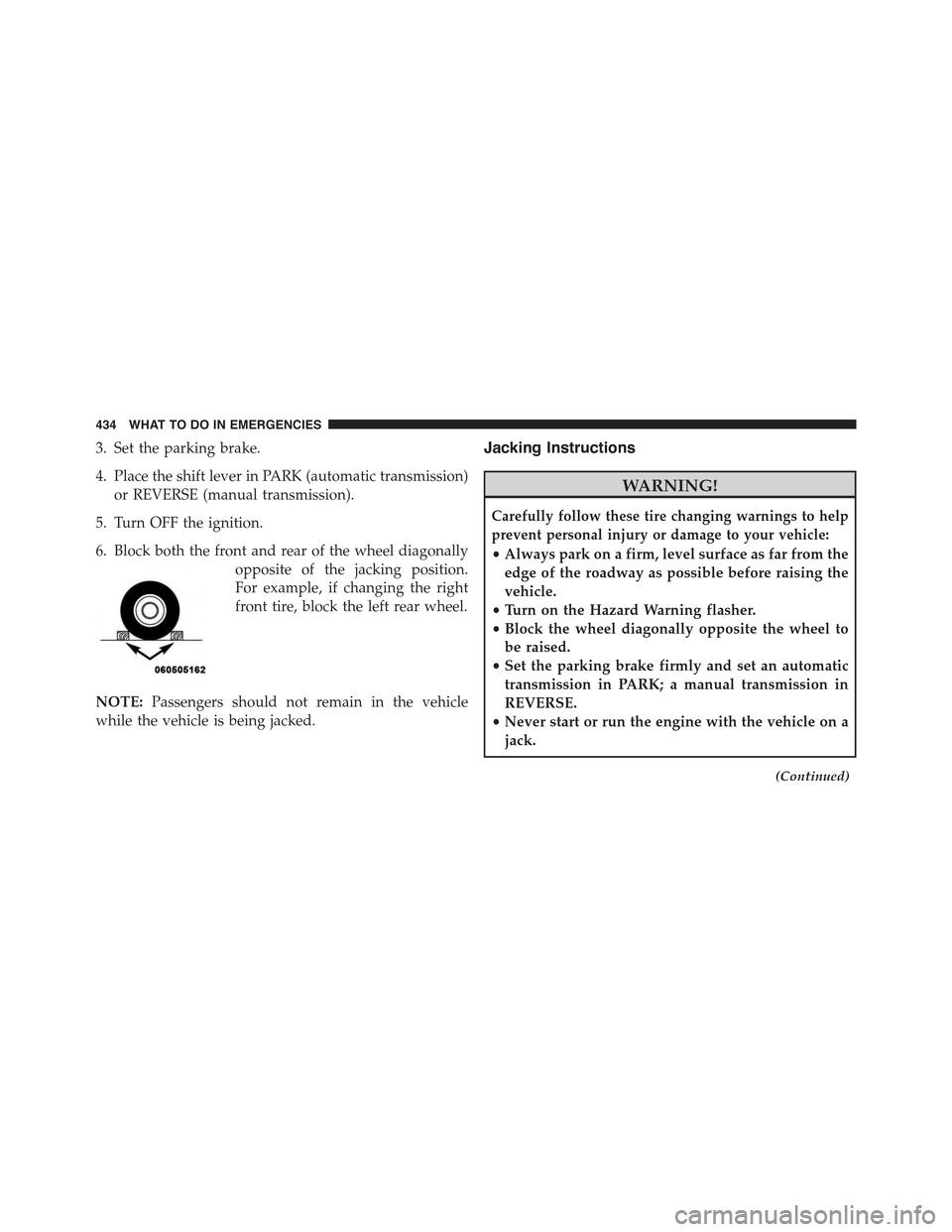
6. Block both the front and rear of the wheel diagonally
opposite of the jacking position.
For example, if changing the right
front tire, block the left rear wheel.
NOTE:Passengers should not remain in the vehicle
while the vehicle is being jacked.
Jacking Instructions
WARNING!
Carefully follow these tire changing warnings to help
prevent personal injury or damage to your vehicle:
•Always park on a firm, level surface as far from the
edge of the roadway as possible before raising the
vehicle.
•Turn on the Hazard Warning flasher.
•Block the wheel diagonally opposite the wheel to
be raised.
•Set the parking brake firmly and set an automatic
transmission in PARK; a manual transmission in
REVERSE.
•Never start or run the engine with the vehicle on a
jack.
(Continued)
434 WHAT TO DO IN EMERGENCIES