tow JEEP COMPASS 2015 1.G Repair Manual
[x] Cancel search | Manufacturer: JEEP, Model Year: 2015, Model line: COMPASS, Model: JEEP COMPASS 2015 1.GPages: 560, PDF Size: 11.51 MB
Page 440 of 560
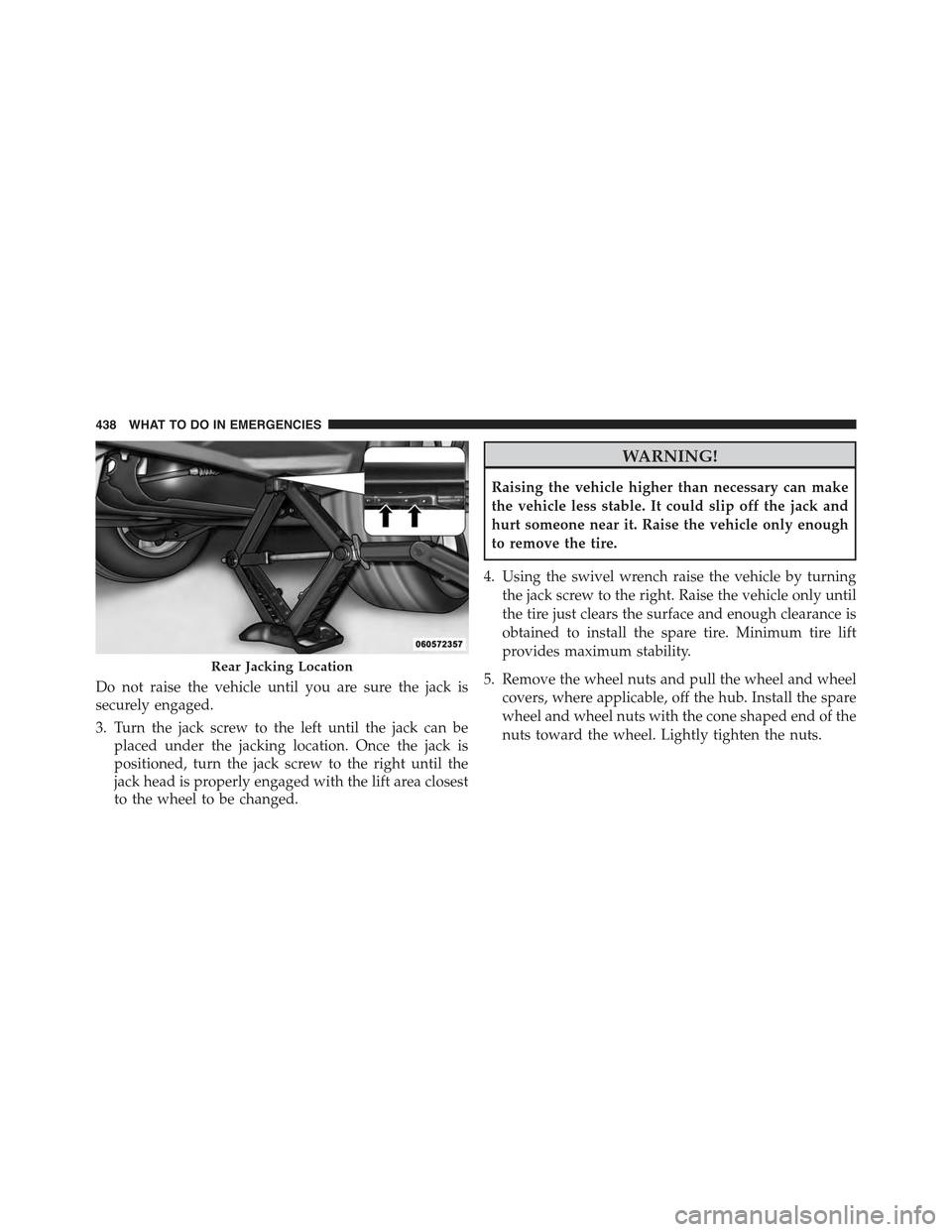
Do not raise the vehicle until you are sure the jack is
securely engaged.
3. Turn the jack screw to the left until the jack can be
placed under the jacking location. Once the jack is
positioned, turn the jack screw to the right until the
jack head is properly engaged with the lift area closest
to the wheel to be changed.
WARNING!
Raising the vehicle higher than necessary can make
the vehicle less stable. It could slip off the jack and
hurt someone near it. Raise the vehicle only enough
to remove the tire.
4. Using the swivel wrench raise the vehicle by turning
the jack screw to the right. Raise the vehicle only until
the tire just clears the surface and enough clearance is
obtained to install the spare tire. Minimum tire lift
provides maximum stability.
5. Remove the wheel nuts and pull the wheel and wheel
covers, where applicable, off the hub. Install the spare
wheel and wheel nuts with the cone shaped end of the
nuts toward the wheel. Lightly tighten the nuts.
Rear Jacking Location
438 WHAT TO DO IN EMERGENCIES
Page 442 of 560
7.Finish tightening the lug nuts. Push down on the
wrench while at the end of the handle for increased
leverage. Tighten the lug nuts in a star pattern until each
lug nut has been tightened twice. Refer to “Torque
Specifications” in this section for proper lug nut torque.
8.Remove the wheel blocks and lower the jack until it is
free. Release the parking brake. Reassemble the lug
wrench to the jack assembly and stow it in the spare tire
area. Secure the assembly using the means provided.
WARNING!
A loose tire or jack thrown forward in a collision or
hard stop could endanger the occupants of the ve-
hicle. Always stow the jack parts and the spare tire in
the places provided.
9. Place the deflated (flat) tire in the cargo area,have the
tire repaired or replaced as soon as possible.
WARNING!
A loose tire thrown forward in a collision or hard stop
could injure the occupants in the vehicle. Have the
deflated (flat) tire repaired or replaced immediately.
10. Check the spare tire pressure as soon as possible.
Correct the tire pressure as required.
11. After 25 miles (40 km) check the lug nut torque with
a torque wrench to ensure that all lug nuts are
properly seated against the wheel.
Road Tire Installation
Vehicles Equipped With Wheel Covers
1. Mount the road tire on the axle.
2.Align the valve notch in the wheel cover with the valve
stem on the wheel. Install the cover by hand. Do not use
a hammer or excessive force to install the cover.
440 WHAT TO DO IN EMERGENCIES
Page 443 of 560
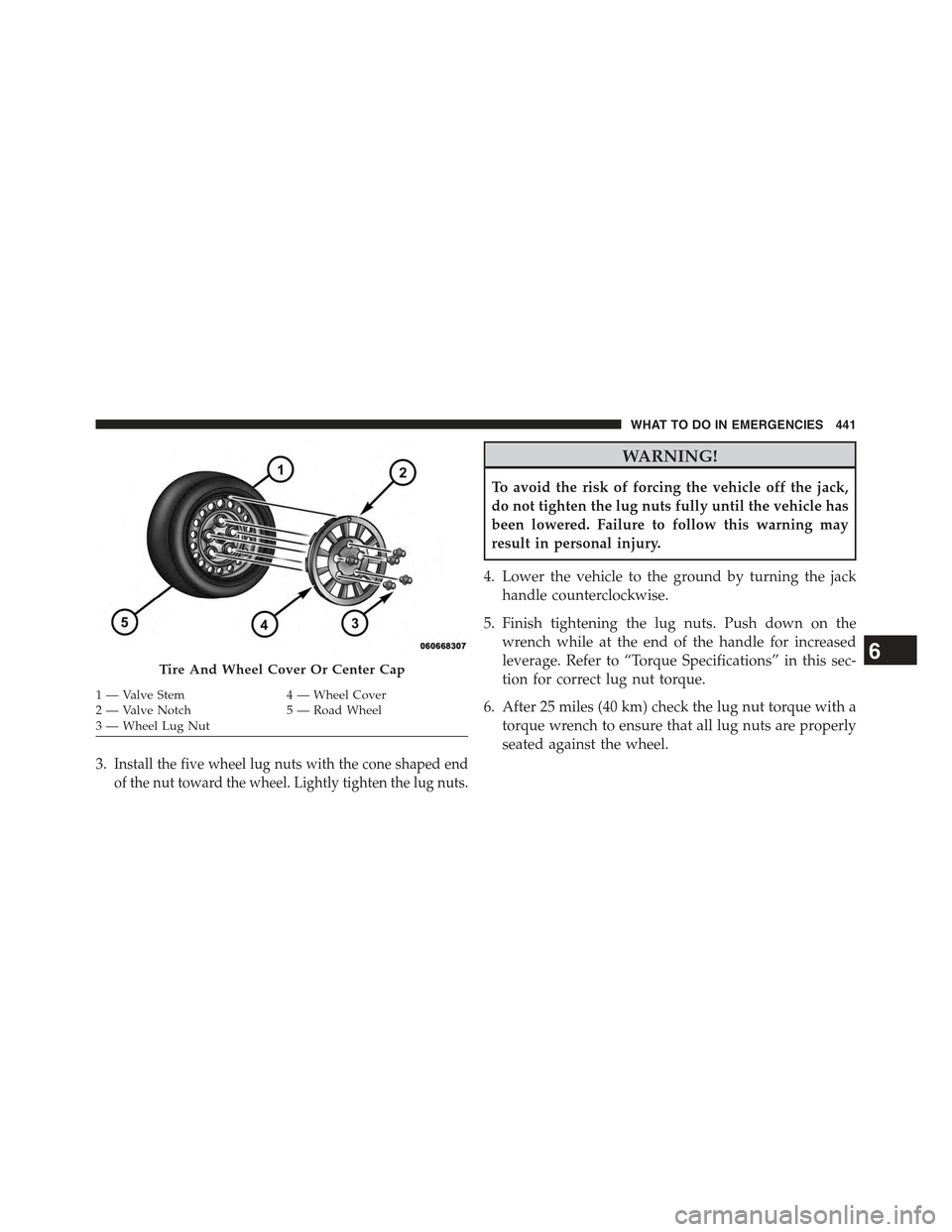
3.Install the five wheel lug nuts with the cone shaped end
of the nut toward the wheel. Lightly tighten the lug nuts.
WARNING!
To avoid the risk of forcing the vehicle off the jack,
do not tighten the lug nuts fully until the vehicle has
been lowered. Failure to follow this warning may
result in personal injury.
4. Lower the vehicle to the ground by turning the jack
handle counterclockwise.
5. Finish tightening the lug nuts. Push down on the
wrench while at the end of the handle for increased
leverage. Refer to “Torque Specifications” in this sec-
tion for correct lug nut torque.
6. After 25 miles (40 km) check the lug nut torque with a
torque wrench to ensure that all lug nuts are properly
seated against the wheel.
Tire And Wheel Cover Or Center Cap
1 — Valve Stem4 — Wheel Cover2—ValveNotch5—RoadWheel3—WheelLugNut
6
WHAT TO DO IN EMERGENCIES 441
Page 444 of 560
Vehicles Without Wheel Covers
1. Mount the road tire on the axle.
2.Install the remaining lug nuts with the cone shaped end
of the nut toward the wheel. Lightly tighten the lug nuts.
WARNING!
To avoid the risk of forcing the vehicle off the jack,
do not fully tighten the lug nuts until the vehicle has
been lowered. Failure to follow this warning may
result in personal injury.
3. Lower the vehicle to the ground by turning the jack
handle counterclockwise.
4. Finish tightening the lug nuts. Push down on the
wrench while at the end of the handle for increased
leverage. Refer to “Torque Specifications” in this sec-
tion for correct lug nut torque.
5. After 25 miles (40 km) check the lug nut torque with a
torque wrench to ensure that all lug nuts are properly
seated against the wheel.
TIRE SERVICE KIT — IF EQUIPPED
Small punctures up to¼” (6 mm) in the tire tread can be
sealed with Tire Service Kit. Foreign objects (e.g., screws
or nails) should not be removed from the tire. Tire Service
Kit can be used in outside temperatures down to approxi-
mately -4°F (-20°C).
This kit will provide a temporary tire seal, allowing you
to drive your vehicle up to 100 miles (160 km) with a
maximum speed of 55 mph (90 km/h).
Tire Service Kit Storage
The Tire Service Kit is located under the load floor in the
cargo area.
442 WHAT TO DO IN EMERGENCIES
Page 448 of 560
WARNING!(Continued)
•Keep Tire Service Kit away from open flames or
heat source.
•A loose Tire Service Kit thrown forward in a
collision or hard stop could endanger the occupants
of the vehicle. Always stow the Tire Service Kit in
the place provided. Failure to follow these warn-
ings can result in injuries that are serious or fatal to
you, your passengers, and others around you.
•Take care not to allow the contents of Tire Service
Kit to come in contact with hair, eyes, or clothing.
Tire Service Kit is harmful if inhaled, swallowed,
or absorbed through the skin. It causes skin, eye,
and respiratory irritation. Flush immediately with
plenty of water if there is any contact with eyes or
skin. Change clothing as soon as possible, if there
is any contact with clothing.
(Continued)
WARNING!(Continued)
•Tire Service Kit Sealant solution contains latex. In
case of an allergic reaction or rash, consult a phy-
sician immediately. Keep Tire Service Kit out of
reach of children. If swallowed, rinse mouth imme-
diately with plenty of water and drink plenty of
water. Do not induce vomiting! Consult a physician
immediately.
Sealing A Tire With Tire Service Kit
(A) Whenever You Stop To Use Tire Service Kit:
1. Pull over to a safe location and turn on the vehicle’s
Hazard Warning flashers.
2. Verify that the valve stem (on the wheel with the
deflated tire) is in a position that is near to the ground.
This will allow the Tire Service Kit Hoses (6) and (7) to
reach the valve stem and keep the Tire Service Kit flat
446 WHAT TO DO IN EMERGENCIES
Page 462 of 560
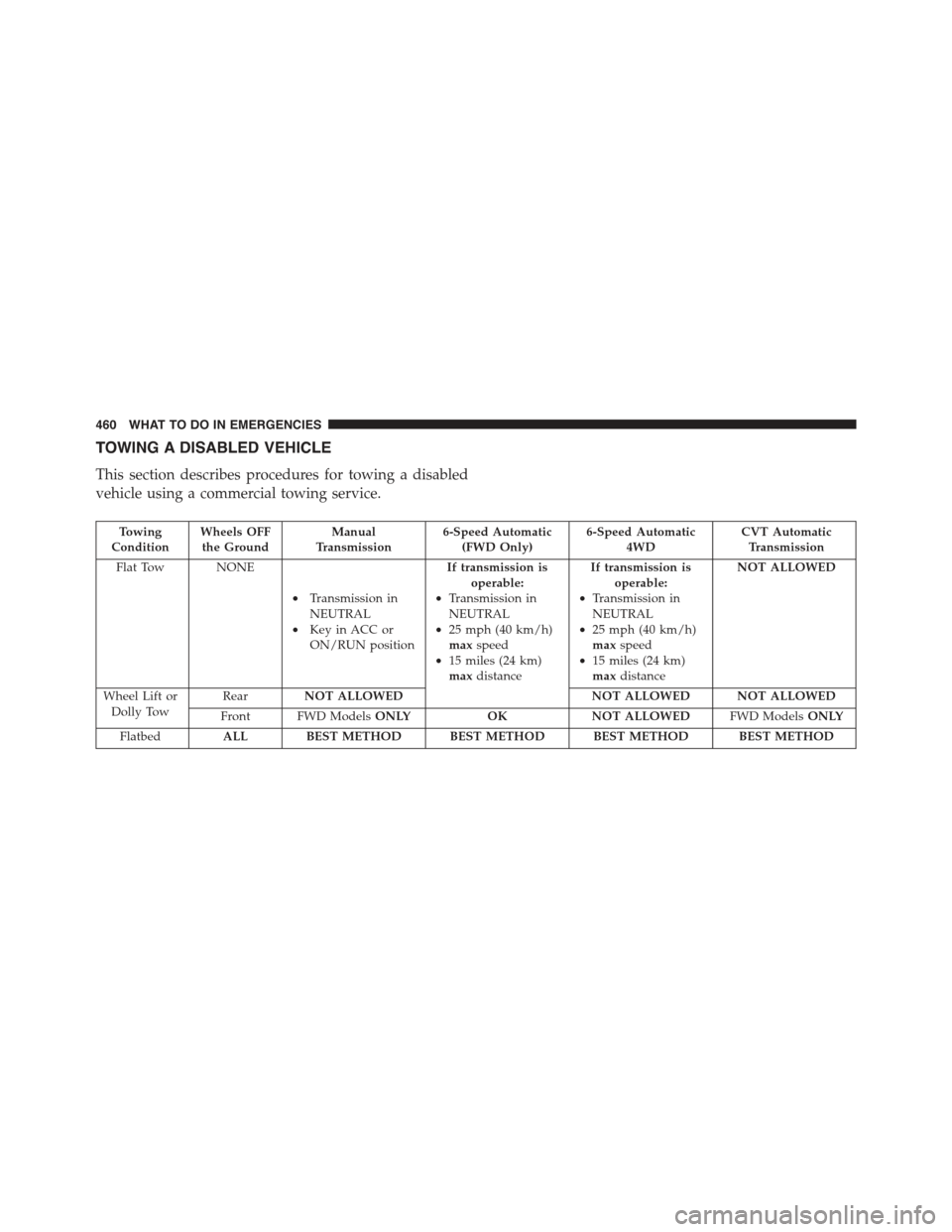
TOWING A DISABLED VEHICLE
This section describes procedures for towing a disabled
vehicle using a commercial towing service.
To w i n gConditionWheels OFFthe GroundManualTransmission6-Speed Automatic(FWD Only)6-Speed Automatic4WDCVT AutomaticTransmission
Flat Tow NONE
•Transmission inNEUTRAL•Key in ACC orON/RUN position
If transmission isoperable:•Transmission inNEUTRAL•25 mph (40 km/h)maxspeed•15 miles (24 km)maxdistance
If transmission isoperable:•Transmission inNEUTRAL•25 mph (40 km/h)maxspeed•15 miles (24 km)maxdistance
NOT ALLOWED
Wheel Lift orDolly TowRearNOT ALLOWEDNOT ALLOWED NOT ALLOWED
Front FWD ModelsONLYOKNOT ALLOWEDFWD ModelsONLY
FlatbedALL BEST METHOD BEST METHOD BEST METHOD BEST METHOD
460 WHAT TO DO IN EMERGENCIES
Page 463 of 560
With Ignition Key
Automatic Transmission
•Front Wheel Drive (FWD) vehicles can be towed with
the front wheels elevated, or on a flatbed truck (all four
wheelsOFFthe ground).
•Four-Wheel Drive (4WD) vehicles can be towed on a
flatbed truck (all four wheelsOFFthe ground).
If the transmission is operable, Front Wheel Drive (FWD)
and Four Wheel Drive (4WD) vehicles, with the 6-speed
automatic transmission only (NOTthe Continuously
Variable automatic transmission [CVT]), may be flat
towed (with all four wheels on the ground) under the
following conditions:
•The transmission must be in NEUTRAL.
•The towing speed must not exceed 25 mph (40 km/h).
•The towing distance must not exceed 15 miles (24 km).
Front Wheel Drive (FWD) models (with 6-speed auto-
maticonly) may also be towed (under the same limita-
tions shown above) with the rear wheels elevated.
CAUTION!
•DO NOT flat tow any vehicle equipped with a
CVT automatic transmission. Damage to the drive-
train will result. If these vehicles require towing,
make sure all drive wheels are OFF the ground.
•Towing this vehicle in violation of the above re-
quirements can cause severe transmission and/or
transfer case damage. Damage from improper tow-
ing is not covered under the New Vehicle Limited
Warranty..
If the vehicle’s battery is discharged, refer to “Shift Lever
Override” in this section for instructions on shifting the
automatic transmission out of PARK for towing.
6
WHAT TO DO IN EMERGENCIES 461
Page 464 of 560
Manual Transmission
•Front Wheel Drive (FWD) or Four-Wheel Drive (4WD)
vehicles can be flat towed (all four wheels on the
ground) with the transmission in NEUTRAL.
•FWD vehicles can be towed with the front wheels
elevated.
•FWD or 4WD vehicles can be towed on a flatbed truck
(all wheelsOFFthe ground).
CAUTION!
•DO NOT flat tow any disabled vehicle if condition
is related to the clutch, transmission or driveline.
Additional damage to the drivetrain could result.
(Continued)
CAUTION!(Continued)
•Towing this vehicle in violation of the above re-
quirements can cause severe engine, transmission,
or drivetrain damage. Damage from improper tow-
ing is not covered under the New Vehicle Limited
Warranty.
All Transmissions
If you must use the accessories (wipers, defroster, etc.)
while being towed, the key must be in the ON/RUN
position, not the ACC position. Make certain the trans-
mission remains in NEUTRAL.
462 WHAT TO DO IN EMERGENCIES
Page 465 of 560
CAUTION!
•Do not use sling-type equipment when towing.
Vehicle damage may occur.
•When securing the vehicle to a flatbed truck, do not
attach to front or rear suspension components.
Damage to your vehicle may result from improper
towing.
Without The Ignition Key
Special care must be taken when the vehicle is towed
with the ignition in the LOCK/OFF position. The only
approved method of towing without the ignition key is
with a flatbed truck. Proper towing equipment is neces-
sary to prevent damage to the vehicle.
6
WHAT TO DO IN EMERGENCIES 463
Page 471 of 560
ONBOARD DIAGNOSTIC SYSTEM — OBD II
Your vehicle is equipped with a sophisticated onboard
diagnostic system called OBD II. This system monitors
the performance of the emissions, engine, and automatic
transmission control systems. When these systems are
operating properly, your vehicle will provide excellent
performance and fuel economy, as well as engine emis-
sions well within current government regulations.
If any of these systems require service, the OBD II system
will turn on the “Malfunction Indicator Light” (MIL). It
will also store diagnostic codes and other information to
assist your service technician in making repairs. Al-
though your vehicle will usually be drivable and not
need towing, see your authorized dealer for service as
soon as possible.
CAUTION!
•Prolonged driving with the MIL on could cause
further damage to the emission control system. It
could also affect fuel economy and driveability.
The vehicle must be serviced before any emissions
tests can be performed.
•If the MIL is flashing while the engine is running,
severe catalytic converter damage and power loss
will soon occur. Immediate service is required.
Loose Fuel Filler Cap Message
After fuel is added, the vehicle diagnostic system can
determine if the fuel filler cap is possibly loose or
improperly installed. A “gASCAP” message will be dis-
played in the instrument cluster. Tighten the gas cap until
a#clicking#sound is heard. This is an indication that the
gas cap is properly tightened. Press the trip odometer
7
MAINTAINING YOUR VEHICLE 469