battery JEEP COMPASS 2016 1.G Owner's Guide
[x] Cancel search | Manufacturer: JEEP, Model Year: 2016, Model line: COMPASS, Model: JEEP COMPASS 2016 1.GPages: 589, PDF Size: 3.63 MB
Page 533 of 589
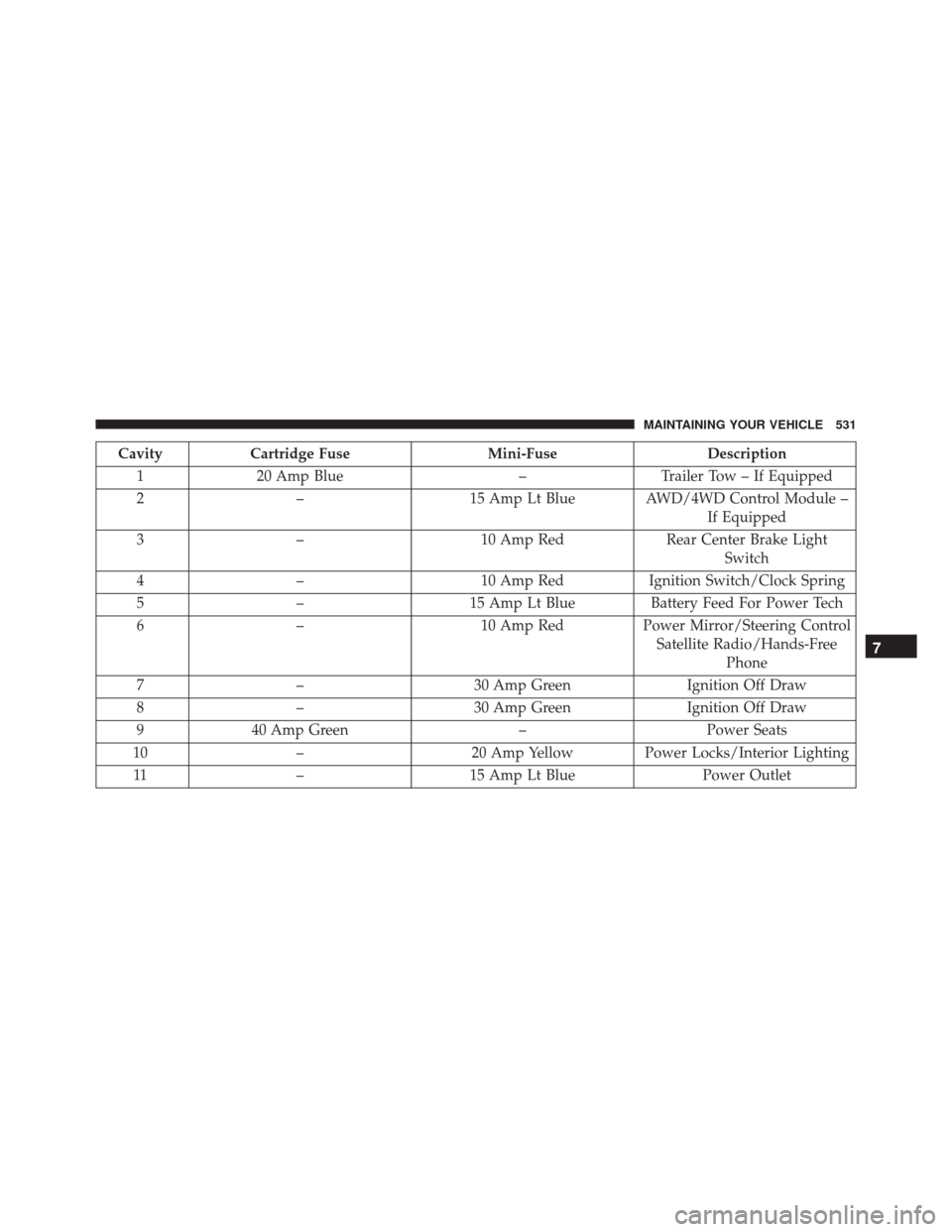
CavityCartridge Fuse Mini-FuseDescription
1 20 Amp Blue –Trailer Tow – If Equipped
2 – 15 Amp Lt Blue AWD/4WD Control Module –
If Equipped
3 – 10 Amp Red Rear Center Brake Light
Switch
4 – 10 Amp RedIgnition Switch/Clock Spring
5 – 15 Amp Lt Blue Battery Feed For Power Tech
6 – 10 Amp RedPower Mirror/Steering Control
Satellite Radio/Hands-Free Phone
7 – 30 Amp Green Ignition Off Draw
8 – 30 Amp Green Ignition Off Draw
9 40 Amp Green –Power Seats
10 – 20 Amp Yellow Power Locks/Interior Lighting
11 – 15 Amp Lt Blue Power Outlet
7
MAINTAINING YOUR VEHICLE 531
Page 537 of 589
VEHICLE STORAGE
If you will not be using your vehicle for more than 21
days, you may want to take steps to preserve your
battery.
•Disengage the mini-fuse in the Power Distribution
Center labeled IOD (Ignition Off-Draw).
• Or disconnect the negative cable from the battery. •
Anytime you store your vehicle, or keep it out of
service (i.e., vacation) for two weeks or more, run the
air conditioning system at idle for about five minutes
in the fresh air and high blower setting. This will
ensure adequate system lubrication to minimize the
possibility of compressor damage when the system is
started again.
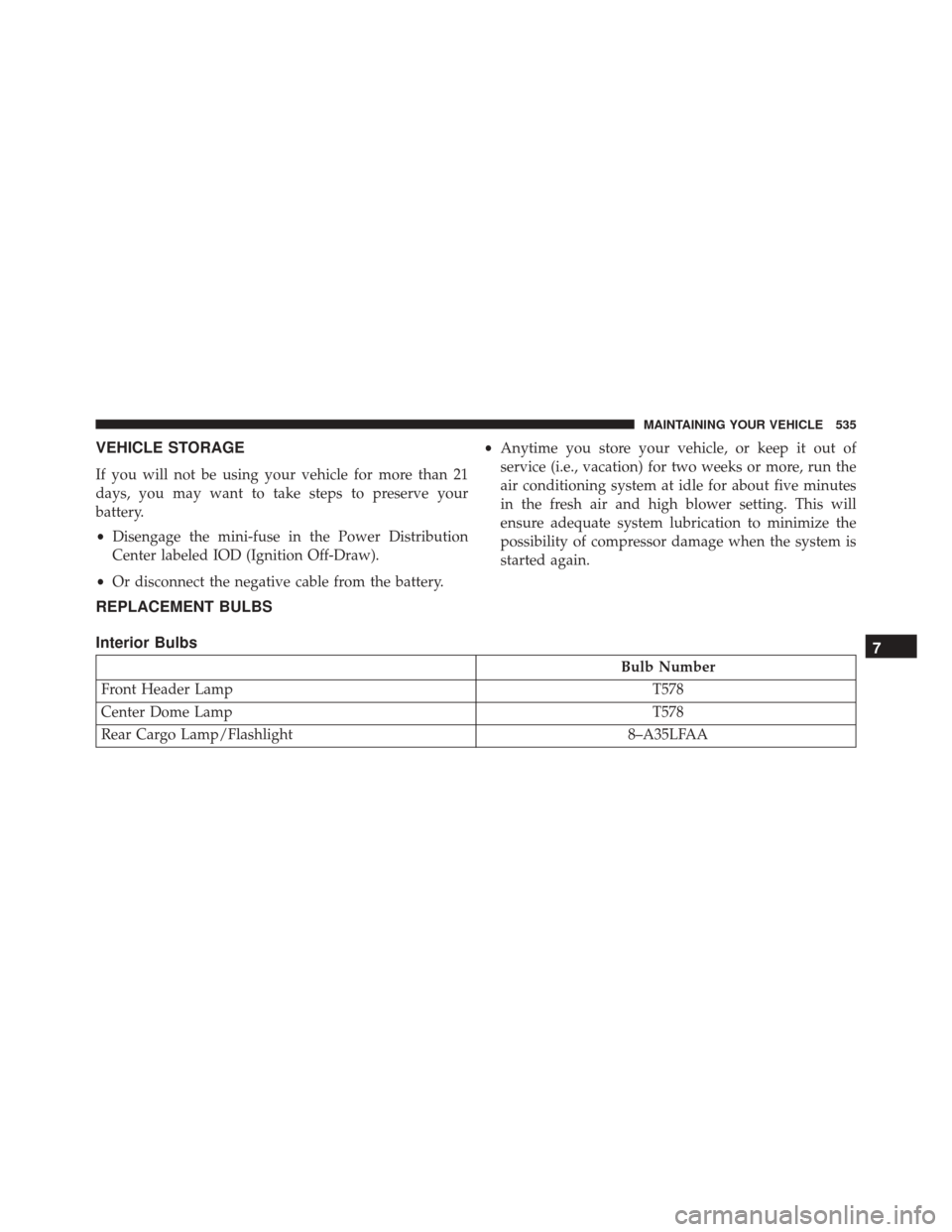
REPLACEMENT BULBS
Interior Bulbs
Bulb Number
Front Header Lamp T578
Center Dome Lamp T578
Rear Cargo Lamp/Flashlight 8–A35LFAA
7
MAINTAINING YOUR VEHICLE 535
Page 548 of 589
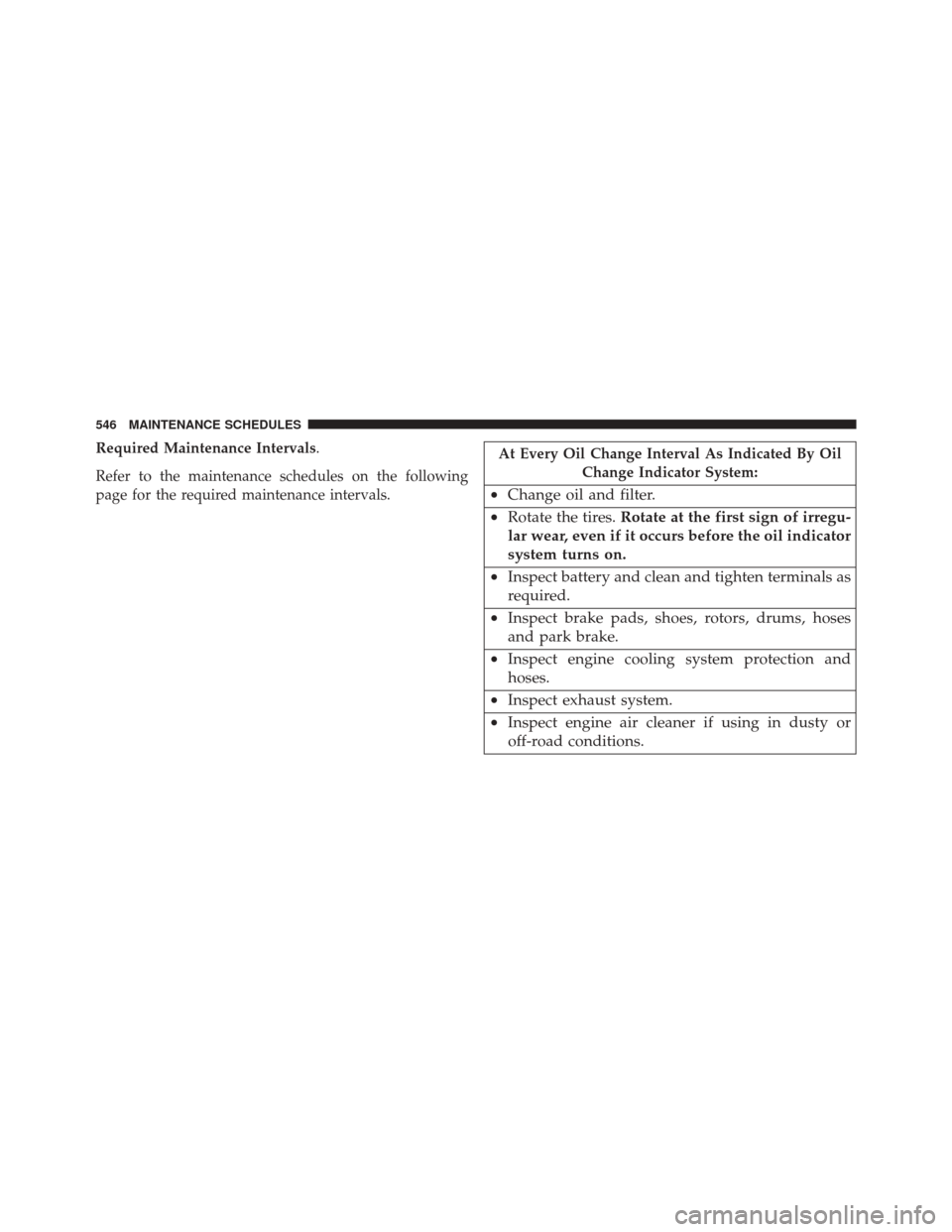
Required Maintenance Intervals.
Refer to the maintenance schedules on the following
page for the required maintenance intervals.At Every Oil Change Interval As Indicated By OilChange Indicator System:
•Change oil and filter.
• Rotate the tires. Rotate at the first sign of irregu-
lar wear, even if it occurs before the oil indicator
system turns on.
• Inspect battery and clean and tighten terminals as
required.
• Inspect brake pads, shoes, rotors, drums, hoses
and park brake.
• Inspect engine cooling system protection and
hoses.
• Inspect exhaust system.
• Inspect engine air cleaner if using in dusty or
off-road conditions.
546 MAINTENANCE SCHEDULES
Page 569 of 589
Capacities........................... .538
Disposal ............................. .513
Anti-Lock Brake System (ABS) ................377
Anti-Lock Warning Light ....................240
Appearance Care ........................ .522
Assistance Towing ........................ .126
Assist, Hill Start ......................... .380
Automatic Dimming Mirror ..................108
Automatic Door Locks ....................32, 33
Automatic Temperature Control (ATC) ..........323
Automatic Transaxle ........................12
Fluid Level Check ...................... .520
Automatic Transmission ...........343, 345, 517, 519
Autostick ............................ .357
Fluid And Filter Changes ..............518, 520
Fluid Level Check ...................... .518
Fluid Type .....................517, 519, 541
Gear Ranges ...................... .346, 353
Special Additives ....................517, 519 Autostick
........................... .357, 359
Axle Fluid ............................. .541
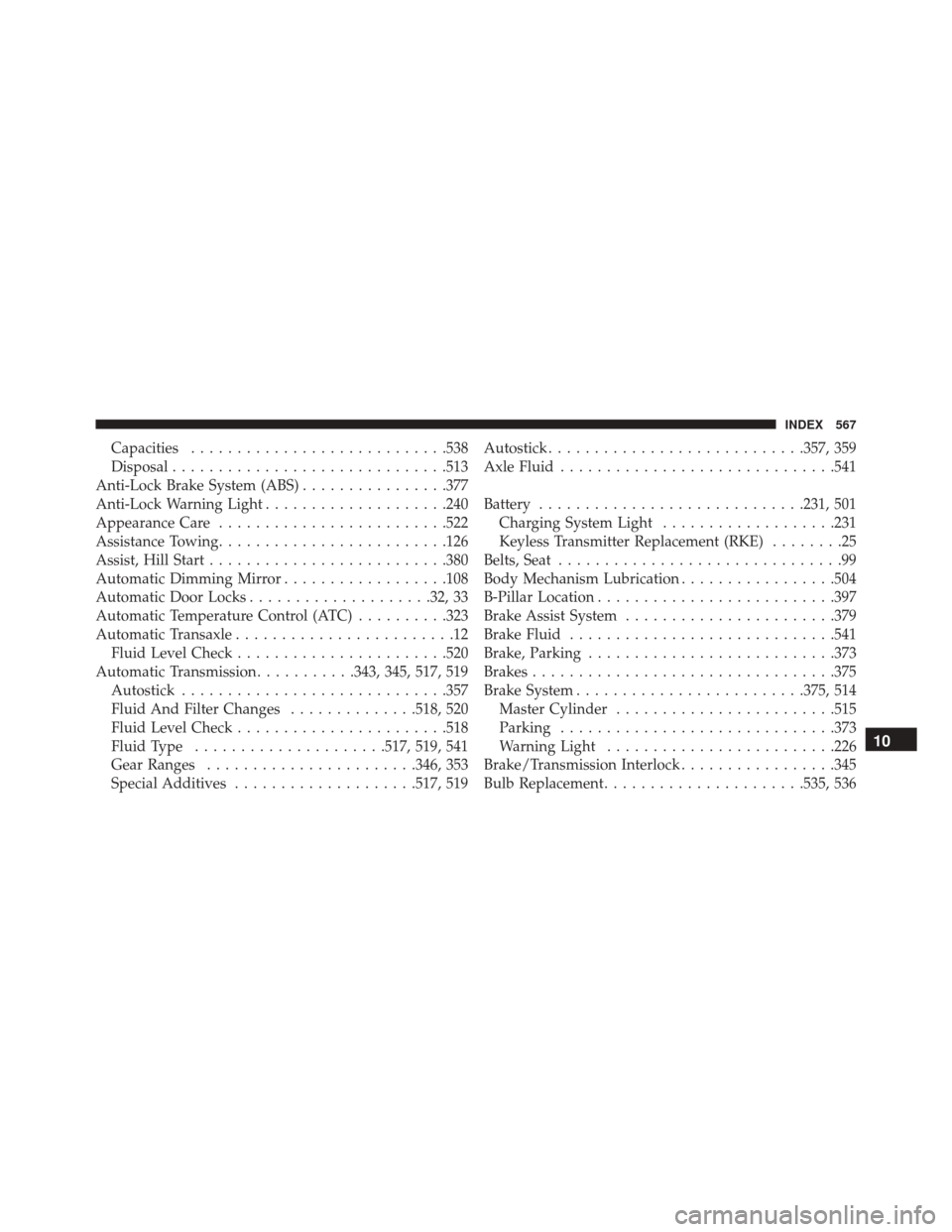
Battery ............................ .231, 501
Charging System Light ...................231
Keyless Transmitter Replacement (RKE) ........25
Belts, Seat ...............................99
Body Mechanism Lubrication .................504
B-Pillar Location ......................... .397
Brake Assist System ...................... .379
Brake Fluid ............................ .541
Brake, Parking .......................... .373
Brakes ................................ .375
Brake System ........................ .375, 514
Master Cylinder ....................... .515
Parking ............................. .373
Warning Light ........................ .226
Brake/T
ransmission Interlock .................345
Bulb Replacement ..................... .535, 53610
INDEX 567
Page 578 of 589
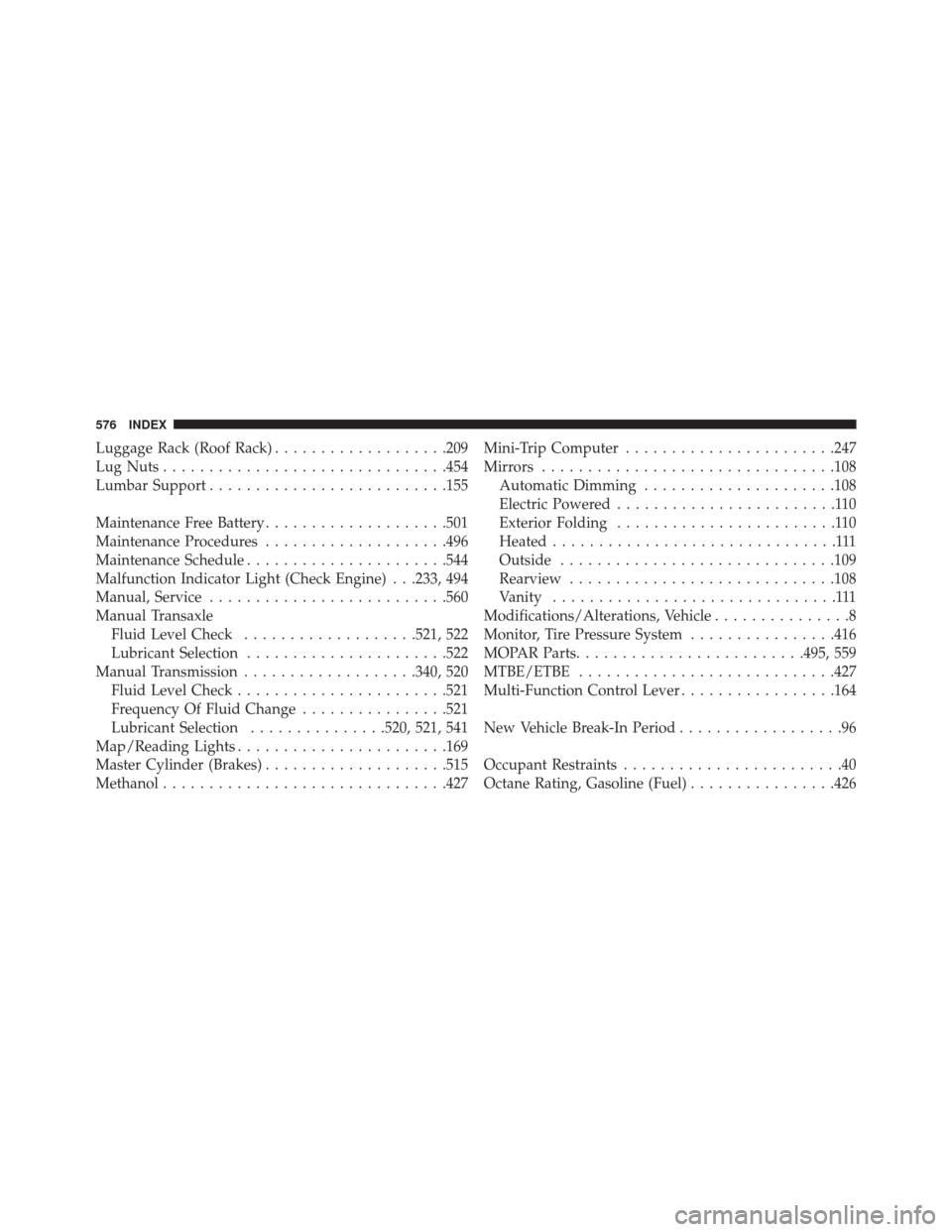
Luggage Rack (Roof Rack)...................209
Lug Nuts .............................. .454
Lumbar Support ......................... .155
Maintenance Free Battery ....................501
Maintenance Procedures ....................496
Maintenance Schedule ..................... .544
Malfunction Indicator Light (Check Engine) . . .233, 494
Manual, Service ......................... .560
Manual Transaxle Fluid Level Check ...................521, 522
Lubricant Selection ..................... .522
Manual Transmission ...................340, 520
Fluid Level Check ...................... .521
Frequency Of Fluid Change ................521
Lubricant Selection ...............520, 521, 541
Map/Reading Lights ...................... .169
Master Cylinder (Brakes) ....................515
Methanol .............................. .427Mini-Trip Computer
...................... .247
Mirrors ............................... .108
Automatic Dimming .....................108
Electric Powered ........................110
Exterior Folding ........................110
Heated ...............................111
Outside ............................. .109
Rearview ............................ .108
Vanity ...............................111
Modifications/Alterations, Vehicle ...............8
Monitor, Tire Pressure System ................416
MOPAR Parts ........................ .495, 559
MTBE/ETBE ........................... .427
Multi-Function Control Lever .................164
New Vehicle Break-In Period ..................96
Occupant Restraints ........................40
Octane Rating, Gasoline (Fuel) ................426
576 INDEX
Page 585 of 589
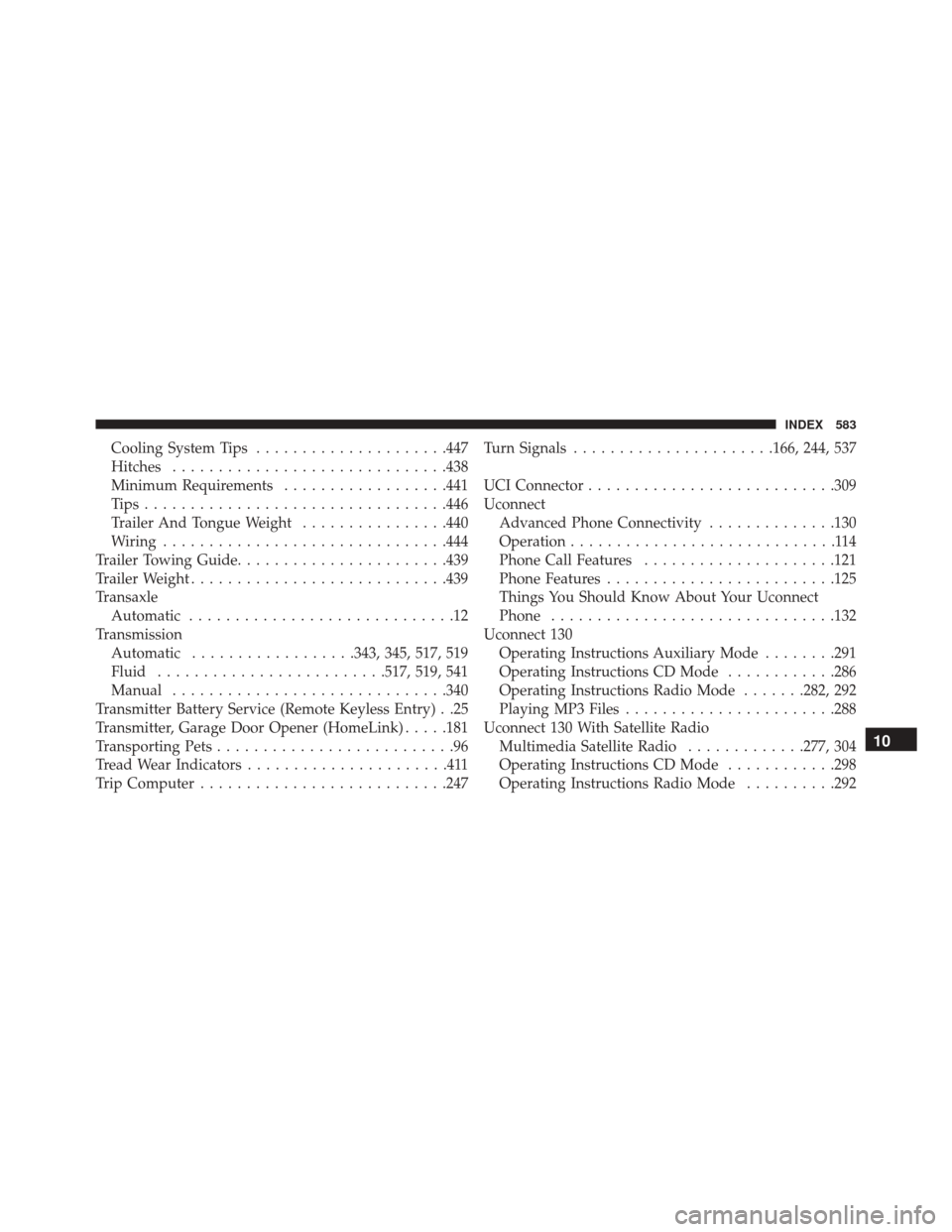
Cooling System Tips.....................447
Hitches ............................. .438
Minimum Requirements ..................441
Tips................................ .446
Trailer And Tongue Weight ................440
Wiring .............................. .444
Trailer Towing Guide ...................... .439
Trailer Weight ........................... .439
Transaxle Automatic .............................12
Transmission Automatic ..................343, 345, 517, 519
Fluid ........................ .517, 519, 541
Manual ............................. .340
Transmitter Battery Service (Remote Keyless Entry) . .25
Transmitter, Garage Door Opener (HomeLink) .....181
Transporting Pets ..........................96
Tread Wear Indicators ......................411
Trip Computer .......................... .247Turn Signals
..................... .166, 244, 537
UCI Connector .......................... .309
Uconnect Advanced Phone Connectivity ..............130
Operation .............................114
Phone Call Features .....................121
Phone Features ........................ .125
Things You Should Know About Your Uconnect
Phone .............................. .132
Uconnect 130 Operating Instructions Auxiliary Mode ........291
Operating Instructions CD Mode ............286
Operating Instructions Radio Mode .......282, 292
Playing MP3 Files ...................... .288
Uconnect 130 With Satellite Radio Multimedia Satellite Radio .............277, 304
Operating Instructions CD Mode ............298
Operating Instructions Radio Mode ..........292
10
INDEX 583
Page 588 of 589

INSTALLATION OF RADIO TRANSMITTING
EQUIPMENT
Special design considerations are incorporated into this
vehicle’s electronic system to provide immunity to radio
frequency signals. Mobile two-way radios and telephone
equipment must be installed properly by trained person-
nel. The following must be observed during installation.
The positive power connection should be made directly
to the battery and fused as close to the battery as possible.
The negative power connection should be made to body
sheet metal adjacent to the negative battery connection.
This connection should not be fused.
Antennas for two-way radios should be mounted on the
roof or the rear area of the vehicle. Care should be used
in mounting antennas with magnet bases. Magnets may
affect the accuracy or operation of the compass on
vehicles so equipped.The antenna cable should be as short as practical and
routed away from the vehicle wiring when possible. Use
only fully shielded coaxial cable.
Carefully match the antenna and cable to the radio to
ensure a low Standing Wave Ratio (SWR).
Mobile radio equipment with output power greater than
normal may require special precautions.
All installations should be checked for possible interfer-
ence between the communications equipment and the
vehicle’s electronic systems.