warning light JEEP COMPASS 2016 1.G Repair Manual
[x] Cancel search | Manufacturer: JEEP, Model Year: 2016, Model line: COMPASS, Model: JEEP COMPASS 2016 1.GPages: 589, PDF Size: 3.63 MB
Page 440 of 589
WARNING!(Continued)
•Weight Distributing Systems may not be compat-
ible with Surge Brake Couplers. Consult with your
hitch and trailer manufacturer or a reputable Rec-
reational Vehicle dealer for additional information.
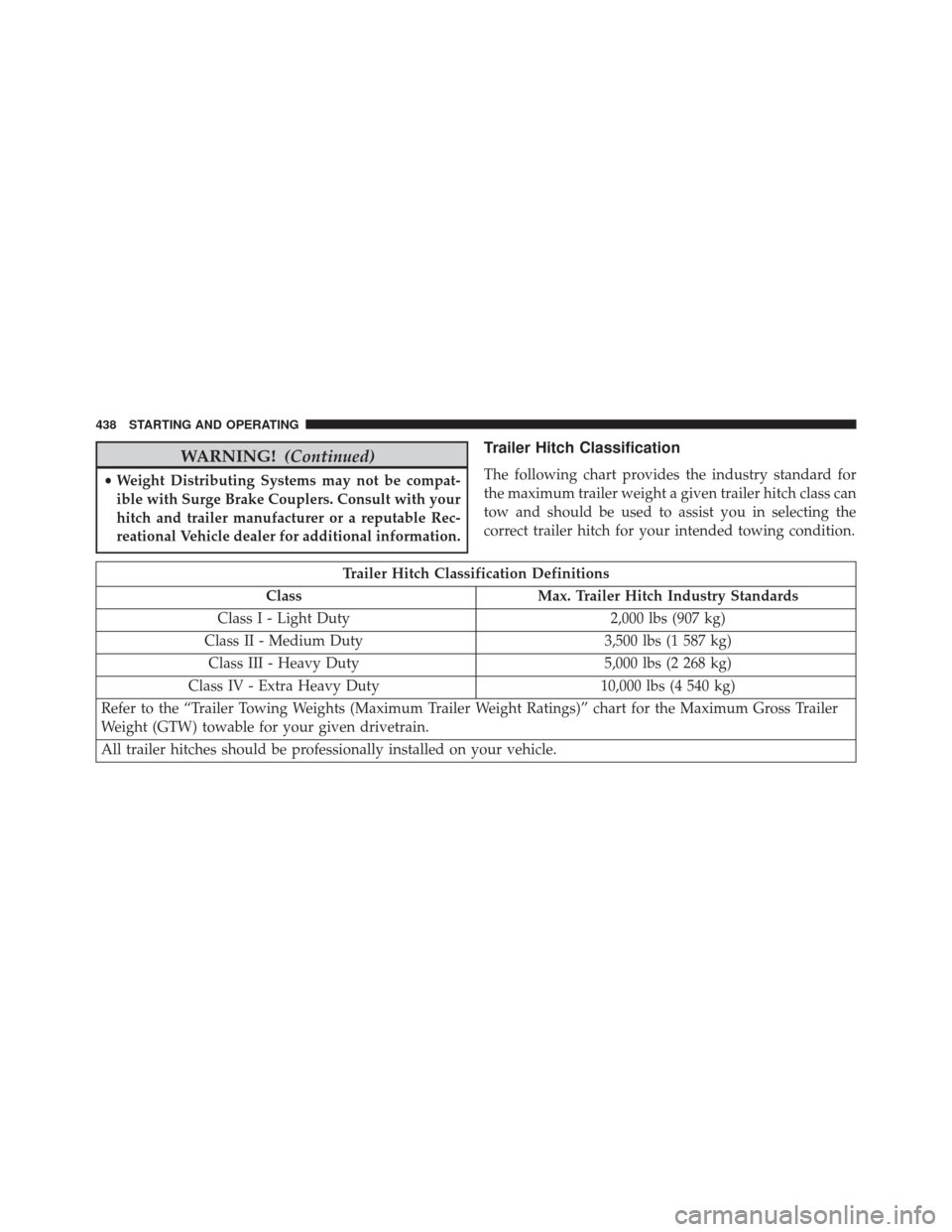
Trailer Hitch Classification
The following chart provides the industry standard for
the maximum trailer weight a given trailer hitch class can
tow and should be used to assist you in selecting the
correct trailer hitch for your intended towing condition.
Trailer Hitch Classification Definitions
Class Max. Trailer Hitch Industry Standards
Class I - Light Duty 2,000 lbs (907 kg)
Class II - Medium Duty 3,500 lbs (1 587 kg)
Class III - Heavy Duty 5,000 lbs (2 268 kg)
Class IV - Extra Heavy Duty 10,000 lbs (4 540 kg)
Refer to the “Trailer Towing Weights (Maximum Trailer Weight Ratings)” chart for the Maximum Gross Trailer
Weight (GTW) towable for your given drivetrain.
All trailer hitches should be professionally installed on your vehicle.
438 STARTING AND OPERATING
Page 446 of 589
WARNING!
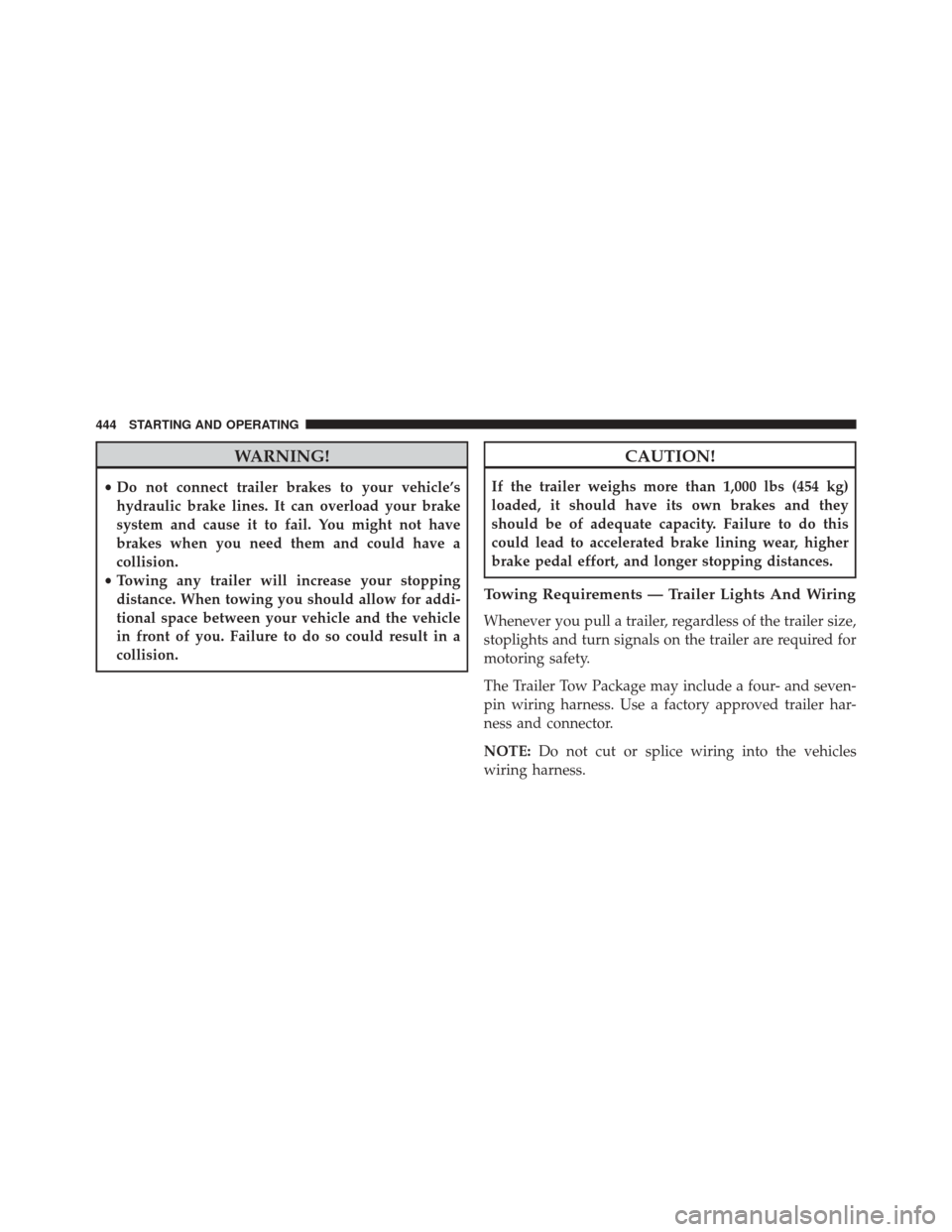
•Do not connect trailer brakes to your vehicle’s
hydraulic brake lines. It can overload your brake
system and cause it to fail. You might not have
brakes when you need them and could have a
collision.
• Towing any trailer will increase your stopping
distance. When towing you should allow for addi-
tional space between your vehicle and the vehicle
in front of you. Failure to do so could result in a
collision.
CAUTION!
If the trailer weighs more than 1,000 lbs (454 kg)
loaded, it should have its own brakes and they
should be of adequate capacity. Failure to do this
could lead to accelerated brake lining wear, higher
brake pedal effort, and longer stopping distances.
Towing Requirements — Trailer Lights And Wiring
Whenever you pull a trailer, regardless of the trailer size,
stoplights and turn signals on the trailer are required for
motoring safety.
The Trailer Tow Package may include a four- and seven-
pin wiring harness. Use a factory approved trailer har-
ness and connector.
NOTE: Do not cut or splice wiring into the vehicles
wiring harness.
444 STARTING AND OPERATING
Page 465 of 589
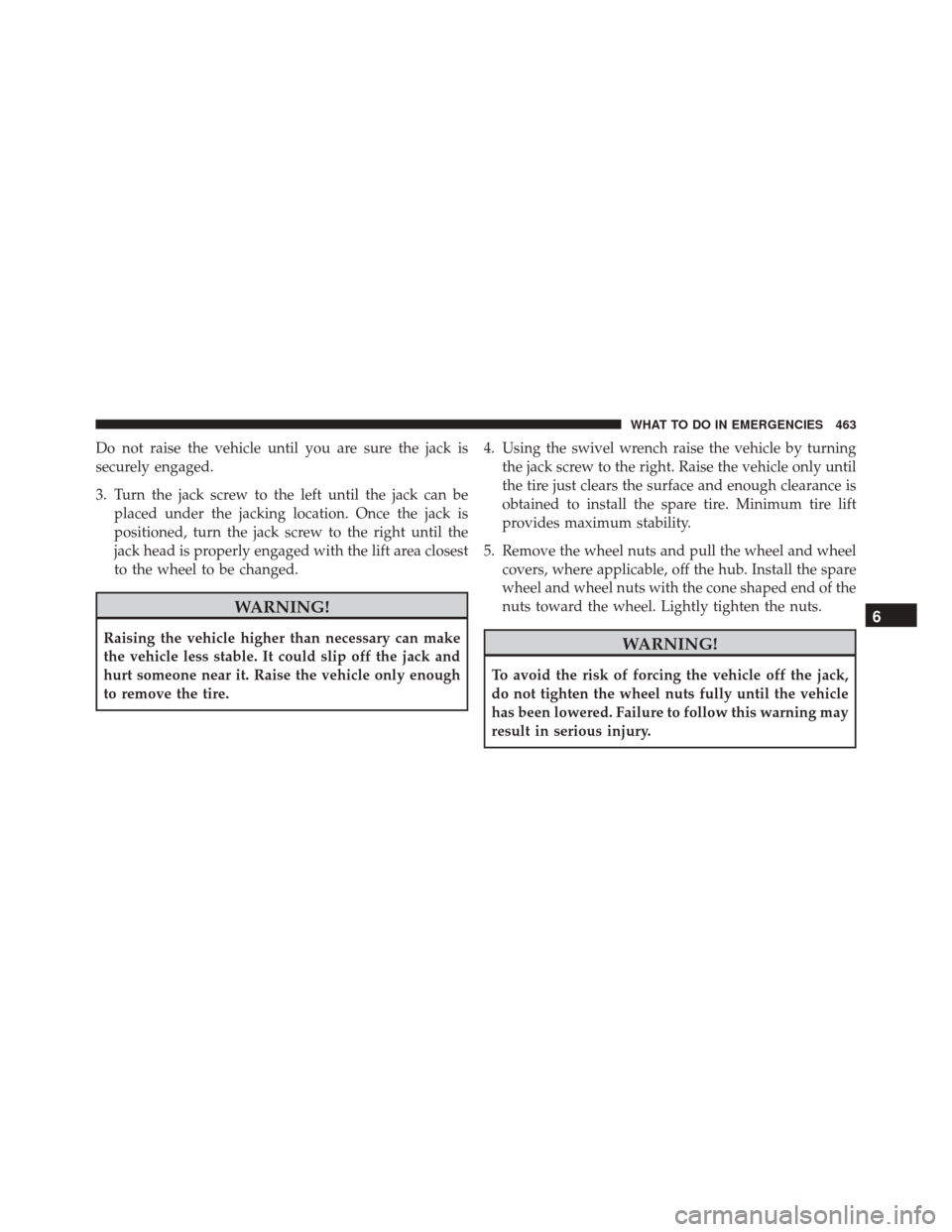
Do not raise the vehicle until you are sure the jack is
securely engaged.
3. Turn the jack screw to the left until the jack can beplaced under the jacking location. Once the jack is
positioned, turn the jack screw to the right until the
jack head is properly engaged with the lift area closest
to the wheel to be changed.
WARNING!
Raising the vehicle higher than necessary can make
the vehicle less stable. It could slip off the jack and
hurt someone near it. Raise the vehicle only enough
to remove the tire. 4. Using the swivel wrench raise the vehicle by turning
the jack screw to the right. Raise the vehicle only until
the tire just clears the surface and enough clearance is
obtained to install the spare tire. Minimum tire lift
provides maximum stability.
5. Remove the wheel nuts and pull the wheel and wheel covers, where applicable, off the hub. Install the spare
wheel and wheel nuts with the cone shaped end of the
nuts toward the wheel. Lightly tighten the nuts.WARNING!
To avoid the risk of forcing the vehicle off the jack,
do not tighten the wheel nuts fully until the vehicle
has been lowered. Failure to follow this warning may
result in serious injury.
6
WHAT TO DO IN EMERGENCIES 463
Page 468 of 589
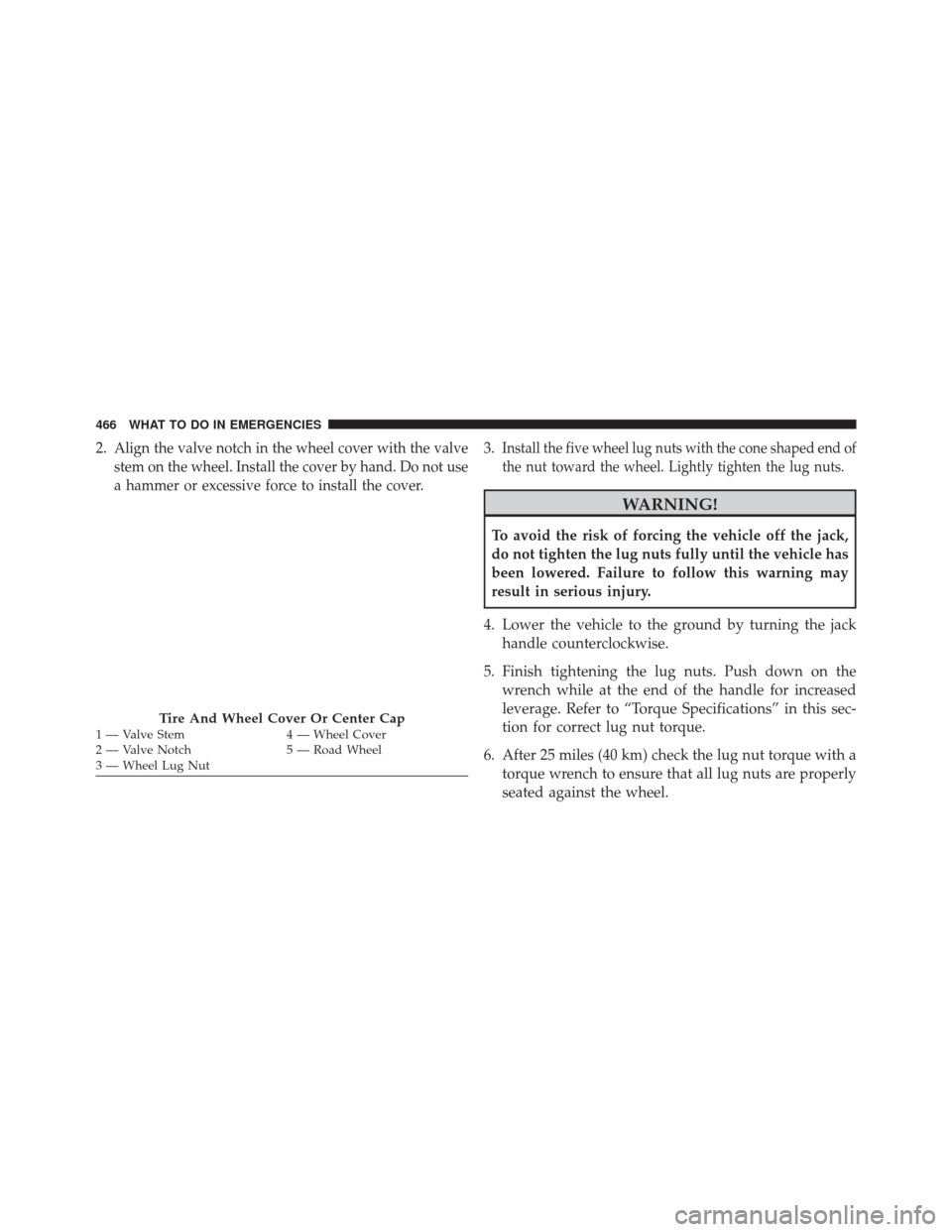
2.Align the valve notch in the wheel cover with the valve
stem on the wheel. Install the cover by hand. Do not use
a hammer or excessive force to install the cover.3.Install the five wheel lug nuts with the cone shaped end of
the nut toward the wheel. Lightly tighten the lug nuts.
WARNING!
To avoid the risk of forcing the vehicle off the jack,
do not tighten the lug nuts fully until the vehicle has
been lowered. Failure to follow this warning may
result in serious injury.
4. Lower the vehicle to the ground by turning the jack handle counterclockwise.
5. Finish tightening the lug nuts. Push down on the wrench while at the end of the handle for increased
leverage. Refer to “Torque Specifications” in this sec-
tion for correct lug nut torque.
6. After 25 miles (40 km) check the lug nut torque with a torque wrench to ensure that all lug nuts are properly
seated against the wheel.
Tire And Wheel Cover Or Center Cap1 — Valve Stem 4 — Wheel Cover
2 — Valve Notch 5 — Road Wheel
3 — Wheel Lug Nut 466 WHAT TO DO IN EMERGENCIES
Page 469 of 589
Vehicles Without Wheel Covers
1. Mount the road tire on the axle.
2.
Install the remaining lug nuts with the cone shaped end
of the nut toward the wheel. Lightly tighten the lug nuts.
WARNING!
To avoid the risk of forcing the vehicle off the jack,
do not fully tighten the lug nuts until the vehicle has
been lowered. Failure to follow this warning may
result in serious injury.
3. Lower the vehicle to the ground by turning the jack handle counterclockwise.
4. Finish tightening the lug nuts. Push down on the wrench while at the end of the handle for increased
leverage. Refer to “Torque Specifications” in this sec-
tion for correct lug nut torque. 5. After 25 miles (40 km) check the lug nut torque with a
torque wrench to ensure that all lug nuts are properly
seated against the wheel.
TIRE SERVICE KIT — IF EQUIPPED
Small punctures up to 1/4 inch (6 mm) in the tire tread
can be sealed with Tire Service Kit. Foreign objects (e.g.,
screws or nails) should not be removed from the tire. Tire
Service Kit can be used in outside temperatures down to
approximately -4°F (-20°C).
This kit will provide a temporary tire seal, allowing you
to drive your vehicle up to 100 miles (160 km) with a
maximum speed of 55 mph (90 km/h).
Tire Service Kit Storage
The Tire Service Kit is located under the load floor in the
cargo area.
6
WHAT TO DO IN EMERGENCIES 467
Page 517 of 589
WARNING!
Riding the brakes can lead to brake failure and
possibly a collision. Driving with your foot resting or
riding on the brake pedal can result in abnormally
high brake temperatures, excessive lining wear, and
possible brake damage. You would not have your full
braking capacity in an emergency.
Brake Master Cylinder
The fluid level in the master cylinder should be checked
when performing under hood services, or immediately if
the brake system warning light is on.
Be sure to clean the top of the master cylinder area before
removing the cap. If necessary, add fluid to bring the
fluid level up to the requirements described on the brake
fluid reservoir. Fluid level can be expected to fall as the
brake pads wear. The brake fluid level should be checkedwhen the pads are replaced. However, low fluid level
may be caused by a leak and a checkup may be needed.
NOTE:
If your vehicle is equipped with a manual
transmission, the brake fluid reservoir supplies fluid to
both the brake system and the clutch release system. The
two systems are separated in the reservoir, and a leak in
one system will not affect the other system. The manual
transmission clutch release system should not require
fluid replacement during the life of the vehicle. If the
brake fluid reservoir is low and the brake system does
not indicate any leaks or other problems, it may be a
result of a leak in the hydraulic clutch release system. See
your local authorized dealer for service.
Use only manufacturer’s recommended brake fluid. Re-
fer to “Fluids, Lubricants, And Genuine Parts” in “Main-
taining Your Vehicle” for further information.7
MAINTAINING YOUR VEHICLE 515
Page 560 of 589
Warranty expires. The manufacturer stands behind only
the manufacturer’s service contracts. If you purchased a
manufacturer’s service contract, you will receive Plan
Provisions and an Owner Identification Card in the mail
within three weeks of the vehicle delivery date. If you
have any questions about the service contract, call the
manufacturer’s Service Contract National Customer
Hotline at 1-800-521-9922 (Canadian residents, call (800)
465-2001 English / (800) 387-9983 French).
The manufacturer will not stand behind any service
contract that is not the manufacturer’s service contract. It
is not responsible for any service contract other than the
manufacturer’s service contract. If you purchased a ser-
vice contract that is not a manufacturer’s service contract,
and you require service after the manufacturer’s New
Vehicle Limited Warranty expires, please refer to the
contract documents, and contact the person listed in
those documents.We appreciate that you have made a major investment
when you purchased the vehicle. An authorized dealer
has also made a major investment in facilities, tools, and
training to assure that you are absolutely delighted with
the ownership experience. You will be pleased with their
sincere efforts to resolve any warranty issues or related
concerns.
WARNING!
Engine exhaust (internal combustion engines only),
some of its constituents, and certain vehicle compo-
nents contain, or emit, chemicals known to the State
of California to cause cancer and birth defects, or
other reproductive harm. In addition, certain fluids
contained in vehicles and certain products of compo-
nent wear contain, or emit, chemicals known to the
State of California to cause cancer and birth defects,
or other reproductive harm.
558 IF YOU NEED CONSUMER ASSISTANCE
Page 568 of 589
Adding Engine Coolant (Antifreeze)............511
Adding Fuel ............................ .430
Adding Washer Fluid ..................... .505
Additives, Fuel .......................... .428
Adjust Down .............................. .151
Forward ............................. .151
Rearward ............................ .151
Up ................................ .151
AirBag.................................61 Advance Front Air Bag ....................63
Air Bag Operation .......................64
Air Bag Warning Light ....................72
Enhanced Accident Response ................71
Event Data Recorder (EDR) .................74
FrontAirBag...........................61
If A Deployment Occurs ...................70
Knee Impact Bolsters .....................65
Maintaining Your Air Bag System ............73Side Air Bags
...........................65
Transporting Pets ........................96
Air Bag Deployment ........................61
Air Bag Light ...................... .72, 99, 225
Air Bag Maintenance .......................73
Air Cleaner, Engine (Engine Air Cleaner Filter) . . . .500
Air Conditioner Maintenance .................502
Air Conditioning ......................... .318
Air Conditioning Controls ...................318
Air Conditioning Filter ..................330, 503
Air Conditioning, Operating Tips ...........329, 331
Air Conditioning Refrigerant ..............502, 503
Air Conditioning System .............318, 323, 502
Air Pressure, Tires ........................ .403
Alarm (Security Alarm) .....................228
Alarm System (Security Alarm) ................18
Alterations/Modifications, Vehicle ...............8
Antenna, Satellite Radio .................278, 305
Antifreeze (Engine Coolant) ...............510, 538
566 INDEX
Page 569 of 589
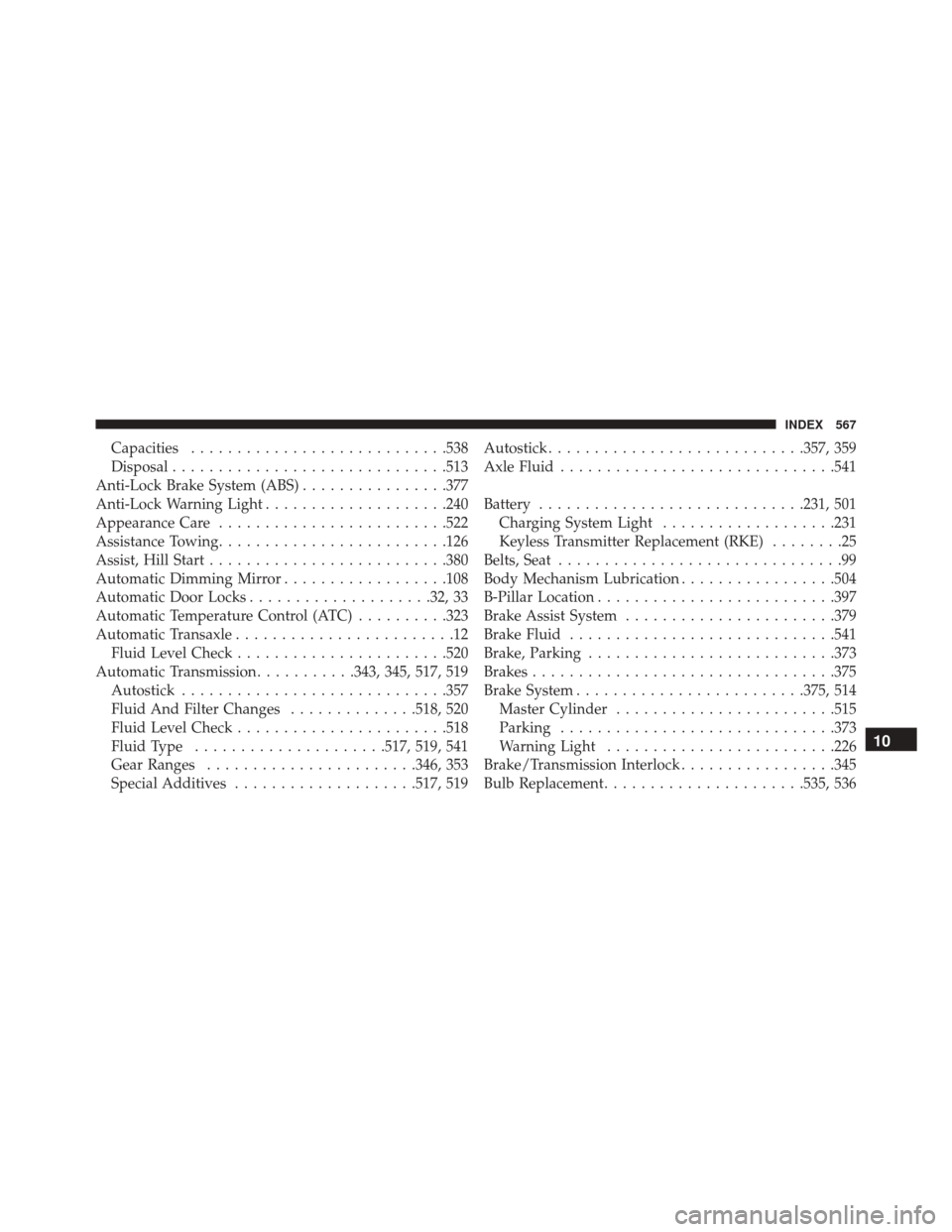
Capacities........................... .538
Disposal ............................. .513
Anti-Lock Brake System (ABS) ................377
Anti-Lock Warning Light ....................240
Appearance Care ........................ .522
Assistance Towing ........................ .126
Assist, Hill Start ......................... .380
Automatic Dimming Mirror ..................108
Automatic Door Locks ....................32, 33
Automatic Temperature Control (ATC) ..........323
Automatic Transaxle ........................12
Fluid Level Check ...................... .520
Automatic Transmission ...........343, 345, 517, 519
Autostick ............................ .357
Fluid And Filter Changes ..............518, 520
Fluid Level Check ...................... .518
Fluid Type .....................517, 519, 541
Gear Ranges ...................... .346, 353
Special Additives ....................517, 519 Autostick
........................... .357, 359
Axle Fluid ............................. .541
Battery ............................ .231, 501
Charging System Light ...................231
Keyless Transmitter Replacement (RKE) ........25
Belts, Seat ...............................99
Body Mechanism Lubrication .................504
B-Pillar Location ......................... .397
Brake Assist System ...................... .379
Brake Fluid ............................ .541
Brake, Parking .......................... .373
Brakes ................................ .375
Brake System ........................ .375, 514
Master Cylinder ....................... .515
Parking ............................. .373
Warning Light ........................ .226
Brake/T
ransmission Interlock .................345
Bulb Replacement ..................... .535, 53610
INDEX 567
Page 570 of 589
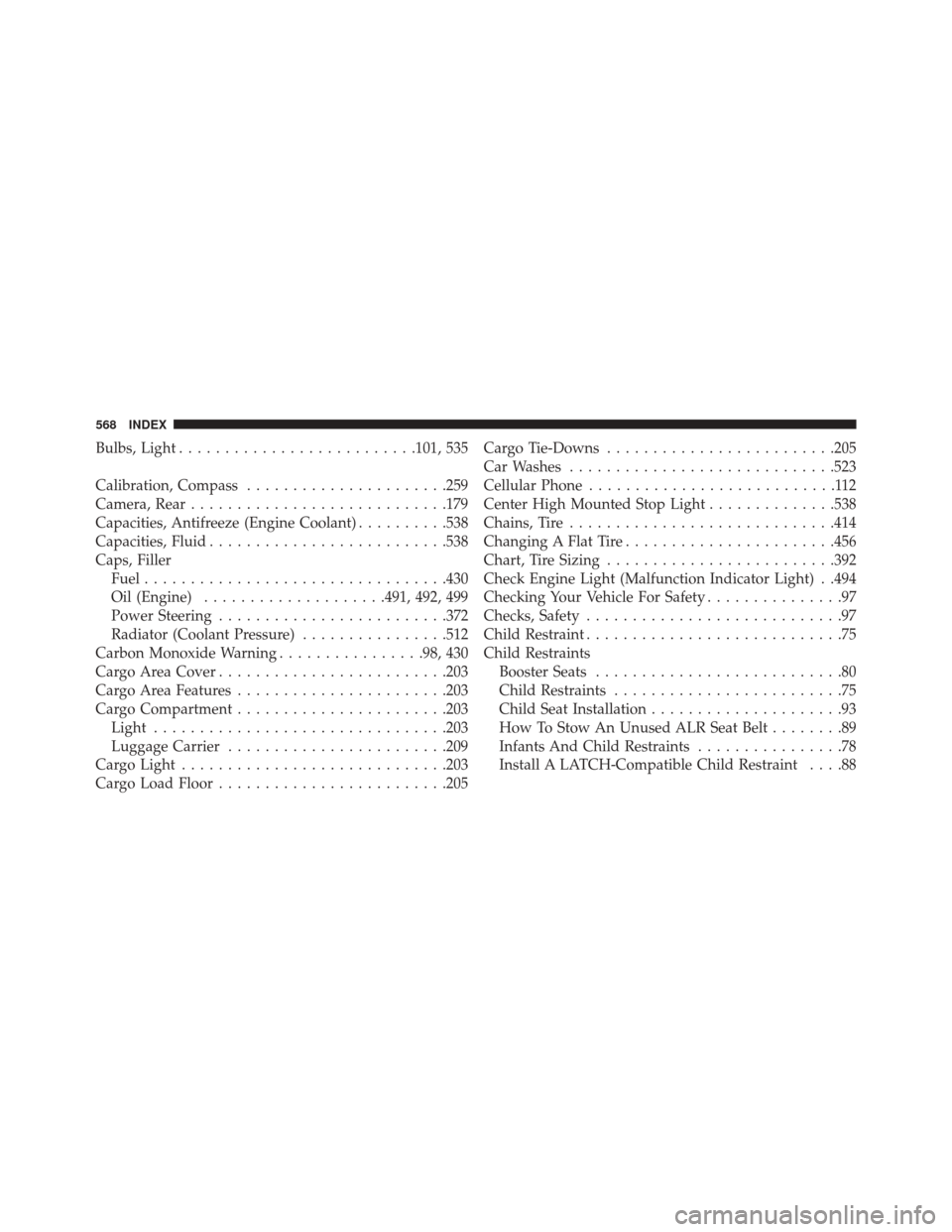
Bulbs, Light......................... .101, 535
Calibration, Compass ..................... .259
Camera, Rear ........................... .179
Capacities, Antifreeze (Engine Coolant) ..........538
Capacities, Fluid ......................... .538
Caps, Filler Fuel ................................ .430
Oil (Engine) ....................491, 492, 499
Power Steering ........................ .372
Radiator (Coolant Pressure) ................512
Carbon Monoxide Warning ................98, 430
Cargo Area Cover ........................ .203
Cargo Area Features ...................... .203
Cargo Compartment ...................... .203
Light ............................... .203
Luggage Carrier ....................... .209
Cargo Light ............................ .203
Cargo Load Floor ........................ .205Cargo Tie-Downs
........................ .205
Car Washes ............................ .523
Cellular Phone ...........................112
Center High Mounted Stop Light ..............538
Chains, Tire ............................ .414
Changing A Flat Tire ...................... .456
Chart, Tire Sizing ........................ .392
Check Engine Light (Malfunction Indicator Light) . .494
Checking Your Vehicle For Safety ...............97
Checks, Safety ............................97
Child Restraint ............................75
Child Restraints Booster Seats ...........................80
Child Restraints .........................75
Child Seat Installation .....................93
How To Stow An Unused ALR Seat Belt ........89
Infants And Child Restraints ................78
Install A LATCH-Compatible Child Restraint ....88
568 INDEX