warning light JEEP COMPASS 2017 2.G Repair Manual
[x] Cancel search | Manufacturer: JEEP, Model Year: 2017, Model line: COMPASS, Model: JEEP COMPASS 2017 2.GPages: 429, PDF Size: 3.46 MB
Page 261 of 429
WARNING!
To avoid the risk of forcing the vehicle off the jack, do
not tighten the lug nuts fully until the vehicle has been
lowered. Failure to follow this warning may result in
serious injury.
4. Lower the vehicle to the ground by turning the jack handle counterclockwise.
5. Finish tightening the lug nuts. Push down on the wrench while at the end of the handle for increased
leverage. Refer to “Torque Specifications” in “Technical
Specifications” for correct lug nut torque.
6. After 25 miles (40 km) check the lug nut torque with a torque wrench to ensure that all lug nuts are properly
seated against the wheel.
Vehicles Without Wheel Covers
1. Mount the road tire on the axle.
2. Install the remaining lug nuts with the cone shaped endof the nut toward the wheel. Lightly tighten the lug
nuts.
WARNING!
To avoid the risk of forcing the vehicle off the jack, do
not fully tighten the lug nuts until the vehicle has been
lowered. Failure to follow this warning may result in
serious injury.
3. Lower the vehicle to the ground by turning the jack handle counterclockwise.
4. Finish tightening the lug nuts. Push down on the wrench while at the end of the handle for increased
leverage. Refer to “Torque Specifications” in “Technical
Specifications” for correct lug nut torque.
5. After 25 miles (40 km) check the lug nut torque with a torque wrench to ensure that all lug nuts are properly
seated against the wheel.
7
IN CASE OF EMERGENCY 259
Page 281 of 429
SCHEDULED SERVICING
Your vehicle is equipped with an automatic oil change
indicator system. The oil change indicator system will
remind you that it is time to take your vehicle in for
scheduled maintenance.
Based on engine operation conditions, the oil change
indicator message will illuminate. This means that service
is required for your vehicle. Operating conditions such as
frequent short-trips, trailer tow, extremely hot or cold
ambient temperatures will influence when the “Change
Oil” or “Oil Change Required” message is displayed.
Severe Operating Conditions can cause the change oil
message to illuminate as early as 3,500 miles (5,600 km)
since last reset. Have your vehicle serviced as soon as
possible, within the next 500 miles (805 km).
On instrument cluster display equipped vehicles, “Oil
Change Required” will be displayed in the cluster and a
single chime will sound, indicating that an oil change is
necessary.
On non-instrument cluster display equipped vehicles,
“Change Oil” will flash in the odometer and a single chime
will sound, indicating that an oil change is necessary.Your authorized dealer will reset the oil change indicator
message after completing the scheduled oil change. If a
scheduled oil change is performed by someone other than
your authorized dealer, the message can be reset by
referring to the steps described under “Warning And
Indicator Lights” or “Instrument Cluster Display” in “Get-
ting To Know Your Instrument Panel” for further informa-
tion.
NOTE:
Under no circumstances should oil change inter-
vals exceed 10,000 miles (16,000 km), twelve months or 350
hours of engine run time, whichever comes first. The 350
hours of engine run or idle time is generally only a concern
for fleet customers.
Severe Duty All Models
Change Engine Oil at 4,000 miles (6,500 km) if the vehicle
is operated in a dusty and off road environment or is
operated predominately at idle or only very low engine
RPM’s. This type of vehicle use is considered Severe Duty.
8
SERVICING AND MAINTENANCE 279
Page 301 of 429
MS.90032) and distilled water for proper corrosion pro-
tection of your engine which contains aluminum com-
ponents.
• Keep the front of the radiator clean. If your vehicle is
equipped with air conditioning, keep the front of the
condenser clean.
• Do not change the thermostat for Summer or Winter
operation. If replacement is ever necessary, install ONLY
the correct type thermostat. Other designs may result in
unsatisfactory engine coolant (antifreeze) performance,
poor gas mileage, and increased emissions.
Brake System
In order to assure brake system performance, all brake
system components should be inspected periodically. Refer
to the “Maintenance Plan” for the proper maintenance
intervals.
WARNING!
Riding the brakes can lead to brake failure and possi-
bly a collision. Driving with your foot resting or riding
on the brake pedal can result in abnormally high brake
(Continued)
WARNING! (Continued)
temperatures, excessive lining wear, and possible
brake damage. You would not have your full braking
capacity in an emergency.
Brake Master Cylinder
The fluid level in the master cylinder should be checked
when performing under hood services, or immediately if
the brake system warning light is on.
Be sure to clean the top of the master cylinder area before
removing the cap. If necessary, add fluid to bring the fluid
level up to the requirements described on the brake fluid
reservoir. Fluid level can be expected to fall as the brake
pads wear. The brake fluid level should be checked when
the pads are replaced. However, low fluid level may be
caused by a leak and a checkup may be needed.
NOTE:If your vehicle is equipped with a manual trans-
mission, the brake fluid reservoir supplies fluid to both the
brake system and the clutch release system. The two
systems are separated in the reservoir, and a leak in one
system will not affect the other system. The manual
transmission clutch release system should not require fluid
replacement during the life of the vehicle. If the brake fluid
8
SERVICING AND MAINTENANCE 299
Page 320 of 429
Keep dismounted tires in a cool, dry place with as little
exposure to light as possible. Protect tires from contact with
oil, grease, and gasoline.
Replacement Tires
The tires on your new vehicle provide a balance of many
characteristics. They should be inspected regularly for
wear and correct cold tire inflation pressures. The manu-
facturer strongly recommends that you use tires equivalent
to the originals in size, quality and performance when
replacement is needed. Refer to the paragraph on “Tread
Wear Indicator”. Refer to the Tire and Loading Information
placard or the Vehicle Certification Label for the size
designation of your tire. The Load Index and Speed
Symbol for your tire will be found on the original equip-
ment tire sidewall. See the Tire Sizing Chart example found
in the “Tire Safety Information” section of this manual for
more information relating to the Load Index and Speed
Symbol of a tire.
It is recommended to replace the two front tires or two rear
tires as a pair. Replacing just one tire can seriously affect
your vehicle’s handling. If you ever replace a wheel, make
sure that the wheel’s specifications match those of the
original wheels.It is recommended you contact your authorized tire dealer
or original equipment dealer with any questions you may
have on tire specifications or capability. Failure to use
equivalent replacement tires may adversely affect the
safety, handling, and ride of your vehicle.
WARNING!
•
Do not use a tire, wheel size, load rating, or speed
rating other than that specified for your vehicle.
Some combinations of unapproved tires and wheels
may change suspension dimensions and perfor-
mance characteristics, resulting in changes to steer-
ing, handling, and braking of your vehicle. This can
cause unpredictable handling and stress to steering
and suspension components. You could lose control
and have a collision resulting in serious injury or
death. Use only the tire and wheel sizes with load
ratings approved for your vehicle.
• Never use a tire with a smaller load index or capacity,
other than what was originally equipped on your
vehicle. Using a tire with a smaller load index could
result in tire overloading and failure. You could lose
control and have a collision.
(Continued)
318 SERVICING AND MAINTENANCE
Page 335 of 429
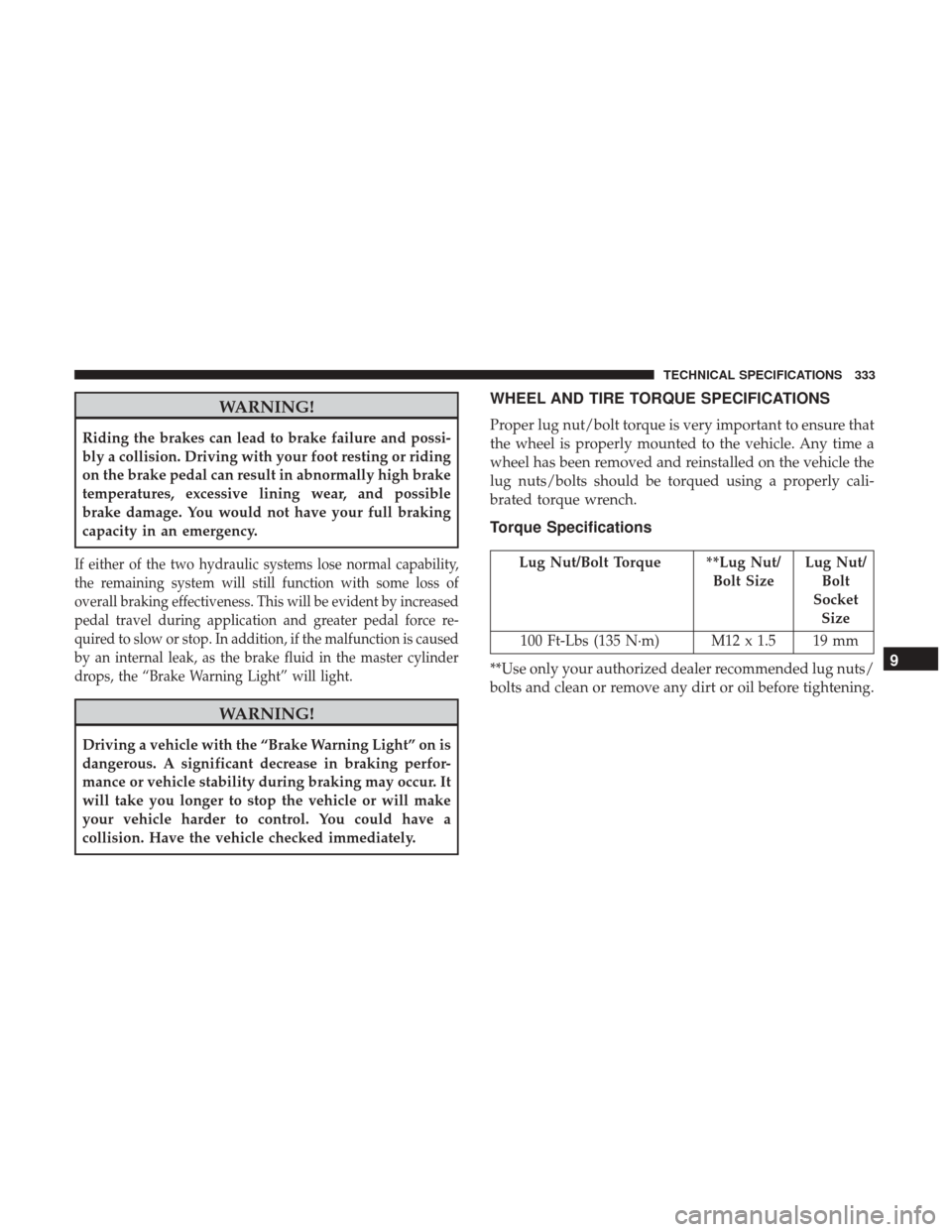
WARNING!
Riding the brakes can lead to brake failure and possi-
bly a collision. Driving with your foot resting or riding
on the brake pedal can result in abnormally high brake
temperatures, excessive lining wear, and possible
brake damage. You would not have your full braking
capacity in an emergency.
If either of the two hydraulic systems lose normal capability,
the remaining system will still function with some loss of
overall braking effectiveness. This will be evident by increased
pedal travel during application and greater pedal force re-
quired to slow or stop. In addition, if the malfunction is caused
by an internal leak, as the brake fluid in the master cylinder
drops, the “Brake Warning Light” will light.
WARNING!
Driving a vehicle with the “Brake Warning Light” on is
dangerous. A significant decrease in braking perfor-
mance or vehicle stability during braking may occur. It
will take you longer to stop the vehicle or will make
your vehicle harder to control. You could have a
collision. Have the vehicle checked immediately.
WHEEL AND TIRE TORQUE SPECIFICATIONS
Proper lug nut/bolt torque is very important to ensure that
the wheel is properly mounted to the vehicle. Any time a
wheel has been removed and reinstalled on the vehicle the
lug nuts/bolts should be torqued using a properly cali-
brated torque wrench.
Torque Specifications
Lug Nut/Bolt Torque **Lug Nut/Bolt SizeLug Nut/
Bolt
Socket Size
100 Ft-Lbs (135 N·m) M12 x 1.5 19 mm
**Use only your authorized dealer recommended lug nuts/
bolts and clean or remove any dirt or oil before tightening.
9
TECHNICAL SPECIFICATIONS 333
Page 384 of 429
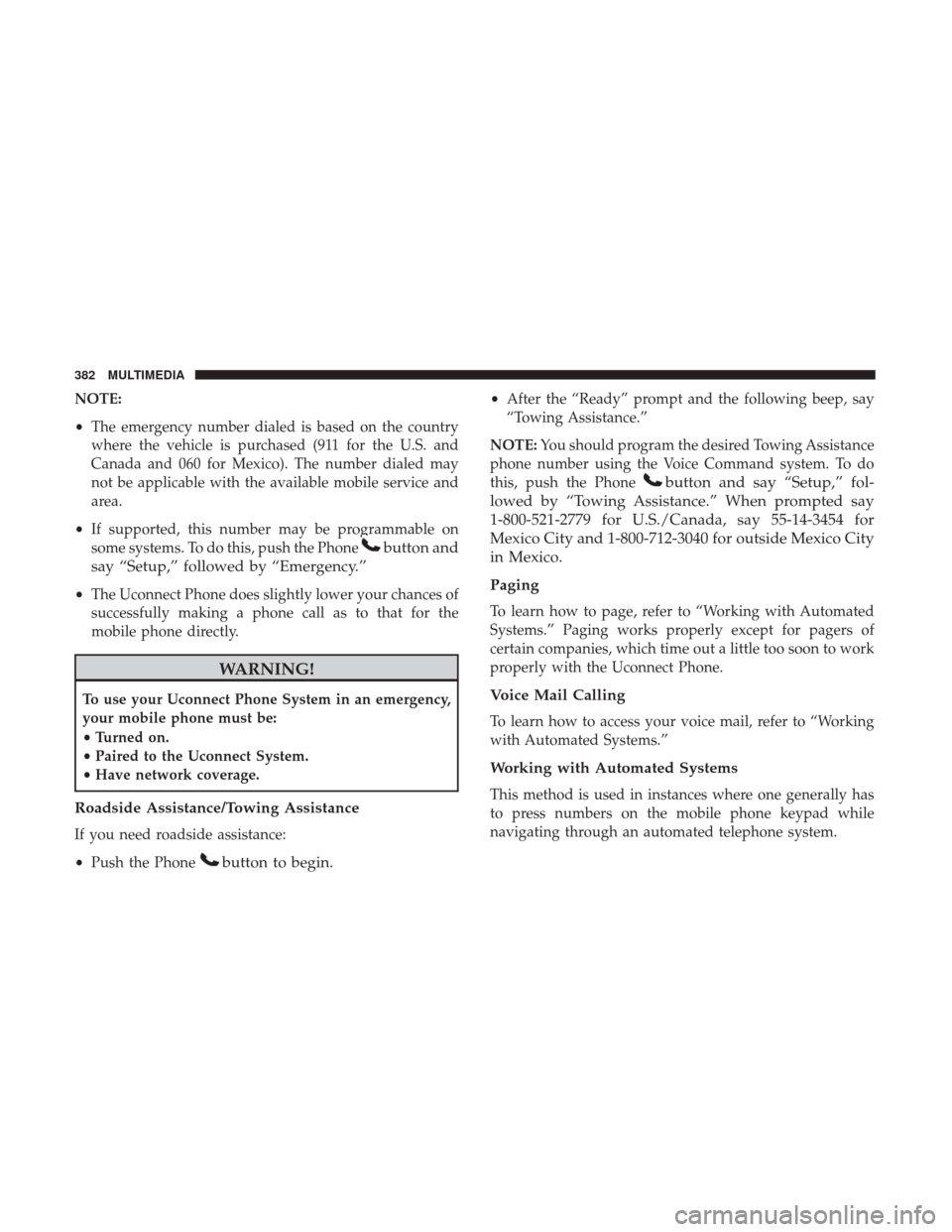
NOTE:
•The emergency number dialed is based on the country
where the vehicle is purchased (911 for the U.S. and
Canada and 060 for Mexico). The number dialed may
not be applicable with the available mobile service and
area.
• If supported, this number may be programmable on
some systems. To do this, push the Phone
button and
say “Setup,” followed by “Emergency.”
• The Uconnect Phone does slightly lower your chances of
successfully making a phone call as to that for the
mobile phone directly.
WARNING!
To use your Uconnect Phone System in an emergency,
your mobile phone must be:
•Turned on.
• Paired to the Uconnect System.
• Have network coverage.
Roadside Assistance/Towing Assistance
If you need roadside assistance:
• Push the Phone
button to begin.
•After the “Ready” prompt and the following beep, say
“Towing Assistance.”
NOTE: You should program the desired Towing Assistance
phone number using the Voice Command system. To do
this, push the Phone
button and say “Setup,” fol-
lowed by “Towing Assistance.” When prompted say
1-800-521-2779 for U.S./Canada, say 55-14-3454 for
Mexico City and 1-800-712-3040 for outside Mexico City
in Mexico.
Paging
To learn how to page, refer to “Working with Automated
Systems.” Paging works properly except for pagers of
certain companies, which time out a little too soon to work
properly with the Uconnect Phone.
Voice Mail Calling
To learn how to access your voice mail, refer to “Working
with Automated Systems.”
Working with Automated Systems
This method is used in instances where one generally has
to press numbers on the mobile phone keypad while
navigating through an automated telephone system.
382 MULTIMEDIA
Page 410 of 429
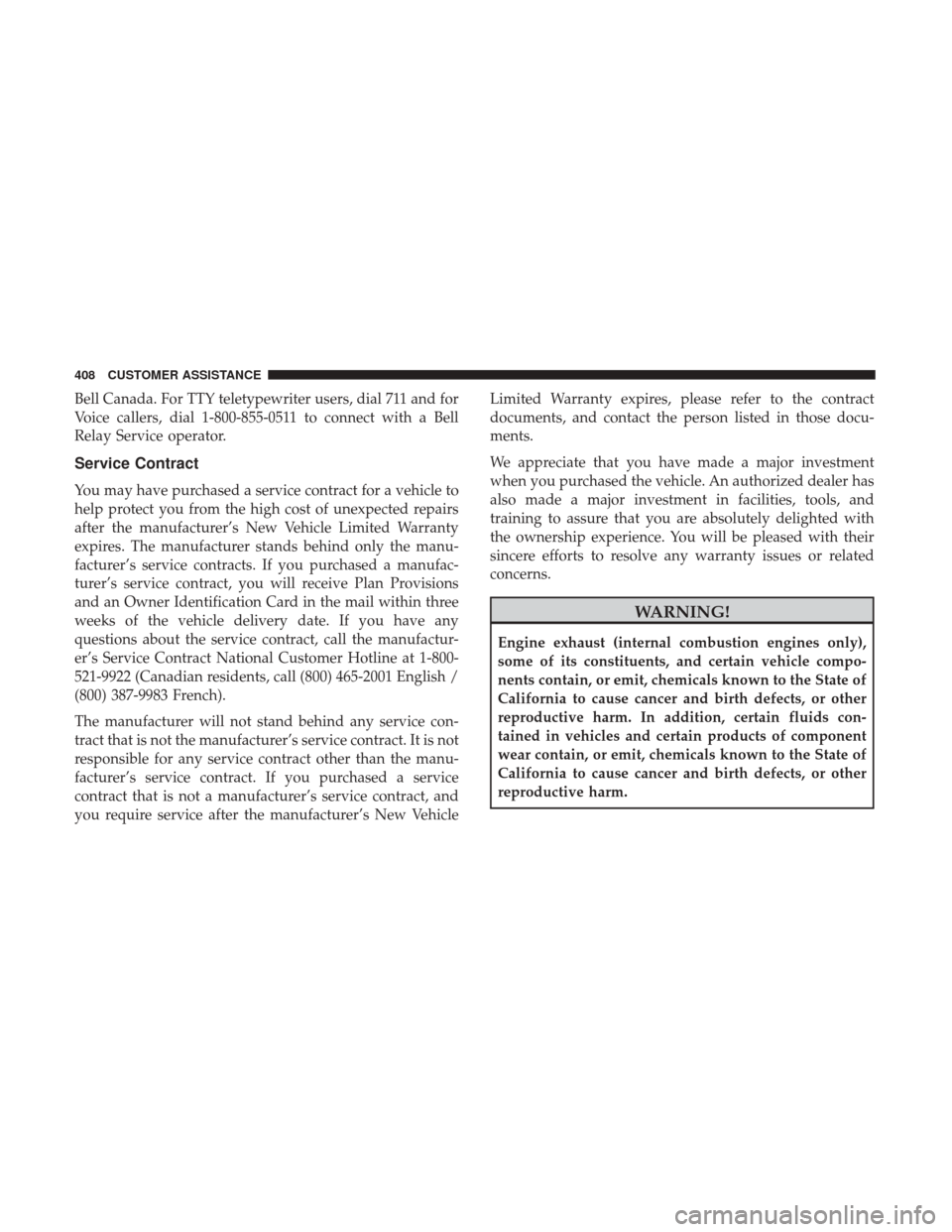
Bell Canada. For TTY teletypewriter users, dial 711 and for
Voice callers, dial 1-800-855-0511 to connect with a Bell
Relay Service operator.
Service Contract
You may have purchased a service contract for a vehicle to
help protect you from the high cost of unexpected repairs
after the manufacturer’s New Vehicle Limited Warranty
expires. The manufacturer stands behind only the manu-
facturer’s service contracts. If you purchased a manufac-
turer’s service contract, you will receive Plan Provisions
and an Owner Identification Card in the mail within three
weeks of the vehicle delivery date. If you have any
questions about the service contract, call the manufactur-
er’s Service Contract National Customer Hotline at 1-800-
521-9922 (Canadian residents, call (800) 465-2001 English /
(800) 387-9983 French).
The manufacturer will not stand behind any service con-
tract that is not the manufacturer’s service contract. It is not
responsible for any service contract other than the manu-
facturer’s service contract. If you purchased a service
contract that is not a manufacturer’s service contract, and
you require service after the manufacturer’s New VehicleLimited Warranty expires, please refer to the contract
documents, and contact the person listed in those docu-
ments.
We appreciate that you have made a major investment
when you purchased the vehicle. An authorized dealer has
also made a major investment in facilities, tools, and
training to assure that you are absolutely delighted with
the ownership experience. You will be pleased with their
sincere efforts to resolve any warranty issues or related
concerns.
WARNING!
Engine exhaust (internal combustion engines only),
some of its constituents, and certain vehicle compo-
nents contain, or emit, chemicals known to the State of
California to cause cancer and birth defects, or other
reproductive harm. In addition, certain fluids con-
tained in vehicles and certain products of component
wear contain, or emit, chemicals known to the State of
California to cause cancer and birth defects, or other
reproductive harm.
408 CUSTOMER ASSISTANCE
Page 414 of 429
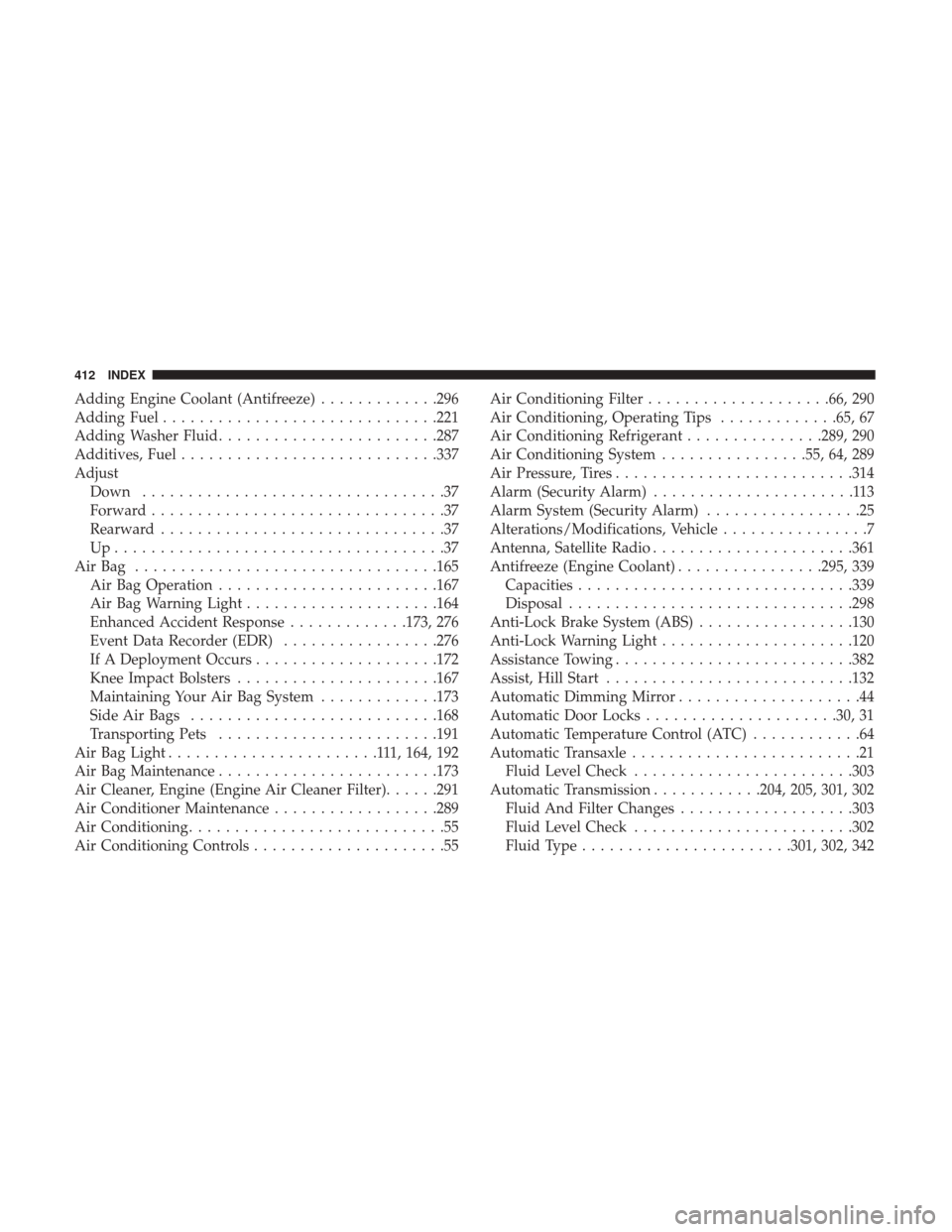
Adding Engine Coolant (Antifreeze).............296
Adding Fuel ............................. .221
Adding Washer Fluid ........................287
Additives, Fuel ............................337
Adjust Down .................................37
Forward ................................37
Rearward ...............................37
Up....................................37
AirBag ................................ .165
Air Bag Operation ........................167
Air Bag Warning Light .....................164
Enhanced Accident Response .............173, 276
Event Data Recorder (EDR) .................276
If A Deployment Occurs ....................172
Knee Impact Bolsters ..................... .167
Maintaining Your Air Bag System .............173
Side Air Bags .......................... .168
Transporting Pets ........................191
Air Bag Light .......................111, 164, 192
Air Bag Maintenance ........................173
Air Cleaner, Engine (Engine Air Cleaner Filter) ......291
Air Conditioner Maintenance ..................289
Air Conditioning ............................55
Air Conditioning Controls .....................55 Air Conditioning Filter
....................66, 290
Air Conditioning, Operating Tips .............65, 67
Air Conditioning Refrigerant ...............289, 290
Air Conditioning System ................55, 64, 289
Air Pressure, Tires ..........................314
Alarm (Security Alarm) ......................113
Alarm System (Security Alarm) .................25
Alterations/Modifications, Vehicle ................7
Antenna, Satellite Radio ..................... .361
Antifreeze (Engine Coolant) ................295, 339
Capacities ............................. .339
Disposal ...............................298
Anti-Lock Brake System (ABS) .................130
Anti-Lock Warning Light .....................120
Assistance T owing.........................
.382
Assist, Hill Start .......................... .132
Automatic Dimming Mirror ....................44
Automatic Door Locks .....................30, 31
Automatic Temperature Control (ATC) ............64
Automatic Transaxle .........................21
Fluid Level Check ........................303
Automatic Transmission ............204, 205, 301, 302
Fluid And Filter Changes ...................303
Fluid Level Check ........................302
Fluid Type .......................301, 302, 342
412 INDEX
Page 415 of 429
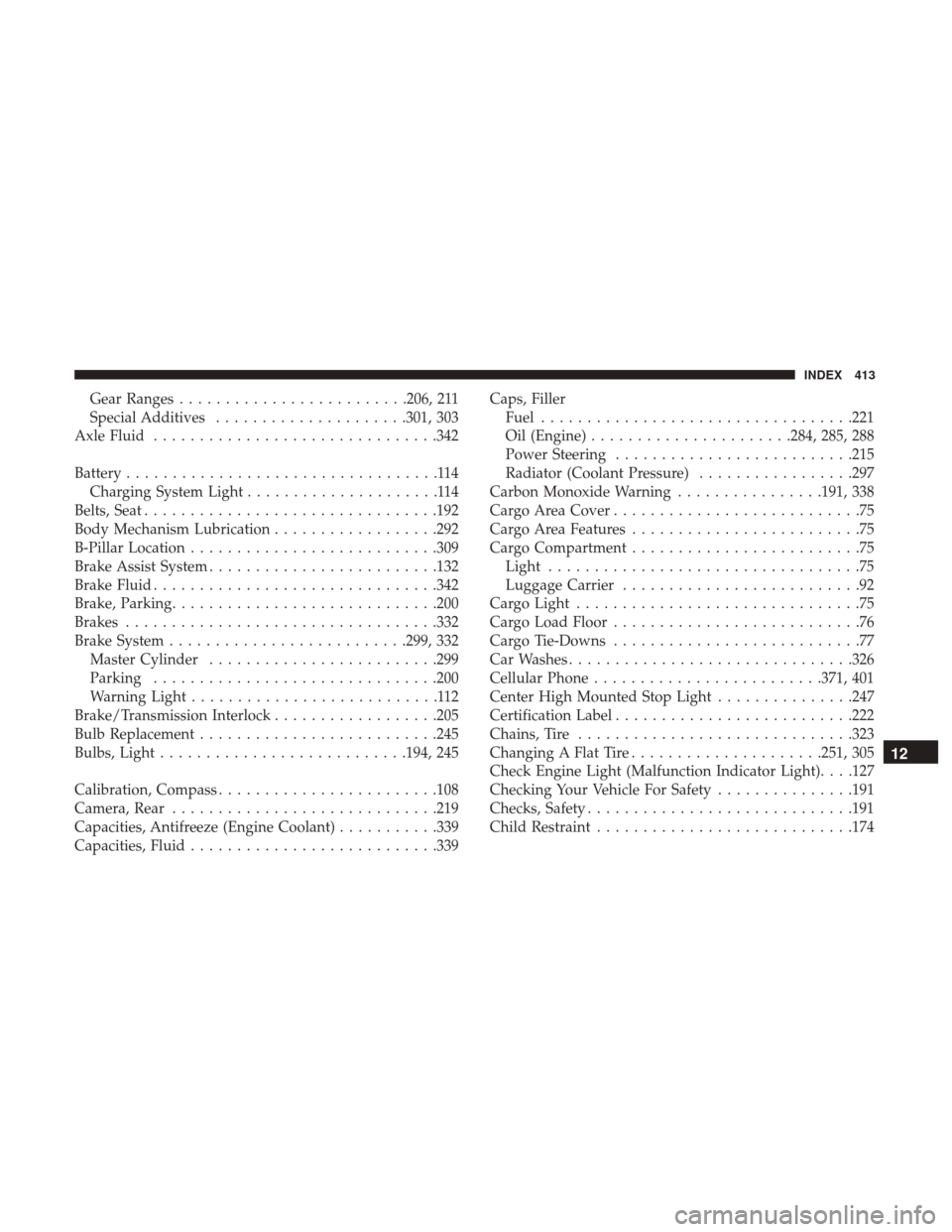
Gear Ranges........................ .206, 211
Special Additives .....................301, 303
Axle Fluid ...............................342
Battery ..................................114
Charging System Light .....................114
Belts, Seat ............................... .192
Body Mechanism Lubrication ..................292
B-Pillar Location .......................... .309
Brake Assist System ........................ .132
Brake Fluid ...............................342
Brake, Parking ............................ .200
Brakes ................................. .332
Brake System ..........................299, 332
Master Cylinder ........................ .299
Parking ...............................200
Warning Light ...........................112
Brake/Transmission Interlock ..................205
Bulb Replacement ..........................245
Bulbs, Light .......................... .194, 245
Calibration, Compass ........................108
Camera, Rear ............................ .219
Capacities, Antifreeze (Engine Coolant) ...........339
Capacities, Fluid .......................... .339Caps, Filler
Fuel ................................. .221
Oil (Engine) ..................... .284, 285, 288
Power Steering ..........................215
Radiator (Coolant Pressure) .................297
Carbon Monoxide Warning ................191, 338
Cargo Area Cover ...........................75
Cargo Area Features .........................75
Cargo Compartment .........................75
Light ..................................75
Luggage Carrier ..........................92
Cargo Light ...............................75
Cargo Load Floor ...........................76
Cargo Tie-Downs ...........................77
Car Washes ...............................326
Cellular Phone ........................ .371, 401
Center High
Mounted Stop Light ...............247
Certification Label ..........................222
Chains, Tire ............................. .323
Changing A Flat Tire .....................251, 305
Check Engine Light (Malfunction Indicator Light). . . .127
Checking Your Vehicle For Safety ...............191
Checks, Safety ............................ .191
Child Restraint ............................174
12
INDEX 413
Page 417 of 429
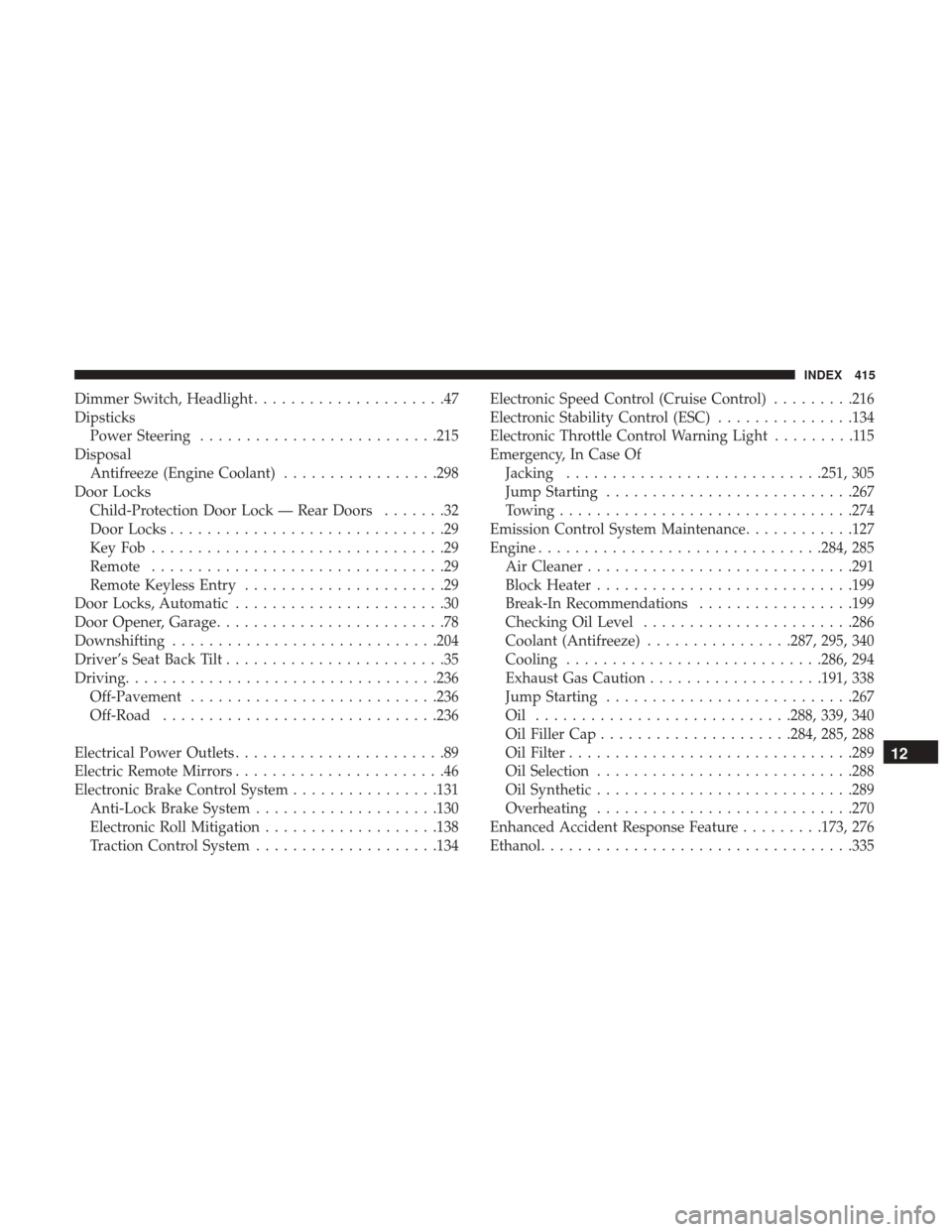
Dimmer Switch, Headlight.....................47
Dipsticks Power Steering ..........................215
Disposal Antifreeze (Engine Coolant) .................298
Door Locks Child-Protection Door Lock — Rear Doors .......32
Door Locks ..............................29
KeyFob................................29
Remote ................................29
Remote Keyless Entry ......................29
Door Locks, Automatic .......................30
Door Opener, Garage .........................78
Downshifting ............................ .204
Driver’s Seat Back Tilt ........................35
Driving ................................. .236
Off-Pavement .......................... .236
Off-Road ............................. .236
Electrical Power Outlets .......................89
Electric Remote Mirrors .......................46
Electronic Brake Control System ................131
Anti-Lock Brake System ....................130
Electronic Roll Mitigation ...................138
Traction Control System ....................134 Electronic Speed Control (Cruise Control)
.........216
Electronic Stability Control (ESC) ...............134
Electronic Throttle Control Warning Light .........115
Emergency, In Case Of Jacking ............................251, 305
Jump Starting .......................... .267
Towing ............................... .274
Emission Control System Maintenance ............127
Engine ...............................284, 285
Air Cleaner ............................ .291
Block Heater ............................199
Break-In Recommendations .................199
Checking Oil Level .......................286
Coolant (Antifreeze) ................287, 295, 340
Cooling ............................286, 294
Exhaust Gas Caution ...................191, 338
Jump Starting .......................... .267
Oil ............................288, 339, 340
Oil
Filler Cap .....................284, 285, 288
Oil Filter ...............................289
Oil Selection ............................288
Oil Synthetic ............................289
Overheating ............................270
Enhanced Accident Response Feature .........173, 276
Ethanol ................................. .335
12
INDEX 415