tire pressure JEEP COMPASS 2021 Owner handbook (in English)
[x] Cancel search | Manufacturer: JEEP, Model Year: 2021, Model line: COMPASS, Model: JEEP COMPASS 2021Pages: 328, PDF Size: 8.85 MB
Page 235 of 328
233
Tire Inflation Pressures
The proper cold tire inflation pressure is
listed on the left side B-Pillar or rear edge of
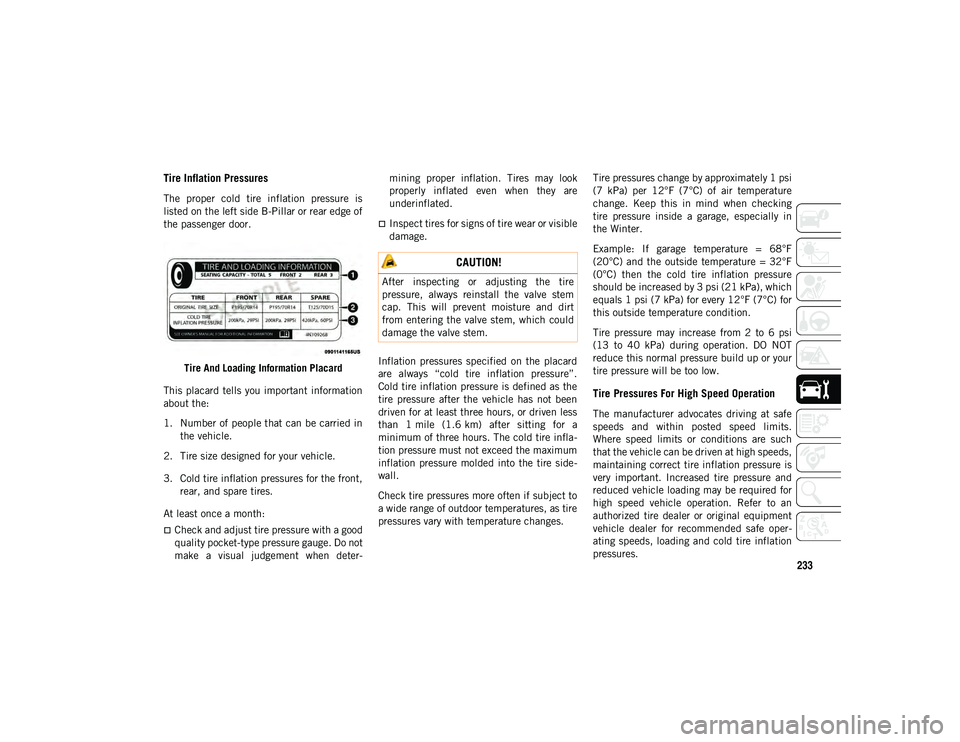
the passenger door.Tire And Loading Information Placard
This placard tells you important information
about the:
1. Number of people that can be carried in the vehicle.
2. Tire size designed for your vehicle.
3. Cold tire inflation pressures for the front, rear, and spare tires.
At least once a month:
Check and adjust tire pressure with a good
quality pocket-type pressure gauge. Do not
make a visual judgement when deter -mining proper inflation. Tires may look
properly inflated even when they are
underinflated.
Inspect tires for signs of tire wear or visible
damage.
Inflation pressures specified on the placard
are always “cold tire inflation pressure”.
Cold tire inflation pressure is defined as the
tire pressure after the vehicle has not been
driven for at least three hours, or driven less
than 1 mile (1.6 km) after sitting for a
minimum of three hours. The cold tire infla -
tion pressure must not exceed the maximum
inflation pressure molded into the tire side -
wall.
Check tire pressures more often if subject to
a wide range of outdoor temperatures, as tire
pressures vary with temperature changes. Tire pressures change by approximately 1 psi
(7 kPa) per 12°F (7°C) of air temperature
change. Keep this in mind when checking
tire pressure inside a garage, especially in
the Winter.
Example: If garage temperature = 68°F
(20°C) and the outside temperature = 32°F
(0°C) then the cold tire inflation pressure
should be increased by 3 psi (21 kPa), which
equals 1 psi (7 kPa) for every 12°F (7°C) for
this outside temperature condition.
Tire pressure may increase from 2 to 6 psi
(13 to 40 kPa) during operation. DO NOT
reduce this normal pressure build up or your
tire pressure will be too low.
Tire Pressures For High Speed Operation
The manufacturer advocates driving at safe
speeds and within posted speed limits.
Where speed limits or conditions are such
that the vehicle can be driven at high speeds,
maintaining correct tire inflation pressure is
very important. Increased tire pressure and
reduced vehicle loading may be required for
high speed vehicle operation. Refer to an
authorized tire dealer or original equipment
vehicle dealer for recommended safe oper
-
ating speeds, loading and cold tire inflation
pressures.
CAUTION!
After inspecting or adjusting the tire
pressure, always reinstall the valve stem
cap. This will prevent moisture and dirt
from entering the valve stem, which could
damage the valve stem.
2020_JEEP_M6_UG_UK.book Page 233
Page 236 of 328
SERVICING AND MAINTENANCE
234
Loading
The vehicle maximum load on the tire must
not exceed the load carrying capacity of the
tire on your vehicle. You will not exceed the
tire's load carrying capacity if you adhere to
the loading conditions, tire size, and cold tire
inflation pressures specified on the Tire
Information placard.
NOTE:
Under a maximum loaded vehicle condition,
gross axle weight ratings (GAWRs) for the
front and rear axles must not be exceeded.
Radial Ply Tires
Tire Repair
If your tire becomes damaged, it may be
repaired if it meets the following criteria:
The tire has not been driven on when flat.
The damage is only on the tread section of
your tire (sidewall damage is not repair-
able).
The puncture is no greater than a ¼ of an
inch (6 mm). Consult an authorized tire dealer for tire
repairs and additional information.
Damaged Run Flat tires, or Run Flat tires
that have experienced a loss of pressure
should be replaced immediately with another
Run Flat tire of identical size and service
description (Load Index and Speed Symbol).
Replace the tire pressure sensor as well as it
is not designed to be reused.
Run Flat Tires — If Equipped
Run Flat tires allow you the capability to drive
50 miles (80 km) at 50 mph (80 km/h) after
a rapid loss of inflation pressure. This rapid
loss of inflation is referred to as the Run Flat
mode. A Run Flat mode occurs when the tire
inflation pressure is of/or below 14 psi (96
kPa). Once a Run Flat tire reaches the run flat
mode it has limited driving capabilities and
needs to be replaced immediately. A Run Flat
tire is not repairable. When a run flat tire is
changed after driving with underinflated tire
condition, please replace the TPM sensor as it
is not designed to be reused when driven
under run flat mode (14 psi (96 kPa)) condi -
tion.
NOTE:
TPM Sensor must be replaced after driving
the vehicle on a flat tire condition.
WARNING!
High speed driving with your vehicle under
maximum load is dangerous. The added
strain on your tires could cause them to
fail. You could have a serious collision. Do
not drive a vehicle loaded to the maximum
capacity at continuous speeds above
75 mph (120 km/h).
WARNING!
Overloading of your tires is dangerous.
Overloading can cause tire failure, affect
vehicle handling, and increase your
stopping distance. Use tires of the
recommended load capacity for your
vehicle. Never overload them.
WARNING!
Combining radial ply tires with other types
of tires on your vehicle will cause your
vehicle to handle poorly. The instability
could cause a collision. Always use radial
ply tires in sets of four. Never combine
them with other types of tires.
2020_JEEP_M6_UG_UK.book Page 234
Page 237 of 328
235
It is not recommended driving a vehicle
loaded at full capacity or to tow a trailer
while a tire is in the run flat mode.
See the tire pressure monitoring section for
more information.
Tire Spinning
When stuck in mud, sand, snow, or ice
conditions, do not spin your vehicle's wheels
above 30 mph (48 km/h) or for longer than
30 seconds continuously without stopping.
Refer to “Freeing A Stuck Vehicle” in “In
Case Of Emergency” for further information.
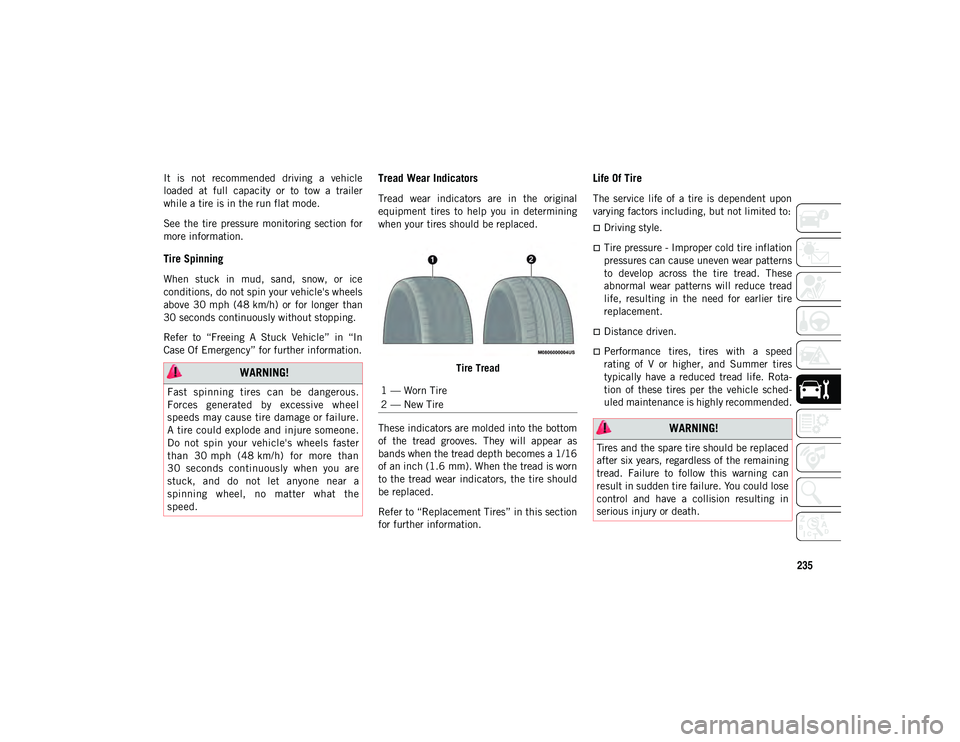
Tread Wear Indicators
Tread wear indicators are in the original
equipment tires to help you in determining
when your tires should be replaced.Tire Tread
These indicators are molded into the bottom
of the tread grooves. They will appear as
bands when the tread depth becomes a 1/16
of an inch (1.6 mm). When the tread is worn
to the tread wear indicators, the tire should
be replaced.
Refer to “Replacement Tires” in this section
for further information.
Life Of Tire
The service life of a tire is dependent upon
varying factors including, but not limited to:
Driving style.
Tire pressure - Improper cold tire inflation
pressures can cause uneven wear patterns
to develop across the tire tread. These
abnormal wear patterns will reduce tread
life, resulting in the need for earlier tire
replacement.
Distance driven.
Performance tires, tires with a speed
rating of V or higher, and Summer tires
typically have a reduced tread life. Rota-
tion of these tires per the vehicle sched -
uled maintenance is highly recommended.
WARNING!
Fast spinning tires can be dangerous.
Forces generated by excessive wheel
speeds may cause tire damage or failure.
A tire could explode and injure someone.
Do not spin your vehicle's wheels faster
than 30 mph (48 km/h) for more than
30 seconds continuously when you are
stuck, and do not let anyone near a
spinning wheel, no matter what the
speed.1 — Worn Tire
2 — New Tire
WARNING!
Tires and the spare tire should be replaced
after six years, regardless of the remaining
tread. Failure to follow this warning can
result in sudden tire failure. You could lose
control and have a collision resulting in
serious injury or death.
2020_JEEP_M6_UG_UK.book Page 235
Page 238 of 328
SERVICING AND MAINTENANCE
236
(Continued)
NOTE:
Wheel Valve Stem must be replaced as well
when installing new tires due to wear and
tear in existing tires.
Keep dismounted tires in a cool, dry place
with as little exposure to light as possible.
Protect tires from contact with oil, grease,
and gasoline.
Replacement Tires
The tires on your new vehicle provide a
balance of many characteristics. They should
be inspected regularly for wear and correct
cold tire inflation pressures. The manufac-
turer strongly recommends that you use tires
equivalent to the originals in size, quality
and performance when replacement is
needed. Refer to the paragraph on “Tread
Wear Indicators” in this section. Refer to the
Tire and Loading Information placard or the
Vehicle Certification Label for the size desig -
nation of your tire. The Load Index and
Speed Symbol for your tire will be found on
the original equipment tire sidewall.
It is recommended to replace the two front
tires or two rear tires as a pair. Replacing just
one tire can seriously affect your vehicle’s
handling. If you ever replace a wheel, make
sure that the wheel’s specifications match
those of the original wheels. It is recommended you contact an authorized
tire dealer or original equipment dealer with
any questions you may have on tire specifica
-
tions or capability. Failure to use equivalent
replacement tires may adversely affect the
safety, handling, and ride of your vehicle.
Tire Types
All Season Tires — If Equipped
All Season tires provide traction for all
seasons (Spring, Summer, Fall, and Winter).
Traction levels may vary between different all
season tires. All season tires can be identi -
fied by the M+S, M&S, M/S or MS designa -
tion on the tire sidewall. Use all season tires
only in sets of four; failure to do so may
adversely affect the safety and handling of
your vehicle.
WARNING!
Do not use a tire, wheel size, load rating,
or speed rating other than that specified
for your vehicle. Some combinations of
unapproved tires and wheels may change
suspension dimensions and performance
characteristics, resulting in changes to
steering, handling, and braking of your
vehicle. This can cause unpredictable
handling and stress to steering and
suspension components. You could lose
control and have a collision resulting in
serious injury or death. Use only the tire
and wheel sizes with load ratings
approved for your vehicle.
Never use a tire with a smaller load index
or capacity, other than what was origi -
nally equipped on your vehicle. Using a
tire with a smaller load index could result
in tire overloading and failure. You could
lose control and have a collision.
Failure to equip your vehicle with tires
having adequate speed capability can
result in sudden tire failure and loss of
vehicle control.
CAUTION!
Replacing original tires with tires of a
different size may result in false
speedometer and odometer readings.
WARNING! (Continued)
2020_JEEP_M6_UG_UK.book Page 236
Page 240 of 328
SERVICING AND MAINTENANCE
238
tion for your vehicle. If your vehicle has this
option, refer to an authorized tire dealer for
the recommended tire rotation pattern.
Compact Spare Tire — If Equipped
The compact spare is for temporary emer-
gency use only. You can identify if your
vehicle is equipped with a compact spare by
looking at the spare tire description on the
Tire and Loading Information Placard
located on the driver’s side door opening or
on the sidewall of the tire. Compact spare
tire descriptions begin with the letter “T” or
“S” preceding the size designation.
Example: T145/80D18 103M.
T, S = Temporary Spare Tire
Since this tire has limited tread life, the orig -
inal equipment tire should be repaired (or
replaced) and reinstalled on your vehicle at
the first opportunity.
Do not install a wheel cover or attempt to
mount a conventional tire on the compact
spare wheel, since the wheel is designed
specifically for the compact spare tire. Do
not install more than one compact spare tire
and wheel on the vehicle at any given time.
Full Size Spare — If Equipped
The full size spare is for temporary emer -
gency use only. This tire may look like the
originally equipped tire on the front or rear
axle of your vehicle, but it is not. This spare
tire may have limited tread life. When the
tread is worn to the tread wear indicators, the
temporary use full size spare tire needs to be
replaced. Since it is not the same as your
original equipment tire, replace (or repair)
the original equipment tire and reinstall on
the vehicle at the first opportunity.
Limited Use Spare — If Equipped
The limited use spare tire is for temporary
emergency use only. This tire is identified by
a label located on the limited use spare
wheel. This label contains the driving limita -
tions for this spare. This tire may look like
the original equipped tire on the front or rear
axle of your vehicle, but it is not. Installation
of this limited use spare tire affects vehicle
handling. Since it is not the same as your
original equipment tire, replace (or repair)
the original equipment tire and reinstall on
the vehicle at the first opportunity.
WARNING!
Compact and collapsible spares are for
temporary emergency use only. With these
spares, do not drive more than 50 mph
(80 km/h). Temporary use spares have
limited tread life. When the tread is worn
to the tread wear indicators, the temporary
use spare tire needs to be replaced. Be
sure to follow the warnings, which apply to
your spare. Failure to do so could result in
spare tire failure and loss of vehicle
control.
WARNING!
Limited use spares are for emergency use
only. Installation of this limited use spare
tire affects vehicle handling. With this tire,
do not drive more than the speed listed on
the limited use spare wheel. Keep inflated
to the cold tire inflation pressures listed on
your Tire and Loading Information Placard
located on the driver’s side B-Pillar or the
rear edge of the driver’s side door. Replace
(or repair) the original equipment tire at
the first opportunity and reinstall it on your
vehicle. Failure to do so could result in
loss of vehicle control.
2020_JEEP_M6_UG_UK.book Page 238
Page 241 of 328
239
(Continued)
Tire Chains (Traction Devices)
Use of traction devices require sufficient
tire-to-body clearance. Follow these recom-
mendations to guard against damage:
Traction device must be of proper size for
the tire, as recommended by the traction
device manufacturer.
Install on front tires only.
For a 215/65R16 tire, use of a snow trac-
tion device with a maximum projection of
7 mm beyond the tire profile is recom -
mended.
No other tire sizes are recommended for
use with a tire chain or traction device.
NOTE:
Any aftermarket tire add on like tire chains
may effect the Tire Pressure Monitoring
System (TPMS) feature performance.
Tire Rotation Recommendations
The tires on the front and rear of your vehicle
operate at different loads and perform
different steering, handling, and braking
functions. For these reasons, they wear at
unequal rates.
These effects can be reduced by timely rota -
tion of tires. The benefits of rotation are
especially worthwhile with aggressive tread
designs such as those on On/Off Road type
tires. Rotation will increase tread life, help to
maintain mud, snow, and wet traction levels,
and contribute to a smooth, quiet ride.
Refer to the “Maintenance Plan” for the
proper maintenance intervals. The reasons
for any rapid or unusual wear should be
corrected prior to rotation being performed.
WARNING!
Using tires of different size and type
(M+S, Snow) between front and rear axles
can cause unpredictable handling. You
could lose control and have a collision.
CAUTION!
To avoid damage to your vehicle or tires,
observe the following precautions:
Because of restricted traction device
clearance between tires and other
suspension components, it is important
that only traction devices in good condi -
tion are used. Broken devices can cause
serious damage. Stop the vehicle imme-
diately if noise occurs that could indi -
cate device breakage. Remove the
damaged parts of the device before
further use.
Install device as tightly as possible and
then retighten after driving about ½ mile
(0.8 km).
Do not exceed 30 mph (48 km/h).
Drive cautiously and avoid severe turns
and large bumps, especially with a
loaded vehicle.
Do not drive for a prolonged period on
dry pavement.
Observe the traction device manufacturer’s
instructions on the method of installation,
operating speed, and conditions for use.
Always use the suggested operating speed
of the device manufacturer’s if it is less
than 30 mph (48 km/h).
Do not use traction devices on a compact
spare tire.
CAUTION! (Continued)
2020_JEEP_M6_UG_UK.book Page 239
Page 242 of 328
SERVICING AND MAINTENANCE
240
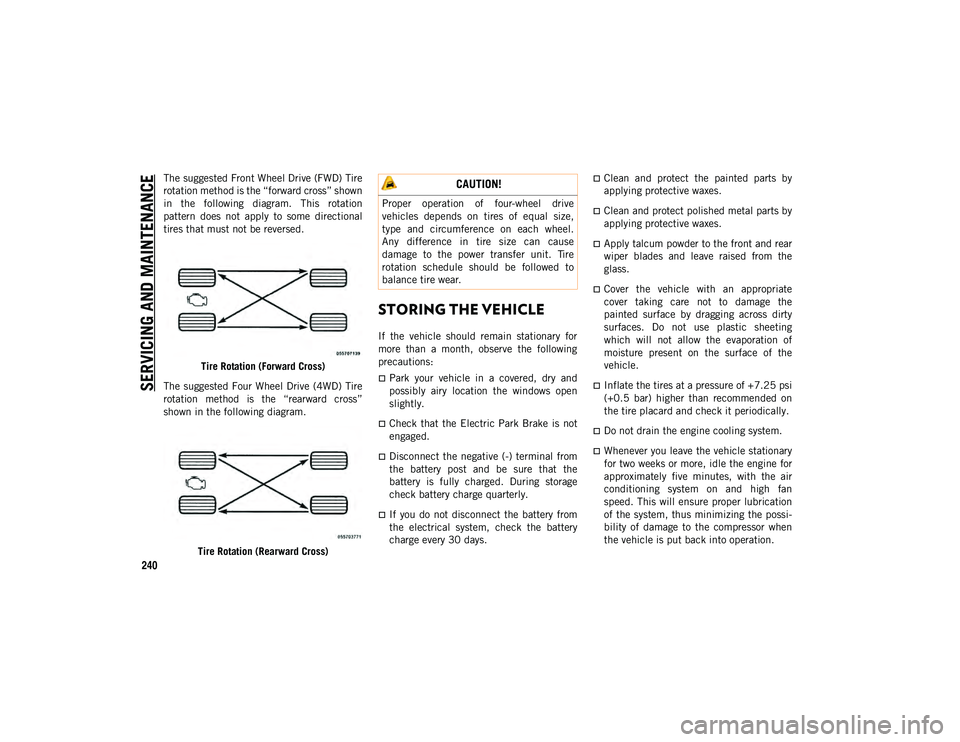
The suggested Front Wheel Drive (FWD) Tire
rotation method is the “forward cross” shown
in the following diagram. This rotation
pattern does not apply to some directional
tires that must not be reversed.Tire Rotation (Forward Cross)
The suggested Four Wheel Drive (4WD) Tire
rotation method is the “rearward cross”
shown in the following diagram.
Tire Rotation (Rearward Cross)
STORING THE VEHICLE
If the vehicle should remain stationary for
more than a month, observe the following
precautions:
Park your vehicle in a covered, dry and
possibly airy location the windows open
slightly.
Check that the Electric Park Brake is not
engaged.
Disconnect the negative (-) terminal from
the battery post and be sure that the
battery is fully charged. During storage
check battery charge quarterly.
If you do not disconnect the battery from
the electrical system, check the battery
charge every 30 days.
Clean and protect the painted parts by
applying protective waxes.
Clean and protect polished metal parts by
applying protective waxes.
Apply talcum powder to the front and rear
wiper blades and leave raised from the
glass.
Cover the vehicle with an appropriate
cover taking care not to damage the
painted surface by dragging across dirty
surfaces. Do not use plastic sheeting
which will not allow the evaporation of
moisture present on the surface of the
vehicle.
Inflate the tires at a pressure of +7.25 psi
(+0.5 bar) higher than recommended on
the tire placard and check it periodically.
Do not drain the engine cooling system.
Whenever you leave the vehicle stationary
for two weeks or more, idle the engine for
approximately five minutes, with the air
conditioning system on and high fan
speed. This will ensure proper lubrication
of the system, thus minimizing the possi -
bility of damage to the compressor when
the vehicle is put back into operation.
CAUTION!
Proper operation of four-wheel drive
vehicles depends on tires of equal size,
type and circumference on each wheel.
Any difference in tire size can cause
damage to the power transfer unit. Tire
rotation schedule should be followed to
balance tire wear.
2020_JEEP_M6_UG_UK.book Page 240
Page 249 of 328
247
preventing the vehicle from resting on the
ground with the body or chassis after
touching the wedge with its lowest and most
projecting parts (usually the underbody),
because this would highly reduce wheel grip.
The wheels, without a suitable grip to the
ground, will not have sufficient hold to move
the vehicle, and will surge.
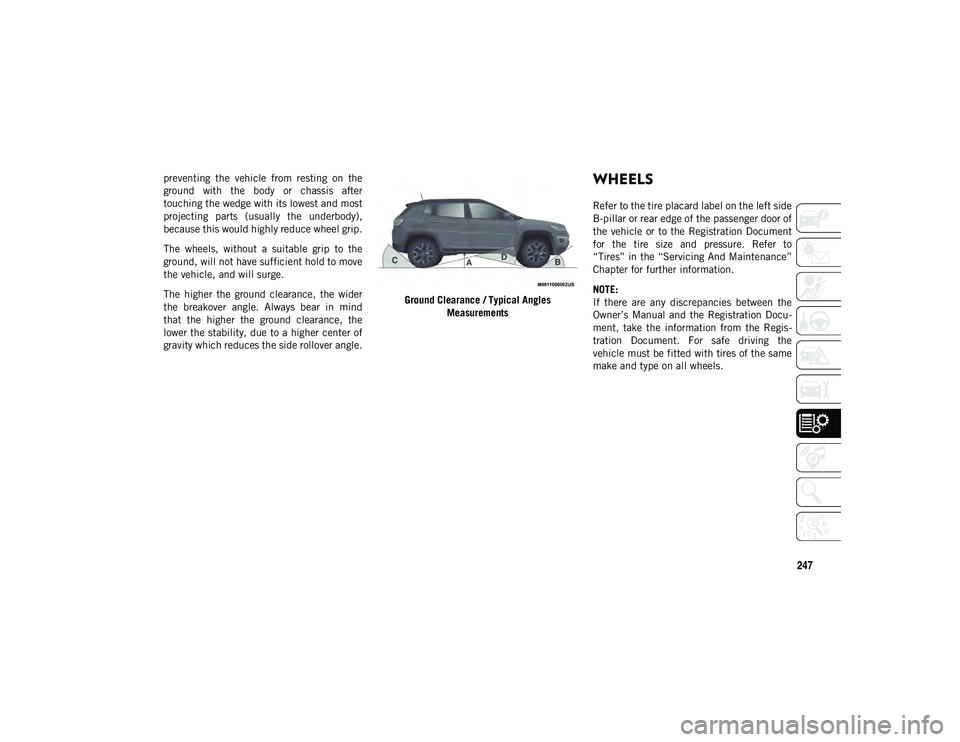
The higher the ground clearance, the wider
the breakover angle. Always bear in mind
that the higher the ground clearance, the
lower the stability, due to a higher center of
gravity which reduces the side rollover angle.Ground Clearance / Typical Angles
MeasurementsWHEELS
Refer to the tire placard label on the left side
B-pillar or rear edge of the passenger door of
the vehicle or to the Registration Document
for the tire size and pressure. Refer to
“Tires” in the “Servicing And Maintenance”
Chapter for further information.
NOTE:
If there are any discrepancies between the
Owner’s Manual and the Registration Docu -
ment, take the information from the Regis -
tration Document. For safe driving the
vehicle must be fitted with tires of the same
make and type on all wheels.
2020_JEEP_M6_UG_UK.book Page 247
Page 250 of 328
TECHNICAL SPECIFICATIONS
248
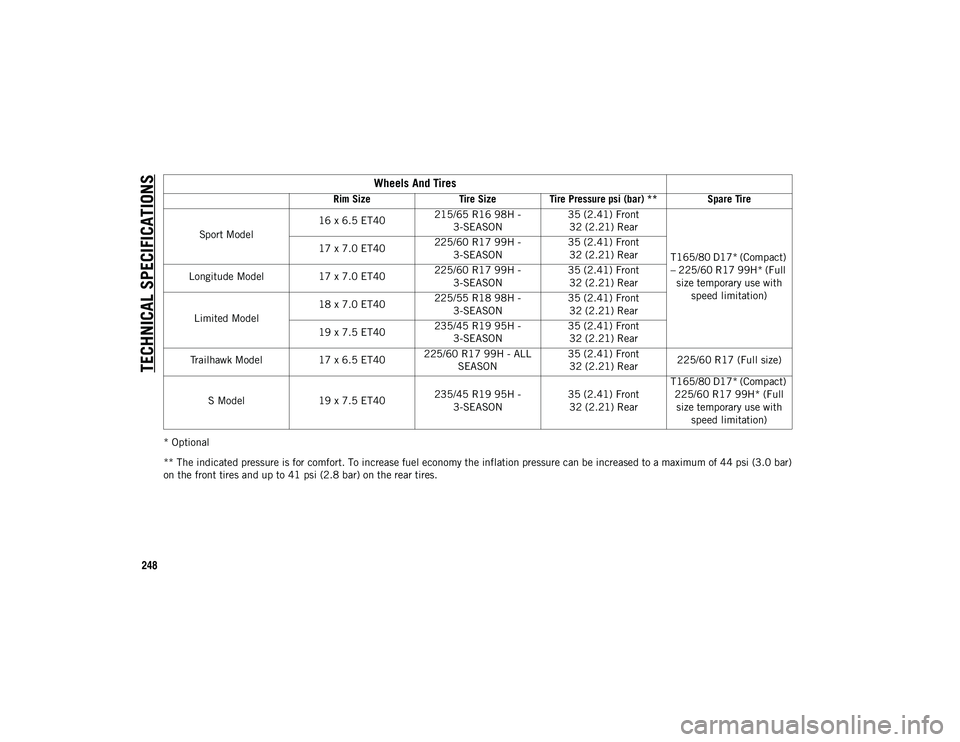
* Optional
** The indicated pressure is for comfort. To increase fuel economy the inflation pressure can be increased to a maximum of 44 psi (3.0 bar)
on the front tires and up to 41 psi (2.8 bar) on the rear tires.
Wheels And Tires
Rim SizeTire SizeTire Pressure psi (bar) ** Spare Tire
Sport Model 16 x 6.5 ET40
215/65 R16 98H -
3-SEASON 35 (2.41) Front
32 (2.21) Rear
T165/80 D17* (Compact)
– 225/60 R17 99H* (Full size temporary use with speed limitation)
17 x 7.0 ET40
225/60 R17 99H -
3-SEASON 35 (2.41) Front
32 (2.21) Rear
Longitude Model 17 x 7.0 ET40225/60 R17 99H -
3-SEASON 35 (2.41) Front
32 (2.21) Rear
Limited Model 18 x 7.0 ET40
225/55 R18 98H -
3-SEASON 35 (2.41) Front
32 (2.21) Rear
19 x 7.5 ET40 235/45 R19 95H -
3-SEASON 35 (2.41) Front
32 (2.21) Rear
Trailhawk Model 17 x 6.5 ET40225/60 R17 99H - ALL
SEASON 35 (2.41) Front
32 (2.21) Rear 225/60 R17 (Full size)
S Model 19 x 7.5 ET40 235/45 R19 95H -
3-SEASON 35 (2.41) Front
32 (2.21) Rear T165/80 D17* (Compact)
225/60 R17 99H* (Full size temporary use with speed limitation)
2020_JEEP_M6_UG_UK.book Page 248
Page 319 of 328
317
INDEX
A
Accessories ....................................... 260Mopar ........................................... 260
Active Speed Limiter .......................... 149
Adaptive Cruise Control (ACC) (Cruise Con -
trol) .................................................. 151
Adding Fuel ...................................... 167
Additives, Fuel .................................. 250
Air Bag ............................................... 99 Air Bag Operation ........................... 101Air Bag Warning Light ....................... 98
Enhanced Accident Response .. 111 , 211
Event Data Recorder (EDR) ............. 211
If Deployment Occurs ..................... 110
Knee Impact Bolsters ..................... 107
Maintaining Your Air Bag System ..... 113
Maintenance .................................. 113
Redundant Air Bag Warning Light ...... 99
Side Air Bags ................................. 107
Transporting Pets ........................... 127
Air Bag Light ..........................59 , 98 , 129
Air Conditioner Maintenance ............... 227
Air Conditioner Refrigerant ................. 227
Air Conditioner System ....................... 227
Air Conditioning................................... 43
Air Conditioning Filter .................. 44 , 228
Air Conditioning, Operating Tips ............ 44 Air Pressure
Tires ............................................. 233
Alarm Arm The System .............................. 18
Disarm The System .......................... 18
Security Alarm ............................18 , 62
Alarm System Security Alarm ............................18 , 19
Android Auto..............................271 , 302
Antifreeze (Engine Coolant) ................ 254
Anti-Lock Brake System (ABS) .............. 72
Anti-Lock Warning Light ....................... 62
Apple CarPlay ............................272 , 303
Arming System Security Alarm ................................. 18
Assist, Hill Start .................................. 78
Audio Jack .................................270 , 276
Audio Systems (Radio) ................262 , 264
Auto Down Power Windows ................... 45
Auto Up Power Windows ...................... 45
Automatic Headlights .......................... 32
Automatic High Beams ........................ 32
Automatic Temperature Control (ATC) ... 43
Automatic Transaxle .......................... 139 Automatic Transmission......................140
Adding Fluid ..................................259
Fluid Level Check ...........................231
Fluid Type ............................. 231 , 259
Special Additives ............................231
Auxiliary (Power Outlet) ........................52
Auxiliary Electrical Outlet (Power
Outlet) ................................................52
Axle Lubrication .................................259
B
Battery ........................................ 60 , 226
Charging System Light ......................60
Belts, Seat ........................................128
Blind Spot Monitoring ..........................80
Brake Assist System ....................... 73 , 84
Brake Control System, Electronic ...........73
Brake Fluid .......................................259
Brake System ....................................230 Fluid Check ........................... 230 , 259
Master Cylinder ..............................230
Parking ..........................................134 Warning Light...................................59
Brake/Transmission Interlock...............140
Bulb Replacement .............................177
Bulbs, Light ......................................130
2020_JEEP_M6_UG_UK.book Page 317