oil level JEEP COMPASS 2021 Owner handbook (in English)
[x] Cancel search | Manufacturer: JEEP, Model Year: 2021, Model line: COMPASS, Model: JEEP COMPASS 2021Pages: 328, PDF Size: 8.85 MB
Page 11 of 328
9
LANESENSE — IF EQUIPPED ................ 162
LaneSense Operation .................... 162
Turning LaneSense On Or Off ........ 162
LaneSense Warning Message ......... 162
Changing LaneSense Status........... 164
PARKVIEW REAR BACK UP CAMERA — IF
EQUIPPED ........................................... 164
REFUELING THE VEHICLE ...................... 165
Emergency Fuel Filler Door
Release ....................................... 166
REFUELING THE VEHICLE — DIESEL
ENGINE ............................................... 167
Adblue (UREA) — If Equipped....... 169
VEHICLE LOADING ............................... 171
Certification Label ........................ 171
TRAILER TOWING ................................. 171
Common Towing Definitions .......... 171
Trailer Towing Weights (Maximum Trailer
Weight Ratings) ........................... 173 Towing Requirements ................... 173
RECREATIONAL TOWING (BEHIND
MOTORHOME, ETC.) ............................ 175
Towing This Vehicle Behind Another
Vehicle ........................................ 175 Recreational Towing — Front-Wheel
Drive (FWD) Models ...................... 175 Recreational Towing — 4X4
Models ........................................ 176
IN CASE OF EMERGENCY
HAZARD WARNING FLASHERS...............177
BULB REPLACEMENT............................177
Replacement Bulbs ...................... 177
High Intensity Discharge (HID)
Headlamps — If Equipped ............ 179 Replacing Exterior Bulbs ............... 179
FUSES.................................................182
General Information...................... 182
Fuse Location .............................. 182
Engine Compartment Fuses/Distribution
Unit ............................................ 182 Engine Compartment Fuses/Auxiliary
Unit ............................................ 185 Interior Fuses............................... 186
Rear Cargo Fuse/Relay Distribution
Unit ............................................ 187
JACKING AND TIRE CHANGING ..............189
Jack Location/Spare Tire Stowage .. 189
Preparations For Jacking .............. 190
Jacking Instructions .................... 190
Road Tire Installation ................... 193
EC Declaration Of Conformance ..... 194
Jack Usage Precautions ................ 195
TIRE SERVICE KIT — IF EQUIPPED ........196
JUMP STARTING .................................202
Preparations For Jump Start .......... 202
Jump Starting Procedure............... 203
REFUELING IN EMERGENCY — IF
EQUIPPED............................................204 IF YOUR ENGINE OVERHEATS ...............204
GEAR SELECTOR OVERRIDE ...................205
FREEING A STUCK VEHICLE...................206
TOWING A DISABLED VEHICLE ..............207
Without The Key Fob .....................208
Front-Wheel Drive (FWD) Models — With
Key Fob .......................................208 4x4 Models ..................................208
Emergency Tow Hooks ..................209
Tow Eye Usage — If Equipped ......209
ENHANCED ACCIDENT RESPONSE SYSTEM
(EARS) ...............................................211 EVENT DATA RECORDER (EDR) ..............211
SERVICING AND MAINTENANCE
SCHEDULED SERVICING ........................212
1.4L Gasoline Engine ...................212
Diesel Engines ..............................217
ENGINE COMPARTMENT .......................222
1.4L Engine .................................222
2.0L Diesel Engine .......................223
1.6L Diesel Engine .......................224
Checking Oil Level ........................225
Adding Washer Fluid ....................225
Maintenance-Free Battery .............226
Pressure Washing..........................227
2020_JEEP_M6_UG_UK.book Page 9
Page 64 of 328
GETTING TO KNOW YOUR INSTRUMENT PANEL
62
much oil is in the engine. The engine oil level
must be checked under the hood.
Oil Temperature Warning Light
This warning light will illuminate to
indicate the engine oil temperature
is high. If the light turns on while
driving, stop the vehicle and shut off
the engine as soon as possible. Wait for oil
temperature to return to normal levels.
Seat Belt Reminder Warning Light
This warning light indicates when
the driver or passenger seat belt is
unbuckled. When the ignition is first
placed in the ON/RUN or ACC/ON/
RUN position and if the driver’s seat belt is
unbuckled, a chime will sound and the light
will turn on. When driving, if the driver or
front passenger seat belt remains unbuckled,
the Seat Belt Reminder Light will flash or
remain on continuously and a chime will
sound.
Refer to “Occupant Restraint Systems” in
“Safety” for further information.
Transmission Fault Warning Light
This light will illuminate (together
with a message in the instrument
cluster display and a buzzer) to indi -cate a transmission fault. Contact an autho
-
rized dealer if the message remains after
restarting the engine.
Transmission Temperature Warning Light —
If Equipped
This warning light will illuminate to
warn of a high transmission fluid
temperature. This may occur with
strenuous usage such as trailer towing. If this
light turns on, stop the vehicle and run the
engine at idle or slightly faster, with the
transmission in PARK or NEUTRAL, until the
light turns off. Once the light turns off, you
may continue to drive normally.
Vehicle Security Warning Light — If
Equipped
This light will flash at a fast rate for
approximately 15 seconds when the
vehicle security alarm is arming,
and then will flash slowly until the vehicle is
disarmed.
Yellow Warning Lights
Anti-Lock Brake (ABS) Warning Light
This warning light monitors the
Anti-Lock Brake System (ABS). The
light will turn on when the ignition is
placed in the ON/RUN or ACC/ON/RUN posi -
tion and may stay on for as long as four
seconds.
If the ABS light remains on or turns on while
driving, then the Anti-Lock portion of the
brake system is not functioning and service
is required as soon as possible. However, the
conventional brake system will continue to
operate normally, assuming the Brake
Warning Light is not also on.
If the ABS light does not turn on when the
ignition is placed in the ON/RUN or ACC/ON/
RUN position, have the brake system
inspected by an authorized dealer.
WARNING!
If you continue operating the vehicle when
the Transmission Temperature Warning
Light is illuminated you could cause the
fluid to boil over, come in contact with hot
engine or exhaust components and cause a
fire.
CAUTION!
Continuous driving with the Transmission
Temperature Warning Light illuminated
will eventually cause severe transmission
damage or transmission failure.
2020_JEEP_M6_UG_UK.book Page 62
Page 69 of 328
67
Active Speed Limiter Fault Indicator Light —
If Equipped
This warning light will illuminate to
signal when there is a fault detected
with the Active Speed Limiter.
Diesel Particulate Filter (DPF) Cleaning In
Progress Indicator Light — Diesel Versions
With DPF Only (If Equipped)
This indicator light will illuminate,
or a message will appear, to indicate
that the DPF system needs to elimi-
nate the trapped pollutants (particulate)
through the regeneration process. The light/
message does not switch on during every
DPF regeneration, but only when driving
conditions require that the driver is notified.
To turn off the symbol, keep the vehicle in
motion until the regeneration process is over.
On average, the process lasts 15 minutes.
Optimal conditions for completing the
process are achieved by traveling at 37 mph
(60 km/h) with engine speed above 2000
rpm.
When this light/message switches on, it does
not indicate a vehicle failure and thus it
should not be taken to a workshop. NOTE:
On some versions, together with the symbol
switching on, the display shows a dedicated
message.
Forward Collision Indicator Light — If
Equipped
This telltale will turn on to warn you
of a possible collision with the
vehicle in front of you.
Forward Collision Warning Off Indicator Light
— If Equipped
This indicator light illuminates to
indicate that Forward Collision
Warning is off.
Immobilizer Fail / VPS Electrical Alarm
Indicator Light
This telltale will illuminate when the
vehicle security alarm system has
detected an attempt to break into
the vehicle.
NOTE:
After cycling the ignition to the ON/RUN
position, the Vehicle Security Warning Light
could illuminate if a problem with the system
is detected. This condition will result in the
engine being shut off after two seconds.
Low Diesel Emissions Additive AdBlue®
(UREA) Indicator Light — If Equipped
The Low Diesel Exhaust Emissions
Additive AdBlue® (UREA) indicator
light illuminates when the AdBlue®
(UREA) level is low.
Fill the AdBlue® (UREA) tank as soon as
possible with at least 1.3 gallons (5 liters) of
AdBlue® (UREA).
CAUTION!
Vehicle travel speed should always be
adapted to the traffic and weather
conditions, and must always comply with
traffic regulations.
The engine can be turned off if the DPF
warning light is on; however, repeated
interruptions of the regeneration process
could cause premature deterioration of the
engine oil. For this reason, it is important
to wait for the symbol to turn off before
turning off the engine. Do not complete
the DPF regeneration process when the
vehicle is stopped.
2020_JEEP_M6_UG_UK.book Page 67
Page 214 of 328
212
SERVICING AND MAINTENANCE
SCHEDULED SERVICING
Correct servicing is crucial for guaranteeing a
long life for the car under the best condi-
tions. For this reason, Jeep has planned a
series of checks and services at fixed
distance intervals and, where provided, at
fixed time intervals, as described in the
Scheduled Servicing plan. To keep the car’s
efficiency in tip-top condition, in the
following Scheduled Service plan pages a
few additional checks are listed that should
be carried out more frequently with respect
to the normal coupon redemption schedule.
Scheduled Servicing is offered by all autho -
rized dealerships according to fixed time or
mileage intervals. If, during each operation,
in addition to the ones scheduled, the need
arises for further replacements or repairs,
these may be carried out with the owner's
explicit agreement only.
The technicians at your dealership know your
vehicle best, and have access to factory
trained information, genuine Mopar parts,
and specially designed electronic and
mechanical tools that can help prevent
future costly repairs. If your car is used
frequently for towing, the interval between
one scheduled servicing operation and the next should be reduced. More frequent main
-
tenance may be needed for vehicles in severe
operating conditions, such as dusty areas
and very short trip driving.
NOTE:
Scheduled Servicing interventions are set
out by the Manufacturer. Failure to have
them carried out may invalidate the
warranty. It is advised to inform an autho -
rized dealership of any small operating irreg -
ularities without waiting for the next service.
1.4L Gasoline Engine
NOTE:
Under no circumstances should oil change
intervals exceed 9,000 miles (15,000 km)
or 12 months, whichever comes first.
Once A Month Or Before A Long Trip
Check engine oil level.
Check windshield washer fluid level.
Check tire pressure and look for unusual
wear or damage. Rotate tires at the first
sign of irregular wear, even if it occurs
before the oil indicator system turns on.
Check the fluid levels of the coolant reser -
voir and brake master cylinder, fill as
needed.
Check function of all interior and exterior
lights.
At Each Oil Change
Change oil and filter.
Rotate the tires. Rotate at the first sign of
irregular wear, even if it occurs before the
oil indicator system turns on.
Inspect battery and clean and tighten
terminals as required.
Inspect the CV/Universal joints.
Inspect brake pads, shoes, rotors, drums,
hoses and park brake.
Inspect engine cooling system protection
and hoses.
Inspect exhaust system.
Inspect engine air cleaner if using in dusty
or off-road conditions. Replace air cleaner
filter, if necessary.
Refer to the “Maintenance Plan” on the
following page for the required maintenance
intervals.
2020_JEEP_M6_UG_UK.book Page 212
Page 220 of 328
SERVICING AND MAINTENANCE
218
Once A Month Or Before A Long Trip
Check engine oil level.
Check windshield washer fluid level.
Check tire pressure and look for unusual
wear or damage. Rotate tires at the first
sign of irregular wear, even if it occurs
before the oil indicator system turns on.
Check the fluid levels of the coolant reser-
voir and brake master cylinder, fill as
needed.
Check function of all interior and exterior
lights.
Control and recovery of additive level for
AdBlue® Diesel emissions (UREA) (if
equipped). At Each Oil Change
Change the engine oil filter.
Inspect the brake hoses and lines.
Inspect for the presence of water in the
fuel filter/water separator unit.
Inspect air cleaner filter if using in dusty
or off-road conditions. Replace air cleaner
filter, if necessary.
Demanding Vehicle Use
Restore additive level for AdBlue® Diesel
emissions (UREA) (if equipped), when the
lamp is illuminated or the message on the
instrument panel.
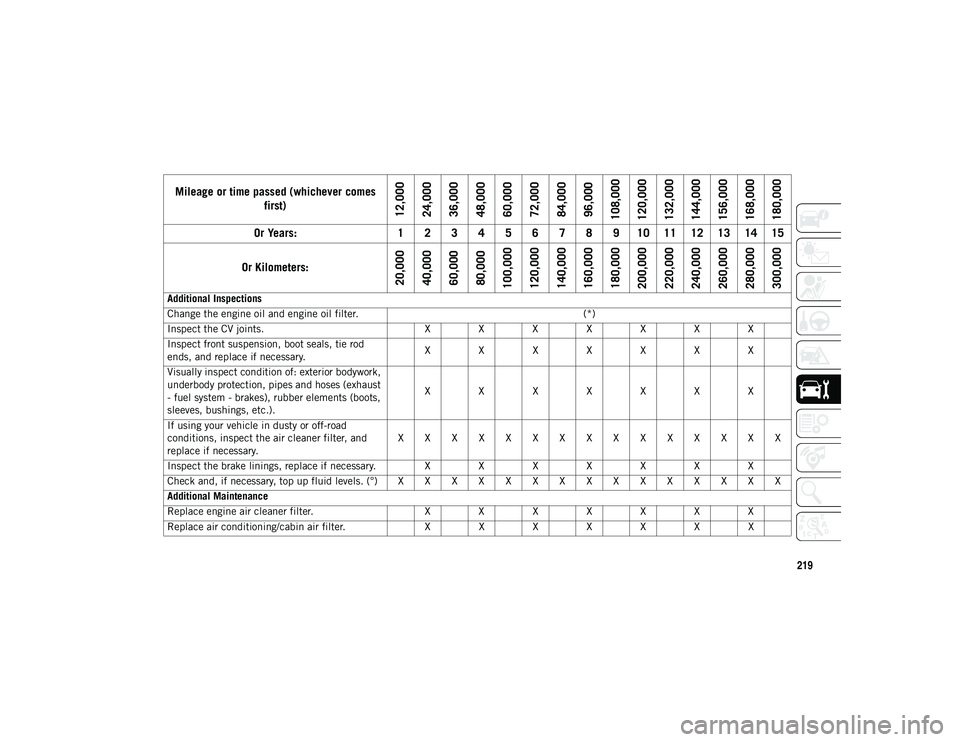
Maintenance Plan — Diesel Engines
NOTE:
Once you have carried out the last interven -
tion in the table, continue with the sched -
uled servicing, maintaining the frequency
indicated in the plan by marking each oper -
ation with a dot or dedicated note. Simply
restarting the maintenance from the start of
the plan may cause the allowed interval to be
exceeded for some operations.
CAUTION!
Failure to perform the required
maintenance items may result in damage
to the vehicle.
2020_JEEP_M6_UG_UK.book Page 218
Page 221 of 328
219
Mileage or time passed (whichever comes
first)
12,000
24,000
36,000
48,000
60,000
72,000
84,000
96,000
108,000
120,000
132,000
144,000
156,000
168,000
180,000
Or Years: 1 2 3 4 5 6 7 8 9 10 11 12 13 14 15
Or Kilometers:
20,000
40,000
60,000
80,000
100,000
120,000
140,000
160,000
180,000
200,000
220,000
240,000
260,000
280,000
300,000
Additional Inspections
Change the engine oil and engine oil filter. (*)
Inspect the CV joints. X X X X X X X
Inspect front suspension, boot seals, tie rod
ends, and replace if necessary. X X X X X X X
Visually inspect condition of: exterior bodywork,
underbody protection, pipes and hoses (exhaust
- fuel system - brakes), rubber elements (boots,
sleeves, bushings, etc.). X X X X X X X
If using your vehicle in dusty or off-road
conditions, inspect the air cleaner filter, and
replace if necessary. X X X X X X X X X X X X X X X
Inspect the brake linings, replace if necessary. X X X X X X X Check and, if necessary, top up fluid levels. (°) X X X X X X X X X X X X X X X
Additional Maintenance
Replace engine air cleaner filter. X X X X X X X
Replace air conditioning/cabin air filter. X X X X X X X
2020_JEEP_M6_UG_UK.book Page 219
Page 227 of 328
225
(Continued)
Checking Oil Level
To assure proper engine lubrication, the
engine oil must be maintained at the correct
level. Check the oil level at regular intervals,
such as every fuel stop. The best time to
check the engine oil level is about five
minutes after a fully warmed up engine is
shut off.
Checking the oil while the vehicle is on level
ground will improve the accuracy of the oil
level readings.
There are three possible dipstick types,
Crosshatched zone.
Crosshatched zone marked SAFE.
Crosshatched zone marked with MIN at
the low end of the range and MAX at the
high end of the range.
Crosshatched zone marked with dimples
at the MIN and the MAX ends of the range.
NOTE:
Always maintain the oil level within the
crosshatch markings on the dipstick.
Adding 1 quart (1.0 liters) of oil when the
reading is at the low end of the dipstick
range will raise the oil level to the high end
of the range marking.
Adding Washer Fluid
The fluid reservoir is located in the front of
the engine compartment. Be sure to check
the fluid level in the reservoir at regular inter -
vals. Fill the reservoir with windshield washer
solvent (not radiator antifreeze) and operate
the system for a few seconds to flush out the
residual washer fluid.
When refilling the washer fluid reservoir,
take some washer fluid, apply it to a cloth or
towel, and wipe clean the wiper blades; this
will help blade performance.
WARNING!
Never smoke while working in the engine
compartment: gas and inflammable
vapors may be present, with the risk of
fire.
Be very careful when working in the
engine compartment when the engine is
hot: you may get burned. Do not get too
close to the radiator cooling fan: the
electric fan may start; danger of injury.
Scarves, ties and other loose clothing
might be pulled by moving parts.
CAUTION!
Be careful not to confuse the various
types of fluids while topping up: they are
not compatible with each other! Topping
up with an unsuitable fluid could
severely damage your car.
The oil level must never exceed the MAX
mark.
Always top up using engine oil of the
same specifications as that already in
the engine.
If the engine oil is being topped up, wait
for the engine to cool down before loos-
ening the filler cap, particularly for vehi -
cles with aluminium cap (if equipped).
WARNING: risk of burns!
Overfilling or underfilling the crankcase
will cause aeration or loss of oil pressure.
This could damage your engine.
CAUTION! (Continued)
2020_JEEP_M6_UG_UK.book Page 225
Page 232 of 328
SERVICING AND MAINTENANCE
230
(Continued)
Cooling System Pressure Cap
The cap must be fully tightened to prevent
loss of engine coolant (antifreeze), and to
ensure that engine coolant (antifreeze) will
return to the radiator from the coolant expan-
sion bottle/recovery tank if so equipped.
The cap should be inspected and cleaned if
there is any accumulation of foreign material
on the sealing surfaces.
Brake System
In order to assure brake system performance,
all brake system components should be
inspected periodically. Refer to the “Mainte -nance Plan” in this section for the proper
maintenance intervals.
Brake Master Cylinder
The fluid in the master cylinder should be
checked when performing under hood
services or immediately if the “Brake
Warning Light” is illuminated.
Be sure to clean the top of the master
cylinder area before removing the cap. If
necessary, add fluid to bring the fluid level
up to the requirements described on the
brake fluid reservoir. With disc brakes, fluid
level can be expected to fall as the brake
pads wear. Brake fluid level should be
checked when pads are replaced. However,
low fluid level may be caused by a leak and
a checkup may be needed.
Use only manufacturer's recommended
brake fluid. Refer to “Fluids And Lubricants”
in “Technical Specifications” for further
information.
WARNING!
Do not open hot engine cooling system.
Never add engine coolant (antifreeze)
when the engine is overheated. Do not
loosen or remove the cap to cool an over
-
heated engine. Heat causes pressure to
build up in the cooling system. To
prevent scalding or injury, do not remove
the pressure cap while the system is hot
or under pressure.
Do not use a pressure cap other than the
one specified for your vehicle. Personal
injury or engine damage may result.
WARNING!
Riding the brakes can lead to brake failure
and possibly a collision. Driving with your
foot resting or riding on the brake pedal
can result in abnormally high brake
temperatures, excessive lining wear, and
possible brake damage. You would not
have your full braking capacity in an
emergency. WARNING!
Use only manufacturer's recommended
brake fluid. Refer to “Fluids And Lubri -
cants” in “Technical Specifications” for
further information. Using the wrong
type of brake fluid can severely damage
your brake system and/or impair its
performance. The proper type of brake
fluid for your vehicle is also identified on
the original factory installed hydraulic
master cylinder reservoir.
To avoid contamination from foreign
matter or moisture, use only new brake
fluid or fluid that has been in a tightly
closed container. Keep the master
cylinder reservoir cap secured at all
times. Brake fluid in a open container
absorbs moisture from the air resulting
in a lower boiling point. This may cause
it to boil unexpectedly during hard or
prolonged braking, resulting in sudden
brake failure. This could result in a colli -
sion.
2020_JEEP_M6_UG_UK.book Page 230
Page 238 of 328
SERVICING AND MAINTENANCE
236
(Continued)
NOTE:
Wheel Valve Stem must be replaced as well
when installing new tires due to wear and
tear in existing tires.
Keep dismounted tires in a cool, dry place
with as little exposure to light as possible.
Protect tires from contact with oil, grease,
and gasoline.
Replacement Tires
The tires on your new vehicle provide a
balance of many characteristics. They should
be inspected regularly for wear and correct
cold tire inflation pressures. The manufac-
turer strongly recommends that you use tires
equivalent to the originals in size, quality
and performance when replacement is
needed. Refer to the paragraph on “Tread
Wear Indicators” in this section. Refer to the
Tire and Loading Information placard or the
Vehicle Certification Label for the size desig -
nation of your tire. The Load Index and
Speed Symbol for your tire will be found on
the original equipment tire sidewall.
It is recommended to replace the two front
tires or two rear tires as a pair. Replacing just
one tire can seriously affect your vehicle’s
handling. If you ever replace a wheel, make
sure that the wheel’s specifications match
those of the original wheels. It is recommended you contact an authorized
tire dealer or original equipment dealer with
any questions you may have on tire specifica
-
tions or capability. Failure to use equivalent
replacement tires may adversely affect the
safety, handling, and ride of your vehicle.
Tire Types
All Season Tires — If Equipped
All Season tires provide traction for all
seasons (Spring, Summer, Fall, and Winter).
Traction levels may vary between different all
season tires. All season tires can be identi -
fied by the M+S, M&S, M/S or MS designa -
tion on the tire sidewall. Use all season tires
only in sets of four; failure to do so may
adversely affect the safety and handling of
your vehicle.
WARNING!
Do not use a tire, wheel size, load rating,
or speed rating other than that specified
for your vehicle. Some combinations of
unapproved tires and wheels may change
suspension dimensions and performance
characteristics, resulting in changes to
steering, handling, and braking of your
vehicle. This can cause unpredictable
handling and stress to steering and
suspension components. You could lose
control and have a collision resulting in
serious injury or death. Use only the tire
and wheel sizes with load ratings
approved for your vehicle.
Never use a tire with a smaller load index
or capacity, other than what was origi -
nally equipped on your vehicle. Using a
tire with a smaller load index could result
in tire overloading and failure. You could
lose control and have a collision.
Failure to equip your vehicle with tires
having adequate speed capability can
result in sudden tire failure and loss of
vehicle control.
CAUTION!
Replacing original tires with tires of a
different size may result in false
speedometer and odometer readings.
WARNING! (Continued)
2020_JEEP_M6_UG_UK.book Page 236
Page 257 of 328
255
FLUIDS AND LUBRICANTS
Engine
Your vehicle is equipped with an engine oil
that has been thoroughly developed and
tested in order to meet the requirements of
the Scheduled Servicing Plan. Constant use
of the prescribed lubricants guarantees the
fuel consumption and emission specifica-
tions. Lubricant quality is crucial for engine
operation and duration. If lubricants
conforming to the specific request are not
available, products that meet the indicated
specifications can be used to top up, in this
case optimal performance of the engine is
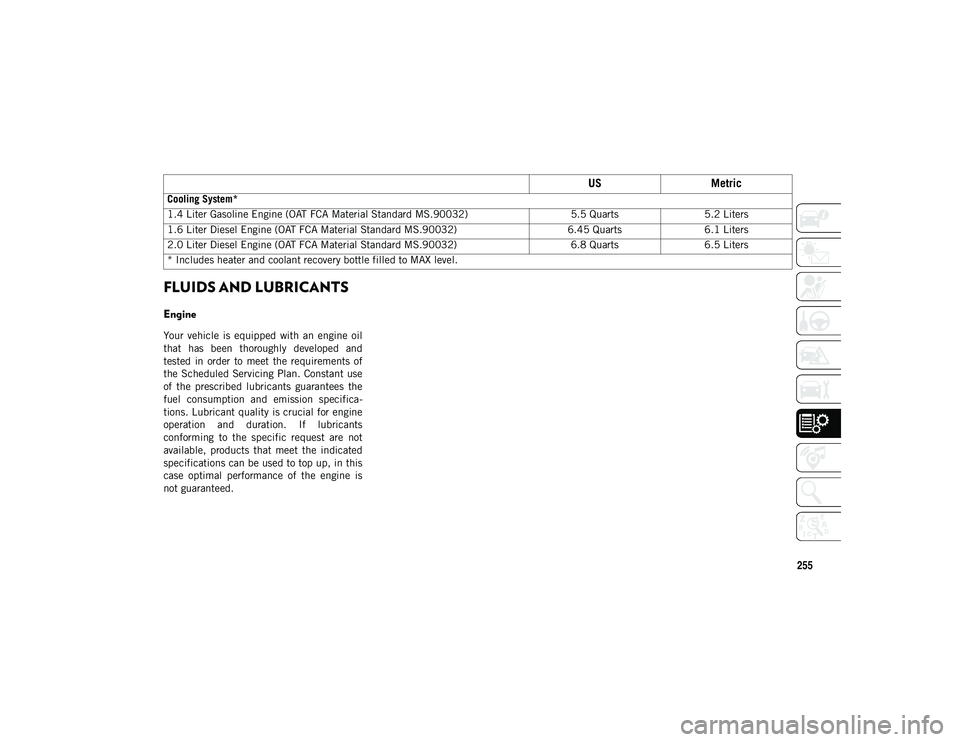
not guaranteed. Cooling System*
1.4 Liter Gasoline Engine (OAT FCA Material Standard MS.90032)
5.5 Quarts5.2 Liters
1.6 Liter Diesel Engine (OAT FCA Material Standard MS.90032) 6.45 Quarts6.1 Liters
2.0 Liter Diesel Engine (OAT FCA Material Standard MS.90032) 6.8 Quarts6.5 Liters
* Includes heater and coolant recovery bottle filled to MAX level.
US Metric
2020_JEEP_M6_UG_UK.book Page 255