torque JEEP COMPASS 2023 User Guide
[x] Cancel search | Manufacturer: JEEP, Model Year: 2023, Model line: COMPASS, Model: JEEP COMPASS 2023Pages: 344, PDF Size: 18.8 MB
Page 196 of 344
194SAFETY
Ready Alert Braking (RAB)
RAB may reduce the time required to reach full
braking during emergency braking situations. It
anticipates when an emergency braking situation
may occur by monitoring how fast the throttle is
released by the driver. The Electronic Brake
Controller (EBC) system will prepare the brake
system for a panic stop.
Traction Control System (TCS)
The TCS monitors the amount of wheel spin for
each of the driven wheels. If wheel spin is
detected, the TCS may apply brake pressure to the
spinning wheel(s) and/or reduce vehicle power to
provide enhanced acceleration and stability. A
feature of the TCS, Brake Limited Differential (BLD)
functions similarly to a limited slip differential and
controls the wheel spin across a driven axle. If one
wheel on a driven axle is spinning faster than the
other, the system will apply the brake of the
spinning wheel. This will allow more vehicle torque
to be applied to the wheel that is not spinning.
BLD may remain enabled even if TCS and ESC are
in reduced modes.
Trailer Sway Control (TSC)
TSC uses sensors in the vehicle to recognize an
excessively swaying trailer and will take the
appropriate actions to attempt to stop the sway.
TSC will become active automatically once an
excessively swaying trailer is recognized.
NOTE:TSC cannot stop all trailers from swaying. Always
use caution when towing a trailer and follow the
trailer tongue weight recommendations
Úpage 154.
When TSC is functioning, the ESC Activation/
Malfunction Indicator Light will flash, the engine
power may be reduced and you may feel the
brakes being applied to individual wheels to
attempt to stop the trailer from swaying. TSC is
disabled when the ESC system is in the “Partial
Off” or “Full Off” modes.
AUXILIARY DRIVING SYSTEMS
BLIND SPOT MONITORING (BSM) —
I
F EQUIPPED
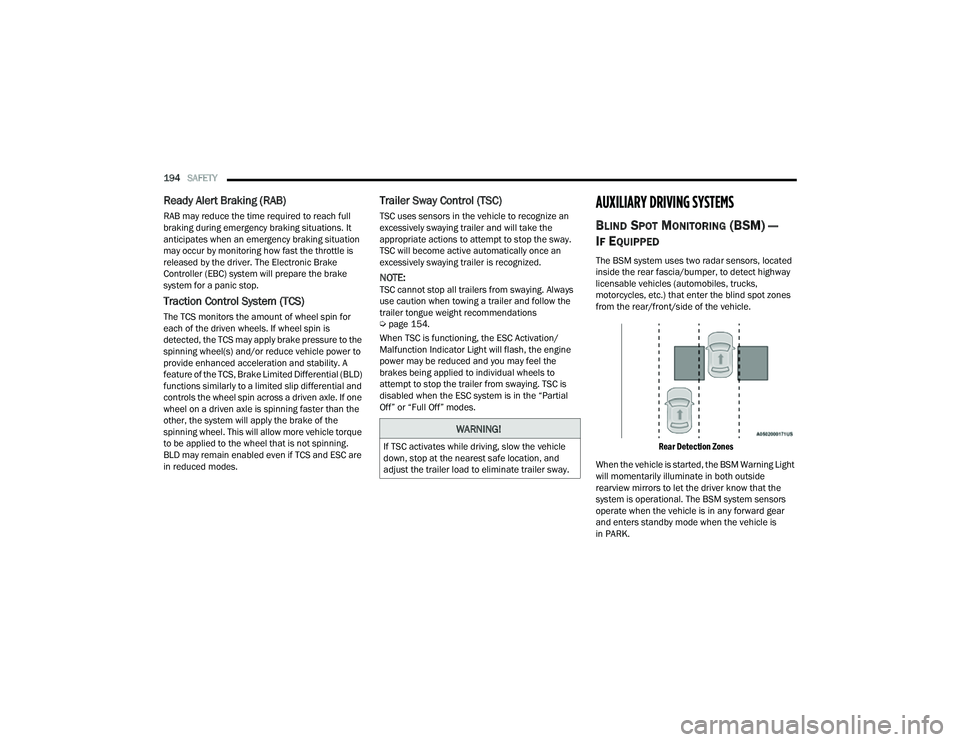
The BSM system uses two radar sensors, located
inside the rear fascia/bumper, to detect highway
licensable vehicles (automobiles, trucks,
motorcycles, etc.) that enter the blind spot zones
from the rear/front/side of the vehicle.
Rear Detection Zones
When the vehicle is started, the BSM Warning Light
will momentarily illuminate in both outside
rearview mirrors to let the driver know that the
system is operational. The BSM system sensors
operate when the vehicle is in any forward gear
and enters standby mode when the vehicle is
in PARK.
WARNING!
If TSC activates while driving, slow the vehicle
down, stop at the nearest safe location, and
adjust the trailer load to eliminate trailer sway.
22_MP_OM_EN_USC_t.book Page 194
Page 197 of 344
SAFETY195
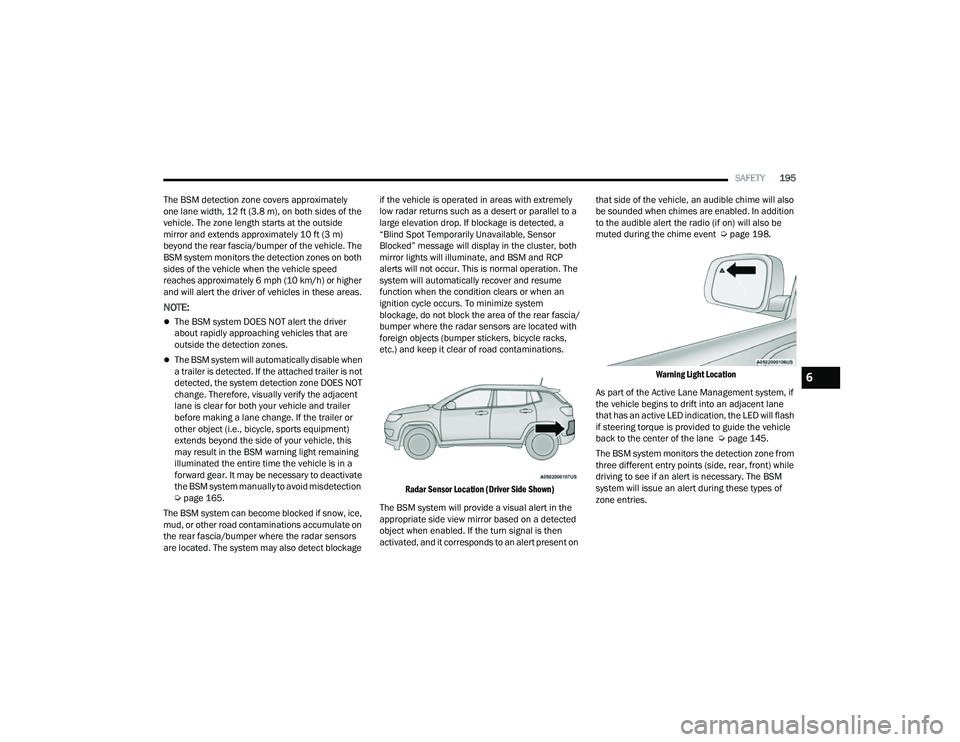
The BSM detection zone covers approximately
one lane width, 12 ft (3.8 m), on both sides of the
vehicle. The zone length starts at the outside
mirror and extends approximately 10 ft (3 m)
beyond the rear fascia/bumper of the vehicle. The
BSM system monitors the detection zones on both
sides of the vehicle when the vehicle speed
reaches approximately 6 mph (10 km/h) or higher
and will alert the driver of vehicles in these areas.
NOTE:
The BSM system DOES NOT alert the driver
about rapidly approaching vehicles that are
outside the detection zones.
The BSM system will automatically disable when
a trailer is detected. If the attached trailer is not
detected, the system detection zone DOES NOT
change. Therefore, visually verify the adjacent
lane is clear for both your vehicle and trailer
before making a lane change. If the trailer or
other object (i.e., bicycle, sports equipment)
extends beyond the side of your vehicle, this
may result in the BSM warning light remaining
illuminated the entire time the vehicle is in a
forward gear. It may be necessary to deactivate
the BSM system manually to avoid misdetection
Ú page 165.
The BSM system can become blocked if snow, ice,
mud, or other road contaminations accumulate on
the rear fascia/bumper where the radar sensors
are located. The system may also detect blockage if the vehicle is operated in areas with extremely
low radar returns such as a desert or parallel to a
large elevation drop. If blockage is detected, a
“Blind Spot Temporarily Unavailable, Sensor
Blocked” message will display in the cluster, both
mirror lights will illuminate, and BSM and RCP
alerts will not occur. This is normal operation. The
system will automatically recover and resume
function when the condition clears or when an
ignition cycle occurs. To minimize system
blockage, do not block the area of the rear fascia/
bumper where the radar sensors are located with
foreign objects (bumper stickers, bicycle racks,
etc.) and keep it clear of road contaminations.
Radar Sensor Location (Driver Side Shown)
The BSM system will provide a visual alert in the
appropriate side view mirror based on a detected
object when enabled. If the turn signal is then
activated, and it corresponds to an alert present on that side of the vehicle, an audible chime will also
be sounded when chimes are enabled. In addition
to the audible alert the radio (if on) will also be
muted during the chime event Ú
page 198.
Warning Light Location
As part of the Active Lane Management system, if
the vehicle begins to drift into an adjacent lane
that has an active LED indication, the LED will flash
if steering torque is provided to guide the vehicle
back to the center of the lane Ú page 145.
The BSM system monitors the detection zone from
three different entry points (side, rear, front) while
driving to see if an alert is necessary. The BSM
system will issue an alert during these types of
zone entries.
6
22_MP_OM_EN_USC_t.book Page 195
Page 244 of 344
242SAFETY
(Continued)
PERIODIC SAFETY CHECKS YOU SHOULD
M
AKE OUTSIDE THE VEHICLE
Tires
Examine tires for excessive tread wear and uneven
wear patterns. Check for stones, nails, glass, or
other objects lodged in the tread or sidewall.
Inspect the tread for cuts and cracks. Inspect
sidewalls for cuts, cracks, and bulges. Check the
lug nut/bolt torque for tightness. Check the tires
(including spare) for proper cold inflation pressure.
Lights
Have someone observe the operation of brake
lights and exterior lights while you work the
controls. Check turn signal and high beam
indicator lights on the instrument panel.
Door Latches
Check for proper closing, latching, and locking.
Fluid Leaks
Check area under the vehicle after overnight
parking for fuel, coolant, oil, or other fluid leaks.
Also, if gasoline fumes are detected or if fuel or
brake fluid leaks are suspected, the cause should
be located and corrected immediately.
ONLY use the driver’s side floor mat on the
driver’s side floor area. To check for interfer -
ence, with the vehicle properly parked with the
engine off, fully depress the accelerator, the
brake, and the clutch pedal (if present) to
check for interference. If your floor mat inter -
feres with the operation of any pedal, or is not
secure to the floor, remove the floor mat from
the vehicle and place the floor mat in your
trunk.
ONLY use the passenger’s side floor mat on
the passenger’s side floor area.
ALWAYS make sure objects cannot fall or slide
into the driver’s side floor area when the
vehicle is moving. Objects can become
trapped under accelerator, brake, or clutch
pedals and could cause a loss of vehicle
control.
WARNING!
NEVER place any objects under the floor mat
(e.g., towels, keys, etc.). These objects could
change the position of the floor mat and may
cause interference with the accelerator,
brake, or clutch pedals.
If the vehicle carpet has been removed and
re-installed, always properly attach carpet to
the floor and check the floor mat fasteners are
secure to the vehicle carpet. Fully depress
each pedal to check for interference with the
accelerator, brake, or clutch pedals then
re-install the floor mats.
It is recommended to only use mild soap and
water to clean your floor mats. After cleaning,
always check your floor mat has been properly
installed and is secured to your vehicle using
the floor mat fasteners by lightly pulling mat.
WARNING!
22_MP_OM_EN_USC_t.book Page 242
Page 254 of 344
252IN CASE OF EMERGENCY
NOTE:
For vehicles equipped, do not attempt to
install a center cap or wheel cover on the
compact spare.
For additional warnings, cautions, and infor -
mation about the spare tire, its use, and
operation Ú page 298.
9. Install and lightly tighten the wheel bolts.
10. Lower the vehicle to the ground by turning the jack handle counterclockwise.
11. Finish tightening the wheel bolts. Push down on the wrench while at the end of the handle
for increased leverage. Tighten the wheel bolts
in a star pattern until each wheel bolt has been
tightened twice Úpage 319. If in doubt about
the correct tightness, have them checked with
a torque wrench by an authorized dealer or at
a service station. 12. Lower the jack until it is free. Remove the
wheel blocks. Reassemble the lug wrench to
the jack assembly and stow it in the spare tire
area. Secure the assembly using the means
provided. Release the parking brake before
driving the vehicle.
Damaged Tire Stowage
13. After 25 miles (40 km), check the wheel bolt torque with a torque wrench to ensure that all
wheel bolts are properly seated against the
wheel. 14. Place the jack on the foam tray and open it far
enough so that it is secured. Once placed in
position, rotate it clockwise to lock it in.
Replace the alignment pin in the center hole to
lock the jack in place.
TIRE SERVICE KIT — IF EQUIPPED
Your vehicle may be equipped with a Tire Service
Kit. Small punctures up to 1/4 inch (6 mm) in the
tire tread can be sealed with Tire Service Kit.
Foreign objects (e.g., screws or nails) should not be
removed from the tire. Tire Service Kit can be used
in outside temperatures down to approximately
-4°F (-20°C). This kit will provide a temporary tire
seal, allowing you to drive your vehicle up to
100 miles (160 km) with a maximum speed of
50 mph (80 km/h).
WARNING!
To avoid the risk of forcing the vehicle off the
jack, do not tighten the wheel nuts fully until the
vehicle has been lowered. Failure to follow this
warning may result in serious injury.
WARNING!
A loose tire or jack thrown forward in a collision
or hard stop could endanger the occupants of
the vehicle. Always stow the jack parts and the
spare tire in the places provided. Have the
deflated (flat) tire repaired or replaced
immediately.
22_MP_OM_EN_USC_t.book Page 252
Page 285 of 344
SERVICING AND MAINTENANCE283
AUTOMATIC TRANSMISSION —
I
F EQUIPPED
Special Additives
It is strongly recommended against using any
special additives in the transmission. Automatic
Transmission Fluid (ATF) is an engineered product
and its performance may be impaired by
supplemental additives. Therefore, do not add any
fluid additives to the transmission. The only
exception to this policy is the use of special dyes
for diagnosing fluid leaks in 6-speed
transmissions. Avoid using transmission sealers as
they may adversely affect seals.
Fluid Level Check
The fluid level is preset at the factory and does not
require adjustment under normal operating
conditions. Routine fluid level checks are not
required; therefore the transmission has no
dipstick. An authorized dealer can check your
transmission fluid level using special service tools.
If you notice fluid leakage or transmission
malfunction, visit an authorized dealer
immediately to have the transmission fluid level
checked. Operating the vehicle with an improper
fluid level can cause severe transmission damage.
Fluid And Filter Changes
Under normal operating conditions, the fluid
installed at the factory will provide satisfactory
lubrication for the life of the vehicle.
Routine fluid and filter changes are not required.
However, change the fluid and filter if the fluid
becomes contaminated (with water, etc.), or if the
transmission is disassembled for any reason.
Selection Of Lubricant
It is important to use the proper transmission fluid
to ensure optimum transmission performance and
life. Use only the manufacturer specified
transmission fluid Ú page 324. It is important to
maintain the transmission fluid at the correct level
using the recommended fluid.
NOTE:No chemical flushes should be used in any trans -
mission; only the approved lubricant should be
used.
Do not allow petroleum-based fluid to contam -
inate the brake fluid. Brake seal components
could be damaged, causing partial or
complete brake failure. This could result in a
collision.
CAUTION!
Do not use chemical flushes in your
transmission as the chemicals can damage your
transmission components. Such damage is not
covered by the New Vehicle Limited Warranty.
WARNING!
CAUTION!
If a transmission fluid leak occurs, visit an
authorized dealer immediately. Severe
transmission damage may occur. An authorized
dealer has the proper tools to adjust the fluid
level accurately.
CAUTION!
Using a transmission fluid other than the
manufacturer recommended fluid may cause
deterioration in transmission shift quality and/or
torque converter shudder. For fluid
specifications Ú page 324.
8
22_MP_OM_EN_USC_t.book Page 283
Page 321 of 344
319
TECHNICAL SPECIFICATIONS
VEHICLE IDENTIFICATION NUMBER (VIN)
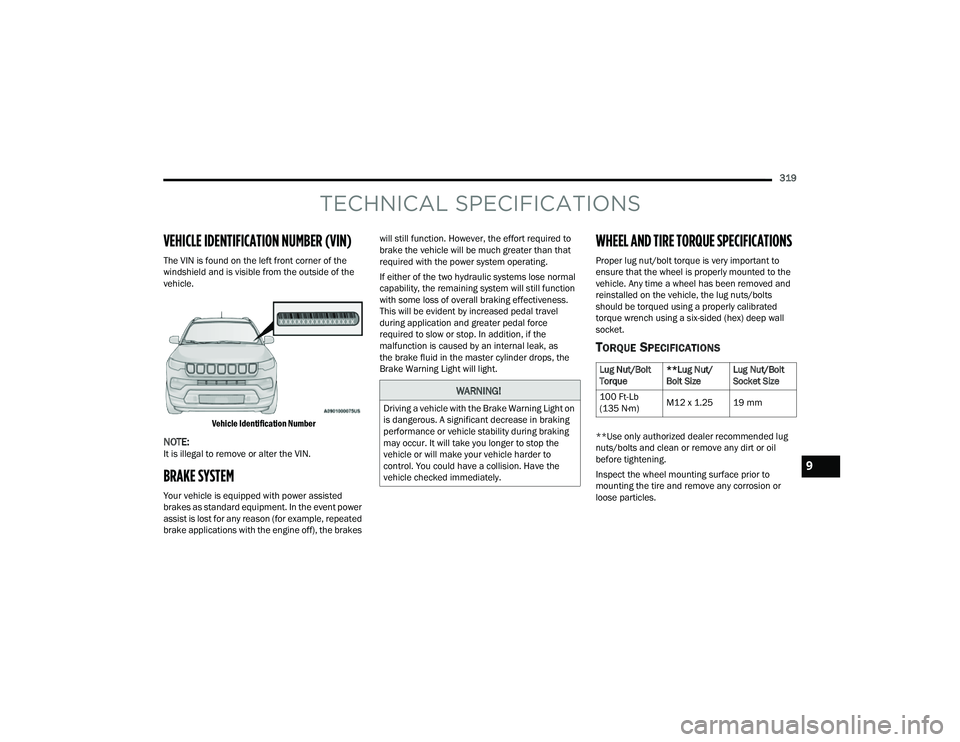
The VIN is found on the left front corner of the
windshield and is visible from the outside of the
vehicle.
Vehicle Identification Number
NOTE:It is illegal to remove or alter the VIN.
BRAKE SYSTEM
Your vehicle is equipped with power assisted
brakes as standard equipment. In the event power
assist is lost for any reason (for example, repeated
brake applications with the engine off), the brakes will still function. However, the effort required to
brake the vehicle will be much greater than that
required with the power system operating.
If either of the two hydraulic systems lose normal
capability, the remaining system will still function
with some loss of overall braking effectiveness.
This will be evident by increased pedal travel
during application and greater pedal force
required to slow or stop. In addition, if the
malfunction is caused by an internal leak, as
the brake fluid in the master cylinder drops, the
Brake Warning Light will light.
WHEEL AND TIRE TORQUE SPECIFICATIONS
Proper lug nut/bolt torque is very important to
ensure that the wheel is properly mounted to the
vehicle. Any time a wheel has been removed and
reinstalled on the vehicle, the lug nuts/bolts
should be torqued using a properly calibrated
torque wrench using a six-sided (hex) deep wall
socket.
TORQUE SPECIFICATIONS
**Use only authorized dealer recommended lug
nuts/bolts and clean or remove any dirt or oil
before tightening.
Inspect the wheel mounting surface prior to
mounting the tire and remove any corrosion or
loose particles.
WARNING!
Driving a vehicle with the Brake Warning Light on
is dangerous. A significant decrease in braking
performance or vehicle stability during braking
may occur. It will take you longer to stop the
vehicle or will make your vehicle harder to
control. You could have a collision. Have the
vehicle checked immediately.
Lug Nut/Bolt
Torque
**Lug Nut/
Bolt SizeLug Nut/Bolt
Socket Size
100 Ft-Lb
(135 N·m) M12 x 1.25 19 mm
9
22_MP_OM_EN_USC_t.book Page 319
Page 322 of 344
320TECHNICAL SPECIFICATIONS
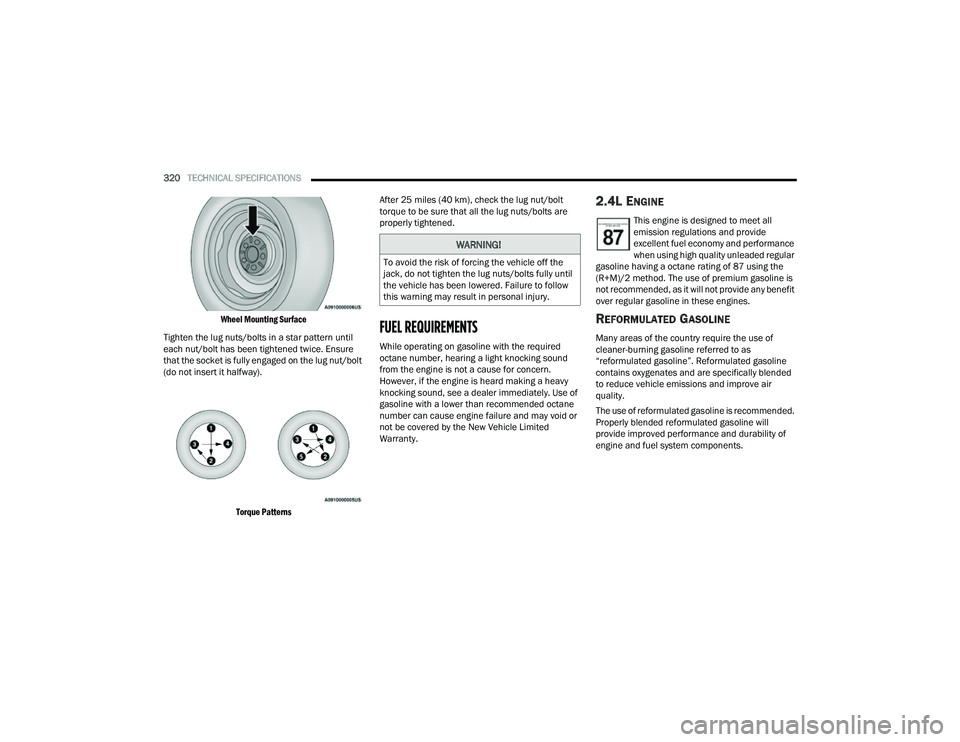
Wheel Mounting Surface
Tighten the lug nuts/bolts in a star pattern until
each nut/bolt has been tightened twice. Ensure
that the socket is fully engaged on the lug nut/bolt
(do not insert it halfway).
Torque Patterns
After 25 miles (40 km), check the lug nut/bolt
torque to be sure that all the lug nuts/bolts are
properly tightened.
FUEL REQUIREMENTS
While operating on gasoline with the required
octane number, hearing a light knocking sound
from the engine is not a cause for concern.
However, if the engine is heard making a heavy
knocking sound, see a dealer immediately. Use of
gasoline with a lower than recommended octane
number can cause engine failure and may void or
not be covered by the New Vehicle Limited
Warranty.
2.4L ENGINE
This engine is designed to meet all
emission regulations and provide
excellent fuel economy and performance
when using high quality unleaded regular
gasoline having a octane rating of 87 using the
(R+M)/2 method. The use of premium gasoline is
not recommended, as it will not provide any benefit
over regular gasoline in these engines.
REFORMULATED GASOLINE
Many areas of the country require the use of
cleaner-burning gasoline referred to as
“reformulated gasoline”. Reformulated gasoline
contains oxygenates and are specifically blended
to reduce vehicle emissions and improve air
quality.
The use of reformulated gasoline is recommended.
Properly blended reformulated gasoline will
provide improved performance and durability of
engine and fuel system components.
WARNING!
To avoid the risk of forcing the vehicle off the
jack, do not tighten the lug nuts/bolts fully until
the vehicle has been lowered. Failure to follow
this warning may result in personal injury.
22_MP_OM_EN_USC_t.book Page 320
Page 338 of 344
336 Snow Chains (Tire Chains)
............................. 311Snow Tires..................................................... 310Spare Tires.......................................... 310, 311Specifications Fuel (Gasoline).......................................... 323Oil.............................................................. 323Starting................................................... 19, 100Automatic Transmission............................ 100Button......................................................... 17Cold Weather............................................ 101Engine Fails To Start................................. 101Remote....................................................... 19Starting And Operating.................................. 100Starting Procedures....................................... 100SteeringColumn Controls.......................................... 43Tilt Column.................................................. 26Wheel, Heated...................................... 26, 27Wheel, Tilt................................................... 26Storage............................................................ 58Storage, Vehicle............................................... 56Stuck, Freeing............................................... 262Sun Roof................................................... 63, 65Sun Visor......................................................... 38Supplemental Restraint System – Air Bag..... 214Sway Control, Trailer...................................... 194Synthetic Engine Oil....................................... 273System, Remote Starting................................. 19
T
Telescoping Steering Column.......................... 26Temperature Control, Automatic (ATC)............. 56Tie Down Hooks, Cargo............................. 70, 71Tilt Steering Column........................................ 26Time DelayHeadlight.............................................. 43, 45Tire And Loading Information Placard........... 303Tire Markings................................................ 298Tire Safety Information................................. 298Tire Service Kit.............................................. 252Tires...................................242, 306, 310, 314Aging (Life Of Tires).................................. 308Air Pressure.............................................. 306Chains...................................................... 311Changing.................................................. 247Compact Spare......................................... 310General Information........................ 306, 310High Speed............................................... 307Inflation Pressure..................................... 306Jacking..................................................... 247Life Of Tires.............................................. 308Load Capacity........................................... 303Pressure Monitoring System (TPMS)...............................94, 201Quality Grading......................................... 314Radial....................................................... 307Replacement............................................ 309Rotation.................................................... 313Safety.............................................. 298, 306
Sizes......................................................... 299Snow Tires................................................ 310Spare Tires...................................... 310, 311Spinning................................................... 308Trailer Towing........................................... 157Tread Wear Indicators.............................. 308Wheel Nut Torque..................................... 319To Open Hood..................................................66Tongue Weight/Trailer Weight...................... 156Tow HooksEmergency................................................ 266Towing........................................................... 154Disabled Vehicle....................................... 264Guide........................................................ 155Recreational............................................. 160Weight...................................................... 155Towing Behind A Motorhome........................ 160Traction Control................................... 191, 194Traffic Sign Assist System............................. 127Trailer Sway Control (TSC)............................. 194Trailer Towing................................................ 154Minimum Requirements........................... 156Tips........................................................... 159Trailer And Tongue Weight........................ 156Wiring....................................................... 158Trailer Towing Guide..................................... 155Trailer Weight................................................ 155TransaxleAutomatic................................................. 106Operation.................................................. 106
22_MP_OM_EN_USC_t.book Page 336