steering wheel JEEP COMPASS 2023 Workshop Manual
[x] Cancel search | Manufacturer: JEEP, Model Year: 2023, Model line: COMPASS, Model: JEEP COMPASS 2023Pages: 344, PDF Size: 18.8 MB
Page 259 of 344
IN CASE OF EMERGENCY257
If tire pressure is less than 19 psi (1.3 Bar):
The tire is too badly damaged. Do not attempt to
drive the vehicle further. Call for assistance.
If the tire pressure is 19 psi (1.3 Bar) or higher:
1. Push the Power Button to turn on
Tire Service Kit and inflate the tire to
the cold tire inflation pressure found
on the tire and loading information
label located in the driver-side door opening.
NOTE:If the tire becomes overinflated, push the Deflation
Button to reduce the tire pressure to the recom -
mended inflation pressure before continuing.
2. Disconnect the Tire Service Kit from the valve stem, reinstall the cap on the valve stem and
unplug from 12 Volt outlet.
3. Place the Tire Service Kit in its proper storage area in the vehicle.
4. Have the tire inspected and repaired or replaced at the earliest opportunity at an
authorized dealer or tire service center. 5. Remove the Speed Limit sticker from the
steering wheel after the tire has been repaired.
6. Replace the Sealant Bottle at an authorized dealer as soon as possible.
NOTE:When having the tire serviced, advise the autho -
rized dealer or service center that the tire has been
sealed using the Tire Service Kit.
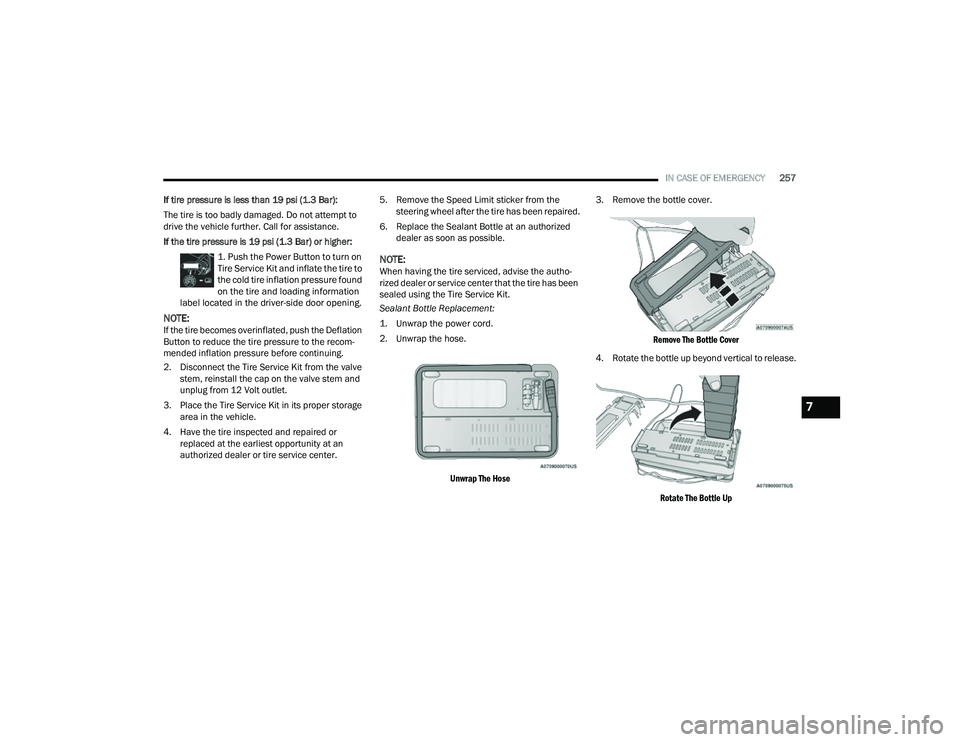
Sealant Bottle Replacement:
1. Unwrap the power cord.
2. Unwrap the hose.
Unwrap The Hose
3. Remove the bottle cover.
Remove The Bottle Cover
4. Rotate the bottle up beyond vertical to release.
Rotate The Bottle Up
7
22_MP_OM_EN_USC_t.book Page 257
Page 264 of 344
262IN CASE OF EMERGENCY
GEAR SELECTOR OVERRIDE
If a malfunction occurs, and the gear selector
cannot be moved out of the PARK position, you can
use the following procedure to temporarily move
the gear selector:
1. Turn the engine OFF.
2. Apply the parking brake.
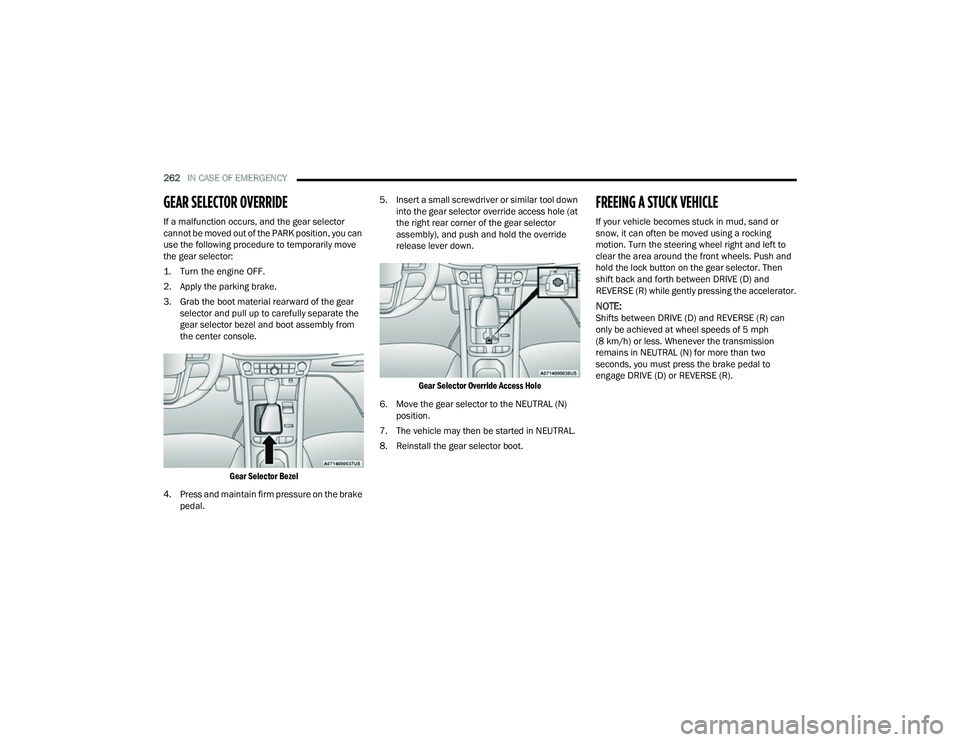
3. Grab the boot material rearward of the gear
selector and pull up to carefully separate the
gear selector bezel and boot assembly from
the center console.
Gear Selector Bezel
4. Press and maintain firm pressure on the brake pedal. 5. Insert a small screwdriver or similar tool down
into the gear selector override access hole (at
the right rear corner of the gear selector
assembly), and push and hold the override
release lever down.
Gear Selector Override Access Hole
6. Move the gear selector to the NEUTRAL (N) position.
7. The vehicle may then be started in NEUTRAL.
8. Reinstall the gear selector boot.
FREEING A STUCK VEHICLE
If your vehicle becomes stuck in mud, sand or
snow, it can often be moved using a rocking
motion. Turn the steering wheel right and left to
clear the area around the front wheels. Push and
hold the lock button on the gear selector. Then
shift back and forth between DRIVE (D) and
REVERSE (R) while gently pressing the accelerator.
NOTE:Shifts between DRIVE (D) and REVERSE (R) can
only be achieved at wheel speeds of 5 mph
(8 km/h) or less. Whenever the transmission
remains in NEUTRAL (N) for more than two
seconds, you must press the brake pedal to
engage DRIVE (D) or REVERSE (R).
22_MP_OM_EN_USC_t.book Page 262
Page 311 of 344
SERVICING AND MAINTENANCE309
Keep dismounted tires in a cool, dry place with as
little exposure to light as possible. Protect tires
from contact with oil, grease, and gasoline.
Replacement Tires
The tires on your new vehicle provide a balance of
many characteristics. They should be inspected
regularly for wear and correct cold tire inflation
pressures. The manufacturer strongly
recommends that you use tires equivalent to the
originals in size, quality and performance when
replacement is needed Ú page 308. Refer to the
Tire and Loading Information placard or the
Vehicle Certification Label for the size designation
of your tire. The Load Index and Speed Symbol for
your tire will be found on the original equipment
tire sidewall.
For more information relating to the Load Index
and Speed Symbol of a tire Ú page 298.
It is recommended to replace the two front tires or
two rear tires as a pair. Replacing just one tire can
seriously affect your vehicle’s handling. If you ever
replace a wheel, make sure that the wheel’s
specifications match those of the original wheels.
It is recommended you contact an authorized tire
dealer or original equipment dealer with any
questions you may have on tire specifications or
capability. Failure to use equivalent replacement
tires may adversely affect the safety, handling, and
ride of your vehicle.
TIRE TYPES
All Season Tires — If Equipped
All Season tires provide traction for all seasons
(Spring, Summer, Autumn, and Winter). Traction
levels may vary between different All Season tires.
All Season tires can be identified by the M+S, M&S,
M/S or MS designation on the tire sidewall. Use All
Season tires only in sets of four; failure to do so
may adversely affect the safety and handling of
your vehicle.
Summer Or Three Season Tires —
If Equipped
Summer tires provide traction in both wet and dry
conditions, and are not intended to be driven in
snow or on ice. If your vehicle is equipped with
Summer tires, be aware these tires are not
designed for Winter or cold driving conditions.
Install Winter tires on your vehicle when ambient
temperatures are less than 40°F (5°C) or if roads
are covered with ice or snow. For more
information, contact an authorized dealer.
WARNING!
Do not use a tire, wheel size, load rating, or
speed rating other than that specified for your
vehicle. Some combinations of unapproved
tires and wheels may change suspension
dimensions and performance characteristics,
resulting in changes to steering, handling, and
braking of your vehicle. This can cause unpre -
dictable handling and stress to steering and
suspension components. You could lose
control and have a collision resulting in
serious injury or death. Use only the tire and
wheel sizes with load ratings approved for
your vehicle.
Never use a tire with a smaller load index or
capacity other than what was originally
equipped on your vehicle. Using a tire with a
smaller load index could result in tire over -
loading and failure. You could lose control and
have a collision.
Failure to equip your vehicle with tires having
adequate speed capability can result in
sudden tire failure and loss of vehicle control.
CAUTION!
Replacing original tires with tires of a different
size may result in false speedometer and
odometer readings.
8
22_MP_OM_EN_USC_t.book Page 309
Page 315 of 344
SERVICING AND MAINTENANCE313
(Continued)
TIRE ROTATION RECOMMENDATIONS
The tires on the front and rear of your vehicle
operate at different loads and perform different
steering, handling, and braking functions. For
these reasons, they wear at unequal rates.
These effects can be reduced by timely rotation of
tires. The benefits of rotation are especially
worthwhile with aggressive tread designs such as
those on On/Off Road type tires. Rotation will
increase tread life, help to maintain mud, snow,
and wet traction levels, and contribute to a
smooth, quiet ride.
For the proper maintenance intervals Úpage 268.
The reasons for any rapid or unusual wear should
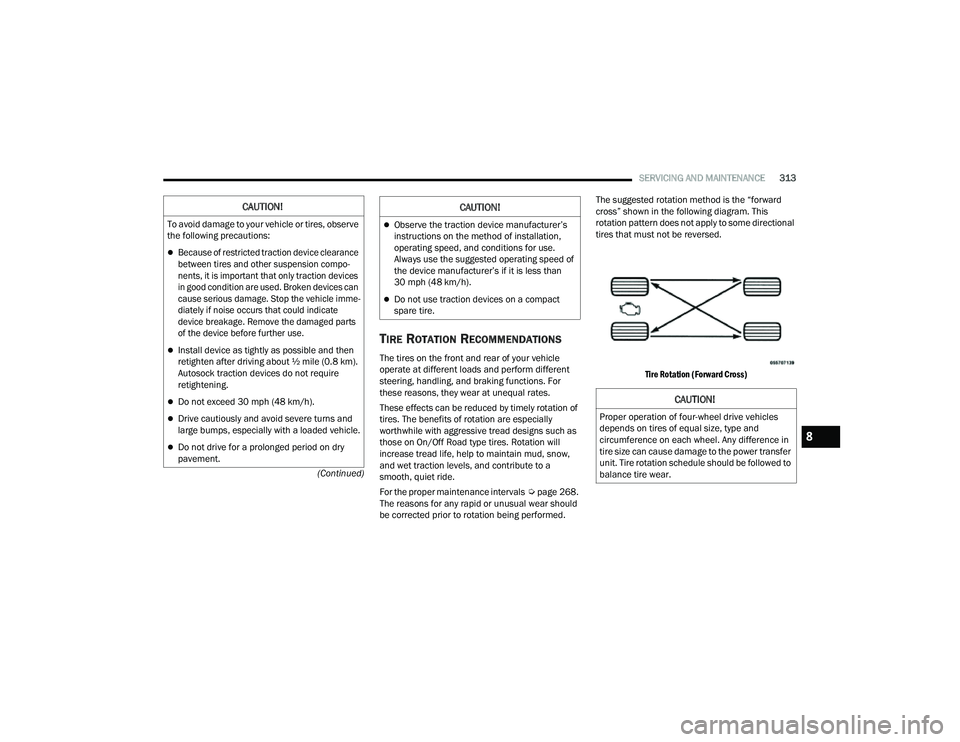
be corrected prior to rotation being performed. The suggested rotation method is the “forward
cross” shown in the following diagram. This
rotation pattern does not apply to some directional
tires that must not be reversed.
Tire Rotation (Forward Cross)
CAUTION!
To avoid damage to your vehicle or tires, observe
the following precautions:
Because of restricted traction device clearance
between tires and other suspension compo -
nents, it is important that only traction devices
in good condition are used. Broken devices can
cause serious damage. Stop the vehicle imme -
diately if noise occurs that could indicate
device breakage. Remove the damaged parts
of the device before further use.
Install device as tightly as possible and then
retighten after driving about ½ mile (0.8 km).
Autosock traction devices do not require
retightening.
Do not exceed 30 mph (48 km/h).
Drive cautiously and avoid severe turns and
large bumps, especially with a loaded vehicle.
Do not drive for a prolonged period on dry
pavement.
Observe the traction device manufacturer’s
instructions on the method of installation,
operating speed, and conditions for use.
Always use the suggested operating speed of
the device manufacturer’s if it is less than
30 mph (48 km/h).
Do not use traction devices on a compact
spare tire.
CAUTION!
CAUTION!
Proper operation of four-wheel drive vehicles
depends on tires of equal size, type and
circumference on each wheel. Any difference in
tire size can cause damage to the power transfer
unit. Tire rotation schedule should be followed to
balance tire wear.
8
22_MP_OM_EN_USC_t.book Page 313
Page 338 of 344
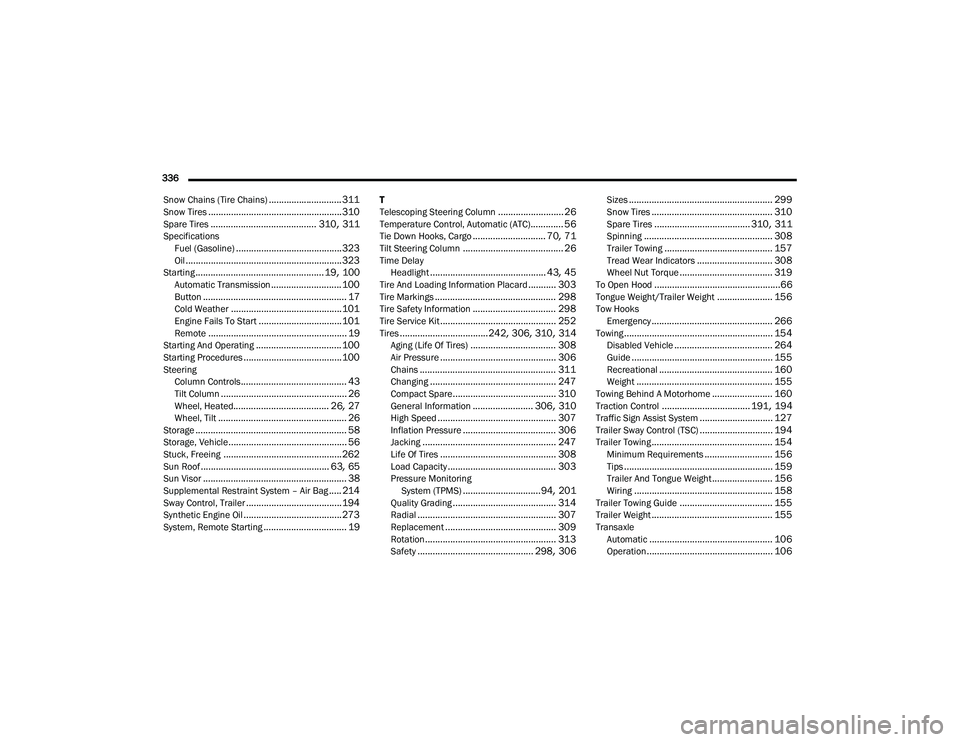
336 Snow Chains (Tire Chains)
............................. 311Snow Tires..................................................... 310Spare Tires.......................................... 310, 311Specifications Fuel (Gasoline).......................................... 323Oil.............................................................. 323Starting................................................... 19, 100Automatic Transmission............................ 100Button......................................................... 17Cold Weather............................................ 101Engine Fails To Start................................. 101Remote....................................................... 19Starting And Operating.................................. 100Starting Procedures....................................... 100SteeringColumn Controls.......................................... 43Tilt Column.................................................. 26Wheel, Heated...................................... 26, 27Wheel, Tilt................................................... 26Storage............................................................ 58Storage, Vehicle............................................... 56Stuck, Freeing............................................... 262Sun Roof................................................... 63, 65Sun Visor......................................................... 38Supplemental Restraint System – Air Bag..... 214Sway Control, Trailer...................................... 194Synthetic Engine Oil....................................... 273System, Remote Starting................................. 19
T
Telescoping Steering Column.......................... 26Temperature Control, Automatic (ATC)............. 56Tie Down Hooks, Cargo............................. 70, 71Tilt Steering Column........................................ 26Time DelayHeadlight.............................................. 43, 45Tire And Loading Information Placard........... 303Tire Markings................................................ 298Tire Safety Information................................. 298Tire Service Kit.............................................. 252Tires...................................242, 306, 310, 314Aging (Life Of Tires).................................. 308Air Pressure.............................................. 306Chains...................................................... 311Changing.................................................. 247Compact Spare......................................... 310General Information........................ 306, 310High Speed............................................... 307Inflation Pressure..................................... 306Jacking..................................................... 247Life Of Tires.............................................. 308Load Capacity........................................... 303Pressure Monitoring System (TPMS)...............................94, 201Quality Grading......................................... 314Radial....................................................... 307Replacement............................................ 309Rotation.................................................... 313Safety.............................................. 298, 306
Sizes......................................................... 299Snow Tires................................................ 310Spare Tires...................................... 310, 311Spinning................................................... 308Trailer Towing........................................... 157Tread Wear Indicators.............................. 308Wheel Nut Torque..................................... 319To Open Hood..................................................66Tongue Weight/Trailer Weight...................... 156Tow HooksEmergency................................................ 266Towing........................................................... 154Disabled Vehicle....................................... 264Guide........................................................ 155Recreational............................................. 160Weight...................................................... 155Towing Behind A Motorhome........................ 160Traction Control................................... 191, 194Traffic Sign Assist System............................. 127Trailer Sway Control (TSC)............................. 194Trailer Towing................................................ 154Minimum Requirements........................... 156Tips........................................................... 159Trailer And Tongue Weight........................ 156Wiring....................................................... 158Trailer Towing Guide..................................... 155Trailer Weight................................................ 155TransaxleAutomatic................................................. 106Operation.................................................. 106
22_MP_OM_EN_USC_t.book Page 336